Introduction
What is GPU?
• It is a processor optimized for 2D/3D graphics, video,
visual computing, and display.
• It is highly parallel, highly multithreaded multiprocessor
optimized for visual computing.
• It provide real-time visual interaction with
computed objects via graphics images, and
video.
• It serves as both a programmable graphics
processor and a scalable parallel computing
platform.
GPU Evolution
• 1980’s – No GPU. PC used VGA controller
• 1990’s – Add more function into VGA controller
• 1997 – 3D acceleration functions:

Hardware for triangle setup and rasterization
Texture mapping
Shading
• 2000 – A single chip graphics processor ( beginning of GPU
term)
• 2005 – Massively parallel programmable processors
• 2007 – CUDA (Compute Unified Device Architecture)
GPU Graphic Trends
• OpenGL – an open standard for 3D programming
• DirectX – a series of Microsoft multimedia programming
•
•
•
•
•
•
•

interfaces
New GPU are being developed every 12 to 18 months
New idea of visual computing:
combines graphics processing and parallel computing
Heterogeneous System – CPU + GPU
GPU evolves into scalable parallel processor
GPU Computing: GPGPU and CUDA
GPU unifies graphics and computing
GPU visual computing application: OpenGL, and DirectX
GPU System Architectures
• CPU-GPU system architecture

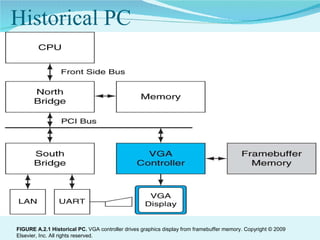
– The Historical PC
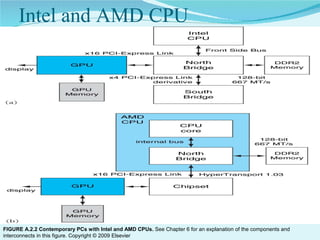
– contemporary PC with Intel and AMD CPUs
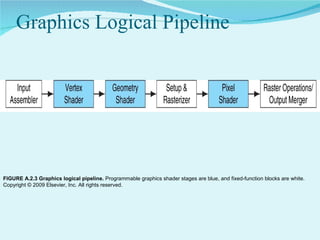
• Graphics Logical Pipeline
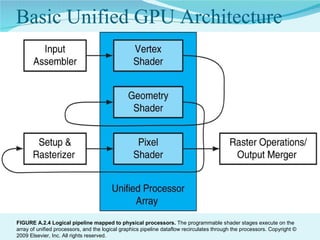
• Basic Unified GPU Architecture
– Processor Array
Historical PC

FIGURE A.2.1 Historical PC. VGA controller drives graphics display from framebuffer memory. Copyright © 2009
Elsevier, Inc. All rights reserved.
Intel and AMD CPU

FIGURE A.2.2 Contemporary PCs with Intel and AMD CPUs. See Chapter 6 for an explanation of the components and
interconnects in this figure. Copyright © 2009 Elsevier
Graphics Logical Pipeline

FIGURE A.2.3 Graphics logical pipeline. Programmable graphics shader stages are blue, and fixed-function blocks are white.
Copyright © 2009 Elsevier, Inc. All rights reserved.
Basic Unified GPU Architecture

FIGURE A.2.4 Logical pipeline mapped to physical processors. The programmable shader stages execute on the
array of unified processors, and the logical graphics pipeline dataflow recirculates through the processors. Copyright ©
2009 Elsevier, Inc. All rights reserved.
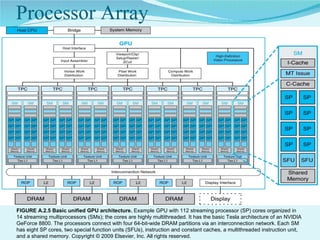
Processor Array

FIGURE A.2.5 Basic unified GPU architecture. Example GPU with 112 streaming processor (SP) cores organized in
14 streaming multiprocessors (SMs); the cores are highly multithreaded. It has the basic Tesla architecture of an NVIDIA
GeForce 8800. The processors connect with four 64-bit-wide DRAM partitions via an interconnection network. Each SM
has eight SP cores, two special function units (SFUs), instruction and constant caches, a multithreaded instruction unit,
and a shared memory. Copyright © 2009 Elsevier, Inc. All rights reserved.
Compare CPU and GPU
Nemo-3D
• Written by the CalTech Jet Propulsion Laboratory
• NEMO-3D simulates quantum phenomena.
• These models require a lot of matrix operations on very large
matrices.
• We are modifying the matrix operation functions so they use
CUDA instead of that slow CPU.
Nemo-3D
Simulation

NEMO-3D
Computation
Module
CUDA
kernel

Visualization

VolQD
Testing - Matrices
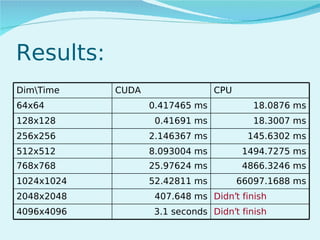
• Test the multiplication of two matrices.
• Creates two matrices with random floating point values.
• We tested with matrices of various dimensions…
Results:
DimTime
64x64

CUDA

CPU
0.417465 ms

18.0876 ms

128x128

0.41691 ms

18.3007 ms

256x256

2.146367 ms

145.6302 ms

512x512

8.093004 ms

1494.7275 ms

768x768

25.97624 ms

4866.3246 ms

1024x1024

52.42811 ms

66097.1688 ms

2048x2048

407.648 ms Didn’t finish

4096x4096

3.1 seconds Didn’t finish
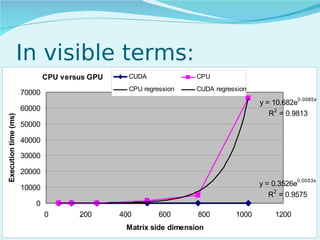
In visible terms:
70000

CUDA

CPU

CPU regression

CPU versus GPU

CUDA regression
0.0085x

y = 10.682e
R2 = 0.9813

Execution time (ms)

60000
50000
40000
30000
20000

0.0053x

y = 0.3526e
2
R = 0.9575

10000
0
0

200

400

600

800

Matrix side dimension

1000

1200
Test results:
Function Execute Time
500

y = 0.0228x - 0.5522
R2 = 1

450

Milliseconds

400
350

CUDA

300

CPU

250

CPU trendline

200

CUDA trendline

150
100

y = 0.0015x - 0.3449
R2 = 0.9996

50
0
0

5000

10000

15000

Number of Atoms

20000

25000

19564926 graphics-processing-unit

  • 2.
    Introduction What is GPU? •It is a processor optimized for 2D/3D graphics, video, visual computing, and display. • It is highly parallel, highly multithreaded multiprocessor optimized for visual computing. • It provide real-time visual interaction with computed objects via graphics images, and video. • It serves as both a programmable graphics processor and a scalable parallel computing platform.
  • 3.
    GPU Evolution • 1980’s– No GPU. PC used VGA controller • 1990’s – Add more function into VGA controller • 1997 – 3D acceleration functions: Hardware for triangle setup and rasterization Texture mapping Shading • 2000 – A single chip graphics processor ( beginning of GPU term) • 2005 – Massively parallel programmable processors • 2007 – CUDA (Compute Unified Device Architecture)
  • 4.
    GPU Graphic Trends •OpenGL – an open standard for 3D programming • DirectX – a series of Microsoft multimedia programming • • • • • • • interfaces New GPU are being developed every 12 to 18 months New idea of visual computing: combines graphics processing and parallel computing Heterogeneous System – CPU + GPU GPU evolves into scalable parallel processor GPU Computing: GPGPU and CUDA GPU unifies graphics and computing GPU visual computing application: OpenGL, and DirectX
  • 5.
    GPU System Architectures •CPU-GPU system architecture – The Historical PC – contemporary PC with Intel and AMD CPUs • Graphics Logical Pipeline • Basic Unified GPU Architecture – Processor Array
  • 6.
    Historical PC FIGURE A.2.1Historical PC. VGA controller drives graphics display from framebuffer memory. Copyright © 2009 Elsevier, Inc. All rights reserved.
  • 7.
    Intel and AMDCPU FIGURE A.2.2 Contemporary PCs with Intel and AMD CPUs. See Chapter 6 for an explanation of the components and interconnects in this figure. Copyright © 2009 Elsevier
  • 8.
    Graphics Logical Pipeline FIGUREA.2.3 Graphics logical pipeline. Programmable graphics shader stages are blue, and fixed-function blocks are white. Copyright © 2009 Elsevier, Inc. All rights reserved.
  • 9.
    Basic Unified GPUArchitecture FIGURE A.2.4 Logical pipeline mapped to physical processors. The programmable shader stages execute on the array of unified processors, and the logical graphics pipeline dataflow recirculates through the processors. Copyright © 2009 Elsevier, Inc. All rights reserved.
  • 10.
    Processor Array FIGURE A.2.5Basic unified GPU architecture. Example GPU with 112 streaming processor (SP) cores organized in 14 streaming multiprocessors (SMs); the cores are highly multithreaded. It has the basic Tesla architecture of an NVIDIA GeForce 8800. The processors connect with four 64-bit-wide DRAM partitions via an interconnection network. Each SM has eight SP cores, two special function units (SFUs), instruction and constant caches, a multithreaded instruction unit, and a shared memory. Copyright © 2009 Elsevier, Inc. All rights reserved.
  • 11.
    Compare CPU andGPU Nemo-3D • Written by the CalTech Jet Propulsion Laboratory • NEMO-3D simulates quantum phenomena. • These models require a lot of matrix operations on very large matrices. • We are modifying the matrix operation functions so they use CUDA instead of that slow CPU.
  • 12.
  • 13.
    Testing - Matrices •Test the multiplication of two matrices. • Creates two matrices with random floating point values. • We tested with matrices of various dimensions…
  • 14.
    Results: DimTime 64x64 CUDA CPU 0.417465 ms 18.0876 ms 128x128 0.41691ms 18.3007 ms 256x256 2.146367 ms 145.6302 ms 512x512 8.093004 ms 1494.7275 ms 768x768 25.97624 ms 4866.3246 ms 1024x1024 52.42811 ms 66097.1688 ms 2048x2048 407.648 ms Didn’t finish 4096x4096 3.1 seconds Didn’t finish
  • 15.
    In visible terms: 70000 CUDA CPU CPUregression CPU versus GPU CUDA regression 0.0085x y = 10.682e R2 = 0.9813 Execution time (ms) 60000 50000 40000 30000 20000 0.0053x y = 0.3526e 2 R = 0.9575 10000 0 0 200 400 600 800 Matrix side dimension 1000 1200
  • 16.
    Test results: Function ExecuteTime 500 y = 0.0228x - 0.5522 R2 = 1 450 Milliseconds 400 350 CUDA 300 CPU 250 CPU trendline 200 CUDA trendline 150 100 y = 0.0015x - 0.3449 R2 = 0.9996 50 0 0 5000 10000 15000 Number of Atoms 20000 25000