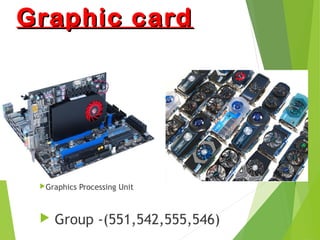
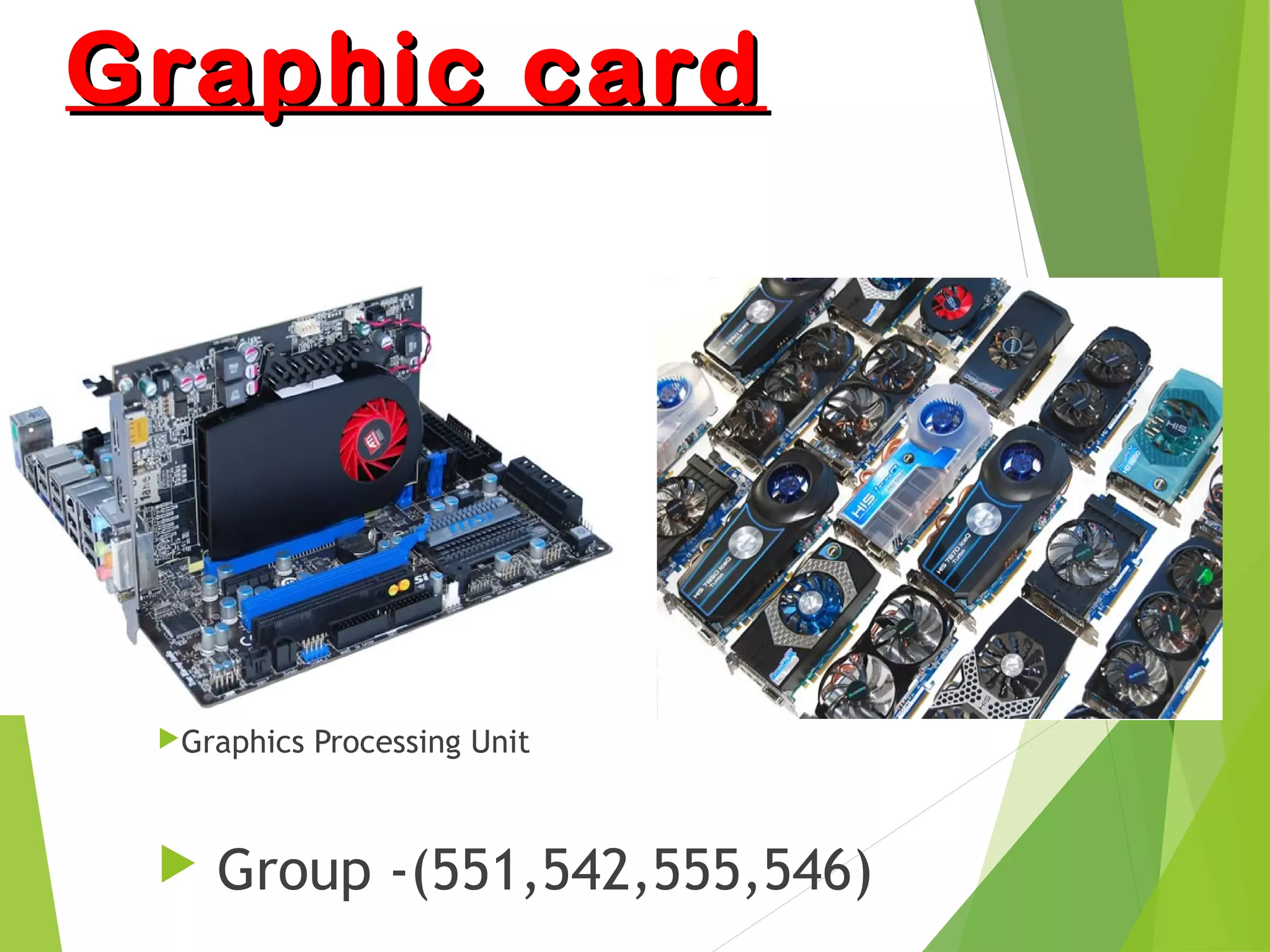
Graphic cardGraphic card
Graphics Processing Unit
 Group -(551,542,555,546)
Agenda
 WHAT IS GRAPHIC CARD
 USES OF GRAPHIC CARDS
 HISTORY OF GRAPHIC CARD
 HOW TO INSTALL GRAPHIC CARD
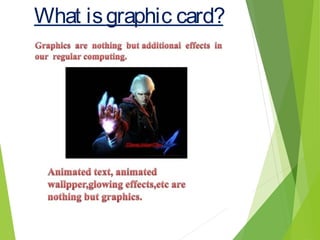
What isgraphic card?
USESOF GRAPHIC CARD
 Animation
 Gaming.
 Design and drafting.
 Special effect creation/ editing.
 And other purpose where fast rendering
and high resolutions are needed.
History of graphic cards?
 Graphicswereused with computer
hardwarebeforethefirst graphic card was
invented.
 In 1965, IBM created thefirst graphic
display machine. TheIBM 1130 computer
wasused with theIBM 2250 display unit.
 In 1981, IBM developed first graphic
cards. It had just 2,4 or 16 colors.
 In 1987, first graphic card with 256 colors
wasinvented by IBM.
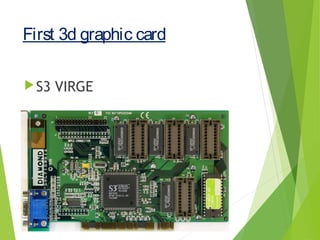
First 3d graphic card
S3 VIRGE
Leading manufacturing
companies
NVIDIA
ATI
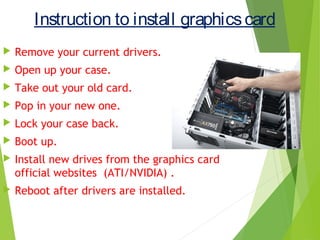
Instruction to install graphicscard
 Remove your current drivers.
 Open up your case.
 Take out your old card.
 Pop in your new one.
 Lock your case back.
 Boot up.
 Install new drives from the graphics card
official websites (ATI/NVIDIA) .
 Reboot after drivers are installed.
GRAPHICS CARD
And how they work
OVERVIEW
 A graphics card is basically a clever piece
of hardware that is very good at doing a
certain types of mathematical operations
CPU vs GPU
and the need of dedicated
GPU
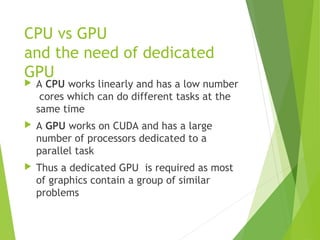
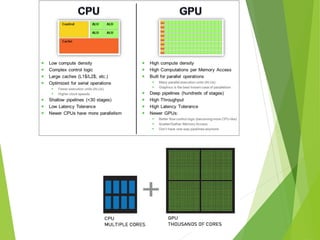
 A CPU works linearly and has a low number
cores which can do different tasks at the
same time
 A GPU works on CUDA and has a large
number of processors dedicated to a
parallel task
 Thus a dedicated GPU is required as most
of graphics contain a group of similar
problems
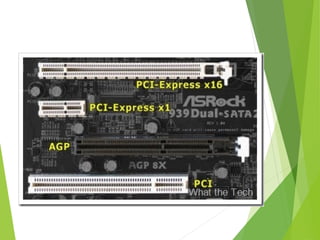
 PCI-E is the bus that the CPU uses to
communicate with GPU
 An API(application program interface)
acts as a gateway between programs and
the GPU
INTERACTION OF CPU WITH
GPU
RENDERING IN GPU
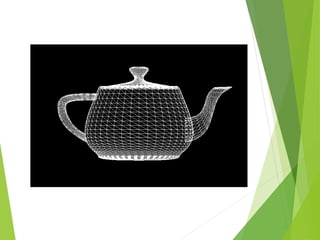
 The building block of all graphic objects is
a triangle having vertices in x,y and z co-
ordinates
 Basic operations on these co-ordinates is
done through the help of matrices
THE PROCESS
 The cores inside the GPU are called the
shader cores it handles vector and pixel
shading
 Both work in harmony
 Once rendering is complete the
ROP(rendered outputs) tells the pixels
what color to be this process is called
rasterisation
CUSTOM EFFECTS
 At this point some custom effects can be added
such as
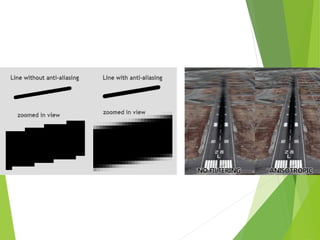
 ANTI-ALIASING: adds intermediate pixels so that
edges do no look jiggered
 ANISOTROPIC FILTERING: tends to make the
overall game graphics look good
 LIGHTING: controls the shadow quality of game
GRAPHIC CARD
SLI OR SCALABLE LINK
INTERFACE
PURPOSE
 EXPLAIN WHAT SLI IS
 HOW ITS USED IN GAMING
TECHNOLOGY
 GO OVER HARDWARE AND SOFTWARE
REQUIREMENT
WHAT IS
SLI?
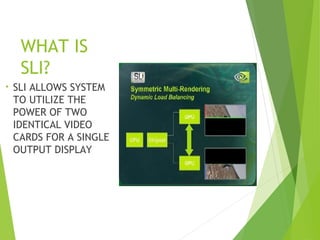
• SLI ALLOWS SYSTEM
TO UTILIZE THE
POWER OF TWO
IDENTICAL VIDEO
CARDS FOR A SINGLE
OUTPUT DISPLAY
BRIEF HISTORY
 3Dfx FIRST INTRODUCED THE
CONCEPT OF SLI IN 1998
 NVIDIA ACQUIRED 3Dfx
 THE CONCEPT OF SLI WAS PUT ON
HOLD
QUAD SLI
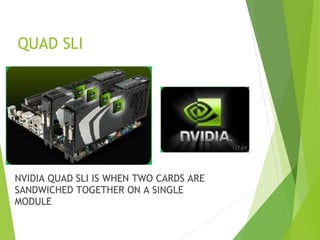
• NVIDIA QUAD SLI IS WHEN TWO CARDS ARE
SANDWICHED TOGETHER ON A SINGLE
MODULE
CURRENT HISTORY
 IN FEBRUARY OF 2008 NVIDIA ACQUIRED
AGEIA TECHNOLOGIES
 HYBRID SLI WAS ANNOUNCED IN FEBRUARY
 MARCH OF 2008 NVIDIA RELEASED THE
GEFORCE 9800GX2 GPU
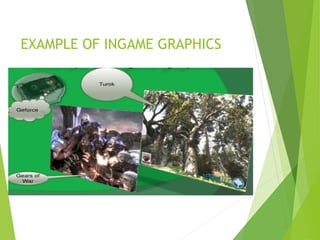
EXAMPLE OF INGAME GRAPHICS
HARDWARE
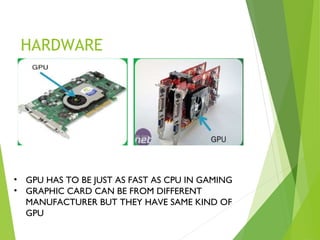
• GPU HAS TO BE JUST AS FAST AS CPU IN GAMING
• GRAPHIC CARD CAN BE FROM DIFFERENT
MANUFACTURER BUT THEY HAVE SAME KIND OF
GPU
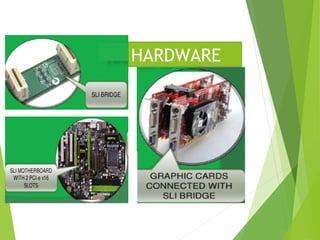
HARDWARE
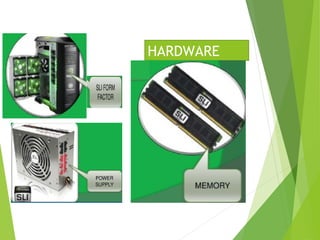
HARDWARE
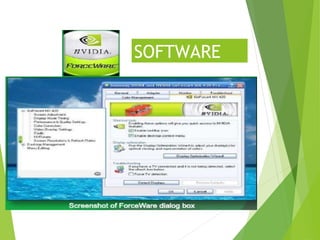
SOFTWARE
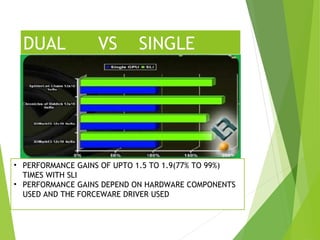
DUAL VS SINGLE
• PERFORMANCE GAINS OF UPTO 1.5 TO 1.9(77% TO 99%)
TIMES WITH SLI
• PERFORMANCE GAINS DEPEND ON HARDWARE COMPONENTS
USED AND THE FORCEWARE DRIVER USED
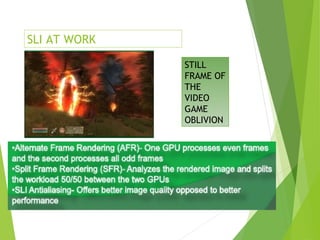
SLI AT WORK
STILL
FRAME OF
THE
VIDEO
GAME
OBLIVION
REVIEW AND CLOSE
 SLI USES TWO OR MORE GPUs TO SHARE
THE WORKLOAD WHEN RENDERING A 3D
SCENE
 SLI IS MOSTLY USED IN COMPUTER SYSTEMS
FOR GAMERS TO INCREASE PERFORMANCE
AND IMAGE QUALITY
 TO ENABLE SLI YOU MUST HAVE THE
REQUIRED HARDWARE THAT HAS PASSED
NVIDIA CERTIFICATON AND THE SOFTWARE
TO COMMUNICATE WITH THAT HARDWARE
Integrated
graphIcs
An integrated graphics processing unit (GPU) doesn't use its own
RAM; it utilizes the system's memory instead. So, if you have a
computer with 4GB of RAM, the video card can use anywhere
between one and five percent of the available memory for graphics
processing. Of course, this percentage varies depending on the size
of task, especially if you're multitasking or playing a game.
dedIcated graphIcs
A dedicated, or discrete, GPU has its own
independent source of video memory, leaving
the RAM your system uses untouched. If you
have a GeForce GTX 980M video card with
4GB of video memory, for example, that
memory is completely separate from your
computer's 16GB of system memory.
Dedicated cards are perfect if you are into
serious gaming or are a professional graphic
designer.
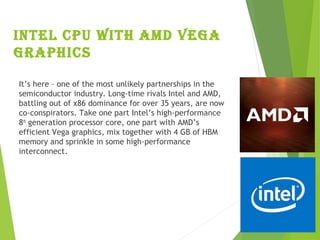
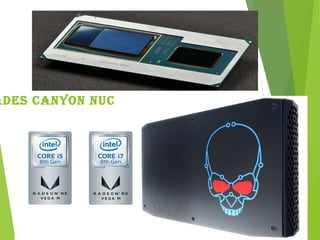
InteL cpU WIth aMd Vega
graphIcs
It’s here – one of the most unlikely partnerships in the
semiconductor industry. Long-time rivals Intel and AMD,
battling out of x86 dominance for over 35 years, are now
co-conspirators. Take one part Intel’s high-performance
8th
 generation processor core, one part with AMD’s
efficient Vega graphics, mix together with 4 GB of HBM
memory and sprinkle in some high-performance
interconnect.
ades canyon nUc
acceLerated processIng UnIt
An Accelerated Processing Unit (APU) combines the CPU
and GPU onto a single chip. The APU was developed by AMD
and initially released under the name Fusion. By combining both
processors onto a single chip, the components are able to
communicate faster and give you greater processing power and
performance. APUs are generally not seen as a replacement to a
standalone graphics card. Instead, they look to replace the GPUs
embedded on the motherboard.
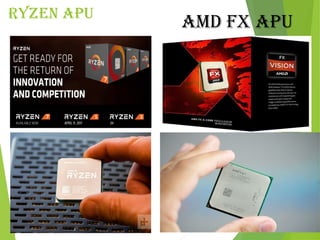
ryZen apU
aMd FX apU
Graphic card

Graphic card

  • 1.
    Graphic cardGraphic card GraphicsProcessing Unit  Group -(551,542,555,546)
  • 2.
    Agenda  WHAT ISGRAPHIC CARD  USES OF GRAPHIC CARDS  HISTORY OF GRAPHIC CARD  HOW TO INSTALL GRAPHIC CARD
  • 3.
  • 4.
    USESOF GRAPHIC CARD Animation  Gaming.  Design and drafting.  Special effect creation/ editing.  And other purpose where fast rendering and high resolutions are needed.
  • 5.
    History of graphiccards?  Graphicswereused with computer hardwarebeforethefirst graphic card was invented.  In 1965, IBM created thefirst graphic display machine. TheIBM 1130 computer wasused with theIBM 2250 display unit.  In 1981, IBM developed first graphic cards. It had just 2,4 or 16 colors.  In 1987, first graphic card with 256 colors wasinvented by IBM.
  • 6.
    First 3d graphiccard S3 VIRGE
  • 7.
  • 9.
    Instruction to installgraphicscard  Remove your current drivers.  Open up your case.  Take out your old card.  Pop in your new one.  Lock your case back.  Boot up.  Install new drives from the graphics card official websites (ATI/NVIDIA) .  Reboot after drivers are installed.
  • 10.
  • 11.
    OVERVIEW  A graphicscard is basically a clever piece of hardware that is very good at doing a certain types of mathematical operations
  • 12.
    CPU vs GPU andthe need of dedicated GPU  A CPU works linearly and has a low number cores which can do different tasks at the same time  A GPU works on CUDA and has a large number of processors dedicated to a parallel task  Thus a dedicated GPU is required as most of graphics contain a group of similar problems
  • 14.
     PCI-E isthe bus that the CPU uses to communicate with GPU  An API(application program interface) acts as a gateway between programs and the GPU INTERACTION OF CPU WITH GPU
  • 16.
    RENDERING IN GPU The building block of all graphic objects is a triangle having vertices in x,y and z co- ordinates  Basic operations on these co-ordinates is done through the help of matrices
  • 18.
    THE PROCESS  Thecores inside the GPU are called the shader cores it handles vector and pixel shading  Both work in harmony  Once rendering is complete the ROP(rendered outputs) tells the pixels what color to be this process is called rasterisation
  • 19.
    CUSTOM EFFECTS  Atthis point some custom effects can be added such as  ANTI-ALIASING: adds intermediate pixels so that edges do no look jiggered  ANISOTROPIC FILTERING: tends to make the overall game graphics look good  LIGHTING: controls the shadow quality of game
  • 21.
    GRAPHIC CARD SLI ORSCALABLE LINK INTERFACE
  • 22.
    PURPOSE  EXPLAIN WHATSLI IS  HOW ITS USED IN GAMING TECHNOLOGY  GO OVER HARDWARE AND SOFTWARE REQUIREMENT
  • 23.
    WHAT IS SLI? • SLIALLOWS SYSTEM TO UTILIZE THE POWER OF TWO IDENTICAL VIDEO CARDS FOR A SINGLE OUTPUT DISPLAY
  • 24.
    BRIEF HISTORY  3DfxFIRST INTRODUCED THE CONCEPT OF SLI IN 1998  NVIDIA ACQUIRED 3Dfx  THE CONCEPT OF SLI WAS PUT ON HOLD
  • 25.
    QUAD SLI • NVIDIAQUAD SLI IS WHEN TWO CARDS ARE SANDWICHED TOGETHER ON A SINGLE MODULE
  • 26.
    CURRENT HISTORY  INFEBRUARY OF 2008 NVIDIA ACQUIRED AGEIA TECHNOLOGIES  HYBRID SLI WAS ANNOUNCED IN FEBRUARY  MARCH OF 2008 NVIDIA RELEASED THE GEFORCE 9800GX2 GPU
  • 27.
  • 28.
    HARDWARE • GPU HASTO BE JUST AS FAST AS CPU IN GAMING • GRAPHIC CARD CAN BE FROM DIFFERENT MANUFACTURER BUT THEY HAVE SAME KIND OF GPU
  • 29.
  • 30.
  • 31.
  • 32.
    DUAL VS SINGLE •PERFORMANCE GAINS OF UPTO 1.5 TO 1.9(77% TO 99%) TIMES WITH SLI • PERFORMANCE GAINS DEPEND ON HARDWARE COMPONENTS USED AND THE FORCEWARE DRIVER USED
  • 33.
    SLI AT WORK STILL FRAMEOF THE VIDEO GAME OBLIVION
  • 34.
    REVIEW AND CLOSE SLI USES TWO OR MORE GPUs TO SHARE THE WORKLOAD WHEN RENDERING A 3D SCENE  SLI IS MOSTLY USED IN COMPUTER SYSTEMS FOR GAMERS TO INCREASE PERFORMANCE AND IMAGE QUALITY  TO ENABLE SLI YOU MUST HAVE THE REQUIRED HARDWARE THAT HAS PASSED NVIDIA CERTIFICATON AND THE SOFTWARE TO COMMUNICATE WITH THAT HARDWARE
  • 35.
    Integrated graphIcs An integrated graphicsprocessing unit (GPU) doesn't use its own RAM; it utilizes the system's memory instead. So, if you have a computer with 4GB of RAM, the video card can use anywhere between one and five percent of the available memory for graphics processing. Of course, this percentage varies depending on the size of task, especially if you're multitasking or playing a game.
  • 36.
    dedIcated graphIcs A dedicated,or discrete, GPU has its own independent source of video memory, leaving the RAM your system uses untouched. If you have a GeForce GTX 980M video card with 4GB of video memory, for example, that memory is completely separate from your computer's 16GB of system memory. Dedicated cards are perfect if you are into serious gaming or are a professional graphic designer.
  • 37.
    InteL cpU WIthaMd Vega graphIcs It’s here – one of the most unlikely partnerships in the semiconductor industry. Long-time rivals Intel and AMD, battling out of x86 dominance for over 35 years, are now co-conspirators. Take one part Intel’s high-performance 8th  generation processor core, one part with AMD’s efficient Vega graphics, mix together with 4 GB of HBM memory and sprinkle in some high-performance interconnect.
  • 38.
  • 39.
    acceLerated processIng UnIt An AcceleratedProcessing Unit (APU) combines the CPU and GPU onto a single chip. The APU was developed by AMD and initially released under the name Fusion. By combining both processors onto a single chip, the components are able to communicate faster and give you greater processing power and performance. APUs are generally not seen as a replacement to a standalone graphics card. Instead, they look to replace the GPUs embedded on the motherboard.
  • 40.