GRAPHICAL PASSWORD
AUTHENTICATION
PRESENTED BY
LIPSA PANIGRAHI
ROLL NO-10cs08
CONTENTS
1. WHAT IS PASSWORD?
2. WHAT IS GRAPHICAL PASSWORD?
3. THE SURVEY.
4. COMPARISION BETWEEN ALPHA-NUMERIC &
GRAPHICAL PASSWORDS.
5. A SIMPLE GRAPHICAL PASSWORD SCHEME.
6. GRAPHICAL PASSWORD-WHAT A CONCEPT.
7. ADVANTAGES OF GRAPHICAL PASSWORDS.
8. DRAWBACKS.
9. CONCLUSION
PASSWORDS
 The most commonly used form of user authentication.
 The weakest links of computer security systems.
 Two conflicting requirements of alphanumeric
passwords
(1) Easy to remember and
(2) Hard to guess.
Many people tend to ignore the second requirement which
lead to weak passwords. Many solutions have been proposed.
Graphical password is one of the solutions.
GRAPHICAL PASSWORDS
 A GRAPHICAL PASSWORD
is an authentication system that works by having the user select from
images, in a specific order, presented in a graphical user interface
(GUI). For this reason, the graphical-password approach is sometimes
called graphical user authentication (GUA).
 It can be used in:
– web log-in application
– ATM machines
– mobile devices
The survey : Two categories
 Recognition Based Techniques
– a user is presented with a set of images and the user passes the
authentication by recognizing and identifying the images he
selected during the registration stage
 Recall Based Techniques
– A user is asked to reproduce something that he created or
selected earlier during the registration stage
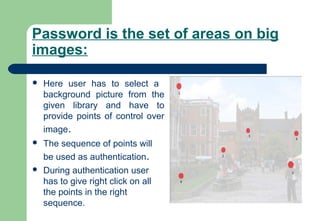
Password is the set of areas on big
images:
 Here user has to select a
background picture from the
given library and have to
provide points of control over
image.
 The sequence of points will
be used as authentication.
 During authentication user
has to give right click on all
the points in the right
sequence.
Recognition Based Techniques
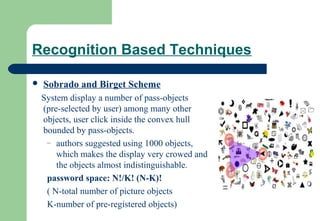
 Sobrado and Birget Scheme
System display a number of pass-objects
(pre-selected by user) among many other
objects, user click inside the convex hull
bounded by pass-objects.
– authors suggested using 1000 objects,
which makes the display very crowed and
the objects almost indistinguishable.
password space: N!/K! (N-K)!
( N-total number of picture objects
K-number of pre-registered objects)
Recall Based Techniques
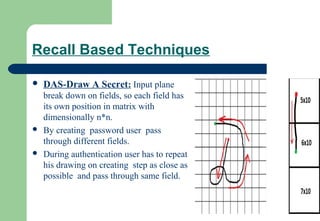
 DAS-Draw A Secret: Input plane
break down on fields, so each field has
its own position in matrix with
dimensionally n*n.
 By creating password user pass
through different fields.
 During authentication user has to repeat
his drawing on creating step as close as
possible and pass through same field.
COMPARISION BETWEEN ALPHA-NUMERIC &
GRAPHICAL PASSWORDS:
Commonly used guidelines for alpha-numeric passwords are:
 The password should be at least 8 characters long.
 The password should not be easy to relate to the user (e.g., last name,
birth date).
 Ideally, the user should combine upper and lower case letters and
digits.
Graphical passwords
 The password consists of some actions that the user performs on an
image.
 Such passwords are easier to remember & hard to guess.
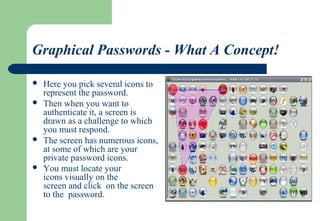
Graphical Passwords - What A Concept!
 Here you pick several icons to
represent the password.
 Then when you want to
authenticate it, a screen is
drawn as a challenge to which
you must respond.
 The screen has numerous icons,
at some of which are your
private password icons.
 You must locate your
icons visually on the
screen and click on the screen
to the password.
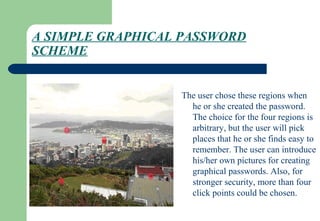
A SIMPLE GRAPHICAL PASSWORD
SCHEME
The user chose these regions when
he or she created the password.
The choice for the four regions is
arbitrary, but the user will pick
places that he or she finds easy to
remember. The user can introduce
his/her own pictures for creating
graphical passwords. Also, for
stronger security, more than four
click points could be chosen.
ADVATAGES OF GRAPHICAL PASSWORDS
 Graphical password schemes provide a way of making more human-
friendly passwords .
 Here the security of the system is very high.
 Here we use a series of selectable images on successive screen pages.
 Dictionary attacks are infeasible.
DRAWBACKS
 Password registration and log-in process take too long.
 Require much more storage space than text based passwords.
 Shoulder Surfing
It means watching over people's shoulders as they process
information. Examples include observing the keyboard as a person
types his or her password, enters a PIN number, or views personal
information.
Because of their graphic nature, nearly all graphical password
schemes are quite vulnerable to shoulder surfing.
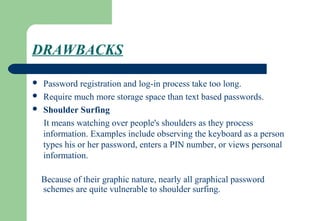
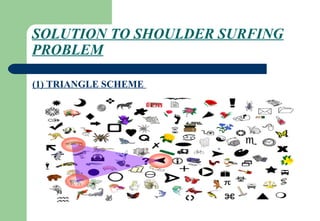
SOLUTION TO SHOULDER SURFING
PROBLEM
(1) TRIANGLE SCHEME
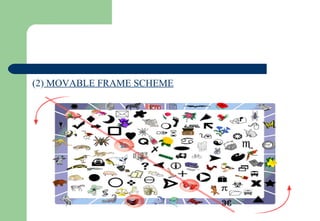
(2) MOVABLE FRAME SCHEME
CONCLUSION
 Graphical passwords are an alternative to textual alphanumeric
password.
 It satisfies both conflicting requirements i.e. it is easy to remember &
it is hard to guess.
 By the solution of the shoulder surfing problem, it becomes more
secure & easier password scheme.
 By implementing other special geometric configurations like triangle
& movable frame, one can achieve more security.
ANY QURIES?

Graphical password

  • 1.
  • 2.
    CONTENTS 1. WHAT ISPASSWORD? 2. WHAT IS GRAPHICAL PASSWORD? 3. THE SURVEY. 4. COMPARISION BETWEEN ALPHA-NUMERIC & GRAPHICAL PASSWORDS. 5. A SIMPLE GRAPHICAL PASSWORD SCHEME. 6. GRAPHICAL PASSWORD-WHAT A CONCEPT. 7. ADVANTAGES OF GRAPHICAL PASSWORDS. 8. DRAWBACKS. 9. CONCLUSION
  • 3.
    PASSWORDS  The mostcommonly used form of user authentication.  The weakest links of computer security systems.  Two conflicting requirements of alphanumeric passwords (1) Easy to remember and (2) Hard to guess. Many people tend to ignore the second requirement which lead to weak passwords. Many solutions have been proposed. Graphical password is one of the solutions.
  • 4.
    GRAPHICAL PASSWORDS  AGRAPHICAL PASSWORD is an authentication system that works by having the user select from images, in a specific order, presented in a graphical user interface (GUI). For this reason, the graphical-password approach is sometimes called graphical user authentication (GUA).  It can be used in: – web log-in application – ATM machines – mobile devices
  • 5.
    The survey :Two categories  Recognition Based Techniques – a user is presented with a set of images and the user passes the authentication by recognizing and identifying the images he selected during the registration stage  Recall Based Techniques – A user is asked to reproduce something that he created or selected earlier during the registration stage
  • 6.
    Password is theset of areas on big images:  Here user has to select a background picture from the given library and have to provide points of control over image.  The sequence of points will be used as authentication.  During authentication user has to give right click on all the points in the right sequence.
  • 7.
    Recognition Based Techniques Sobrado and Birget Scheme System display a number of pass-objects (pre-selected by user) among many other objects, user click inside the convex hull bounded by pass-objects. – authors suggested using 1000 objects, which makes the display very crowed and the objects almost indistinguishable. password space: N!/K! (N-K)! ( N-total number of picture objects K-number of pre-registered objects)
  • 8.
    Recall Based Techniques DAS-Draw A Secret: Input plane break down on fields, so each field has its own position in matrix with dimensionally n*n.  By creating password user pass through different fields.  During authentication user has to repeat his drawing on creating step as close as possible and pass through same field.
  • 9.
    COMPARISION BETWEEN ALPHA-NUMERIC& GRAPHICAL PASSWORDS: Commonly used guidelines for alpha-numeric passwords are:  The password should be at least 8 characters long.  The password should not be easy to relate to the user (e.g., last name, birth date).  Ideally, the user should combine upper and lower case letters and digits. Graphical passwords  The password consists of some actions that the user performs on an image.  Such passwords are easier to remember & hard to guess.
  • 10.
    Graphical Passwords -What A Concept!  Here you pick several icons to represent the password.  Then when you want to authenticate it, a screen is drawn as a challenge to which you must respond.  The screen has numerous icons, at some of which are your private password icons.  You must locate your icons visually on the screen and click on the screen to the password.
  • 11.
    A SIMPLE GRAPHICALPASSWORD SCHEME The user chose these regions when he or she created the password. The choice for the four regions is arbitrary, but the user will pick places that he or she finds easy to remember. The user can introduce his/her own pictures for creating graphical passwords. Also, for stronger security, more than four click points could be chosen.
  • 12.
    ADVATAGES OF GRAPHICALPASSWORDS  Graphical password schemes provide a way of making more human- friendly passwords .  Here the security of the system is very high.  Here we use a series of selectable images on successive screen pages.  Dictionary attacks are infeasible.
  • 13.
    DRAWBACKS  Password registrationand log-in process take too long.  Require much more storage space than text based passwords.  Shoulder Surfing It means watching over people's shoulders as they process information. Examples include observing the keyboard as a person types his or her password, enters a PIN number, or views personal information. Because of their graphic nature, nearly all graphical password schemes are quite vulnerable to shoulder surfing.
  • 14.
    SOLUTION TO SHOULDERSURFING PROBLEM (1) TRIANGLE SCHEME
  • 15.
  • 16.
    CONCLUSION  Graphical passwordsare an alternative to textual alphanumeric password.  It satisfies both conflicting requirements i.e. it is easy to remember & it is hard to guess.  By the solution of the shoulder surfing problem, it becomes more secure & easier password scheme.  By implementing other special geometric configurations like triangle & movable frame, one can achieve more security.
  • 17.