CAPTCHA AS GRAPHICAL PASSWORDS
A NEW SECURITY PRIMITIVE BASED ON
HARD AI PROBLEMS
By
Gopinath.R
(1BY14SCS08)
M.Tech (CSE),BMSIT
Under the Guidance of:
Mr. Ravi Kumar B.N
Asst. Professor , Dept of CSE, BMSIT
AGENDA
 Introduction
 Background
 Captcha as Graphical Password
 Recognition Based CaRP
 Security Analysis
 Applications
 Conclusion 2
INTRODUCTION
 Using hard Artificial Intelligence problems for Security is an exciting
new paradigm.
 Under this paradigm, the most notable primitive is Captcha, which
distinguishes human users from computers by presenting a
challenge, i.e., a puzzle .
 Captcha is now a standard Internet security technique to protect
online email and other services from being abused by bots.
 A new security primitive based on hard AI problems, namely, a novel
family of graphical password systems integrating Captcha
technology, called as CaRP.
 CaRP is click-based graphical passwords, where a sequence of
clicks on an image is used to derive a password.
3
BACKGROUND
 Graphical Passwords
Recall Based Techniques
A user is asked to reproduce something that he created or
selected earlier during the registration stage
Recognition Based Techniques
A user is presented with a set of images and the user passes the
authentication by recognizing and identifying the images he
selected during the registration stage.
Cued-recall Technique
An extra cue is provided to users to remember and target specific
locations within a presented image.
4
 Captcha
Completely Automated Public Turing test to tell Computers &
Humans Apart.
It is a program that is a challenge response to test to separate humans
from computer programs.
TYPES:
Text Captcha
The Text Captcha relies on character recognition
Image-Recognition Captcha (IRC)
The IRC relies on recognition of non-character objects.
5
TEXT BASED
simple, normal questions :-
 what is the sum of three & thirty-five ?
 If today is Saturday, what is day after tomorrow?
 Which of mango, table & water is a fruit?
 Very effective, needs a large question bank.
 Cognitively challenged ,users find it hard.
6
IMAGE-RECOGNITION CAPTCHA
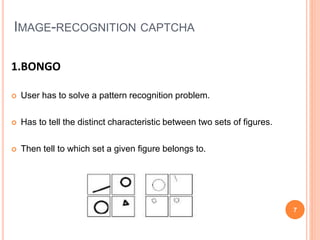
1.BONGO
 User has to solve a pattern recognition problem.
 Has to tell the distinct characteristic between two sets of figures.
 Then tell to which set a given figure belongs to.
7
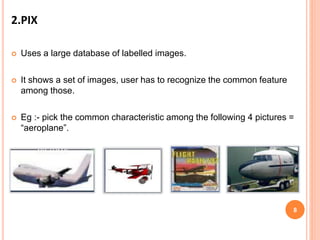
2.PIX
 Uses a large database of labelled images.
 It shows a set of images, user has to recognize the common feature
among those.
 Eg :- pick the common characteristic among the following 4 pictures =
“aeroplane”.
8
 Captcha in Authentication
 It was introduced to use both Captcha and password in
authentication protocol, called as Captcha-based Password
Authentication (CbPA) protocol.
 The CbPA-protocol requires solving a Captcha challenge after
inputting a valid pair of user ID and password.
9
CAPTCHA AS GRAPHICAL
PASSWORDS- CARP
A New Way to Thwart Guessing Attacks
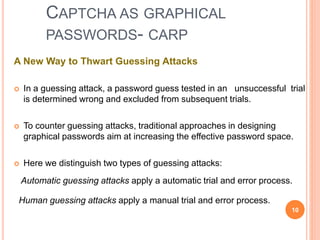
 In a guessing attack, a password guess tested in an unsuccessful trial
is determined wrong and excluded from subsequent trials.
 To counter guessing attacks, traditional approaches in designing
graphical passwords aim at increasing the effective password space.
 Here we distinguish two types of guessing attacks:
Automatic guessing attacks apply a automatic trial and error process.
Human guessing attacks apply a manual trial and error process.
10
CaRP: An Overview
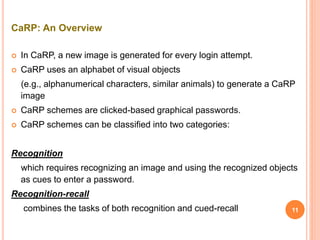
 In CaRP, a new image is generated for every login attempt.
 CaRP uses an alphabet of visual objects
(e.g., alphanumerical characters, similar animals) to generate a CaRP
image
 CaRP schemes are clicked-based graphical passwords.
 CaRP schemes can be classified into two categories:
Recognition
which requires recognizing an image and using the recognized objects
as cues to enter a password.
Recognition-recall
combines the tasks of both recognition and cued-recall 11
USER AUTHENTICATION WITH
CARP SCHEMES
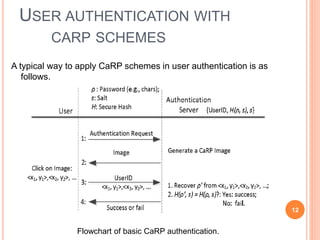
A typical way to apply CaRP schemes in user authentication is as
follows.
12
Flowchart of basic CaRP authentication.
 The authentication server AS stores a salt s and a hash value H(ρ,s)
for each user ID .
 Upon receiving a login request, AS generates a CaRP image.
 The coordinates of the clicked points are recorded and sent to AS
along with the user ID.
 AS maps the received coordinates onto the CaRP image, and
recovers a sequence of visual object IDs .
 Then AS retrieves salt s of the account, calculates the hash value of
ρ with the salt.
 Authentication succeeds only if the two hash values match.
13
RECOGNITION BASED CARP
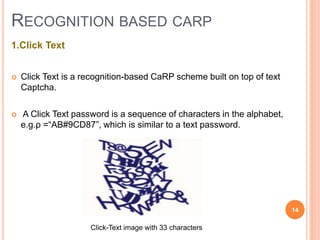
1.Click Text
 Click Text is a recognition-based CaRP scheme built on top of text
Captcha.
 A Click Text password is a sequence of characters in the alphabet,
e.g.ρ =“AB#9CD87”, which is similar to a text password.
14
Click-Text image with 33 characters
2.Click Animal
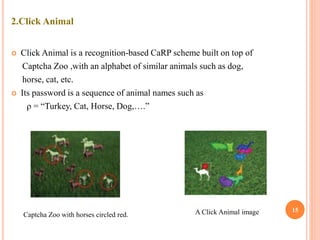
 Click Animal is a recognition-based CaRP scheme built on top of
Captcha Zoo ,with an alphabet of similar animals such as dog,
horse, cat, etc.
 Its password is a sequence of animal names such as
ρ = “Turkey, Cat, Horse, Dog,….”
15
Captcha Zoo with horses circled red. A Click Animal image
3.Animal Grid
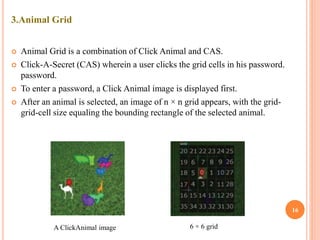
 Animal Grid is a combination of Click Animal and CAS.
 Click-A-Secret (CAS) wherein a user clicks the grid cells in his password.
password.
 To enter a password, a Click Animal image is displayed first.
 After an animal is selected, an image of n × n grid appears, with the grid-
grid-cell size equaling the bounding rectangle of the selected animal.
16
A ClickAnimal image 6 × 6 grid
SECURITY ANALYSIS
 Security of Underlying Captcha
As a framework of graphical passwords, CaRP does not
rely on any specific Captcha scheme.
If one Captcha scheme gets broken, a new robust
Captcha scheme can be used to construct a new CaRP
scheme
17
 Automatic online guessing attcks
In automatic online guessing attacks, the trial and error
process is executed automatically whereas dictionaries can
beconstructed manually
18
APPLICATIONS
 CaRP can be applied on touch-screen devices .
 Many e-banking systems uses Captchas in user logins that
requires solving a Captcha challenge for every online login
attempt.
 CaRP increases spammer’s operating cost and thus helps
reduce spam emails.
 If CaRP is combined with a policy to throttle the number of
emails sent to new recipients per login session, leads to
reduced outbound spam traffic.
19
CONCLUSION
 CaRP is both a Captcha and a graphical password scheme.
 A desired security property that other graphical password schemes
lack.
 CaRP is also resistant to Captcha relay attacks, and, if combined with
dual-view technologies shoulder-surfing attacks.
 CaRP can also help to reduce spam emails sent from a Web email
service
 More efforts will be attracted by CaRP than ordinary Captcha.
 CaRP does not rely on any specific Captcha scheme. 20
REFERENCES
[1] Bin B. Zhu, Jeff Yan, Guanbo Bao, Maowei Yang, and Ning Xu “Captcha as
Graphical Passwords—A New Security Primitive Based on Hard AI Problems”
VOL. 9, NO. 6, JUNE 2014
[2] R. Biddle, S. Chiasson, and P. C. van Oorschot, “Graphical passwords:
Learning from the first twelve years,” ACM Compute Surveys, vol. 44, no. 4,
2012.
[3] I. Jermyn, A. Mayer, F. Monrose, M. Reiter, and A. Rubin, “The design and
analysis of graphical passwords,” in Proc. 8th USENIX Security Symp., 1999,
pp. 1–15.
[4] H. Tao and C. Adams, “Pass-Go: A proposal to improve the usability of
graphical passwords,” Int. J. Netw. Security , vol. 7, no. 2, pp. 273– 292, 2008.
[5] S. Wiedenbeck, J. Waters, J. C. Birget, A. Brodskiy, and N. Memon,
“PassPoints: Design and longitudinal evaluation of a graphical password
system,” Int. J. HCI, vol. 63, pp. 102–127, Jul. 2005.
21
Thank you…!!!
22

Captcha as graphical password

  • 1.
    CAPTCHA AS GRAPHICALPASSWORDS A NEW SECURITY PRIMITIVE BASED ON HARD AI PROBLEMS By Gopinath.R (1BY14SCS08) M.Tech (CSE),BMSIT Under the Guidance of: Mr. Ravi Kumar B.N Asst. Professor , Dept of CSE, BMSIT
  • 2.
    AGENDA  Introduction  Background Captcha as Graphical Password  Recognition Based CaRP  Security Analysis  Applications  Conclusion 2
  • 3.
    INTRODUCTION  Using hardArtificial Intelligence problems for Security is an exciting new paradigm.  Under this paradigm, the most notable primitive is Captcha, which distinguishes human users from computers by presenting a challenge, i.e., a puzzle .  Captcha is now a standard Internet security technique to protect online email and other services from being abused by bots.  A new security primitive based on hard AI problems, namely, a novel family of graphical password systems integrating Captcha technology, called as CaRP.  CaRP is click-based graphical passwords, where a sequence of clicks on an image is used to derive a password. 3
  • 4.
    BACKGROUND  Graphical Passwords RecallBased Techniques A user is asked to reproduce something that he created or selected earlier during the registration stage Recognition Based Techniques A user is presented with a set of images and the user passes the authentication by recognizing and identifying the images he selected during the registration stage. Cued-recall Technique An extra cue is provided to users to remember and target specific locations within a presented image. 4
  • 5.
     Captcha Completely AutomatedPublic Turing test to tell Computers & Humans Apart. It is a program that is a challenge response to test to separate humans from computer programs. TYPES: Text Captcha The Text Captcha relies on character recognition Image-Recognition Captcha (IRC) The IRC relies on recognition of non-character objects. 5
  • 6.
    TEXT BASED simple, normalquestions :-  what is the sum of three & thirty-five ?  If today is Saturday, what is day after tomorrow?  Which of mango, table & water is a fruit?  Very effective, needs a large question bank.  Cognitively challenged ,users find it hard. 6
  • 7.
    IMAGE-RECOGNITION CAPTCHA 1.BONGO  Userhas to solve a pattern recognition problem.  Has to tell the distinct characteristic between two sets of figures.  Then tell to which set a given figure belongs to. 7
  • 8.
    2.PIX  Uses alarge database of labelled images.  It shows a set of images, user has to recognize the common feature among those.  Eg :- pick the common characteristic among the following 4 pictures = “aeroplane”. 8
  • 9.
     Captcha inAuthentication  It was introduced to use both Captcha and password in authentication protocol, called as Captcha-based Password Authentication (CbPA) protocol.  The CbPA-protocol requires solving a Captcha challenge after inputting a valid pair of user ID and password. 9
  • 10.
    CAPTCHA AS GRAPHICAL PASSWORDS-CARP A New Way to Thwart Guessing Attacks  In a guessing attack, a password guess tested in an unsuccessful trial is determined wrong and excluded from subsequent trials.  To counter guessing attacks, traditional approaches in designing graphical passwords aim at increasing the effective password space.  Here we distinguish two types of guessing attacks: Automatic guessing attacks apply a automatic trial and error process. Human guessing attacks apply a manual trial and error process. 10
  • 11.
    CaRP: An Overview In CaRP, a new image is generated for every login attempt.  CaRP uses an alphabet of visual objects (e.g., alphanumerical characters, similar animals) to generate a CaRP image  CaRP schemes are clicked-based graphical passwords.  CaRP schemes can be classified into two categories: Recognition which requires recognizing an image and using the recognized objects as cues to enter a password. Recognition-recall combines the tasks of both recognition and cued-recall 11
  • 12.
    USER AUTHENTICATION WITH CARPSCHEMES A typical way to apply CaRP schemes in user authentication is as follows. 12 Flowchart of basic CaRP authentication.
  • 13.
     The authenticationserver AS stores a salt s and a hash value H(ρ,s) for each user ID .  Upon receiving a login request, AS generates a CaRP image.  The coordinates of the clicked points are recorded and sent to AS along with the user ID.  AS maps the received coordinates onto the CaRP image, and recovers a sequence of visual object IDs .  Then AS retrieves salt s of the account, calculates the hash value of ρ with the salt.  Authentication succeeds only if the two hash values match. 13
  • 14.
    RECOGNITION BASED CARP 1.ClickText  Click Text is a recognition-based CaRP scheme built on top of text Captcha.  A Click Text password is a sequence of characters in the alphabet, e.g.ρ =“AB#9CD87”, which is similar to a text password. 14 Click-Text image with 33 characters
  • 15.
    2.Click Animal  ClickAnimal is a recognition-based CaRP scheme built on top of Captcha Zoo ,with an alphabet of similar animals such as dog, horse, cat, etc.  Its password is a sequence of animal names such as ρ = “Turkey, Cat, Horse, Dog,….” 15 Captcha Zoo with horses circled red. A Click Animal image
  • 16.
    3.Animal Grid  AnimalGrid is a combination of Click Animal and CAS.  Click-A-Secret (CAS) wherein a user clicks the grid cells in his password. password.  To enter a password, a Click Animal image is displayed first.  After an animal is selected, an image of n × n grid appears, with the grid- grid-cell size equaling the bounding rectangle of the selected animal. 16 A ClickAnimal image 6 × 6 grid
  • 17.
    SECURITY ANALYSIS  Securityof Underlying Captcha As a framework of graphical passwords, CaRP does not rely on any specific Captcha scheme. If one Captcha scheme gets broken, a new robust Captcha scheme can be used to construct a new CaRP scheme 17
  • 18.
     Automatic onlineguessing attcks In automatic online guessing attacks, the trial and error process is executed automatically whereas dictionaries can beconstructed manually 18
  • 19.
    APPLICATIONS  CaRP canbe applied on touch-screen devices .  Many e-banking systems uses Captchas in user logins that requires solving a Captcha challenge for every online login attempt.  CaRP increases spammer’s operating cost and thus helps reduce spam emails.  If CaRP is combined with a policy to throttle the number of emails sent to new recipients per login session, leads to reduced outbound spam traffic. 19
  • 20.
    CONCLUSION  CaRP isboth a Captcha and a graphical password scheme.  A desired security property that other graphical password schemes lack.  CaRP is also resistant to Captcha relay attacks, and, if combined with dual-view technologies shoulder-surfing attacks.  CaRP can also help to reduce spam emails sent from a Web email service  More efforts will be attracted by CaRP than ordinary Captcha.  CaRP does not rely on any specific Captcha scheme. 20
  • 21.
    REFERENCES [1] Bin B.Zhu, Jeff Yan, Guanbo Bao, Maowei Yang, and Ning Xu “Captcha as Graphical Passwords—A New Security Primitive Based on Hard AI Problems” VOL. 9, NO. 6, JUNE 2014 [2] R. Biddle, S. Chiasson, and P. C. van Oorschot, “Graphical passwords: Learning from the first twelve years,” ACM Compute Surveys, vol. 44, no. 4, 2012. [3] I. Jermyn, A. Mayer, F. Monrose, M. Reiter, and A. Rubin, “The design and analysis of graphical passwords,” in Proc. 8th USENIX Security Symp., 1999, pp. 1–15. [4] H. Tao and C. Adams, “Pass-Go: A proposal to improve the usability of graphical passwords,” Int. J. Netw. Security , vol. 7, no. 2, pp. 273– 292, 2008. [5] S. Wiedenbeck, J. Waters, J. C. Birget, A. Brodskiy, and N. Memon, “PassPoints: Design and longitudinal evaluation of a graphical password system,” Int. J. HCI, vol. 63, pp. 102–127, Jul. 2005. 21
  • 22.