Venkat Java Projects
Mobile:+91 9966499110 Visit:www.venkatjavaprojects.com
Email:venkatjavaprojects@gmail.com
MODELING AND PREDICTING CYBER
HACKING BREACHES
ABSTRACT:
Analyzing cyber incident data sets is an important method for
deepening our understanding of the evolution of the threat situation. This
is a relatively new research topic, and many studies remain to be done.
In this paper, we report a statistical analysis of a breach incident data set
corresponding to 12 years (2005–2017) of cyber hacking activities that
include malware attacks. We show that, in contrast to the findings
reported in the literature, both hacking breach incident inter-arrival times
and breach sizes should be modeled by stochastic processes, rather than
by distributions because they exhibit autocorrelations. Then, we propose
particular stochastic process models to, respectively, fit the inter-arrival
times and the breach sizes. We also show that these models can predict
the inter-arrival times and the breach sizes. In order to get deeper
insights into the evolution of hacking breach incidents, we conduct both
qualitative and quantitative trend analyses on the data set. We draw a set
of cybersecurity insights, including that the threat of cyber hacks is
indeed getting worse in terms of their frequency, but not in terms of the
magnitude of their damage.
Venkat Java Projects
Mobile:+91 9966499110 Visit:www.venkatjavaprojects.com
Email:venkatjavaprojects@gmail.com
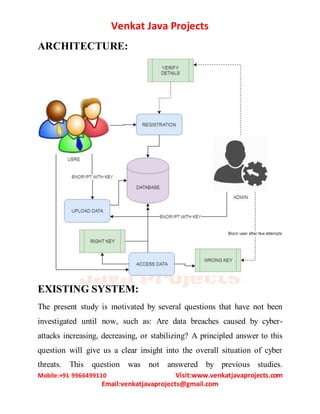
ARCHITECTURE:
EXISTING SYSTEM:
The present study is motivated by several questions that have not been
investigated until now, such as: Are data breaches caused by cyber-
attacks increasing, decreasing, or stabilizing? A principled answer to this
question will give us a clear insight into the overall situation of cyber
threats. This question was not answered by previous studies.
Venkat Java Projects
Mobile:+91 9966499110 Visit:www.venkatjavaprojects.com
Email:venkatjavaprojects@gmail.com
Specifically, the dataset analyzed in [7] only covered the time span from
2000 to 2008 and does not necessarily contain the breach incidents that
are caused by cyber-attacks; the dataset analyzed in [9] is more recent,
but contains two kinds of incidents: negligent breaches (i.e., incidents
caused by lost, discarded, stolen devices and other reasons) and
malicious breaching. Since negligent breaches represent more human
errors than cyber-attacks, we do not consider them in the present study.
Because the malicious breaches studied in [9] contain four sub-
categories: hacking (including malware), insider, payment card fraud,
and unknown, this study will focus on the hacking sub-category (called
hacking breach dataset thereafter), while noting that the other three sub-
categories are interesting on their own and should be analyzed
separately.Recently, researchers started modeling data breach incidents.
Maillart and Sornettestudied the statistical properties of the personal
identity losses in the United States between year 2000 and 2008. They
found that the number of breach incidents dramatically increases from
2000 to July 2006 but remains stable thereafter. Edwards et al. analyzed
a dataset containing 2,253 breach incidents that span over a decade
(2005 to 2015). They found that neither the size nor the frequency of
data breaches has increased over the years. Wheatley et al., analyzed a
dataset that is combined from corresponds to organizational breach
incidents between year 2000 and 2015. They found that the frequency of
large breach incidents (i.e., the ones that breach more than 50,000
Venkat Java Projects
Mobile:+91 9966499110 Visit:www.venkatjavaprojects.com
Email:venkatjavaprojects@gmail.com
records) occurring to US firms is independent of time, but the frequency
of large breach incidents occurring to non-US firms exhibits an
increasing trend.
PROPOSEDSYSTEM:
In this paper, we make the following three contributions. First, we
show that both the hacking breach incident interarrival times (reflecting
incident frequency) and breach sizes should be modeled by stochastic
processes, rather than by distributions. We find that a particular point
process can adequately describe the evolution of the hacking breach
incidents inter-arrival times and that a particular ARMA-GARCH model
can adequately describe the evolution of the hacking breach sizes, where
ARMA is acronym for “AutoRegressive and Moving Average” and
GARCH is acronym for “Generalized AutoRegressive Conditional
Heteroskedasticity.”We show that these stochastic process models can
predict the inter-arrival times and the breach sizes. To the best of our
knowledge, this is the first paper showing that stochastic processes,
rather than distributions, should be used to model these cyber threat
factors. Second, we discover a positive dependence between the
incidents inter-arrival times and the breach sizes, and show that this
dependence can be adequately described by a particular copula. We also
show that when predicting inter-arrival times and breach sizes, it is
necessary to consider the dependence; otherwise, the prediction results
Venkat Java Projects
Mobile:+91 9966499110 Visit:www.venkatjavaprojects.com
Email:venkatjavaprojects@gmail.com
are not accurate. To the best of our knowledge, this is the first work
showing the existence of this dependence and the consequence of
ignoring it. Third, we conduct both qualitative and quantitative trend
analyses of the cyber hacking breach incidents. We find that the
situation is indeed getting worse in terms of the incidents inter-arrival
time because hacking breach incidents become more and more frequent,
but the situation is stabilizing in terms of the incident breach size,
indicating that the damage of individual hacking breach incidents will
not get much worse. We hope the present study will inspire more
investigations, which can offer deep insights into alternate risk
mitigation approaches. Such insights are useful to insurance companies,
government agencies, and regulators because they need to deeply
understand the nature of data breach risks.
ALGORITHM:
SUPPORT VECTOR MACHINE
“Support Vector Machine” (SVM) is a supervised machine learning
algorithm which can be used for both classification and regression
challenges. However, it is mostly used in classification problems. In this
algorithm, we plot each data item as a point in n-dimensional space
(where n is number of features you have) with the value of each feature
being the value of a particular coordinate. Then, we perform
classification by finding the hyper-plane that differentiate the two
Venkat Java Projects
Mobile:+91 9966499110 Visit:www.venkatjavaprojects.com
Email:venkatjavaprojects@gmail.com
classes very well (look at the below snapshot).Support Vectors are
simply the co-ordinates of individual observation. Support Vector
Machine is a frontier which best segregates the two classes (hyper-plane/
line).More formally, a support vector machine constructs a hyper plane
or set of hyper planes in a high- or infinite-dimensional space, which can
be used for classification, regression, or other tasks like outliers
detection. Intuitively, a good separation is achieved by the hyper plane
that has the largest distance to the nearest training-data point of any class
(so-called functional margin), since in general the larger the margin the
lower the generalization error of the classifier.Whereas the original
problem may be stated in a finite dimensional space, it often happens
that the sets to discriminate are not linearly separable in that space. For
this reason, it was proposed that the original finite-dimensional space be
mapped into a much higher-dimensional space, presumably making the
separation easier in that space.
MODULES:
1. UPLOAD DATA
The data resource to database can be uploaded by both
administrator and authorized user. The data can be uploaded with
key in order to maintain the secrecy of the data that is not released
without knowledge of user. The users are authorized based on their
details that are shared to admin and admin can authorize each user.
Venkat Java Projects
Mobile:+91 9966499110 Visit:www.venkatjavaprojects.com
Email:venkatjavaprojects@gmail.com
Only Authorized users are allowed to access the system and upload
or request for files.
2. ACCESS DETAILS
The access of data from the database can be given by
administrators. Uploaded data are managed by admin and admin is
the only person to provide the rights to process the accessing details
and approve or unapproved users based on their details.
3. USER PERMISSIONS
The data from any resources are allowed to access the data with
only permission from administrator. Prior to access data, users are
allowed by admin to share their data and verify the details which are
provided by user. If user is access the data with wrong attempts then,
users are blocked accordingly. If user is requested to unblock them,
based on the requests and previous activities admin is unblock users.
4. DATA ANALYSIS
Data analyses are done with the help of graph. The collected
data are applied to graph in order to get the best analysis and
prediction of dataset and given data policies. The dataset can be
analyzed through this pictorial representation in order to better
understand of the data details.
FUTUREWORK:
Venkat Java Projects
Mobile:+91 9966499110 Visit:www.venkatjavaprojects.com
Email:venkatjavaprojects@gmail.com
There are many open problems that are left for future research. For
example, it is both interesting and challenging to investigate how to
predict the extremely large values and how to deal with missing data
(i.e., breach incidents that are not reported). It is also worthwhile to
estimate the exact occurring times of breach incidents. Finally, more
research needs to be conducted towards understanding the predictability
of breach incidents (i.e., the upper bound of prediction accuracy).
REQUIREMENT ANALYSIS
The project involved analyzing the design of few applications so as
to make the application more users friendly. To do so, it was really
important to keep the navigations from one screen to the other well
ordered and at the same time reducing the amount of typing the user
needs to do. In order to make the application more accessible, the
browser version had to be chosen so that it is compatible with most of
the Browsers.
REQUIREMENT SPECIFICATION
Functional Requirements
 Graphical User interface with the User.
Software Requirements
Venkat Java Projects
Mobile:+91 9966499110 Visit:www.venkatjavaprojects.com
Email:venkatjavaprojects@gmail.com
For developing the application the following are the Software
Requirements:
1. Python
2. Django
3. Mysql
4. Wampserver
Operating Systems supported
1. Windows 7
2. Windows XP
3. Windows 8
Technologies and Languages used to Develop
1. Python
Debugger and Emulator
 Any Browser (Particularly Chrome)
Hardware Requirements
Venkat Java Projects
Mobile:+91 9966499110 Visit:www.venkatjavaprojects.com
Email:venkatjavaprojects@gmail.com
For developing the application the following are the Hardware
Requirements:
 Processor: Pentium IV or higher
 RAM: 256 MB
 Space on Hard Disk: minimum 512MB
CONCLUSION:
We analyzed a hacking breach dataset from the points of view of
the incidents inter-arrival time and the breach size, and showed that they
both should be modeled by stochastic processes rather than distributions.
The statistical models developed in this paper show satisfactory fitting
and prediction accuracies. In particular, we propose using a copula-
based approach to predict the joint probability that an incident with a
certain magnitude of breach size will occur during a future period of
time. Statistical tests show that the methodologies proposed in this paper
are better than those which are presented in the literature, because the
latter ignored both the temporal correlations and the dependence
between the incidents inter-arrival times and the breach sizes. We
conducted qualitative and quantitative analyses to draw further insights.
We drew a set of cybersecurity insights, including that the threat of
cyber hacking breach incidents is indeed getting worse in terms of their
frequency, but not the magnitude of their damage. The methodology
Venkat Java Projects
Mobile:+91 9966499110 Visit:www.venkatjavaprojects.com
Email:venkatjavaprojects@gmail.com
presented in this paper can be adopted or adapted to analyze datasets of a
similar nature.

modeling and predicting cyber hacking breaches

  • 1.
    Venkat Java Projects Mobile:+919966499110 Visit:www.venkatjavaprojects.com Email:venkatjavaprojects@gmail.com MODELING AND PREDICTING CYBER HACKING BREACHES ABSTRACT: Analyzing cyber incident data sets is an important method for deepening our understanding of the evolution of the threat situation. This is a relatively new research topic, and many studies remain to be done. In this paper, we report a statistical analysis of a breach incident data set corresponding to 12 years (2005–2017) of cyber hacking activities that include malware attacks. We show that, in contrast to the findings reported in the literature, both hacking breach incident inter-arrival times and breach sizes should be modeled by stochastic processes, rather than by distributions because they exhibit autocorrelations. Then, we propose particular stochastic process models to, respectively, fit the inter-arrival times and the breach sizes. We also show that these models can predict the inter-arrival times and the breach sizes. In order to get deeper insights into the evolution of hacking breach incidents, we conduct both qualitative and quantitative trend analyses on the data set. We draw a set of cybersecurity insights, including that the threat of cyber hacks is indeed getting worse in terms of their frequency, but not in terms of the magnitude of their damage.
  • 2.
    Venkat Java Projects Mobile:+919966499110 Visit:www.venkatjavaprojects.com Email:venkatjavaprojects@gmail.com ARCHITECTURE: EXISTING SYSTEM: The present study is motivated by several questions that have not been investigated until now, such as: Are data breaches caused by cyber- attacks increasing, decreasing, or stabilizing? A principled answer to this question will give us a clear insight into the overall situation of cyber threats. This question was not answered by previous studies.
  • 3.
    Venkat Java Projects Mobile:+919966499110 Visit:www.venkatjavaprojects.com Email:venkatjavaprojects@gmail.com Specifically, the dataset analyzed in [7] only covered the time span from 2000 to 2008 and does not necessarily contain the breach incidents that are caused by cyber-attacks; the dataset analyzed in [9] is more recent, but contains two kinds of incidents: negligent breaches (i.e., incidents caused by lost, discarded, stolen devices and other reasons) and malicious breaching. Since negligent breaches represent more human errors than cyber-attacks, we do not consider them in the present study. Because the malicious breaches studied in [9] contain four sub- categories: hacking (including malware), insider, payment card fraud, and unknown, this study will focus on the hacking sub-category (called hacking breach dataset thereafter), while noting that the other three sub- categories are interesting on their own and should be analyzed separately.Recently, researchers started modeling data breach incidents. Maillart and Sornettestudied the statistical properties of the personal identity losses in the United States between year 2000 and 2008. They found that the number of breach incidents dramatically increases from 2000 to July 2006 but remains stable thereafter. Edwards et al. analyzed a dataset containing 2,253 breach incidents that span over a decade (2005 to 2015). They found that neither the size nor the frequency of data breaches has increased over the years. Wheatley et al., analyzed a dataset that is combined from corresponds to organizational breach incidents between year 2000 and 2015. They found that the frequency of large breach incidents (i.e., the ones that breach more than 50,000
  • 4.
    Venkat Java Projects Mobile:+919966499110 Visit:www.venkatjavaprojects.com Email:venkatjavaprojects@gmail.com records) occurring to US firms is independent of time, but the frequency of large breach incidents occurring to non-US firms exhibits an increasing trend. PROPOSEDSYSTEM: In this paper, we make the following three contributions. First, we show that both the hacking breach incident interarrival times (reflecting incident frequency) and breach sizes should be modeled by stochastic processes, rather than by distributions. We find that a particular point process can adequately describe the evolution of the hacking breach incidents inter-arrival times and that a particular ARMA-GARCH model can adequately describe the evolution of the hacking breach sizes, where ARMA is acronym for “AutoRegressive and Moving Average” and GARCH is acronym for “Generalized AutoRegressive Conditional Heteroskedasticity.”We show that these stochastic process models can predict the inter-arrival times and the breach sizes. To the best of our knowledge, this is the first paper showing that stochastic processes, rather than distributions, should be used to model these cyber threat factors. Second, we discover a positive dependence between the incidents inter-arrival times and the breach sizes, and show that this dependence can be adequately described by a particular copula. We also show that when predicting inter-arrival times and breach sizes, it is necessary to consider the dependence; otherwise, the prediction results
  • 5.
    Venkat Java Projects Mobile:+919966499110 Visit:www.venkatjavaprojects.com Email:venkatjavaprojects@gmail.com are not accurate. To the best of our knowledge, this is the first work showing the existence of this dependence and the consequence of ignoring it. Third, we conduct both qualitative and quantitative trend analyses of the cyber hacking breach incidents. We find that the situation is indeed getting worse in terms of the incidents inter-arrival time because hacking breach incidents become more and more frequent, but the situation is stabilizing in terms of the incident breach size, indicating that the damage of individual hacking breach incidents will not get much worse. We hope the present study will inspire more investigations, which can offer deep insights into alternate risk mitigation approaches. Such insights are useful to insurance companies, government agencies, and regulators because they need to deeply understand the nature of data breach risks. ALGORITHM: SUPPORT VECTOR MACHINE “Support Vector Machine” (SVM) is a supervised machine learning algorithm which can be used for both classification and regression challenges. However, it is mostly used in classification problems. In this algorithm, we plot each data item as a point in n-dimensional space (where n is number of features you have) with the value of each feature being the value of a particular coordinate. Then, we perform classification by finding the hyper-plane that differentiate the two
  • 6.
    Venkat Java Projects Mobile:+919966499110 Visit:www.venkatjavaprojects.com Email:venkatjavaprojects@gmail.com classes very well (look at the below snapshot).Support Vectors are simply the co-ordinates of individual observation. Support Vector Machine is a frontier which best segregates the two classes (hyper-plane/ line).More formally, a support vector machine constructs a hyper plane or set of hyper planes in a high- or infinite-dimensional space, which can be used for classification, regression, or other tasks like outliers detection. Intuitively, a good separation is achieved by the hyper plane that has the largest distance to the nearest training-data point of any class (so-called functional margin), since in general the larger the margin the lower the generalization error of the classifier.Whereas the original problem may be stated in a finite dimensional space, it often happens that the sets to discriminate are not linearly separable in that space. For this reason, it was proposed that the original finite-dimensional space be mapped into a much higher-dimensional space, presumably making the separation easier in that space. MODULES: 1. UPLOAD DATA The data resource to database can be uploaded by both administrator and authorized user. The data can be uploaded with key in order to maintain the secrecy of the data that is not released without knowledge of user. The users are authorized based on their details that are shared to admin and admin can authorize each user.
  • 7.
    Venkat Java Projects Mobile:+919966499110 Visit:www.venkatjavaprojects.com Email:venkatjavaprojects@gmail.com Only Authorized users are allowed to access the system and upload or request for files. 2. ACCESS DETAILS The access of data from the database can be given by administrators. Uploaded data are managed by admin and admin is the only person to provide the rights to process the accessing details and approve or unapproved users based on their details. 3. USER PERMISSIONS The data from any resources are allowed to access the data with only permission from administrator. Prior to access data, users are allowed by admin to share their data and verify the details which are provided by user. If user is access the data with wrong attempts then, users are blocked accordingly. If user is requested to unblock them, based on the requests and previous activities admin is unblock users. 4. DATA ANALYSIS Data analyses are done with the help of graph. The collected data are applied to graph in order to get the best analysis and prediction of dataset and given data policies. The dataset can be analyzed through this pictorial representation in order to better understand of the data details. FUTUREWORK:
  • 8.
    Venkat Java Projects Mobile:+919966499110 Visit:www.venkatjavaprojects.com Email:venkatjavaprojects@gmail.com There are many open problems that are left for future research. For example, it is both interesting and challenging to investigate how to predict the extremely large values and how to deal with missing data (i.e., breach incidents that are not reported). It is also worthwhile to estimate the exact occurring times of breach incidents. Finally, more research needs to be conducted towards understanding the predictability of breach incidents (i.e., the upper bound of prediction accuracy). REQUIREMENT ANALYSIS The project involved analyzing the design of few applications so as to make the application more users friendly. To do so, it was really important to keep the navigations from one screen to the other well ordered and at the same time reducing the amount of typing the user needs to do. In order to make the application more accessible, the browser version had to be chosen so that it is compatible with most of the Browsers. REQUIREMENT SPECIFICATION Functional Requirements  Graphical User interface with the User. Software Requirements
  • 9.
    Venkat Java Projects Mobile:+919966499110 Visit:www.venkatjavaprojects.com Email:venkatjavaprojects@gmail.com For developing the application the following are the Software Requirements: 1. Python 2. Django 3. Mysql 4. Wampserver Operating Systems supported 1. Windows 7 2. Windows XP 3. Windows 8 Technologies and Languages used to Develop 1. Python Debugger and Emulator  Any Browser (Particularly Chrome) Hardware Requirements
  • 10.
    Venkat Java Projects Mobile:+919966499110 Visit:www.venkatjavaprojects.com Email:venkatjavaprojects@gmail.com For developing the application the following are the Hardware Requirements:  Processor: Pentium IV or higher  RAM: 256 MB  Space on Hard Disk: minimum 512MB CONCLUSION: We analyzed a hacking breach dataset from the points of view of the incidents inter-arrival time and the breach size, and showed that they both should be modeled by stochastic processes rather than distributions. The statistical models developed in this paper show satisfactory fitting and prediction accuracies. In particular, we propose using a copula- based approach to predict the joint probability that an incident with a certain magnitude of breach size will occur during a future period of time. Statistical tests show that the methodologies proposed in this paper are better than those which are presented in the literature, because the latter ignored both the temporal correlations and the dependence between the incidents inter-arrival times and the breach sizes. We conducted qualitative and quantitative analyses to draw further insights. We drew a set of cybersecurity insights, including that the threat of cyber hacking breach incidents is indeed getting worse in terms of their frequency, but not the magnitude of their damage. The methodology
  • 11.
    Venkat Java Projects Mobile:+919966499110 Visit:www.venkatjavaprojects.com Email:venkatjavaprojects@gmail.com presented in this paper can be adopted or adapted to analyze datasets of a similar nature.