4
Graph
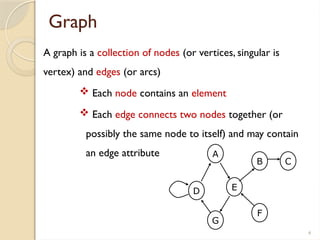
A graph isa collection of nodes (or vertices, singular is
vertex) and edges (or arcs)
Each node contains an element
Each edge connects two nodes together (or
possibly the same node to itself) and may contain
an edge attribute A
B
G
E
F
D
C
6
Undirected graph
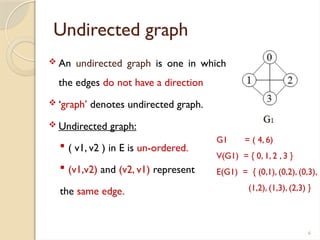
Anundirected graph is one in which
the edges do not have a direction
‘graph’ denotes undirected graph.
Undirected graph:
( v1, v2 ) in E is un-ordered.
(v1,v2) and (v2, v1) represent
the same edge.
G1 = ( 4, 6)
V(G1) = { 0, 1, 2 , 3 }
E(G1) = { (0,1), (0,2), (0,3),
(1,2), (1,3), (2,3) }
7.
7
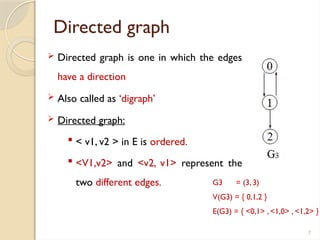
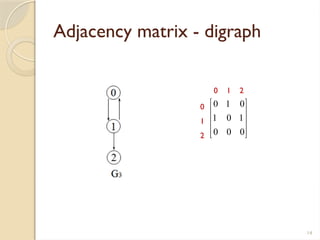
Directed graphis one in which the edges
have a direction
Also called as ‘digraph’
Directed graph:
< v1, v2 > in E is ordered.
<V1,v2> and <v2, v1> represent the
two different edges. G3 = (3, 3)
V(G3) = { 0,1,2 }
E(G3) = { <0,1> , <1,0> , <1,2> }
Directed graph
8.
8
Adjacent and Incident
If (v0, v1) is an edge in an undirected graph,
– v0 and v1 are adjacent
– The edge (v0, v1) is incident on vertices v0 and v1
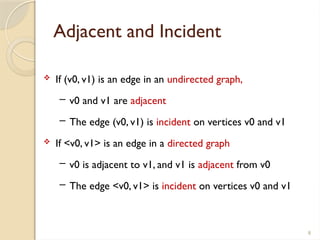
If <v0, v1> is an edge in a directed graph
– v0 is adjacent to v1, and v1 is adjacent from v0
– The edge <v0, v1> is incident on vertices v0 and v1
9.
9
Cycle
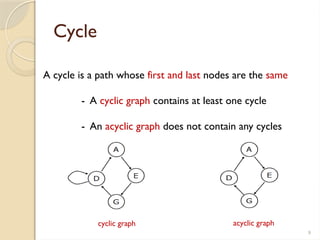
A cycle isa path whose first and last nodes are the same
- A cyclic graph contains at least one cycle
- An acyclic graph does not contain any cycles
cyclic graph acyclic graph
12
Adjacency matrix
LetG=(V,E) be a graph with n vertices.
The adjacency matrix of G is a two-dimensional
n by n array, say adj_mat
If the edge (vi, vj) is in E(G), adj_mat[i][j]=1
If there is no edge in E(G), adj_mat[i][j]=0
The adjacency matrix for an undirected graph is symmetric
the adjacency matrix for a digraph need not be symmetric
15
From theadjacency matrix, to determine the connection of
vertices is easy
The degree of a vertex is
For a digraph,
the row sum is the out_degree
the column sum is the in_degree
Merits of Adjacency Matrix
adj mat i j
j
n
_ [ ][ ]
0
1
ind vi A j i
j
n
( ) [ , ]
0
1
outd vi A i j
j
n
( ) [ , ]
0
1
16.
16
Demerits of adjacencymatrix
Storage complexity: O(|V|2
)
Difficult to insert and delete nodes.
17.
17
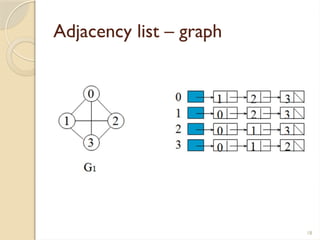
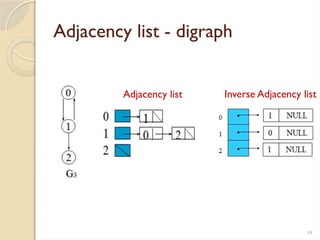
Adjacency list
Toovercome the problem arise in the adjacency matrix,
linked list can be used
The adjacency list contains two lists
1. node list
2. edge list
20
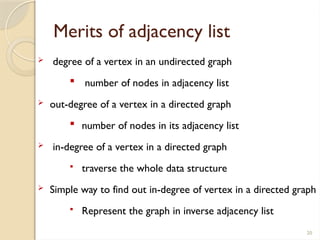
Merits of adjacencylist
degree of a vertex in an undirected graph
number of nodes in adjacency list
out-degree of a vertex in a directed graph
number of nodes in its adjacency list
in-degree of a vertex in a directed graph
traverse the whole data structure
Simple way to find out in-degree of vertex in a directed graph
Represent the graph in inverse adjacency list



![12
Adjacency matrix
Let G=(V,E) be a graph with n vertices.
The adjacency matrix of G is a two-dimensional
n by n array, say adj_mat
If the edge (vi, vj) is in E(G), adj_mat[i][j]=1
If there is no edge in E(G), adj_mat[i][j]=0
The adjacency matrix for an undirected graph is symmetric
the adjacency matrix for a digraph need not be symmetric](https://image.slidesharecdn.com/dsapresentationslidesdone-250908070736-55e8c4a6/85/DSA-presentation-slides-done-for-present-pptx-12-320.jpg)

![15
From the adjacency matrix, to determine the connection of
vertices is easy
The degree of a vertex is
For a digraph,
the row sum is the out_degree
the column sum is the in_degree
Merits of Adjacency Matrix
adj mat i j
j
n
_ [ ][ ]
0
1
ind vi A j i
j
n
( ) [ , ]
0
1
outd vi A i j
j
n
( ) [ , ]
0
1](https://image.slidesharecdn.com/dsapresentationslidesdone-250908070736-55e8c4a6/85/DSA-presentation-slides-done-for-present-pptx-15-320.jpg)