Graph (I)
Bruce Nan
Email: xiaomingnan@gmail.com
Seven Bridges of Königsberg
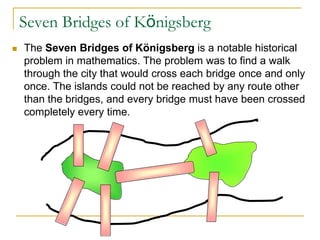
 The Seven Bridges of Königsberg is a notable historical
problem in mathematics. The problem was to find a walk
through the city that would cross each bridge once and only
once. The islands could not be reached by any route other
than the bridges, and every bridge must have been crossed
completely every time.
Euler’s Analysis
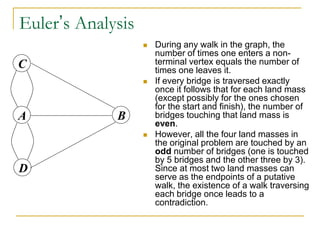
 During any walk in the graph, the
number of times one enters a non-
terminal vertex equals the number of
times one leaves it.
 If every bridge is traversed exactly
once it follows that for each land mass
(except possibly for the ones chosen
for the start and finish), the number of
bridges touching that land mass is
even.
 However, all the four land masses in
the original problem are touched by an
odd number of bridges (one is touched
by 5 bridges and the other three by 3).
Since at most two land masses can
serve as the endpoints of a putative
walk, the existence of a walk traversing
each bridge once leads to a
contradiction.
C
A
D
B
Eulerian path
 In graph theory, an Eulerian trail is a trail in
a graph which visits every edge exactly once.
Similarly, an Eulerian circuit or Eulerian
cycle is a Eulerian trail which starts and ends
on the same vertex.
What is a Graph?
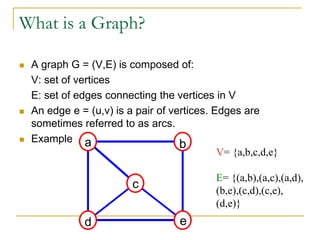
 A graph G = (V,E) is composed of:
V: set of vertices
E: set of edges connecting the vertices in V
 An edge e = (u,v) is a pair of vertices. Edges are
sometimes referred to as arcs.
 Example a b
c
d e
V= {a,b,c,d,e}
E= {(a,b),(a,c),(a,d),
(b,e),(c,d),(c,e),
(d,e)}
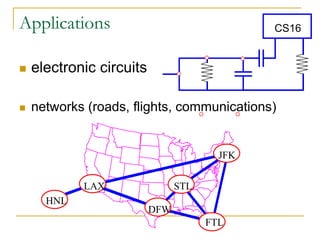
Applications
 electronic circuits
 networks (roads, flights, communications)
CS16
LAX
JFK
LAX
DFW
STL
HNL
FTL
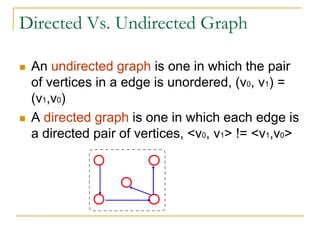
Directed Vs. Undirected Graph
 An undirected graph is one in which the pair
of vertices in a edge is unordered, (v0, v1) =
(v1,v0)
 A directed graph is one in which each edge is
a directed pair of vertices, <v0, v1> != <v1,v0>
Terminology: Adjacent
 If (v0, v1) is an edge in an undirected graph,
 v0 and v1 are adjacent
 The edge (v0, v1) is incident on vertices v0 and v1
 If <v0, v1> is an edge in a directed graph
 v0 is adjacent to v1, and v1 is adjacent from v0
 The edge <v0, v1> is incident on v0 and v1
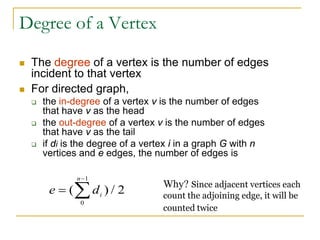
Degree of a Vertex
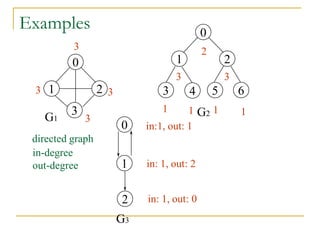
 The degree of a vertex is the number of edges
incident to that vertex
 For directed graph,
 the in-degree of a vertex v is the number of edges
that have v as the head
 the out-degree of a vertex v is the number of edges
that have v as the tail
 if di is the degree of a vertex i in a graph G with n
vertices and e edges, the number of edges is
e di
n
=
−
∑
( ) /
0
1
2
Why? Since adjacent vertices each
count the adjoining edge, it will be
counted twice
Examples 0
1 2
3 4 5 6
G1
G2
3 2
3 3
1 1 1 1
directed graph
in-degree
out-degree
0
1
2
G3
in:1, out: 1
in: 1, out: 2
in: 1, out: 0
0
1 2
3
3
3
3
Path
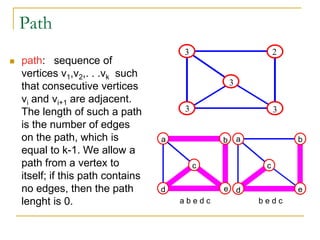
 path: sequence of
vertices v1,v2,. . .vk such
that consecutive vertices
vi and vi+1 are adjacent.
The length of such a path
is the number of edges
on the path, which is
equal to k-1. We allow a
path from a vertex to
itself; if this path contains
no edges, then the path
lenght is 0.
3
3 3
3
2
a b
c
d e
a b
c
d e
a b e d c b e d c
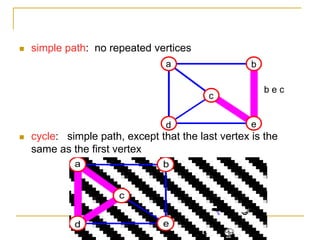
 simple path: no repeated vertices
 cycle: simple path, except that the last vertex is the
same as the first vertex
a b
c
d e
b e c
a c d a
a b
c
d e
More Terminology
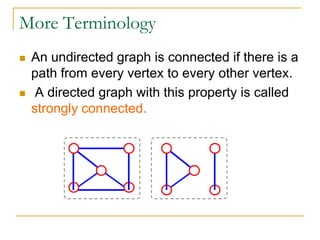
 An undirected graph is connected if there is a
path from every vertex to every other vertex.
 A directed graph with this property is called
strongly connected.
More Terminology
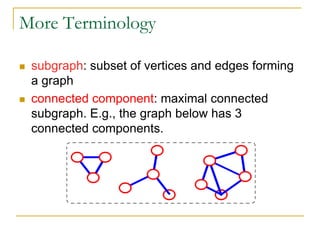
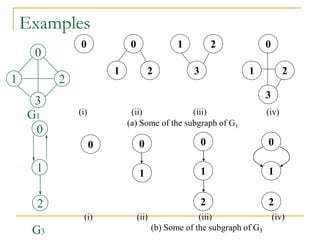
 subgraph: subset of vertices and edges forming
a graph
 connected component: maximal connected
subgraph. E.g., the graph below has 3
connected components.
Examples
0 0
1 2 3
1 2 0
1 2
3
(i) (ii) (iii) (iv)
(a) Some of the subgraph of G1
0 0
1
0
1
2
0
1
2
(i) (ii) (iii) (iv)
(b) Some of the subgraph of G3
0
1 2
3
G1
0
1
2
G3
Tree and Forests
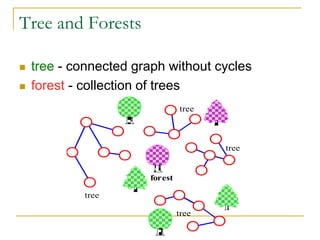
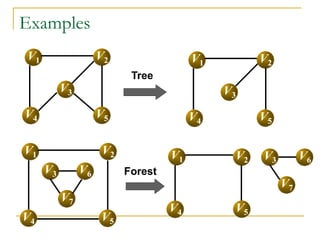
 tree - connected graph without cycles
 forest - collection of trees
tree
forest
tree
tree
tree
Examples
V1 V2
V3
V4 V5
Tree
V1 V2
V3
V4 V5
V1 V2
V3
V4 V5
V6
V7
Forest
V1 V2 V3
V4 V5
V6
V7
Connectivity
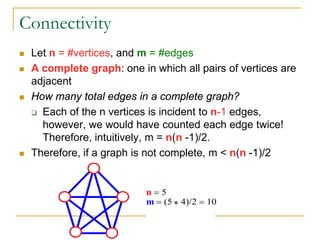
 Let n = #vertices, and m = #edges
 A complete graph: one in which all pairs of vertices are
adjacent
 How many total edges in a complete graph?
 Each of the n vertices is incident to n-1 edges,
however, we would have counted each edge twice!
Therefore, intuitively, m = n(n -1)/2.
 Therefore, if a graph is not complete, m < n(n -1)/2
n = 5
m = (5 ∗ 4)/2 = 10
More Connectivity
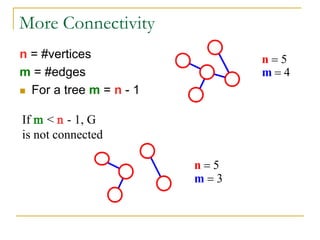
n = #vertices
m = #edges
 For a tree m = n - 1
n = 5
m = 4
If m < n - 1, G
is not connected
n = 5
m = 3
How to store a Graph?
 Adjacent Matrix
 Adjacent Lists
Adjacent Matrix
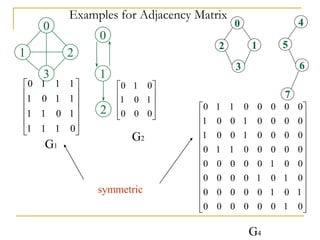
 Let G=(V,E) be a graph with n vertices.
 The adjacency matrix of G is a two-dimensional
n by n array, say adj_mat
 If the edge (vi, vj) is in E(G), adj_mat[i][j]=1
 If there is no such edge in E(G), adj_mat[i][j]=0
 The adjacency matrix for an undirected graph is
symmetric; the adjacency matrix for a digraph
need not be symmetric
Examples for Adjacency Matrix
0
1
1
1
1
0
1
1
1
1
0
1
1
1
1
0












0
1
0
1
0
0
0
1
0










0
1
1
0
0
0
0
0
1
0
0
1
0
0
0
0
1
0
0
1
0
0
0
0
0
1
1
0
0
0
0
0
0
0
0
0
0
1
0
0
0
0
0
0
1
0
1
0
0
0
0
0
0
1
0
1
0
0
0
0
0
0
1
0


























G1
G2
G4
0
1 2
3
0
1
2
1
0
2
3
4
5
6
7
symmetric
More Adjacent Matrix
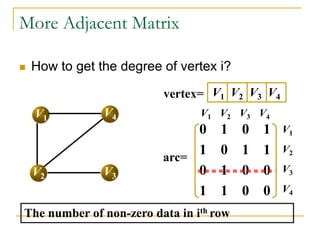
 How to get the degree of vertex i?
V1
V3
V4
V2
V1 V2 V3 V4
vertex=
0 1 0 1
1 0 1 1
0 1 0 0
1 1 0 0
arc=
V1 V2 V3 V4
V1
V2
V3
V4
The number of non-zero data in ith row
More Adjacent Matrix
How to ensure if there is edge on vi and vj?
V1
V3
V4
V2
V1 V2 V3 V4
vertex=
0 1 0 1
1 0 1 1
0 1 0 0
1 1 0 0
arc=
V1 V2 V3 V4
V1
V2
V3
V4
Test whether arc[i][j] is 1
More Adjacent Matrix
V1
V3
V4
V2
V1 V2 V3 V4
vertex=
0 1 0 1
1 0 1 1
0 1 0 0
1 1 0 0
arc=
V1 V2 V3 V4
V1
V2
V3
V4
How to find all adjacent vertices of vi?
Traverse all ith row elements, if arc[i][j] is 1, vj is
the adjacent vetex of vi
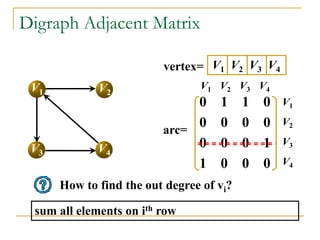
Digraph Adjacent Matrix
V1 V2
V3 V4
V1 V2 V3 V4
vertex=
0 1 1 0
0 0 0 0
0 0 0 1
1 0 0 0
arc=
V1 V2 V3 V4
V1
V2
V3
V4
How to find the out degree of vi?
sum all elements on ith row
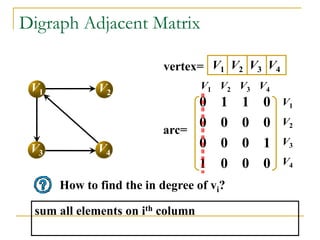
Digraph Adjacent Matrix
How to find the in degree of vi?
sum all elements on ith column
V1 V2
V3 V4
V1 V2 V3 V4
vertex=
0 1 1 0
0 0 0 0
0 0 0 1
1 0 0 0
arc=
V1 V2 V3 V4
V1
V2
V3
V4
More Adjacent Matrix
 From the adjacency matrix, to determine the
connection of vertices is easy
 The degree of a vertex is
 For a digraph (= directed graph), the row sum is the
out_degree, while the column sum is the in_degree
ind vi A j i
j
n
( ) [ , ]
=
=
−
∑
0
1
adj mat i j
j
n
_ [ ][ ]
=
−
∑
0
1
outd vi A i j
j
n
( ) [ , ]
=
=
−
∑
0
1
Create Adjacent Matrix
buildGraph(int a[ ], int n, int e)
{
vertexNum=n; arcNum=e;
for (i=0; i<vertexNum; i++)
vertex[i]=a[i];
for (i=0; i<vertexNum; i++) //initialization
for (j=0; j<vertexNum; j++)
arc[i][j]=0;
for (k=0; k<arcNum; k++) //get each edge
{
cin>>i>>j; //the vertices of the edge
arc[i][j]=1; arc[j][i]=1; //adjacency
}
}
Practice Time
 Implement following functions
 Given a graph, create the adjacent matrix
 Insert edges between u and v
 Delete edge between u and v
 Output the degree of u
 Output all the adjacent vertices of u
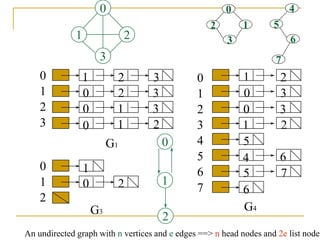
Adjacency Lists
 The space complexity of Adjacent Matrix?
 Idea for Adjacency List:
 For each vertex vi, using a list to store all adjacent
vertices with vi, which is referred as vi’s edge list
 Implementation
 Vector array
0
1
2
3
0
1
2
0
1
2
3
4
5
6
7
1 2 3
0 2 3
0 1 3
0 1 2
G1
1
0 2
G3
1 2
0 3
0 3
1 2
5
4 6
5 7
6
G4
0
1 2
3
0
1
2
1
0
2
3
4
5
6
7
An undirected graph with n vertices and e edges ==> n head nodes and 2e list node
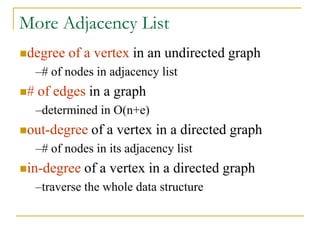
More Adjacency List
degree of a vertex in an undirected graph
–# of nodes in adjacency list
# of edges in a graph
–determined in O(n+e)
out-degree of a vertex in a directed graph
–# of nodes in its adjacency list
in-degree of a vertex in a directed graph
–traverse the whole data structure
Graph Traversal
 Problem: Search for a certain node or
traverse all nodes in the graph
 Depth First Search
 Once a possible path is found, continue the
search until the end of the path
 Breadth First Search
 Start several paths at a time, and advance in each
one step at a time
 Topological Sorting
Graph Traversal
 Both graph traversal procedures share one fundamental
idea, namely, that it is necessary to mark the vertices we
have seen before so we don’t try to explore them again.
Otherwise we get trapped in a maze and can’t find our
way out.
 BFS and DFS differ only in the order in which they
explore vertices.
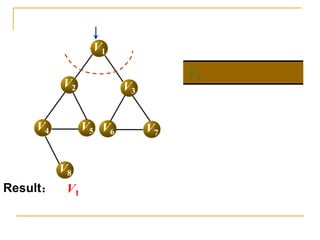
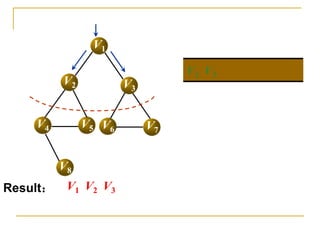
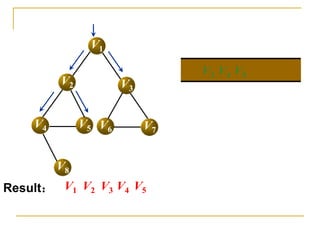
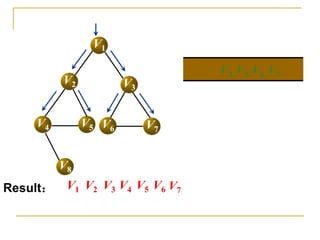
Breadth-First Search (BFS)
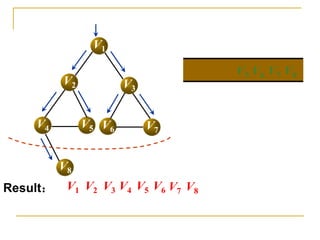
 A Breadth-First Search (BFS) traverses a connected component
of a graph, and in doing so defines a spanning tree with several
useful properties.
 The starting vertex s has level 0, and, as in DFS, defines that
point as an “anchor.”
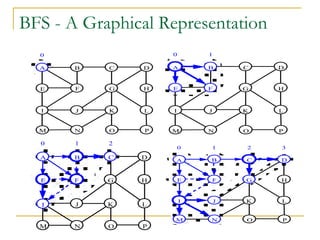
 In the first round, the string is unrolled the length of one edge,
and all of the edges that are only one edge away from the anchor
are visited.
 These edges are placed into level 1
 In the second round, all the new edges that can be reached by
unrolling the string 2 edges are visited and placed in level 2.
 This continues until every vertex has been assigned a level.
 The label of any vertex v corresponds to the length of the
shortest path from s to v.
BFS - A Graphical Representation
M N O P
I J K L
E F G H
A B C D
0
M N O P
I J K L
E F G H
A B C D
0 1
M N O P
I J K L
E F G H
A B C D
0 1 2 3
M N O P
I J K L
E F G H
A C D
B
0 1 2
V1
V3
V2
V4 V5 V6 V7
V8
Result: V1
V1
V1
V3
V2
V4 V5 V6 V7
V8
V1
V2
V2 V3
V3
Result:
V1
V3
V2
V4 V5 V6 V7
V8
V1 V2 V3
V3
V4
V4
V5
V5
Result:
V1
V3
V2
V4 V5 V6 V7
V8
V1 V2 V3 V4
V4
V5
V5
V6
V6
V7
V7
Result:
V1
V3
V2
V4 V5 V6 V7
V8
V1 V2 V3 V4 V5
V5
V6
V6
V7
V7 V8
V8
Result:
Code – BFS Using Adjacent Matrix
template <class T>
void MGraph::BFSTraverse(int v)
{
front=rear=-1; //Assuming no overflow
cout<<vertex[v]; visited[v]=1; Q[++rear]=v;
while (front!=rear)
{
v=Q[++front];
for (j=0; j<vertexNum; j++)
if (arc[v][j]==1 && visited[j]==0 ) {
cout<<vertex[j]; visited[j]=1; Q[++rear]=j;
}
}
}
Code – BFS Using Adjacent List
template <class T>
void ALGraph::BFSTraverse(int v)
{
front=rear=-1;
cout<<adjlist[v].vertex; visited[v]=1; Q[++rear]=v;
while (front!=rear)
{
v=Q[++front]; p=adjlist[v].firstedge;
while (p!=NULL)
{
j= p->adjvex;
if (visited[j]==0) {
cout<<adjlist[j].vertex; visited[j]=1; Q[++rear]=j;
}
p=p->next;
}
}
}
BFS Usage
 Finding a path
In a maze, how to find a path from the start to the
end using least steps?
 Exploiting traversal

Class01_Computer_Contest_Level_3_Notes_Sep_07 - Copy.pdf

  • 1.
    Graph (I) Bruce Nan Email:xiaomingnan@gmail.com
  • 2.
    Seven Bridges ofKönigsberg  The Seven Bridges of Königsberg is a notable historical problem in mathematics. The problem was to find a walk through the city that would cross each bridge once and only once. The islands could not be reached by any route other than the bridges, and every bridge must have been crossed completely every time.
  • 3.
    Euler’s Analysis  Duringany walk in the graph, the number of times one enters a non- terminal vertex equals the number of times one leaves it.  If every bridge is traversed exactly once it follows that for each land mass (except possibly for the ones chosen for the start and finish), the number of bridges touching that land mass is even.  However, all the four land masses in the original problem are touched by an odd number of bridges (one is touched by 5 bridges and the other three by 3). Since at most two land masses can serve as the endpoints of a putative walk, the existence of a walk traversing each bridge once leads to a contradiction. C A D B
  • 4.
    Eulerian path  Ingraph theory, an Eulerian trail is a trail in a graph which visits every edge exactly once. Similarly, an Eulerian circuit or Eulerian cycle is a Eulerian trail which starts and ends on the same vertex.
  • 5.
    What is aGraph?  A graph G = (V,E) is composed of: V: set of vertices E: set of edges connecting the vertices in V  An edge e = (u,v) is a pair of vertices. Edges are sometimes referred to as arcs.  Example a b c d e V= {a,b,c,d,e} E= {(a,b),(a,c),(a,d), (b,e),(c,d),(c,e), (d,e)}
  • 6.
    Applications  electronic circuits networks (roads, flights, communications) CS16 LAX JFK LAX DFW STL HNL FTL
  • 7.
    Directed Vs. UndirectedGraph  An undirected graph is one in which the pair of vertices in a edge is unordered, (v0, v1) = (v1,v0)  A directed graph is one in which each edge is a directed pair of vertices, <v0, v1> != <v1,v0>
  • 8.
    Terminology: Adjacent  If(v0, v1) is an edge in an undirected graph,  v0 and v1 are adjacent  The edge (v0, v1) is incident on vertices v0 and v1  If <v0, v1> is an edge in a directed graph  v0 is adjacent to v1, and v1 is adjacent from v0  The edge <v0, v1> is incident on v0 and v1
  • 9.
    Degree of aVertex  The degree of a vertex is the number of edges incident to that vertex  For directed graph,  the in-degree of a vertex v is the number of edges that have v as the head  the out-degree of a vertex v is the number of edges that have v as the tail  if di is the degree of a vertex i in a graph G with n vertices and e edges, the number of edges is e di n = − ∑ ( ) / 0 1 2 Why? Since adjacent vertices each count the adjoining edge, it will be counted twice
  • 10.
    Examples 0 1 2 34 5 6 G1 G2 3 2 3 3 1 1 1 1 directed graph in-degree out-degree 0 1 2 G3 in:1, out: 1 in: 1, out: 2 in: 1, out: 0 0 1 2 3 3 3 3
  • 11.
    Path  path: sequenceof vertices v1,v2,. . .vk such that consecutive vertices vi and vi+1 are adjacent. The length of such a path is the number of edges on the path, which is equal to k-1. We allow a path from a vertex to itself; if this path contains no edges, then the path lenght is 0. 3 3 3 3 2 a b c d e a b c d e a b e d c b e d c
  • 12.
     simple path:no repeated vertices  cycle: simple path, except that the last vertex is the same as the first vertex a b c d e b e c a c d a a b c d e
  • 13.
    More Terminology  Anundirected graph is connected if there is a path from every vertex to every other vertex.  A directed graph with this property is called strongly connected.
  • 14.
    More Terminology  subgraph:subset of vertices and edges forming a graph  connected component: maximal connected subgraph. E.g., the graph below has 3 connected components.
  • 15.
    Examples 0 0 1 23 1 2 0 1 2 3 (i) (ii) (iii) (iv) (a) Some of the subgraph of G1 0 0 1 0 1 2 0 1 2 (i) (ii) (iii) (iv) (b) Some of the subgraph of G3 0 1 2 3 G1 0 1 2 G3
  • 16.
    Tree and Forests tree - connected graph without cycles  forest - collection of trees tree forest tree tree tree
  • 17.
    Examples V1 V2 V3 V4 V5 Tree V1V2 V3 V4 V5 V1 V2 V3 V4 V5 V6 V7 Forest V1 V2 V3 V4 V5 V6 V7
  • 18.
    Connectivity  Let n= #vertices, and m = #edges  A complete graph: one in which all pairs of vertices are adjacent  How many total edges in a complete graph?  Each of the n vertices is incident to n-1 edges, however, we would have counted each edge twice! Therefore, intuitively, m = n(n -1)/2.  Therefore, if a graph is not complete, m < n(n -1)/2 n = 5 m = (5 ∗ 4)/2 = 10
  • 19.
    More Connectivity n =#vertices m = #edges  For a tree m = n - 1 n = 5 m = 4 If m < n - 1, G is not connected n = 5 m = 3
  • 20.
    How to storea Graph?  Adjacent Matrix  Adjacent Lists
  • 21.
    Adjacent Matrix  LetG=(V,E) be a graph with n vertices.  The adjacency matrix of G is a two-dimensional n by n array, say adj_mat  If the edge (vi, vj) is in E(G), adj_mat[i][j]=1  If there is no such edge in E(G), adj_mat[i][j]=0  The adjacency matrix for an undirected graph is symmetric; the adjacency matrix for a digraph need not be symmetric
  • 22.
    Examples for AdjacencyMatrix 0 1 1 1 1 0 1 1 1 1 0 1 1 1 1 0             0 1 0 1 0 0 0 1 0           0 1 1 0 0 0 0 0 1 0 0 1 0 0 0 0 1 0 0 1 0 0 0 0 0 1 1 0 0 0 0 0 0 0 0 0 0 1 0 0 0 0 0 0 1 0 1 0 0 0 0 0 0 1 0 1 0 0 0 0 0 0 1 0                           G1 G2 G4 0 1 2 3 0 1 2 1 0 2 3 4 5 6 7 symmetric
  • 23.
    More Adjacent Matrix How to get the degree of vertex i? V1 V3 V4 V2 V1 V2 V3 V4 vertex= 0 1 0 1 1 0 1 1 0 1 0 0 1 1 0 0 arc= V1 V2 V3 V4 V1 V2 V3 V4 The number of non-zero data in ith row
  • 24.
    More Adjacent Matrix Howto ensure if there is edge on vi and vj? V1 V3 V4 V2 V1 V2 V3 V4 vertex= 0 1 0 1 1 0 1 1 0 1 0 0 1 1 0 0 arc= V1 V2 V3 V4 V1 V2 V3 V4 Test whether arc[i][j] is 1
  • 25.
    More Adjacent Matrix V1 V3 V4 V2 V1V2 V3 V4 vertex= 0 1 0 1 1 0 1 1 0 1 0 0 1 1 0 0 arc= V1 V2 V3 V4 V1 V2 V3 V4 How to find all adjacent vertices of vi? Traverse all ith row elements, if arc[i][j] is 1, vj is the adjacent vetex of vi
  • 26.
    Digraph Adjacent Matrix V1V2 V3 V4 V1 V2 V3 V4 vertex= 0 1 1 0 0 0 0 0 0 0 0 1 1 0 0 0 arc= V1 V2 V3 V4 V1 V2 V3 V4 How to find the out degree of vi? sum all elements on ith row
  • 27.
    Digraph Adjacent Matrix Howto find the in degree of vi? sum all elements on ith column V1 V2 V3 V4 V1 V2 V3 V4 vertex= 0 1 1 0 0 0 0 0 0 0 0 1 1 0 0 0 arc= V1 V2 V3 V4 V1 V2 V3 V4
  • 28.
    More Adjacent Matrix From the adjacency matrix, to determine the connection of vertices is easy  The degree of a vertex is  For a digraph (= directed graph), the row sum is the out_degree, while the column sum is the in_degree ind vi A j i j n ( ) [ , ] = = − ∑ 0 1 adj mat i j j n _ [ ][ ] = − ∑ 0 1 outd vi A i j j n ( ) [ , ] = = − ∑ 0 1
  • 29.
    Create Adjacent Matrix buildGraph(inta[ ], int n, int e) { vertexNum=n; arcNum=e; for (i=0; i<vertexNum; i++) vertex[i]=a[i]; for (i=0; i<vertexNum; i++) //initialization for (j=0; j<vertexNum; j++) arc[i][j]=0; for (k=0; k<arcNum; k++) //get each edge { cin>>i>>j; //the vertices of the edge arc[i][j]=1; arc[j][i]=1; //adjacency } }
  • 30.
    Practice Time  Implementfollowing functions  Given a graph, create the adjacent matrix  Insert edges between u and v  Delete edge between u and v  Output the degree of u  Output all the adjacent vertices of u
  • 31.
    Adjacency Lists  Thespace complexity of Adjacent Matrix?  Idea for Adjacency List:  For each vertex vi, using a list to store all adjacent vertices with vi, which is referred as vi’s edge list  Implementation  Vector array
  • 32.
    0 1 2 3 0 1 2 0 1 2 3 4 5 6 7 1 2 3 02 3 0 1 3 0 1 2 G1 1 0 2 G3 1 2 0 3 0 3 1 2 5 4 6 5 7 6 G4 0 1 2 3 0 1 2 1 0 2 3 4 5 6 7 An undirected graph with n vertices and e edges ==> n head nodes and 2e list node
  • 33.
    More Adjacency List degreeof a vertex in an undirected graph –# of nodes in adjacency list # of edges in a graph –determined in O(n+e) out-degree of a vertex in a directed graph –# of nodes in its adjacency list in-degree of a vertex in a directed graph –traverse the whole data structure
  • 34.
    Graph Traversal  Problem:Search for a certain node or traverse all nodes in the graph  Depth First Search  Once a possible path is found, continue the search until the end of the path  Breadth First Search  Start several paths at a time, and advance in each one step at a time  Topological Sorting
  • 35.
    Graph Traversal  Bothgraph traversal procedures share one fundamental idea, namely, that it is necessary to mark the vertices we have seen before so we don’t try to explore them again. Otherwise we get trapped in a maze and can’t find our way out.  BFS and DFS differ only in the order in which they explore vertices.
  • 36.
    Breadth-First Search (BFS) A Breadth-First Search (BFS) traverses a connected component of a graph, and in doing so defines a spanning tree with several useful properties.  The starting vertex s has level 0, and, as in DFS, defines that point as an “anchor.”  In the first round, the string is unrolled the length of one edge, and all of the edges that are only one edge away from the anchor are visited.  These edges are placed into level 1  In the second round, all the new edges that can be reached by unrolling the string 2 edges are visited and placed in level 2.  This continues until every vertex has been assigned a level.  The label of any vertex v corresponds to the length of the shortest path from s to v.
  • 37.
    BFS - AGraphical Representation M N O P I J K L E F G H A B C D 0 M N O P I J K L E F G H A B C D 0 1 M N O P I J K L E F G H A B C D 0 1 2 3 M N O P I J K L E F G H A C D B 0 1 2
  • 38.
    V1 V3 V2 V4 V5 V6V7 V8 Result: V1 V1
  • 39.
    V1 V3 V2 V4 V5 V6V7 V8 V1 V2 V2 V3 V3 Result:
  • 40.
    V1 V3 V2 V4 V5 V6V7 V8 V1 V2 V3 V3 V4 V4 V5 V5 Result:
  • 41.
    V1 V3 V2 V4 V5 V6V7 V8 V1 V2 V3 V4 V4 V5 V5 V6 V6 V7 V7 Result:
  • 42.
    V1 V3 V2 V4 V5 V6V7 V8 V1 V2 V3 V4 V5 V5 V6 V6 V7 V7 V8 V8 Result:
  • 43.
    Code – BFSUsing Adjacent Matrix template <class T> void MGraph::BFSTraverse(int v) { front=rear=-1; //Assuming no overflow cout<<vertex[v]; visited[v]=1; Q[++rear]=v; while (front!=rear) { v=Q[++front]; for (j=0; j<vertexNum; j++) if (arc[v][j]==1 && visited[j]==0 ) { cout<<vertex[j]; visited[j]=1; Q[++rear]=j; } } }
  • 44.
    Code – BFSUsing Adjacent List template <class T> void ALGraph::BFSTraverse(int v) { front=rear=-1; cout<<adjlist[v].vertex; visited[v]=1; Q[++rear]=v; while (front!=rear) { v=Q[++front]; p=adjlist[v].firstedge; while (p!=NULL) { j= p->adjvex; if (visited[j]==0) { cout<<adjlist[j].vertex; visited[j]=1; Q[++rear]=j; } p=p->next; } } }
  • 45.
    BFS Usage  Findinga path In a maze, how to find a path from the start to the end using least steps?  Exploiting traversal