Backtracking
Chapter 16
2012
Eng.sallysalem@gmail.com
 Backtracking is a systematic way to search for the
solution to a problem.
 solution space .
 This space must include at least one (optimal) solution to
the problem.
Examples
Rat in a Maze
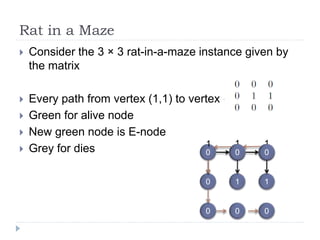
 Consider the 3 × 3 rat-in-a-maze instance given by
the matrix
 Every path from vertex (1,1) to vertex (3,3)
 Green for alive node
 New green node is E-node
 Grey for dies 0 0 0
0 1
0
1
00
1 1 1
00
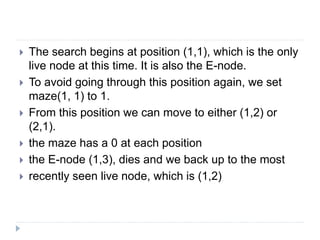
 The search begins at position (1,1), which is the only
live node at this time. It is also the E-node.
 To avoid going through this position again, we set
maze(1, 1) to 1.
 From this position we can move to either (1,2) or
(2,1).
 the maze has a 0 at each position
 the E-node (1,3), dies and we back up to the most
 recently seen live node, which is (1,2)
Traveling Salesperson
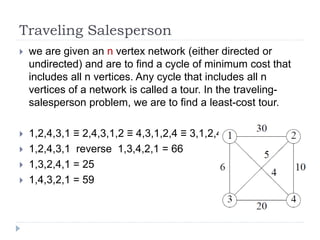
 we are given an n vertex network (either directed or
undirected) and are to find a cycle of minimum cost that
includes all n vertices. Any cycle that includes all n
vertices of a network is called a tour. In the traveling-
salesperson problem, we are to find a least-cost tour.
 1,2,4,3,1 ≡ 2,4,3,1,2 ≡ 4,3,1,2,4 ≡ 3,1,2,4,3
 1,2,4,3,1 reverse 1,3,4,2,1 = 66
 1,3,2,4,1 = 25
 1,4,3,2,1 = 59
Traveling Salesperson
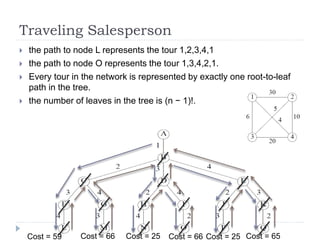
 the path to node L represents the tour 1,2,3,4,1
 the path to node O represents the tour 1,3,4,2,1.
 Every tour in the network is represented by exactly one root-to-leaf
path in the tree.
 the number of leaves in the tree is (n − 1)!.
Cost = 59 Cost = 66 Cost = 25 Cost = 66 Cost = 25 Cost = 65
Traveling Salesperson
 A backtracking algorithm will find a minimum-cost tour by searching
the solution space tree in a depth-first manner, beginning at the root.
 At L the tour1,2,3,4,1 is recorded as the best tour seen so far. Its
cost is 59.
 From L we back- track to the live node F. As F has no unexamined
children, it is killed and we backtrack to node C. C becomes the E-
node, and we move forward to G and then to M. We have now
constructed the tour 1,2,4,3,1 whose cost is 66. Since this tour isn’t
superior to the best tour we have, we discard the new tour and
backtrack to G, then C, and then B
 From B the search moves forward to D and then to H and
 N. The tour 1,3,2,4,1 defined at N has cost 25 and is better than the
previous best tour. We save 1,3,2,4,1 as the best tour seen so far.
From N the search backtracks to H and then to D. At D we can again
move forward. We reach node O.
 Continuing in this way, we search the entire tree; 1,3,2,4,1 is the
least-cost tour.
Applications
Container Loading
 The problem
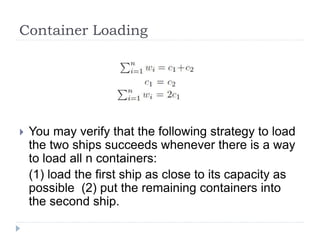
 We have two ships and n containers. The capacity of
the first ship is c1, and that of the second c2. wi is the
weight of container i, and .
 We wish to determine whether there is a way to load all
n containers.
 Example
 When n = 3, c1 = c2 = 50, and w = [10, 40, 40],
 we can load containers 1 and 2 onto the first ship and
container 3 onto the second ship.
 If the weights are [20, 40, 40], then we cannot load the
containers onto the ships.
Container Loading
 You may verify that the following strategy to load
the two ships succeeds whenever there is a way
to load all n containers:
(1) load the first ship as close to its capacity as
possible (2) put the remaining containers into
the second ship.
Container Loading
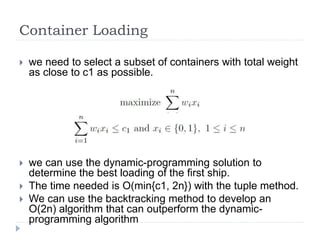
 we need to select a subset of containers with total weight
as close to c1 as possible.
 we can use the dynamic-programming solution to
determine the best loading of the first ship.
 The time needed is O(min{c1, 2n}) with the tuple method.
 We can use the backtracking method to develop an
O(2n) algorithm that can outperform the dynamic-
programming algorithm
First Backtracking Solution
 Example
 Suppose that n = 4, w = [8, 6, 2, 3], and c1 = 12.
cw = 0
cw = 8
cw = 14 >
c1
cw = 8
cw =
10
1
cw =
0
cw = 10 xi values are [1, 0, 1, 0]
cw = 8
1
cw = 11 xi values are [1, 0, 0, 1]
First Backtracking Solution
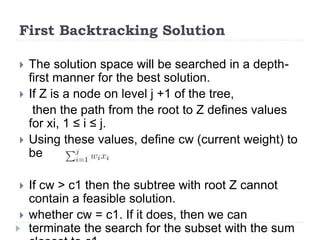
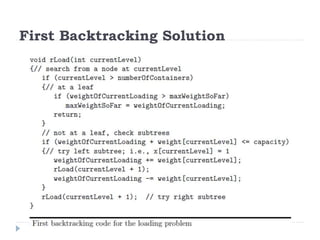
 The solution space will be searched in a depth-
first manner for the best solution.
 If Z is a node on level j +1 of the tree,
then the path from the root to Z defines values
for xi, 1 ≤ i ≤ j.
 Using these values, define cw (current weight) to
be
 If cw > c1 then the subtree with root Z cannot
contain a feasible solution.
 whether cw = c1. If it does, then we can
terminate the search for the subset with the sum
First Backtracking Solution
Second Backtracking Solution
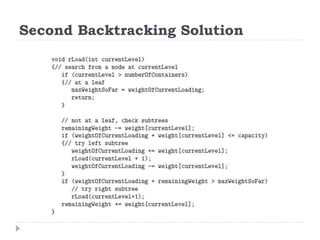
 We can improve the expected performance of function rLoad by not
moving into right subtrees that cannot possibly contain better
solutions than the best found so far.
 n = 4, w = [8, 6, 2, 3], and c1 = 12.
cw = 0
cw = 8
cw = 8
cw =
10
0
cw = 10 xi values are [1, 0, 1, 0]
cw = 8
1
cw = 11 xi values are [1, 0, 0, 1]
remaining=4
And weight=6
Remainging < weight
Second Backtracking Solution
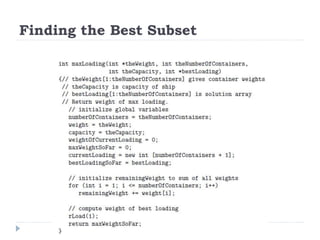
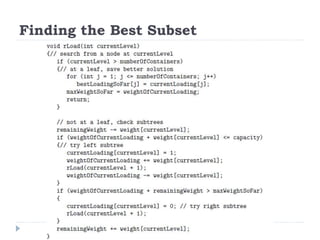
Finding the Best Subset
 To remember this subset, we employ a one-dimensional
array bestLoadingSoFar.
 The array currentLoading is used to record the path
from the search tree root to the current node (i.e., it
saves the xi values on this path)
 The array bestLoadingSoFar records the best solution
found so far. Whenever a leaf with a better value is
reached, bestLoadingSoFar is updated to represent the
path from the root to this leaf.
Finding the Best Subset
Max Clique
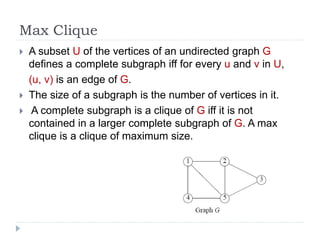
 A subset U of the vertices of an undirected graph G
defines a complete subgraph iff for every u and v in U,
(u, v) is an edge of G.
 The size of a subgraph is the number of vertices in it.
 A complete subgraph is a clique of G iff it is not
contained in a larger complete subgraph of G. A max
clique is a clique of maximum size.
Max Clique
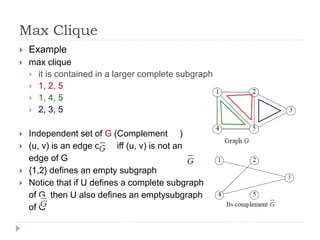
 Example
 max clique
 it is contained in a larger complete subgraph
 1, 2, 5
 1, 4, 5
 2, 3, 5
 Independent set of G (Complement )
 (u, v) is an edge of iff (u, v) is not an
edge of G
 {1,2} defines an empty subgraph
 Notice that if U defines a complete subgraph
of G, then U also defines an emptysubgraph
of G
Max Clique
 Example
 Suppose we have a collection of n animals. We may
define a compatibility graph G that has n vertices. (u, v) is
an edge of G iff animals u and v are compatible.
 A max clique of G defines a largest subset of mutually
compatible animals.
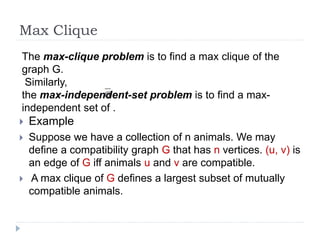
The max-clique problem is to find a max clique of the
graph G.
Similarly,
the max-independent-set problem is to find a max-
independent set of .
Max Clique
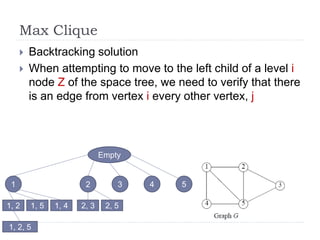
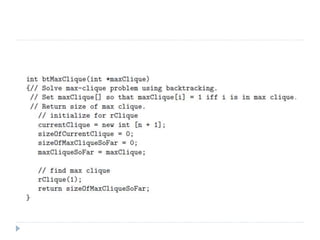
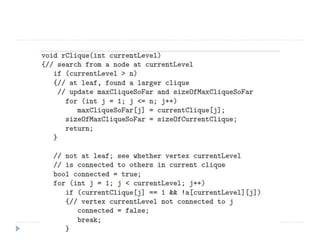
 Backtracking solution
 When attempting to move to the left child of a level i
node Z of the space tree, we need to verify that there
is an edge from vertex i every other vertex, j
Empty
4 52 31
1, 51, 2 1, 4 2, 3 2, 5
1, 2, 5
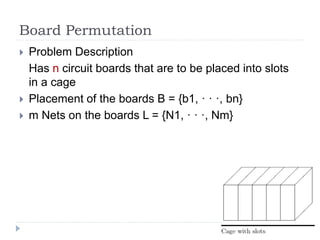
Board Permutation
 Problem Description
Has n circuit boards that are to be placed into slots
in a cage
 Placement of the boards B = {b1, · · ·, bn}
 m Nets on the boards L = {N1, · · ·, Nm}
Board Permutation
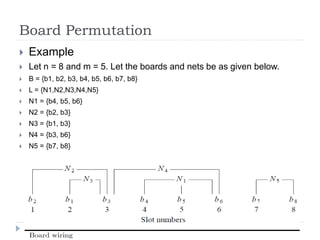
 Example
 Let n = 8 and m = 5. Let the boards and nets be as given below.
 B = {b1, b2, b3, b4, b5, b6, b7, b8}
 L = {N1,N2,N3,N4,N5}
 N1 = {b4, b5, b6}
 N2 = {b2, b3}
 N3 = {b1, b3}
 N4 = {b3, b6}
 N5 = {b7, b8}
Board Permutation
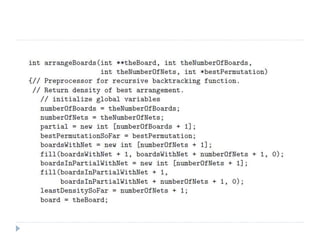
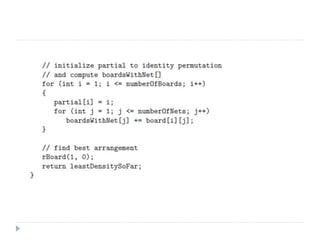
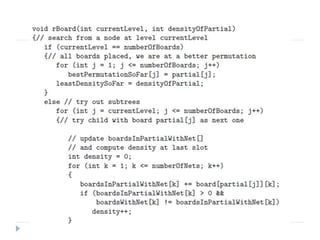
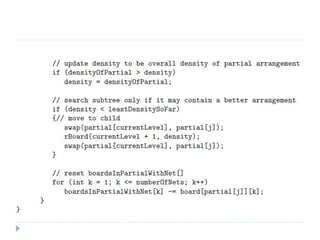
 The backtracking algorithm will search a permutation
space for the best board permutation.
 represent the input as an integer array board such
that board[i][j] is 1 iff net Nj includes board bi
 boardsWithNet[j] be the number of boards that
include net Nj .
 boardsInPartialWithNet[j] be the number of boards
in partial[1:i]
Thank you

Backtracking

  • 1.
  • 2.
     Backtracking isa systematic way to search for the solution to a problem.  solution space .  This space must include at least one (optimal) solution to the problem.
  • 3.
  • 4.
    Rat in aMaze  Consider the 3 × 3 rat-in-a-maze instance given by the matrix  Every path from vertex (1,1) to vertex (3,3)  Green for alive node  New green node is E-node  Grey for dies 0 0 0 0 1 0 1 00 1 1 1 00
  • 5.
     The searchbegins at position (1,1), which is the only live node at this time. It is also the E-node.  To avoid going through this position again, we set maze(1, 1) to 1.  From this position we can move to either (1,2) or (2,1).  the maze has a 0 at each position  the E-node (1,3), dies and we back up to the most  recently seen live node, which is (1,2)
  • 6.
    Traveling Salesperson  weare given an n vertex network (either directed or undirected) and are to find a cycle of minimum cost that includes all n vertices. Any cycle that includes all n vertices of a network is called a tour. In the traveling- salesperson problem, we are to find a least-cost tour.  1,2,4,3,1 ≡ 2,4,3,1,2 ≡ 4,3,1,2,4 ≡ 3,1,2,4,3  1,2,4,3,1 reverse 1,3,4,2,1 = 66  1,3,2,4,1 = 25  1,4,3,2,1 = 59
  • 7.
    Traveling Salesperson  thepath to node L represents the tour 1,2,3,4,1  the path to node O represents the tour 1,3,4,2,1.  Every tour in the network is represented by exactly one root-to-leaf path in the tree.  the number of leaves in the tree is (n − 1)!. Cost = 59 Cost = 66 Cost = 25 Cost = 66 Cost = 25 Cost = 65
  • 8.
    Traveling Salesperson  Abacktracking algorithm will find a minimum-cost tour by searching the solution space tree in a depth-first manner, beginning at the root.  At L the tour1,2,3,4,1 is recorded as the best tour seen so far. Its cost is 59.  From L we back- track to the live node F. As F has no unexamined children, it is killed and we backtrack to node C. C becomes the E- node, and we move forward to G and then to M. We have now constructed the tour 1,2,4,3,1 whose cost is 66. Since this tour isn’t superior to the best tour we have, we discard the new tour and backtrack to G, then C, and then B  From B the search moves forward to D and then to H and  N. The tour 1,3,2,4,1 defined at N has cost 25 and is better than the previous best tour. We save 1,3,2,4,1 as the best tour seen so far. From N the search backtracks to H and then to D. At D we can again move forward. We reach node O.  Continuing in this way, we search the entire tree; 1,3,2,4,1 is the least-cost tour.
  • 9.
  • 10.
    Container Loading  Theproblem  We have two ships and n containers. The capacity of the first ship is c1, and that of the second c2. wi is the weight of container i, and .  We wish to determine whether there is a way to load all n containers.  Example  When n = 3, c1 = c2 = 50, and w = [10, 40, 40],  we can load containers 1 and 2 onto the first ship and container 3 onto the second ship.  If the weights are [20, 40, 40], then we cannot load the containers onto the ships.
  • 11.
    Container Loading  Youmay verify that the following strategy to load the two ships succeeds whenever there is a way to load all n containers: (1) load the first ship as close to its capacity as possible (2) put the remaining containers into the second ship.
  • 12.
    Container Loading  weneed to select a subset of containers with total weight as close to c1 as possible.  we can use the dynamic-programming solution to determine the best loading of the first ship.  The time needed is O(min{c1, 2n}) with the tuple method.  We can use the backtracking method to develop an O(2n) algorithm that can outperform the dynamic- programming algorithm
  • 13.
    First Backtracking Solution Example  Suppose that n = 4, w = [8, 6, 2, 3], and c1 = 12. cw = 0 cw = 8 cw = 14 > c1 cw = 8 cw = 10 1 cw = 0 cw = 10 xi values are [1, 0, 1, 0] cw = 8 1 cw = 11 xi values are [1, 0, 0, 1]
  • 14.
    First Backtracking Solution The solution space will be searched in a depth- first manner for the best solution.  If Z is a node on level j +1 of the tree, then the path from the root to Z defines values for xi, 1 ≤ i ≤ j.  Using these values, define cw (current weight) to be  If cw > c1 then the subtree with root Z cannot contain a feasible solution.  whether cw = c1. If it does, then we can terminate the search for the subset with the sum
  • 15.
  • 16.
    Second Backtracking Solution We can improve the expected performance of function rLoad by not moving into right subtrees that cannot possibly contain better solutions than the best found so far.  n = 4, w = [8, 6, 2, 3], and c1 = 12. cw = 0 cw = 8 cw = 8 cw = 10 0 cw = 10 xi values are [1, 0, 1, 0] cw = 8 1 cw = 11 xi values are [1, 0, 0, 1] remaining=4 And weight=6 Remainging < weight
  • 17.
  • 18.
    Finding the BestSubset  To remember this subset, we employ a one-dimensional array bestLoadingSoFar.  The array currentLoading is used to record the path from the search tree root to the current node (i.e., it saves the xi values on this path)  The array bestLoadingSoFar records the best solution found so far. Whenever a leaf with a better value is reached, bestLoadingSoFar is updated to represent the path from the root to this leaf.
  • 19.
  • 20.
  • 21.
    Max Clique  Asubset U of the vertices of an undirected graph G defines a complete subgraph iff for every u and v in U, (u, v) is an edge of G.  The size of a subgraph is the number of vertices in it.  A complete subgraph is a clique of G iff it is not contained in a larger complete subgraph of G. A max clique is a clique of maximum size.
  • 22.
    Max Clique  Example max clique  it is contained in a larger complete subgraph  1, 2, 5  1, 4, 5  2, 3, 5  Independent set of G (Complement )  (u, v) is an edge of iff (u, v) is not an edge of G  {1,2} defines an empty subgraph  Notice that if U defines a complete subgraph of G, then U also defines an emptysubgraph of G
  • 23.
    Max Clique  Example Suppose we have a collection of n animals. We may define a compatibility graph G that has n vertices. (u, v) is an edge of G iff animals u and v are compatible.  A max clique of G defines a largest subset of mutually compatible animals. The max-clique problem is to find a max clique of the graph G. Similarly, the max-independent-set problem is to find a max- independent set of .
  • 24.
    Max Clique  Backtrackingsolution  When attempting to move to the left child of a level i node Z of the space tree, we need to verify that there is an edge from vertex i every other vertex, j Empty 4 52 31 1, 51, 2 1, 4 2, 3 2, 5 1, 2, 5
  • 28.
    Board Permutation  ProblemDescription Has n circuit boards that are to be placed into slots in a cage  Placement of the boards B = {b1, · · ·, bn}  m Nets on the boards L = {N1, · · ·, Nm}
  • 29.
    Board Permutation  Example Let n = 8 and m = 5. Let the boards and nets be as given below.  B = {b1, b2, b3, b4, b5, b6, b7, b8}  L = {N1,N2,N3,N4,N5}  N1 = {b4, b5, b6}  N2 = {b2, b3}  N3 = {b1, b3}  N4 = {b3, b6}  N5 = {b7, b8}
  • 30.
    Board Permutation  Thebacktracking algorithm will search a permutation space for the best board permutation.  represent the input as an integer array board such that board[i][j] is 1 iff net Nj includes board bi  boardsWithNet[j] be the number of boards that include net Nj .  boardsInPartialWithNet[j] be the number of boards in partial[1:i]
  • 35.

Editor's Notes

  • #9 1,4,3,2,1 = 29 (1,2, 3, 4, 1)
  • #10 1,4,3,2,1 = 29 (1,2, 3, 4, 1)
  • #11 1,4,3,2,1 = 29 (1,2, 3, 4, 1)