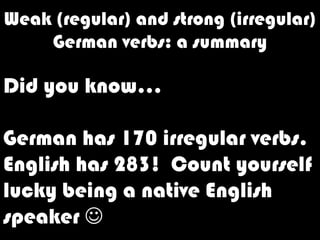
Weak (regular) and strong (irregular) Germanverbs: a summaryDid you know…German has 170 irregular verbs.English has 283!  Count yourself lucky being a native English speaker 
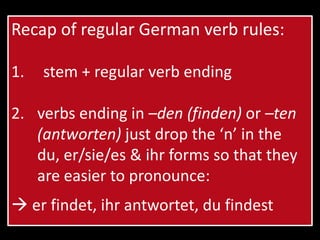
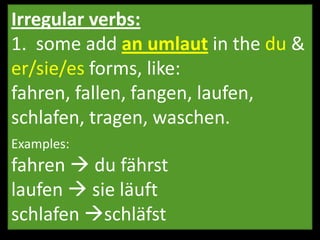
Recap of regular German verb rules:stem + regular verb endingverbs ending in –den (finden) or –ten (antworten) just drop the ‘n’ in the du, er/sie/es & ihr forms so that they are easier to pronounce:erfindet, ihrantwortet, du findestIrregular verbs:1.  some add an umlautin the du & er/sie/esforms, like:fahren, fallen, fangen, laufen, schlafen, tragen, waschen.Examples:fahrendu fährstlaufensieläuftschlafenschläfst
Some verbs change their vowel in the du & er/sie/es forms, like:helfen(to help) hilfst, hilftlesen(to read) liest, liestgeben(to give) gibst, gibtsprechen(to speak) sprichst, sprichtsehen(to see) siehst, siehtnehmen(to take) nimmst, nimmttreffen(to meet) triffst, trifft
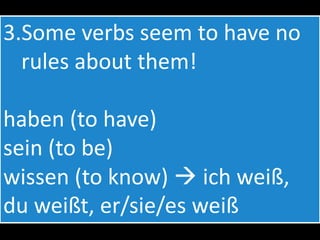
3.Some verbs seem to have no rules about them!haben (to have)sein (to be)wissen (to know)  ich weiß, du weißt, er/sie/es weiß
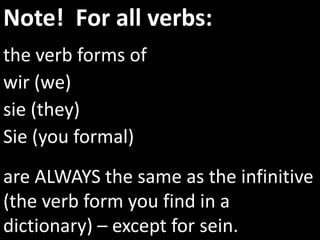
Note!  For all verbs:the verb forms of wir (we) sie (they) Sie (you formal)are ALWAYS the same as the infinitive (the verb form you find in a dictionary) – except for sein.
The ihr (you plural) verb form is ALWAYS the infinitive minus the -en plus –tdenken (to think)= ihr denkttreffen (to meet) = ihr trefft	laufen (to run) = ihr lauft	lesen (to read) = ihr lest
How can you tell if a verb is regular?Check a dictionary or verb list – if it isn’t in there, it’s regular!All irregular verbs are listed in your dictionary.
Verb overview

Verb overview

  • 1.
    Weak (regular) andstrong (irregular) Germanverbs: a summaryDid you know…German has 170 irregular verbs.English has 283! Count yourself lucky being a native English speaker 
  • 2.
    Recap of regularGerman verb rules:stem + regular verb endingverbs ending in –den (finden) or –ten (antworten) just drop the ‘n’ in the du, er/sie/es & ihr forms so that they are easier to pronounce:erfindet, ihrantwortet, du findestIrregular verbs:1. some add an umlautin the du & er/sie/esforms, like:fahren, fallen, fangen, laufen, schlafen, tragen, waschen.Examples:fahrendu fährstlaufensieläuftschlafenschläfst
  • 3.
    Some verbs changetheir vowel in the du & er/sie/es forms, like:helfen(to help) hilfst, hilftlesen(to read) liest, liestgeben(to give) gibst, gibtsprechen(to speak) sprichst, sprichtsehen(to see) siehst, siehtnehmen(to take) nimmst, nimmttreffen(to meet) triffst, trifft
  • 4.
    3.Some verbs seemto have no rules about them!haben (to have)sein (to be)wissen (to know)  ich weiß, du weißt, er/sie/es weiß
  • 5.
    Note! Forall verbs:the verb forms of wir (we) sie (they) Sie (you formal)are ALWAYS the same as the infinitive (the verb form you find in a dictionary) – except for sein.
  • 6.
    The ihr (youplural) verb form is ALWAYS the infinitive minus the -en plus –tdenken (to think)= ihr denkttreffen (to meet) = ihr trefft laufen (to run) = ihr lauft lesen (to read) = ihr lest
  • 7.
    How can youtell if a verb is regular?Check a dictionary or verb list – if it isn’t in there, it’s regular!All irregular verbs are listed in your dictionary.