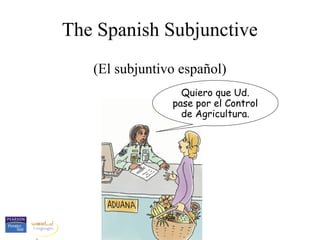
The Spanish Subjunctive
(El subjuntivo español)
Quiero que Ud.
pase por el Control
de Agricultura.
The Spanish Subjunctive
Until now, you have been using verb tenses (present,
preterit, and imperfect) in the indicative mood (or mode).
The indicative is used to express real, definite, or factual
actions or states of being.
Now, you are going to learn about the subjunctive mode.
It is used to express the hypothetical or subjective, such
as a speaker’s attitudes, wishes, feelings, emotions, or
doubts. Unlike the indicative, which states facts, the
subjunctive describes reality subjectively, or refers to
actions or states that are not yet reality at all (and maybe
never will be).
Por ejemplo…
I may want you to do something, but you may not do it.
I may suggest that you read the rest of this, but…
Your parents might recommend that you wash the dishes
right away, but you might not do it at all.
A friend may insist that you go with him, but you might
not want to go.
You might hope that something happens, but it may not
happen.
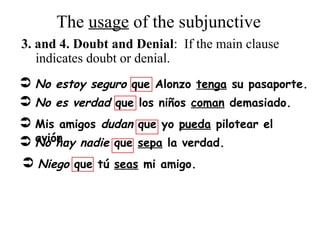
The Spanish Subjunctive
Notice the following examples:
Creo que Luis va a Cartagena.
I believe that Luis is going to
Cartagena. (Certainty: indicative)
No creo que Luis vaya a San Andrés.
I don’t think that Luis is going to San
Andrés. (Uncertainty: subjunctive)
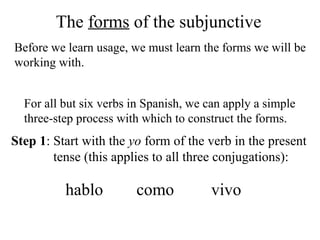
hablo como vivo
Step 1: Start with the yo form of the verb in the present
tense (this applies to all three conjugations):
The forms of the subjunctive
Before we learn usage, we must learn the forms we will be
working with.
For all but six verbs in Spanish, we can apply a simple
three-step process with which to construct the forms.
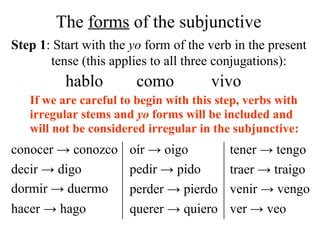
If we are careful to begin with this step, verbs with
irregular stems and yo forms will be included and
will not be considered irregular in the subjunctive:
conocer → conozco
The forms of the subjunctive
hablo como vivo
decir → digo
hacer → hago
perder → pierdo
querer → quiero
pedir → pido traer → traigo
oír → oigo tener → tengo
venir → vengo
ver → veo
dormir → duermo
Step 1: Start with the yo form of the verb in the present
tense (this applies to all three conjugations):
The forms of the subjunctive
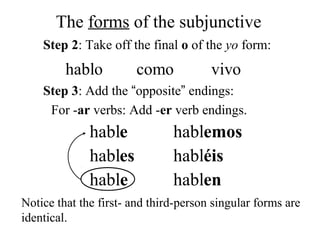
habl com viv
Step 2: Take off the final o of the yo form:
Step 3: Add the “opposite” endings:
For -ar verbs: Add -er verb endings.
habl
habl
habl
habl
habl
habl
e
es
e
emos
éis
en
Notice that the first- and third-person singular forms are
identical.
o o o
The forms of the subjunctive
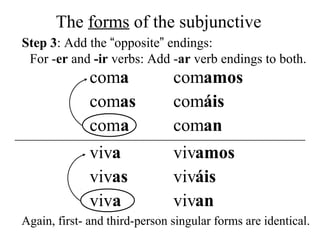
Step 3: Add the “opposite” endings:
For -er and -ir verbs: Add -ar verb endings to both.
com
com
com
com
com
com
a
as
a
amos
áis
an
viv
viv
viv
viv
viv
viv
a
as
a
amos
áis
an
Again, first- and third-person singular forms are identical.
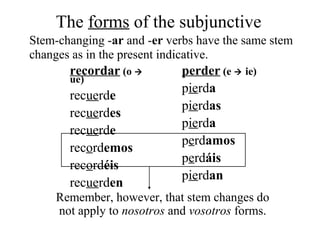
recordar (o 
ue)
recuerde
recuerdes
recuerde
recordemos
recordéis
recuerden
perder (e  ie)
pierda
pierdas
pierda
perdamos
perdáis
pierdan
Remember, however, that stem changes do
not apply to nosotros and vosotros forms.
The forms of the subjunctive
Stem-changing -ar and -er verbs have the same stem
changes as in the present indicative.
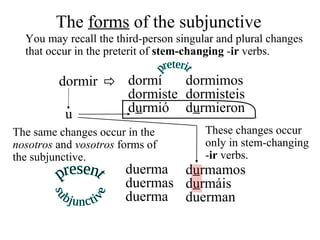
dormir dormimos
dormisteis
durmieron
dormí
dormiste
durmió

u
duerma
duermas
duerma
durmamos
durmáis
duerman
The forms of the subjunctive
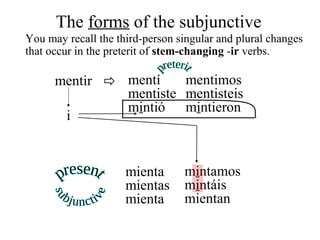
You may recall the third-person singular and plural changes
that occur in the preterit of stem-changing -ir verbs.
The same changes occur in the
nosotros and vosotros forms of
the subjunctive.
These changes occur
only in stem-changing
-ir verbs.
mentir mentimos
mentisteis
mintieron
mentí
mentiste
mintió

i
mienta
mientas
mienta
mintamos
mintáis
mientan
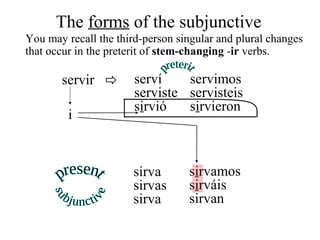
You may recall the third-person singular and plural changes
that occur in the preterit of stem-changing -ir verbs.
The forms of the subjunctive
sirvamos
sirváis
sirvan
You may recall the third-person singular and plural changes
that occur in the preterit of stem-changing -ir verbs.
The forms of the subjunctive
servir servimos
servisteis
sirvieron
serví
serviste
sirvió

i
sirva
sirvas
sirva
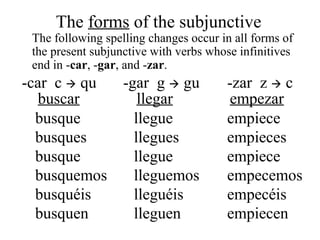
-car c  qu
The forms of the subjunctive
The following spelling changes occur in all forms of
the present subjunctive with verbs whose infinitives
end in -car, -gar, and -zar.
-gar g  gu -zar z  c
buscar
busque
busques
busque
busquemos
busquéis
busquen
llegar
llegue
llegues
llegue
lleguemos
lleguéis
lleguen
empezar
empiece
empieces
empiece
empecemos
empecéis
empiecen
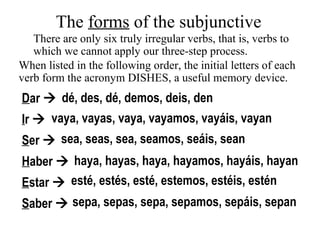
Dar 
Ir 
Ser 
Haber 
Estar 
Saber 
dé, des, dé, demos, deis, den
vaya, vayas, vaya, vayamos, vayáis, vayan
sea, seas, sea, seamos, seáis, sean
haya, hayas, haya, hayamos, hayáis, hayan
esté, estés, esté, estemos, estéis, estén
sepa, sepas, sepa, sepamos, sepáis, sepan
There are only six truly irregular verbs, that is, verbs to
which we cannot apply our three-step process.
The forms of the subjunctive
When listed in the following order, the initial letters of each
verb form the acronym DISHES, a useful memory device.
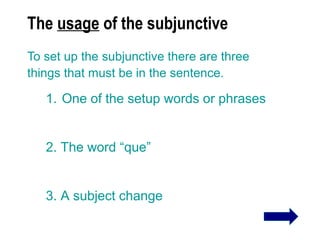
The usage of the subjunctive
To set up the subjunctive there are three
things that must be in the sentence.
1. One of the setup words or phrases
2. The word “que”
3. A subject change
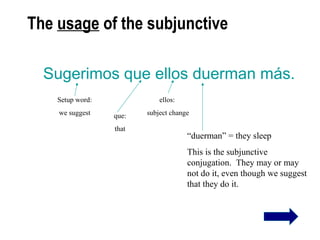
The usage of the subjunctive
Sugerimos que ellos duerman más.
Setup word:
we suggest que:
that
ellos:
subject change
“duerman” = they sleep
This is the subjunctive
conjugation. They may or may
not do it, even though we suggest
that they do it.
The usage of the subjunctive
Recomiendo que tú hagas la tarea.
Setup word:
I recommend que:
that
tú:
subject change
“hagas” = you do
This is the subjunctive
conjugation. You may or may
not do it, even though I
recommend that you do it.
The usage of the subjunctive
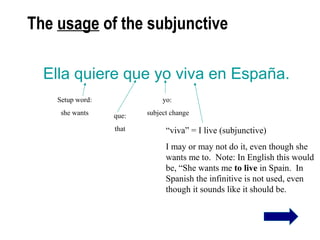
Ella quiere que yo viva en España.
Setup word:
she wants que:
that
yo:
subject change
“viva” = I live (subjunctive)
I may or may not do it, even though she
wants me to. Note: In English this would
be, “She wants me to live in Spain. In
Spanish the infinitive is not used, even
though it sounds like it should be.
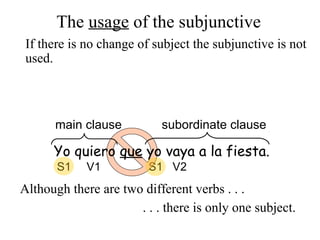
S1 V1 S1 V2
The usage of the subjunctive
If there is no change of subject the subjunctive is not
used.
Yo quiero que yo vaya a la fiesta.
main clause subordinate clause
Although there are two different verbs . . .
. . . there is only one subject.
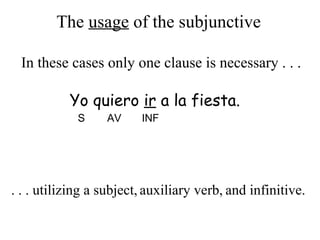
In these cases only one clause is necessary . . .
S AV INF
The usage of the subjunctive
Yo quiero ir a la fiesta.
. . . utilizing a subject, auxiliary verb, and infinitive.
The usage of the subjunctive
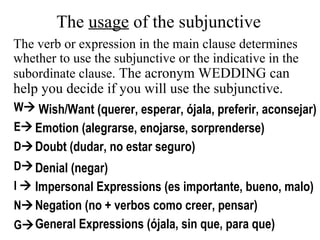
The verb or expression in the main clause determines
whether to use the subjunctive or the indicative in the
subordinate clause. The acronym WEDDING can
help you decide if you will use the subjunctive.
W
E
D
D
I 
N
G
Wish/Want (querer, esperar, ójala, preferir, aconsejar)
Impersonal Expressions (es importante, bueno, malo)
Negation (no + verbos como creer, pensar)
General Expressions (ójala, sin que, para que)
Emotion (alegrarse, enojarse, sorprenderse)
Doubt (dudar, no estar seguro)
Denial (negar)
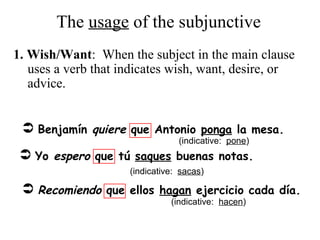
 Benjamín quiere que Antonio ponga la mesa.
 Yo espero que tú saques buenas notas.
 Recomiendo que ellos hagan ejercicio cada día.
(indicative: pone)
(indicative: sacas)
(indicative: hacen)
The usage of the subjunctive
1. Wish/Want: When the subject in the main clause
uses a verb that indicates wish, want, desire, or
advice.
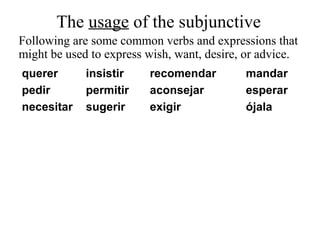
querer insistir recomendar mandar
pedir permitir aconsejar esperar
necesitar sugerir exigir ójala
The usage of the subjunctive
Following are some common verbs and expressions that
might be used to express wish, want, desire, or advice.
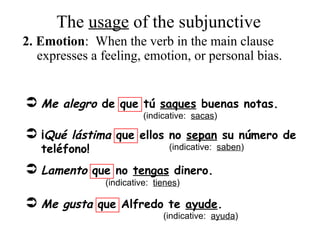
 Me alegro de que tú saques buenas notas.
 ¡Qué lástima que ellos no sepan su número de
teléfono!
 Lamento que no tengas dinero.
 Me gusta que Alfredo te ayude.
(indicative: sacas)
(indicative: saben)
(indicative: tienes)
(indicative: ayuda)
The usage of the subjunctive
2. Emotion: When the verb in the main clause
expresses a feeling, emotion, or personal bias.
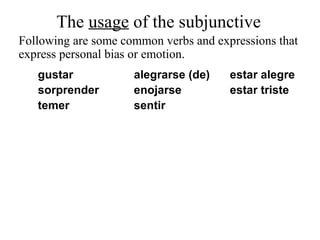
gustar alegrarse (de) estar alegre
sorprender enojarse estar triste
temer sentir
The usage of the subjunctive
Following are some common verbs and expressions that
express personal bias or emotion.
 No es verdad que los niños coman demasiado.
 No estoy seguro que Alonzo tenga su pasaporte.
 Mis amigos dudan que yo pueda pilotear el
avión. No hay nadie que sepa la verdad.
The usage of the subjunctive
3. and 4. Doubt and Denial: If the main clause
indicates doubt or denial.
 Niego que tú seas mi amigo.
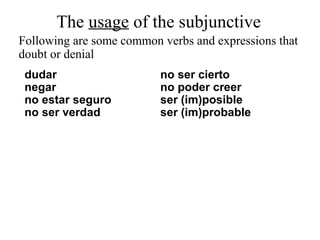
dudar no ser cierto
negar no poder creer
no estar seguro ser (im)posible
no ser verdad ser (im)probable
The usage of the subjunctive
Following are some common verbs and expressions that
doubt or denial
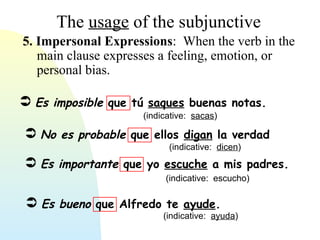
 Es imposible que tú saques buenas notas.
 No es probable que ellos digan la verdad
 Es importante que yo escuche a mis padres.
 Es bueno que Alfredo te ayude.
(indicative: sacas)
(indicative: dicen)
(indicative: escucho)
(indicative: ayuda)
The usage of the subjunctive
5. Impersonal Expressions: When the verb in the
main clause expresses a feeling, emotion, or
personal bias.
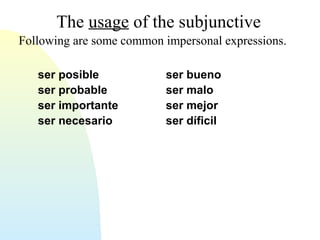
ser posible ser bueno
ser probable ser malo
ser importante ser mejor
ser necesario ser díficil
The usage of the subjunctive
Following are some common impersonal expressions.
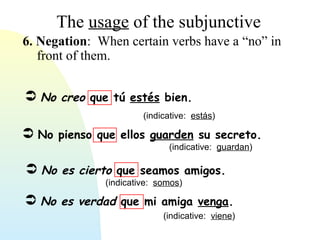
 No creo que tú estés bien.
 No pienso que ellos guarden su secreto.
 No es cierto que seamos amigos.
 No es verdad que mi amiga venga.
(indicative: estás)
(indicative: guardan)
(indicative: somos)
(indicative: viene)
The usage of the subjunctive
6. Negation: When certain verbs have a “no” in
front of them.
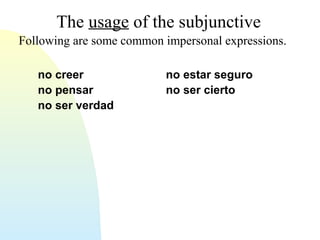
no creer no estar seguro
no pensar no ser cierto
no ser verdad
The usage of the subjunctive
Following are some common impersonal expressions.
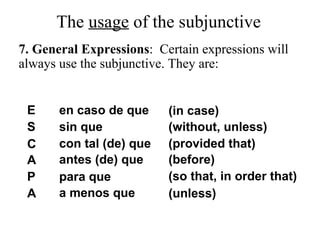
E
S
C
A
P
A
en caso de que
sin que
con tal (de) que
antes (de) que
para que
a menos que
(in case)
(without, unless)
(provided that)
(before)
(so that, in order that)
(unless)
The usage of the subjunctive
7. General Expressions: Certain expressions will
always use the subjunctive. They are:
FIN

Spanish present subjunctive notes

  • 1.
    The Spanish Subjunctive (Elsubjuntivo español) Quiero que Ud. pase por el Control de Agricultura.
  • 2.
    The Spanish Subjunctive Untilnow, you have been using verb tenses (present, preterit, and imperfect) in the indicative mood (or mode). The indicative is used to express real, definite, or factual actions or states of being. Now, you are going to learn about the subjunctive mode. It is used to express the hypothetical or subjective, such as a speaker’s attitudes, wishes, feelings, emotions, or doubts. Unlike the indicative, which states facts, the subjunctive describes reality subjectively, or refers to actions or states that are not yet reality at all (and maybe never will be).
  • 3.
    Por ejemplo… I maywant you to do something, but you may not do it. I may suggest that you read the rest of this, but… Your parents might recommend that you wash the dishes right away, but you might not do it at all. A friend may insist that you go with him, but you might not want to go. You might hope that something happens, but it may not happen.
  • 4.
    The Spanish Subjunctive Noticethe following examples: Creo que Luis va a Cartagena. I believe that Luis is going to Cartagena. (Certainty: indicative) No creo que Luis vaya a San Andrés. I don’t think that Luis is going to San Andrés. (Uncertainty: subjunctive)
  • 5.
    hablo como vivo Step1: Start with the yo form of the verb in the present tense (this applies to all three conjugations): The forms of the subjunctive Before we learn usage, we must learn the forms we will be working with. For all but six verbs in Spanish, we can apply a simple three-step process with which to construct the forms.
  • 6.
    If we arecareful to begin with this step, verbs with irregular stems and yo forms will be included and will not be considered irregular in the subjunctive: conocer → conozco The forms of the subjunctive hablo como vivo decir → digo hacer → hago perder → pierdo querer → quiero pedir → pido traer → traigo oír → oigo tener → tengo venir → vengo ver → veo dormir → duermo Step 1: Start with the yo form of the verb in the present tense (this applies to all three conjugations):
  • 7.
    The forms ofthe subjunctive habl com viv Step 2: Take off the final o of the yo form: Step 3: Add the “opposite” endings: For -ar verbs: Add -er verb endings. habl habl habl habl habl habl e es e emos éis en Notice that the first- and third-person singular forms are identical. o o o
  • 8.
    The forms ofthe subjunctive Step 3: Add the “opposite” endings: For -er and -ir verbs: Add -ar verb endings to both. com com com com com com a as a amos áis an viv viv viv viv viv viv a as a amos áis an Again, first- and third-person singular forms are identical.
  • 9.
    recordar (o  ue) recuerde recuerdes recuerde recordemos recordéis recuerden perder(e  ie) pierda pierdas pierda perdamos perdáis pierdan Remember, however, that stem changes do not apply to nosotros and vosotros forms. The forms of the subjunctive Stem-changing -ar and -er verbs have the same stem changes as in the present indicative.
  • 10.
    dormir dormimos dormisteis durmieron dormí dormiste durmió  u duerma duermas duerma durmamos durmáis duerman The formsof the subjunctive You may recall the third-person singular and plural changes that occur in the preterit of stem-changing -ir verbs. The same changes occur in the nosotros and vosotros forms of the subjunctive. These changes occur only in stem-changing -ir verbs.
  • 11.
    mentir mentimos mentisteis mintieron mentí mentiste mintió  i mienta mientas mienta mintamos mintáis mientan You mayrecall the third-person singular and plural changes that occur in the preterit of stem-changing -ir verbs. The forms of the subjunctive
  • 12.
    sirvamos sirváis sirvan You may recallthe third-person singular and plural changes that occur in the preterit of stem-changing -ir verbs. The forms of the subjunctive servir servimos servisteis sirvieron serví serviste sirvió  i sirva sirvas sirva
  • 13.
    -car c qu The forms of the subjunctive The following spelling changes occur in all forms of the present subjunctive with verbs whose infinitives end in -car, -gar, and -zar. -gar g  gu -zar z  c buscar busque busques busque busquemos busquéis busquen llegar llegue llegues llegue lleguemos lleguéis lleguen empezar empiece empieces empiece empecemos empecéis empiecen
  • 14.
    Dar  Ir  Ser Haber  Estar  Saber  dé, des, dé, demos, deis, den vaya, vayas, vaya, vayamos, vayáis, vayan sea, seas, sea, seamos, seáis, sean haya, hayas, haya, hayamos, hayáis, hayan esté, estés, esté, estemos, estéis, estén sepa, sepas, sepa, sepamos, sepáis, sepan There are only six truly irregular verbs, that is, verbs to which we cannot apply our three-step process. The forms of the subjunctive When listed in the following order, the initial letters of each verb form the acronym DISHES, a useful memory device.
  • 15.
    The usage ofthe subjunctive To set up the subjunctive there are three things that must be in the sentence. 1. One of the setup words or phrases 2. The word “que” 3. A subject change
  • 16.
    The usage ofthe subjunctive Sugerimos que ellos duerman más. Setup word: we suggest que: that ellos: subject change “duerman” = they sleep This is the subjunctive conjugation. They may or may not do it, even though we suggest that they do it.
  • 17.
    The usage ofthe subjunctive Recomiendo que tú hagas la tarea. Setup word: I recommend que: that tú: subject change “hagas” = you do This is the subjunctive conjugation. You may or may not do it, even though I recommend that you do it.
  • 18.
    The usage ofthe subjunctive Ella quiere que yo viva en España. Setup word: she wants que: that yo: subject change “viva” = I live (subjunctive) I may or may not do it, even though she wants me to. Note: In English this would be, “She wants me to live in Spain. In Spanish the infinitive is not used, even though it sounds like it should be.
  • 19.
    S1 V1 S1V2 The usage of the subjunctive If there is no change of subject the subjunctive is not used. Yo quiero que yo vaya a la fiesta. main clause subordinate clause Although there are two different verbs . . . . . . there is only one subject.
  • 20.
    In these casesonly one clause is necessary . . . S AV INF The usage of the subjunctive Yo quiero ir a la fiesta. . . . utilizing a subject, auxiliary verb, and infinitive.
  • 21.
    The usage ofthe subjunctive The verb or expression in the main clause determines whether to use the subjunctive or the indicative in the subordinate clause. The acronym WEDDING can help you decide if you will use the subjunctive. W E D D I  N G Wish/Want (querer, esperar, ójala, preferir, aconsejar) Impersonal Expressions (es importante, bueno, malo) Negation (no + verbos como creer, pensar) General Expressions (ójala, sin que, para que) Emotion (alegrarse, enojarse, sorprenderse) Doubt (dudar, no estar seguro) Denial (negar)
  • 22.
     Benjamín quiereque Antonio ponga la mesa.  Yo espero que tú saques buenas notas.  Recomiendo que ellos hagan ejercicio cada día. (indicative: pone) (indicative: sacas) (indicative: hacen) The usage of the subjunctive 1. Wish/Want: When the subject in the main clause uses a verb that indicates wish, want, desire, or advice.
  • 23.
    querer insistir recomendarmandar pedir permitir aconsejar esperar necesitar sugerir exigir ójala The usage of the subjunctive Following are some common verbs and expressions that might be used to express wish, want, desire, or advice.
  • 24.
     Me alegrode que tú saques buenas notas.  ¡Qué lástima que ellos no sepan su número de teléfono!  Lamento que no tengas dinero.  Me gusta que Alfredo te ayude. (indicative: sacas) (indicative: saben) (indicative: tienes) (indicative: ayuda) The usage of the subjunctive 2. Emotion: When the verb in the main clause expresses a feeling, emotion, or personal bias.
  • 25.
    gustar alegrarse (de)estar alegre sorprender enojarse estar triste temer sentir The usage of the subjunctive Following are some common verbs and expressions that express personal bias or emotion.
  • 26.
     No esverdad que los niños coman demasiado.  No estoy seguro que Alonzo tenga su pasaporte.  Mis amigos dudan que yo pueda pilotear el avión. No hay nadie que sepa la verdad. The usage of the subjunctive 3. and 4. Doubt and Denial: If the main clause indicates doubt or denial.  Niego que tú seas mi amigo.
  • 27.
    dudar no sercierto negar no poder creer no estar seguro ser (im)posible no ser verdad ser (im)probable The usage of the subjunctive Following are some common verbs and expressions that doubt or denial
  • 28.
     Es imposibleque tú saques buenas notas.  No es probable que ellos digan la verdad  Es importante que yo escuche a mis padres.  Es bueno que Alfredo te ayude. (indicative: sacas) (indicative: dicen) (indicative: escucho) (indicative: ayuda) The usage of the subjunctive 5. Impersonal Expressions: When the verb in the main clause expresses a feeling, emotion, or personal bias.
  • 29.
    ser posible serbueno ser probable ser malo ser importante ser mejor ser necesario ser díficil The usage of the subjunctive Following are some common impersonal expressions.
  • 30.
     No creoque tú estés bien.  No pienso que ellos guarden su secreto.  No es cierto que seamos amigos.  No es verdad que mi amiga venga. (indicative: estás) (indicative: guardan) (indicative: somos) (indicative: viene) The usage of the subjunctive 6. Negation: When certain verbs have a “no” in front of them.
  • 31.
    no creer noestar seguro no pensar no ser cierto no ser verdad The usage of the subjunctive Following are some common impersonal expressions.
  • 32.
    E S C A P A en caso deque sin que con tal (de) que antes (de) que para que a menos que (in case) (without, unless) (provided that) (before) (so that, in order that) (unless) The usage of the subjunctive 7. General Expressions: Certain expressions will always use the subjunctive. They are:
  • 33.

Editor's Notes