IMPERATIVE MOOD
AND THE SIGNS
Name: Karen Medina Garcia
Group: 201
Teacher: Maria Concepción Villa
IMPERATIVE MOOD
To give orders, warnings and instruction in English, we
use the imperative form:
 Order: Be quiet.
 Warning: Take care!
 Instructions: Listen to me carefully
Imperative sentences can end with a period (.) or an
exclamation point (!).
Use the base form of the verb (without “to”). Imperative
sentences can be affirmative or negative to indicate
prohibitions.
Use the base form of the verb (without “to”). Imperative sentences
can be affirmative or negative to indicate prohibitions.
Affirmative:
Verb +

Object +

complement

Bing

Your book

To class.

Negative:
Do not or
don’t

Verb +

Object +

complement

Don’t

Bing

Your book

To class.
USE OF IMPERATIVE MOOD:
 Give orders (commands) or prohibitions.

Example: Don’t open the box.
 Give instructions.
Example: Add two cups of sugar.
 Make requests.
Example: Confirm your attendance at 555-555.
 Demand or require that an action be performed.
Example: Fill out the application form with blank ink.
 Its use may be extended to signal permission.
Example: Bring your spouse and children to the party.
IMPERATIVE MOOD
When use the imperative form with an adult, use “you” (usted)
and we “soften” the imperative form with “let’s” or “please”:
 Let’s go now.
 Please listen to what I’m saying.

The imperative can be used for all subjects, but you can also
use “let’s” before the verb if you are including yourself in the
imperative (use the preposition us).
For the negative of “let’s” is “let’s not”
 Let’s not argue!
Information of Type
SIGN
A sign is a sign, a gesture or otherwise, which
advises or warns of something. The signal
therefore replaces the written word or language.
They are due to Convention, so are easily
interpreted.
When it comes to symbols, the signals are
placed in visible locations and are normally
made in different colors and shapes.
They are divided into 3 information, prohibition
and prevention.
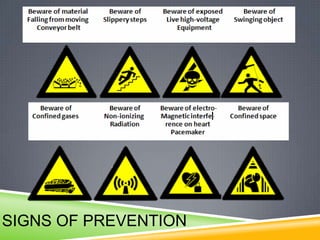
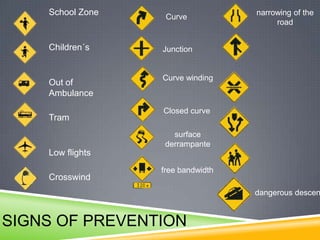
SIGNS OF PREVENTION
 DEFINITION

Prevention or preventive signals are those that are used to
indicate in advance the approximation of certain conditions
of the road or concurrent to her involving an actual or
potential hazard which can be avoided by taking certain
precautions.
 FORM
They will be square-shaped with one vertex down forming a
rhombus, with the exception of special signals which will be
of special design.
 COLOR
Background and edge: yellow symbols, letters and frame:
black
PROHIBITION SIGNS
 DEFINITION

Prohibition signs are those that are used to indicate
the existence of physical limitations or regulatory
prohibitions that govern any action or place
 FORM
They will be have a form of circle, octagon and some
of triangle
 COLOR
Are usually signs of white with a red hoop and the text
are black or white depend the color.
INFORMATIVE SIGNS
They are signs with legends or symbols, which are
intended to guide the user along their route by streets
and highways and inform you about names and location
of towns, attractions, services, mileage, and certain
recommendations that should be noted. These signals
are classified into:
 Identification
 Destination
 Recommendation
 General information
 Services and tourism
INFORMATIVE SIGNS
 Identification

They are designed to identify the streets according to its name and the
roads according to their number of road and mileage.
 Destination
They are designed to inform users about the name and location of each
of the destinations presented along its route. Its application is paramount
at intersections where the user must choose the path to follow according
to the selected destination.
 General information and recommendation
The purpose of these signs is to inform certain provisions and safety
precautions that should be observed, as well as some general
information that should be known.
 Services and tourism
They are intended to inform of the existence of a service or a site of
tourism or recreational interest
Examples
SIGNS OF PREVENTION
SIGNS OF PREVENTION
School Zone

Children´s

Out of
Ambulance
Tram

Curve

narrowing of the
road

Junction

Curve winding

Closed curve
surface
derrampante

Low flights
Crosswind

free bandwidth

dangerous descen

SIGNS OF PREVENTION
SIGNS OF PREVENTION

Imperative mood

  • 1.
    IMPERATIVE MOOD AND THESIGNS Name: Karen Medina Garcia Group: 201 Teacher: Maria Concepción Villa
  • 2.
    IMPERATIVE MOOD To giveorders, warnings and instruction in English, we use the imperative form:  Order: Be quiet.  Warning: Take care!  Instructions: Listen to me carefully Imperative sentences can end with a period (.) or an exclamation point (!). Use the base form of the verb (without “to”). Imperative sentences can be affirmative or negative to indicate prohibitions.
  • 3.
    Use the baseform of the verb (without “to”). Imperative sentences can be affirmative or negative to indicate prohibitions. Affirmative: Verb + Object + complement Bing Your book To class. Negative: Do not or don’t Verb + Object + complement Don’t Bing Your book To class.
  • 4.
    USE OF IMPERATIVEMOOD:  Give orders (commands) or prohibitions. Example: Don’t open the box.  Give instructions. Example: Add two cups of sugar.  Make requests. Example: Confirm your attendance at 555-555.  Demand or require that an action be performed. Example: Fill out the application form with blank ink.  Its use may be extended to signal permission. Example: Bring your spouse and children to the party.
  • 5.
    IMPERATIVE MOOD When usethe imperative form with an adult, use “you” (usted) and we “soften” the imperative form with “let’s” or “please”:  Let’s go now.  Please listen to what I’m saying. The imperative can be used for all subjects, but you can also use “let’s” before the verb if you are including yourself in the imperative (use the preposition us). For the negative of “let’s” is “let’s not”  Let’s not argue!
  • 6.
  • 7.
    SIGN A sign isa sign, a gesture or otherwise, which advises or warns of something. The signal therefore replaces the written word or language. They are due to Convention, so are easily interpreted. When it comes to symbols, the signals are placed in visible locations and are normally made in different colors and shapes. They are divided into 3 information, prohibition and prevention.
  • 8.
    SIGNS OF PREVENTION DEFINITION Prevention or preventive signals are those that are used to indicate in advance the approximation of certain conditions of the road or concurrent to her involving an actual or potential hazard which can be avoided by taking certain precautions.  FORM They will be square-shaped with one vertex down forming a rhombus, with the exception of special signals which will be of special design.  COLOR Background and edge: yellow symbols, letters and frame: black
  • 9.
    PROHIBITION SIGNS  DEFINITION Prohibitionsigns are those that are used to indicate the existence of physical limitations or regulatory prohibitions that govern any action or place  FORM They will be have a form of circle, octagon and some of triangle  COLOR Are usually signs of white with a red hoop and the text are black or white depend the color.
  • 10.
    INFORMATIVE SIGNS They aresigns with legends or symbols, which are intended to guide the user along their route by streets and highways and inform you about names and location of towns, attractions, services, mileage, and certain recommendations that should be noted. These signals are classified into:  Identification  Destination  Recommendation  General information  Services and tourism
  • 11.
    INFORMATIVE SIGNS  Identification Theyare designed to identify the streets according to its name and the roads according to their number of road and mileage.  Destination They are designed to inform users about the name and location of each of the destinations presented along its route. Its application is paramount at intersections where the user must choose the path to follow according to the selected destination.  General information and recommendation The purpose of these signs is to inform certain provisions and safety precautions that should be observed, as well as some general information that should be known.  Services and tourism They are intended to inform of the existence of a service or a site of tourism or recreational interest
  • 12.
  • 13.
  • 14.
  • 15.
    School Zone Children´s Out of Ambulance Tram Curve narrowingof the road Junction Curve winding Closed curve surface derrampante Low flights Crosswind free bandwidth dangerous descen SIGNS OF PREVENTION
  • 16.