Grammar
   Book
By: Carmen Adair
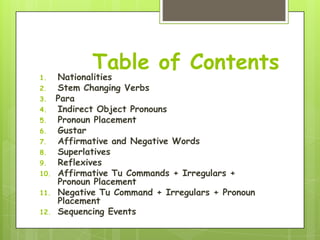
Table of Contents
1.    Nationalities
2.    Stem Changing Verbs
3.    Para
4.    Indirect Object Pronouns
5.    Pronoun Placement
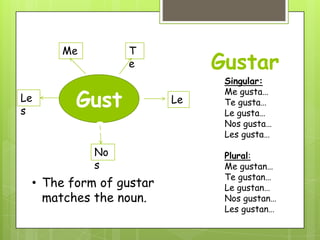
6.    Gustar
7.    Affirmative and Negative Words
8.    Superlatives
9.    Reflexives
10.   Affirmative Tu Commands + Irregulars +
      Pronoun Placement
11.   Negative Tu Command + Irregulars + Pronoun
      Placement
12.   Sequencing Events
Nationalities
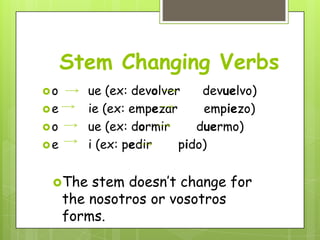
Stem Changing Verbs
o      ue (ex: devolver    devuelvo)
e      ie (ex: empezar     empiezo)
o      ue (ex: dormir     duermo)
e      i (ex: pedir    pido)


 The    stem doesn’t change for
     the nosotros or vosotros
     forms.
Para
 Parameans for or in order to.
 Use para to indicate:
  The recipient of items. Ex: El regalo para
   tú mama.
  Purpose. Ex: Vamos al restaurante para
   comer.
  Implied purpose. Ex: Tengo dinero para
   [comprar] algo.
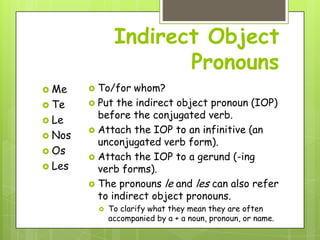
Indirect Object
                        Pronouns
 Me     To/for whom?
 Te     Put the indirect object pronoun (IOP)

 Le
          before the conjugated verb.
         Attach the IOP to an infinitive (an
 Nos
          unconjugated verb form).
 Os
         Attach the IOP to a gerund (-ing
 Les     verb forms).
         The pronouns le and les can also refer
          to indirect object pronouns.
               To clarify what they mean they are often
                accompanied by a + a noun, pronoun, or name.
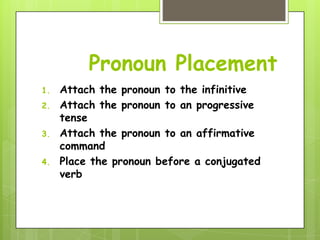
Pronoun Placement
1.   Attach the pronoun to the infinitive
2.   Attach the pronoun to an progressive
     tense
3.   Attach the pronoun to an affirmative
     command
4.   Place the pronoun before a conjugated
     verb
Me         T
                e            Gustar
                              Singular:

        Gust
                              Me gusta…
Le                      Le    Te gusta…
s                             Le gusta…
         a                    Nos gusta…
                              Les gusta…

           No                 Plural:
           s                  Me gustan…
                              Te gustan…
 • The form of gustar         Le gustan…
   matches the noun.          Nos gustan…
                              Les gustan…
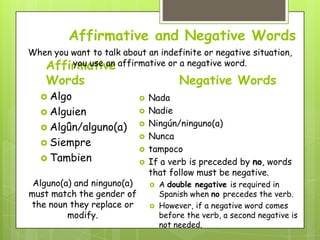
Affirmative and Negative Words
When you want to talk about an indefinite or negative situation,
   Affirmative affirmative or a negative word.
         you use an

    Words                                Negative Words
   Algo                       Nada
   Alguien                    Nadie
   Algûn/alguno(a)
                               Ningún/ninguno(a)
                               Nunca
   Siempre
                               tampoco
   Tambien                    If a verb is preceded by no, words
                                that follow must be negative.
 Alguno(a) and ninguno(a)          A double negative is required in
must match the gender of            Spanish when no precedes the verb.
the noun they replace or           However, if a negative word comes
         modify.                    before the verb, a second negative is
                                    not needed.
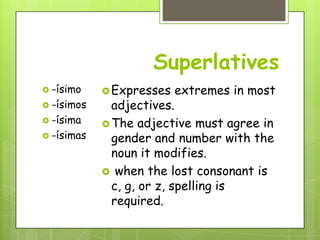
Superlatives
 -ísimo     Expresses   extremes in most
 -ísimos     adjectives.
 -ísima     The adjective must agree in
 -ísimas     gender and number with the
              noun it modifies.
             when the lost consonant is
              c, g, or z, spelling is
              required.
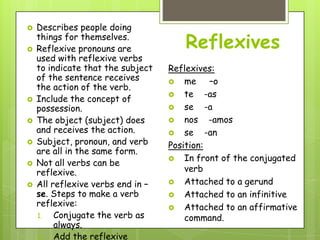
   Describes people doing


    things for themselves.
    Reflexive pronouns are            Reflexives
    used with reflexive verbs
    to indicate that the subject   Reflexives:
    of the sentence receives        me       –o
    the action of the verb.
                                    te      -as
   Include the concept of
    possession.                     se      -a
   The object (subject) does       nos      -amos
    and receives the action.        se      -an
   Subject, pronoun, and verb     Position:
    are all in the same form.
                                    In front of the conjugated
   Not all verbs can be
    reflexive.                         verb
   All reflexive verbs end in –    Attached to a gerund
    se. Steps to make a verb        Attached to an infinitive
    reflexive:                      Attached to an affirmative
    1.   Conjugate the verb as         command.
         always.
    2.   Add the reflexive
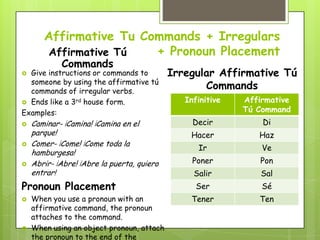
Affirmative Tu Commands + Irregulars
        Affirmative Tú  + Pronoun Placement
            Commands
 Give instructions or commands to          Irregular Affirmative Tú
  someone by using the affirmative tú
  commands of irregular verbs.
                                                   Commands
 Ends like a 3rd house form.                  Infinitive   Affirmative
Examples:                                                   Tú Command
   Caminar- ¡Camina! ¡Camina en el              Decir          Di
    parque!                                     Hacer          Haz
   Comer- ¡Come! ¡Come toda la
                                                  Ir            Ve
    hamburgesa!
   Abrir- ¡Abre! ¡Abre la puerta, quiero        Poner          Pon
    entrar!                                      Salir          Sal
Pronoun Placement                                 Ser           Sé
   When you use a pronoun with an              Tener          Ten
    affirmative command, the pronoun
    attaches to the command.
   When using an object pronoun, attach
    the pronoun to the end of the
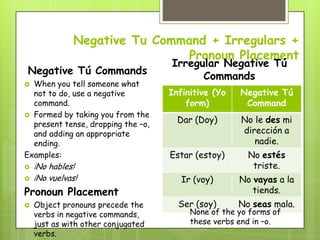
Negative Tu Command + Irregulars +
                                Pronoun Placement
                                    Irregular Negative Tú
Negative Tú Commands                      Commands
 When you tell someone what
  not to do, use a negative         Infinitive (Yo   Negative Tú
  command.                              form)         Command
 Formed by taking you from the
  present tense, dropping the –o,
                                      Dar (Doy)      No le des mi
  and adding an appropriate                          dirección a
  ending.                                               nadie.
Examples:                           Estar (estoy)      No estés
   ¡No hables!                                         triste.
   ¡No vuelvas!                       Ir (voy)      No vayas a la
Pronoun Placement                                       tiends.
   Object pronouns precede the       Ser (soy)      No seas mala.
    verbs in negative commands,          None of the yo forms of
    just as with other conjugated        these verbs end in –o.
    verbs.
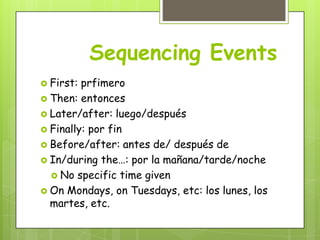
Sequencing Events
 First: prfimero
 Then: entonces
 Later/after: luego/después
 Finally: por fin
 Before/after: antes de/ después de
 In/during the…: por la mañana/tarde/noche
   No specific time given
 On Mondays, on Tuesdays, etc: los lunes, los
  martes, etc.

Spanish Grammar Book

  • 1.
    Grammar Book By: Carmen Adair
  • 2.
    Table of Contents 1. Nationalities 2. Stem Changing Verbs 3. Para 4. Indirect Object Pronouns 5. Pronoun Placement 6. Gustar 7. Affirmative and Negative Words 8. Superlatives 9. Reflexives 10. Affirmative Tu Commands + Irregulars + Pronoun Placement 11. Negative Tu Command + Irregulars + Pronoun Placement 12. Sequencing Events
  • 3.
  • 4.
    Stem Changing Verbs o ue (ex: devolver devuelvo) e ie (ex: empezar empiezo) o ue (ex: dormir duermo) e i (ex: pedir pido) The stem doesn’t change for the nosotros or vosotros forms.
  • 5.
    Para  Parameans foror in order to.  Use para to indicate:  The recipient of items. Ex: El regalo para tú mama.  Purpose. Ex: Vamos al restaurante para comer.  Implied purpose. Ex: Tengo dinero para [comprar] algo.
  • 6.
    Indirect Object Pronouns  Me  To/for whom?  Te  Put the indirect object pronoun (IOP)  Le before the conjugated verb.  Attach the IOP to an infinitive (an  Nos unconjugated verb form).  Os  Attach the IOP to a gerund (-ing  Les verb forms).  The pronouns le and les can also refer to indirect object pronouns.  To clarify what they mean they are often accompanied by a + a noun, pronoun, or name.
  • 7.
    Pronoun Placement 1. Attach the pronoun to the infinitive 2. Attach the pronoun to an progressive tense 3. Attach the pronoun to an affirmative command 4. Place the pronoun before a conjugated verb
  • 8.
    Me T e Gustar Singular: Gust Me gusta… Le Le Te gusta… s Le gusta… a Nos gusta… Les gusta… No Plural: s Me gustan… Te gustan… • The form of gustar Le gustan… matches the noun. Nos gustan… Les gustan…
  • 9.
    Affirmative and NegativeWords When you want to talk about an indefinite or negative situation, Affirmative affirmative or a negative word. you use an Words Negative Words  Algo  Nada  Alguien  Nadie  Algûn/alguno(a)  Ningún/ninguno(a)  Nunca  Siempre  tampoco  Tambien  If a verb is preceded by no, words that follow must be negative. Alguno(a) and ninguno(a)  A double negative is required in must match the gender of Spanish when no precedes the verb. the noun they replace or  However, if a negative word comes modify. before the verb, a second negative is not needed.
  • 10.
    Superlatives  -ísimo  Expresses extremes in most  -ísimos adjectives.  -ísima  The adjective must agree in  -ísimas gender and number with the noun it modifies.  when the lost consonant is c, g, or z, spelling is required.
  • 11.
    Describes people doing  things for themselves. Reflexive pronouns are Reflexives used with reflexive verbs to indicate that the subject Reflexives: of the sentence receives  me –o the action of the verb.  te -as  Include the concept of possession.  se -a  The object (subject) does  nos -amos and receives the action.  se -an  Subject, pronoun, and verb Position: are all in the same form.  In front of the conjugated  Not all verbs can be reflexive. verb  All reflexive verbs end in –  Attached to a gerund se. Steps to make a verb  Attached to an infinitive reflexive:  Attached to an affirmative 1. Conjugate the verb as command. always. 2. Add the reflexive
  • 12.
    Affirmative Tu Commands+ Irregulars Affirmative Tú + Pronoun Placement Commands  Give instructions or commands to Irregular Affirmative Tú someone by using the affirmative tú commands of irregular verbs. Commands  Ends like a 3rd house form. Infinitive Affirmative Examples: Tú Command  Caminar- ¡Camina! ¡Camina en el Decir Di parque! Hacer Haz  Comer- ¡Come! ¡Come toda la Ir Ve hamburgesa!  Abrir- ¡Abre! ¡Abre la puerta, quiero Poner Pon entrar! Salir Sal Pronoun Placement Ser Sé  When you use a pronoun with an Tener Ten affirmative command, the pronoun attaches to the command.  When using an object pronoun, attach the pronoun to the end of the
  • 13.
    Negative Tu Command+ Irregulars + Pronoun Placement Irregular Negative Tú Negative Tú Commands Commands  When you tell someone what not to do, use a negative Infinitive (Yo Negative Tú command. form) Command  Formed by taking you from the present tense, dropping the –o, Dar (Doy) No le des mi and adding an appropriate dirección a ending. nadie. Examples: Estar (estoy) No estés  ¡No hables! triste.  ¡No vuelvas! Ir (voy) No vayas a la Pronoun Placement tiends.  Object pronouns precede the Ser (soy) No seas mala. verbs in negative commands, None of the yo forms of just as with other conjugated these verbs end in –o. verbs.
  • 14.
    Sequencing Events  First:prfimero  Then: entonces  Later/after: luego/después  Finally: por fin  Before/after: antes de/ después de  In/during the…: por la mañana/tarde/noche  No specific time given  On Mondays, on Tuesdays, etc: los lunes, los martes, etc.