Grammar Book
Spring 2013
Raquel Hynes
Table of contents
 reflexive verbs
 por + para
 to become- hacerse, ponerse, volverse, llegar a
 Future
 conditional
 present perfect
 relative pronouns
 qué vs cuál
 the neuter lo
 subjunctive in adverbial clauses
 past subjunctive
 comparisons + superlatives
 Adverbs
Table of contents
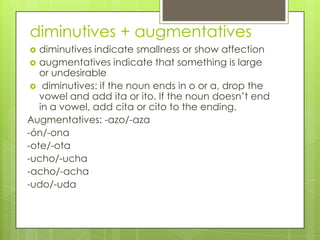
 diminutives + augmentatives
 present perfect subjunctive
 uses of se
 past participles as adjectives
 time expressions with hacer
 Future perfect
 conditional perfect
 si clauses
 transitional expressions
 pero vs. sino
 passive voice
 negative and indefinite expressions
 Past perfect
 past perfect subjunctive se
 uses of the infinitive
 prepositions: a, hacia, con de, desde, en, entre, hasta, sin
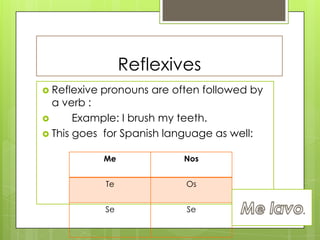
Reflexives
 Reflexive pronouns are often followed by
a verb :
 Example: I brush my teeth.
 This goes for Spanish language as well:
Me Nos
Te Os
Se Se
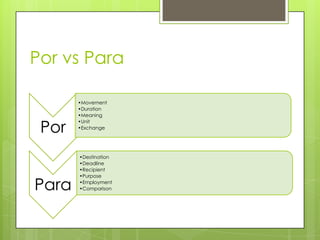
Por vs Para
Por
•Movement
•Duration
•Meaning
•Unit
•Exchange
Para
•Destination
•Deadline
•Recipient
•Purpose
•Employment
•Comparison
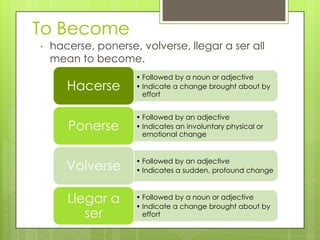
To Become
• hacerse, ponerse, volverse, llegar a ser all
mean to become.
• Followed by a noun or adjective
• Indicate a change brought about by
effort
Hacerse
• Followed by an adjective
• Indicates an involuntary physical or
emotional change
Ponerse
• Followed by an adjective
• Indicates a sudden, profound changeVolverse
• Followed by a noun or adjective
• Indicate a change brought about by
effort
Llegar a
ser
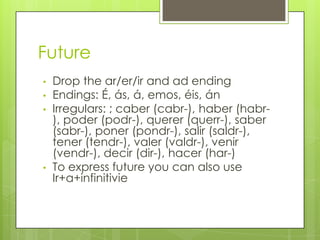
Future
• Drop the ar/er/ir and ad ending
• Endings: É, ás, á, emos, éis, án
• Irregulars: ; caber (cabr-), haber (habr-
), poder (podr-), querer (querr-), saber
(sabr-), poner (pondr-), salir (saldr-),
tener (tendr-), valer (valdr-), venir
(vendr-), decir (dir-), hacer (har-)
• To express future you can also use
Ir+a+infinitivie
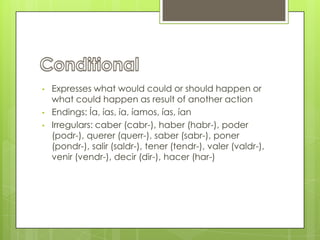
• Expresses what would could or should happen or
what could happen as result of another action
• Endings: Ía, ías, ía, íamos, ías, ían
• Irregulars: caber (cabr-), haber (habr-), poder
(podr-), querer (querr-), saber (sabr-), poner
(pondr-), salir (saldr-), tener (tendr-), valer (valdr-),
venir (vendr-), decir (dir-), hacer (har-)
Present Perfect
• Expresses things that have just recently
happened
• The present perfect is conjugated haber +
conjugated verb
• The verb endings are: -ado for –ar and –
ido for er and ir
9
Relative Pronouns
• Relative pronouns are practically conjunctions.
They connect sentences to make more interesting
and complex sentences.
• que, el/la que, el/la cual, quien/quienes, cuyo
• Que refers to people or things
• El cual and la que are used in more formal
sentences, but are basically the same thing
• Quien and quienes are used for people only.
• Cuyo refers to whose
10
Que vs Cual
Qué is used when asking for
definitions or general
information.
Cuál usually is used
before es and other forms
ofser when not seeking a
definition or more specific
things.
Neuter Lo
• Use lo and a masculine singular
adjective to relay ideas.
• The adjective cant describe
anything tangible, just an idea or
characteristic.
12
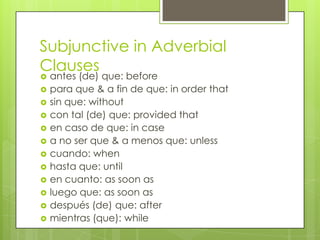
Subjunctive in Adverbial
Clauses
 antes (de) que: before
 para que & a fin de que: in order that
 sin que: without
 con tal (de) que: provided that
 en caso de que: in case
 a no ser que & a menos que: unless
 cuando: when
 hasta que: until
 en cuanto: as soon as
 luego que: as soon as
 después (de) que: after
 mientras (que): while
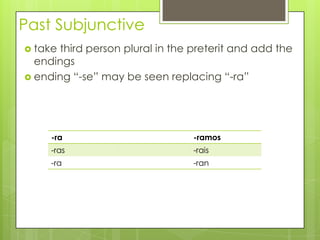
Past Subjunctive
 take third person plural in the preterit and add the
endings
 ending “-se” may be seen replacing “-ra”
-ra -ramos
-ras -rais
-ra -ran
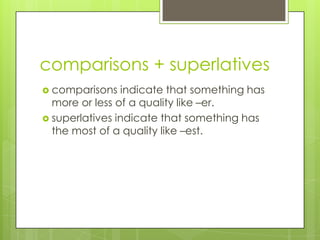
comparisons + superlatives
 comparisons indicate that something has
more or less of a quality like –er.
 superlatives indicate that something has
the most of a quality like –est.
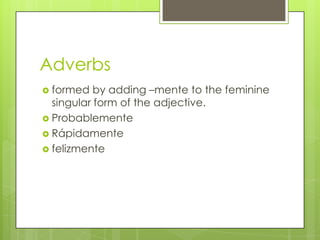
Adverbs
 formed by adding –mente to the feminine
singular form of the adjective.
 Probablemente
 Rápidamente
 felizmente
diminutives + augmentatives
 diminutives indicate smallness or show affection
 augmentatives indicate that something is large
or undesirable
 diminutives: if the noun ends in o or a, drop the
vowel and add ita or ito. If the noun doesn‟t end
in a vowel, add cita or cito to the ending.
Augmentatives: -azo/-aza
-ón/-ona
-ote/-ota
-ucho/-ucha
-acho/-acha
-udo/-uda
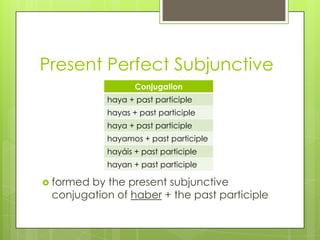
Present Perfect Subjunctive
 formed by the present subjunctive
conjugation of haber + the past participle
Conjugation
haya + past participle
hayas + past participle
haya + past participle
hayamos + past participle
hayáis + past participle
hayan + past participle
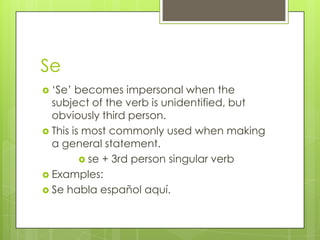
Se
 „Se‟ becomes impersonal when the
subject of the verb is unidentified, but
obviously third person.
 This is most commonly used when making
a general statement.
 se + 3rd person singular verb
 Examples:
 Se habla español aquí.
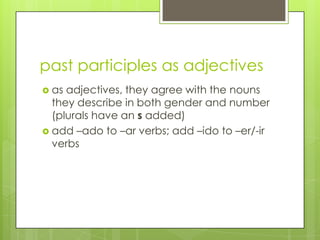
past participles as adjectives
 as adjectives, they agree with the nouns
they describe in both gender and number
(plurals have an s added)
 add –ado to –ar verbs; add –ido to –er/-ir
verbs
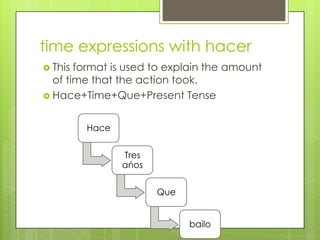
time expressions with hacer
 This format is used to explain the amount
of time that the action took.
 Hace+Time+Que+Present Tense
Hace
Tres
ańos
Que
bailo
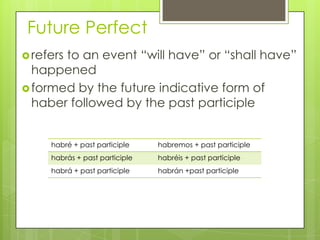
Future Perfect
refers to an event “will have” or “shall have”
happened
formed by the future indicative form of
haber followed by the past participle
habré + past participle habremos + past participle
habrás + past participle habréis + past participle
habrá + past participle habrán +past participle
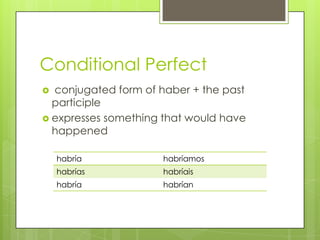
Conditional Perfect
 conjugated form of haber + the past
participle
 expresses something that would have
happened
habría habríamos
habrías habríais
habría habrían
Si Clauses
 They can come before or after the main
clause and often contradict the main
clause.
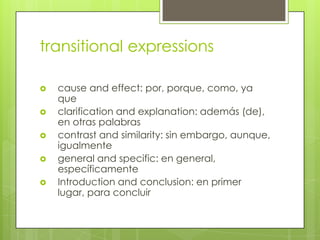
transitional expressions
 cause and effect: por, porque, como, ya
que
 clarification and explanation: además (de),
en otras palabras
 contrast and similarity: sin embargo, aunque,
igualmente
 general and specific: en general,
específicamente
 Introduction and conclusion: en primer
lugar, para concluir
pero vs. sino
 Pero indicates contrast, but sino indicates
direct negation of the other cause.
Passive Voice
 A common use of the passive voice is to
indicate what happened to the subject of
the sentence without saying who or what
carried out the action.
 Las computadoras fueron vendidas. It is
not specified who carried out the action.
Negative Expressions
 Used when referring to nobody or nothing.
 nada
 nadie
 ningún
 ninguno/a
 ni
 nunca
 tampoco
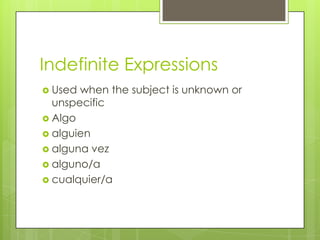
Indefinite Expressions
 Used when the subject is unknown or
unspecific
 Algo
 alguien
 alguna vez
 alguno/a
 cualquier/a
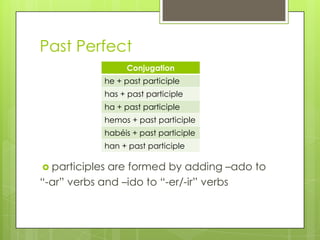
Past Perfect
 participles are formed by adding –ado to
“-ar” verbs and –ido to “-er/-ir” verbs
Conjugation
he + past participle
has + past participle
ha + past participle
hemos + past participle
habéis + past participle
han + past participle
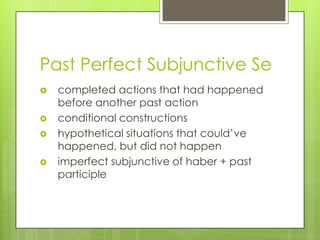
Past Perfect Subjunctive Se
 completed actions that had happened
before another past action
 conditional constructions
 hypothetical situations that could‟ve
happened, but did not happen
 imperfect subjunctive of haber + past
participle
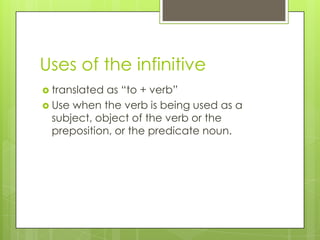
Uses of the infinitive
 translated as “to + verb”
 Use when the verb is being used as a
subject, object of the verb or the
preposition, or the predicate noun.
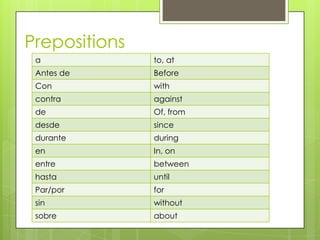
Prepositions
a to, at
Antes de Before
Con with
contra against
de Of, from
desde since
durante during
en In, on
entre between
hasta until
Par/por for
sin without
sobre about

Grammar book 2013 spring

  • 1.
  • 2.
    Table of contents reflexive verbs  por + para  to become- hacerse, ponerse, volverse, llegar a  Future  conditional  present perfect  relative pronouns  qué vs cuál  the neuter lo  subjunctive in adverbial clauses  past subjunctive  comparisons + superlatives  Adverbs
  • 3.
    Table of contents diminutives + augmentatives  present perfect subjunctive  uses of se  past participles as adjectives  time expressions with hacer  Future perfect  conditional perfect  si clauses  transitional expressions  pero vs. sino  passive voice  negative and indefinite expressions  Past perfect  past perfect subjunctive se  uses of the infinitive  prepositions: a, hacia, con de, desde, en, entre, hasta, sin
  • 4.
    Reflexives  Reflexive pronounsare often followed by a verb :  Example: I brush my teeth.  This goes for Spanish language as well: Me Nos Te Os Se Se
  • 5.
  • 6.
    To Become • hacerse,ponerse, volverse, llegar a ser all mean to become. • Followed by a noun or adjective • Indicate a change brought about by effort Hacerse • Followed by an adjective • Indicates an involuntary physical or emotional change Ponerse • Followed by an adjective • Indicates a sudden, profound changeVolverse • Followed by a noun or adjective • Indicate a change brought about by effort Llegar a ser
  • 7.
    Future • Drop thear/er/ir and ad ending • Endings: É, ás, á, emos, éis, án • Irregulars: ; caber (cabr-), haber (habr- ), poder (podr-), querer (querr-), saber (sabr-), poner (pondr-), salir (saldr-), tener (tendr-), valer (valdr-), venir (vendr-), decir (dir-), hacer (har-) • To express future you can also use Ir+a+infinitivie
  • 8.
    • Expresses whatwould could or should happen or what could happen as result of another action • Endings: Ía, ías, ía, íamos, ías, ían • Irregulars: caber (cabr-), haber (habr-), poder (podr-), querer (querr-), saber (sabr-), poner (pondr-), salir (saldr-), tener (tendr-), valer (valdr-), venir (vendr-), decir (dir-), hacer (har-)
  • 9.
    Present Perfect • Expressesthings that have just recently happened • The present perfect is conjugated haber + conjugated verb • The verb endings are: -ado for –ar and – ido for er and ir 9
  • 10.
    Relative Pronouns • Relativepronouns are practically conjunctions. They connect sentences to make more interesting and complex sentences. • que, el/la que, el/la cual, quien/quienes, cuyo • Que refers to people or things • El cual and la que are used in more formal sentences, but are basically the same thing • Quien and quienes are used for people only. • Cuyo refers to whose 10
  • 11.
    Que vs Cual Quéis used when asking for definitions or general information. Cuál usually is used before es and other forms ofser when not seeking a definition or more specific things.
  • 12.
    Neuter Lo • Uselo and a masculine singular adjective to relay ideas. • The adjective cant describe anything tangible, just an idea or characteristic. 12
  • 13.
    Subjunctive in Adverbial Clauses antes (de) que: before  para que & a fin de que: in order that  sin que: without  con tal (de) que: provided that  en caso de que: in case  a no ser que & a menos que: unless  cuando: when  hasta que: until  en cuanto: as soon as  luego que: as soon as  después (de) que: after  mientras (que): while
  • 14.
    Past Subjunctive  takethird person plural in the preterit and add the endings  ending “-se” may be seen replacing “-ra” -ra -ramos -ras -rais -ra -ran
  • 15.
    comparisons + superlatives comparisons indicate that something has more or less of a quality like –er.  superlatives indicate that something has the most of a quality like –est.
  • 16.
    Adverbs  formed byadding –mente to the feminine singular form of the adjective.  Probablemente  Rápidamente  felizmente
  • 17.
    diminutives + augmentatives diminutives indicate smallness or show affection  augmentatives indicate that something is large or undesirable  diminutives: if the noun ends in o or a, drop the vowel and add ita or ito. If the noun doesn‟t end in a vowel, add cita or cito to the ending. Augmentatives: -azo/-aza -ón/-ona -ote/-ota -ucho/-ucha -acho/-acha -udo/-uda
  • 18.
    Present Perfect Subjunctive formed by the present subjunctive conjugation of haber + the past participle Conjugation haya + past participle hayas + past participle haya + past participle hayamos + past participle hayáis + past participle hayan + past participle
  • 19.
    Se  „Se‟ becomesimpersonal when the subject of the verb is unidentified, but obviously third person.  This is most commonly used when making a general statement.  se + 3rd person singular verb  Examples:  Se habla español aquí.
  • 20.
    past participles asadjectives  as adjectives, they agree with the nouns they describe in both gender and number (plurals have an s added)  add –ado to –ar verbs; add –ido to –er/-ir verbs
  • 21.
    time expressions withhacer  This format is used to explain the amount of time that the action took.  Hace+Time+Que+Present Tense Hace Tres ańos Que bailo
  • 22.
    Future Perfect refers toan event “will have” or “shall have” happened formed by the future indicative form of haber followed by the past participle habré + past participle habremos + past participle habrás + past participle habréis + past participle habrá + past participle habrán +past participle
  • 23.
    Conditional Perfect  conjugatedform of haber + the past participle  expresses something that would have happened habría habríamos habrías habríais habría habrían
  • 24.
    Si Clauses  Theycan come before or after the main clause and often contradict the main clause.
  • 25.
    transitional expressions  causeand effect: por, porque, como, ya que  clarification and explanation: además (de), en otras palabras  contrast and similarity: sin embargo, aunque, igualmente  general and specific: en general, específicamente  Introduction and conclusion: en primer lugar, para concluir
  • 26.
    pero vs. sino Pero indicates contrast, but sino indicates direct negation of the other cause.
  • 27.
    Passive Voice  Acommon use of the passive voice is to indicate what happened to the subject of the sentence without saying who or what carried out the action.  Las computadoras fueron vendidas. It is not specified who carried out the action.
  • 28.
    Negative Expressions  Usedwhen referring to nobody or nothing.  nada  nadie  ningún  ninguno/a  ni  nunca  tampoco
  • 29.
    Indefinite Expressions  Usedwhen the subject is unknown or unspecific  Algo  alguien  alguna vez  alguno/a  cualquier/a
  • 30.
    Past Perfect  participlesare formed by adding –ado to “-ar” verbs and –ido to “-er/-ir” verbs Conjugation he + past participle has + past participle ha + past participle hemos + past participle habéis + past participle han + past participle
  • 31.
    Past Perfect SubjunctiveSe  completed actions that had happened before another past action  conditional constructions  hypothetical situations that could‟ve happened, but did not happen  imperfect subjunctive of haber + past participle
  • 32.
    Uses of theinfinitive  translated as “to + verb”  Use when the verb is being used as a subject, object of the verb or the preposition, or the predicate noun.
  • 33.
    Prepositions a to, at Antesde Before Con with contra against de Of, from desde since durante during en In, on entre between hasta until Par/por for sin without sobre about