Grammar BookSemester 2Humberto Hayes
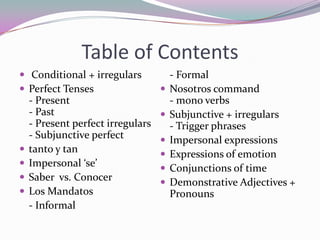
Table of Contents Conditional + irregularsPerfect Tenses- Present- Past- Present perfect irregulars- Subjunctive perfecttanto y tanImpersonal ‘se’Saber  vs. ConocerLos Mandatos	- Informal	- FormalNosotros command- mono verbsSubjunctive + irregulars- Trigger phrasesImpersonal expressionsExpressions of emotionConjunctions of timeDemonstrative Adjectives + Pronouns
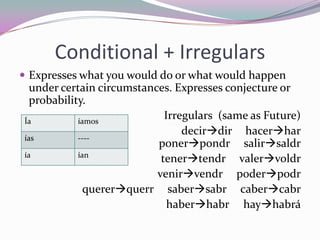
Conditional + IrregularsExpresses what you would do or what would happen under certain circumstances. Expresses conjecture or probability.Irregulars  (same as Future)decirdirhacerharponerpondrsalirsaldrtenertendrvalervoldrvenirvendrpoderpodrquererquerrsabersabrcabercabrhaberhabrhayhabrá
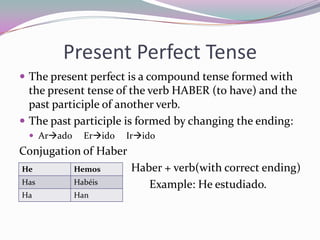
Present Perfect TenseThe present perfect is a compound tense formed with the present tense of the verb HABER (to have) and the past participle of another verb.The past participle is formed by changing the ending:AradoEridoIridoConjugation of Haber	Haber + verb(with correct ending)				Example: He estudiado.
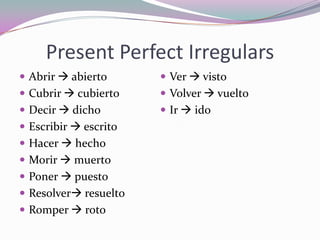
Present Perfect IrregularsAbrir abiertoCubrir  cubiertoDecir dichoEscribir  escritoHacer hechoMorir  muertoPoner  puestoResolver resueltoRomper  rotoVer  vistoVolver  vueltoIr  ido
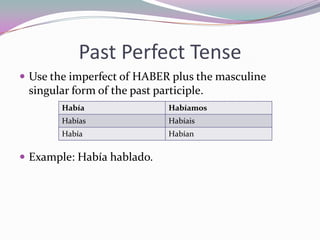
Past Perfect TenseUse the imperfect of HABER plus the masculine singular form of the past participle.Example: Habíahablado.
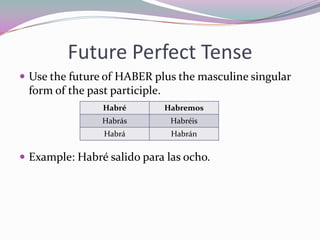
Future Perfect TenseUse the future of HABER plus the masculine singular form of the past participle.Example: Habrésalidoparalasocho.
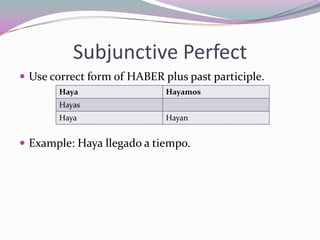
Subjunctive PerfectUse correct form of HABER plus past participle.Example: Hayallegado a tiempo.
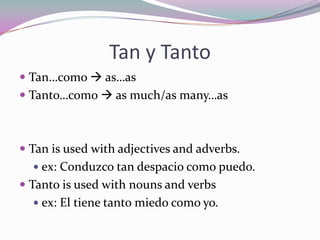
Tan y TantoTan…como as…asTanto…como  as much/as many…asTan is used with adjectives and adverbs.ex: Conduzco tan despaciocomopuedo.Tanto is used with nouns and verbsex: El tienetantomiedocomoyo.
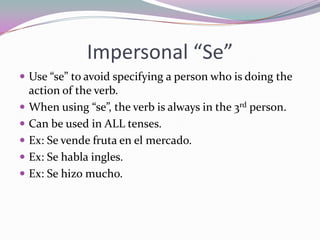
Impersonal “Se”Use “se” to avoid specifying a person who is doing the action of the verb.When using “se”, the verb is always in the 3rd person.Can be used in ALL tenses.Ex: Se vendefruta en el mercado.Ex: Se habla ingles.Ex: Se hizo mucho.
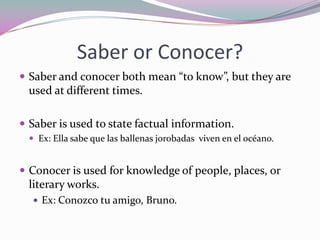
Saber or Conocer?Saber and conocer both mean “to know”, but they are used at different times.Saber is used to state factual information.Ex: Ella sabequelasballenasjorobadasviven en el océano.Conocer is used for knowledge of people, places, or literary works.Ex: Conozcotu amigo, Bruno.
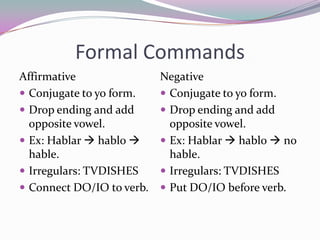
Formal CommandsAffirmativeConjugate to yo form.Drop ending and add opposite vowel.Ex: Hablar hablo  hable.Irregulars: TVDISHESConnect DO/IO to verb.NegativeConjugate to yo form.Drop ending and add opposite vowel.Ex: Hablar  hablo  no hable.Irregulars: TVDISHESPut DO/IO before verb.
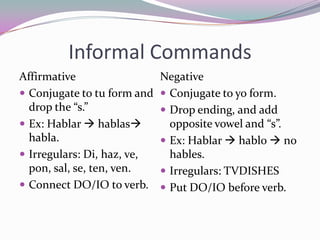
Informal CommandsAffirmativeConjugate to tu form and drop the “s.”Ex: Hablar hablas habla.Irregulars: Di, haz, ve, pon, sal, se, ten, ven.Connect DO/IO to verb.NegativeConjugate to yo form.Drop ending, and add opposite vowel and “s”.Ex: Hablar  hablo  no hables.Irregulars: TVDISHESPut DO/IO before verb.
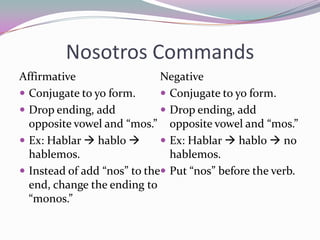
Nosotros CommandsAffirmativeConjugate to yo form.Drop ending, add opposite vowel and “mos.”Ex: Hablar hablo  hablemos.Instead of add “nos” to the end, change the ending to “monos.”NegativeConjugate to yo form.Drop ending, add opposite vowel and “mos.”Ex: Hablar hablo  no hablemos.Put “nos” before the verb.
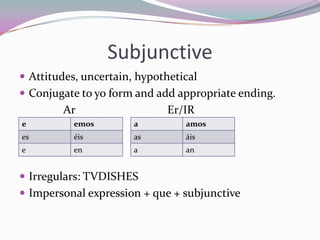
SubjunctiveAttitudes, uncertain, hypotheticalConjugate to yo form and add appropriate ending.ArEr/IRIrregulars: TVDISHESImpersonal expression + que + subjunctive
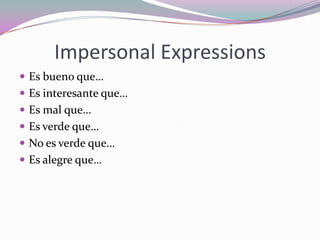
Impersonal ExpressionsEs bueno que…Es interesante que…Es mal que…Es verde que…No es verde que…Es alegre que…
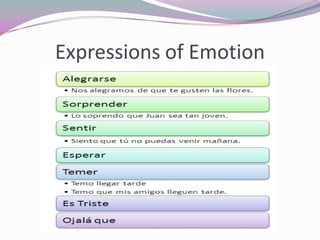
Expressions of Emotion
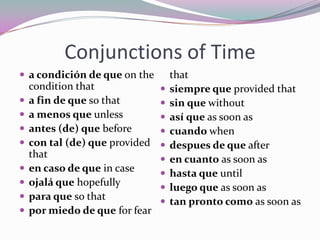
Conjunctions of Timea condición de que on the condition that a fin de que so that a menosque unless antes (de) que before con tal (de) que provided that en caso de que in case ojaláque hopefully paraque so that pormiedo de que for fear that siempreque provided that sin quewithoutasíque as soon as cuandowhen despuesde que after en cuanto as soon as hastaque until luegoque as soon as tan pronto como as soon as
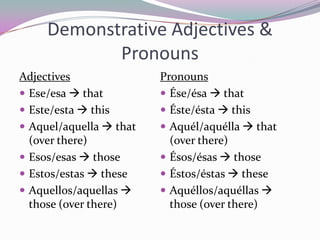
Demonstrative Adjectives & PronounsAdjectivesEse/esa thatEste/esta  thisAquel/aquella  that (over there)Esos/esas  thoseEstos/estas  theseAquellos/aquellas  those (over there)PronounsÉse/ésa thatÉste/ésta thisAquél/aquélla that (over there)Ésos/ésas thoseÉstos/éstas theseAquéllos/aquéllas those (over there)

Grammar book 2

  • 1.
  • 2.
    Table of Contents Conditional+ irregularsPerfect Tenses- Present- Past- Present perfect irregulars- Subjunctive perfecttanto y tanImpersonal ‘se’Saber vs. ConocerLos Mandatos - Informal - FormalNosotros command- mono verbsSubjunctive + irregulars- Trigger phrasesImpersonal expressionsExpressions of emotionConjunctions of timeDemonstrative Adjectives + Pronouns
  • 3.
    Conditional + IrregularsExpresseswhat you would do or what would happen under certain circumstances. Expresses conjecture or probability.Irregulars (same as Future)decirdirhacerharponerpondrsalirsaldrtenertendrvalervoldrvenirvendrpoderpodrquererquerrsabersabrcabercabrhaberhabrhayhabrá
  • 4.
    Present Perfect TenseThepresent perfect is a compound tense formed with the present tense of the verb HABER (to have) and the past participle of another verb.The past participle is formed by changing the ending:AradoEridoIridoConjugation of Haber Haber + verb(with correct ending) Example: He estudiado.
  • 5.
    Present Perfect IrregularsAbrirabiertoCubrir  cubiertoDecir dichoEscribir  escritoHacer hechoMorir  muertoPoner  puestoResolver resueltoRomper  rotoVer  vistoVolver  vueltoIr  ido
  • 6.
    Past Perfect TenseUsethe imperfect of HABER plus the masculine singular form of the past participle.Example: Habíahablado.
  • 7.
    Future Perfect TenseUsethe future of HABER plus the masculine singular form of the past participle.Example: Habrésalidoparalasocho.
  • 8.
    Subjunctive PerfectUse correctform of HABER plus past participle.Example: Hayallegado a tiempo.
  • 9.
    Tan y TantoTan…comoas…asTanto…como  as much/as many…asTan is used with adjectives and adverbs.ex: Conduzco tan despaciocomopuedo.Tanto is used with nouns and verbsex: El tienetantomiedocomoyo.
  • 10.
    Impersonal “Se”Use “se”to avoid specifying a person who is doing the action of the verb.When using “se”, the verb is always in the 3rd person.Can be used in ALL tenses.Ex: Se vendefruta en el mercado.Ex: Se habla ingles.Ex: Se hizo mucho.
  • 11.
    Saber or Conocer?Saberand conocer both mean “to know”, but they are used at different times.Saber is used to state factual information.Ex: Ella sabequelasballenasjorobadasviven en el océano.Conocer is used for knowledge of people, places, or literary works.Ex: Conozcotu amigo, Bruno.
  • 12.
    Formal CommandsAffirmativeConjugate toyo form.Drop ending and add opposite vowel.Ex: Hablar hablo  hable.Irregulars: TVDISHESConnect DO/IO to verb.NegativeConjugate to yo form.Drop ending and add opposite vowel.Ex: Hablar  hablo  no hable.Irregulars: TVDISHESPut DO/IO before verb.
  • 13.
    Informal CommandsAffirmativeConjugate totu form and drop the “s.”Ex: Hablar hablas habla.Irregulars: Di, haz, ve, pon, sal, se, ten, ven.Connect DO/IO to verb.NegativeConjugate to yo form.Drop ending, and add opposite vowel and “s”.Ex: Hablar  hablo  no hables.Irregulars: TVDISHESPut DO/IO before verb.
  • 14.
    Nosotros CommandsAffirmativeConjugate toyo form.Drop ending, add opposite vowel and “mos.”Ex: Hablar hablo  hablemos.Instead of add “nos” to the end, change the ending to “monos.”NegativeConjugate to yo form.Drop ending, add opposite vowel and “mos.”Ex: Hablar hablo  no hablemos.Put “nos” before the verb.
  • 15.
    SubjunctiveAttitudes, uncertain, hypotheticalConjugateto yo form and add appropriate ending.ArEr/IRIrregulars: TVDISHESImpersonal expression + que + subjunctive
  • 16.
    Impersonal ExpressionsEs buenoque…Es interesante que…Es mal que…Es verde que…No es verde que…Es alegre que…
  • 17.
  • 18.
    Conjunctions of Timeacondición de que on the condition that a fin de que so that a menosque unless antes (de) que before con tal (de) que provided that en caso de que in case ojaláque hopefully paraque so that pormiedo de que for fear that siempreque provided that sin quewithoutasíque as soon as cuandowhen despuesde que after en cuanto as soon as hastaque until luegoque as soon as tan pronto como as soon as
  • 19.
    Demonstrative Adjectives &PronounsAdjectivesEse/esa thatEste/esta  thisAquel/aquella  that (over there)Esos/esas  thoseEstos/estas  theseAquellos/aquellas  those (over there)PronounsÉse/ésa thatÉste/ésta thisAquél/aquélla that (over there)Ésos/ésas thoseÉstos/éstas theseAquéllos/aquéllas those (over there)