¡EL ULTIMO LIBRO DE GRAMÁTICA PARA MEJORAR
SUS GRADES USTEDES EN SUS CLASES DE ESPAÑOL!
POR ELIZABETH LUCIER
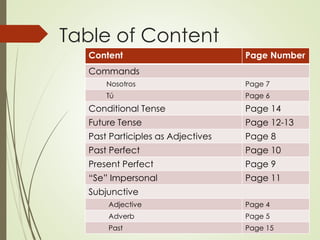
Table of Content
Content Page Number
Commands
Nosotros Page 7
Tú Page 6
Conditional Tense Page 14
Future Tense Page 12-13
Past Participles as Adjectives Page 8
Past Perfect Page 10
Present Perfect Page 9
“Se” Impersonal Page 11
Subjunctive
Adjective Page 4
Adverb Page 5
Past Page 15
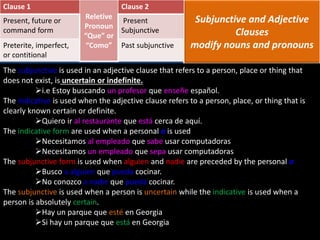
Subjunctive and Adjective
Clauses
modify nouns and pronouns
The subjunctive is used in an adjective clause that refers to a person, place or thing that
does not exist, is uncertain or indefinite.
i.e Estoy buscando un profesor que enseñe español.
The indicative is used when the adjective clause refers to a person, place, or thing that is
clearly known certain or definite.
Quiero ir al restaurante que está cerca de aquí.
The indicative form are used when a personal a is used
Necesitamos al empleado que sabe usar computadoras
Necesitamos un empleado que sepa usar computadoras
The subjunctive form is used when alguien and nadie are preceded by the personal a
Busco a alguien que pueda cocinar.
No conozco a nadie que pueda cocinar.
The subjunctive is used when a person is uncertain while the indicative is used when a
person is absolutely certain.
Hay un parque que esté en Georgia
Si hay un parque que está en Georgia
Clause 1
Reletive
Pronoun
“Que” or
“Como”
Clause 2
Present, future or
command form
Present
Subjunctive
Preterite, imperfect,
or contitional
Past subjunctive
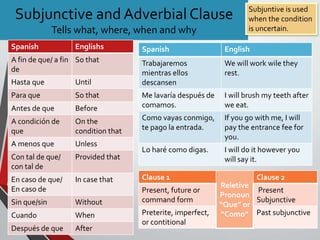
Subjunctive and Adverbial Clause
Tells what, where, when and why
Spanish Englishs
A fin de que/ a fin
de
So that
Hasta que Until
Para que So that
Antes de que Before
A condición de
que
On the
condition that
A menos que Unless
Con tal de que/
con tal de
Provided that
En caso de que/
En caso de
In case that
Sin que/sin Without
Cuando When
Después de que After
Spanish English
Trabajaremos
mientras ellos
descansen
We will work wile they
rest.
Me lavaría después de
comamos.
I will brush my teeth after
we eat.
Como vayas conmigo,
te pago la entrada.
If you go with me, I will
pay the entrance fee for
you.
Lo haré como digas. I will do it however you
will say it.
Subjuntive is used
when the condition
is uncertain.
Clause 1
Reletive
Pronoun
“Que” or
“Como”
Clause 2
Present, future or
command form
Present
Subjunctive
Preterite, imperfect,
or contitional
Past subjunctive
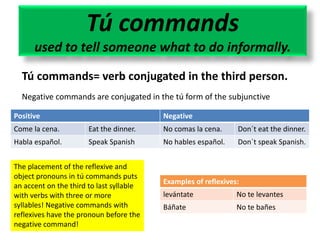
Tú commands
used to tell someone what to do informally.
Tú commands= verb conjugated in the third person.
Negative commands are conjugated in the tú form of the subjunctive
Positive Negative
Come la cena. Eat the dinner. No comas la cena. Don´t eat the dinner.
Habla español. Speak Spanish No hables español. Don´t speak Spanish.
The placement of the reflexive and
object pronouns in tú commands puts
an accent on the third to last syllable
with verbs with three or more
syllables! Negative commands with
reflexives have the pronoun before the
negative command!
Examples of reflexives:
levántate No te levantes
Báñate No te bañes
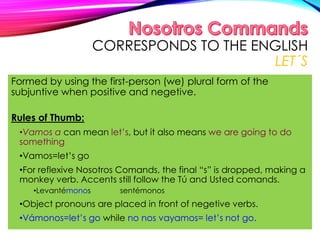
CORRESPONDS TO THE ENGLISH
LET´S
Formed by using the first-person (we) plural form of the
subjuntive when positive and negetive.
Rules of Thumb:
•Vamos a can mean let’s, but it also means we are going to do
something
•Vamos=let’s go
•For reflexive Nosotros Comands, the final “s” is dropped, making a
monkey verb. Accents still follow the Tú and Usted comands.
•Levantémonos sentémonos
•Object pronouns are placed in front of negetive verbs.
•Vámonos=let’s go while no nos vayamos= let’s not go.
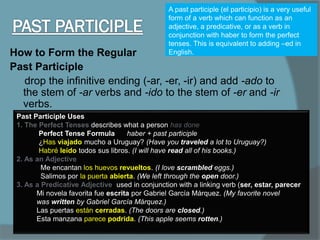
How to Form the Regular
Past Participle
drop the infinitive ending (-ar, -er, -ir) and add -ado to
the stem of -ar verbs and -ido to the stem of -er and -ir
verbs.
A past participle (el participio) is a very useful
form of a verb which can function as an
adjective, a predicative, or as a verb in
conjunction with haber to form the perfect
tenses. This is equivalent to adding –ed in
English.
Past Participle Uses
1. The Perfect Tenses describes what a person has done
Perfect Tense Formula haber + past participle
¿Has viajado mucho a Uruguay? (Have you traveled a lot to Uruguay?)
Habré leído todos sus libros. (I will have read all of his books.)
2. As an Adjective
Me encantan los huevos revueltos. (I love scrambled eggs.)
Salimos por la puerta abierta. (We left through the open door.)
3. As a Predicative Adjective used in conjunction with a linking verb (ser, estar, parecer
Mi novela favorita fue escrita por Gabriel García Márquez. (My favorite novel
was written by Gabriel García Márquez.)
Las puertas están cerradas. (The doors are closed.)
Esta manzana parece podrida. (This apple seems rotten.)
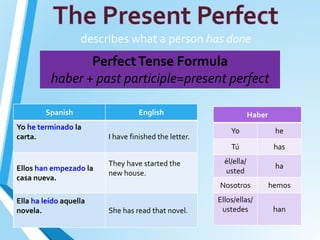
describes what a person has done
Spanish English
Yo he terminado la
carta. I have finished the letter.
Ellos han empezado la
casa nueva.
They have started the
new house.
Ella ha leído aquella
novela. She has read that novel.
PerfectTense Formula
haber + past participle=present perfect
Haber
Yo he
Tú has
él/ella/
usted
ha
Nosotros hemos
Ellos/ellas/
ustedes han
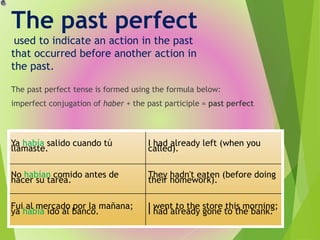
The past perfect
used to indicate an action in the past
that occurred before another action in
the past.
The past perfect tense is formed using the formula below:
imperfect conjugation of haber + the past participle = past perfect
Ya había salido cuando tú
llamaste.
I had already left (when you
called).
No habían comido antes de
hacer su tarea.
They hadn't eaten (before doing
their homework).
Fui al mercado por la mañana;
ya había ido al banco.
I went to the store this morning;
I had already gone to the bank.
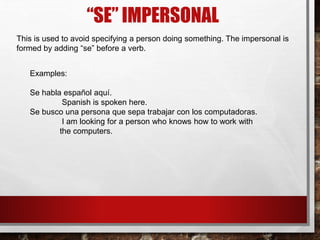
“SE” IMPERSONAL
This is used to avoid specifying a person doing something. The impersonal is
formed by adding “se” before a verb.
Examples:
Se habla español aquí.
Spanish is spoken here.
Se busco una persona que sepa trabajar con los computadoras.
I am looking for a person who knows how to work with
the computers.
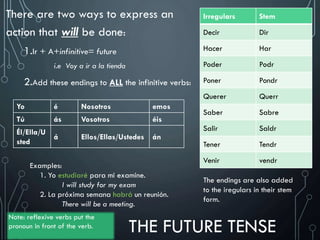
THE FUTURE TENSE
There are two ways to express an
action that will be done:
1.Ir + A+infinitive= future
i.e Voy a ir a la tienda
2.Add these endings to ALL the infinitive verbs:
Yo é Nosotros emos
Tú ás Vosotros éis
Él/Ella/U
sted
á Ellos/Ellas/Ustedes án
Irregulars Stem
Decir Dir
Hacer Har
Poder Podr
Poner Pondr
Querer Querr
Saber Sabre
Salir Saldr
Tener Tendr
Venir vendr
The endings are also added
to the iregulars in their stem
form.
Examples:
1. Yo estudiaré para mi examine.
I will study for my exam
2. La próxima semana habrá un reunión.
There will be a meeting.
Note: reflexive verbs put the
pronoun in front of the verb.
While using the Future Tense
Probability
 This is used to express I wonder, I
bet, Probably, must be, and may
be. (It often expresses a
conjecture about the present
conditions, events, or actions. It
resembles the words I wonder It’s
probably It must be.
Examples:
¿Dónde estará mis libros?
I wonder where my books are.
Estarán encima mi escritorio.
They must be on my desk.
Willingness
The future is also used to refer
to someone´s willingness. This is
expressed querer+[infinitive]
Examples:
¿Quieres llamar el mecánico?
Will you call the mechanic?
¿Quieren ustedes
escuchamos?
Will you please listen to us?
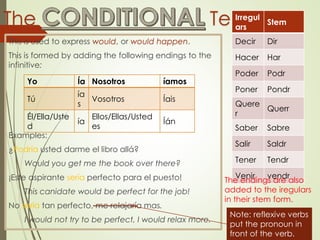
The Tense
This is used to express would, or would happen.
This is formed by adding the following endings to the
infinitive:
Examples:
¿Podría usted darme el libro allá?
Would you get me the book over there?
¡Este aspirante sería perfecto para el puesto!
This canidate would be perfect for the job!
No sería tan perfecto, me relajaría mas.
I would not try to be perfect, I would relax more.
Yo Ía Nosotros íamos
Tú
ía
s
Vosotros Íais
Él/Ella/Uste
d
ía
Ellos/Ellas/Usted
es
Íán
Irregul
ars
Stem
Decir Dir
Hacer Har
Poder Podr
Poner Pondr
Quere
r
Querr
Saber Sabre
Salir Saldr
Tener Tendr
Venir vendr
The endings are also
added to the iregulars
in their stem form.
Note: reflexive verbs
put the pronoun in
front of the verb.
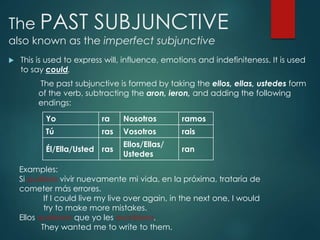
The PAST SUBJUNCTIVE
also known as the imperfect subjunctive
 This is used to express will, influence, emotions and indefiniteness. It is used
to say could.
The past subjunctive is formed by taking the ellos, ellas, ustedes form
of the verb, subtracting the aron, ieron, and adding the following
endings:
Yo ra Nosotros ramos
Tú ras Vosotros rais
Él/Ella/Usted ras
Ellos/Ellas/
Ustedes
ran
Examples:
Si pudiera vivir nuevamente mi vida, en la próxima, trataría de
cometer más errores.
If I could live my live over again, in the next one, I would
try to make more mistakes.
Ellos quisieran que yo les escribiera.
They wanted me to write to them.

Grammar book 2

  • 1.
    ¡EL ULTIMO LIBRODE GRAMÁTICA PARA MEJORAR SUS GRADES USTEDES EN SUS CLASES DE ESPAÑOL! POR ELIZABETH LUCIER
  • 3.
    Table of Content ContentPage Number Commands Nosotros Page 7 Tú Page 6 Conditional Tense Page 14 Future Tense Page 12-13 Past Participles as Adjectives Page 8 Past Perfect Page 10 Present Perfect Page 9 “Se” Impersonal Page 11 Subjunctive Adjective Page 4 Adverb Page 5 Past Page 15
  • 4.
    Subjunctive and Adjective Clauses modifynouns and pronouns The subjunctive is used in an adjective clause that refers to a person, place or thing that does not exist, is uncertain or indefinite. i.e Estoy buscando un profesor que enseñe español. The indicative is used when the adjective clause refers to a person, place, or thing that is clearly known certain or definite. Quiero ir al restaurante que está cerca de aquí. The indicative form are used when a personal a is used Necesitamos al empleado que sabe usar computadoras Necesitamos un empleado que sepa usar computadoras The subjunctive form is used when alguien and nadie are preceded by the personal a Busco a alguien que pueda cocinar. No conozco a nadie que pueda cocinar. The subjunctive is used when a person is uncertain while the indicative is used when a person is absolutely certain. Hay un parque que esté en Georgia Si hay un parque que está en Georgia Clause 1 Reletive Pronoun “Que” or “Como” Clause 2 Present, future or command form Present Subjunctive Preterite, imperfect, or contitional Past subjunctive
  • 5.
    Subjunctive and AdverbialClause Tells what, where, when and why Spanish Englishs A fin de que/ a fin de So that Hasta que Until Para que So that Antes de que Before A condición de que On the condition that A menos que Unless Con tal de que/ con tal de Provided that En caso de que/ En caso de In case that Sin que/sin Without Cuando When Después de que After Spanish English Trabajaremos mientras ellos descansen We will work wile they rest. Me lavaría después de comamos. I will brush my teeth after we eat. Como vayas conmigo, te pago la entrada. If you go with me, I will pay the entrance fee for you. Lo haré como digas. I will do it however you will say it. Subjuntive is used when the condition is uncertain. Clause 1 Reletive Pronoun “Que” or “Como” Clause 2 Present, future or command form Present Subjunctive Preterite, imperfect, or contitional Past subjunctive
  • 6.
    Tú commands used totell someone what to do informally. Tú commands= verb conjugated in the third person. Negative commands are conjugated in the tú form of the subjunctive Positive Negative Come la cena. Eat the dinner. No comas la cena. Don´t eat the dinner. Habla español. Speak Spanish No hables español. Don´t speak Spanish. The placement of the reflexive and object pronouns in tú commands puts an accent on the third to last syllable with verbs with three or more syllables! Negative commands with reflexives have the pronoun before the negative command! Examples of reflexives: levántate No te levantes Báñate No te bañes
  • 7.
    CORRESPONDS TO THEENGLISH LET´S Formed by using the first-person (we) plural form of the subjuntive when positive and negetive. Rules of Thumb: •Vamos a can mean let’s, but it also means we are going to do something •Vamos=let’s go •For reflexive Nosotros Comands, the final “s” is dropped, making a monkey verb. Accents still follow the Tú and Usted comands. •Levantémonos sentémonos •Object pronouns are placed in front of negetive verbs. •Vámonos=let’s go while no nos vayamos= let’s not go.
  • 8.
    How to Formthe Regular Past Participle drop the infinitive ending (-ar, -er, -ir) and add -ado to the stem of -ar verbs and -ido to the stem of -er and -ir verbs. A past participle (el participio) is a very useful form of a verb which can function as an adjective, a predicative, or as a verb in conjunction with haber to form the perfect tenses. This is equivalent to adding –ed in English. Past Participle Uses 1. The Perfect Tenses describes what a person has done Perfect Tense Formula haber + past participle ¿Has viajado mucho a Uruguay? (Have you traveled a lot to Uruguay?) Habré leído todos sus libros. (I will have read all of his books.) 2. As an Adjective Me encantan los huevos revueltos. (I love scrambled eggs.) Salimos por la puerta abierta. (We left through the open door.) 3. As a Predicative Adjective used in conjunction with a linking verb (ser, estar, parecer Mi novela favorita fue escrita por Gabriel García Márquez. (My favorite novel was written by Gabriel García Márquez.) Las puertas están cerradas. (The doors are closed.) Esta manzana parece podrida. (This apple seems rotten.)
  • 9.
    describes what aperson has done Spanish English Yo he terminado la carta. I have finished the letter. Ellos han empezado la casa nueva. They have started the new house. Ella ha leído aquella novela. She has read that novel. PerfectTense Formula haber + past participle=present perfect Haber Yo he Tú has él/ella/ usted ha Nosotros hemos Ellos/ellas/ ustedes han
  • 10.
    The past perfect usedto indicate an action in the past that occurred before another action in the past. The past perfect tense is formed using the formula below: imperfect conjugation of haber + the past participle = past perfect Ya había salido cuando tú llamaste. I had already left (when you called). No habían comido antes de hacer su tarea. They hadn't eaten (before doing their homework). Fui al mercado por la mañana; ya había ido al banco. I went to the store this morning; I had already gone to the bank.
  • 11.
    “SE” IMPERSONAL This isused to avoid specifying a person doing something. The impersonal is formed by adding “se” before a verb. Examples: Se habla español aquí. Spanish is spoken here. Se busco una persona que sepa trabajar con los computadoras. I am looking for a person who knows how to work with the computers.
  • 12.
    THE FUTURE TENSE Thereare two ways to express an action that will be done: 1.Ir + A+infinitive= future i.e Voy a ir a la tienda 2.Add these endings to ALL the infinitive verbs: Yo é Nosotros emos Tú ás Vosotros éis Él/Ella/U sted á Ellos/Ellas/Ustedes án Irregulars Stem Decir Dir Hacer Har Poder Podr Poner Pondr Querer Querr Saber Sabre Salir Saldr Tener Tendr Venir vendr The endings are also added to the iregulars in their stem form. Examples: 1. Yo estudiaré para mi examine. I will study for my exam 2. La próxima semana habrá un reunión. There will be a meeting. Note: reflexive verbs put the pronoun in front of the verb.
  • 13.
    While using theFuture Tense Probability  This is used to express I wonder, I bet, Probably, must be, and may be. (It often expresses a conjecture about the present conditions, events, or actions. It resembles the words I wonder It’s probably It must be. Examples: ¿Dónde estará mis libros? I wonder where my books are. Estarán encima mi escritorio. They must be on my desk. Willingness The future is also used to refer to someone´s willingness. This is expressed querer+[infinitive] Examples: ¿Quieres llamar el mecánico? Will you call the mechanic? ¿Quieren ustedes escuchamos? Will you please listen to us?
  • 14.
    The Tense This isused to express would, or would happen. This is formed by adding the following endings to the infinitive: Examples: ¿Podría usted darme el libro allá? Would you get me the book over there? ¡Este aspirante sería perfecto para el puesto! This canidate would be perfect for the job! No sería tan perfecto, me relajaría mas. I would not try to be perfect, I would relax more. Yo Ía Nosotros íamos Tú ía s Vosotros Íais Él/Ella/Uste d ía Ellos/Ellas/Usted es Íán Irregul ars Stem Decir Dir Hacer Har Poder Podr Poner Pondr Quere r Querr Saber Sabre Salir Saldr Tener Tendr Venir vendr The endings are also added to the iregulars in their stem form. Note: reflexive verbs put the pronoun in front of the verb.
  • 15.
    The PAST SUBJUNCTIVE alsoknown as the imperfect subjunctive  This is used to express will, influence, emotions and indefiniteness. It is used to say could. The past subjunctive is formed by taking the ellos, ellas, ustedes form of the verb, subtracting the aron, ieron, and adding the following endings: Yo ra Nosotros ramos Tú ras Vosotros rais Él/Ella/Usted ras Ellos/Ellas/ Ustedes ran Examples: Si pudiera vivir nuevamente mi vida, en la próxima, trataría de cometer más errores. If I could live my live over again, in the next one, I would try to make more mistakes. Ellos quisieran que yo les escribiera. They wanted me to write to them.