What is an adverb?
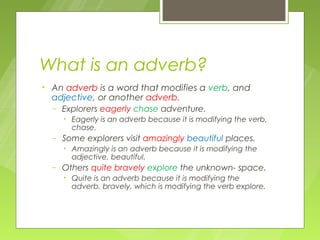
•   An adverb is a word that modifies a verb, and
    adjective, or another adverb.
    – Explorers eagerly chase adventure.
        •   Eagerly is an adverb because it is modifying the verb,
            chase.
    –   Some explorers visit amazingly beautiful places.
        •   Amazingly is an adverb because it is modifying the
            adjective, beautiful.
    –   Others quite bravely explore the unknown- space.
        •   Quite is an adverb because it is modifying the
            adverb, bravely, which is modifying the verb explore.
Adverbs
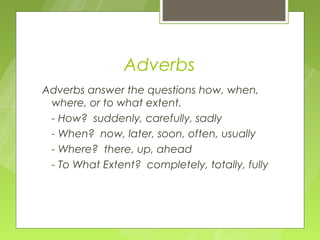
Adverbs answer the questions how, when,
 where, or to what extent.
 - How? suddenly, carefully, sadly
 - When? now, later, soon, often, usually
 - Where? there, up, ahead
 - To What Extent? completely, totally, fully
Adverbs
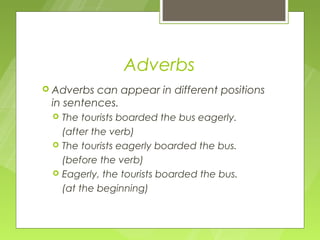
 Adverbs can appear in different positions
 in sentences.
    The tourists boarded the bus eagerly.
     (after the verb)
    The tourists eagerly boarded the bus.
     (before the verb)
    Eagerly, the tourists boarded the bus.
     (at the beginning)
Adverbs
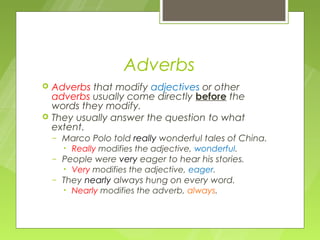
   Adverbs that modify adjectives or other
    adverbs usually come directly before the
    words they modify.
   They usually answer the question to what
    extent.
    –   Marco Polo told really wonderful tales of China.
        • Really modifies the adjective, wonderful.
    –   People were very eager to hear his stories.
        • Very modifies the adjective, eager.
    –   They nearly always hung on every word.
        • Nearly modifies the adverb, always.
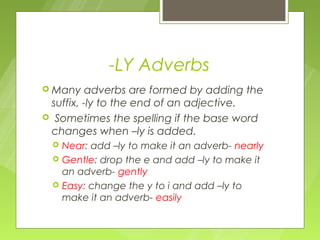
-LY Adverbs
 Many    adverbs are formed by adding the
 suffix, -ly to the end of an adjective.
 Sometimes the spelling if the base word
 changes when –ly is added.
    Near: add –ly to make it an adverb- nearly
    Gentle: drop the e and add –ly to make it
     an adverb- gently
    Easy: change the y to i and add –ly to
     make it an adverb- easily
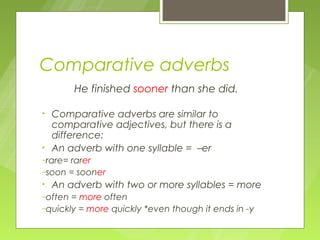
Comparative adverbs
         He finished sooner than she did.

•   Comparative adverbs are similar to
    comparative adjectives, but there is a
    difference:
•   An adverb with one syllable = –er
–rare=rarer
–soon = sooner
•   An adverb with two or more syllables = more
–often = more often
–quickly = more quickly *even though it ends in -y
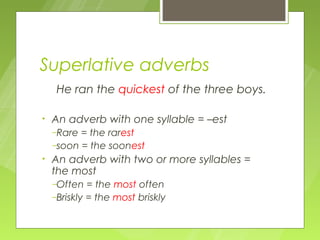
Superlative adverbs
    He ran the quickest of the three boys.

•   An adverb with one syllable = –est
    –Rare = the rarest
    –soon = the soonest
•   An adverb with two or more syllables =
    the most
    –Often   = the most often
    –Briskly = the most briskly
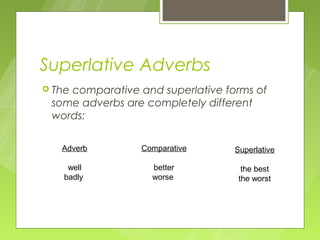
Superlative Adverbs
 The
    comparative and superlative forms of
 some adverbs are completely different
 words:

   Adverb        Comparative      Superlative

    well           better           the best
   badly           worse           the worst
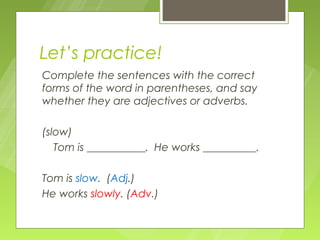
Let’s practice!
Complete the sentences with the correct
forms of the word in parentheses, and say
whether they are adjectives or adverbs.

(slow)
   Tom is ___________. He works __________.

Tom is slow. (Adj.)
He works slowly. (Adv.)
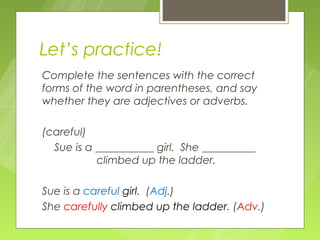
Let’s practice!
Complete the sentences with the correct
forms of the word in parentheses, and say
whether they are adjectives or adverbs.

(careful)
  Sue is a ___________ girl. She __________
           climbed up the ladder.

Sue is a careful girl. (Adj.)
She carefully climbed up the ladder. (Adv.)
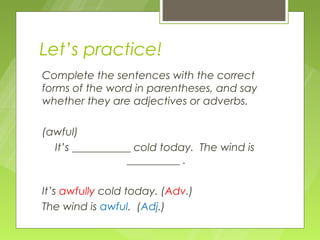
Let’s practice!
Complete the sentences with the correct
forms of the word in parentheses, and say
whether they are adjectives or adverbs.

(awful)
  It’s ___________ cold today. The wind is
                 __________ .

It’s awfully cold today. (Adv.)
The wind is awful. (Adj.)
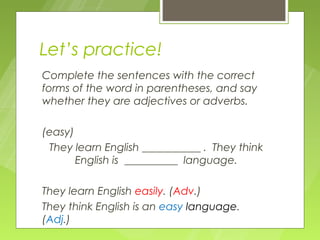
Let’s practice!
Complete the sentences with the correct
forms of the word in parentheses, and say
whether they are adjectives or adverbs.

(easy)
 They learn English ___________ . They think
       English is __________ language.

They learn English easily. (Adv.)
They think English is an easy language.
(Adj.)
Let’s practice!
Complete the sentences with the correct
forms of the word in parentheses, and say
whether they are adjectives or adverbs.

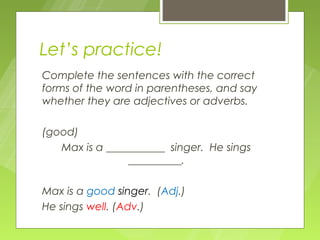
(good)
   Max is a ___________ singer. He sings
                __________.

Max is a good singer. (Adj.)
He sings well. (Adv.)
Let’s practice!
Identify the adverbs in the sentences.
Remember: adverbs answer –who, -when,
-where, and –to what extent.

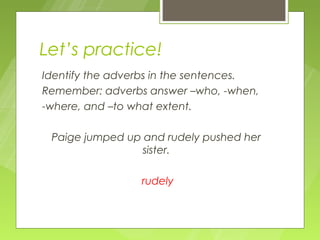
 Paige jumped up and rudely pushed her
                 sister.

                 rudely
Let’s practice!
Identify the adverbs in the sentences.
Remember: adverbs answer –who, -when,
-where, and –to what extent.

   Rarely did Christian go to company
               meetings.

                 rarely
Let’s practice!
Identify the adverbs in the sentences.
Remember: adverbs answer –who, -when,
-where, and –to what extent.

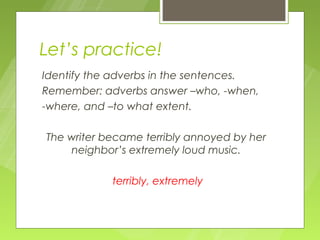
The writer became terribly annoyed by her
    neighbor’s extremely loud music.

            terribly, extremely
Let’s practice!
Identify the adverbs in the sentences.
Remember: adverbs answer –who, -when,
-where, and –to what extent.

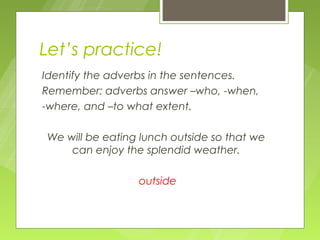
We will be eating lunch outside so that we
    can enjoy the splendid weather.

                 outside
Let’s practice!
Identify the adverbs in the sentences.
Remember: adverbs answer –who, -when,
-where, and –to what extent.

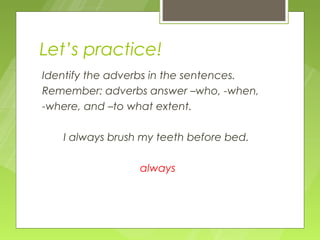
   I always brush my teeth before bed.

                 always
Let’s practice!
Identify the adverbs in the sentences.
Remember: adverbs answer –who, -when,
-where, and –to what extent.

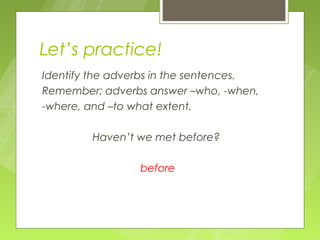
        Haven’t we met before?

                 before
Let’s practice!
Identify the adverbs in the sentences.
Remember: adverbs answer –who, -when,
-where, and –to what extent.

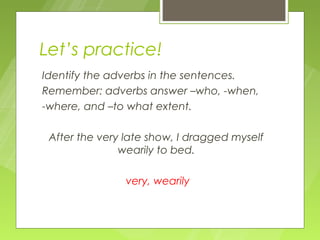
 After the very late show, I dragged myself
               wearily to bed.

                very, wearily
Let’s practice!
Identify the adverbs in the sentences.
Remember: adverbs answer –who, -when,
-where, and –to what extent.

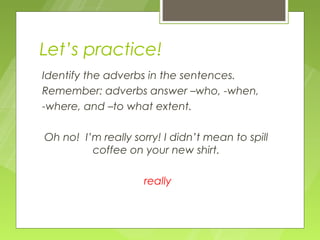
Oh no! I’m really sorry! I didn’t mean to spill
         coffee on your new shirt.

                    really

09 13 adverbs

  • 1.
    What is anadverb? • An adverb is a word that modifies a verb, and adjective, or another adverb. – Explorers eagerly chase adventure. • Eagerly is an adverb because it is modifying the verb, chase. – Some explorers visit amazingly beautiful places. • Amazingly is an adverb because it is modifying the adjective, beautiful. – Others quite bravely explore the unknown- space. • Quite is an adverb because it is modifying the adverb, bravely, which is modifying the verb explore.
  • 2.
    Adverbs Adverbs answer thequestions how, when, where, or to what extent. - How? suddenly, carefully, sadly - When? now, later, soon, often, usually - Where? there, up, ahead - To What Extent? completely, totally, fully
  • 3.
    Adverbs  Adverbs canappear in different positions in sentences.  The tourists boarded the bus eagerly. (after the verb)  The tourists eagerly boarded the bus. (before the verb)  Eagerly, the tourists boarded the bus. (at the beginning)
  • 4.
    Adverbs  Adverbs that modify adjectives or other adverbs usually come directly before the words they modify.  They usually answer the question to what extent. – Marco Polo told really wonderful tales of China. • Really modifies the adjective, wonderful. – People were very eager to hear his stories. • Very modifies the adjective, eager. – They nearly always hung on every word. • Nearly modifies the adverb, always.
  • 5.
    -LY Adverbs  Many adverbs are formed by adding the suffix, -ly to the end of an adjective.  Sometimes the spelling if the base word changes when –ly is added.  Near: add –ly to make it an adverb- nearly  Gentle: drop the e and add –ly to make it an adverb- gently  Easy: change the y to i and add –ly to make it an adverb- easily
  • 6.
    Comparative adverbs He finished sooner than she did. • Comparative adverbs are similar to comparative adjectives, but there is a difference: • An adverb with one syllable = –er –rare=rarer –soon = sooner • An adverb with two or more syllables = more –often = more often –quickly = more quickly *even though it ends in -y
  • 7.
    Superlative adverbs He ran the quickest of the three boys. • An adverb with one syllable = –est –Rare = the rarest –soon = the soonest • An adverb with two or more syllables = the most –Often = the most often –Briskly = the most briskly
  • 8.
    Superlative Adverbs  The comparative and superlative forms of some adverbs are completely different words: Adverb Comparative Superlative well better the best badly worse the worst
  • 9.
    Let’s practice! Complete thesentences with the correct forms of the word in parentheses, and say whether they are adjectives or adverbs. (slow) Tom is ___________. He works __________. Tom is slow. (Adj.) He works slowly. (Adv.)
  • 10.
    Let’s practice! Complete thesentences with the correct forms of the word in parentheses, and say whether they are adjectives or adverbs. (careful) Sue is a ___________ girl. She __________ climbed up the ladder. Sue is a careful girl. (Adj.) She carefully climbed up the ladder. (Adv.)
  • 11.
    Let’s practice! Complete thesentences with the correct forms of the word in parentheses, and say whether they are adjectives or adverbs. (awful) It’s ___________ cold today. The wind is __________ . It’s awfully cold today. (Adv.) The wind is awful. (Adj.)
  • 12.
    Let’s practice! Complete thesentences with the correct forms of the word in parentheses, and say whether they are adjectives or adverbs. (easy) They learn English ___________ . They think English is __________ language. They learn English easily. (Adv.) They think English is an easy language. (Adj.)
  • 13.
    Let’s practice! Complete thesentences with the correct forms of the word in parentheses, and say whether they are adjectives or adverbs. (good) Max is a ___________ singer. He sings __________. Max is a good singer. (Adj.) He sings well. (Adv.)
  • 14.
    Let’s practice! Identify theadverbs in the sentences. Remember: adverbs answer –who, -when, -where, and –to what extent. Paige jumped up and rudely pushed her sister. rudely
  • 15.
    Let’s practice! Identify theadverbs in the sentences. Remember: adverbs answer –who, -when, -where, and –to what extent. Rarely did Christian go to company meetings. rarely
  • 16.
    Let’s practice! Identify theadverbs in the sentences. Remember: adverbs answer –who, -when, -where, and –to what extent. The writer became terribly annoyed by her neighbor’s extremely loud music. terribly, extremely
  • 17.
    Let’s practice! Identify theadverbs in the sentences. Remember: adverbs answer –who, -when, -where, and –to what extent. We will be eating lunch outside so that we can enjoy the splendid weather. outside
  • 18.
    Let’s practice! Identify theadverbs in the sentences. Remember: adverbs answer –who, -when, -where, and –to what extent. I always brush my teeth before bed. always
  • 19.
    Let’s practice! Identify theadverbs in the sentences. Remember: adverbs answer –who, -when, -where, and –to what extent. Haven’t we met before? before
  • 20.
    Let’s practice! Identify theadverbs in the sentences. Remember: adverbs answer –who, -when, -where, and –to what extent. After the very late show, I dragged myself wearily to bed. very, wearily
  • 21.
    Let’s practice! Identify theadverbs in the sentences. Remember: adverbs answer –who, -when, -where, and –to what extent. Oh no! I’m really sorry! I didn’t mean to spill coffee on your new shirt. really