BACTERIA:
ENUMERATION
Mr. Krishnakant B. Bhelkar
Asst. Professor,
Gurunanak College of Pharmacy,
Nagpur
Unit I
Pharmaceutical Microbiology
B. Pharm III Semester
TYPES OF BACTERIAL COUNT
• Total Bacterial Count
This is the no. of bacterial cells present in the bacterial culture. It
includes dead as well as living cells.
Thus
Total bacterial cell count = No. of dead cells + No. of living cells
Methods like microscopy, total nitrogen determination,
measurement by cell activity can not distinguish between
dead cells and alive cells and measures both types of cells,
hence gives total bacterial cell count
• Total Viable Count
A viable cell count is the number living bacterial cells or actively
growing/dividing cells in a sample.
The plate count method or spread plate technique relies on
bacteria growing a colony on a nutrient medium.
NEED OF BACTERIAL ENUMERATION
Microbiologist often has to determine the number of bacteria in a
given sample for various purposes, such as
• To compare the amount of bacterial growth under various
conditions.
• It is also important in dairy microbiology, food microbiology, and
water microbiology.
• Knowing the bacterial count in drinking water, fresh milk,
buttermilk, yogurt.
METHODS OF ENUMERATION OF
BACTERIAL CELLS
There are various methods used for bacterial enumeration
• Determination of Cell Number
• Direct Count Methods (Total Count)
 Microscopy Technique
 Coulter Counter Technique
• Indirect Count Methods (Viable Count)
 Serial Dilution Method
 Membrane Filter Count
• Determination of Cell Mass
 Determination of Dry Weight
 Measurement of Cell Nitrogen
 Turbidimetric Method
• Determination of Cell Activity
DETERMINATION OF CELL NUMBER
Direct Count Methods (Total Count)
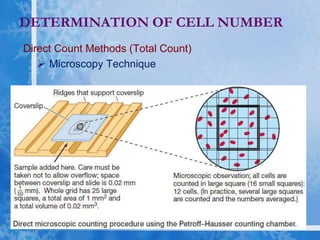
 Microscopy Technique
• A total count of microbial numbers can be achieved using
a microscope to observe and enumerate the cells present
in a culture or natural sample.
• The method is simple, but the results can be unreliable.
• Microscopic counts can be done on either samples dried
on slides or on samples in liquid. Dried samples can be
stained to increase contrast between cells and their
background.
• With liquid samples, specially designed counting
chambers such as Petroff- Hausser Counting Chamber
are used.
DETERMINATION OF CELL NUMBER
Direct Count Methods (Total Count)
 Microscopy Technique
• In Petroff- Hausser Counting Chamber counting chamber,
a grid with squares of known area is marked on the
surface of a glass slide.
• When the coverslip is placed on the chamber, each
square on the grid has a precisely measured volume.
• The number of cells per unit area of grid can be counted
under the microscope, giving a measure of the number of
cells per small chamber volume.
• The number of cells per milliliter of suspension is
calculated by employing a conversion factor based on the
volume of the chamber sample.
DETERMINATION OF CELL NUMBER
Direct Count Methods (Total Count)
 Microscopy Technique
DETERMINATION OF CELL NUMBER
Direct Count Methods (Total Count)
 Coulter Counter Technique
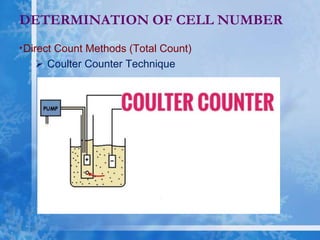
 A Coulter counter is a device that is used to measure the
number of cells in a certain volume of a sample
suspension.
 The counter achieves this enumeration by monitoring the
decrease in electrical conductivity that occurs when the
cells pass through a small opening in the device.
 This was originally developed for use with blood cells,
 In micro-biology it is used to determine the total number
of bacterial cells in samples.
• .
DETERMINATION OF CELL NUMBER
Direct Count Methods (Total Count)
 Coulter Counter Technique
Indirect Count Methods (Viable Count)
 Serial Dilution Method (Plate Count Method)
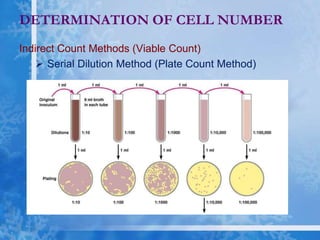
 Serial dilution is a process through which the
concentration of an organism, bacteria is systematically
reduced through successive resuspension in fixed
volumes of liquid diluent.
 Usually the volume of the diluent is a multiple of 10 to
facilitate logarithmic reduction of the sample organism.
• The assumption made in the viable counting procedure is
that
• each viable cell can grow and divide to yield one colony.
• • Thus, colony numbers are a reflection of cell numbers.
• • There are at least two ways of performing a plate count:
the
• spread-plate method and the pour-plate method.
DETERMINATION OF CELL NUMBER
Indirect Count Methods (Viable Count)
 Serial Dilution Method (Plate Count Method)
 Procedure
 One ml of bacterial culture is taken from the bacterial
culture and added to 9 milliliters of an appropriate
liquid medium.
 Then, one milliliter of this first dilution is added to
another tube containing nine milliliters of medium.
 The process can be repeated until several different
concentrations of bacteria have been prepared.
DETERMINATION OF CELL NUMBER
Indirect Count Methods (Viable Count)
 Serial Dilution Method (Plate Count Method)
DETERMINATION OF CELL NUMBER
Indirect Count Methods (Viable Count)
 Membrane Filter Count
This method is used to test large volumes of samples
In membrane filter count method, known volumes are
filtered through membrane filter with pores 0.45 μm in
diameter,
Bacteria are retained on the surface of a membrane
filter and then transferred to a culture medium to grow
and subsequently be counted.
DETERMINATION OF CELL NUMBER
Indirect Count Methods (Viable Count)
 Membrane Filter Count
DETERMINATION OF CELL NUMBER
 Determination of Dry Weight
 Dry weight of pre-weighed filter paper containing pellets
of microbial cells is measured.
 Dry weight of filter paper is nullified by subtracting the dry
weight of only filter paper of similar size.
 Thus dry weight of microbial cells can be obtained.
 However, it can be used only with very dense
suspensions and the cells must be washed free of all
extraneous matter.
 Dry weight may not always be an indicative of the amount
of living material in the cells.
• DETERMINATION OF CELL MASS
 Determination of Dry Weight
 Dry weight may continue to increase without
corresponding cell growth due to the accumulation of
intracellular reserve materials. Yet, for many organisms,
the determination of dry weight is an accurate and
reliable way to measure growth and is widely used in
research.
 Advantages- only way to determine growth of filamentous
bacteria. It is rapid and easy.
 Disadvantages- cumbersome, not very accurate. It does
not give you cell numbers or increase in mass. It cannot
distinguish between live and dead cells and must work
within certain absorbency (more than 107 and less than
108).
• DETERMINATION OF CELL MASS
 Measurement of Cell Nitrogen
 Bacterial cells comprised of about 14% nitrogen content
on dry weight basis.
 Hence in this method, purified and dried cell mass is
subjected to quantitative chemical analysis to determine
total nitrogen.
 This can be correlated with the total bacterial cell mass
and ultimately to bacterial cell count.
• DETERMINATION OF CELL MASS
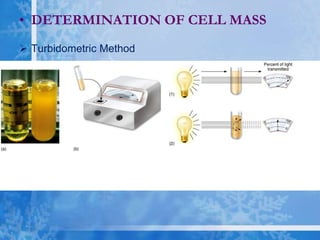
 Turbidimetric Method
Bacterial cells are actual objects instead of dissolved
substances, Hence cells scatter light, and a rapid and
quite useful method of estimating cell numbers based on
this property is turbidity.
A suspension of cells looks cloudy (turbid) to the eye
because cells scatter light passing through the
suspension.
The more cells that are present, the more light is
scattered, and hence the more turbid the suspension.
What is actually assessed in a turbidimetric measurement
is total cell mass.
However, because cell mass is proportional to cell
number, turbidity can be used as a measure of cell
numbers
• DETERMINATION OF CELL MASS
 Turbidimetric Method
Turbidimetry is a simple, rapid method for following
growth.
 A spectrophotometer or calorimeter can be used for
turbidimetric measurements of cell mass.
A spectrophotometer is used to determine turbidity
("cloudiness") by measuring the amount of light that
passed through a suspension of cells.
More cells = more turbidity; more turbidity = less light
passing through the suspension
However, the culture to be measured must be dense
enough to register some turbidity on the instrument.
• DETERMINATION OF CELL MASS
 Turbidimetric Method
Moreover, it may not be possible to measure cultures
grown in deeply coloured media or cultures that contain
suspended material other than bacteria.
It must also be recognised that dead as well as living cells
contribute to turbidity.
(%T) percent transmission - fewer cells present (less
turbidity) and thus will allow more light to pass through.
Therefore the %T is higher when the cell number is lower.
Absorbance is the opposite of %T.
More light is absorbed when more cells are present and
thus absorbance goes up as turbidity (or cell number)
goes up.
• DETERMINATION OF CELL MASS
 Turbidometric Method
• DETERMINATION OF CELL MASS
Another indirect way of estimating bacterial numbers is measuring
the metabolic activity of the population (for example, acid
production or oxygen consumption, nutrient utilization, waste
production, pH, etc).
The assumption is that the amount of acid produced or oxygen
consumed under specific conditions and during a fixed period of
time is proportional to the magnitude of bacterial population.
Admittedly, the measurement of acid or any other end product is a
very indirect approach to the measurement of growth and is
applicable only in special circumstances.
DETERMINATION OF CELL ACTIVITY
Bacterial Cells Enumeration

Bacterial Cells Enumeration

  • 1.
    BACTERIA: ENUMERATION Mr. Krishnakant B.Bhelkar Asst. Professor, Gurunanak College of Pharmacy, Nagpur Unit I Pharmaceutical Microbiology B. Pharm III Semester
  • 2.
    TYPES OF BACTERIALCOUNT • Total Bacterial Count This is the no. of bacterial cells present in the bacterial culture. It includes dead as well as living cells. Thus Total bacterial cell count = No. of dead cells + No. of living cells Methods like microscopy, total nitrogen determination, measurement by cell activity can not distinguish between dead cells and alive cells and measures both types of cells, hence gives total bacterial cell count • Total Viable Count A viable cell count is the number living bacterial cells or actively growing/dividing cells in a sample. The plate count method or spread plate technique relies on bacteria growing a colony on a nutrient medium.
  • 3.
    NEED OF BACTERIALENUMERATION Microbiologist often has to determine the number of bacteria in a given sample for various purposes, such as • To compare the amount of bacterial growth under various conditions. • It is also important in dairy microbiology, food microbiology, and water microbiology. • Knowing the bacterial count in drinking water, fresh milk, buttermilk, yogurt.
  • 4.
    METHODS OF ENUMERATIONOF BACTERIAL CELLS There are various methods used for bacterial enumeration • Determination of Cell Number • Direct Count Methods (Total Count)  Microscopy Technique  Coulter Counter Technique • Indirect Count Methods (Viable Count)  Serial Dilution Method  Membrane Filter Count • Determination of Cell Mass  Determination of Dry Weight  Measurement of Cell Nitrogen  Turbidimetric Method • Determination of Cell Activity
  • 5.
    DETERMINATION OF CELLNUMBER Direct Count Methods (Total Count)  Microscopy Technique • A total count of microbial numbers can be achieved using a microscope to observe and enumerate the cells present in a culture or natural sample. • The method is simple, but the results can be unreliable. • Microscopic counts can be done on either samples dried on slides or on samples in liquid. Dried samples can be stained to increase contrast between cells and their background. • With liquid samples, specially designed counting chambers such as Petroff- Hausser Counting Chamber are used.
  • 6.
    DETERMINATION OF CELLNUMBER Direct Count Methods (Total Count)  Microscopy Technique • In Petroff- Hausser Counting Chamber counting chamber, a grid with squares of known area is marked on the surface of a glass slide. • When the coverslip is placed on the chamber, each square on the grid has a precisely measured volume. • The number of cells per unit area of grid can be counted under the microscope, giving a measure of the number of cells per small chamber volume. • The number of cells per milliliter of suspension is calculated by employing a conversion factor based on the volume of the chamber sample.
  • 7.
    DETERMINATION OF CELLNUMBER Direct Count Methods (Total Count)  Microscopy Technique
  • 8.
    DETERMINATION OF CELLNUMBER Direct Count Methods (Total Count)  Coulter Counter Technique  A Coulter counter is a device that is used to measure the number of cells in a certain volume of a sample suspension.  The counter achieves this enumeration by monitoring the decrease in electrical conductivity that occurs when the cells pass through a small opening in the device.  This was originally developed for use with blood cells,  In micro-biology it is used to determine the total number of bacterial cells in samples.
  • 9.
    • . DETERMINATION OFCELL NUMBER Direct Count Methods (Total Count)  Coulter Counter Technique
  • 10.
    Indirect Count Methods(Viable Count)  Serial Dilution Method (Plate Count Method)  Serial dilution is a process through which the concentration of an organism, bacteria is systematically reduced through successive resuspension in fixed volumes of liquid diluent.  Usually the volume of the diluent is a multiple of 10 to facilitate logarithmic reduction of the sample organism. • The assumption made in the viable counting procedure is that • each viable cell can grow and divide to yield one colony. • • Thus, colony numbers are a reflection of cell numbers. • • There are at least two ways of performing a plate count: the • spread-plate method and the pour-plate method. DETERMINATION OF CELL NUMBER
  • 11.
    Indirect Count Methods(Viable Count)  Serial Dilution Method (Plate Count Method)  Procedure  One ml of bacterial culture is taken from the bacterial culture and added to 9 milliliters of an appropriate liquid medium.  Then, one milliliter of this first dilution is added to another tube containing nine milliliters of medium.  The process can be repeated until several different concentrations of bacteria have been prepared. DETERMINATION OF CELL NUMBER
  • 12.
    Indirect Count Methods(Viable Count)  Serial Dilution Method (Plate Count Method) DETERMINATION OF CELL NUMBER
  • 13.
    Indirect Count Methods(Viable Count)  Membrane Filter Count This method is used to test large volumes of samples In membrane filter count method, known volumes are filtered through membrane filter with pores 0.45 μm in diameter, Bacteria are retained on the surface of a membrane filter and then transferred to a culture medium to grow and subsequently be counted. DETERMINATION OF CELL NUMBER
  • 14.
    Indirect Count Methods(Viable Count)  Membrane Filter Count DETERMINATION OF CELL NUMBER
  • 15.
     Determination ofDry Weight  Dry weight of pre-weighed filter paper containing pellets of microbial cells is measured.  Dry weight of filter paper is nullified by subtracting the dry weight of only filter paper of similar size.  Thus dry weight of microbial cells can be obtained.  However, it can be used only with very dense suspensions and the cells must be washed free of all extraneous matter.  Dry weight may not always be an indicative of the amount of living material in the cells. • DETERMINATION OF CELL MASS
  • 16.
     Determination ofDry Weight  Dry weight may continue to increase without corresponding cell growth due to the accumulation of intracellular reserve materials. Yet, for many organisms, the determination of dry weight is an accurate and reliable way to measure growth and is widely used in research.  Advantages- only way to determine growth of filamentous bacteria. It is rapid and easy.  Disadvantages- cumbersome, not very accurate. It does not give you cell numbers or increase in mass. It cannot distinguish between live and dead cells and must work within certain absorbency (more than 107 and less than 108). • DETERMINATION OF CELL MASS
  • 17.
     Measurement ofCell Nitrogen  Bacterial cells comprised of about 14% nitrogen content on dry weight basis.  Hence in this method, purified and dried cell mass is subjected to quantitative chemical analysis to determine total nitrogen.  This can be correlated with the total bacterial cell mass and ultimately to bacterial cell count. • DETERMINATION OF CELL MASS
  • 18.
     Turbidimetric Method Bacterialcells are actual objects instead of dissolved substances, Hence cells scatter light, and a rapid and quite useful method of estimating cell numbers based on this property is turbidity. A suspension of cells looks cloudy (turbid) to the eye because cells scatter light passing through the suspension. The more cells that are present, the more light is scattered, and hence the more turbid the suspension. What is actually assessed in a turbidimetric measurement is total cell mass. However, because cell mass is proportional to cell number, turbidity can be used as a measure of cell numbers • DETERMINATION OF CELL MASS
  • 19.
     Turbidimetric Method Turbidimetryis a simple, rapid method for following growth.  A spectrophotometer or calorimeter can be used for turbidimetric measurements of cell mass. A spectrophotometer is used to determine turbidity ("cloudiness") by measuring the amount of light that passed through a suspension of cells. More cells = more turbidity; more turbidity = less light passing through the suspension However, the culture to be measured must be dense enough to register some turbidity on the instrument. • DETERMINATION OF CELL MASS
  • 20.
     Turbidimetric Method Moreover,it may not be possible to measure cultures grown in deeply coloured media or cultures that contain suspended material other than bacteria. It must also be recognised that dead as well as living cells contribute to turbidity. (%T) percent transmission - fewer cells present (less turbidity) and thus will allow more light to pass through. Therefore the %T is higher when the cell number is lower. Absorbance is the opposite of %T. More light is absorbed when more cells are present and thus absorbance goes up as turbidity (or cell number) goes up. • DETERMINATION OF CELL MASS
  • 21.
     Turbidometric Method •DETERMINATION OF CELL MASS
  • 22.
    Another indirect wayof estimating bacterial numbers is measuring the metabolic activity of the population (for example, acid production or oxygen consumption, nutrient utilization, waste production, pH, etc). The assumption is that the amount of acid produced or oxygen consumed under specific conditions and during a fixed period of time is proportional to the magnitude of bacterial population. Admittedly, the measurement of acid or any other end product is a very indirect approach to the measurement of growth and is applicable only in special circumstances. DETERMINATION OF CELL ACTIVITY