STAININGTECHNIQUES
• Based on function of stain:
1. Simple staining – only one dye is used-
differentiation among bacteria is impossible-
Eg. Simple Staining.
2. Differential staining- more than one dye is
used- Differentiation among bacteria is
possible- Eg. Gram’s staining, Acid-fast
staining.
3. Special staining – more than one dye used -
Special structures are seen.
Eg. Capsule staining, Spore staining.
Each staining methods have own principles but
the following steps may be common:
Basic stain(+ve charge) –
To stain -ve charged molecules of bacteria
Mostly used because cell surface is –ve charge.
Acidic Stain(-ve charge)
To stain +ve charged molecules of bacteria.
Used to stain the bacterial capsules.
As cell surface is –ve charged- Basic dyes
mostly used.
Principle of staining:
•Clean grease-free slide.
•Bacteria to be stained.
•Inoculating loops- to transfer bacterial
suspension to slide.
•Bunsen burner – to sterilise inoculating
loops before and after smear
preparation.
•Pencil marker – to mark (particularly
central portion of slide) where bacterial
smear is applied
Basic requirements for staining:
Smear preparation:
Putting of bacterial suspension (bacteria
in liquid) tobe stained on the central
portion of slide in a circular fashion, air-
dried, heat-fixed, the resultant
preparation called bacterial smear-
appears dull white.
Basic initial steps before staining:
• Simple to perform- only one basic stain used.
Eg. Crystal violet, Methylene blue, Basic
fuschin, Malachite green etc.,
Principle:
- All bacteria in smear takes stain and
appears in colour of stain.
- Basic stain more affinity towards bacterial
surface & stains the bacteria.
Uses:
To study morphology and arrangement of
bacteria.
SIMPLE STAINING:
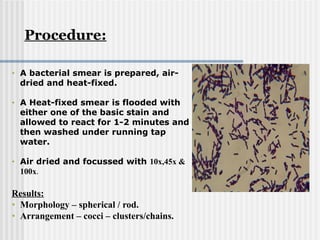
• A bacterial smear is prepared, air-
dried and heat-fixed.
• A Heat-fixed smear is flooded with
either one of the basic stain and
allowed to react for 1-2 minutes and
then washed under running tap
water.
• Air dried and focussed with 10x,45x &
100x.
Results:
• Morphology – spherical / rod.
• Arrangement – cocci – clusters/chains.
Procedure:
GRAM STAINING
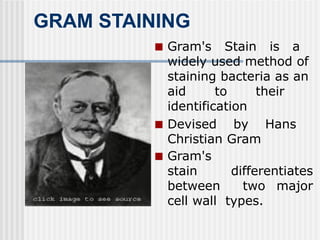
■ Gram's Stain is a
widely used method of
staining bacteria as an
aid to their
identification
■ Devised by Hans
Christian Gram
■ Gram's
stain differentiates
between two major
cell wall types.
GRAM STAINING
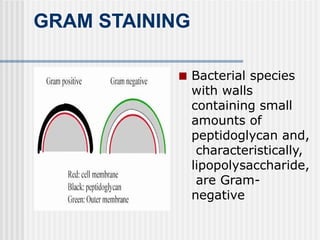
■ Bacterial species
with walls
containing small
amounts of
peptidoglycan and,
characteristically,
lipopolysaccharide,
are Gram-
negative
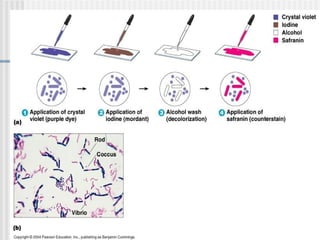
The process includes the use of:
a primary stain (crystal violet)
a mordant (helper) iodine solution, a
decolorizer (95% ethanol),
a counterstain (safranin).
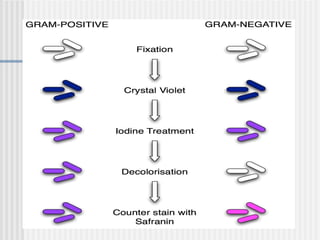
1. Crystal violet - all bacteria take crystal
violet- so all appears violet.
2. Iodine – Crystal Violet-iodine(CV-I) complex
is formed.
3. Acetone- bacteria with high lipid content
loose CV-I complex(appear colouless) but
bacteria with less lipid content retains CV-I
complex ( appear violet).
4. Safranine/ dilute carbol fuchsin – only
colouless bacteria takes – appear pink.
PRINCIPLE:
Colour:
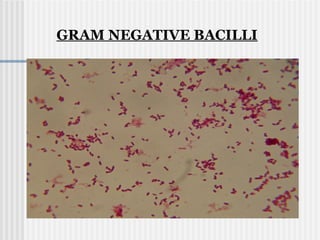
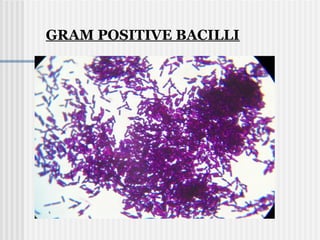
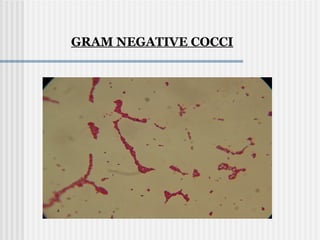
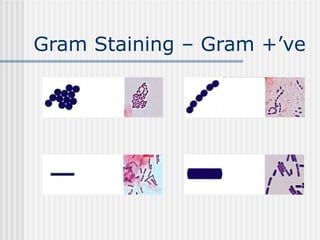
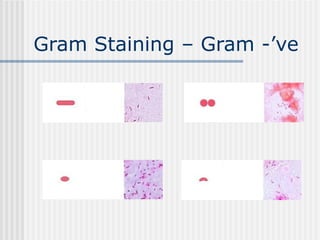
Purple colored bacteria – Gram positive
Pink colored bacteria – Gram negative
Shape:
Spherical – cocci
Rod – bacilli
Arrangement
Cocci in clusters – staphylococci
Cocci in chains - streptococci
RESULT:
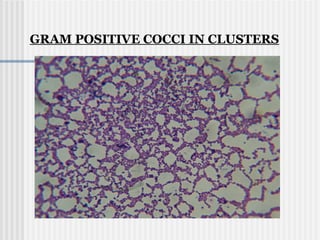
GRAM POSITIVE COCCI IN CLUSTERS
GRAM NEGATIVE BACILLI
GRAM POSITIVE BACILLI
GRAM NEGATIVE COCCI
Gram Staining – Gram +’ve
Gram Staining – Gram -’ve
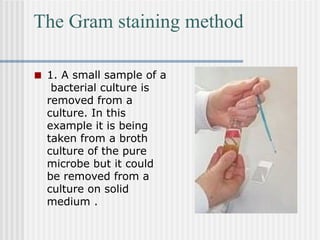
The Gram staining method
■ 1. A small sample of a
bacterial culture is
removed from a
culture. In this
example it is being
taken from a broth
culture of the pure
microbe but it could
be removed from a
culture on solid
medium .
The Gram staining method
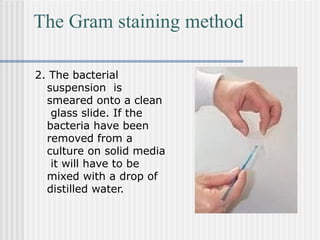
2. The bacterial
suspension is
smeared onto a clean
glass slide. If the
bacteria have been
removed from a
culture on solid media
it will have to be
mixed with a drop of
distilled water.
The Gram staining method
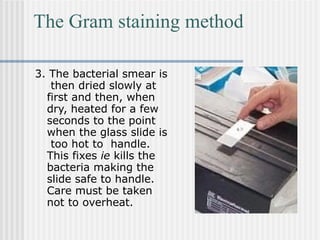
3. The bacterial smear is
then dried slowly at
first and then, when
dry, heated for a few
seconds to the point
when the glass slide is
too hot to handle.
This fixes ie kills the
bacteria making the
slide safe to handle.
Care must be taken
not to overheat.
The Gram staining method
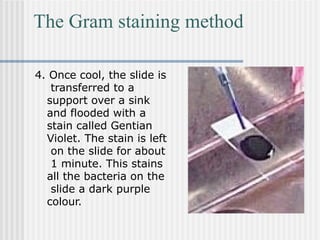
4. Once cool, the slide is
transferred to a
support over a sink
and flooded with a
stain called Gentian
Violet. The stain is left
on the slide for about
1 minute. This stains
all the bacteria on the
slide a dark purple
colour.
The Gram staining method
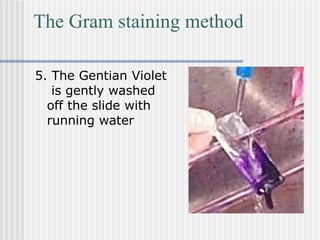
5. The Gentian Violet
is gently washed
off the slide with
running water
The Gram staining method
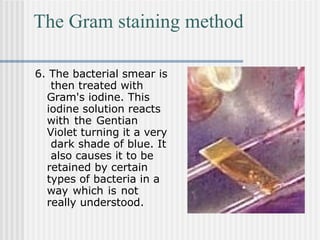
6. The bacterial smear is
then treated with
Gram's iodine. This
iodine solution reacts
with the Gentian
Violet turning it a very
dark shade of blue. It
also causes it to be
retained by certain
types of bacteria in a
way which is not
really understood.
The Gram staining method
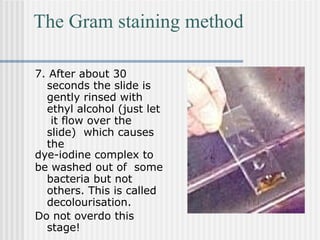
7. After about 30
seconds the slide is
gently rinsed with
ethyl alcohol (just let
it flow over the
slide) which causes
the
dye-iodine complex to
be washed out of some
bacteria but not
others. This is called
decolourisation.
Do not overdo this
stage!
The Gram staining method
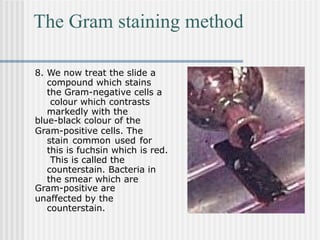
8. We now treat the slide a
compound which stains
the Gram-negative cells a
colour which contrasts
markedly with the
blue-black colour of the
Gram-positive cells. The
stain common used for
this is fuchsin which is red.
This is called the
counterstain. Bacteria in
the smear which are
Gram-positive are
unaffected by the
counterstain.
The Gram staining method
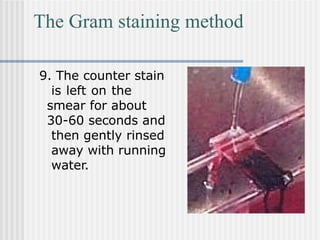
9. The counter stain
is left on the
smear for about
30-60 seconds and
then gently rinsed
away with running
water.
The Gram staining method
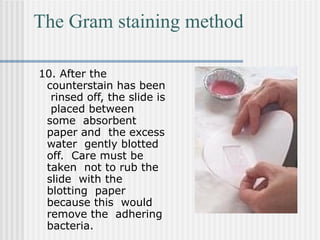
10. After the
counterstain has been
rinsed off, the slide is
placed between
some absorbent
paper and the excess
water gently blotted
off. Care must be
taken not to rub the
slide with the
blotting paper
because this would
remove the adhering
bacteria.
The Gram staining method
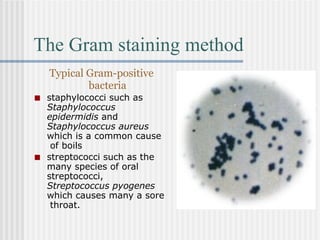
Typical Gram-positive
bacteria
■ staphylococci such as
Staphylococcus
epidermidis and
Staphylococcus aureus
which is a common cause
of boils
■ streptococci such as the
many species of oral
streptococci,
Streptococcus pyogenes
which causes many a sore
throat.
The Gram staining method
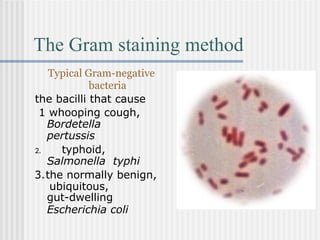
Typical Gram-negative
bacteria
the bacilli that cause
1 whooping cough,
Bordetella
pertussis
2. typhoid,
Salmonella typhi
3.the normally benign,
ubiquitous,
gut-dwelling
Escherichia coli
Crystal violet – 1 min - wash.
Iodine – 1 min – wash.
Acetone add drop by drop and watch out
colour comes out – wash immediately.
Safarnine/dilute carbol fuchsin – 1 min-
wash.
Allow to dry – examine under microscope.
Note: Results should be confirmed only with
100x.
PROCEDURE:
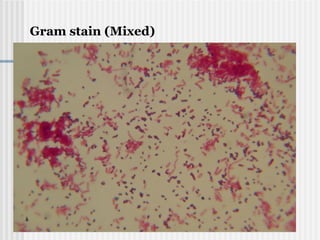
Gram stain (Mixed)
Gram positive cocci in clusters:
1. Staphylococci species.
Gram negative cocci in chains:
1. Streptococci species.
Gram negative cocci:
1. Neisseria species.
Gram negative bacilli:
1. Escherichia coli
2. Klebsiella pneumoniae
EXAMPLES:
• To stain Mycobacterium species especially
M.tuberculosis.
• High lipid content – makes decolorisation very
difficult –extraordinary property.
• Principle:
• Acid fast(resist)
• – Property of Mycobacterium species
• - once this bacteria stained with primary dye
• – difficult to decolorise with acid.
• This property due to Mycolic acid in cell wall of
• M.tuberculosis – also Alcohol fast
ACID-FAST STAINING:
(Ziehl-Neelsen stain)
1.Strong carbol fuchsin – primary stain
2.20% sulphuric acid/3% Hcl – decoloriser
– acid-fast property.
3. 95% alcohol- decoloriser- alcohol – fast
property
4. Methylene blue/ Malachite green-
counterstain.
Note:
5% sulphuric acid – for M.leprae.
1% sulphuric acid – for Nocardia species.
Staining reagents:
1. Strong carbol fucshin-heat till steam rises –
allow 5-10 min to act (alternately leave it
10-15 min – cold staining method) – wash.
2. Decolorise with acid-alcohol mixture till get
a faint pink colour in the smear (take 3-5
min) – wash.
3. Methylene blue/Malachite green – 2 min –
wash.
4. Allow to dry and focuss under microscope.
•
Procedure:
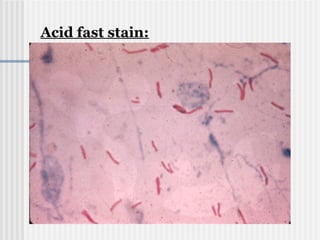
• Pink bacilli – Acid fast bacteria/bacilli
Eg., M.tuberculosis – long slender
bacilli.
• M. leprae – short thick bacilli.
• Blue colored bacteria – Non-acid fast
Eg., Epithelial cells, pus cells, other
bacteria.
Result:
Acid fast stain:
Used to stain special structures of
bacteria– capsule, spores, flagella,
metachromatic granules.
SPECIAL STAIN
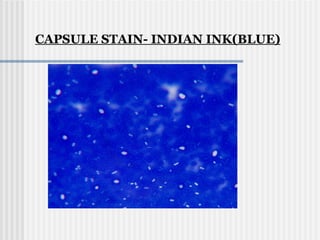
CAPSULE STAIN:
Negative stain:
1.Drop of Nigrosin ink+ indian ink
2. Bacterial culture ( 1-2 colonies)
3. Spread evenly and air-dry.
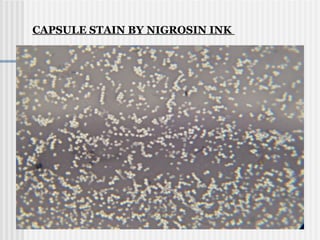
4. Look for unstained structures against
stained background.
CAPSULE STAIN BY NIGROSIN INK
CAPSULE STAIN- INDIAN INK(BLUE)
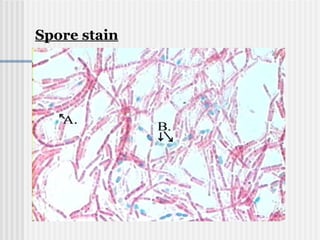
SPORE STAIN:
1. Malachite green- 2 min- heat stain till
steam rises -2 min - wash.
2. Counterstain with safranin –1 min- wash.
3. Dry the slide and examine.
Spore forming bacteria:
Eg., Clostridium species.
Bacillus species – Eg. B. anthracis
Spore stain
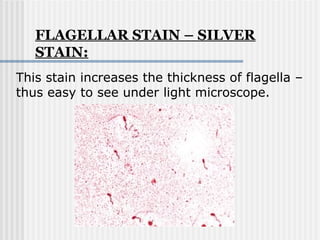
FLAGELLAR STAIN – SILVER
STAIN:
This stain increases the thickness of flagella –
thus easy to see under light microscope.
Metachromatic granule staining:
To demonstrate polar granules of
Corynebacterium diphtheriae.
Take up the stain of methylene blue – but
appears bluish black – hence granules called
metachromatic granules.
Bacilli stains blue not bluish black.


STAININGTECHNIQUES WITH VIDEOS .pptx

  • 1.
  • 2.
    • Based onfunction of stain: 1. Simple staining – only one dye is used- differentiation among bacteria is impossible- Eg. Simple Staining. 2. Differential staining- more than one dye is used- Differentiation among bacteria is possible- Eg. Gram’s staining, Acid-fast staining. 3. Special staining – more than one dye used - Special structures are seen. Eg. Capsule staining, Spore staining.
  • 3.
    Each staining methodshave own principles but the following steps may be common: Basic stain(+ve charge) – To stain -ve charged molecules of bacteria Mostly used because cell surface is –ve charge. Acidic Stain(-ve charge) To stain +ve charged molecules of bacteria. Used to stain the bacterial capsules. As cell surface is –ve charged- Basic dyes mostly used. Principle of staining:
  • 4.
    •Clean grease-free slide. •Bacteriato be stained. •Inoculating loops- to transfer bacterial suspension to slide. •Bunsen burner – to sterilise inoculating loops before and after smear preparation. •Pencil marker – to mark (particularly central portion of slide) where bacterial smear is applied Basic requirements for staining:
  • 5.
    Smear preparation: Putting ofbacterial suspension (bacteria in liquid) tobe stained on the central portion of slide in a circular fashion, air- dried, heat-fixed, the resultant preparation called bacterial smear- appears dull white. Basic initial steps before staining:
  • 6.
    • Simple toperform- only one basic stain used. Eg. Crystal violet, Methylene blue, Basic fuschin, Malachite green etc., Principle: - All bacteria in smear takes stain and appears in colour of stain. - Basic stain more affinity towards bacterial surface & stains the bacteria. Uses: To study morphology and arrangement of bacteria. SIMPLE STAINING:
  • 7.
    • A bacterialsmear is prepared, air- dried and heat-fixed. • A Heat-fixed smear is flooded with either one of the basic stain and allowed to react for 1-2 minutes and then washed under running tap water. • Air dried and focussed with 10x,45x & 100x. Results: • Morphology – spherical / rod. • Arrangement – cocci – clusters/chains. Procedure:
  • 8.
    GRAM STAINING ■ Gram'sStain is a widely used method of staining bacteria as an aid to their identification ■ Devised by Hans Christian Gram ■ Gram's stain differentiates between two major cell wall types.
  • 9.
    GRAM STAINING ■ Bacterialspecies with walls containing small amounts of peptidoglycan and, characteristically, lipopolysaccharide, are Gram- negative
  • 10.
    The process includesthe use of: a primary stain (crystal violet) a mordant (helper) iodine solution, a decolorizer (95% ethanol), a counterstain (safranin).
  • 11.
    1. Crystal violet- all bacteria take crystal violet- so all appears violet. 2. Iodine – Crystal Violet-iodine(CV-I) complex is formed. 3. Acetone- bacteria with high lipid content loose CV-I complex(appear colouless) but bacteria with less lipid content retains CV-I complex ( appear violet). 4. Safranine/ dilute carbol fuchsin – only colouless bacteria takes – appear pink. PRINCIPLE:
  • 12.
    Colour: Purple colored bacteria– Gram positive Pink colored bacteria – Gram negative Shape: Spherical – cocci Rod – bacilli Arrangement Cocci in clusters – staphylococci Cocci in chains - streptococci RESULT:
  • 13.
  • 14.
  • 15.
  • 16.
  • 18.
    Gram Staining –Gram +’ve
  • 19.
    Gram Staining –Gram -’ve
  • 21.
    The Gram stainingmethod ■ 1. A small sample of a bacterial culture is removed from a culture. In this example it is being taken from a broth culture of the pure microbe but it could be removed from a culture on solid medium .
  • 22.
    The Gram stainingmethod 2. The bacterial suspension is smeared onto a clean glass slide. If the bacteria have been removed from a culture on solid media it will have to be mixed with a drop of distilled water.
  • 23.
    The Gram stainingmethod 3. The bacterial smear is then dried slowly at first and then, when dry, heated for a few seconds to the point when the glass slide is too hot to handle. This fixes ie kills the bacteria making the slide safe to handle. Care must be taken not to overheat.
  • 24.
    The Gram stainingmethod 4. Once cool, the slide is transferred to a support over a sink and flooded with a stain called Gentian Violet. The stain is left on the slide for about 1 minute. This stains all the bacteria on the slide a dark purple colour.
  • 25.
    The Gram stainingmethod 5. The Gentian Violet is gently washed off the slide with running water
  • 26.
    The Gram stainingmethod 6. The bacterial smear is then treated with Gram's iodine. This iodine solution reacts with the Gentian Violet turning it a very dark shade of blue. It also causes it to be retained by certain types of bacteria in a way which is not really understood.
  • 27.
    The Gram stainingmethod 7. After about 30 seconds the slide is gently rinsed with ethyl alcohol (just let it flow over the slide) which causes the dye-iodine complex to be washed out of some bacteria but not others. This is called decolourisation. Do not overdo this stage!
  • 28.
    The Gram stainingmethod 8. We now treat the slide a compound which stains the Gram-negative cells a colour which contrasts markedly with the blue-black colour of the Gram-positive cells. The stain common used for this is fuchsin which is red. This is called the counterstain. Bacteria in the smear which are Gram-positive are unaffected by the counterstain.
  • 29.
    The Gram stainingmethod 9. The counter stain is left on the smear for about 30-60 seconds and then gently rinsed away with running water.
  • 30.
    The Gram stainingmethod 10. After the counterstain has been rinsed off, the slide is placed between some absorbent paper and the excess water gently blotted off. Care must be taken not to rub the slide with the blotting paper because this would remove the adhering bacteria.
  • 31.
    The Gram stainingmethod Typical Gram-positive bacteria ■ staphylococci such as Staphylococcus epidermidis and Staphylococcus aureus which is a common cause of boils ■ streptococci such as the many species of oral streptococci, Streptococcus pyogenes which causes many a sore throat.
  • 32.
    The Gram stainingmethod Typical Gram-negative bacteria the bacilli that cause 1 whooping cough, Bordetella pertussis 2. typhoid, Salmonella typhi 3.the normally benign, ubiquitous, gut-dwelling Escherichia coli
  • 33.
    Crystal violet –1 min - wash. Iodine – 1 min – wash. Acetone add drop by drop and watch out colour comes out – wash immediately. Safarnine/dilute carbol fuchsin – 1 min- wash. Allow to dry – examine under microscope. Note: Results should be confirmed only with 100x. PROCEDURE:
  • 34.
  • 35.
    Gram positive cocciin clusters: 1. Staphylococci species. Gram negative cocci in chains: 1. Streptococci species. Gram negative cocci: 1. Neisseria species. Gram negative bacilli: 1. Escherichia coli 2. Klebsiella pneumoniae EXAMPLES:
  • 36.
    • To stainMycobacterium species especially M.tuberculosis. • High lipid content – makes decolorisation very difficult –extraordinary property. • Principle: • Acid fast(resist) • – Property of Mycobacterium species • - once this bacteria stained with primary dye • – difficult to decolorise with acid. • This property due to Mycolic acid in cell wall of • M.tuberculosis – also Alcohol fast ACID-FAST STAINING: (Ziehl-Neelsen stain)
  • 37.
    1.Strong carbol fuchsin– primary stain 2.20% sulphuric acid/3% Hcl – decoloriser – acid-fast property. 3. 95% alcohol- decoloriser- alcohol – fast property 4. Methylene blue/ Malachite green- counterstain. Note: 5% sulphuric acid – for M.leprae. 1% sulphuric acid – for Nocardia species. Staining reagents:
  • 38.
    1. Strong carbolfucshin-heat till steam rises – allow 5-10 min to act (alternately leave it 10-15 min – cold staining method) – wash. 2. Decolorise with acid-alcohol mixture till get a faint pink colour in the smear (take 3-5 min) – wash. 3. Methylene blue/Malachite green – 2 min – wash. 4. Allow to dry and focuss under microscope. • Procedure:
  • 39.
    • Pink bacilli– Acid fast bacteria/bacilli Eg., M.tuberculosis – long slender bacilli. • M. leprae – short thick bacilli. • Blue colored bacteria – Non-acid fast Eg., Epithelial cells, pus cells, other bacteria. Result:
  • 40.
  • 41.
    Used to stainspecial structures of bacteria– capsule, spores, flagella, metachromatic granules. SPECIAL STAIN
  • 42.
    CAPSULE STAIN: Negative stain: 1.Dropof Nigrosin ink+ indian ink 2. Bacterial culture ( 1-2 colonies) 3. Spread evenly and air-dry. 4. Look for unstained structures against stained background.
  • 43.
    CAPSULE STAIN BYNIGROSIN INK
  • 44.
  • 45.
    SPORE STAIN: 1. Malachitegreen- 2 min- heat stain till steam rises -2 min - wash. 2. Counterstain with safranin –1 min- wash. 3. Dry the slide and examine. Spore forming bacteria: Eg., Clostridium species. Bacillus species – Eg. B. anthracis
  • 46.
  • 47.
    FLAGELLAR STAIN –SILVER STAIN: This stain increases the thickness of flagella – thus easy to see under light microscope.
  • 48.
    Metachromatic granule staining: Todemonstrate polar granules of Corynebacterium diphtheriae. Take up the stain of methylene blue – but appears bluish black – hence granules called metachromatic granules. Bacilli stains blue not bluish black.