Unit 5 – Lesson 6Unit 5 – Lesson 6
Power Loss in Transmission
and the Transformer
Nelson Reference::
605 - 610, 595 - 596 for AC605 - 610, 595 - 596 for AC
McGraw-Hill Reference:McGraw-Hill Reference:
736 – 737, 739 - 742736 – 737, 739 - 742
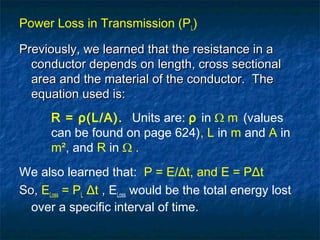
Power Loss in Transmission (PL)
Previously, we learned that the resistance in aPreviously, we learned that the resistance in a
conductor depends on length, cross sectionalconductor depends on length, cross sectional
area and the material of the conductor. Thearea and the material of the conductor. The
equation used is:equation used is:
R = ρ(L/A). Units are: ρ in Ω m (values
can be found on page 624), L in m and A in
m², and R in Ω .
We also learned that: P = E/Δt, and E = PΔt
So,So, ELoss = PL Δt ,, ELoss would be the total energy lost
over a specific interval of time.
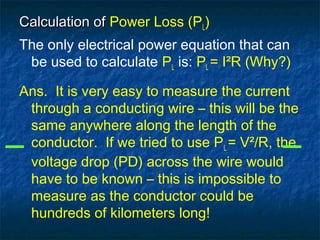
Calculation ofCalculation of Power Loss (PL)
The only electrical power equation that can
be used to calculate PL is: PL = I²R (Why?)
Ans. It is very easy to measure the current
through a conducting wire – this will be the
same anywhere along the length of the
conductor. If we tried to use PL = V²/R, the
voltage drop (PD) across the wire would
have to be known – this is impossible to
measure as the conductor could be
hundreds of kilometers long!
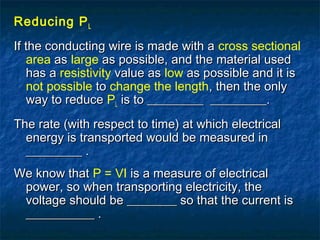
Reducing PL
If the conducting wire is made with aIf the conducting wire is made with a cross sectional
area asas large as possible, and the material usedas possible, and the material used
has ahas a resistivity value asvalue as low as possible and it isas possible and it is
not possible toto change the length, then the only, then the only
way to reduceway to reduce PL is to _________ _________.is to _________ _________.
The rate (with respect to time) at which electricalThe rate (with respect to time) at which electrical
energy is transported would be measured inenergy is transported would be measured in
_________ ._________ .
We know thatWe know that P = VI is a measure of electricalis a measure of electrical
power, so when transporting electricity, thepower, so when transporting electricity, the
voltage should be ________ so that the current isvoltage should be ________ so that the current is
___________ .___________ .
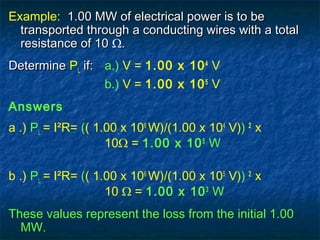
Example: 1.00 MW of electrical power is to be1.00 MW of electrical power is to be
transported through a conducting wires with a totaltransported through a conducting wires with a total
resistance of 10resistance of 10 Ω..
DetermineDetermine PL if:if: a.) V = 1.00 x 10⁴
V
b.) V = 1.00 x 10⁵
V
Answers
a .) PL = I²R= (( 1.00 x 10⁶
W)/(1.00 x 104
V)) 2
x
10Ω = 1.00 x 10⁵
W
b .) PL = I²R= (( 1.00 x 10⁶
W)/(1.00 x 105
V)) 2
x
10 Ω = 1.00 x 10³
W
These values represent the loss from the initial 1.00
MW.
The Transformer (Academic class starts here)
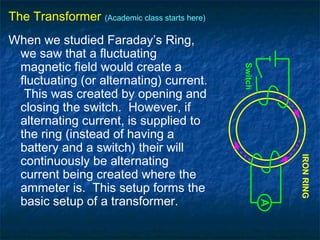
When we studied Faraday’s Ring,
we saw that a fluctuating
magnetic field would create a
fluctuating (or alternating) current.
This was created by opening and
closing the switch. However, if
alternating current, is supplied to
the ring (instead of having a
battery and a switch) their will
continuously be alternating
current being created where the
ammeter is. This setup forms the
basic setup of a transformer.
A
IRONRING
Switch
What is Alternating Current?
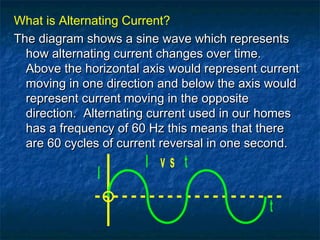
The diagram shows a sine wave which representsThe diagram shows a sine wave which represents
how alternating current changes over time.how alternating current changes over time.
Above the horizontal axis would represent currentAbove the horizontal axis would represent current
moving in one direction and below the axis wouldmoving in one direction and below the axis would
represent current moving in the oppositerepresent current moving in the opposite
direction. Alternating current used in our homesdirection. Alternating current used in our homes
has a frequency of 60 Hz this means that therehas a frequency of 60 Hz this means that there
are 60 cycles of current reversal in one second.are 60 cycles of current reversal in one second.
I
t
I v s t
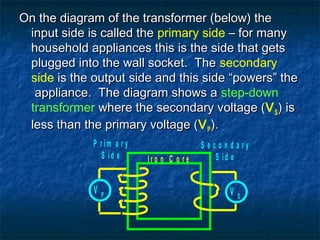
On the diagram of the transformer (below) theOn the diagram of the transformer (below) the
input side is called theinput side is called the primary side – for many– for many
household appliances this is the side that getshousehold appliances this is the side that gets
plugged into the wall socket. Theplugged into the wall socket. The secondary
side is the output side and this side “powers” theis the output side and this side “powers” the
appliance. The diagram shows aappliance. The diagram shows a step-down
transformer where the secondary voltage (where the secondary voltage (VS ) is) is
less than the primary voltage (less than the primary voltage (VP ).).
I r o n C o r e
V S
V P
P r i m a r y
S id e
S e c o n d a r y
S id e
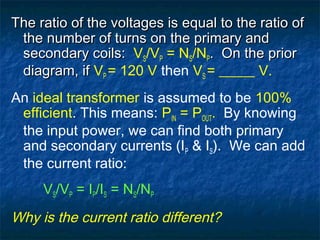
The ratio of the voltages is equal to the ratio ofThe ratio of the voltages is equal to the ratio of
the number of turns on the primary andthe number of turns on the primary and
secondary coils:secondary coils: VS/VP = NS/NP. On the prior. On the prior
diagram, ifdiagram, if VP = 120 V then VS = _____ V.
An ideal transformer is assumed to be 100%
efficient. This means: PIN = POUT. By knowing
the input power, we can find both primary
and secondary currents (IP & IS). We can add
the current ratio:
VS/VP = IP/IS = NS/NP
Why is the current ratio different?
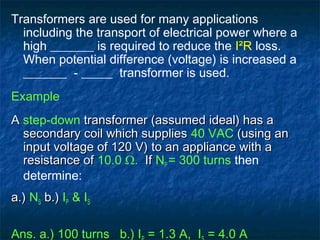
Transformers are used for many applications
including the transport of electrical power where a
high _______ is required to reduce the I²R loss.
When potential difference (voltage) is increased a
_______ - _____ transformer is used.
Example
AA step-down transformer (assumed ideal) has atransformer (assumed ideal) has a
secondary coil which suppliessecondary coil which supplies 40 VAC (using an(using an
input voltage of 120 V)input voltage of 120 V) to anto an appliance with aappliance with a
resistance ofresistance of 10.0 Ω. IfIf NP = 300 turns then
determine:
a.)a.) NS b.)b.) IP & IS
Ans. a.) 100 turns b.) I = 1.3 A, I = 4.0 A
Practice Questions
Nelson TextbookNelson Textbook
Page 609 #1, 2, 3, 6, 7Page 609 #1, 2, 3, 6, 7
Page 612 # 2, 5Page 612 # 2, 5
Workbook
Page 61b #1 - 6 (left side)Page 61b #1 - 6 (left side)
Previously used questions
McGraw-Hill Page 742 # 1 – 4McGraw-Hill Page 742 # 1 – 4

Grade 11, U5 L6, P-Loss and Transformer

  • 1.
    Unit 5 –Lesson 6Unit 5 – Lesson 6 Power Loss in Transmission and the Transformer Nelson Reference:: 605 - 610, 595 - 596 for AC605 - 610, 595 - 596 for AC McGraw-Hill Reference:McGraw-Hill Reference: 736 – 737, 739 - 742736 – 737, 739 - 742
  • 2.
    Power Loss inTransmission (PL) Previously, we learned that the resistance in aPreviously, we learned that the resistance in a conductor depends on length, cross sectionalconductor depends on length, cross sectional area and the material of the conductor. Thearea and the material of the conductor. The equation used is:equation used is: R = ρ(L/A). Units are: ρ in Ω m (values can be found on page 624), L in m and A in m², and R in Ω . We also learned that: P = E/Δt, and E = PΔt So,So, ELoss = PL Δt ,, ELoss would be the total energy lost over a specific interval of time.
  • 3.
    Calculation ofCalculation ofPower Loss (PL) The only electrical power equation that can be used to calculate PL is: PL = I²R (Why?) Ans. It is very easy to measure the current through a conducting wire – this will be the same anywhere along the length of the conductor. If we tried to use PL = V²/R, the voltage drop (PD) across the wire would have to be known – this is impossible to measure as the conductor could be hundreds of kilometers long!
  • 4.
    Reducing PL If theconducting wire is made with aIf the conducting wire is made with a cross sectional area asas large as possible, and the material usedas possible, and the material used has ahas a resistivity value asvalue as low as possible and it isas possible and it is not possible toto change the length, then the only, then the only way to reduceway to reduce PL is to _________ _________.is to _________ _________. The rate (with respect to time) at which electricalThe rate (with respect to time) at which electrical energy is transported would be measured inenergy is transported would be measured in _________ ._________ . We know thatWe know that P = VI is a measure of electricalis a measure of electrical power, so when transporting electricity, thepower, so when transporting electricity, the voltage should be ________ so that the current isvoltage should be ________ so that the current is ___________ .___________ .
  • 5.
    Example: 1.00 MWof electrical power is to be1.00 MW of electrical power is to be transported through a conducting wires with a totaltransported through a conducting wires with a total resistance of 10resistance of 10 Ω.. DetermineDetermine PL if:if: a.) V = 1.00 x 10⁴ V b.) V = 1.00 x 10⁵ V Answers a .) PL = I²R= (( 1.00 x 10⁶ W)/(1.00 x 104 V)) 2 x 10Ω = 1.00 x 10⁵ W b .) PL = I²R= (( 1.00 x 10⁶ W)/(1.00 x 105 V)) 2 x 10 Ω = 1.00 x 10³ W These values represent the loss from the initial 1.00 MW.
  • 6.
    The Transformer (Academicclass starts here) When we studied Faraday’s Ring, we saw that a fluctuating magnetic field would create a fluctuating (or alternating) current. This was created by opening and closing the switch. However, if alternating current, is supplied to the ring (instead of having a battery and a switch) their will continuously be alternating current being created where the ammeter is. This setup forms the basic setup of a transformer. A IRONRING Switch
  • 7.
    What is AlternatingCurrent? The diagram shows a sine wave which representsThe diagram shows a sine wave which represents how alternating current changes over time.how alternating current changes over time. Above the horizontal axis would represent currentAbove the horizontal axis would represent current moving in one direction and below the axis wouldmoving in one direction and below the axis would represent current moving in the oppositerepresent current moving in the opposite direction. Alternating current used in our homesdirection. Alternating current used in our homes has a frequency of 60 Hz this means that therehas a frequency of 60 Hz this means that there are 60 cycles of current reversal in one second.are 60 cycles of current reversal in one second. I t I v s t
  • 8.
    On the diagramof the transformer (below) theOn the diagram of the transformer (below) the input side is called theinput side is called the primary side – for many– for many household appliances this is the side that getshousehold appliances this is the side that gets plugged into the wall socket. Theplugged into the wall socket. The secondary side is the output side and this side “powers” theis the output side and this side “powers” the appliance. The diagram shows aappliance. The diagram shows a step-down transformer where the secondary voltage (where the secondary voltage (VS ) is) is less than the primary voltage (less than the primary voltage (VP ).). I r o n C o r e V S V P P r i m a r y S id e S e c o n d a r y S id e
  • 9.
    The ratio ofthe voltages is equal to the ratio ofThe ratio of the voltages is equal to the ratio of the number of turns on the primary andthe number of turns on the primary and secondary coils:secondary coils: VS/VP = NS/NP. On the prior. On the prior diagram, ifdiagram, if VP = 120 V then VS = _____ V. An ideal transformer is assumed to be 100% efficient. This means: PIN = POUT. By knowing the input power, we can find both primary and secondary currents (IP & IS). We can add the current ratio: VS/VP = IP/IS = NS/NP Why is the current ratio different?
  • 10.
    Transformers are usedfor many applications including the transport of electrical power where a high _______ is required to reduce the I²R loss. When potential difference (voltage) is increased a _______ - _____ transformer is used. Example AA step-down transformer (assumed ideal) has atransformer (assumed ideal) has a secondary coil which suppliessecondary coil which supplies 40 VAC (using an(using an input voltage of 120 V)input voltage of 120 V) to anto an appliance with aappliance with a resistance ofresistance of 10.0 Ω. IfIf NP = 300 turns then determine: a.)a.) NS b.)b.) IP & IS Ans. a.) 100 turns b.) I = 1.3 A, I = 4.0 A
  • 11.
    Practice Questions Nelson TextbookNelsonTextbook Page 609 #1, 2, 3, 6, 7Page 609 #1, 2, 3, 6, 7 Page 612 # 2, 5Page 612 # 2, 5 Workbook Page 61b #1 - 6 (left side)Page 61b #1 - 6 (left side)
  • 12.
    Previously used questions McGraw-HillPage 742 # 1 – 4McGraw-Hill Page 742 # 1 – 4