Invasive SpeciesInvasive Species
Non-Native SpeciesNon-Native Species
Can you name a species that lives in
Ontario but is not native to Ontario?
Do you think that species has an impact
on the natural environment?
How and why did the species get here?
Non-Native SpeciesNon-Native Species
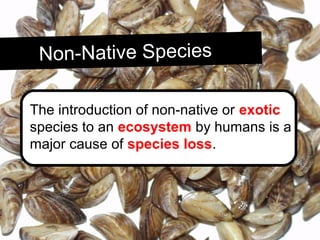
The introduction of non-native or exotic
species to an ecosystem by humans is a
major cause of species loss.
Non-Native SpeciesNon-Native Species
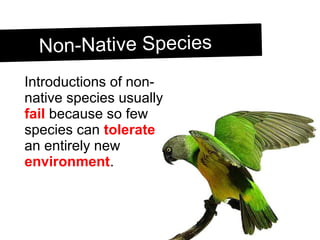
Introductions of non-
native species usually
fail because so few
species can tolerate
an entirely new
environment.
Non-Native SpeciesNon-Native Species
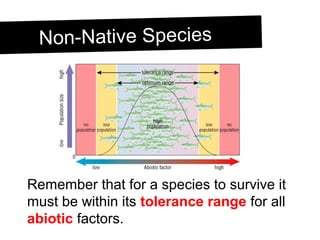
Remember that for a species to survive it
must be within its tolerance range for all
abiotic factors.
Non-Native SpeciesNon-Native Species
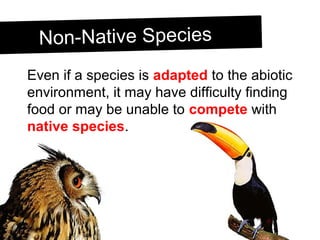
Even if a species is adapted to the abiotic
environment, it may have difficulty finding
food or may be unable to compete with
native species.
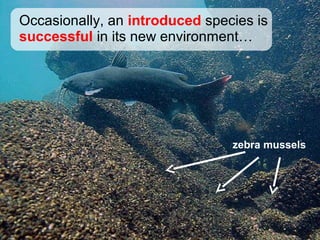
Occasionally, an introduced species is
successful in its new environment…
zebra mussels
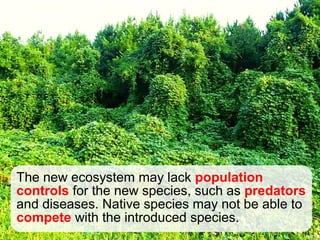
The new ecosystem may lack population
controls for the new species, such as predators
and diseases. Native species may not be able to
compete with the introduced species.
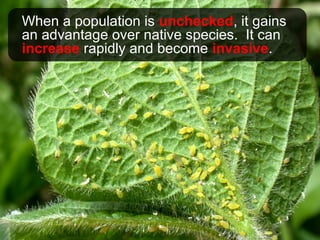
When a population is unchecked, it gains
an advantage over native species. It can
increase rapidly and become invasive.
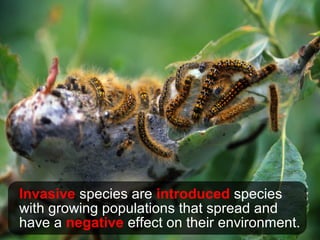
Invasive species are introduced species
with growing populations that spread and
have a negative effect on their environment.
Non-Native SpeciesNon-Native Species
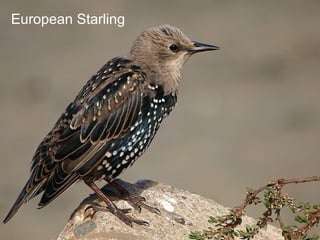
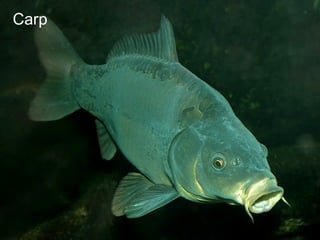
There are well over
3000 invasive species
in Canada. In the Great
Lakes, there are over
185 invasive species.
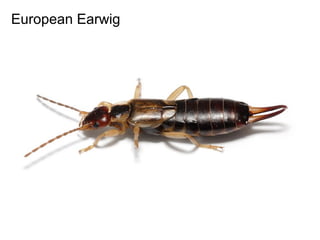
European Earwig
European Starling
Carp
Non-Native SpeciesNon-Native Species
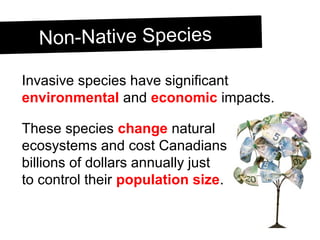
Invasive species have significant
environmental and economic impacts.
These species change natural
ecosystems and cost Canadians
billions of dollars annually just
to control their population size.
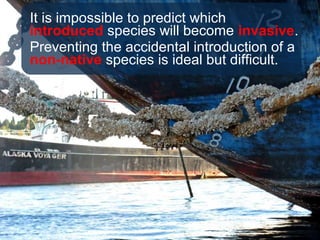
It is impossible to predict which
introduced species will become invasive.
Preventing the accidental introduction of a
non-native species is ideal but difficult.
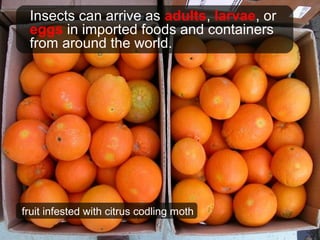
Insects can arrive as adults, larvae, or
eggs in imported foods and containers
from around the world.
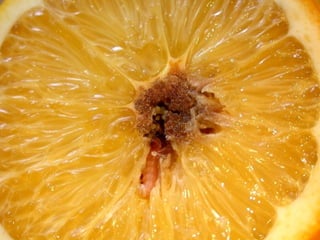
fruit infested with citrus codling moth
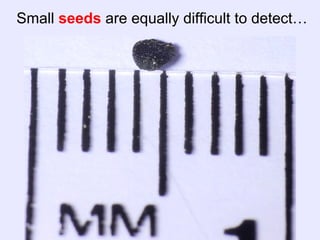
Small seeds are equally difficult to detect…
Controlling Introduced SpeciesControlling Introduced Species
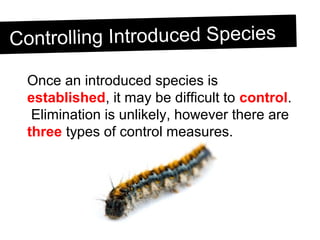
Once an introduced species is
established, it may be difficult to control.
Elimination is unlikely, however there are
three types of control measures.
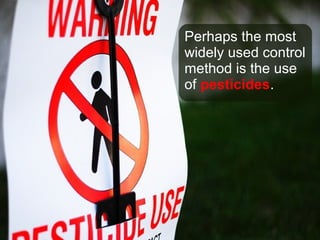
Perhaps the most
widely used control
method is the use
of pesticides.
Chemical ControlChemical Control
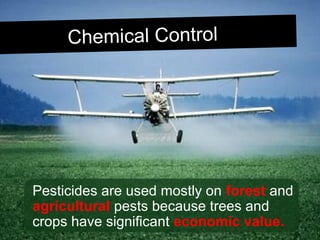
Pesticides are used mostly on forest and
agricultural pests because trees and
crops have significant economic value.
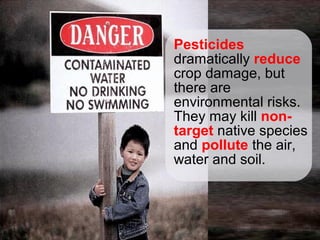
Pesticides
dramatically reduce
crop damage, but
there are
environmental risks.
They may kill non-
target native species
and pollute the air,
water and soil.
Mechanical ControlMechanical Control
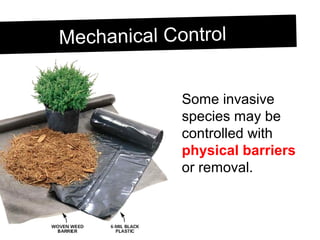
Some invasive
species may be
controlled with
physical barriers
or removal.
Mechanical ControlMechanical Control
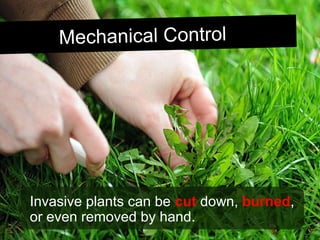
Invasive plants can be cut down, burned,
or even removed by hand.
Mechanical ControlMechanical Control
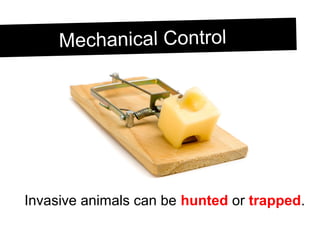
Invasive animals can be hunted or trapped.
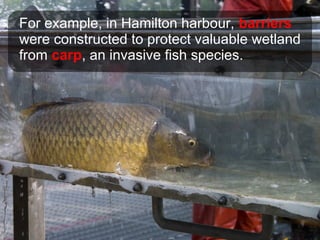
For example, in Hamilton harbour, barriers
were constructed to protect valuable wetland
from carp, an invasive fish species.
Biological ControlBiological Control
Biological control is a challenging but effective
method of controlling invasive species.
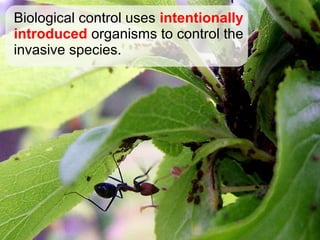
Biological control uses intentionally
introduced organisms to control the
invasive species.
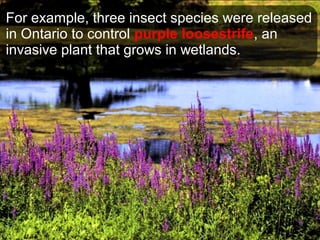
For example, three insect species were released
in Ontario to control purple loosestrife, an
invasive plant that grows in wetlands.

Grade 9-U3-L9-Invasive species