A2 G&P
US Government and Politics
The Constitution
Objectives today
• Challenge George!
• Re-cap the following points:
Creation of the constitution
Amendments and the Bill of Rights
Separation of Powers
Checks and Balances
Federalism
• FACE OFF : UK vs US constitution
Challenge George!
• George, you have to name all of the US
Presidents since 1932.
• Don’t forget to include their dates, parties and
nicknames
• The others will check your progress!
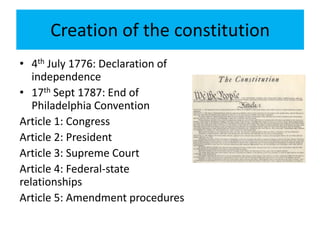
Creation of the constitution
• 4th July 1776: Declaration of
independence
• 17th Sept 1787: End of
Philadelphia Convention
Article 1: Congress
Article 2: President
Article 3: Supreme Court
Article 4: Federal-state
relationships
Article 5: Amendment procedures
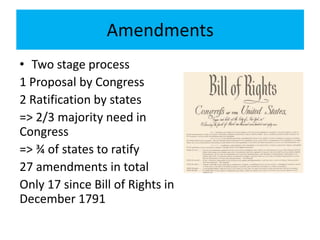
Amendments
• Two stage process
1 Proposal by Congress
2 Ratification by states
=> 2/3 majority need in
Congress
=> ¾ of states to ratify
27 amendments in total
Only 17 since Bill of Rights in
December 1791
Some Amendments
Amen
dment
Ratified Description
1st 1791 Rights to Religion, Speech, Press,
Assembly, Petition
2nd 1791 Right to Bear Arms
3rd 1791 Quartering of Soldiers
4th 1791 Search and Seizure
5th 1791
Grand Jury, Double Jeopardy, Self-
Incrimination, Due Process
6th 1791
Rights of Accused in Criminal
Prosecutions: Rights to Jury Trial,
to Confront Opposing Witnesses
and to Counsel
7th 1791 Jury Trial
8th 1791
Protections against Excessive Bail,
Cruel and Unusual Punishment
9th 1791 Non-Enumerated Rights
10th 1791 Rights Reserved to States
13th 1865 Slavery Prohibited
15th 1880 Blacks given vote
16th 1913 Federal Income Tax
22nd 1951 2 term limit for
President
26th 1971 Voting age at 18
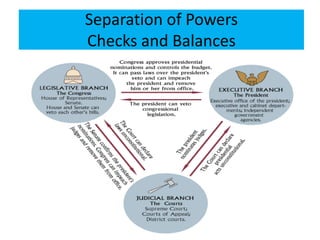
Separation of Powers
Checks and Balances
Checks and Balances: Political Impact
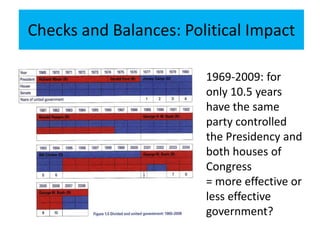
1969-2009: for
only 10.5 years
have the same
party controlled
the Presidency and
both houses of
Congress
= more effective or
less effective
government?
Federalism in theory
• A theory of government by which political power is
divided between a national government and state
governments, each having their own area of
substantive jurisdiction. = decentralisation
• Not clearly defined in the constitution.
• Federal government and Supreme Court has
‘enumerated’ powers
• 10th Amendment reserved all remaining powers ‘to the
states and the people’
• Supreme Court is the umpire!
• Not a fixed idea. Has changed and developed over
time.
Federalism in practice
• ‘Dual Federalism’ from 1780s to 1920s = state
governments has most political power and focus
on states rights
• Effect of Wall Street Crash and Depression saw
greater involvement and spending by central
government => categorical grants
• But, last 3 decades of 20th century saw 4
republican Presidents and shift back towards
state power.
• What do you think happened under George W
Bush?
Federalism in practice
He presided over the largest
increase in inflation-
adjusted federal
government spending since
Lyndon Johnson’s Great
Society in 1960s
1. Education
2. War in Iraq
3. Homeland security
4. Spending on Medicare
5. Banking collapse in
2008
Federalism in practice
Legal Consequences
• Huge variety in state laws (marriage / drive cars / attend school / drugs /
assisted suicide)
• Federal and state courts
Political Consequences
• All elections state based and state run
• Each state decides: how candidates chosen and elected
• Political parties decentralised and state based
Economic Consequences
• Huge federal grants
• Complex tax system => federal and state income tax
Regionalism
• Racial, religious and ideological differences between areas of US
• Conservatism of the Deep South vs liberalism of Northeast
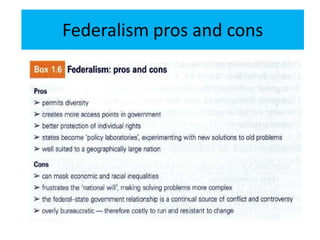
Federalism pros and cons
Objectives today
• Challenge George!
• Re-cap the following points:
Creation of the constitution
Amendments and the Bill of Rights
Separation of Powers
Checks and Balances
Federalism
• FACE OFF : UK vs US constitution
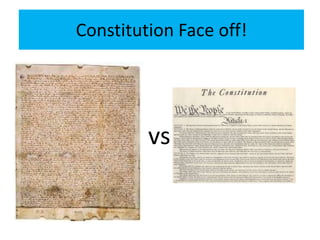
Constitution Face off!
vs
Objectives today
• Challenge George!
• Re-cap the following points:
Creation of the constitution
Amendments and the Bill of Rights
Separation of Powers
Checks and Balances
Federalism
• FACE OFF : UK vs US constitution
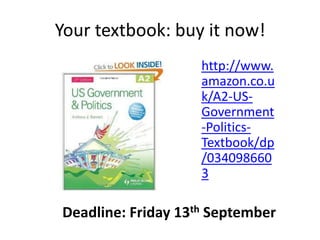
Your textbook: buy it now!
http://www.
amazon.co.u
k/A2-US-
Government
-Politics-
Textbook/dp
/034098660
3
Deadline: Friday 13th September

G&P US Constitution Key Points

  • 1.
    A2 G&P US Governmentand Politics The Constitution
  • 2.
    Objectives today • ChallengeGeorge! • Re-cap the following points: Creation of the constitution Amendments and the Bill of Rights Separation of Powers Checks and Balances Federalism • FACE OFF : UK vs US constitution
  • 3.
    Challenge George! • George,you have to name all of the US Presidents since 1932. • Don’t forget to include their dates, parties and nicknames • The others will check your progress!
  • 4.
    Creation of theconstitution • 4th July 1776: Declaration of independence • 17th Sept 1787: End of Philadelphia Convention Article 1: Congress Article 2: President Article 3: Supreme Court Article 4: Federal-state relationships Article 5: Amendment procedures
  • 5.
    Amendments • Two stageprocess 1 Proposal by Congress 2 Ratification by states => 2/3 majority need in Congress => ¾ of states to ratify 27 amendments in total Only 17 since Bill of Rights in December 1791
  • 6.
    Some Amendments Amen dment Ratified Description 1st1791 Rights to Religion, Speech, Press, Assembly, Petition 2nd 1791 Right to Bear Arms 3rd 1791 Quartering of Soldiers 4th 1791 Search and Seizure 5th 1791 Grand Jury, Double Jeopardy, Self- Incrimination, Due Process 6th 1791 Rights of Accused in Criminal Prosecutions: Rights to Jury Trial, to Confront Opposing Witnesses and to Counsel 7th 1791 Jury Trial 8th 1791 Protections against Excessive Bail, Cruel and Unusual Punishment 9th 1791 Non-Enumerated Rights 10th 1791 Rights Reserved to States 13th 1865 Slavery Prohibited 15th 1880 Blacks given vote 16th 1913 Federal Income Tax 22nd 1951 2 term limit for President 26th 1971 Voting age at 18
  • 7.
  • 8.
    Checks and Balances:Political Impact 1969-2009: for only 10.5 years have the same party controlled the Presidency and both houses of Congress = more effective or less effective government?
  • 9.
    Federalism in theory •A theory of government by which political power is divided between a national government and state governments, each having their own area of substantive jurisdiction. = decentralisation • Not clearly defined in the constitution. • Federal government and Supreme Court has ‘enumerated’ powers • 10th Amendment reserved all remaining powers ‘to the states and the people’ • Supreme Court is the umpire! • Not a fixed idea. Has changed and developed over time.
  • 10.
    Federalism in practice •‘Dual Federalism’ from 1780s to 1920s = state governments has most political power and focus on states rights • Effect of Wall Street Crash and Depression saw greater involvement and spending by central government => categorical grants • But, last 3 decades of 20th century saw 4 republican Presidents and shift back towards state power. • What do you think happened under George W Bush?
  • 11.
    Federalism in practice Hepresided over the largest increase in inflation- adjusted federal government spending since Lyndon Johnson’s Great Society in 1960s 1. Education 2. War in Iraq 3. Homeland security 4. Spending on Medicare 5. Banking collapse in 2008
  • 12.
    Federalism in practice LegalConsequences • Huge variety in state laws (marriage / drive cars / attend school / drugs / assisted suicide) • Federal and state courts Political Consequences • All elections state based and state run • Each state decides: how candidates chosen and elected • Political parties decentralised and state based Economic Consequences • Huge federal grants • Complex tax system => federal and state income tax Regionalism • Racial, religious and ideological differences between areas of US • Conservatism of the Deep South vs liberalism of Northeast
  • 13.
  • 14.
    Objectives today • ChallengeGeorge! • Re-cap the following points: Creation of the constitution Amendments and the Bill of Rights Separation of Powers Checks and Balances Federalism • FACE OFF : UK vs US constitution
  • 15.
  • 16.
    Objectives today • ChallengeGeorge! • Re-cap the following points: Creation of the constitution Amendments and the Bill of Rights Separation of Powers Checks and Balances Federalism • FACE OFF : UK vs US constitution
  • 17.
    Your textbook: buyit now! http://www. amazon.co.u k/A2-US- Government -Politics- Textbook/dp /034098660 3 Deadline: Friday 13th September