Civil Liberties and Civil Rights Wilson Chapters 18 and 19
What’s the Difference? Civil Liberties involve basic freedoms (speech and religion) and are protected by amendment 1 Civil Rights involve protection against discriminatory treatment and are protected by Amendment 5 (national govt) and 14 (states)
Whose looking out for you? Sources of protection: Constitution (ex post facto, bills of attainder and habeas corpus are banned) Bill of Rights Legislation: Civil Rights Acts of ‘64 and ‘68,  Voting Rights Act of 1965 Court Decisions:  Brown v. Board and Roe v. Wade State Constitutions
Federalism and Your Rights Bill of Rights only truly affected the  national government  and did not include protections against state government (Barron v. Baltimore, 1833)
Federalism and Your Rights Modifying effect of the 14th Amendment The due process clause has been used to apply most of the provisions of the Bill of Rights to the States The “total incorporation” view would apply all of the provisions of the Bill of Rights to the states. Nationalize the Bill of Rights. The “selective incorporation” view would only apply some provisions in a case-by-case basis
What does the Court Say? Gitlow v. New York Gitlow, a communist, was convicted of criminal anarchy in a state court Supreme Court- upheld conviction, BUT added that states may not deny freedom of speech and press Palko V Connecticut Any right that is so important that liberty would not exist without it, must be upheld by states Griswold v Connecticut 1965 Privacy protected by Amendment #9
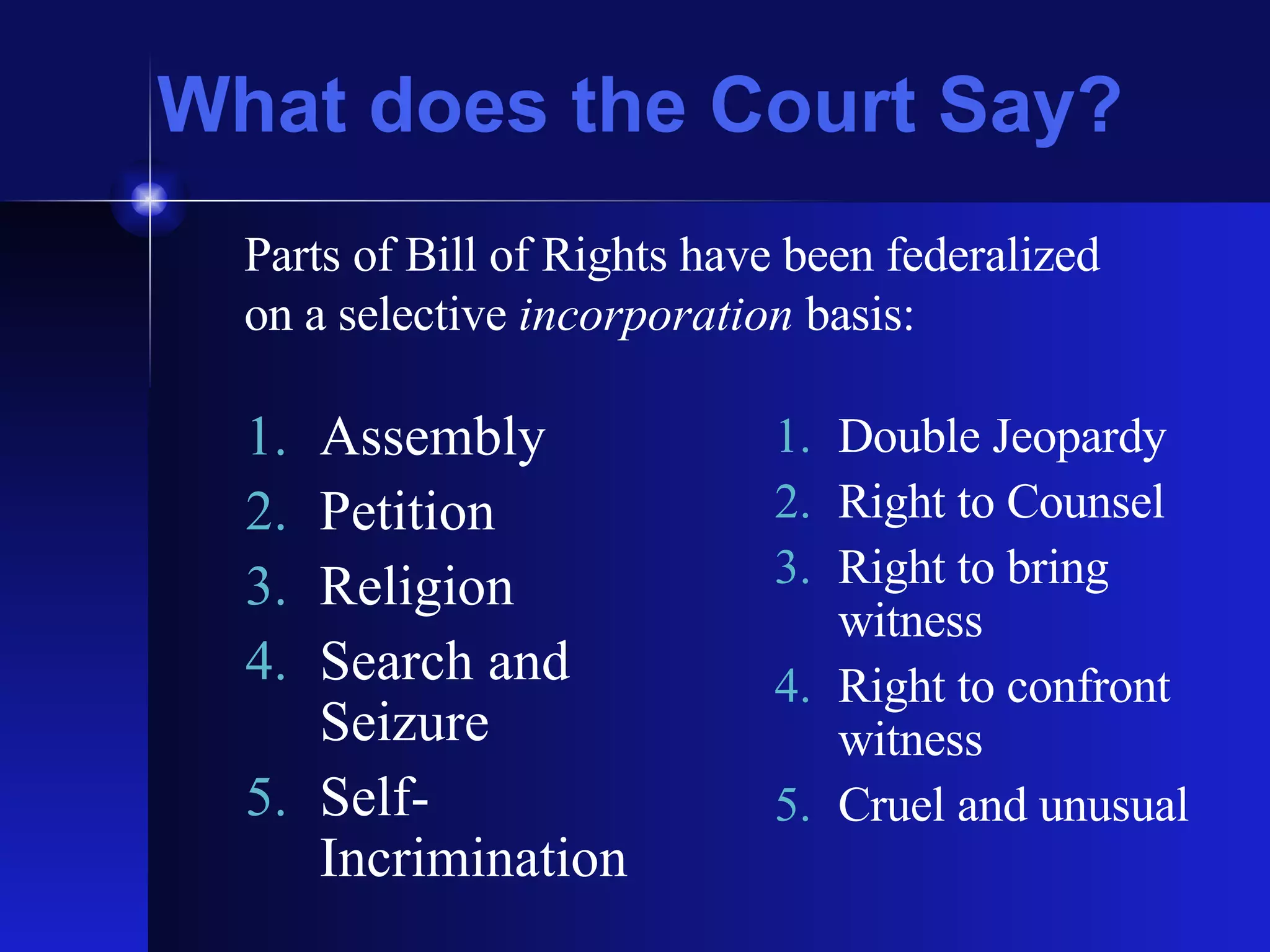
What does the Court Say? Assembly Petition Religion Search and Seizure Self-Incrimination Double Jeopardy Right to Counsel Right to bring witness Right to confront witness Cruel and unusual Parts of Bill of Rights have been federalized on a selective  incorporation  basis:
The First Amendment and You I. FREEDOM OF RELIGION Establishment clause: government may not establish an official religion Accomodationist view: Government should bend a bit and allow some church/state blending (nativity scenes on city property) Separationist view: No blending ( wall of separation ) Endorsement view:no govt. practice that endorses religion (no 10 commandments in court house) Nonpreferentialist view: cannot favor one, but can support religion in general
The First Amendment and You FREEDOM OF RELIGION Continued Lemon v Kurtzman- established 3-part test to determine if a statute or practice violates the  establishment clause Nonsecular (religious) purpose Advances or inhibits religion Excessive entanglement with government If any of these are present, the statute is unconstitutional
The First Amendment and You FREEDOM OF RELIGION Continued Key rulings: Everson v. Board - establishment clause to states Engle v Vitale: no state sponsored prayer in school Abbington v Schempp: no devotional Bible-reading in public school Unconstitutional to require teaching creationism State laws may not prohibit teaching of evolution Unconstitutional to require posting of 10 commandments in schools Released time for students is constitutional
The First Amendment and You FREEDOM OF RELIGION Continued Key rulings: Tax exemptions for churches are constitutional as they are for other nonprofit institutions Christmas displays are constitutional as long as they include some secular content State aid to parochial schools: texts, lunches, bus Impermissible aid to parochial schools: field trips, teacher salaries, counseling, remedial instruction Zelman v. Simmons-Harris: public money can be used to send disadvantaged students to religious schools in school voucher program
The First Amendment and You FREEDOM OF RELIGION-Free Exercise Clause Freedom of worship Problem of contradiction between establishment clause and free exercise clause Distinction between belief (always allowed) and practice (not always allowed) History of placing burden of proof on either state or religion to provide compelling evidence of need to restrain or allow practice (currently burden is on religion)
The First Amendment and You FREEDOM OF RELIGION-Free Exercise Clause Restricted Religious practices Polygamy Not vaccinating children prior to entering school Not paying Social Security taxes (Amish) Wearing a Jewish skullcap in military Permitted Practices Not saluting the flag Not sending children to school past 8th grade (Amish)
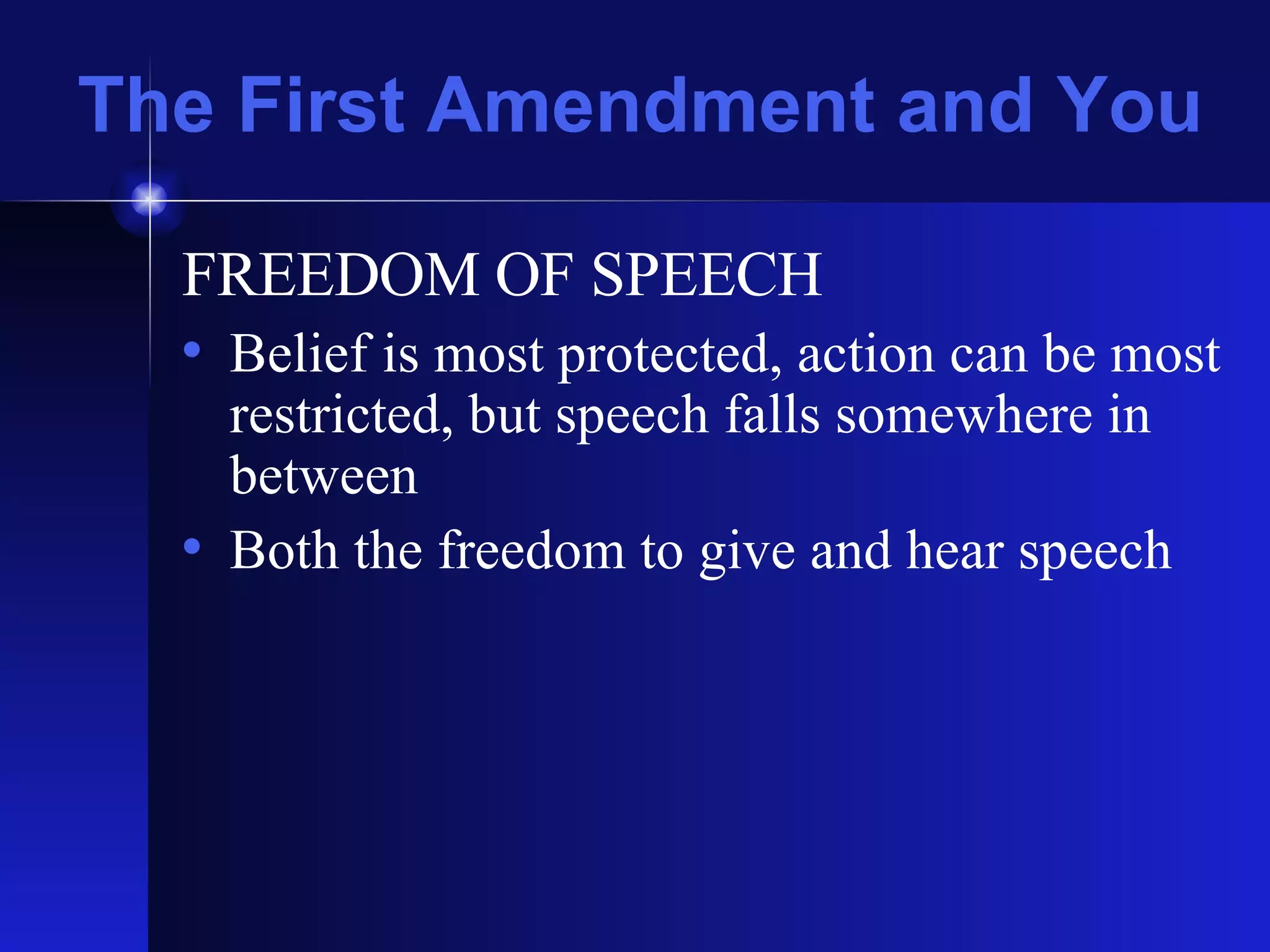
The First Amendment and You FREEDOM OF SPEECH Belief is most protected, action can be most restricted, but speech falls somewhere in between Both the freedom to give and hear speech
The First Amendment and You FREEDOM OF SPEECH- Court tests Bad Tendency doctrine Limit when it might lead to harm State leg. Should determine Clear and Present danger  Schenck v. US Speech can be suppressed only if there is an imminent threat to society Preferred position doctrine Free speech is of the utmost importance
The First Amendment and You FREEDOM OF SPEECH- Court tests Prior restraint Blocking speech before it is given (unconstitutional) Pentagon Papers case Vagueness Speech restrictions must be clear Least drastic means test Laws cannot restrict speech if there are other means to handle the problem
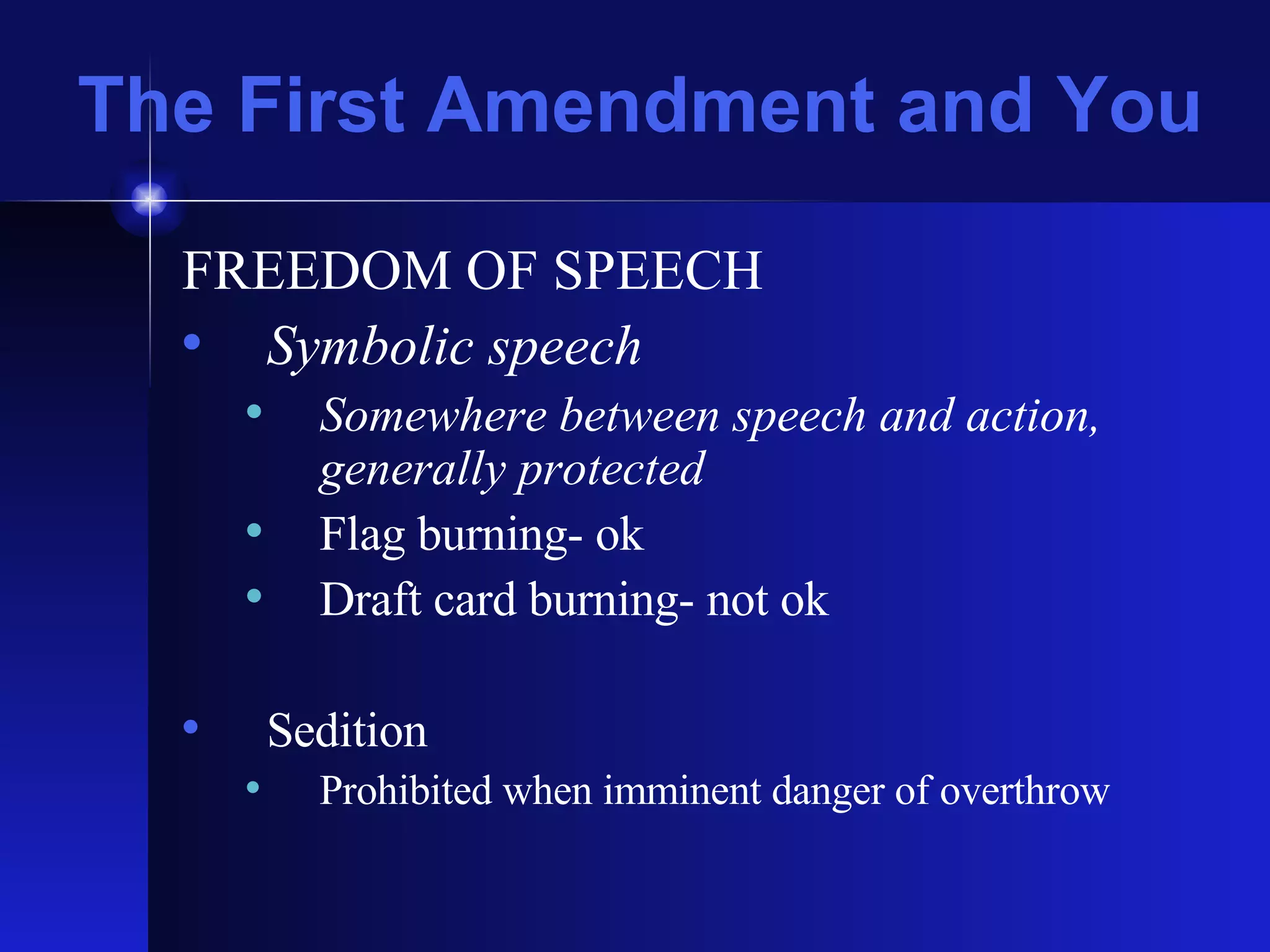
The First Amendment and You FREEDOM OF SPEECH Symbolic speech Somewhere between speech and action, generally protected Flag burning- ok Draft card burning- not ok Sedition Prohibited when imminent danger of overthrow
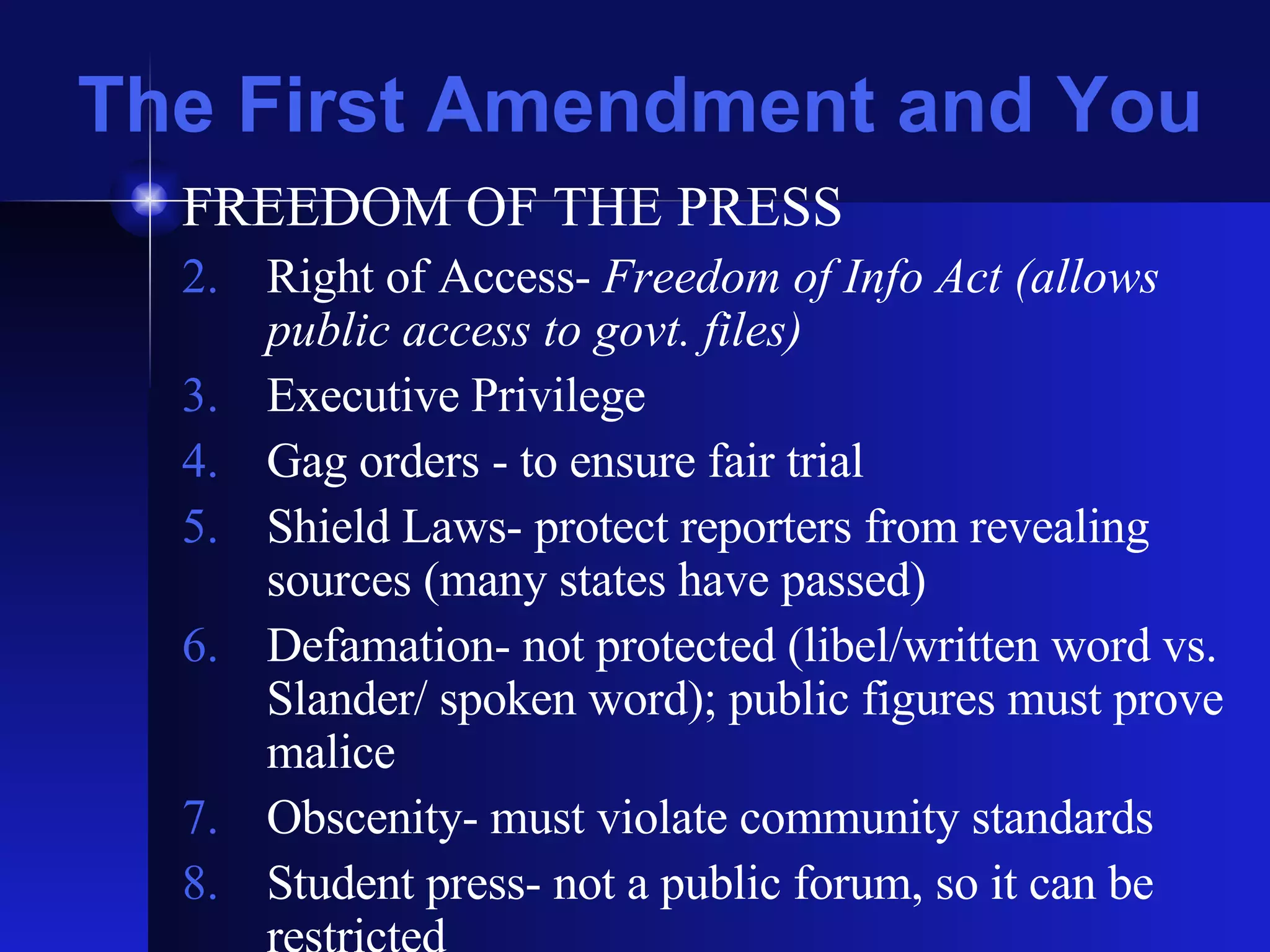
The First Amendment and You FREEDOM OF THE PRESS Right of Access-  Freedom of Info Act (allows public access to govt. files) Executive Privilege Gag orders - to ensure fair trial Shield Laws- protect reporters from revealing sources (many states have passed) Defamation- not protected (libel/written word vs. Slander/ spoken word); public figures must prove malice Obscenity- must violate community standards Student press- not a public forum, so it can be restricted
The First Amendment and You FREEDOM OF ASSEMBLY AND PETITION Freedom of Petition Right to petition the government for redress of grievances Justifies lobbying Protects freedom of association (political and personal ) - Hatch Act restricts political activities of federal employees Freedom of Assembly Govt may regulate time, place and manner May require police permits Reluctance to issue prior restraint Applies to public places, not private places
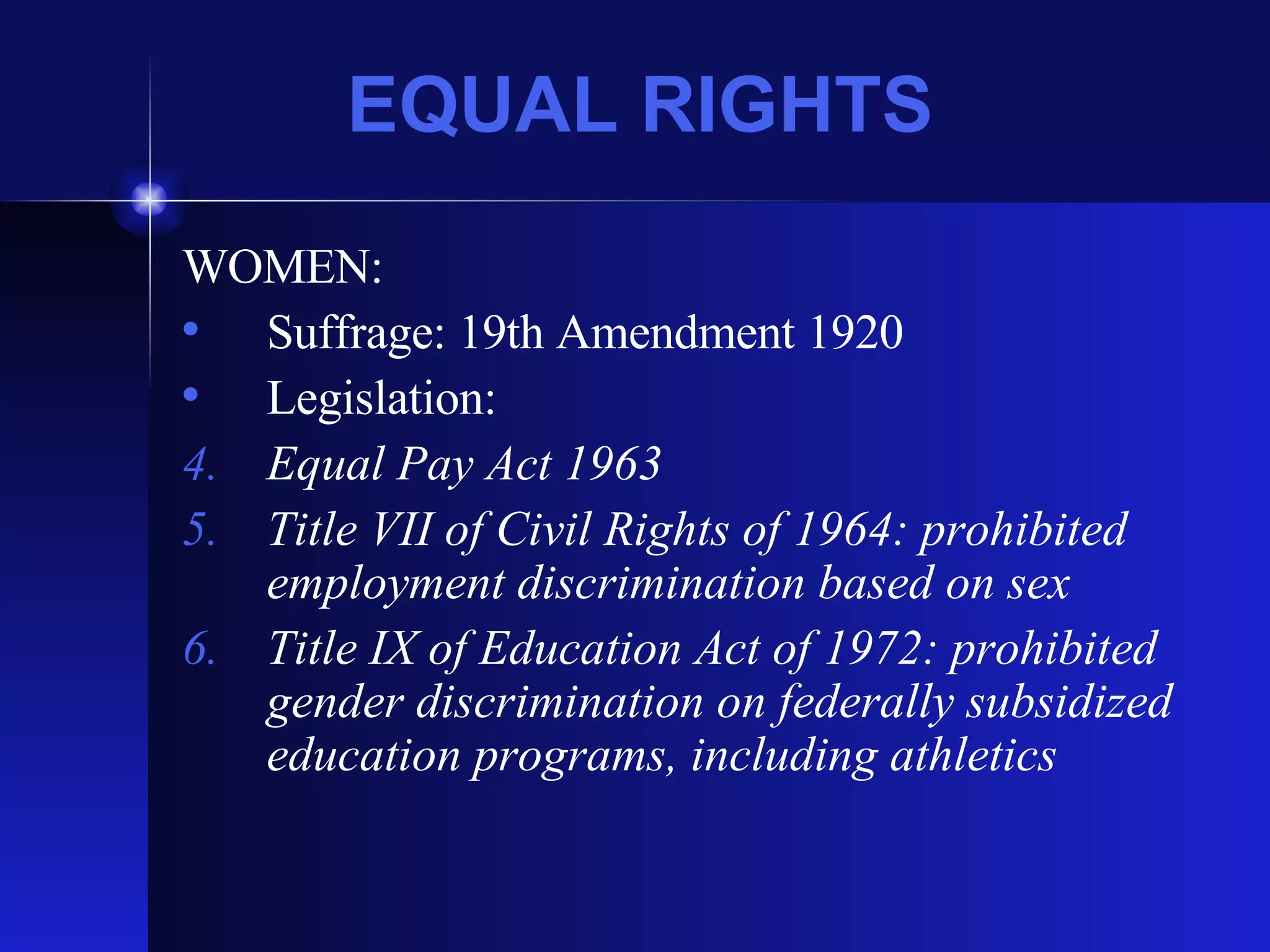
EQUAL RIGHTS WOMEN: Suffrage: 19th Amendment 1920 Legislation: Equal Pay Act 1963 Title VII of Civil Rights of 1964: prohibited employment discrimination based on sex Title IX of Education Act of 1972: prohibited gender discrimination on federally subsidized education programs, including athletics
EQUAL RIGHTS WOMEN: Litigation Reed v. Reed 1971: Court ruled against arbitrary gender-based discrimination as violation of 14th amendments equal protection clause Roe v. Wade 1973 Electoral success 1992 Year of the Woman Gender gap - more women voted in 1996 Soccer moms 2 female SC justices Interest groups: NOW, Emily’s list
EQUAL RIGHTS AFRICAN- AMERICANS Dred Scott Decision in 1857 denied the right of Scott, a slave, to sue (slaves were not citizens) Civil War Amendments (13, 14, 15) to protect blacks against the state govts. Jim Crow laws (Plessy v Ferguson) Resistance against de jure segregation (  Brown v. Board) Increased political success Economic success has lagged behind Backlash against affirmative action
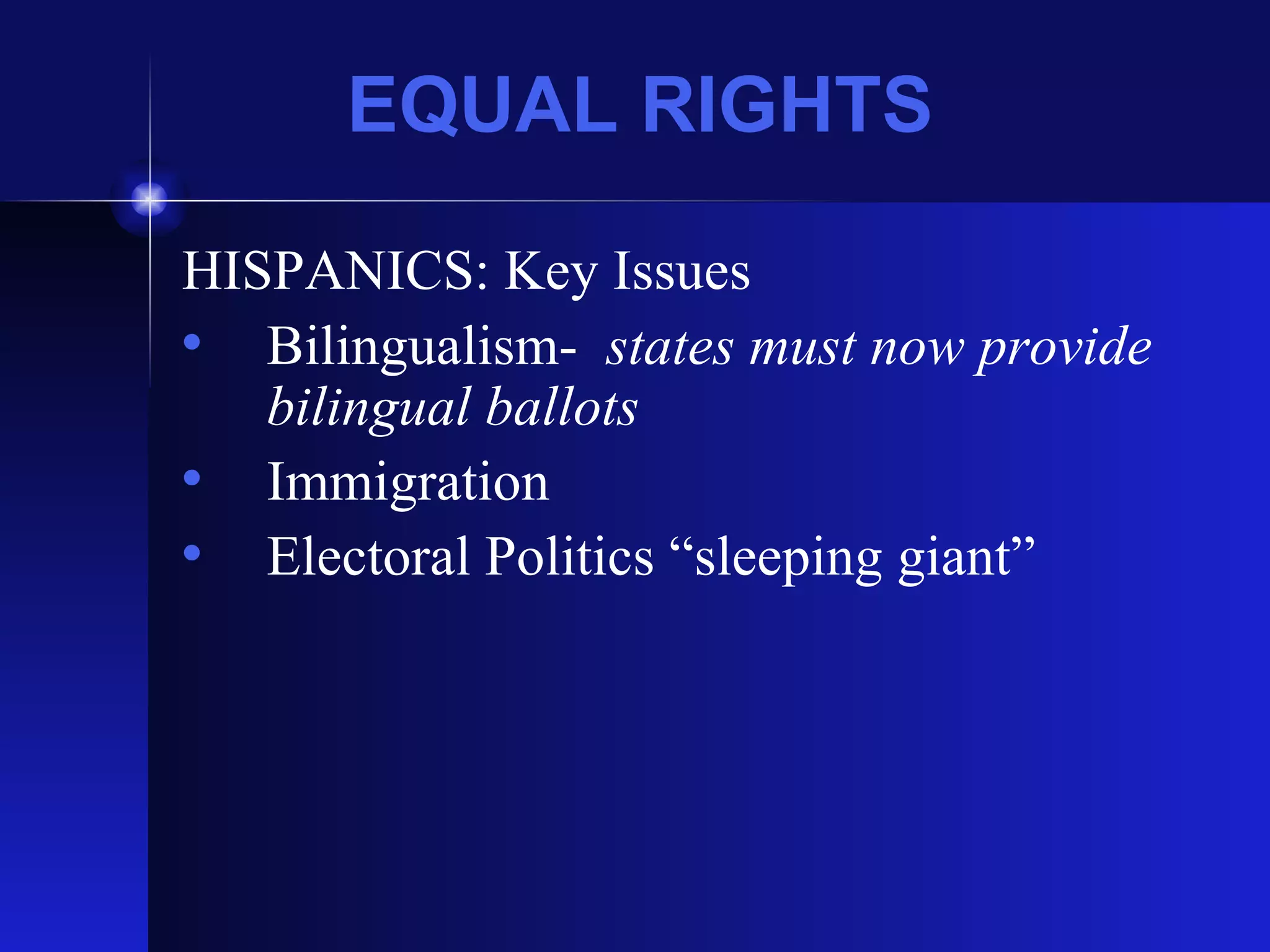
EQUAL RIGHTS HISPANICS: Key Issues Bilingualism-  states must now provide bilingual ballots Immigration Electoral Politics “sleeping giant”
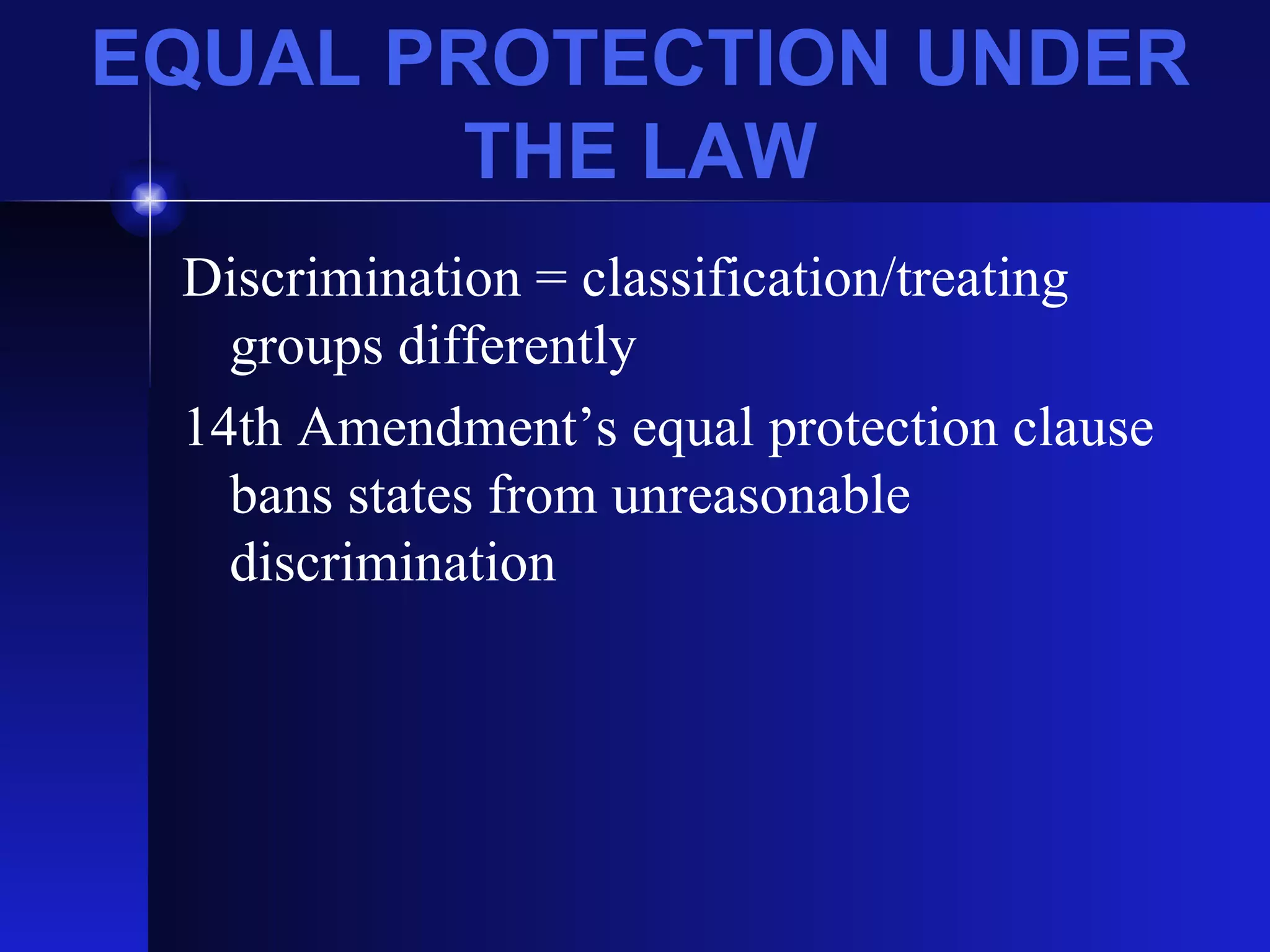
EQUAL PROTECTION UNDER THE LAW Discrimination = classification/treating groups differently 14th Amendment’s equal protection clause bans states from unreasonable discrimination
EQUAL PROTECTION UNDER THE LAW COURT TESTS ON DISCRIMINATION: RATIONAL BASIS TEST- discrimination is permissible if it has a reasonable relationship to proper purpose of govt. (polygamy, prohibit felons from teaching) SUSPECT CLASSIFICATION TEST Suspect class has historically received unequal treatment (discrimination receives strict scrutiny)
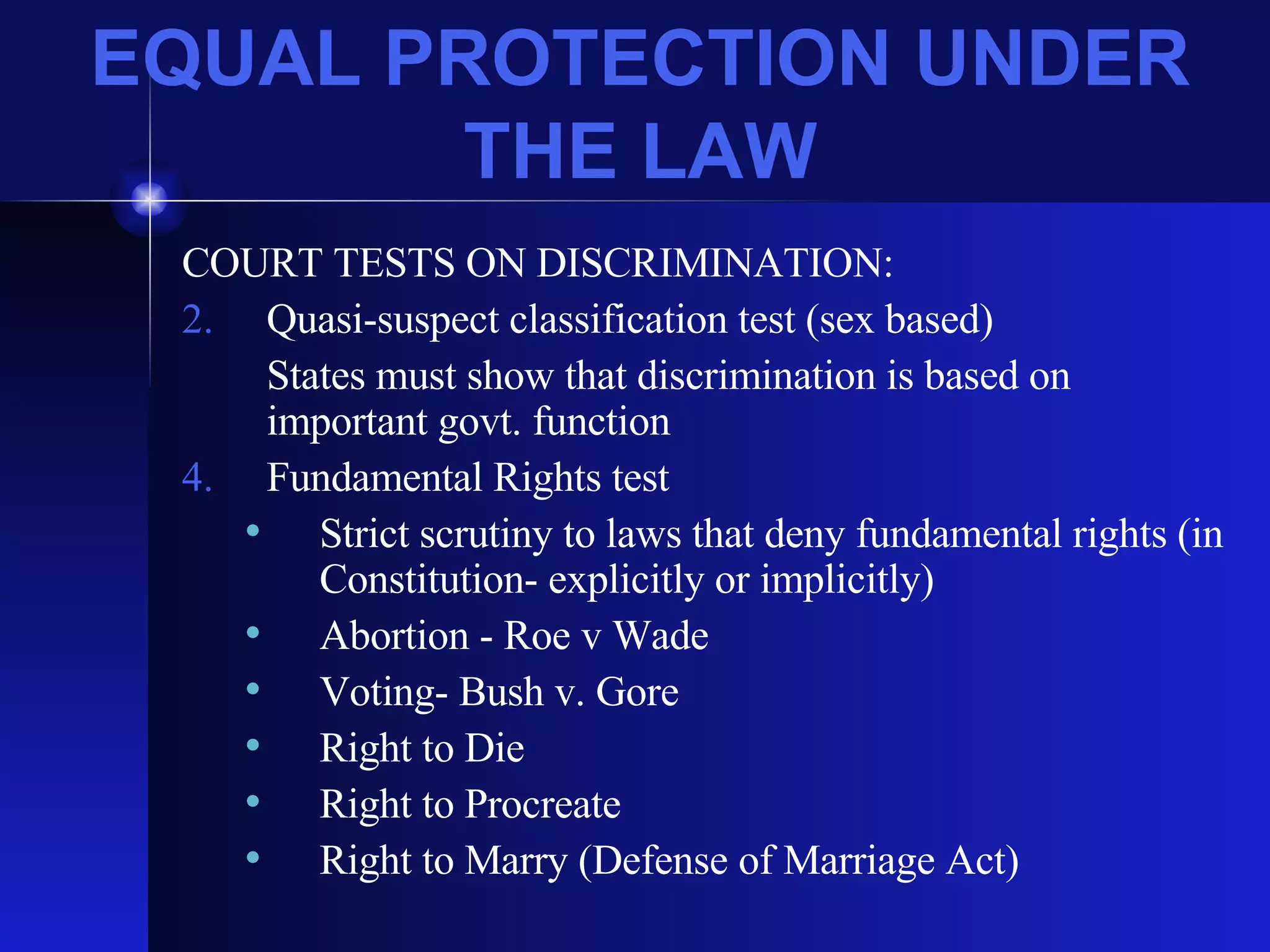
EQUAL PROTECTION UNDER THE LAW COURT TESTS ON DISCRIMINATION: Quasi-suspect classification test (sex based) States must show that discrimination is based on important govt. function Fundamental Rights test Strict scrutiny to laws that deny fundamental rights (in Constitution- explicitly or implicitly) Abortion - Roe v Wade Voting- Bush v. Gore Right to Die Right to Procreate Right to Marry (Defense of Marriage Act)
BARRIERS TO VOTING 15th Amendment banned voting discrimination based upon race, southern states found ways around that: Poll tax (banned by 24th Amendment) Literacy test (banned by voting rights act of 1965) Grandfather clause (unconstitutional)
BARRIERS TO VOTING VOTING RIGHTS ACT of 1965 (Provisions) States w/ history of problems must clear w/ Justice Dept. any changes Suspended literacy tests Empowered fed officials to register voters Empowered fed officials to count ballots Ballots in languages other than English EFFECTS Increase in turnout, more blacks elected
PRIVATE DISCRIMINATION AND THE FEDERAL RESPONSE 5th and 14th amendment prohibits govt. from discriminating, but what prevents private individuals or businesses from discriminating? 13th amendment prohibits relics of slavery Commerce clause Power to tax and spend (attach strings to federal grants and contracts)
PRIVATE DISCRIMINATION AND THE FEDERAL RESPONSE FEDERAL RESPONSES: Civil Rights Act 1866- prohibits discrimination in private contracts Civil Rights Act of 1964- Title II bans discrimination in places of public accommodation (Congress’ Commerce power); racial preferences to remedy not required, but allowed Civil Rights Act of 1968 (Fair Housing) Age Discrimination in Employment Americans with Disabilities Act
CITIZENSHIP Methods of Acquisition: Jus Soil (all born in US) Jus Sanguinis (born to US citizen living overseas) Naturalization Methods of losing citizenship Expatriation (renounce citizenship) Denaturalization (strip cit. From naturalized citizen who acquired cit. Through fraud) Aliens (citizens of another nation who are living in the US) Current law allows 675,000 legal admittance each year
Life, Liberty, Property and Due Process of Law Govt.  Strives to protect individual property rights Two types of due process: Procedural (govt. must use fair procedures to deny life, liberty and property) Observe Bill of Rights Provide Reasonable notice Provide Chance to be heard Illegal searches violate procedural due process Substantive (Laws that enable denying life, liberty and property must be fair) Ex. Ban on all abortions in a state would violate substantive due process
Life, Liberty, Property and Due Process of Law Distinguishing Procedural vs. Substantive: Police Strip Searches (P) Compulsory vaccination laws (S) Minimum Wage laws (S) Firing a city employee without a hearing (P)
GOVERNMENT AND CRIME 1. Arrests can be made with warrant (probable cause - 4th amendment) or without (emergency) 2. Searches made with a warrant (probable cause and specific) or without (under certain circumstances) 3. Wiretapping only with warrant 4.  Exclusionary rule- illegally obtained evidence cannot be used in court; Argument that it lets crooks “off the hook” 5. No self incrimination (5th amendment) 6. Police questioning (cannot force; Miranda warnings- right to remain silent…) 7. Habeas corpus- must be brought to court to determine if fairly held
GOVERNMENT AND CRIME RIGHTS OF THE ACCUSED Right to Counsel (Gideon v Wainright) No Excessive bail (8th Amendment) Speedy and Public Trial Grand jury indictment (required in fed but not state cases) Trial by jury (guaranteed in criminal cases  though most cases are plea bargained) Witness No Cruel and Unusual punishment (8th Amend) No Double Jeopardy (except crime that violates state and federal law)
And finally…THE PATRIOT ACT FBI AND CIA have greater powers to  Wiretap phones Monitor email Survey financial and student records Conduct searches w/o prior notice Federal government can deport/detain noncitizens w/o judicial appeal Weakens protection of the 4th Amendment

Wilson Ch18 19

  • 1.
    Civil Liberties andCivil Rights Wilson Chapters 18 and 19
  • 2.
    What’s the Difference?Civil Liberties involve basic freedoms (speech and religion) and are protected by amendment 1 Civil Rights involve protection against discriminatory treatment and are protected by Amendment 5 (national govt) and 14 (states)
  • 3.
    Whose looking outfor you? Sources of protection: Constitution (ex post facto, bills of attainder and habeas corpus are banned) Bill of Rights Legislation: Civil Rights Acts of ‘64 and ‘68, Voting Rights Act of 1965 Court Decisions: Brown v. Board and Roe v. Wade State Constitutions
  • 4.
    Federalism and YourRights Bill of Rights only truly affected the national government and did not include protections against state government (Barron v. Baltimore, 1833)
  • 5.
    Federalism and YourRights Modifying effect of the 14th Amendment The due process clause has been used to apply most of the provisions of the Bill of Rights to the States The “total incorporation” view would apply all of the provisions of the Bill of Rights to the states. Nationalize the Bill of Rights. The “selective incorporation” view would only apply some provisions in a case-by-case basis
  • 6.
    What does theCourt Say? Gitlow v. New York Gitlow, a communist, was convicted of criminal anarchy in a state court Supreme Court- upheld conviction, BUT added that states may not deny freedom of speech and press Palko V Connecticut Any right that is so important that liberty would not exist without it, must be upheld by states Griswold v Connecticut 1965 Privacy protected by Amendment #9
  • 7.
    What does theCourt Say? Assembly Petition Religion Search and Seizure Self-Incrimination Double Jeopardy Right to Counsel Right to bring witness Right to confront witness Cruel and unusual Parts of Bill of Rights have been federalized on a selective incorporation basis:
  • 8.
    The First Amendmentand You I. FREEDOM OF RELIGION Establishment clause: government may not establish an official religion Accomodationist view: Government should bend a bit and allow some church/state blending (nativity scenes on city property) Separationist view: No blending ( wall of separation ) Endorsement view:no govt. practice that endorses religion (no 10 commandments in court house) Nonpreferentialist view: cannot favor one, but can support religion in general
  • 9.
    The First Amendmentand You FREEDOM OF RELIGION Continued Lemon v Kurtzman- established 3-part test to determine if a statute or practice violates the establishment clause Nonsecular (religious) purpose Advances or inhibits religion Excessive entanglement with government If any of these are present, the statute is unconstitutional
  • 10.
    The First Amendmentand You FREEDOM OF RELIGION Continued Key rulings: Everson v. Board - establishment clause to states Engle v Vitale: no state sponsored prayer in school Abbington v Schempp: no devotional Bible-reading in public school Unconstitutional to require teaching creationism State laws may not prohibit teaching of evolution Unconstitutional to require posting of 10 commandments in schools Released time for students is constitutional
  • 11.
    The First Amendmentand You FREEDOM OF RELIGION Continued Key rulings: Tax exemptions for churches are constitutional as they are for other nonprofit institutions Christmas displays are constitutional as long as they include some secular content State aid to parochial schools: texts, lunches, bus Impermissible aid to parochial schools: field trips, teacher salaries, counseling, remedial instruction Zelman v. Simmons-Harris: public money can be used to send disadvantaged students to religious schools in school voucher program
  • 12.
    The First Amendmentand You FREEDOM OF RELIGION-Free Exercise Clause Freedom of worship Problem of contradiction between establishment clause and free exercise clause Distinction between belief (always allowed) and practice (not always allowed) History of placing burden of proof on either state or religion to provide compelling evidence of need to restrain or allow practice (currently burden is on religion)
  • 13.
    The First Amendmentand You FREEDOM OF RELIGION-Free Exercise Clause Restricted Religious practices Polygamy Not vaccinating children prior to entering school Not paying Social Security taxes (Amish) Wearing a Jewish skullcap in military Permitted Practices Not saluting the flag Not sending children to school past 8th grade (Amish)
  • 14.
    The First Amendmentand You FREEDOM OF SPEECH Belief is most protected, action can be most restricted, but speech falls somewhere in between Both the freedom to give and hear speech
  • 15.
    The First Amendmentand You FREEDOM OF SPEECH- Court tests Bad Tendency doctrine Limit when it might lead to harm State leg. Should determine Clear and Present danger Schenck v. US Speech can be suppressed only if there is an imminent threat to society Preferred position doctrine Free speech is of the utmost importance
  • 16.
    The First Amendmentand You FREEDOM OF SPEECH- Court tests Prior restraint Blocking speech before it is given (unconstitutional) Pentagon Papers case Vagueness Speech restrictions must be clear Least drastic means test Laws cannot restrict speech if there are other means to handle the problem
  • 17.
    The First Amendmentand You FREEDOM OF SPEECH Symbolic speech Somewhere between speech and action, generally protected Flag burning- ok Draft card burning- not ok Sedition Prohibited when imminent danger of overthrow
  • 18.
    The First Amendmentand You FREEDOM OF THE PRESS Right of Access- Freedom of Info Act (allows public access to govt. files) Executive Privilege Gag orders - to ensure fair trial Shield Laws- protect reporters from revealing sources (many states have passed) Defamation- not protected (libel/written word vs. Slander/ spoken word); public figures must prove malice Obscenity- must violate community standards Student press- not a public forum, so it can be restricted
  • 19.
    The First Amendmentand You FREEDOM OF ASSEMBLY AND PETITION Freedom of Petition Right to petition the government for redress of grievances Justifies lobbying Protects freedom of association (political and personal ) - Hatch Act restricts political activities of federal employees Freedom of Assembly Govt may regulate time, place and manner May require police permits Reluctance to issue prior restraint Applies to public places, not private places
  • 20.
    EQUAL RIGHTS WOMEN:Suffrage: 19th Amendment 1920 Legislation: Equal Pay Act 1963 Title VII of Civil Rights of 1964: prohibited employment discrimination based on sex Title IX of Education Act of 1972: prohibited gender discrimination on federally subsidized education programs, including athletics
  • 21.
    EQUAL RIGHTS WOMEN:Litigation Reed v. Reed 1971: Court ruled against arbitrary gender-based discrimination as violation of 14th amendments equal protection clause Roe v. Wade 1973 Electoral success 1992 Year of the Woman Gender gap - more women voted in 1996 Soccer moms 2 female SC justices Interest groups: NOW, Emily’s list
  • 22.
    EQUAL RIGHTS AFRICAN-AMERICANS Dred Scott Decision in 1857 denied the right of Scott, a slave, to sue (slaves were not citizens) Civil War Amendments (13, 14, 15) to protect blacks against the state govts. Jim Crow laws (Plessy v Ferguson) Resistance against de jure segregation ( Brown v. Board) Increased political success Economic success has lagged behind Backlash against affirmative action
  • 23.
    EQUAL RIGHTS HISPANICS:Key Issues Bilingualism- states must now provide bilingual ballots Immigration Electoral Politics “sleeping giant”
  • 24.
    EQUAL PROTECTION UNDERTHE LAW Discrimination = classification/treating groups differently 14th Amendment’s equal protection clause bans states from unreasonable discrimination
  • 25.
    EQUAL PROTECTION UNDERTHE LAW COURT TESTS ON DISCRIMINATION: RATIONAL BASIS TEST- discrimination is permissible if it has a reasonable relationship to proper purpose of govt. (polygamy, prohibit felons from teaching) SUSPECT CLASSIFICATION TEST Suspect class has historically received unequal treatment (discrimination receives strict scrutiny)
  • 26.
    EQUAL PROTECTION UNDERTHE LAW COURT TESTS ON DISCRIMINATION: Quasi-suspect classification test (sex based) States must show that discrimination is based on important govt. function Fundamental Rights test Strict scrutiny to laws that deny fundamental rights (in Constitution- explicitly or implicitly) Abortion - Roe v Wade Voting- Bush v. Gore Right to Die Right to Procreate Right to Marry (Defense of Marriage Act)
  • 27.
    BARRIERS TO VOTING15th Amendment banned voting discrimination based upon race, southern states found ways around that: Poll tax (banned by 24th Amendment) Literacy test (banned by voting rights act of 1965) Grandfather clause (unconstitutional)
  • 28.
    BARRIERS TO VOTINGVOTING RIGHTS ACT of 1965 (Provisions) States w/ history of problems must clear w/ Justice Dept. any changes Suspended literacy tests Empowered fed officials to register voters Empowered fed officials to count ballots Ballots in languages other than English EFFECTS Increase in turnout, more blacks elected
  • 29.
    PRIVATE DISCRIMINATION ANDTHE FEDERAL RESPONSE 5th and 14th amendment prohibits govt. from discriminating, but what prevents private individuals or businesses from discriminating? 13th amendment prohibits relics of slavery Commerce clause Power to tax and spend (attach strings to federal grants and contracts)
  • 30.
    PRIVATE DISCRIMINATION ANDTHE FEDERAL RESPONSE FEDERAL RESPONSES: Civil Rights Act 1866- prohibits discrimination in private contracts Civil Rights Act of 1964- Title II bans discrimination in places of public accommodation (Congress’ Commerce power); racial preferences to remedy not required, but allowed Civil Rights Act of 1968 (Fair Housing) Age Discrimination in Employment Americans with Disabilities Act
  • 31.
    CITIZENSHIP Methods ofAcquisition: Jus Soil (all born in US) Jus Sanguinis (born to US citizen living overseas) Naturalization Methods of losing citizenship Expatriation (renounce citizenship) Denaturalization (strip cit. From naturalized citizen who acquired cit. Through fraud) Aliens (citizens of another nation who are living in the US) Current law allows 675,000 legal admittance each year
  • 32.
    Life, Liberty, Propertyand Due Process of Law Govt. Strives to protect individual property rights Two types of due process: Procedural (govt. must use fair procedures to deny life, liberty and property) Observe Bill of Rights Provide Reasonable notice Provide Chance to be heard Illegal searches violate procedural due process Substantive (Laws that enable denying life, liberty and property must be fair) Ex. Ban on all abortions in a state would violate substantive due process
  • 33.
    Life, Liberty, Propertyand Due Process of Law Distinguishing Procedural vs. Substantive: Police Strip Searches (P) Compulsory vaccination laws (S) Minimum Wage laws (S) Firing a city employee without a hearing (P)
  • 34.
    GOVERNMENT AND CRIME1. Arrests can be made with warrant (probable cause - 4th amendment) or without (emergency) 2. Searches made with a warrant (probable cause and specific) or without (under certain circumstances) 3. Wiretapping only with warrant 4. Exclusionary rule- illegally obtained evidence cannot be used in court; Argument that it lets crooks “off the hook” 5. No self incrimination (5th amendment) 6. Police questioning (cannot force; Miranda warnings- right to remain silent…) 7. Habeas corpus- must be brought to court to determine if fairly held
  • 35.
    GOVERNMENT AND CRIMERIGHTS OF THE ACCUSED Right to Counsel (Gideon v Wainright) No Excessive bail (8th Amendment) Speedy and Public Trial Grand jury indictment (required in fed but not state cases) Trial by jury (guaranteed in criminal cases though most cases are plea bargained) Witness No Cruel and Unusual punishment (8th Amend) No Double Jeopardy (except crime that violates state and federal law)
  • 36.
    And finally…THE PATRIOTACT FBI AND CIA have greater powers to Wiretap phones Monitor email Survey financial and student records Conduct searches w/o prior notice Federal government can deport/detain noncitizens w/o judicial appeal Weakens protection of the 4th Amendment