Chapter Fifteen The Bureaucracy
The United States Bureaucracy Bureaucracy : a large, complex organization composed of appointed officials Political authority over the bureaucracy is shared by president and Congress Federal agencies share functions with related state and local government agencies
Growth of the Bureaucracy Patronage in the 19 th  and early 20 th  centuries rewarded supporters, induced congressional support, and built party organizations The Civil War showed the administrative weakness of the federal government and increased demands for civil service reform
Growth of the Bureaucracy The post-Civil War period saw industrialization and the emergence of a national economy The power of national government to regulate interstate commerce became necessary and controversial
Expansion of the Bureaucracy The Depression and World War II led to government activism The Supreme Court upheld laws that granted discretion to administrative agencies Heavy use of income taxes supported war effort and a large bureaucracy
The Impact of 9/11 9/11 attacks could also affect the bureaucracy as profoundly as WWII and the Depression A new cabinet agency (Department of Homeland Security) was created Intelligence-gathering activities were consolidated under a National Intelligence Director
Growth of the Bureaucracy Today Modest increase in  the number of government employees Significant indirect increase in number of employees through use of private contractors, state and local government employees Growth in discretionary authority
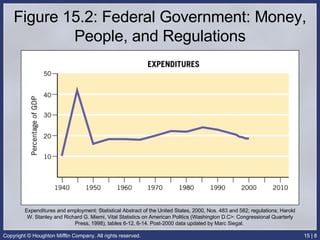
Figure 15.2: Federal Government: Money, People, and Regulations Expenditures and employment: Statistical Abstract of the United States, 2000, Nos. 483 and 582; regulations; Harold W. Stanley and Richard G. Miemi, Vital Statistics on American Politics (Washington D.C>: Congressional Quarterly Press, 1998), tables 6-12, 6-14. Post-2000 data updated by Marc Siegal.
Recruitment and Retention Competitive service: bureaucrats compete for jobs through OPM Appointment by merit based on written exam or through selection criteria
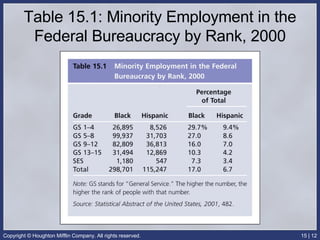
Table 15.1: Minority Employment in the Federal Bureaucracy by Rank, 2000
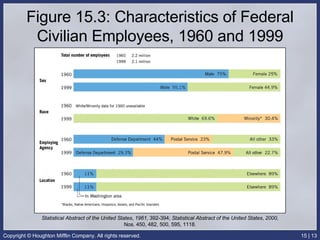
Figure 15.3: Characteristics of Federal Civilian Employees, 1960 and 1999 Statistical Abstract of the United States ,  1961,  392-394;  Statistical Abstract of the United States ,  2000,  Nos. 450, 482, 500, 595, 1118.
Recruitment and Retention Competitive service system has become more decentralized, less reliant on OPM referral Excepted service : bureaucrats appointed by agencies, typically in a nonpartisan fashion
Firing a Bureaucrat Most bureaucrats cannot be easily fired The Senior Executive Service (SES) was established to provide the president and cabinet with more control in personnel decisions But very few SES members have actually been fired
Carrying Out Policy Most bureaucrats try to carry out policy, even those they disagree with But bureaucrats do have obstructive powers—Whistleblower Protection Act (1989) Most civil servants have highly structured jobs that make their personal attitudes irrelevant
Constraints on the Bureaucracy Constraints are much greater on government agencies than on private bureaucracies Hiring, firing, pay, and other procedures are established by law, not by the market Constraints come from citizens: agencies try to respond to citizen demands for openness, honesty, and fairness
Agency Allies Agencies often seek alliances with congressional committees and interest groups These alliances are far less common today—politics has become too complicated Issue networks: groups that regularly debate government policy on certain issues
Congressional Oversight Congress creates agencies  Congress authorizes funds for programs Congressional appropriations provide funds for the agency to spend on its programs Congressional investigations
Bureaucratic Pathologies Red tape : complex, sometimes conflicting rules  Conflict : agencies work at cross-purposes Duplication : two or more agencies seem to do the same thing Imperialism : tendency of agencies to grow, irrespective of programs’ benefits and costs Waste : spending more than is necessary to buy some product or service
Reforming the Bureaucracy National Performance Review (NPR) in 1993 designed to reinvent government calling for less centralized management, more employee initiatives, fewer detailed rules, and more customer satisfaction
Reforming the Bureaucracy Most rules and red tape are due to struggles between the president and Congress or to agencies’ efforts to avoid alienating influential voters Periods of divided government worsen matters, especially in implementing policy

ap gov chap 15

  • 1.
  • 2.
    The United StatesBureaucracy Bureaucracy : a large, complex organization composed of appointed officials Political authority over the bureaucracy is shared by president and Congress Federal agencies share functions with related state and local government agencies
  • 3.
    Growth of theBureaucracy Patronage in the 19 th and early 20 th centuries rewarded supporters, induced congressional support, and built party organizations The Civil War showed the administrative weakness of the federal government and increased demands for civil service reform
  • 4.
    Growth of theBureaucracy The post-Civil War period saw industrialization and the emergence of a national economy The power of national government to regulate interstate commerce became necessary and controversial
  • 5.
    Expansion of theBureaucracy The Depression and World War II led to government activism The Supreme Court upheld laws that granted discretion to administrative agencies Heavy use of income taxes supported war effort and a large bureaucracy
  • 6.
    The Impact of9/11 9/11 attacks could also affect the bureaucracy as profoundly as WWII and the Depression A new cabinet agency (Department of Homeland Security) was created Intelligence-gathering activities were consolidated under a National Intelligence Director
  • 7.
    Growth of theBureaucracy Today Modest increase in the number of government employees Significant indirect increase in number of employees through use of private contractors, state and local government employees Growth in discretionary authority
  • 8.
    Figure 15.2: FederalGovernment: Money, People, and Regulations Expenditures and employment: Statistical Abstract of the United States, 2000, Nos. 483 and 582; regulations; Harold W. Stanley and Richard G. Miemi, Vital Statistics on American Politics (Washington D.C>: Congressional Quarterly Press, 1998), tables 6-12, 6-14. Post-2000 data updated by Marc Siegal.
  • 9.
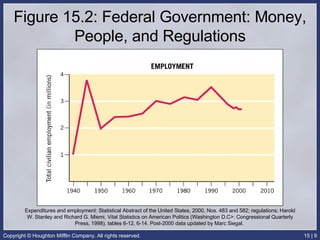
    Figure 15.2: FederalGovernment: Money, People, and Regulations Expenditures and employment: Statistical Abstract of the United States, 2000, Nos. 483 and 582; regulations; Harold W. Stanley and Richard G. Miemi, Vital Statistics on American Politics (Washington D.C>: Congressional Quarterly Press, 1998), tables 6-12, 6-14. Post-2000 data updated by Marc Siegal.
  • 10.
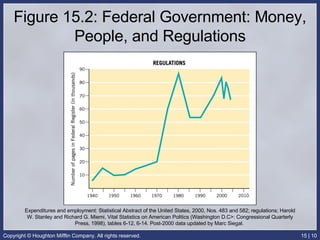
    Figure 15.2: FederalGovernment: Money, People, and Regulations Expenditures and employment: Statistical Abstract of the United States, 2000, Nos. 483 and 582; regulations; Harold W. Stanley and Richard G. Miemi, Vital Statistics on American Politics (Washington D.C>: Congressional Quarterly Press, 1998), tables 6-12, 6-14. Post-2000 data updated by Marc Siegal.
  • 11.
    Recruitment and RetentionCompetitive service: bureaucrats compete for jobs through OPM Appointment by merit based on written exam or through selection criteria
  • 12.
    Table 15.1: MinorityEmployment in the Federal Bureaucracy by Rank, 2000
  • 13.
    Figure 15.3: Characteristicsof Federal Civilian Employees, 1960 and 1999 Statistical Abstract of the United States , 1961, 392-394; Statistical Abstract of the United States , 2000, Nos. 450, 482, 500, 595, 1118.
  • 14.
    Recruitment and RetentionCompetitive service system has become more decentralized, less reliant on OPM referral Excepted service : bureaucrats appointed by agencies, typically in a nonpartisan fashion
  • 15.
    Firing a BureaucratMost bureaucrats cannot be easily fired The Senior Executive Service (SES) was established to provide the president and cabinet with more control in personnel decisions But very few SES members have actually been fired
  • 16.
    Carrying Out PolicyMost bureaucrats try to carry out policy, even those they disagree with But bureaucrats do have obstructive powers—Whistleblower Protection Act (1989) Most civil servants have highly structured jobs that make their personal attitudes irrelevant
  • 17.
    Constraints on theBureaucracy Constraints are much greater on government agencies than on private bureaucracies Hiring, firing, pay, and other procedures are established by law, not by the market Constraints come from citizens: agencies try to respond to citizen demands for openness, honesty, and fairness
  • 18.
    Agency Allies Agenciesoften seek alliances with congressional committees and interest groups These alliances are far less common today—politics has become too complicated Issue networks: groups that regularly debate government policy on certain issues
  • 19.
    Congressional Oversight Congresscreates agencies Congress authorizes funds for programs Congressional appropriations provide funds for the agency to spend on its programs Congressional investigations
  • 20.
    Bureaucratic Pathologies Redtape : complex, sometimes conflicting rules Conflict : agencies work at cross-purposes Duplication : two or more agencies seem to do the same thing Imperialism : tendency of agencies to grow, irrespective of programs’ benefits and costs Waste : spending more than is necessary to buy some product or service
  • 21.
    Reforming the BureaucracyNational Performance Review (NPR) in 1993 designed to reinvent government calling for less centralized management, more employee initiatives, fewer detailed rules, and more customer satisfaction
  • 22.
    Reforming the BureaucracyMost rules and red tape are due to struggles between the president and Congress or to agencies’ efforts to avoid alienating influential voters Periods of divided government worsen matters, especially in implementing policy