GOV4A
The Government of the US
Scott Thomas | May 2013
Exam success is
not a lottery!
Know your
terms
Know the
Articles
Know the
Examples
Session 4
The Executive Branch
of the US
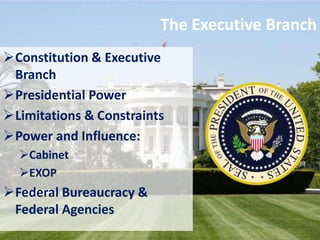
The Executive Branch
Constitution & Executive
Branch
Presidential Power
Limitations & Constraints
Power and Influence:
Cabinet
EXOP
Federal Bureaucracy &
Federal Agencies
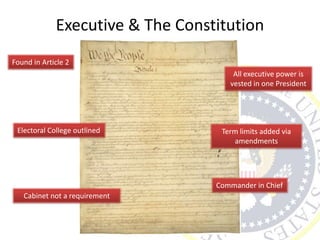
Executive & The Constitution
Found in Article 2
All executive power is
vested in one President
Commander in Chief
Cabinet not a requirement
Electoral College outlined Term limits added via
amendments
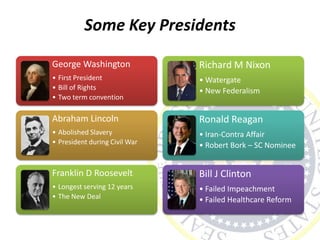
Some Key Presidents
George Washington
• First President
• Bill of Rights
• Two term convention
Abraham Lincoln
• Abolished Slavery
• President during Civil War
Franklin D Roosevelt
• Longest serving 12 years
• The New Deal
Richard M Nixon
• Watergate
• New Federalism
Ronald Reagan
• Iran-Contra Affair
• Robert Bork – SC Nominee
Bill J Clinton
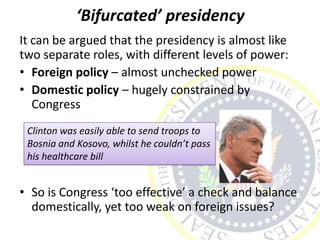
• Failed Impeachment
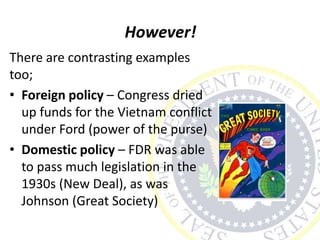
• Failed Healthcare Reform
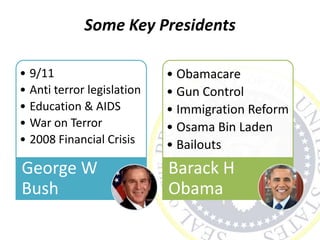
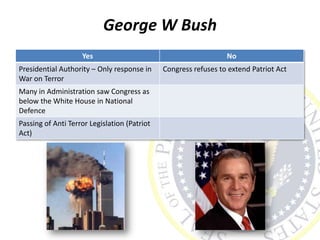
Some Key Presidents
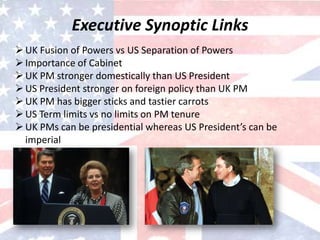
• 9/11
• Anti terror legislation
• Education & AIDS
• War on Terror
• 2008 Financial Crisis
George W
Bush
• Obamacare
• Gun Control
• Immigration Reform
• Osama Bin Laden
• Bailouts
Barack H
Obama
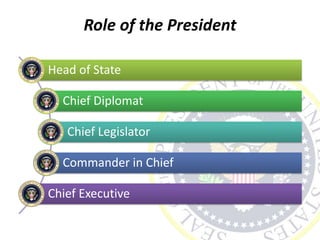
Role of the President
Head of State
Chief Diplomat
Chief Legislator
Commander in Chief
Chief Executive
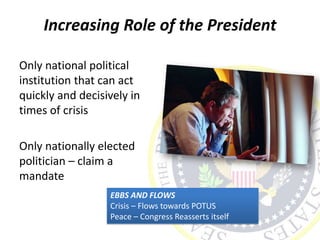
Increasing Role of the President
Only national political
institution that can act
quickly and decisively in
times of crisis
Only nationally elected
politician – claim a
mandate
EBBS AND FLOWS
Crisis – Flows towards POTUS
Peace – Congress Reasserts itself
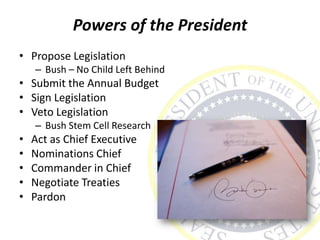
Powers of the President
• Propose Legislation
– Bush – No Child Left Behind
• Submit the Annual Budget
• Sign Legislation
• Veto Legislation
– Bush Stem Cell Research
• Act as Chief Executive
• Nominations Chief
• Commander in Chief
• Negotiate Treaties
• Pardon
Power of Veto
Presidents can veto legislation, i.e. not make it
law
Standard Veto
Sends it back to Congress
Pocket Veto
Doesn’t sign within last 10 days of Congress
Line Item Veto
Power to veto certain parts of legislation, ruled
unconstitutional by Clinton v New York 1998
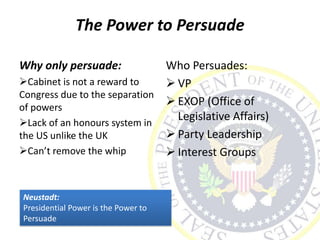
The Power to Persuade
Why only persuade:
Cabinet is not a reward to
Congress due to the separation
of powers
Lack of an honours system in
the US unlike the UK
Can’t remove the whip
Who Persuades:
 VP
 EXOP (Office of
Legislative Affairs)
 Party Leadership
 Interest Groups
Neustadt:
Presidential Power is the Power to
Persuade
The President Persuades
Sometimes the Presidents wades into the
persuasion personally
Phone Calls
Budget Vote 1993 Clinton rang Marjorie Margolies
Mezvinsky to get her to cast her vote
Support Legislation
Campaign in District
Only if Popular!!!!
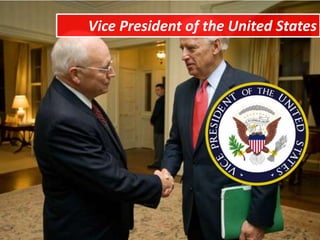
Vice President of the United States
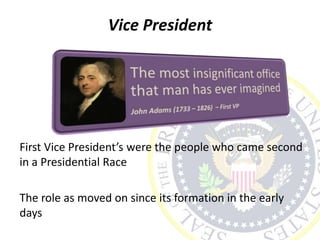
Vice President
First Vice President’s were the people who came second
in a Presidential Race
The role as moved on since its formation in the early
days
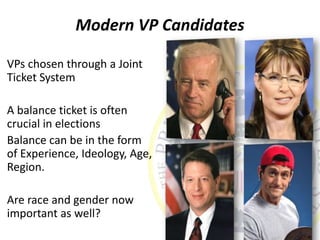
Modern VP Candidates
VPs chosen through a Joint
Ticket System
A balance ticket is often
crucial in elections
Balance can be in the form
of Experience, Ideology, Age,
Region.
Are race and gender now
important as well?
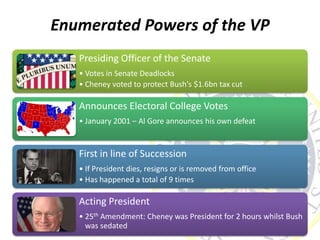
Enumerated Powers of the VP
Presiding Officer of the Senate
• Votes in Senate Deadlocks
• Cheney voted to protect Bush's $1.6bn tax cut
Announces Electoral College Votes
• January 2001 – Al Gore announces his own defeat
First in line of Succession
• If President dies, resigns or is removed from office
• Has happened a total of 9 times
Acting President
• 25th Amendment: Cheney was President for 2 hours whilst Bush
was sedated
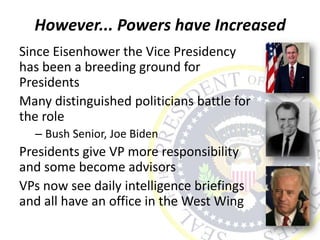
However... Powers have Increased
Since Eisenhower the Vice Presidency
has been a breeding ground for
Presidents
Many distinguished politicians battle for
the role
– Bush Senior, Joe Biden
Presidents give VP more responsibility
and some become advisors
VPs now see daily intelligence briefings
and all have an office in the West Wing
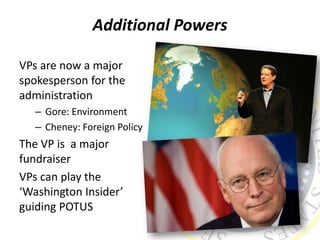
Additional Powers
VPs are now a major
spokesperson for the
administration
– Gore: Environment
– Cheney: Foreign Policy
The VP is a major
fundraiser
VPs can play the
‘Washington Insider’
guiding POTUS
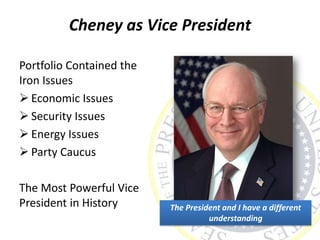
Cheney as Vice President
Portfolio Contained the
Iron Issues
 Economic Issues
 Security Issues
 Energy Issues
 Party Caucus
The Most Powerful Vice
President in History The President and I have a different
understanding
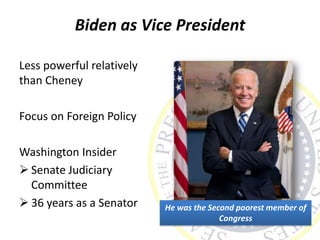
Biden as Vice President
Less powerful relatively
than Cheney
Focus on Foreign Policy
Washington Insider
 Senate Judiciary
Committee
 36 years as a Senator He was the Second poorest member of
Congress
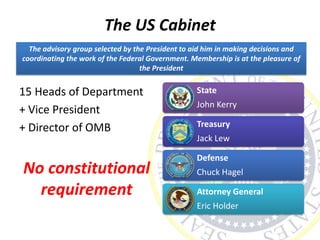
The US Cabinet
15 Heads of Department
+ Vice President
+ Director of OMB
No constitutional
requirement
State
John Kerry
Treasury
Jack Lew
Defense
Chuck Hagel
Attorney General
Eric Holder
The advisory group selected by the President to aid him in making decisions and
coordinating the work of the Federal Government. Membership is at the pleasure of
the President
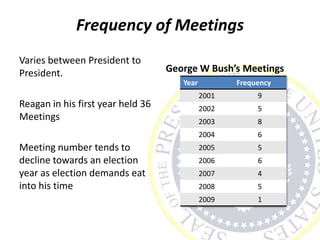
Frequency of Meetings
Varies between President to
President.
Reagan in his first year held 36
Meetings
Meeting number tends to
decline towards an election
year as election demands eat
into his time
George W Bush’s Meetings
Year Frequency
2001 9
2002 5
2003 8
2004 6
2005 5
2006 6
2007 4
2008 5
2009 1
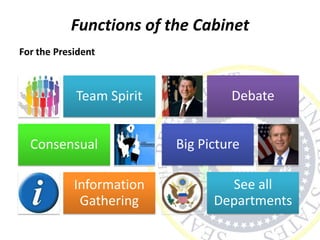
Functions of the Cabinet
For the President
Team Spirit
Consensual
Information
Gathering
Debate
Big Picture
See all
Departments
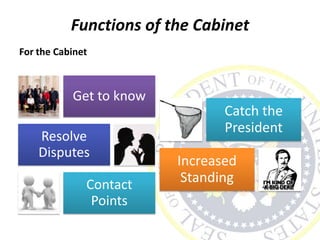
Functions of the Cabinet
For the Cabinet
Get to know
Resolve
Disputes
Contact
Points
Catch the
President
Increased
Standing
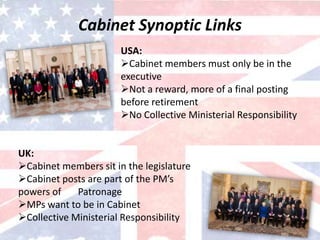
Cabinet Synoptic Links
UK:
Cabinet members sit in the legislature
Cabinet posts are part of the PM’s
powers of Patronage
MPs want to be in Cabinet
Collective Ministerial Responsibility
USA:
Cabinet members must only be in the
executive
Not a reward, more of a final posting
before retirement
No Collective Ministerial Responsibility
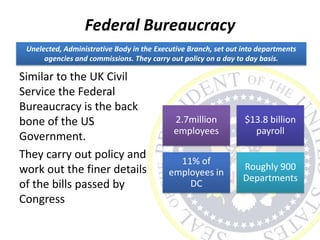
Federal Bureaucracy
Similar to the UK Civil
Service the Federal
Bureaucracy is the back
bone of the US
Government.
They carry out policy and
work out the finer details
of the bills passed by
Congress
2.7million
employees
$13.8 billion
payroll
11% of
employees in
DC
Roughly 900
Departments
Unelected, Administrative Body in the Executive Branch, set out into departments
agencies and commissions. They carry out policy on a day to day basis.
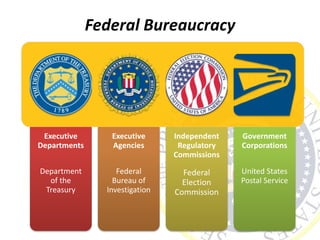
Federal Bureaucracy
Executive
Departments
Department
of the
Treasury
Executive
Agencies
Federal
Bureau of
Investigation
Independent
Regulatory
Commissions
Federal
Election
Commission
Government
Corporations
United States
Postal Service
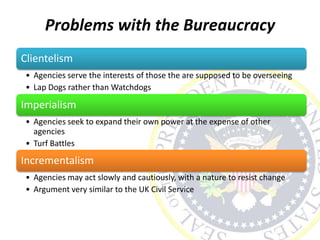
Problems with the Bureaucracy
Clientelism
• Agencies serve the interests of those the are supposed to be overseeing
• Lap Dogs rather than Watchdogs
Imperialism
• Agencies seek to expand their own power at the expense of other
agencies
• Turf Battles
Incrementalism
• Agencies may act slowly and cautiously, with a nature to resist change
• Argument very similar to the UK Civil Service
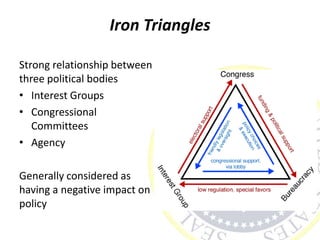
Iron Triangles
Strong relationship between
three political bodies
• Interest Groups
• Congressional
Committees
• Agency
Generally considered as
having a negative impact on
policy
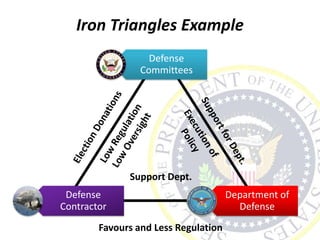
Iron Triangles Example
Department of
Defense
Defense
Committees
Defense
Contractor
Favours and Less Regulation
Support Dept.
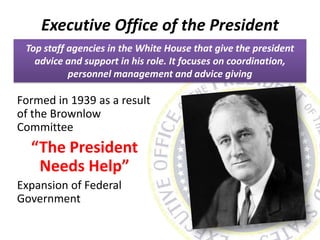
Executive Office of the President
Formed in 1939 as a result
of the Brownlow
Committee
“The President
Needs Help”
Expansion of Federal
Government
Top staff agencies in the White House that give the president
advice and support in his role. It focuses on coordination,
personnel management and advice giving
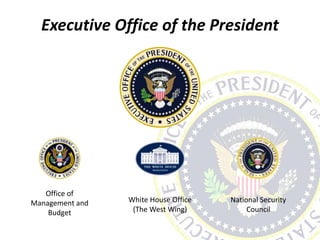
Executive Office of the President
Office of
Management and
Budget
National Security
Council
White House Office
(The West Wing)
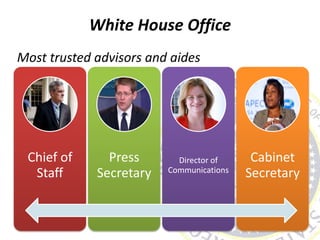
White House Office
Most trusted advisors and aides
Chief of
Staff
Press
Secretary
Director of
Communications
Cabinet
Secretary
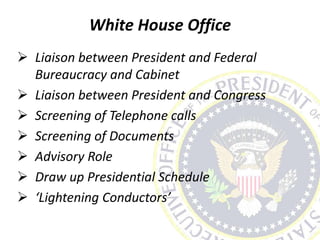
White House Office
 Liaison between President and Federal
Bureaucracy and Cabinet
 Liaison between President and Congress
 Screening of Telephone calls
 Screening of Documents
 Advisory Role
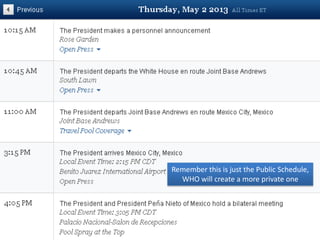
 Draw up Presidential Schedule
 ‘Lightening Conductors’
Remember this is just the Public Schedule,
WHO will create a more private one
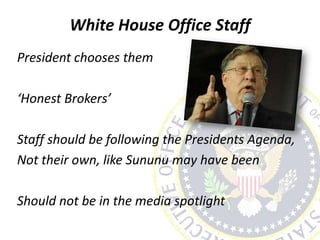
White House Office Staff
President chooses them
‘Honest Brokers’
Staff should be following the Presidents Agenda,
Not their own, like Sununu may have been
Should not be in the media spotlight
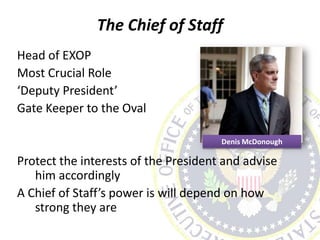
The Chief of Staff
Head of EXOP
Most Crucial Role
‘Deputy President’
Gate Keeper to the Oval
Protect the interests of the President and advise
him accordingly
A Chief of Staff’s power is will depend on how
strong they are
Denis McDonough
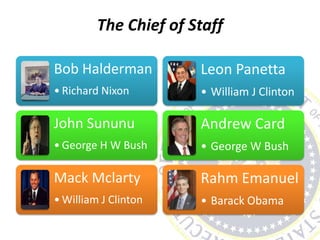
The Chief of Staff
Bob Halderman
• Richard Nixon
John Sununu
• George H W Bush
Mack Mclarty
• William J Clinton
Leon Panetta
• William J Clinton
Andrew Card
• George W Bush
Rahm Emanuel
• Barack Obama
Office of Management and Budget
Created by Nixon in 1970
Oversees the spending by all
Federal departments and
agencies
Advises the President on the
allocation of Federal Funds
Director is the only Senate
confirmed position within
EXOP.
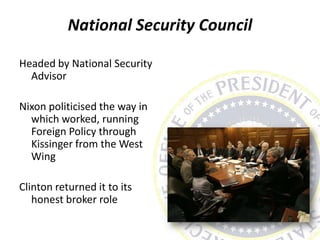
National Security Council
Headed by National Security
Advisor
Nixon politicised the way in
which worked, running
Foreign Policy through
Kissinger from the West
Wing
Clinton returned it to its
honest broker role
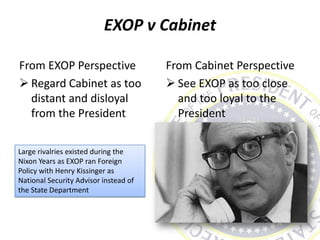
EXOP v Cabinet
From EXOP Perspective
 Regard Cabinet as too
distant and disloyal
from the President
From Cabinet Perspective
 See EXOP as too close
and too loyal to the
President
Large rivalries existed during the
Nixon Years as EXOP ran Foreign
Policy with Henry Kissinger as
National Security Advisor instead of
the State Department
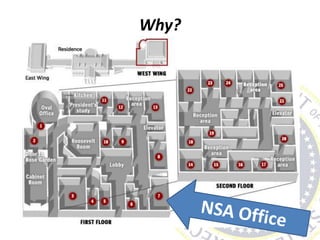
Why?
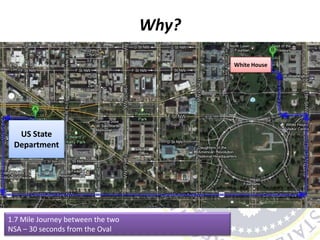
Why?
US State
Department
White House
1.7 Mile Journey between the two
NSA – 30 seconds from the Oval
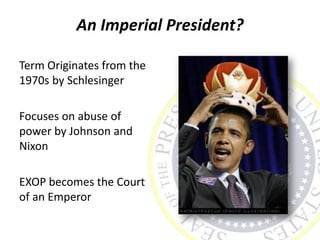
An Imperial President?
Term Originates from the
1970s by Schlesinger
Focuses on abuse of
power by Johnson and
Nixon
EXOP becomes the Court
of an Emperor
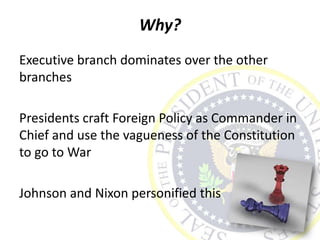
Why?
Executive branch dominates over the other
branches
Presidents craft Foreign Policy as Commander in
Chief and use the vagueness of the Constitution
to go to War
Johnson and Nixon personified this
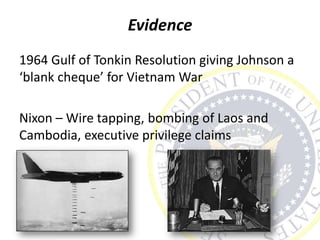
Evidence
1964 Gulf of Tonkin Resolution giving Johnson a
‘blank cheque’ for Vietnam War
Nixon – Wire tapping, bombing of Laos and
Cambodia, executive privilege claims
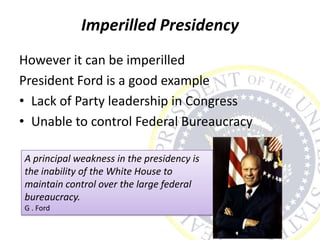
Imperilled Presidency
However it can be imperilled
President Ford is a good example
• Lack of Party leadership in Congress
• Unable to control Federal Bureaucracy
A principal weakness in the presidency is
the inability of the White House to
maintain control over the large federal
bureaucracy.
G . Ford
‘Bifurcated’ presidency
It can be argued that the presidency is almost like
two separate roles, with different levels of power:
• Foreign policy – almost unchecked power
• Domestic policy – hugely constrained by
Congress
• So is Congress ‘too effective’ a check and balance
domestically, yet too weak on foreign issues?
Clinton was easily able to send troops to
Bosnia and Kosovo, whilst he couldn’t pass
his healthcare bill
However!
There are contrasting examples
too;
• Foreign policy – Congress dried
up funds for the Vietnam conflict
under Ford (power of the purse)
• Domestic policy – FDR was able
to pass much legislation in the
1930s (New Deal), as was
Johnson (Great Society)
George W Bush
Yes No
Presidential Authority – Only response in
War on Terror
Congress refuses to extend Patriot Act
Many in Administration saw Congress as
below the White House in National
Defence
Passing of Anti Terror Legislation (Patriot
Act)
Executive Synoptic Links
UK Fusion of Powers vs US Separation of Powers
Importance of Cabinet
UK PM stronger domestically than US President
US President stronger on foreign policy than UK PM
UK PM has bigger sticks and tastier carrots
US Term limits vs no limits on PM tenure
UK PMs can be presidential whereas US President’s can be
imperial
Exam success is
not a lottery!
Know your
terms
Know the
Articles
Know the
Examples
Answer the question, the whole
question and nothing but the
question

The Executive Branch | The Presidency

  • 1.
    GOV4A The Government ofthe US Scott Thomas | May 2013
  • 2.
    Exam success is nota lottery! Know your terms Know the Articles Know the Examples
  • 3.
    Session 4 The ExecutiveBranch of the US
  • 4.
    The Executive Branch Constitution& Executive Branch Presidential Power Limitations & Constraints Power and Influence: Cabinet EXOP Federal Bureaucracy & Federal Agencies
  • 5.
    Executive & TheConstitution Found in Article 2 All executive power is vested in one President Commander in Chief Cabinet not a requirement Electoral College outlined Term limits added via amendments
  • 6.
    Some Key Presidents GeorgeWashington • First President • Bill of Rights • Two term convention Abraham Lincoln • Abolished Slavery • President during Civil War Franklin D Roosevelt • Longest serving 12 years • The New Deal Richard M Nixon • Watergate • New Federalism Ronald Reagan • Iran-Contra Affair • Robert Bork – SC Nominee Bill J Clinton • Failed Impeachment • Failed Healthcare Reform
  • 7.
    Some Key Presidents •9/11 • Anti terror legislation • Education & AIDS • War on Terror • 2008 Financial Crisis George W Bush • Obamacare • Gun Control • Immigration Reform • Osama Bin Laden • Bailouts Barack H Obama
  • 8.
    Role of thePresident Head of State Chief Diplomat Chief Legislator Commander in Chief Chief Executive
  • 9.
    Increasing Role ofthe President Only national political institution that can act quickly and decisively in times of crisis Only nationally elected politician – claim a mandate EBBS AND FLOWS Crisis – Flows towards POTUS Peace – Congress Reasserts itself
  • 10.
    Powers of thePresident • Propose Legislation – Bush – No Child Left Behind • Submit the Annual Budget • Sign Legislation • Veto Legislation – Bush Stem Cell Research • Act as Chief Executive • Nominations Chief • Commander in Chief • Negotiate Treaties • Pardon
  • 11.
    Power of Veto Presidentscan veto legislation, i.e. not make it law Standard Veto Sends it back to Congress Pocket Veto Doesn’t sign within last 10 days of Congress Line Item Veto Power to veto certain parts of legislation, ruled unconstitutional by Clinton v New York 1998
  • 12.
    The Power toPersuade Why only persuade: Cabinet is not a reward to Congress due to the separation of powers Lack of an honours system in the US unlike the UK Can’t remove the whip Who Persuades:  VP  EXOP (Office of Legislative Affairs)  Party Leadership  Interest Groups Neustadt: Presidential Power is the Power to Persuade
  • 13.
    The President Persuades Sometimesthe Presidents wades into the persuasion personally Phone Calls Budget Vote 1993 Clinton rang Marjorie Margolies Mezvinsky to get her to cast her vote Support Legislation Campaign in District Only if Popular!!!!
  • 14.
    Vice President ofthe United States
  • 15.
    Vice President First VicePresident’s were the people who came second in a Presidential Race The role as moved on since its formation in the early days
  • 16.
    Modern VP Candidates VPschosen through a Joint Ticket System A balance ticket is often crucial in elections Balance can be in the form of Experience, Ideology, Age, Region. Are race and gender now important as well?
  • 17.
    Enumerated Powers ofthe VP Presiding Officer of the Senate • Votes in Senate Deadlocks • Cheney voted to protect Bush's $1.6bn tax cut Announces Electoral College Votes • January 2001 – Al Gore announces his own defeat First in line of Succession • If President dies, resigns or is removed from office • Has happened a total of 9 times Acting President • 25th Amendment: Cheney was President for 2 hours whilst Bush was sedated
  • 18.
    However... Powers haveIncreased Since Eisenhower the Vice Presidency has been a breeding ground for Presidents Many distinguished politicians battle for the role – Bush Senior, Joe Biden Presidents give VP more responsibility and some become advisors VPs now see daily intelligence briefings and all have an office in the West Wing
  • 19.
    Additional Powers VPs arenow a major spokesperson for the administration – Gore: Environment – Cheney: Foreign Policy The VP is a major fundraiser VPs can play the ‘Washington Insider’ guiding POTUS
  • 20.
    Cheney as VicePresident Portfolio Contained the Iron Issues  Economic Issues  Security Issues  Energy Issues  Party Caucus The Most Powerful Vice President in History The President and I have a different understanding
  • 21.
    Biden as VicePresident Less powerful relatively than Cheney Focus on Foreign Policy Washington Insider  Senate Judiciary Committee  36 years as a Senator He was the Second poorest member of Congress
  • 22.
    The US Cabinet 15Heads of Department + Vice President + Director of OMB No constitutional requirement State John Kerry Treasury Jack Lew Defense Chuck Hagel Attorney General Eric Holder The advisory group selected by the President to aid him in making decisions and coordinating the work of the Federal Government. Membership is at the pleasure of the President
  • 23.
    Frequency of Meetings Variesbetween President to President. Reagan in his first year held 36 Meetings Meeting number tends to decline towards an election year as election demands eat into his time George W Bush’s Meetings Year Frequency 2001 9 2002 5 2003 8 2004 6 2005 5 2006 6 2007 4 2008 5 2009 1
  • 24.
    Functions of theCabinet For the President Team Spirit Consensual Information Gathering Debate Big Picture See all Departments
  • 25.
    Functions of theCabinet For the Cabinet Get to know Resolve Disputes Contact Points Catch the President Increased Standing
  • 26.
    Cabinet Synoptic Links UK: Cabinetmembers sit in the legislature Cabinet posts are part of the PM’s powers of Patronage MPs want to be in Cabinet Collective Ministerial Responsibility USA: Cabinet members must only be in the executive Not a reward, more of a final posting before retirement No Collective Ministerial Responsibility
  • 27.
    Federal Bureaucracy Similar tothe UK Civil Service the Federal Bureaucracy is the back bone of the US Government. They carry out policy and work out the finer details of the bills passed by Congress 2.7million employees $13.8 billion payroll 11% of employees in DC Roughly 900 Departments Unelected, Administrative Body in the Executive Branch, set out into departments agencies and commissions. They carry out policy on a day to day basis.
  • 28.
    Federal Bureaucracy Executive Departments Department of the Treasury Executive Agencies Federal Bureauof Investigation Independent Regulatory Commissions Federal Election Commission Government Corporations United States Postal Service
  • 29.
    Problems with theBureaucracy Clientelism • Agencies serve the interests of those the are supposed to be overseeing • Lap Dogs rather than Watchdogs Imperialism • Agencies seek to expand their own power at the expense of other agencies • Turf Battles Incrementalism • Agencies may act slowly and cautiously, with a nature to resist change • Argument very similar to the UK Civil Service
  • 30.
    Iron Triangles Strong relationshipbetween three political bodies • Interest Groups • Congressional Committees • Agency Generally considered as having a negative impact on policy
  • 31.
    Iron Triangles Example Departmentof Defense Defense Committees Defense Contractor Favours and Less Regulation Support Dept.
  • 32.
    Executive Office ofthe President
  • 33.
    Executive Office ofthe President Formed in 1939 as a result of the Brownlow Committee “The President Needs Help” Expansion of Federal Government Top staff agencies in the White House that give the president advice and support in his role. It focuses on coordination, personnel management and advice giving
  • 34.
    Executive Office ofthe President Office of Management and Budget National Security Council White House Office (The West Wing)
  • 35.
    White House Office Mosttrusted advisors and aides Chief of Staff Press Secretary Director of Communications Cabinet Secretary
  • 36.
    White House Office Liaison between President and Federal Bureaucracy and Cabinet  Liaison between President and Congress  Screening of Telephone calls  Screening of Documents  Advisory Role  Draw up Presidential Schedule  ‘Lightening Conductors’
  • 37.
    Remember this isjust the Public Schedule, WHO will create a more private one
  • 38.
    White House OfficeStaff President chooses them ‘Honest Brokers’ Staff should be following the Presidents Agenda, Not their own, like Sununu may have been Should not be in the media spotlight
  • 39.
    The Chief ofStaff Head of EXOP Most Crucial Role ‘Deputy President’ Gate Keeper to the Oval Protect the interests of the President and advise him accordingly A Chief of Staff’s power is will depend on how strong they are Denis McDonough
  • 40.
    The Chief ofStaff Bob Halderman • Richard Nixon John Sununu • George H W Bush Mack Mclarty • William J Clinton Leon Panetta • William J Clinton Andrew Card • George W Bush Rahm Emanuel • Barack Obama
  • 41.
    Office of Managementand Budget Created by Nixon in 1970 Oversees the spending by all Federal departments and agencies Advises the President on the allocation of Federal Funds Director is the only Senate confirmed position within EXOP.
  • 42.
    National Security Council Headedby National Security Advisor Nixon politicised the way in which worked, running Foreign Policy through Kissinger from the West Wing Clinton returned it to its honest broker role
  • 43.
    EXOP v Cabinet FromEXOP Perspective  Regard Cabinet as too distant and disloyal from the President From Cabinet Perspective  See EXOP as too close and too loyal to the President Large rivalries existed during the Nixon Years as EXOP ran Foreign Policy with Henry Kissinger as National Security Advisor instead of the State Department
  • 44.
  • 45.
    Why? US State Department White House 1.7Mile Journey between the two NSA – 30 seconds from the Oval
  • 46.
    An Imperial President? TermOriginates from the 1970s by Schlesinger Focuses on abuse of power by Johnson and Nixon EXOP becomes the Court of an Emperor
  • 47.
    Why? Executive branch dominatesover the other branches Presidents craft Foreign Policy as Commander in Chief and use the vagueness of the Constitution to go to War Johnson and Nixon personified this
  • 48.
    Evidence 1964 Gulf ofTonkin Resolution giving Johnson a ‘blank cheque’ for Vietnam War Nixon – Wire tapping, bombing of Laos and Cambodia, executive privilege claims
  • 49.
    Imperilled Presidency However itcan be imperilled President Ford is a good example • Lack of Party leadership in Congress • Unable to control Federal Bureaucracy A principal weakness in the presidency is the inability of the White House to maintain control over the large federal bureaucracy. G . Ford
  • 50.
    ‘Bifurcated’ presidency It canbe argued that the presidency is almost like two separate roles, with different levels of power: • Foreign policy – almost unchecked power • Domestic policy – hugely constrained by Congress • So is Congress ‘too effective’ a check and balance domestically, yet too weak on foreign issues? Clinton was easily able to send troops to Bosnia and Kosovo, whilst he couldn’t pass his healthcare bill
  • 51.
    However! There are contrastingexamples too; • Foreign policy – Congress dried up funds for the Vietnam conflict under Ford (power of the purse) • Domestic policy – FDR was able to pass much legislation in the 1930s (New Deal), as was Johnson (Great Society)
  • 52.
    George W Bush YesNo Presidential Authority – Only response in War on Terror Congress refuses to extend Patriot Act Many in Administration saw Congress as below the White House in National Defence Passing of Anti Terror Legislation (Patriot Act)
  • 53.
    Executive Synoptic Links UKFusion of Powers vs US Separation of Powers Importance of Cabinet UK PM stronger domestically than US President US President stronger on foreign policy than UK PM UK PM has bigger sticks and tastier carrots US Term limits vs no limits on PM tenure UK PMs can be presidential whereas US President’s can be imperial
  • 54.
    Exam success is nota lottery! Know your terms Know the Articles Know the Examples
  • 55.
    Answer the question,the whole question and nothing but the question

Editor's Notes