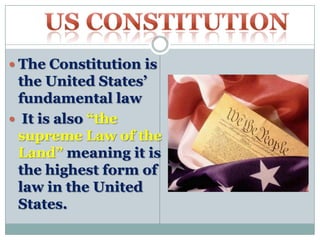
 The Constitution is
the United States’
fundamental law
 It is also “the
supreme Law of the
Land” meaning it is
the highest form of
law in the United
States.
 It sets out the basic
principles upon which
government in the US
was built and operates
today.
 Length/Size of:
 Relatively brief
document
 7000 words
 6 pages long
 Constitution is broken
into (3) parts:
1. The Preamble
2. 7 numbered sections
called Articles
3. The 27 Amendments
 Article I
 Legislative Branch
 Article II
 Executive Branch
 Article III
 Judicial Branch
 Article IV
 State Relationship
 This part of the
Constitution
deals with:
How formal
amendments
may be added.
 This part of the
Constitution
states:
The Constitution
is the nation’s
supreme law.
Oath of office
 This part of the
Constitution
deals with:
The ratification
of the
Constitution.
 In the US, all political
power resides in the
people and is the only
source for any and all
governmental power.
 Where does the
National Government
get its power?
People/States
Define
Constitutionalism
Government must
be conducted
according to
constitutional
principles
Legislative,
executive and
judicial powers
are distributed
(separated)
among 3 distinct
and independent
branches of the
government.
 Framer’s purpose:
Limit the powers of government
 The (3) branches of Federal government
are tied together by a system of checks and
balances
 What does this mean?
 Each branch can “check” the power of
another
 Power divided
between the
legislative and
executive branch
between the 2 major
parties.
 Impact on
government:
 NOTHING gets
done.
 Power of the courts to
determine whether
what government does
is in accord with what
the Constitution
provides.
 Definition:
 Power to declare a
government action
illegal, null and
void.
 Framers wanted
a stronger
central
government.
 And also wanted
to keep the
concept of self-
government.
 The United States
Constitution has
been in force for
over 200 years,
making it the
oldest written
constitution in the
world.
 Big difference is that the US is not the
same country as it was in 1789.
 Population over 300 million
 50 States
 World leader
1. 1st Method: Proposal by Congress,
ratification by state legislatures (used 26/27)
 2nd Method: Proposal
by Congress,
ratification by state
conventions (used once)
 21st Amendment:
Congress felt
conventions would
reflect people’s
views better than
state legislatures.
3rd Method: Proposal by convention of states,
ratification by state conventions (never used)
4th Method: Proposal by convention of states,
ratification by state legislatures (never used)
 More than 10,000 joint
resolutions have been
proposed to Congress
since 1789.
 Only 33 have been sent
to states.
 Failed Resolutions:
 Equal Rights Amendment
 Forbid abolishing slavery
 The first 10
Amendments to the
Constitution are
known as the Bill of
Rights – proposed in
the 1st session of
Congress in 1789.
 Why were they
proposed so quickly?
 So the Anti-Federalists
would ratify the
Constitution.
 These amendments
set out the great
constitutional
guarantees:
 Of freedom of belief
and expression,
 of freedom and
security of the
person,
 and of fair and
equal treatment
before the law.
 Change in Electoral College procedure: 1 vote
for President and 1 vote for Vice President
 Reason: Election of 1800 ended in a tie
between members of same political party.
 13th Amendment
 Abolish Slavery
 14th Amendment
Equal citizenship
and protection
under law
 15th Amendment
No denial of right
to vote based on
race
Civil War Amendments
18th Amendment 26th Amendment
 Prohibition of selling,
manufacturing ,
transporting alcohol.
 Minimum voting
age no higher
than 18.
 Many changes have been made in the
Constitution which have not inv0lved the
Amendment process.
 There are (5) ways this change can
happen.
 Congress has been a
major agent of
constitutional change in
two important ways:
1. passed laws to spell
out some of the
Constitution’s brief
provisions
2. added to the
Constitution by the
way it has used many
of its powers
Judiciary Act of 1789 Presidential Succession
 Allows for
Congress to set
up lower federal
courts.
 Constitution says
Vice-President takes
over for President ;
but Congress
decides after that.
 The manner in which
various Presidents have
used their powers has
also contributed to the
growth of the
Constitution.
 Power to declare war:
 Congress has this power;
but every president has
used military without
Congressional
Declaration of War.
 Define: pact made by
the President directly
with the head of a
Foreign government.
 Treaty = agreement
with foreign country
approved by Congress.
 Executive agreements
are used more often:
 WHY? treaties are
more cumbersome.
 The nation’s
courts interpret
and apply the
Constitution in
many cases they
hear.
 Marbury v.
Madison
 No mention of
political parties in the
Constitution; yet they
have been a major
source of
constitutional change.
 Most Framers were
opposed to political
parties, but they have
shaped the way are
government operates.
 Neither the Constitution nor law provided for
the nomination of a candidate for president.
 Electoral College
 Body that makes formal selection of President
 What role do parties play in Congress?
 Much of the business is organized and conducted
based on the political parties
 The President makes appointments with an eye
on party politics.
 Unwritten custom
may be as strong as
written law, and
many customs have
developed in our
governmental
system.
 There are many
examples of this…
 The Cabinet (advisory body to President) is made
up of the heads of the 15 executive departments
 Custom established the precedent that the vice-
president became president when there was a
death in the office – What ended this custom?
 The 25th Amendment
 Senatorial Courtesy
 President will ask senators from a state about a
presidential appointee from that state.
 Custom for Presidents to serve (2) terms:
 22nd Amendment
Constitution

Constitution

  • 2.
     The Constitutionis the United States’ fundamental law  It is also “the supreme Law of the Land” meaning it is the highest form of law in the United States.
  • 3.
     It setsout the basic principles upon which government in the US was built and operates today.  Length/Size of:  Relatively brief document  7000 words  6 pages long
  • 4.
     Constitution isbroken into (3) parts: 1. The Preamble 2. 7 numbered sections called Articles 3. The 27 Amendments
  • 5.
     Article I Legislative Branch  Article II  Executive Branch  Article III  Judicial Branch  Article IV  State Relationship
  • 6.
     This partof the Constitution deals with: How formal amendments may be added.
  • 7.
     This partof the Constitution states: The Constitution is the nation’s supreme law. Oath of office
  • 8.
     This partof the Constitution deals with: The ratification of the Constitution.
  • 9.
     In theUS, all political power resides in the people and is the only source for any and all governmental power.  Where does the National Government get its power? People/States
  • 10.
  • 11.
    Legislative, executive and judicial powers aredistributed (separated) among 3 distinct and independent branches of the government.
  • 12.
     Framer’s purpose: Limitthe powers of government
  • 14.
     The (3)branches of Federal government are tied together by a system of checks and balances  What does this mean?  Each branch can “check” the power of another
  • 16.
     Power divided betweenthe legislative and executive branch between the 2 major parties.  Impact on government:  NOTHING gets done.
  • 17.
     Power ofthe courts to determine whether what government does is in accord with what the Constitution provides.  Definition:  Power to declare a government action illegal, null and void.
  • 18.
     Framers wanted astronger central government.  And also wanted to keep the concept of self- government.
  • 19.
     The UnitedStates Constitution has been in force for over 200 years, making it the oldest written constitution in the world.
  • 20.
     Big differenceis that the US is not the same country as it was in 1789.  Population over 300 million  50 States  World leader
  • 21.
    1. 1st Method:Proposal by Congress, ratification by state legislatures (used 26/27)
  • 22.
     2nd Method:Proposal by Congress, ratification by state conventions (used once)  21st Amendment: Congress felt conventions would reflect people’s views better than state legislatures.
  • 23.
    3rd Method: Proposalby convention of states, ratification by state conventions (never used) 4th Method: Proposal by convention of states, ratification by state legislatures (never used)
  • 24.
     More than10,000 joint resolutions have been proposed to Congress since 1789.  Only 33 have been sent to states.  Failed Resolutions:  Equal Rights Amendment  Forbid abolishing slavery
  • 25.
     The first10 Amendments to the Constitution are known as the Bill of Rights – proposed in the 1st session of Congress in 1789.  Why were they proposed so quickly?  So the Anti-Federalists would ratify the Constitution.
  • 26.
     These amendments setout the great constitutional guarantees:  Of freedom of belief and expression,  of freedom and security of the person,  and of fair and equal treatment before the law.
  • 27.
     Change inElectoral College procedure: 1 vote for President and 1 vote for Vice President  Reason: Election of 1800 ended in a tie between members of same political party.
  • 28.
     13th Amendment Abolish Slavery  14th Amendment Equal citizenship and protection under law  15th Amendment No denial of right to vote based on race Civil War Amendments
  • 29.
    18th Amendment 26thAmendment  Prohibition of selling, manufacturing , transporting alcohol.  Minimum voting age no higher than 18.
  • 30.
     Many changeshave been made in the Constitution which have not inv0lved the Amendment process.  There are (5) ways this change can happen.
  • 31.
     Congress hasbeen a major agent of constitutional change in two important ways: 1. passed laws to spell out some of the Constitution’s brief provisions 2. added to the Constitution by the way it has used many of its powers
  • 32.
    Judiciary Act of1789 Presidential Succession  Allows for Congress to set up lower federal courts.  Constitution says Vice-President takes over for President ; but Congress decides after that.
  • 33.
     The mannerin which various Presidents have used their powers has also contributed to the growth of the Constitution.  Power to declare war:  Congress has this power; but every president has used military without Congressional Declaration of War.
  • 34.
     Define: pactmade by the President directly with the head of a Foreign government.  Treaty = agreement with foreign country approved by Congress.  Executive agreements are used more often:  WHY? treaties are more cumbersome.
  • 35.
     The nation’s courtsinterpret and apply the Constitution in many cases they hear.  Marbury v. Madison
  • 36.
     No mentionof political parties in the Constitution; yet they have been a major source of constitutional change.  Most Framers were opposed to political parties, but they have shaped the way are government operates.
  • 37.
     Neither theConstitution nor law provided for the nomination of a candidate for president.  Electoral College  Body that makes formal selection of President  What role do parties play in Congress?  Much of the business is organized and conducted based on the political parties  The President makes appointments with an eye on party politics.
  • 38.
     Unwritten custom maybe as strong as written law, and many customs have developed in our governmental system.  There are many examples of this…
  • 39.
     The Cabinet(advisory body to President) is made up of the heads of the 15 executive departments  Custom established the precedent that the vice- president became president when there was a death in the office – What ended this custom?  The 25th Amendment  Senatorial Courtesy  President will ask senators from a state about a presidential appointee from that state.  Custom for Presidents to serve (2) terms:  22nd Amendment