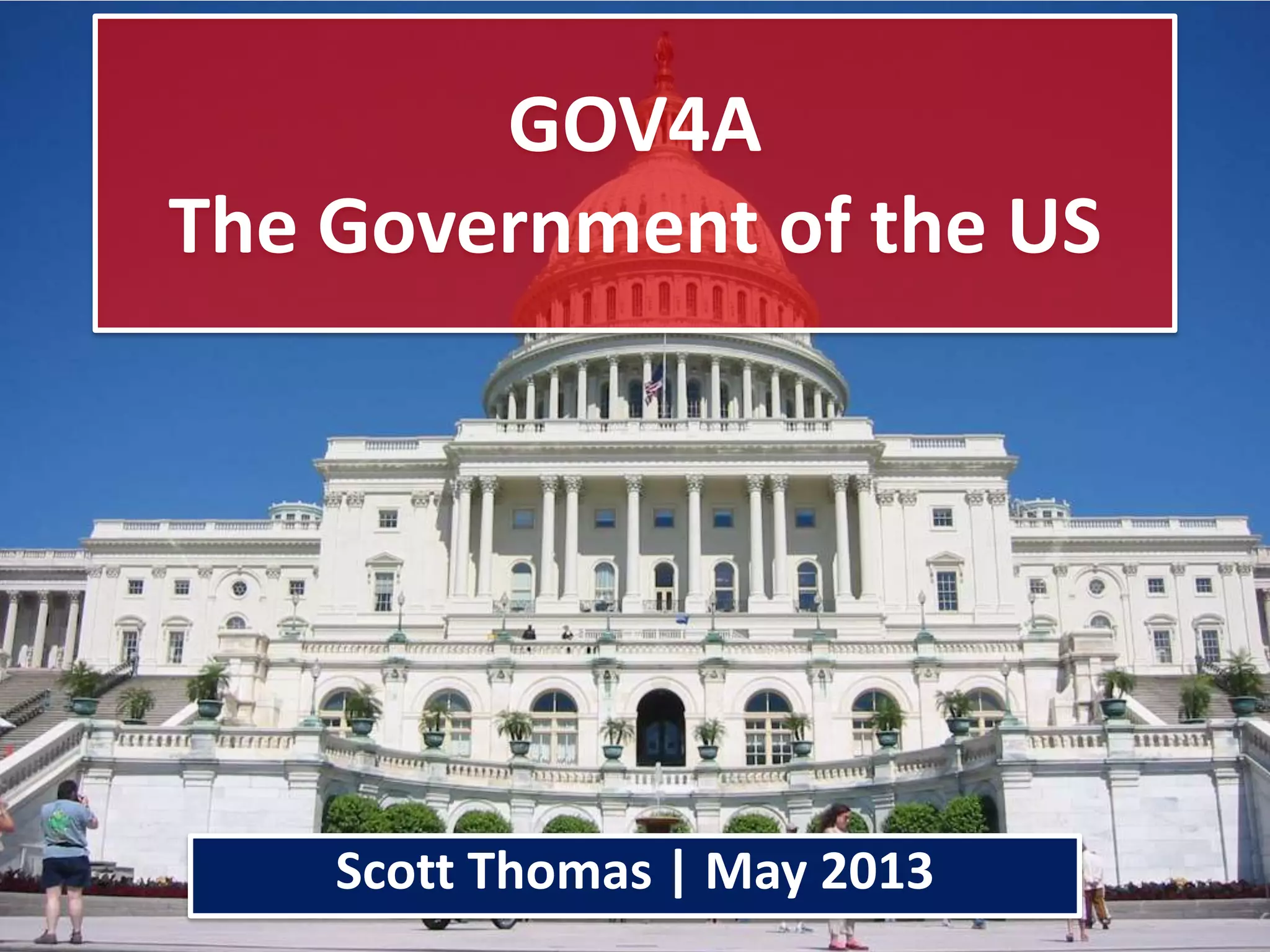
GOV4A
The Government of the US
Scott Thomas | May 2013
Exam success is
not a lottery!
Know your
terms
Know the
Articles
Know the
Examples
Session 3
The Legislative Branch
of the US
The Legislative Branch
Constitutional Role
Composition
Differences between Houses
Importance of the Parties
Roles of Congress
Relationship with
Government and Supreme
Court
Congress & The Constitution
Congress is Article One
Powers outlined in this
are known as
Enumerated powers
Section 8 – Final Clause
Elastic Clause
If Article One references
Congress surely it is the most
important branch?
Divides Congress into two
House of Representatives
Senate
Bicameral System is
known as the
Connecticut CompromiseHouse Elected via Popular Vote
Senate indirect elected until 1914
Concurrent Powers of Congress
Equal Legislative Power
Override Presidential Veto
Initiate Constitutional Amendments
Declarations of War
Confirm appointed Vice Presidents
Declared Wars
Elastic Clause
“to make all laws which shall be necessary and
proper for carrying into execution the
foregoing powers, and all other powers vested
in this Constitution in the Government of the
United States, or in any department or officer
thereof”
Article 1, Section 8, Final Clause
House of Representatives
Make up of the House
435 Seats
200 Democrats
232 Republicans
3 Vacant
Each member represents a ‘Congressional District’
States are given a number of districts in proportion to their population
House is presided over by the Speaker of the House
Key Demographics
Gender Balance: Male 82% Female 28%
Ethnicity:
African American 41
Asian 7
Caucasian 336
Hispanic 27
Not Stated 22
Other 5
Powers of the House
Known as Exclusive Powers
• Initiate Money Bills
– Power of the Purse
• Impeachment
– Voted to impeach Clinton in 1998
• Elect a President should the Electoral College
Deadlock
– John Quincy Adams elected President in Deadlock
Speaker of the
House
• Presiding Officer of the
House
• Second in Presidential
Succession
• Leader of Majority party in
the House normally becomes
Speaker through ballot
• No requirement that the
Speaker be a member of the
House
John Boehner (R)
Ohio 8th District
Role of the Speaker
Notably Partisan Role
Speaker doesn’t typically debate or vote unless it’s
close
Responsible for the passage o legislation and which
will make it to the floor
Speaker normally designates to someone else to
preside over the proceedings in the House
Responsible for maintaining decorum in the House
House Leadership
John Boehner (R)
Ohio 8th District
Eric Cantor (R)
Virginia 7th District
Nancy Pelosi (D)
California 12th District
Speaker Majority Leader Minority Leader
Majority & Minority Leaders
• Elected via closed door
party caucus every
Congress
• Represent the Party
• Liaison between
Congress and White
House
• Day to Day director of
Operations on the
House Floor
Leaders More Important in The Senate
Running for the House
Elections are every 2 years (all elected)
US Citizens for 7 years
Must be a resident in
representative state
Candidates must be at
least 25 years old
Some states may impose a locality rule
You need to first secure
the nomination from your
Party
You may need to win a
Primary Election
You May be challenged as
an incumbent
Congressional Districts
The House has 435 Seats
These are given to states depending on
population, roughly 700,000 people in each
district
Every 10 years after a census the number is
changed per state
Congressional Districts
Gerrymandering
• Gerrymandering is a form of redistricting in
which electoral districts boundaries are
deliberately modified for electoral purposes,
thereby producing a contorted or unusual
shape.
CGP Grey Explains:
•Gerrymandering
Gerrymandering
Negative: when used to allege that a party is
gaining disproportionate power – packing
districts with hardcore support form one party,
creating wasted votes.
Positive: producing a proportion of
constituencies with an African-American or
other minority in the majority (these are then
called "minority-majority districts").
Some Brilliant Gerrymandering
US Senate
Make up of the Senate
100 Seats
53 Democrats
45 Republicans
2 Independents
Each member represents a State
States are allocated 2 Senators each
The two Independents caucus with the Democrats, thus bringing Democrat majority to 55
Key Demographics
Gender Balance: Male 80% Female 20%
Ethnicity:
African American 2
Asian 1
Caucasian 93
Hispanic 2
Not Stated 2
Voting in the States
1 from each Party Both Democrats Both Republicans
Running for the Senate
Elections are every 2 years (1/3 of Senate)
US Citizens for
9 years
Must be a
resident in
representative
state
Candidates
must be at
least 30 years
old You need to first secure
the nomination from your
Party
You may need to win a
Primary Election
You May be challenged as
an incumbent
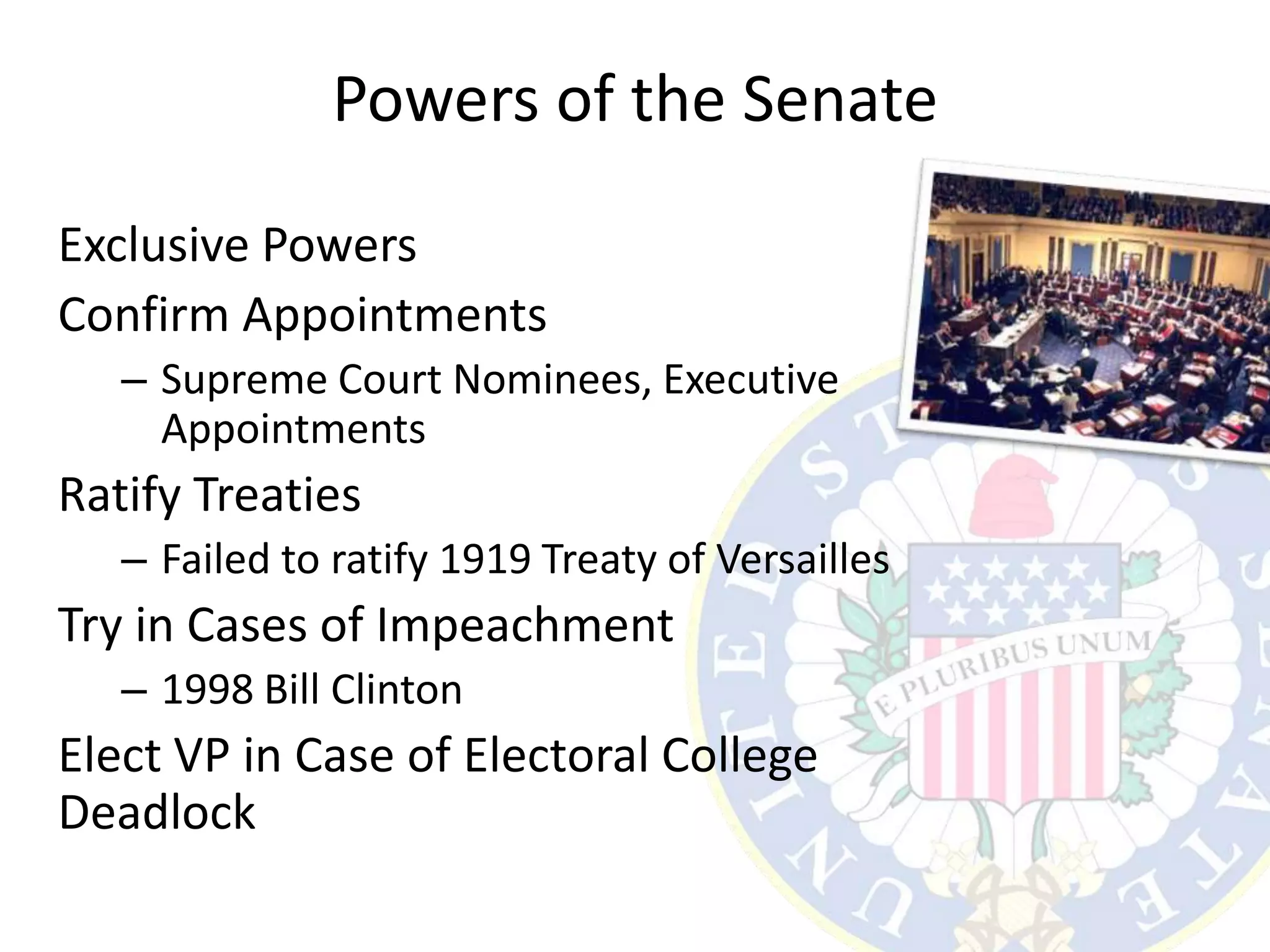
Powers of the Senate
Exclusive Powers
Confirm Appointments
– Supreme Court Nominees, Executive
Appointments
Ratify Treaties
– Failed to ratify 1919 Treaty of Versailles
Try in Cases of Impeachment
– 1998 Bill Clinton
Elect VP in Case of Electoral College
Deadlock
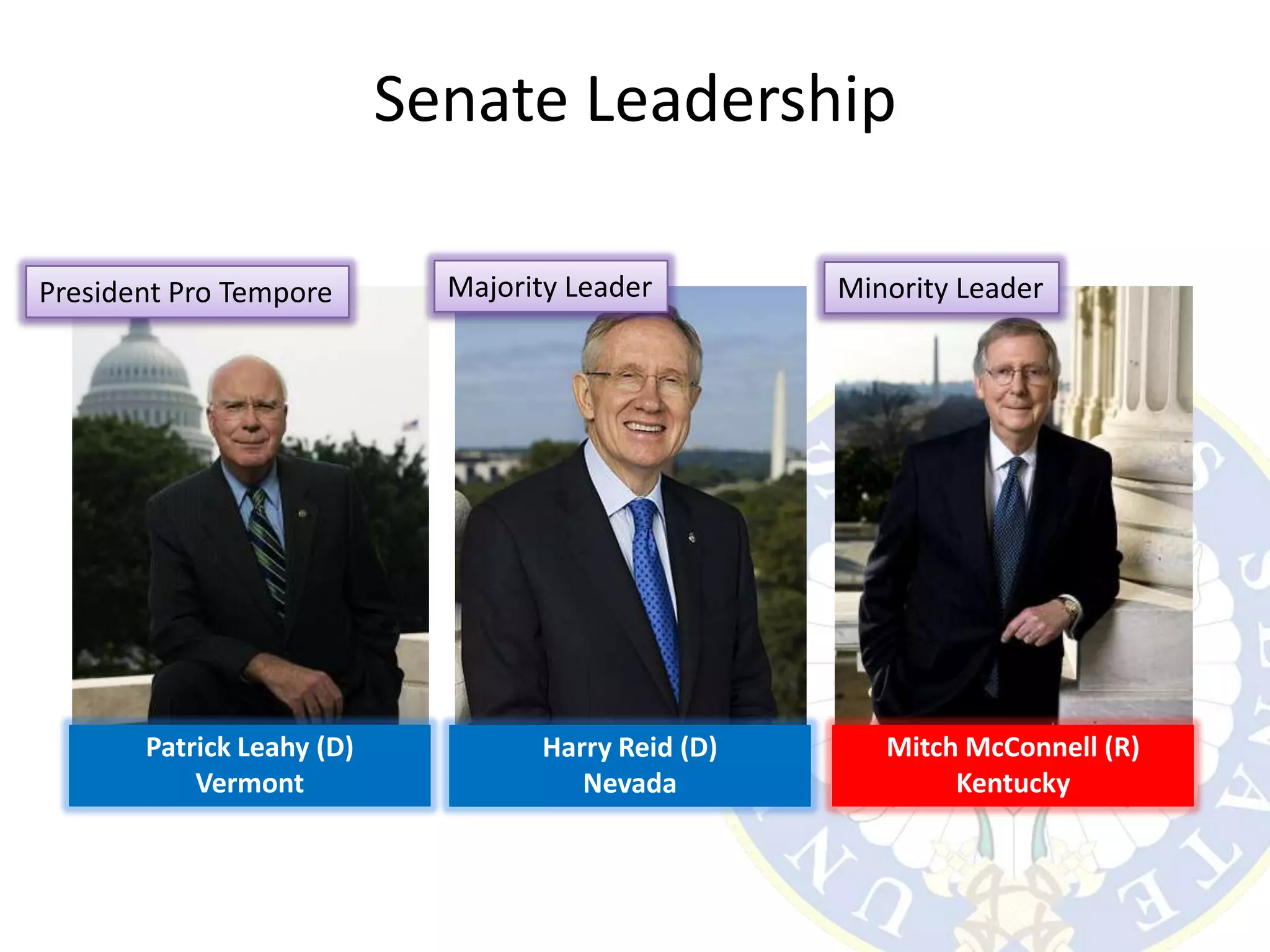
Senate Leadership
Patrick Leahy (D)
Vermont
Harry Reid (D)
Nevada
Mitch McConnell (R)
Kentucky
President Pro Tempore Majority Leader Minority Leader
Filibuster
A device by which a Senator or Group of
Senators can attempt to talk a bill to death by
using delaying tactics.
Strom Thurmond 1957
Filibustered a Civil Rights
Bill for 24hrs 18mins
Rand Paul 2013
Attempted to stop John
Brennen’s appointment as
CIA Director: 12hrs 52mins
Power is derived from a
Senator’s right to
unlimited debate
If 3/5 of the House vote to
end a filibuster it is known
as a Cloture Motion
Which is Better?
Senate
• Longer terms
• Represent entire state
• Easier to achieve more public
recognition
• More powers
• Trying the accused
• More committee places
• Projection to a Presidency
• Vote is worth more so
bargaining more common
• More likely to get a piece of
the action
BUT!
• House Controls money bills
‘Power of the Purse’
• Equal pay
• Equal legislative power
DEMOCRATS
Last 15 Vice Presidential
Nominations: 14 were
Senators
Passage of a Bill in Congress
• Concurrent Passage through Congress
– Through both House and Senate
Problems:
• Concurrent Passage means there will be
differences
First Reading
A formality – There is no debate and no vote
Typically thousands of bills are introduced
Committee Stage
Congressional Standing Committees decide on which bills they are going to ‘hear’
Many bills will not get a hearing and are said to be ‘pigeon holed’
Pork Barrelling happens in this stage
Committees are normally filled with experts or specialists
Bills may die if they can’t get reported out such as Clinton’s Healthcare Reforms
Timetabling
House of Representatives
The House Rules Committee makes the
decisions on which Bills make it to the floor
and how long they will be debated for.
Senate
This is done by Unanimous Consent
Agreement
Meaning Senate Leadership agree on
which bills will make it to the floor
Second Reading
House of Representatives
Members debate and vote on the bill in the
form that comes from the committee
Senate
Members debate and vote on the bill in
the form that comes from the committee
Here a bill may end up being filibustered
Third Reading
House of Representatives
Final opportunity to debate the bill.
Debate would tend to small before the vote
Senate
Final opportunity to debate the bill.
Debate would tend to small before the
vote
Conference Committee
Due to concurrent passage of the bills different bills will be produced. A conference
committee was typically used to reconcile the two bills.
Typically only 10% of bills go this route now
Congressional Leadership now typically reconcile the bill.
Presidential Action
3 Options
Sign Bill in to Law
Leave it on the Desk – Becomes law after 10 days
Veto – Sent it back to Congress
Pocket Veto – within the last 10 days of Congress an unsigned bill will die
Congressional Committees
Most important part of the Legislative Process
Members of Congress will seek assignment to
committees so they can get pork projects for
their constituents
Washington State members will seek Defense
Committee seats
Unlike the UK the committee
stage is before the 2nd Reading
Functions of Committees
Branch of Congress Function
Senate & House Conduct the Committee Stage in the
passage of a bill
E.g. 1993 Bill Clinton’s Healthcare reform
Senate & House Conduct investigations into the area of
that committee
E.g. Senate Foreign Relations Committee –
NATO Enlargement
Senate ONLY Confirm some appointments such as
Supreme Court Judges, Cabinet Posts
E.g. Robert Bork or Clarence Thomas
House Rules Committee
The Traffic Cop of the House
It’s job is prioritising the bills for votes on the
floor of the House
It can attach time limits and rules to the debates
of a bill
13 Members
9 Majority Party
4 Minority Party
Pete Sessions TX (R)
Select Committees
Known as ‘Special’ or ‘Investigative’
Formed on an ad hoc basis for a
particular issue
Tend to investigate an issue that would
either:
a) Take up too much time in standing
committee
b) Come under many different
committees
Iran-Contra or 9/11 are notable examples
Committee Chairs
Always come from the Majority
Party
Used to be done by Seniority Rule
Now elected through secret ballots
6 year term limits imposed by
Republicans in the 1990s
Seniority Rule: Chairs of congressional standing committees will
be from the majority party and be the longest continuous service
on that committee
Why is Party Discipline so weak?
“Lack of Tasty Carrots and Sizeable
Sticks”
On Capitol Hill the Lobbyists and
Electorate rule
Congressmen generally pay a lot of
attention to what the folks back home say,
they are very concerned with getting
themselves re-elected
Interest Groups play a massive part in this
Legislative Synoptic Links
UK is an unbalanced bi-cameral system
Parties are far more dominant (whipping)
Members of the Executive are in the Legislature
Legislative process is slightly different
Exam success is
not a lottery!
Know your
terms
Know the
Articles
Know the
Examples
Answer the question, the whole
question and nothing but the
question

The Legislative Branch | Congress

  • 1.
    GOV4A The Government ofthe US Scott Thomas | May 2013
  • 2.
    Exam success is nota lottery! Know your terms Know the Articles Know the Examples
  • 3.
    Session 3 The LegislativeBranch of the US
  • 4.
    The Legislative Branch ConstitutionalRole Composition Differences between Houses Importance of the Parties Roles of Congress Relationship with Government and Supreme Court
  • 5.
    Congress & TheConstitution Congress is Article One Powers outlined in this are known as Enumerated powers Section 8 – Final Clause Elastic Clause If Article One references Congress surely it is the most important branch? Divides Congress into two House of Representatives Senate Bicameral System is known as the Connecticut CompromiseHouse Elected via Popular Vote Senate indirect elected until 1914
  • 6.
    Concurrent Powers ofCongress Equal Legislative Power Override Presidential Veto Initiate Constitutional Amendments Declarations of War Confirm appointed Vice Presidents
  • 7.
  • 8.
    Elastic Clause “to makeall laws which shall be necessary and proper for carrying into execution the foregoing powers, and all other powers vested in this Constitution in the Government of the United States, or in any department or officer thereof” Article 1, Section 8, Final Clause
  • 9.
  • 10.
    Make up ofthe House 435 Seats 200 Democrats 232 Republicans 3 Vacant Each member represents a ‘Congressional District’ States are given a number of districts in proportion to their population House is presided over by the Speaker of the House
  • 11.
    Key Demographics Gender Balance:Male 82% Female 28% Ethnicity: African American 41 Asian 7 Caucasian 336 Hispanic 27 Not Stated 22 Other 5
  • 12.
    Powers of theHouse Known as Exclusive Powers • Initiate Money Bills – Power of the Purse • Impeachment – Voted to impeach Clinton in 1998 • Elect a President should the Electoral College Deadlock – John Quincy Adams elected President in Deadlock
  • 13.
    Speaker of the House •Presiding Officer of the House • Second in Presidential Succession • Leader of Majority party in the House normally becomes Speaker through ballot • No requirement that the Speaker be a member of the House John Boehner (R) Ohio 8th District
  • 14.
    Role of theSpeaker Notably Partisan Role Speaker doesn’t typically debate or vote unless it’s close Responsible for the passage o legislation and which will make it to the floor Speaker normally designates to someone else to preside over the proceedings in the House Responsible for maintaining decorum in the House
  • 15.
    House Leadership John Boehner(R) Ohio 8th District Eric Cantor (R) Virginia 7th District Nancy Pelosi (D) California 12th District Speaker Majority Leader Minority Leader
  • 16.
    Majority & MinorityLeaders • Elected via closed door party caucus every Congress • Represent the Party • Liaison between Congress and White House • Day to Day director of Operations on the House Floor Leaders More Important in The Senate
  • 17.
    Running for theHouse Elections are every 2 years (all elected) US Citizens for 7 years Must be a resident in representative state Candidates must be at least 25 years old Some states may impose a locality rule You need to first secure the nomination from your Party You may need to win a Primary Election You May be challenged as an incumbent
  • 18.
    Congressional Districts The Househas 435 Seats These are given to states depending on population, roughly 700,000 people in each district Every 10 years after a census the number is changed per state
  • 19.
  • 20.
    Gerrymandering • Gerrymandering isa form of redistricting in which electoral districts boundaries are deliberately modified for electoral purposes, thereby producing a contorted or unusual shape. CGP Grey Explains: •Gerrymandering
  • 21.
    Gerrymandering Negative: when usedto allege that a party is gaining disproportionate power – packing districts with hardcore support form one party, creating wasted votes. Positive: producing a proportion of constituencies with an African-American or other minority in the majority (these are then called "minority-majority districts").
  • 22.
  • 23.
  • 24.
    Make up ofthe Senate 100 Seats 53 Democrats 45 Republicans 2 Independents Each member represents a State States are allocated 2 Senators each The two Independents caucus with the Democrats, thus bringing Democrat majority to 55
  • 25.
    Key Demographics Gender Balance:Male 80% Female 20% Ethnicity: African American 2 Asian 1 Caucasian 93 Hispanic 2 Not Stated 2
  • 26.
    Voting in theStates 1 from each Party Both Democrats Both Republicans
  • 27.
    Running for theSenate Elections are every 2 years (1/3 of Senate) US Citizens for 9 years Must be a resident in representative state Candidates must be at least 30 years old You need to first secure the nomination from your Party You may need to win a Primary Election You May be challenged as an incumbent
  • 28.
    Powers of theSenate Exclusive Powers Confirm Appointments – Supreme Court Nominees, Executive Appointments Ratify Treaties – Failed to ratify 1919 Treaty of Versailles Try in Cases of Impeachment – 1998 Bill Clinton Elect VP in Case of Electoral College Deadlock
  • 29.
    Senate Leadership Patrick Leahy(D) Vermont Harry Reid (D) Nevada Mitch McConnell (R) Kentucky President Pro Tempore Majority Leader Minority Leader
  • 30.
    Filibuster A device bywhich a Senator or Group of Senators can attempt to talk a bill to death by using delaying tactics. Strom Thurmond 1957 Filibustered a Civil Rights Bill for 24hrs 18mins Rand Paul 2013 Attempted to stop John Brennen’s appointment as CIA Director: 12hrs 52mins Power is derived from a Senator’s right to unlimited debate If 3/5 of the House vote to end a filibuster it is known as a Cloture Motion
  • 31.
    Which is Better? Senate •Longer terms • Represent entire state • Easier to achieve more public recognition • More powers • Trying the accused • More committee places • Projection to a Presidency • Vote is worth more so bargaining more common • More likely to get a piece of the action BUT! • House Controls money bills ‘Power of the Purse’ • Equal pay • Equal legislative power DEMOCRATS Last 15 Vice Presidential Nominations: 14 were Senators
  • 32.
    Passage of aBill in Congress • Concurrent Passage through Congress – Through both House and Senate Problems: • Concurrent Passage means there will be differences
  • 33.
    First Reading A formality– There is no debate and no vote Typically thousands of bills are introduced
  • 34.
    Committee Stage Congressional StandingCommittees decide on which bills they are going to ‘hear’ Many bills will not get a hearing and are said to be ‘pigeon holed’ Pork Barrelling happens in this stage Committees are normally filled with experts or specialists Bills may die if they can’t get reported out such as Clinton’s Healthcare Reforms
  • 35.
    Timetabling House of Representatives TheHouse Rules Committee makes the decisions on which Bills make it to the floor and how long they will be debated for. Senate This is done by Unanimous Consent Agreement Meaning Senate Leadership agree on which bills will make it to the floor
  • 36.
    Second Reading House ofRepresentatives Members debate and vote on the bill in the form that comes from the committee Senate Members debate and vote on the bill in the form that comes from the committee Here a bill may end up being filibustered
  • 37.
    Third Reading House ofRepresentatives Final opportunity to debate the bill. Debate would tend to small before the vote Senate Final opportunity to debate the bill. Debate would tend to small before the vote
  • 38.
    Conference Committee Due toconcurrent passage of the bills different bills will be produced. A conference committee was typically used to reconcile the two bills. Typically only 10% of bills go this route now Congressional Leadership now typically reconcile the bill.
  • 39.
    Presidential Action 3 Options SignBill in to Law Leave it on the Desk – Becomes law after 10 days Veto – Sent it back to Congress Pocket Veto – within the last 10 days of Congress an unsigned bill will die
  • 40.
    Congressional Committees Most importantpart of the Legislative Process Members of Congress will seek assignment to committees so they can get pork projects for their constituents Washington State members will seek Defense Committee seats Unlike the UK the committee stage is before the 2nd Reading
  • 41.
    Functions of Committees Branchof Congress Function Senate & House Conduct the Committee Stage in the passage of a bill E.g. 1993 Bill Clinton’s Healthcare reform Senate & House Conduct investigations into the area of that committee E.g. Senate Foreign Relations Committee – NATO Enlargement Senate ONLY Confirm some appointments such as Supreme Court Judges, Cabinet Posts E.g. Robert Bork or Clarence Thomas
  • 42.
    House Rules Committee TheTraffic Cop of the House It’s job is prioritising the bills for votes on the floor of the House It can attach time limits and rules to the debates of a bill 13 Members 9 Majority Party 4 Minority Party Pete Sessions TX (R)
  • 43.
    Select Committees Known as‘Special’ or ‘Investigative’ Formed on an ad hoc basis for a particular issue Tend to investigate an issue that would either: a) Take up too much time in standing committee b) Come under many different committees Iran-Contra or 9/11 are notable examples
  • 44.
    Committee Chairs Always comefrom the Majority Party Used to be done by Seniority Rule Now elected through secret ballots 6 year term limits imposed by Republicans in the 1990s Seniority Rule: Chairs of congressional standing committees will be from the majority party and be the longest continuous service on that committee
  • 45.
    Why is PartyDiscipline so weak? “Lack of Tasty Carrots and Sizeable Sticks” On Capitol Hill the Lobbyists and Electorate rule Congressmen generally pay a lot of attention to what the folks back home say, they are very concerned with getting themselves re-elected Interest Groups play a massive part in this
  • 46.
    Legislative Synoptic Links UKis an unbalanced bi-cameral system Parties are far more dominant (whipping) Members of the Executive are in the Legislature Legislative process is slightly different
  • 47.
    Exam success is nota lottery! Know your terms Know the Articles Know the Examples
  • 48.
    Answer the question,the whole question and nothing but the question

Editor's Notes