A2 Government & Politics Examples Unit 3
Topic Example
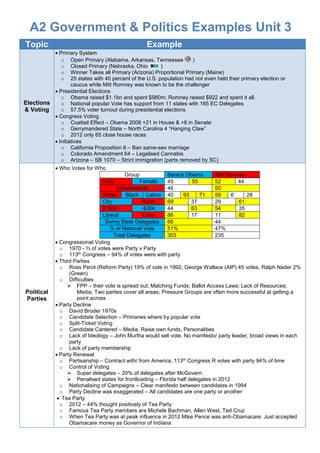
Elections
& Voting
 Primary System
o Open Primary (Alabama, Arkansas, Tennessee )
o Closed Primary (Nebraska, Ohio )
o Winner Takes all Primary (Arizona) Proportional Primary (Maine)
o 25 states with 40 percent of the U.S. population had not even held their primary election or
caucus while Mitt Romney was known to be the challenger
 Presidential Elections
o Obama raised $1.1bn and spent $980m; Romney raised $922 and spent it all.
o National popular Vote has support from 11 states with 165 EC Delegates
o 57.5% voter turnout during presidential elections
 Congress Voting
o Coattail Effect – Obama 2008 +21 in House & +8 in Senate
o Gerrymandered State – North Carolina 4 “Hanging Claw”
o 2012 only 65 close house races
 Initiatives
o California Proposition 8 – Ban same-sex marriage
o Colorado Amendment 64 – Legalised Cannabis
o Arizona – SB 1070 – Strict immigration (parts removed by SC)
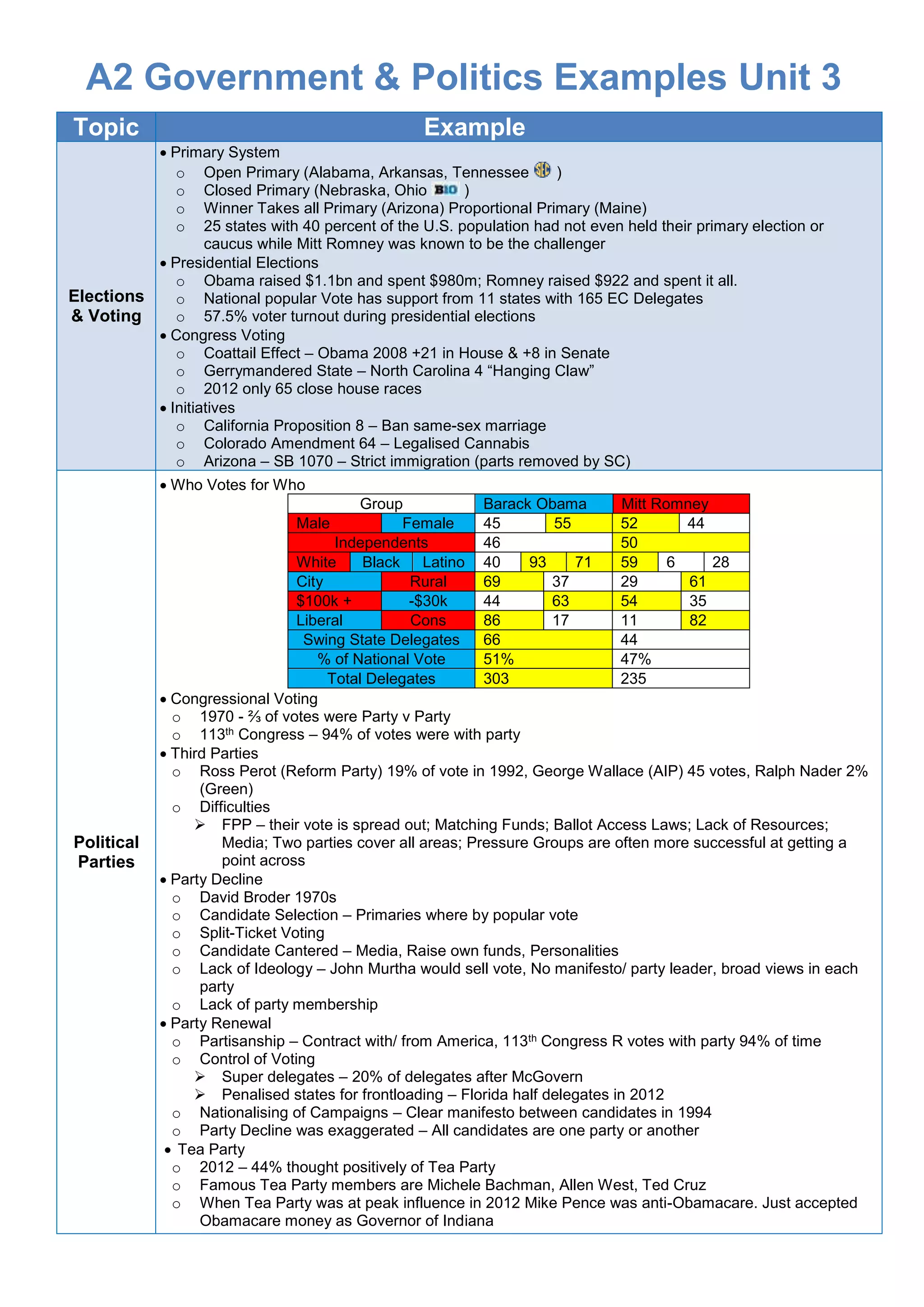
Political
Parties
 Who Votes for Who
Group Barack Obama Mitt Romney
Male Female 45 55 52 44
Independents 46 50
White Black Latino 40 93 71 59 6 28
City Rural 69 37 29 61
$100k + -$30k 44 63 54 35
Liberal Cons 86 17 11 82
Swing State Delegates 66 44
% of National Vote 51% 47%
Total Delegates 303 235
 Congressional Voting
o 1970 - ⅔ of votes were Party v Party
o 113th Congress – 94% of votes were with party
 Third Parties
o Ross Perot (Reform Party) 19% of vote in 1992, George Wallace (AIP) 45 votes, Ralph Nader 2%
(Green)
o Difficulties
 FPP – their vote is spread out; Matching Funds; Ballot Access Laws; Lack of Resources;
Media; Two parties cover all areas; Pressure Groups are often more successful at getting a
point across
 Party Decline
o David Broder 1970s
o Candidate Selection – Primaries where by popular vote
o Split-Ticket Voting
o Candidate Cantered – Media, Raise own funds, Personalities
o Lack of Ideology – John Murtha would sell vote, No manifesto/ party leader, broad views in each
party
o Lack of party membership
 Party Renewal
o Partisanship – Contract with/ from America, 113th Congress R votes with party 94% of time
o Control of Voting
 Super delegates – 20% of delegates after McGovern
 Penalised states for frontloading – Florida half delegates in 2012
o Nationalising of Campaigns – Clear manifesto between candidates in 1994
o Party Decline was exaggerated – All candidates are one party or another
 Tea Party
o 2012 – 44% thought positively of Tea Party
o Famous Tea Party members are Michele Bachman, Allen West, Ted Cruz
o When Tea Party was at peak influence in 2012 Mike Pence was anti-Obamacare. Just accepted
Obamacare money as Governor of Indiana
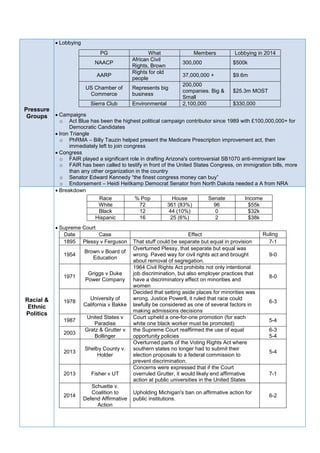
Pressure
Groups
 Lobbying
 Campaigns
o Act Blue has been the highest political campaign contributor since 1989 with £100,000,000+ for
Democratic Candidates
 Iron Triangle
o PhRMA – Billy Tauzin helped present the Medicare Prescription improvement act, then
immediately left to join congress
 Congress
o FAIR played a significant role in drafting Arizona's controversial SB1070 anti-immigrant law
o FAIR has been called to testify in front of the United States Congress, on immigration bills, more
than any other organization in the country
o Senator Edward Kennedy “the finest congress money can buy”
o Endorsement – Heidi Heitkamp Democrat Senator from North Dakota needed a A from NRA
PG What Members Lobbying in 2014
NAACP
African Civil
Rights, Brown
300,000 $500k
AARP
Rights for old
people
37,000,000 + $9.6m
US Chamber of
Commerce
Represents big
business
200,000
companies. Big &
Small
$25.3m MOST
Sierra Club Environmental 2,100,000 $330,000
Racial &
Ethnic
Politics
 Breakdown
 Supreme Court
Date Case Effect Ruling
1895 Plessy v Ferguson That stuff could be separate but equal in provision 7-1
1954
Brown v Board of
Education
Overturned Plessy, that separate but equal was
wrong. Paved way for civil rights act and brought
about removal of segregation.
9-0
1971
Griggs v Duke
Power Company
1964 Civil Rights Act prohibits not only intentional
job discrimination, but also employer practices that
have a discriminatory effect on minorities and
women
8-0
1978
University of
California v Bakke
Decided that setting aside places for minorities was
wrong, Justice Powerll, it ruled that race could
lawfully be considered as one of several factors in
making admissions decisions
6-3
1987
United States v
Paradise
Court upheld a one-for-one promotion (for each
white one black worker must be promoted)
5-4
2003
Gratz & Grutter v
Bollinger
the Supreme Court reaffirmed the use of equal
opportunity policies
6-3
5-4
2013
Shelby County v.
Holder
Overturned parts of the Voting Rights Act where
southern states no longer had to submit their
election proposals to a federal commission to
prevent discrimination.
5-4
2013 Fisher v UT
Concerns were expressed that if the Court
overruled Grutter, it would likely end affirmative
action at public universities in the United States
7-1
2014
Schuette v.
Coalition to
Defend Affirmative
Action
Upholding Michigan's ban on affirmative action for
public institutions.
6-2
Race % Pop House Senate Income
White 72 361 (83%) 96 $55k
Black 12 44 (10%) 0 $32k
Hispanic 16 25 (6%) 2 $38k
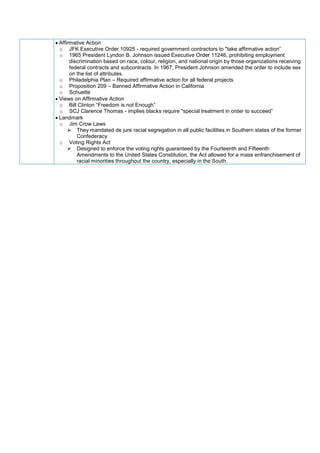
 Affirmative Action
o JFK Executive Order 10925 - required government contractors to "take affirmative action”
o 1965 President Lyndon B. Johnson issued Executive Order 11246, prohibiting employment
discrimination based on race, colour, religion, and national origin by those organizations receiving
federal contracts and subcontracts. In 1967, President Johnson amended the order to include sex
on the list of attributes.
o Philadelphia Plan – Required affirmative action for all federal projects
o Proposition 209 – Banned Affirmative Action in California
o Schuette
 Views on Affirmative Action
o Bill Clinton “Freedom is not Enough”
o SCJ Clarence Thomas - implies blacks require "special treatment in order to succeed”
 Landmark
o Jim Crow Laws
 They mandated de jure racial segregation in all public facilities in Southern states of the former
Confederacy
o Voting Rights Act
 Designed to enforce the voting rights guaranteed by the Fourteenth and Fifteenth
Amendments to the United States Constitution, the Act allowed for a mass enfranchisement of
racial minorities throughout the country, especially in the South.

A2 Edexcel Government & Politics Unit 3 examples and case studies

  • 1.
    A2 Government &Politics Examples Unit 3 Topic Example Elections & Voting  Primary System o Open Primary (Alabama, Arkansas, Tennessee ) o Closed Primary (Nebraska, Ohio ) o Winner Takes all Primary (Arizona) Proportional Primary (Maine) o 25 states with 40 percent of the U.S. population had not even held their primary election or caucus while Mitt Romney was known to be the challenger  Presidential Elections o Obama raised $1.1bn and spent $980m; Romney raised $922 and spent it all. o National popular Vote has support from 11 states with 165 EC Delegates o 57.5% voter turnout during presidential elections  Congress Voting o Coattail Effect – Obama 2008 +21 in House & +8 in Senate o Gerrymandered State – North Carolina 4 “Hanging Claw” o 2012 only 65 close house races  Initiatives o California Proposition 8 – Ban same-sex marriage o Colorado Amendment 64 – Legalised Cannabis o Arizona – SB 1070 – Strict immigration (parts removed by SC) Political Parties  Who Votes for Who Group Barack Obama Mitt Romney Male Female 45 55 52 44 Independents 46 50 White Black Latino 40 93 71 59 6 28 City Rural 69 37 29 61 $100k + -$30k 44 63 54 35 Liberal Cons 86 17 11 82 Swing State Delegates 66 44 % of National Vote 51% 47% Total Delegates 303 235  Congressional Voting o 1970 - ⅔ of votes were Party v Party o 113th Congress – 94% of votes were with party  Third Parties o Ross Perot (Reform Party) 19% of vote in 1992, George Wallace (AIP) 45 votes, Ralph Nader 2% (Green) o Difficulties  FPP – their vote is spread out; Matching Funds; Ballot Access Laws; Lack of Resources; Media; Two parties cover all areas; Pressure Groups are often more successful at getting a point across  Party Decline o David Broder 1970s o Candidate Selection – Primaries where by popular vote o Split-Ticket Voting o Candidate Cantered – Media, Raise own funds, Personalities o Lack of Ideology – John Murtha would sell vote, No manifesto/ party leader, broad views in each party o Lack of party membership  Party Renewal o Partisanship – Contract with/ from America, 113th Congress R votes with party 94% of time o Control of Voting  Super delegates – 20% of delegates after McGovern  Penalised states for frontloading – Florida half delegates in 2012 o Nationalising of Campaigns – Clear manifesto between candidates in 1994 o Party Decline was exaggerated – All candidates are one party or another  Tea Party o 2012 – 44% thought positively of Tea Party o Famous Tea Party members are Michele Bachman, Allen West, Ted Cruz o When Tea Party was at peak influence in 2012 Mike Pence was anti-Obamacare. Just accepted Obamacare money as Governor of Indiana
  • 2.
    Pressure Groups  Lobbying  Campaigns oAct Blue has been the highest political campaign contributor since 1989 with £100,000,000+ for Democratic Candidates  Iron Triangle o PhRMA – Billy Tauzin helped present the Medicare Prescription improvement act, then immediately left to join congress  Congress o FAIR played a significant role in drafting Arizona's controversial SB1070 anti-immigrant law o FAIR has been called to testify in front of the United States Congress, on immigration bills, more than any other organization in the country o Senator Edward Kennedy “the finest congress money can buy” o Endorsement – Heidi Heitkamp Democrat Senator from North Dakota needed a A from NRA PG What Members Lobbying in 2014 NAACP African Civil Rights, Brown 300,000 $500k AARP Rights for old people 37,000,000 + $9.6m US Chamber of Commerce Represents big business 200,000 companies. Big & Small $25.3m MOST Sierra Club Environmental 2,100,000 $330,000 Racial & Ethnic Politics  Breakdown  Supreme Court Date Case Effect Ruling 1895 Plessy v Ferguson That stuff could be separate but equal in provision 7-1 1954 Brown v Board of Education Overturned Plessy, that separate but equal was wrong. Paved way for civil rights act and brought about removal of segregation. 9-0 1971 Griggs v Duke Power Company 1964 Civil Rights Act prohibits not only intentional job discrimination, but also employer practices that have a discriminatory effect on minorities and women 8-0 1978 University of California v Bakke Decided that setting aside places for minorities was wrong, Justice Powerll, it ruled that race could lawfully be considered as one of several factors in making admissions decisions 6-3 1987 United States v Paradise Court upheld a one-for-one promotion (for each white one black worker must be promoted) 5-4 2003 Gratz & Grutter v Bollinger the Supreme Court reaffirmed the use of equal opportunity policies 6-3 5-4 2013 Shelby County v. Holder Overturned parts of the Voting Rights Act where southern states no longer had to submit their election proposals to a federal commission to prevent discrimination. 5-4 2013 Fisher v UT Concerns were expressed that if the Court overruled Grutter, it would likely end affirmative action at public universities in the United States 7-1 2014 Schuette v. Coalition to Defend Affirmative Action Upholding Michigan's ban on affirmative action for public institutions. 6-2 Race % Pop House Senate Income White 72 361 (83%) 96 $55k Black 12 44 (10%) 0 $32k Hispanic 16 25 (6%) 2 $38k
  • 3.
     Affirmative Action oJFK Executive Order 10925 - required government contractors to "take affirmative action” o 1965 President Lyndon B. Johnson issued Executive Order 11246, prohibiting employment discrimination based on race, colour, religion, and national origin by those organizations receiving federal contracts and subcontracts. In 1967, President Johnson amended the order to include sex on the list of attributes. o Philadelphia Plan – Required affirmative action for all federal projects o Proposition 209 – Banned Affirmative Action in California o Schuette  Views on Affirmative Action o Bill Clinton “Freedom is not Enough” o SCJ Clarence Thomas - implies blacks require "special treatment in order to succeed”  Landmark o Jim Crow Laws  They mandated de jure racial segregation in all public facilities in Southern states of the former Confederacy o Voting Rights Act  Designed to enforce the voting rights guaranteed by the Fourteenth and Fifteenth Amendments to the United States Constitution, the Act allowed for a mass enfranchisement of racial minorities throughout the country, especially in the South.