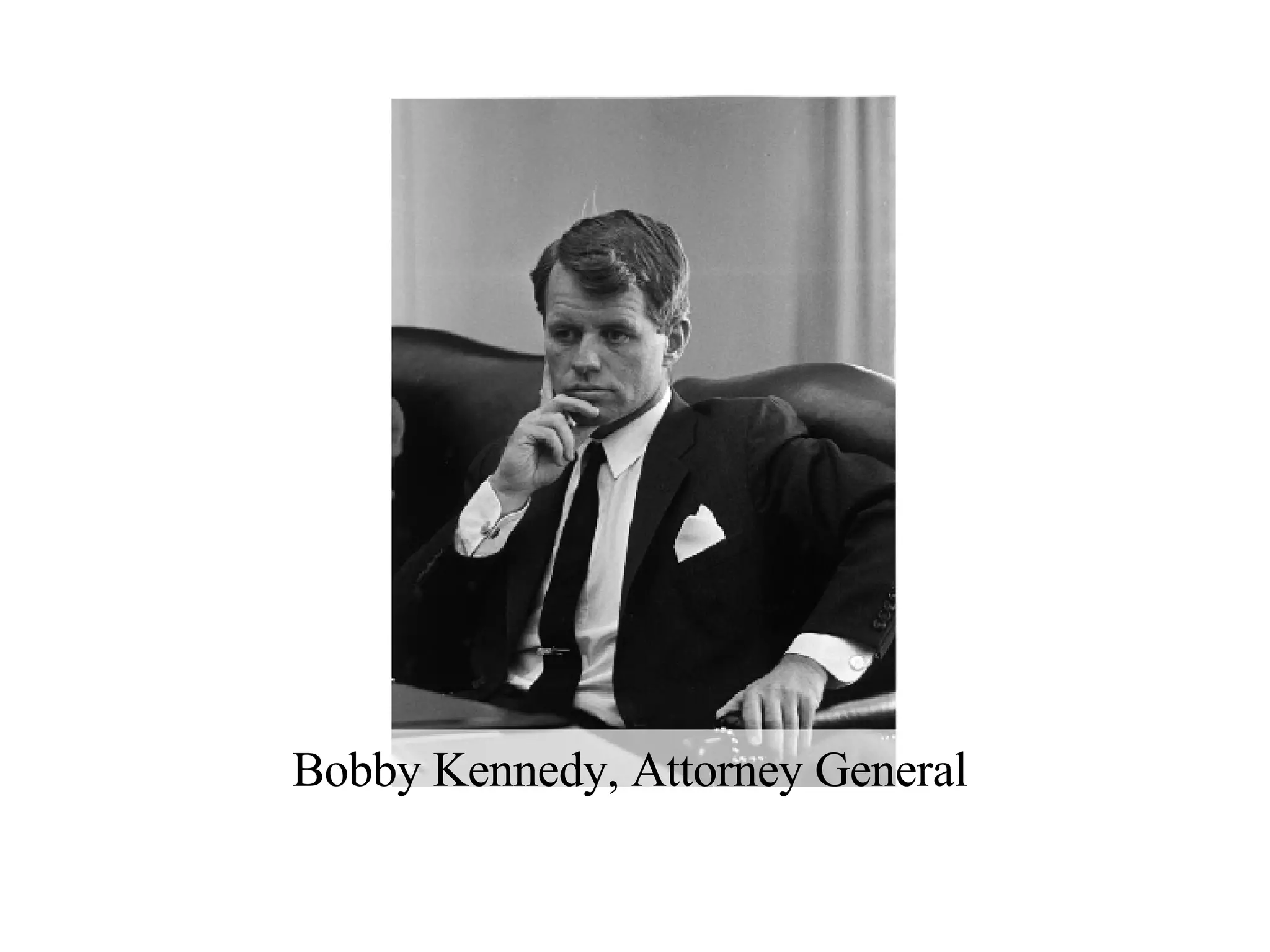
Bobby Kennedy, Attorney General
Robert McNamara, Secretary of Defense
Dean Rusk, Secretary of State
Flexible response: Kennedy’s plan to expand US military options, continuing to build nuclear capabilities and also strengthening conventional weapons.
Green Berets—special military units to assist with combating Communism
Alliance for Progress: a program to expand economic aid to Latin America, offering billions in aid in exchange for democratic and capitalist reforms
Peace Corps—volunteers to assist in developing countries.
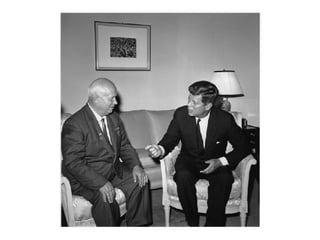
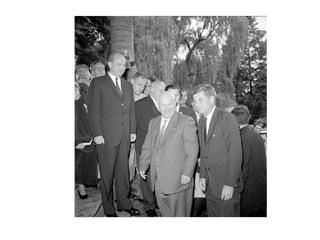
Kennedy’s Cold War battleground #1: The Bay of Pigs
 
 
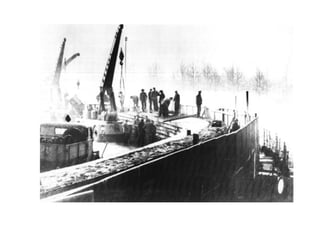
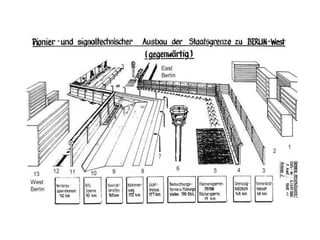
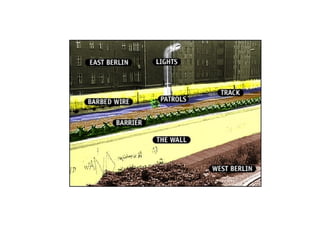
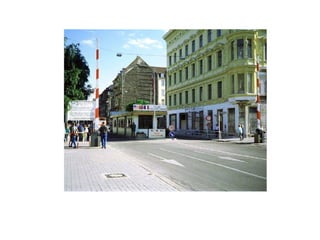
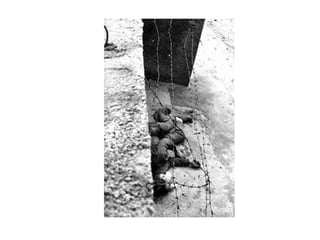
Kennedy’s Cold War battleground #2: Berlin
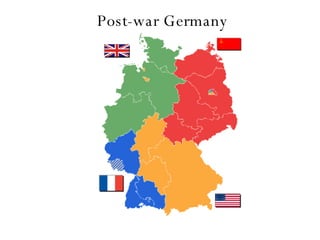
Post-war Germany
It is 1961, and after only a few months in office you face a challenge from the Soviets. Premier Khrushchev has issued an ultimatum on Berlin: The Western powers must join the Soviet Union in signing a peace treaty with East and West Germany; recognize East Germany; and withdraw from Berlin by year's end. Western access to Berlin would require East German permission.  Any violation of East German territory would be regarded as an act of aggression. If you don't sign, Khrushchev promises to sign his own treaty with East Germany with substantially the same terms.  The message is clear: Withdraw from West Berlin, or you may be forced to leave. If you call his bluff and stay put, you risk a major confrontation with Moscow -- perhaps even military conflict.  If you withdraw, you risk appearing weak to your allies and to the Soviets, who might respond with even more provocative policies in the future. What do you do?


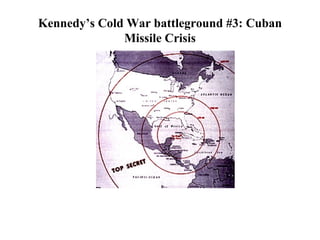
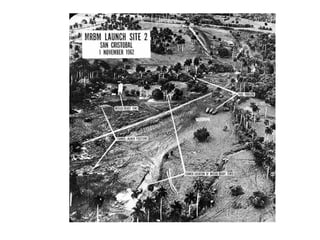
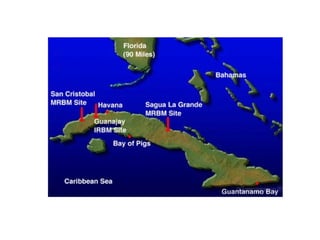
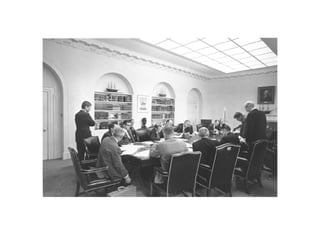
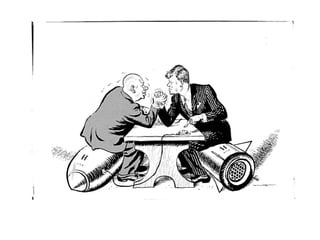
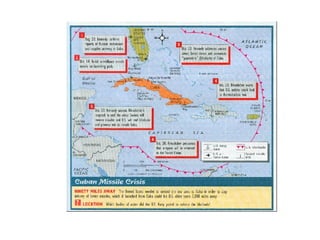
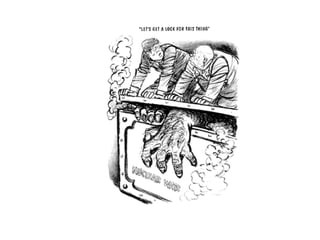
Kennedy’s Cold War battleground #3: Cuban Missile Crisis


You are the President.  What do you do?  Why? Wait for international pressure and support “ Surgical air strike” All out air strike Invade A combination of choices above Other…what?
 
 
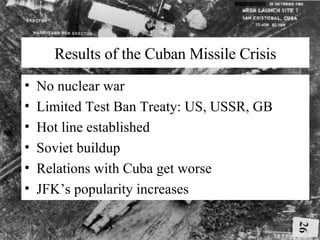
Results of the Cuban Missile Crisis No nuclear war Limited Test Ban Treaty: US, USSR, GB Hot line established Soviet buildup Relations with Cuba get worse JFK’s popularity increases
 
I am talking about genuine peace, the kind of peace that makes life on earth worth living, the kind that enables men and nations to grow and to hope and to build a better life for their children-not merely peace for Americans but peace for all men and women, not merely peace in our time but peace for all time.   JFK, June 10, 1963
Kennedy’s Cold War battleground #4: Vietnam
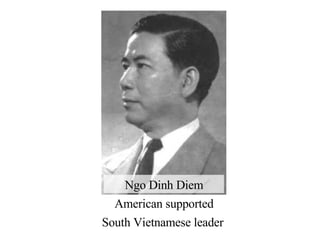
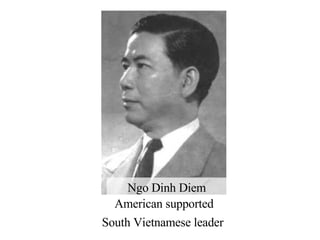
Ngo Dinh Diem American supported South Vietnamese leader
 
Ngo Dinh Diem American supported South Vietnamese leader
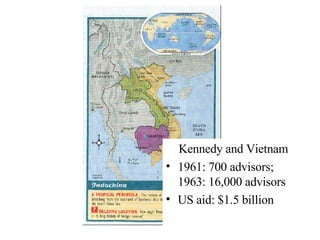
Kennedy and Vietnam 1961: 700 advisors; 1963: 16,000 advisors US aid: $1.5 billion
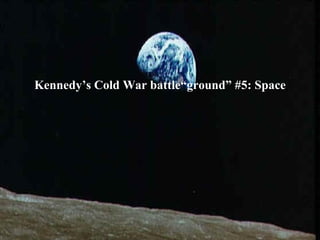
Kennedy’s Cold War battle“ground” #5: Space
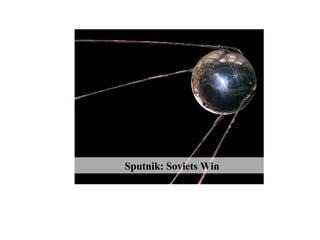
Sputnik: Soviets Win
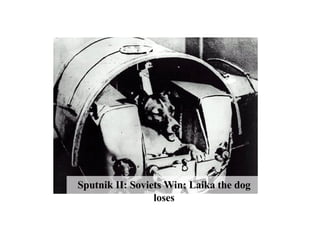
Sputnik II: Soviets Win; Laika the dog loses
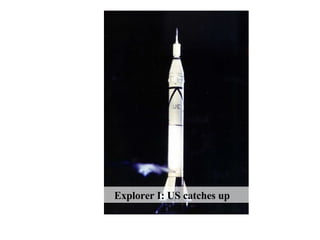
Explorer I: US catches up
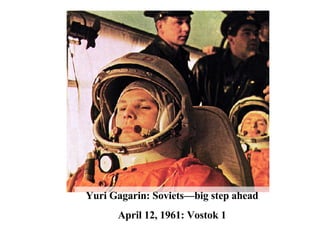
Yuri Gagarin: Soviets—big step ahead April 12, 1961: Vostok 1
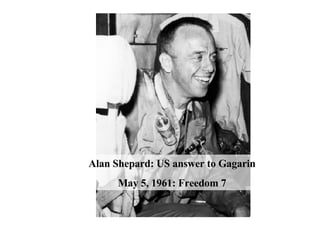
Alan Shepard: US answer to Gagarin May 5, 1961: Freedom 7
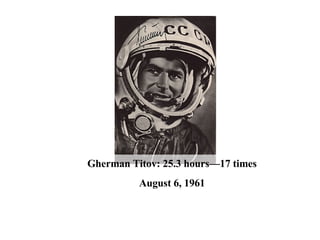
Gherman Titov: 25.3 hours—17 times August 6, 1961
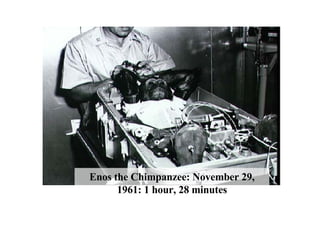
Enos the Chimpanzee: November 29, 1961: 1 hour, 28 minutes
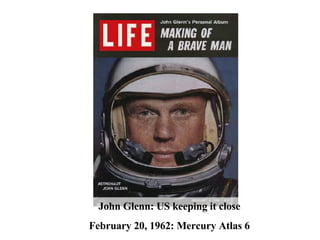
John Glenn: US keeping it close February 20, 1962: Mercury Atlas 6
"I believe that this nation should commit itself to achieving the goal, before this decade is out, of landing a man on the moon and returning him safely to the Earth."
“ No single space project in this period will be more impressive to mankind, or more important for the long-range exploration of space; and none will be so difficult or expensive to accomplish…” JFK
We choose to go to the moon in this decade and do the other things, not because they are easy, but because they are hard, because that goal will serve to organize and measure the best of our energies and skills, because that challenge is one that we are willing to accept, one we are unwilling to postpone, and one which we intend to win, and the others, too.   JFK, September 12, 1962

JFK Foreign Policy

  • 1.
  • 2.
  • 3.
  • 4.
    Flexible response: Kennedy’splan to expand US military options, continuing to build nuclear capabilities and also strengthening conventional weapons.
  • 5.
    Green Berets—special militaryunits to assist with combating Communism
  • 6.
    Alliance for Progress:a program to expand economic aid to Latin America, offering billions in aid in exchange for democratic and capitalist reforms
  • 7.
    Peace Corps—volunteers toassist in developing countries.
  • 8.
    Kennedy’s Cold Warbattleground #1: The Bay of Pigs
  • 9.
  • 10.
  • 11.
    Kennedy’s Cold Warbattleground #2: Berlin
  • 12.
  • 13.
    It is 1961,and after only a few months in office you face a challenge from the Soviets. Premier Khrushchev has issued an ultimatum on Berlin: The Western powers must join the Soviet Union in signing a peace treaty with East and West Germany; recognize East Germany; and withdraw from Berlin by year's end. Western access to Berlin would require East German permission. Any violation of East German territory would be regarded as an act of aggression. If you don't sign, Khrushchev promises to sign his own treaty with East Germany with substantially the same terms. The message is clear: Withdraw from West Berlin, or you may be forced to leave. If you call his bluff and stay put, you risk a major confrontation with Moscow -- perhaps even military conflict. If you withdraw, you risk appearing weak to your allies and to the Soviets, who might respond with even more provocative policies in the future. What do you do?
  • 14.
  • 15.
  • 16.
  • 17.
  • 18.
  • 19.
    Kennedy’s Cold Warbattleground #3: Cuban Missile Crisis
  • 20.
  • 21.
  • 22.
  • 23.
  • 24.
  • 25.
  • 26.
  • 27.
    You are thePresident. What do you do? Why? Wait for international pressure and support “ Surgical air strike” All out air strike Invade A combination of choices above Other…what?
  • 28.
  • 29.
  • 30.
    Results of theCuban Missile Crisis No nuclear war Limited Test Ban Treaty: US, USSR, GB Hot line established Soviet buildup Relations with Cuba get worse JFK’s popularity increases
  • 31.
  • 32.
    I am talkingabout genuine peace, the kind of peace that makes life on earth worth living, the kind that enables men and nations to grow and to hope and to build a better life for their children-not merely peace for Americans but peace for all men and women, not merely peace in our time but peace for all time. JFK, June 10, 1963
  • 33.
    Kennedy’s Cold Warbattleground #4: Vietnam
  • 34.
    Ngo Dinh DiemAmerican supported South Vietnamese leader
  • 35.
  • 36.
    Ngo Dinh DiemAmerican supported South Vietnamese leader
  • 37.
    Kennedy and Vietnam1961: 700 advisors; 1963: 16,000 advisors US aid: $1.5 billion
  • 38.
    Kennedy’s Cold Warbattle“ground” #5: Space
  • 39.
  • 40.
    Sputnik II: SovietsWin; Laika the dog loses
  • 41.
    Explorer I: UScatches up
  • 42.
    Yuri Gagarin: Soviets—bigstep ahead April 12, 1961: Vostok 1
  • 43.
    Alan Shepard: USanswer to Gagarin May 5, 1961: Freedom 7
  • 44.
    Gherman Titov: 25.3hours—17 times August 6, 1961
  • 45.
    Enos the Chimpanzee:November 29, 1961: 1 hour, 28 minutes
  • 46.
    John Glenn: USkeeping it close February 20, 1962: Mercury Atlas 6
  • 47.
    "I believe thatthis nation should commit itself to achieving the goal, before this decade is out, of landing a man on the moon and returning him safely to the Earth."
  • 48.
    “ No singlespace project in this period will be more impressive to mankind, or more important for the long-range exploration of space; and none will be so difficult or expensive to accomplish…” JFK
  • 49.
    We choose togo to the moon in this decade and do the other things, not because they are easy, but because they are hard, because that goal will serve to organize and measure the best of our energies and skills, because that challenge is one that we are willing to accept, one we are unwilling to postpone, and one which we intend to win, and the others, too. JFK, September 12, 1962