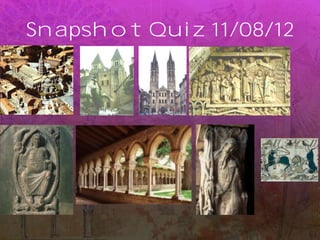
Snapshot Quiz 11/08/12
Gothic Art and
Architecture
12-16th Centuries
France, Germany, Italy
Highlights from
Lecture:
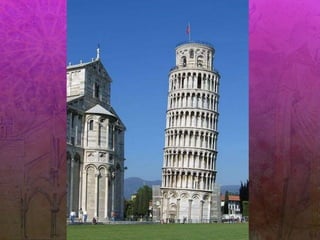
• Pisa
• St Denis and Abbot Sugur
• Notre Dame
• Chartres Cathedral
• Amiens
• St. Urbain
• Rouen Cathedral
• Salisbury
• Florence Cathedral
• Ghiberti and Pisano
Baptistry Door
• Gothic Classicism
• Claus Sluter Moses Well
• Roettgen Pieta
• Martini. The Road to
Calvary
• Giotto Madonna
Enthroned
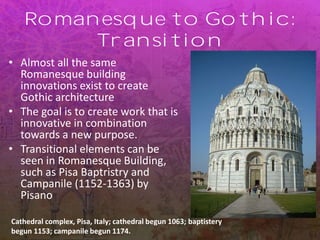
Romanesque to Gothic:
Transition
• Almost all the same
Romanesque building
innovations exist to create
Gothic architecture
• The goal is to create work that is
innovative in combination
towards a new purpose.
• Transitional elements can be
seen in Romanesque Building,
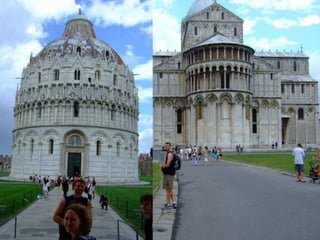
such as Pisa Baptristry and
Campanile (1152-1363) by
Pisano
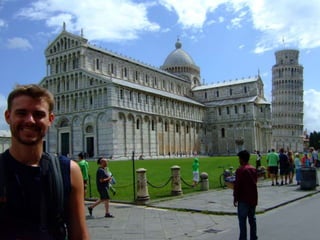
Cathedral complex, Pisa, Italy; cathedral begun 1063; baptistery
begun 1153; campanile begun 1174.
Gothic Context
• Vasari – a writer during the Renaissance described
Gothic Art was monstrous and barbarous invented by
Goths
• Downfall of Rome? – Ugly and Crude
• Downfall of Art? 13 and 14th Centuries all the rage
was Goth Art!
• Started in France in 1140 then Prague and Czech
Republic- Islamic and Byzantine Art still popular at
this time
What was going on during
this time?
• 100 year war- 1137 shattered peace between
France and England
• 14th Century- great plague-quarter of its
people dead
• Great Schism- opposing popes resided in
Rome and in Avignon ( southern France)
• Time for knights, maidens, Crusades, Kings,
Queens
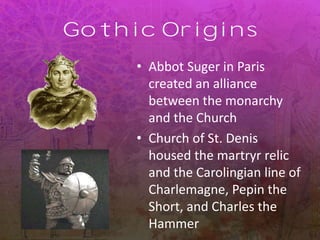
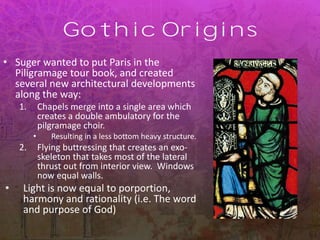
Gothic Origins
• Abbot Suger in Paris
created an alliance
between the monarchy
and the Church
• Church of St. Denis
housed the martryr relic
and the Carolingian line of
Charlemagne, Pepin the
Short, and Charles the
Hammer
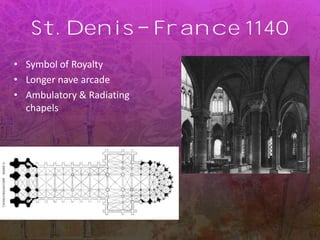
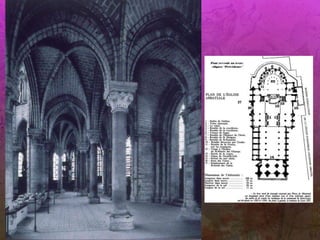
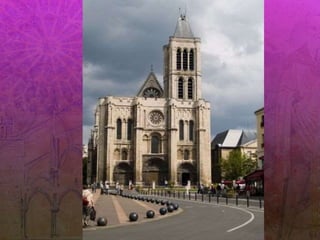
St. Denis France 1140
• Symbol of Royalty
• Longer nave arcade
• Ambulatory & Radiating
chapels
Gothic Origins
• Suger wanted to put Paris in the
Piligramage tour book, and created
several new architectural developments
along the way:
1. Chapels merge into a single area which
creates a double ambulatory for the
pilgramage choir.
• Resulting in a less bottom heavy structure.
2. Flying buttressing that creates an exo-
skeleton that takes most of the lateral
thrust out from interior view. Windows
now equal walls.
• Light is now equal to porportion,
harmony and rationality (i.e. The word
and purpose of God)
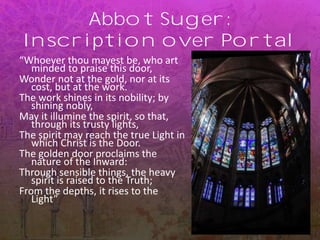
Abbot Suger:
Inscription over Portal
“Whoever thou mayest be, who art
minded to praise this door,
Wonder not at the gold, nor at its
cost, but at the work.
The work shines in its nobility; by
shining nobly,
May it illumine the spirit, so that,
through its trusty lights,
The spirit may reach the true Light in
which Christ is the Door.
The golden door proclaims the
nature of the Inward:
Through sensible things, the heavy
spirit is raised to the Truth;
From the depths, it rises to the
Light”
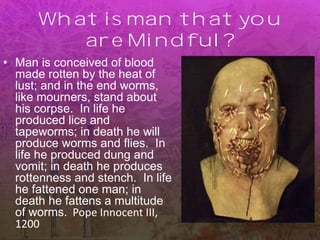
What is man that you
are Mindful?
• Man is conceived of blood
made rotten by the heat of
lust; and in the end worms,
like mourners, stand about
his corpse. In life he
produced lice and
tapeworms; in death he will
produce worms and flies. In
life he produced dung and
vomit; in death he produces
rottenness and stench. In life
he fattened one man; in
death he fattens a multitude
of worms. Pope Innocent III,
1200
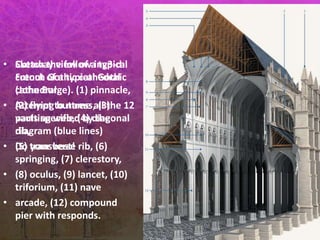
• Cutaway view of a typical
French Gothic cathedral
(John Burge). (1) pinnacle,
• (2) flying buttress, (3)
vaulting web, (4) diagonal
rib,
• (5) transverse rib, (6)
springing, (7) clerestory,
• (8) oculus, (9) lancet, (10)
triforium, (11) nave
• arcade, (12) compound
pier with responds.
• Sketch the follow ing3-d
cutout of a typical Gothic
cathedral.
• Attempt to name all the 12
parts specified by the
diagram (blue lines)
• Do your best!
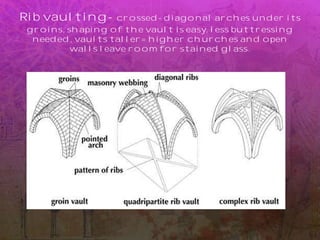
Rib vaulting- crossed- diagonal arches under its
groins, shaping of the vault is easy, less buttressing
needed, vaults taller= higher churches and open
walls leave room for stained glass.
Abbot Gothic Style
• The interaction of harmony, proportion,
mathematics, with light and the new “Gothic”
formulations, creates a mystical quality:
– “it transports us into some strange region of the
universe which neither exists entirely in the slime
of earth nor entirely in the purity of Heaven.”
• His designs become wildly popular, and begin
an immitation transfusion across Europe.
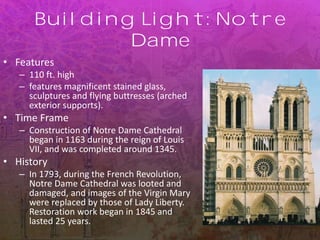
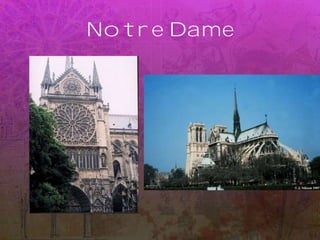
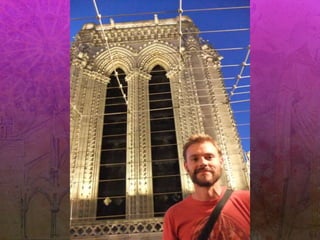
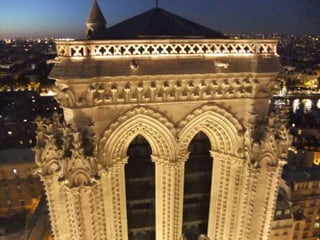
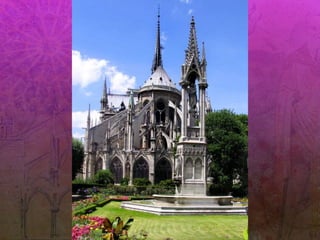
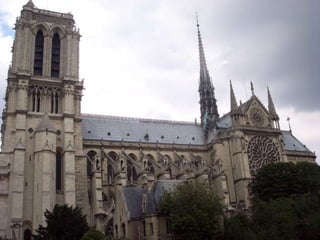
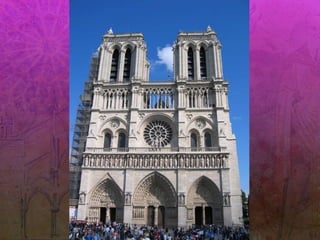
Building Light: Notre
Dame
• Features
– 110 ft. high
– features magnificent stained glass,
sculptures and flying buttresses (arched
exterior supports).
• Time Frame
– Construction of Notre Dame Cathedral
began in 1163 during the reign of Louis
VII, and was completed around 1345.
• History
– In 1793, during the French Revolution,
Notre Dame Cathedral was looted and
damaged, and images of the Virgin Mary
were replaced by those of Lady Liberty.
Restoration work began in 1845 and
lasted 25 years.
Notre Dame: Dimensions
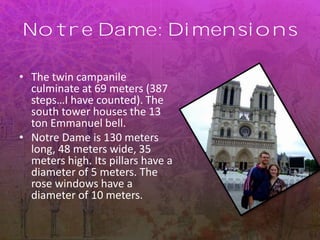
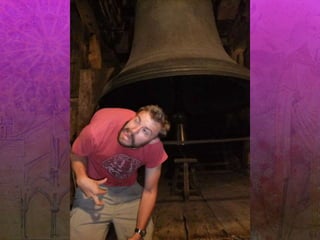
• The twin campanile
culminate at 69 meters (387
steps…I have counted). The
south tower houses the 13
ton Emmanuel bell.
• Notre Dame is 130 meters
long, 48 meters wide, 35
meters high. Its pillars have a
diameter of 5 meters. The
rose windows have a
diameter of 10 meters.
Hunchback?
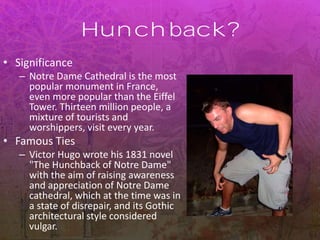
• Significance
– Notre Dame Cathedral is the most
popular monument in France,
even more popular than the Eiffel
Tower. Thirteen million people, a
mixture of tourists and
worshippers, visit every year.
• Famous Ties
– Victor Hugo wrote his 1831 novel
"The Hunchback of Notre Dame"
with the aim of raising awareness
and appreciation of Notre Dame
cathedral, which at the time was in
a state of disrepair, and its Gothic
architectural style considered
vulgar.
Notre Dame
Vaulting
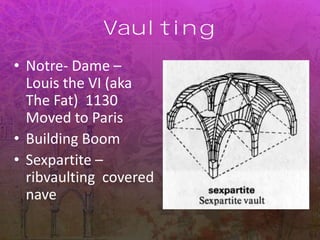
• Notre- Dame –
Louis the VI (aka
The Fat) 1130
Moved to Paris
• Building Boom
• Sexpartite –
ribvaulting covered
nave
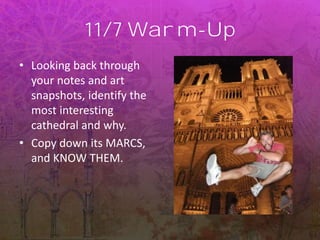
11/7 Warm-Up
• Looking back through
your notes and art
snapshots, identify the
most interesting
cathedral and why.
• Copy down its MARCS,
and KNOW THEM.
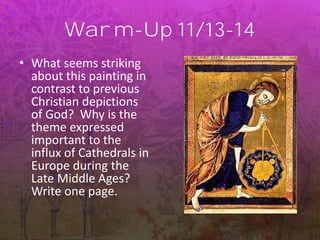
Warm-Up 11/13-14
• What seems striking
about this painting in
contrast to previous
Christian depictions
of God? Why is the
theme expressed
important to the
influx of Cathedrals in
Europe during the
Late Middle Ages?
Write one page.
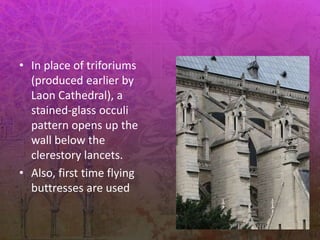
• In place of triforiums
(produced earlier by
Laon Cathedral), a
stained-glass occuli
pattern opens up the
wall below the
clerestory lancets.
• Also, first time flying
buttresses are used
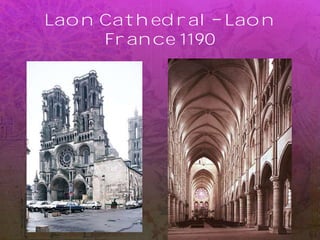
Laon Cathedral Laon
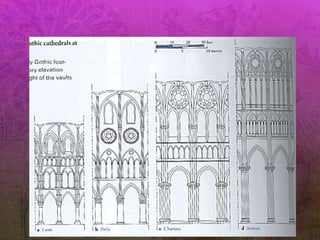
France 1190
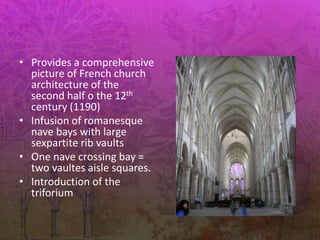
• Provides a comprehensive
picture of French church
architecture of the
second half o the 12th
century (1190)
• Infusion of romanesque
nave bays with large
sexpartite rib vaults
• One nave crossing bay =
two vaultes aisle squares.
• Introduction of the
triforium
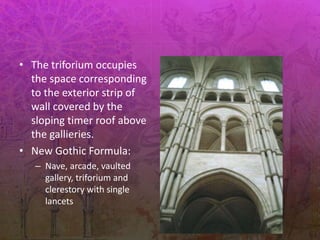
• The triforium occupies
the space corresponding
to the exterior strip of
wall covered by the
sloping timer roof above
the gallieries.
• New Gothic Formula:
– Nave, arcade, vaulted
gallery, triforium and
clerestory with single
lancets
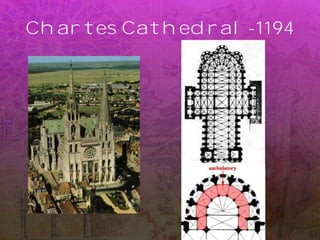
Chartes Cathedral -1194
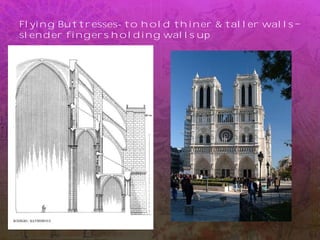
Flying Buttresses- to hold thiner & taller walls
slender fingers holding walls up
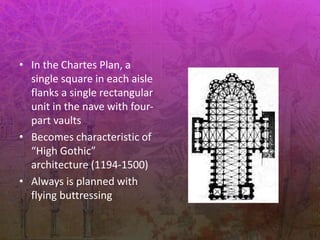
• In the Chartes Plan, a
single square in each aisle
flanks a single rectangular
unit in the nave with four-
part vaults
• Becomes characteristic of
“High Gothic”
architecture (1194-1500)
• Always is planned with
flying buttressing
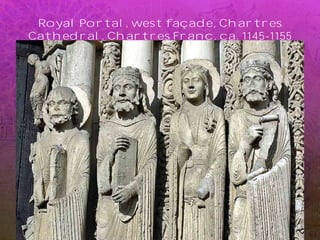
Royal Portal, west façade, Chartres
Cathedral, Chartres Franc, ca. 1145-1155
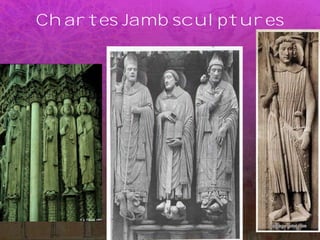
Chartes Jamb sculptures
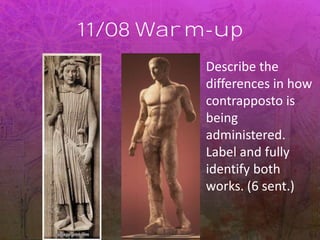
11/08 Warm-up
Describe the
differences in how
contrapposto is
being
administered.
Label and fully
identify both
works. (6 sent.)
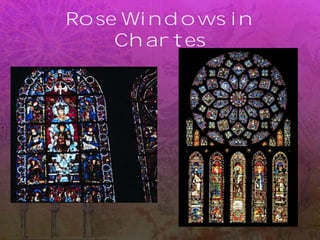
Rose Windows in
Chartes
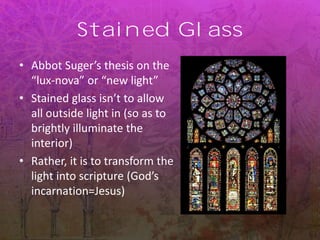
Stained Glass
• Abbot Suger’s thesis on the
“lux-nova” or “new light”
• Stained glass isn’t to allow
all outside light in (so as to
brightly illuminate the
interior)
• Rather, it is to transform the
light into scripture (God’s
incarnation=Jesus)
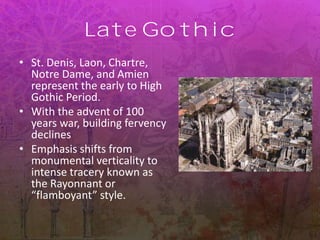
Late Gothic
• St. Denis, Laon, Chartre,
Notre Dame, and Amien
represent the early to High
Gothic Period.
• With the advent of 100
years war, building fervency
declines
• Emphasis shifts from
monumental verticality to
intense tracery known as
the Rayonnant or
“flamboyant” style.
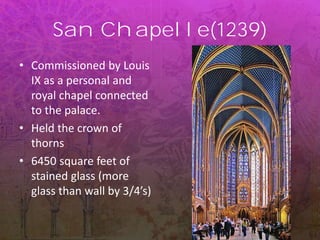
San Chapelle(1239)
• Commissioned by Louis
IX as a personal and
royal chapel connected
to the palace.
• Held the crown of
thorns
• 6450 square feet of
stained glass (more
glass than wall by 3/4’s)
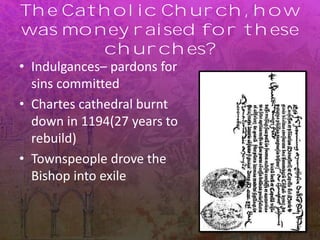
The Catholic Church, how
was money raised for these
churches?
• Indulgances– pardons for
sins committed
• Chartes cathedral burnt
down in 1194(27 years to
rebuild)
• Townspeople drove the
Bishop into exile
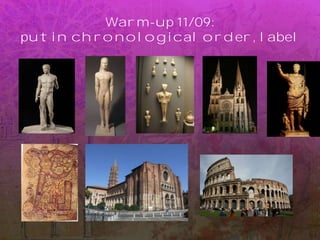
Warm-up 11/09:
put in chronological order, label
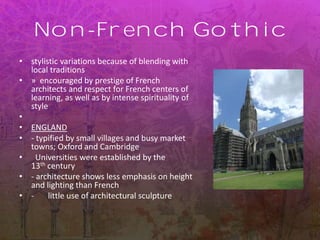
Non-French Gothic
• stylistic variations because of blending with
local traditions
• » encouraged by prestige of French
architects and respect for French centers of
learning, as well as by intense spirituality of
style
•
• ENGLAND
• - typified by small villages and busy market
towns; Oxford and Cambridge
• Universities were established by the
13th century
• - architecture shows less emphasis on height
and lighting than French
• - little use of architectural sculpture
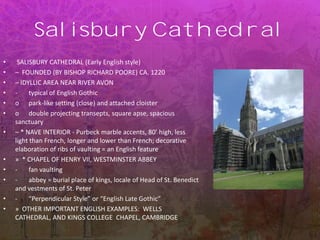
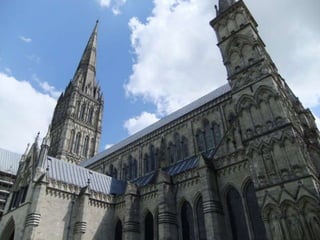
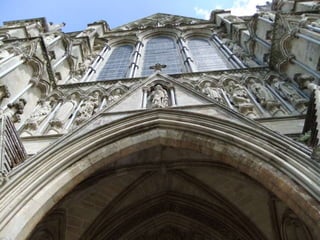
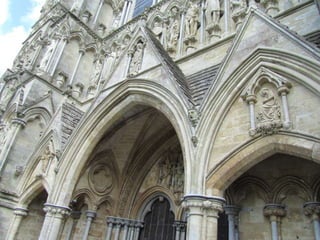
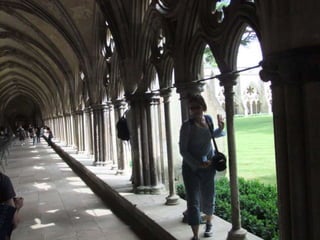
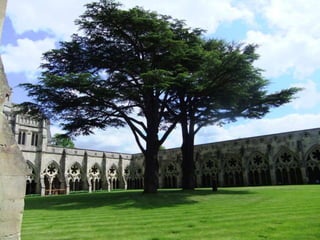
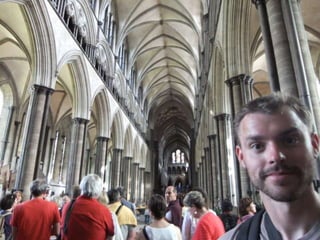
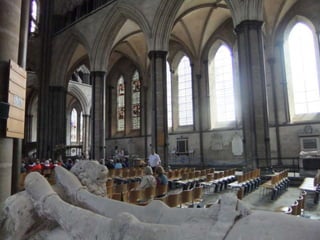
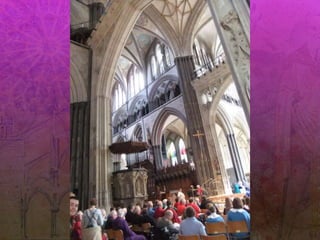
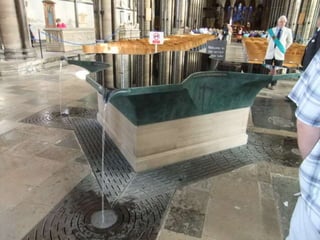
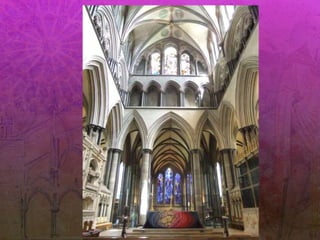
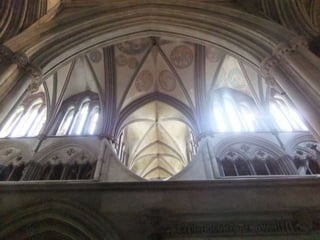
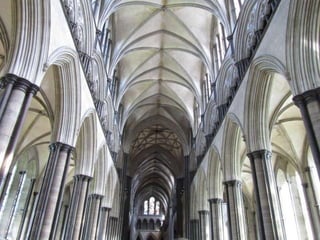
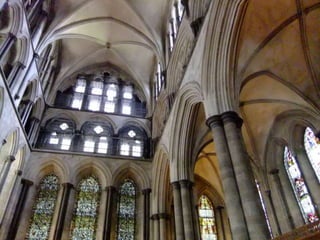
Salisbury Cathedral
• SALISBURY CATHEDRAL (Early English style)
• – FOUNDED (BY BISHOP RICHARD POORE) CA. 1220
• – IDYLLIC AREA NEAR RIVER AVON
• - typical of English Gothic
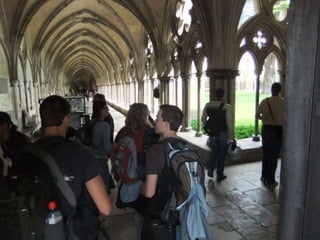
• o park-like setting (close) and attached cloister
• o double projecting transepts, square apse, spacious
sanctuary
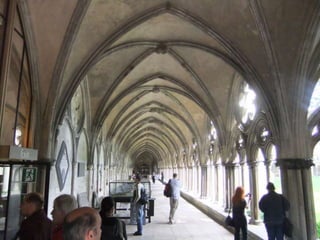
• – * NAVE INTERIOR - Purbeck marble accents, 80’ high, less
light than French, longer and lower than French; decorative
elaboration of ribs of vaulting = an English feature
• » * CHAPEL OF HENRY VII, WESTMINSTER ABBEY
• - fan vaulting
• - abbey = burial place of kings, locale of Head of St. Benedict
and vestments of St. Peter
• - “Perpendicular Style” or “English Late Gothic”
• » OTHER IMPORTANT ENGLISH EXAMPLES: WELLS
CATHEDRAL, AND KINGS COLLEGE CHAPEL, CAMBRIDGE
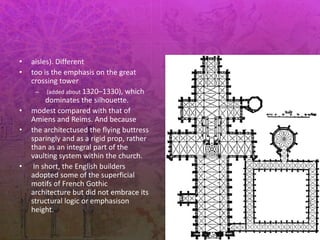
• aisles). Different
• too is the emphasis on the great
crossing tower
– (added about 1320–1330), which
dominates the silhouette.
• modest compared with that of
Amiens and Reims. And because
• the architectused the flying buttress
sparingly and as a rigid prop, rather
than as an integral part of the
vaulting system within the church.
• In short, the English builders
adopted some of the superficial
motifs of French Gothic
architecture but did not embrace its
structural logic or emphasison
height.
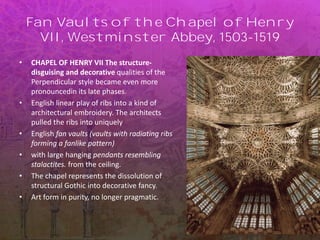
Fan Vaults of the Chapel of Henry
VII, Westminster Abbey, 1503-1519
• CHAPEL OF HENRY VII The structure-
disguising and decorative qualities of the
Perpendicular style became even more
pronouncedin its late phases.
• English linear play of ribs into a kind of
architectural embroidery. The architects
pulled the ribs into uniquely
• English fan vaults (vaults with radiating ribs
forming a fanlike pattern)
• with large hanging pendants resembling
stalactites. from the ceiling.
• The chapel represents the dissolution of
structural Gothic into decorative fancy.
• Art form in purity, no longer pragmatic.
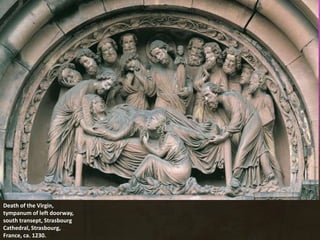
Death of the Virgin,
tympanum of left doorway,
south transept, Strasbourg
Cathedral, Strasbourg,
France, ca. 1230.
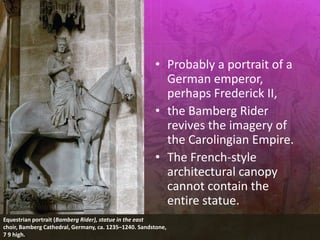
• Probably a portrait of a
German emperor,
perhaps Frederick II,
• the Bamberg Rider
revives the imagery of
the Carolingian Empire.
• The French-style
architectural canopy
cannot contain the
entire statue.
Equestrian portrait (Bamberg Rider), statue in the east
choir, Bamberg Cathedral, Germany, ca. 1235–1240. Sandstone,
7 9 high.
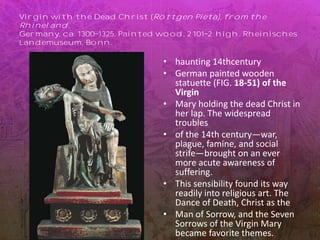
Virgin with the Dead Christ (Röttgen Pietà), from the
Rhineland,
Germany, ca. 1300 1325. Painted wood, 2 101 2 high. Rheinisches
Landemuseum, Bonn.
• haunting 14thcentury
• German painted wooden
statuette (FIG. 18-51) of the
Virgin
• Mary holding the dead Christ in
her lap. The widespread
troubles
• of the 14th century—war,
plague, famine, and social
strife—brought on an ever
more acute awareness of
suffering.
• This sensibility found its way
readily into religious art. The
Dance of Death, Christ as the
• Man of Sorrow, and the Seven
Sorrows of the Virgin Mary
became favorite themes.
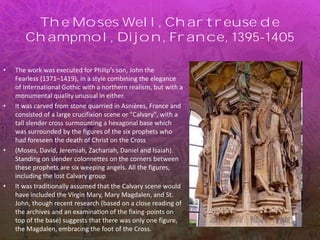
The Moses Well, Chartreuse de
Champmol, Dijon, France, 1395-1405
• The work was executed for Philip’s son, John the
Fearless (1371–1419), in a style combining the elegance
of International Gothic with a northern realism, but with a
monumental quality unusual in either.
• It was carved from stone quarried in Asnières, France and
consisted of a large crucifixion scene or "Calvary", with a
tall slender cross surmounting a hexagonal base which
was surrounded by the figures of the six prophets who
had foreseen the death of Christ on the Cross
• (Moses, David, Jeremiah, Zachariah, Daniel and Isaiah).
Standing on slender colonnettes on the corners between
these prophets are six weeping angels. All the figures,
including the lost Calvary group
• It was traditionally assumed that the Calvary scene would
have included the Virgin Mary, Mary Magdalen, and St.
John, though recent research (based on a close reading of
the archives and an examination of the fixing-points on
top of the base) suggests that there was only one figure,
the Magdalen, embracing the foot of the Cross.
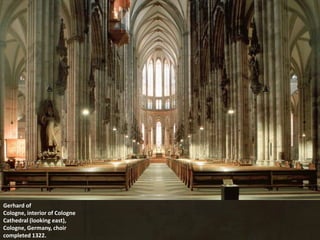
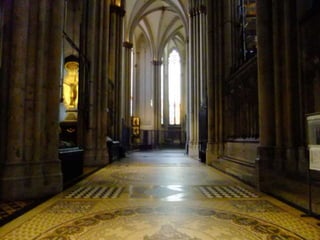
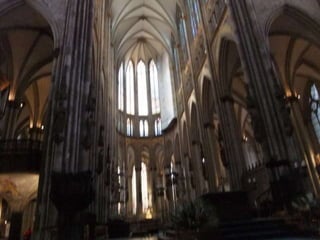
Gerhard of
Cologne, interior of Cologne
Cathedral (looking east),
Cologne, Germany, choir
completed 1322.
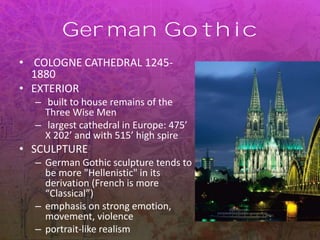
German Gothic
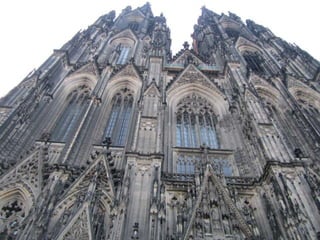
• COLOGNE CATHEDRAL 1245-
1880
• EXTERIOR
– built to house remains of the
Three Wise Men
– largest cathedral in Europe: 475’
X 202’ and with 515’ high spire
• SCULPTURE
– German Gothic sculpture tends to
be more "Hellenistic" in its
derivation (French is more
“Classical”)
– emphasis on strong emotion,
movement, violence
– portrait-like realism
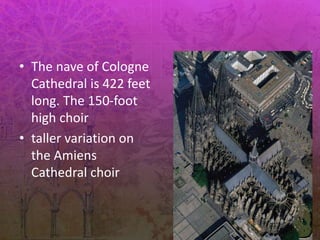
• The nave of Cologne
Cathedral is 422 feet
long. The 150-foot
high choir
• taller variation on
the Amiens
Cathedral choir
11. gothic art and architecture

11. gothic art and architecture

  • 1.
  • 2.
    Gothic Art and Architecture 12-16thCenturies France, Germany, Italy
  • 3.
    Highlights from Lecture: • Pisa •St Denis and Abbot Sugur • Notre Dame • Chartres Cathedral • Amiens • St. Urbain • Rouen Cathedral • Salisbury • Florence Cathedral • Ghiberti and Pisano Baptistry Door • Gothic Classicism • Claus Sluter Moses Well • Roettgen Pieta • Martini. The Road to Calvary • Giotto Madonna Enthroned
  • 4.
    Romanesque to Gothic: Transition •Almost all the same Romanesque building innovations exist to create Gothic architecture • The goal is to create work that is innovative in combination towards a new purpose. • Transitional elements can be seen in Romanesque Building, such as Pisa Baptristry and Campanile (1152-1363) by Pisano Cathedral complex, Pisa, Italy; cathedral begun 1063; baptistery begun 1153; campanile begun 1174.
  • 9.
    Gothic Context • Vasari– a writer during the Renaissance described Gothic Art was monstrous and barbarous invented by Goths • Downfall of Rome? – Ugly and Crude • Downfall of Art? 13 and 14th Centuries all the rage was Goth Art! • Started in France in 1140 then Prague and Czech Republic- Islamic and Byzantine Art still popular at this time
  • 10.
    What was goingon during this time? • 100 year war- 1137 shattered peace between France and England • 14th Century- great plague-quarter of its people dead • Great Schism- opposing popes resided in Rome and in Avignon ( southern France) • Time for knights, maidens, Crusades, Kings, Queens
  • 11.
    Gothic Origins • AbbotSuger in Paris created an alliance between the monarchy and the Church • Church of St. Denis housed the martryr relic and the Carolingian line of Charlemagne, Pepin the Short, and Charles the Hammer
  • 12.
    St. Denis France1140 • Symbol of Royalty • Longer nave arcade • Ambulatory & Radiating chapels
  • 13.
    Gothic Origins • Sugerwanted to put Paris in the Piligramage tour book, and created several new architectural developments along the way: 1. Chapels merge into a single area which creates a double ambulatory for the pilgramage choir. • Resulting in a less bottom heavy structure. 2. Flying buttressing that creates an exo- skeleton that takes most of the lateral thrust out from interior view. Windows now equal walls. • Light is now equal to porportion, harmony and rationality (i.e. The word and purpose of God)
  • 14.
    Abbot Suger: Inscription overPortal “Whoever thou mayest be, who art minded to praise this door, Wonder not at the gold, nor at its cost, but at the work. The work shines in its nobility; by shining nobly, May it illumine the spirit, so that, through its trusty lights, The spirit may reach the true Light in which Christ is the Door. The golden door proclaims the nature of the Inward: Through sensible things, the heavy spirit is raised to the Truth; From the depths, it rises to the Light”
  • 15.
    What is manthat you are Mindful? • Man is conceived of blood made rotten by the heat of lust; and in the end worms, like mourners, stand about his corpse. In life he produced lice and tapeworms; in death he will produce worms and flies. In life he produced dung and vomit; in death he produces rottenness and stench. In life he fattened one man; in death he fattens a multitude of worms. Pope Innocent III, 1200
  • 17.
    • Cutaway viewof a typical French Gothic cathedral (John Burge). (1) pinnacle, • (2) flying buttress, (3) vaulting web, (4) diagonal rib, • (5) transverse rib, (6) springing, (7) clerestory, • (8) oculus, (9) lancet, (10) triforium, (11) nave • arcade, (12) compound pier with responds. • Sketch the follow ing3-d cutout of a typical Gothic cathedral. • Attempt to name all the 12 parts specified by the diagram (blue lines) • Do your best!
  • 19.
    Rib vaulting- crossed-diagonal arches under its groins, shaping of the vault is easy, less buttressing needed, vaults taller= higher churches and open walls leave room for stained glass.
  • 21.
    Abbot Gothic Style •The interaction of harmony, proportion, mathematics, with light and the new “Gothic” formulations, creates a mystical quality: – “it transports us into some strange region of the universe which neither exists entirely in the slime of earth nor entirely in the purity of Heaven.” • His designs become wildly popular, and begin an immitation transfusion across Europe.
  • 22.
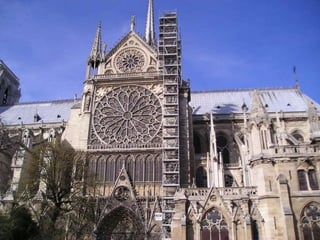
    Building Light: Notre Dame •Features – 110 ft. high – features magnificent stained glass, sculptures and flying buttresses (arched exterior supports). • Time Frame – Construction of Notre Dame Cathedral began in 1163 during the reign of Louis VII, and was completed around 1345. • History – In 1793, during the French Revolution, Notre Dame Cathedral was looted and damaged, and images of the Virgin Mary were replaced by those of Lady Liberty. Restoration work began in 1845 and lasted 25 years.
  • 23.
    Notre Dame: Dimensions •The twin campanile culminate at 69 meters (387 steps…I have counted). The south tower houses the 13 ton Emmanuel bell. • Notre Dame is 130 meters long, 48 meters wide, 35 meters high. Its pillars have a diameter of 5 meters. The rose windows have a diameter of 10 meters.
  • 24.
    Hunchback? • Significance – NotreDame Cathedral is the most popular monument in France, even more popular than the Eiffel Tower. Thirteen million people, a mixture of tourists and worshippers, visit every year. • Famous Ties – Victor Hugo wrote his 1831 novel "The Hunchback of Notre Dame" with the aim of raising awareness and appreciation of Notre Dame cathedral, which at the time was in a state of disrepair, and its Gothic architectural style considered vulgar.
  • 25.
  • 26.
    Vaulting • Notre- Dame– Louis the VI (aka The Fat) 1130 Moved to Paris • Building Boom • Sexpartite – ribvaulting covered nave
  • 37.
    11/7 Warm-Up • Lookingback through your notes and art snapshots, identify the most interesting cathedral and why. • Copy down its MARCS, and KNOW THEM.
  • 38.
    Warm-Up 11/13-14 • Whatseems striking about this painting in contrast to previous Christian depictions of God? Why is the theme expressed important to the influx of Cathedrals in Europe during the Late Middle Ages? Write one page.
  • 40.
    • In placeof triforiums (produced earlier by Laon Cathedral), a stained-glass occuli pattern opens up the wall below the clerestory lancets. • Also, first time flying buttresses are used
  • 44.
  • 45.
    • Provides acomprehensive picture of French church architecture of the second half o the 12th century (1190) • Infusion of romanesque nave bays with large sexpartite rib vaults • One nave crossing bay = two vaultes aisle squares. • Introduction of the triforium
  • 46.
    • The triforiumoccupies the space corresponding to the exterior strip of wall covered by the sloping timer roof above the gallieries. • New Gothic Formula: – Nave, arcade, vaulted gallery, triforium and clerestory with single lancets
  • 47.
  • 48.
    Flying Buttresses- tohold thiner & taller walls slender fingers holding walls up
  • 49.
    • In theChartes Plan, a single square in each aisle flanks a single rectangular unit in the nave with four- part vaults • Becomes characteristic of “High Gothic” architecture (1194-1500) • Always is planned with flying buttressing
  • 51.
    Royal Portal, westfaçade, Chartres Cathedral, Chartres Franc, ca. 1145-1155
  • 52.
  • 53.
    11/08 Warm-up Describe the differencesin how contrapposto is being administered. Label and fully identify both works. (6 sent.)
  • 54.
  • 55.
    Stained Glass • AbbotSuger’s thesis on the “lux-nova” or “new light” • Stained glass isn’t to allow all outside light in (so as to brightly illuminate the interior) • Rather, it is to transform the light into scripture (God’s incarnation=Jesus)
  • 57.
    Late Gothic • St.Denis, Laon, Chartre, Notre Dame, and Amien represent the early to High Gothic Period. • With the advent of 100 years war, building fervency declines • Emphasis shifts from monumental verticality to intense tracery known as the Rayonnant or “flamboyant” style.
  • 58.
    San Chapelle(1239) • Commissionedby Louis IX as a personal and royal chapel connected to the palace. • Held the crown of thorns • 6450 square feet of stained glass (more glass than wall by 3/4’s)
  • 61.
    The Catholic Church,how was money raised for these churches? • Indulgances– pardons for sins committed • Chartes cathedral burnt down in 1194(27 years to rebuild) • Townspeople drove the Bishop into exile
  • 62.
    Warm-up 11/09: put inchronological order, label
  • 63.
    Non-French Gothic • stylisticvariations because of blending with local traditions • » encouraged by prestige of French architects and respect for French centers of learning, as well as by intense spirituality of style • • ENGLAND • - typified by small villages and busy market towns; Oxford and Cambridge • Universities were established by the 13th century • - architecture shows less emphasis on height and lighting than French • - little use of architectural sculpture
  • 64.
    Salisbury Cathedral • SALISBURYCATHEDRAL (Early English style) • – FOUNDED (BY BISHOP RICHARD POORE) CA. 1220 • – IDYLLIC AREA NEAR RIVER AVON • - typical of English Gothic • o park-like setting (close) and attached cloister • o double projecting transepts, square apse, spacious sanctuary • – * NAVE INTERIOR - Purbeck marble accents, 80’ high, less light than French, longer and lower than French; decorative elaboration of ribs of vaulting = an English feature • » * CHAPEL OF HENRY VII, WESTMINSTER ABBEY • - fan vaulting • - abbey = burial place of kings, locale of Head of St. Benedict and vestments of St. Peter • - “Perpendicular Style” or “English Late Gothic” • » OTHER IMPORTANT ENGLISH EXAMPLES: WELLS CATHEDRAL, AND KINGS COLLEGE CHAPEL, CAMBRIDGE
  • 65.
    • aisles). Different •too is the emphasis on the great crossing tower – (added about 1320–1330), which dominates the silhouette. • modest compared with that of Amiens and Reims. And because • the architectused the flying buttress sparingly and as a rigid prop, rather than as an integral part of the vaulting system within the church. • In short, the English builders adopted some of the superficial motifs of French Gothic architecture but did not embrace its structural logic or emphasison height.
  • 88.
    Fan Vaults ofthe Chapel of Henry VII, Westminster Abbey, 1503-1519 • CHAPEL OF HENRY VII The structure- disguising and decorative qualities of the Perpendicular style became even more pronouncedin its late phases. • English linear play of ribs into a kind of architectural embroidery. The architects pulled the ribs into uniquely • English fan vaults (vaults with radiating ribs forming a fanlike pattern) • with large hanging pendants resembling stalactites. from the ceiling. • The chapel represents the dissolution of structural Gothic into decorative fancy. • Art form in purity, no longer pragmatic.
  • 91.
    Death of theVirgin, tympanum of left doorway, south transept, Strasbourg Cathedral, Strasbourg, France, ca. 1230.
  • 92.
    • Probably aportrait of a German emperor, perhaps Frederick II, • the Bamberg Rider revives the imagery of the Carolingian Empire. • The French-style architectural canopy cannot contain the entire statue. Equestrian portrait (Bamberg Rider), statue in the east choir, Bamberg Cathedral, Germany, ca. 1235–1240. Sandstone, 7 9 high.
  • 93.
    Virgin with theDead Christ (Röttgen Pietà), from the Rhineland, Germany, ca. 1300 1325. Painted wood, 2 101 2 high. Rheinisches Landemuseum, Bonn. • haunting 14thcentury • German painted wooden statuette (FIG. 18-51) of the Virgin • Mary holding the dead Christ in her lap. The widespread troubles • of the 14th century—war, plague, famine, and social strife—brought on an ever more acute awareness of suffering. • This sensibility found its way readily into religious art. The Dance of Death, Christ as the • Man of Sorrow, and the Seven Sorrows of the Virgin Mary became favorite themes.
  • 94.
    The Moses Well,Chartreuse de Champmol, Dijon, France, 1395-1405 • The work was executed for Philip’s son, John the Fearless (1371–1419), in a style combining the elegance of International Gothic with a northern realism, but with a monumental quality unusual in either. • It was carved from stone quarried in Asnières, France and consisted of a large crucifixion scene or "Calvary", with a tall slender cross surmounting a hexagonal base which was surrounded by the figures of the six prophets who had foreseen the death of Christ on the Cross • (Moses, David, Jeremiah, Zachariah, Daniel and Isaiah). Standing on slender colonnettes on the corners between these prophets are six weeping angels. All the figures, including the lost Calvary group • It was traditionally assumed that the Calvary scene would have included the Virgin Mary, Mary Magdalen, and St. John, though recent research (based on a close reading of the archives and an examination of the fixing-points on top of the base) suggests that there was only one figure, the Magdalen, embracing the foot of the Cross.
  • 95.
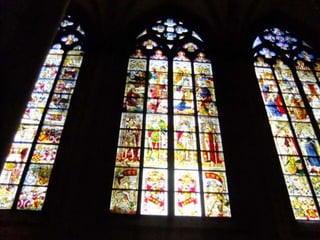
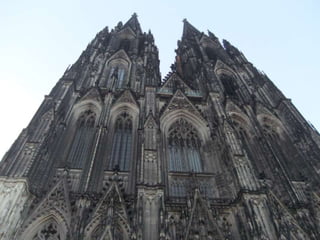
    Gerhard of Cologne, interiorof Cologne Cathedral (looking east), Cologne, Germany, choir completed 1322.
  • 96.
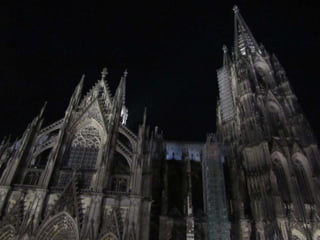
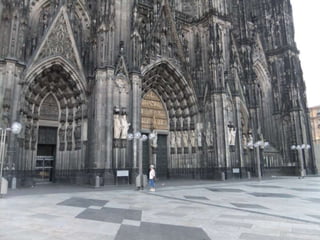
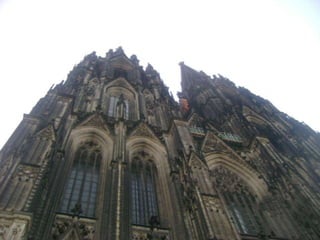
    German Gothic • COLOGNECATHEDRAL 1245- 1880 • EXTERIOR – built to house remains of the Three Wise Men – largest cathedral in Europe: 475’ X 202’ and with 515’ high spire • SCULPTURE – German Gothic sculpture tends to be more "Hellenistic" in its derivation (French is more “Classical”) – emphasis on strong emotion, movement, violence – portrait-like realism
  • 97.
    • The naveof Cologne Cathedral is 422 feet long. The 150-foot high choir • taller variation on the Amiens Cathedral choir