Romanesque  vs.  Gothic 1050-1200  1100-1500 Religion: Christ is the judge People live in fear T he last judgment common subject Crusades Pilgrimages Economics Feudalism-little economic freedom New trade routes Rural society- Monasteries Architecture Churches solid and grounded Destination of pilgrimage route Religion God is less vengeful Virgin Mary is the queen of heaven-intervener Triumph of the papacy Society Emphasis on  education and philosophy Importance of women Courtly love Chivalry Economics and politics Trade Craft guilds and unions Emerging Kingdoms Urbanization Urban churches vertical thin and light
Gothic Europe: Time of Turmoil and change  Prosperity and Urbanization Power shift from rural monastery to city cathedral Paris becomes the intellectual center of Europe Death and Destruction 100 year war began:1337 between England and France Black Plague: 14th century
Women Assume Prominent role Cult of the Virgin Mary: high status Eleanor of Aquitane (1st French Queen) supports literature that emphasizes courtly love and chivalry
Gothic Advances Space and verticality  Flying buttresses lead to thinner and less massive walls More windows; use of stained glass
Saint Denis 735,1137-1281  Saint Dionysis(3rd c) : an Apostle who brought Christianity to Gaul, and died a martyr. St. Denis: originated as a Carolingian basilica(735) France’s royal church and a symbol of the monarchy.  burial place of St.Denis and French Kings too small & in disrepair Remodeled to  become the key monument of Early Gothic art
Abbot Suger ( soo-gay the rebuilding of  Saint Denis 1081-1151 Goals: increase prestige of Saint Denis and of the monarchy. Rebuilt France’s royal church Birthplace of French Gothic architecture Shine with light  A way station on the road to paradise
Saint Denis: vaults. Saint Denis, France1140-1144 art card #2 Lightweight vaults spring from slender columns. Walls between chapels are eliminated and outer walls filled with stained glass Thrust of arches is directed to buttresses Plan View Crypt
Advantages of a pointed arch Pointed arch: crown of arches can all be the same level regardless of span channel the thrust down instead of out Look taller than round arch Flexibility: vaulting of compartments of varying shapes Less buttressing and larger windows
Anagogical window, St. Denis lux nova “ new light” Metaphysical properties Divine light: can be seen and felt, not touched Metaphor for God
Parts of the nave elevation
Flying Buttresses
France, Chartres, Chartres Cathedral  (of Notre Dame) South View    built 1134, burned 1194, rebuilt in high Gothic style 1194-1220 AC # 4 South  tower: 1194 transition from Romanesque to Gothic North Tower 1507: Late Gothic
Chartres Cathedral   West façade   Chartres France   Tripartite organization Lancet window  above portals Rose window above lancet
Gothic from 1100 ART:A creative movement celebrating the heavenly city of God Height and light Stained glass windows Statuary comes alive Environment: Shift from rural to urban: monastery to cathedral ECONOMIC: Guilds (precursors to unions) Book production from monastery to secular for profit SOCIAL: Role of women: no longer handmaidens of the devil Cult of the Virgin replaced Eve the great sinner Romantic love  Poetry and music French courts POLITICAL: Beginnings of European boundaries and countries
Iconography of Chartres The City as the center of learning  Center of town: high on a hill St. Augustine:  summa:  summary of law, philosophy and theology Combination of the secular and the spiritual The Bible in stone and glass Nature: plant and animal forms Instruction: teaching of the seven liberal arts History: from Adam and Eve to the last judgement Morality: virtue and  vice; wise and foolish, saved and damned
Royal Portal, west façade Chartres Cathedral  1145-1155   Copied the “Royal” portals of Saint Denis Statues of kings and Queens flank the doorways Sculpture proclaims majesty and power of Christ Mary is prominent (Cult of the virgin Mary) Figures integrated with the architecture and stand as individuals
Royal Portal,  west façade  Chartres Cathedral  1145-1155  left portal slide  Left Portal Tympanum: Close of Christ’s days on earth and his ascension Archivolts: signs of the zodiac, labors of the months (symbols of cosmic and earthly worlds
Royal Portal, west façade Chartres Cathedral  1145-1155 Center Portal: Christ in mandorla, signs of 4 evangelists Tympanum: second coming of Christ (the last Judgment)  Lintel:, 24 elders of the Apocalypse, 12 Apostles
Right Portal,  Christ in Mary’s lap  art card #5 Archivolts: 7 female liberal arts and male champions Tympanum: Christ’s early life
Right Portal Archivolts, west façade Chartres Cathedral  1145-1155   Outer archivolt Ptolemy: invented calendar and clock Grammar Donatus (Anc. Roman grammarian) Inner Archivolt: Music (striking bells of perfect intervals) Pythagoras
Chartres Cathedral central Jamb Statues  Columns of Kings and Queens of the old testament flank 3 doors ancestors of Christ Jamb statues destroyed during French revolution, why? How are they different than classical caryatids? Attached to columns Different from Romanesque? New naturalism 3D personalities More naturalistic although still elongated Stand out from the wall-3D no dangling feet Kindly human faces
Laon Cathedral  1160-1200 Early Gothic What makes it Gothic? Pointed arches Rose window deep portals open structure of towers
Laon Cathedral  Laon, France 1190 Early Gothic Romanesque features: nave bays w/ 6 part rib vaults Module system: ¼ crossing square 2 groin vaulted squares in each aisle
Laon 1190 Early Gothic Features Pointed rib vault w/ pointed arch triforium
Laon 4 story  Early Gothic Elevation: nave arcade, vaulted gallery, triforium, clerestory with lancets more unified space, not compartmentalized Romanesque: alternate support system(above nave piers), vaulted gallery
Notre Dame of Paris 1163-1250  Louis VI moves his official residence to Paris Building activity and commercial growth New Cathedral built Flying buttresses
High Gothic 1194-1300:  standard is height and luminosity Chartres completed 1220 118’ Reims: 1211-1290 Nave 125’ tall Amiens: begun 1220, nave= 144 ft Ratio of height to width continues to increase Chartres Reims Amiens Laon Paris Nave  arcade gallery clerestory triforium Clerestory: Oculi and lancet windows
France, Chartres, Chartres Cathedral of Notre Dame Plan  Rebuilt  1194-122  1194 fire destroys parts of Chartres Cathedral New plan: the first  high Gothic  building: planned from the beginning with flying buttresses
High Gothic : Chartres Cathedral of Notre Dame, Chartres, France,  Nave   1194-1222   No alternate support system Unified interior: Vast continuous space  flowing quality Tripartite Elevation: arcade, triforium and clerestory(emphasized; double lancet with oculus) Gallery( which acted as a buttress) eliminated in favor of  triforium
St. Sernin 1010,  St. Etienne1067,  Chartres 1194 (E. Romanesque)  (L. Romanesque)  Gothic
Chartres Cathedral of Notre Dame  Rose Window and lancets, n. transept 1194-122  Stone bar tracery Narrative Scene Center of Rose : Virgin Mary Lancets: St. Anne and 4 Old testament prophets Symbolism Square and circle:heaven and earth Rose= Virgin Mary
Chartres Cathedral of Notre Dame  Stained Glass  Virgin and Child and Angels ; Chartres France 12-13 c.  Emphasis on Mary queen of heaven Traditional frontal composition
Hagia Sophia mosaic  Gothic Stained glass Light  reflecting   light  transmitting     young and worldly Virgin and child Chartres cathedral
Maze of ThChartresTT On the left is a  labyrinth,  note it is #2 above. People would walk it as part of their pilgrimage to a holy site.
Chartres Cathedral of Notre Dame   Transept Portals   Saints, 1220-1230  Classical revolution Forceful projection ( fully in the round)  from architecture Individual personalities of saints Bodies turned at angles Soft , not stiff drapery
Saint Theodore, Jamb Statues Chartres 1230 Ideal Christian Knight (far left)  Gothic crusader costume Pronounced movement in body Note the suggested contrapposto pose because of the diagonal of the sword strap across one hip
Romanesque Tympanum at Cathedral of Saint-Lazare The Last Judgment by Gislebertus, 1120 Note similarities, through the lines or bands that separate the levels of action,  to ancient narrative art works such as the Column of Trajan or the Standard of Ur. While these works dealt with the subject of war and victory, Romanesque and Gothic art deal almost exclusively with stories from the bible and the life of Christ.
Amiens Cathedral begun 1220  Robert de Luzarches, Thomas de Cormont,  Renaud de Cormont  AC #14( plan and façade) High Gothic Formula: Rectangular bay system 4 part rib vault dissolution of heavy walls excellent buttressing
Amiens Nave, 144 feet high Self sustaining skeletal architecture: perfect expression of Gothic spirituality Nave arcade, triforium, clerestory Buttressing eliminated mass What would be its Byzantine counterpart?
How did the focus of religious art change between the Romanesque and Gothic period?  ROMANESQUE Emphasis on the damnation Women-devils Eve the sinner Books produced by monks Bible source of all knowledge GOTHIC Emphasis on salvation Cult of the virgin Mary the redeemer Dedication to love Books produced by secular sources Emphasis on the intellectual- St. Thomas Aquinas
Early Christian Youthful  Byzantine: pantocrater-  ruler of heaven and earth Consider these mosaics in comparison to stained glass windows
Reims Cathedral Reims France 1225-1290 Kings gallery above Rose window Openings taller, narrower, more intricate Dematerialize the building Glass replaces stone in tympanums
Chartres 1194  Amiens 1220  Reims 1225 The development of Gothic architecture
West façade Reims,-Visitation jamb statues 1230   Classical naturalistic style, appear to be conversing! Detached from background, full bodied Celebration of Mary’s life
 
Compare the four heads
The Rayonnant Style  “Radiant”  1250-1300 From the Royal Paris court Wealthy, powerful, prestigious Bar tracery and light  turns architecture into radiant light
Sainte- Chapelle Paris France 1243-1248 Patron:Louis IX “The Saintly king” Glass replaces whole building (6,450 sq ft of glass) A Carved Reliquary for Christ’s crown of thorns 6’ reliquary 1190  relics of 3 magi Cologne Germany
Sainte Chapelle interior 1243-1248  Slender architectural forms linearity Rayonnant Style
Virgin of Paris Notre Dame, Paris early14 c. Worldly queen and son Humanization artificial “S” curve, body is lost
Hermes and infant Dionysis high classical Greece Note similarities of the poses also note how the works reflect cultural values,
Gothic  Flamboyant Style Saint Maclou, Rouen France 1500-1514 Flame like tracery 5 portals bend out in an arc
Book illumination and Luxury Arts Paris intellectual center Fine books produced not by clergy but by urban factories Dante:  The Divine Comedy  1320
Villard de Honnecourt 1220-1235 Ink on Vellum Personal sketchbook All sketches based on geometric forms
God as architect of the world,  folio 1 verso of a moralized Bible, from Paris , ca. 1220-1230.  Ink, tempera, and gold leaf on vellum,  13 1/2" X 8 1/4”. By Sterreichische Circle: eternity –one God Sun , moon and matter Using tools-industrious mortal
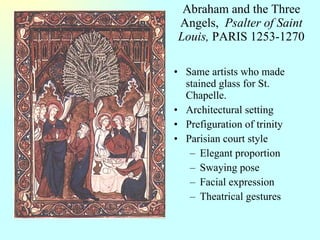
Abraham and the Three Angels,  Psalter of Saint Louis,  PARIS 1253-1270 Same artists who made stained glass for St. Chapelle. Architectural setting Prefiguration of trinity  Parisian court style Elegant proportion Swaying pose Facial expression Theatrical gestures
Master Honore Breviary of Phillippe le Bel,  Paris France 1296 Pioneer of naturalism Figures modeled But lacking background Court Style Note similarities to Islamic and Celtic art in terms of pattern making
Virgin of Jeanne D’Evreux  Saint Denis,  Silver gilt with enamel 1339,  27inches  Reliquary for the hair of the Virgin Mary  Gift from the Queen to the church Holding fleur de Lis -symbol of Royalty Crown is missing Sophisticated and Elegant S curve “ hipshot” position small head Gothic mannerism heavy drapery
Gothic Outside France 2nd half of 13th cent. Gothic becomes international style (in Europe). Modified to fit local preferences
Salisbury Cathedral, Salisbury, England  ( View from NW) 1220-1258  Different from French? Emphasis on length, not height Crossing tower dominates, not W. facade Similarities: Lancet windows, blind arcades Superficial Gothic attributes, not structural logic  or emphasis on height
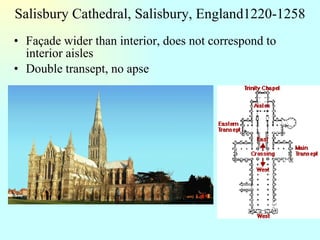
Salisbury Cathedral, Salisbury, England1220-1258 Façade wider than interior, does not correspond to interior aisles Double transept, no apse
Interior Salisbury Cathedral How does it depart from French gothic Style? Pier colonnettes stop at spring line Vault ribs rise from triforium Two tone color Horizontality
English Gothic 14th Cent.  The Perpendicular Style Choir of Gloucester Cathedral Verticality of decorative details
Chapel of Henry VII Westminster Abbey, London 1503-1519  Perpendicular style  disguises structure Fan vault hanging pendants Decorative fancy Kings tomb and portraits of Henry and Queen Elizabeth Reminder of human mortality
Germany Architecture remained conservatively Romanesque until 13th Cent German art is passionate and emotional
Gerhard of Cologne, Cologne Cathedral, begun 1248 Germany nave, towers, façade 1880
Similar to Amiens Light and height Choir from Nave Cologne Cathedral
Death of the Virgin, Tympanum 1230, Strasbourg Cathedral 12 apostles gather around a “gothic “ Mary Christ holds Mother’s soul Classical characteristics? Organization Natural drapery Gothic Art Humanized and natural German Gothic Passionate drama Medieval or non-classicizing characteristics? No space for bodies Unnatural movement
Ekkehard and Uta,  Naumburg Cathedral, Germany 1249-1255  6’2” French Gothic Attached to columns, below canopies Period costumes Changes from earlier Drapery is accurate Very realistic Humanization Secular Real people(donors) in a church
Virgin with Dead Christ,  Germany 1300-1325 painted wood Humanization of religious themes Troubles of the 14 th  century War, plague, famine, social strife Christ and Mary share human woes Christ: Stunted and distorted , evokes feeling and compassion
These two works represent the work of sculptors working in two different media, in two different cultural contexts and with different religious purposes in mind.   Rottgen Pieta, 1300-1325, painted wood, 2’10” high Virgin of Jeanne d’Evreux, Saint Denis, France 1339. Silver gilt and enamel
Italy Gothic and Non Gothic
Lorenzo Maitani,  Orvieto Cathedral ,Orvieto Italy 1310 Regional Diversity Gothic façade over E. Christian church What is  Gothic? Pointed gables Rose window 4 pinnacles
Orvieto, 1310; Miniato al Monte1062; Pisa cathedral 1063
Milan Cathedral ,  Milan Italy 1386 Waning of the Gothic style Built by committee; Italian proportion, Gothic décor, new Renaissance style
 

Gothic art n fall

  • 1.
    Romanesque vs. Gothic 1050-1200 1100-1500 Religion: Christ is the judge People live in fear T he last judgment common subject Crusades Pilgrimages Economics Feudalism-little economic freedom New trade routes Rural society- Monasteries Architecture Churches solid and grounded Destination of pilgrimage route Religion God is less vengeful Virgin Mary is the queen of heaven-intervener Triumph of the papacy Society Emphasis on education and philosophy Importance of women Courtly love Chivalry Economics and politics Trade Craft guilds and unions Emerging Kingdoms Urbanization Urban churches vertical thin and light
  • 2.
    Gothic Europe: Timeof Turmoil and change Prosperity and Urbanization Power shift from rural monastery to city cathedral Paris becomes the intellectual center of Europe Death and Destruction 100 year war began:1337 between England and France Black Plague: 14th century
  • 3.
    Women Assume Prominentrole Cult of the Virgin Mary: high status Eleanor of Aquitane (1st French Queen) supports literature that emphasizes courtly love and chivalry
  • 4.
    Gothic Advances Spaceand verticality Flying buttresses lead to thinner and less massive walls More windows; use of stained glass
  • 5.
    Saint Denis 735,1137-1281 Saint Dionysis(3rd c) : an Apostle who brought Christianity to Gaul, and died a martyr. St. Denis: originated as a Carolingian basilica(735) France’s royal church and a symbol of the monarchy. burial place of St.Denis and French Kings too small & in disrepair Remodeled to become the key monument of Early Gothic art
  • 6.
    Abbot Suger (soo-gay the rebuilding of Saint Denis 1081-1151 Goals: increase prestige of Saint Denis and of the monarchy. Rebuilt France’s royal church Birthplace of French Gothic architecture Shine with light A way station on the road to paradise
  • 7.
    Saint Denis: vaults.Saint Denis, France1140-1144 art card #2 Lightweight vaults spring from slender columns. Walls between chapels are eliminated and outer walls filled with stained glass Thrust of arches is directed to buttresses Plan View Crypt
  • 8.
    Advantages of apointed arch Pointed arch: crown of arches can all be the same level regardless of span channel the thrust down instead of out Look taller than round arch Flexibility: vaulting of compartments of varying shapes Less buttressing and larger windows
  • 9.
    Anagogical window, St.Denis lux nova “ new light” Metaphysical properties Divine light: can be seen and felt, not touched Metaphor for God
  • 10.
    Parts of thenave elevation
  • 11.
  • 12.
    France, Chartres, ChartresCathedral (of Notre Dame) South View built 1134, burned 1194, rebuilt in high Gothic style 1194-1220 AC # 4 South tower: 1194 transition from Romanesque to Gothic North Tower 1507: Late Gothic
  • 13.
    Chartres Cathedral West façade Chartres France Tripartite organization Lancet window above portals Rose window above lancet
  • 14.
    Gothic from 1100ART:A creative movement celebrating the heavenly city of God Height and light Stained glass windows Statuary comes alive Environment: Shift from rural to urban: monastery to cathedral ECONOMIC: Guilds (precursors to unions) Book production from monastery to secular for profit SOCIAL: Role of women: no longer handmaidens of the devil Cult of the Virgin replaced Eve the great sinner Romantic love Poetry and music French courts POLITICAL: Beginnings of European boundaries and countries
  • 15.
    Iconography of ChartresThe City as the center of learning Center of town: high on a hill St. Augustine: summa: summary of law, philosophy and theology Combination of the secular and the spiritual The Bible in stone and glass Nature: plant and animal forms Instruction: teaching of the seven liberal arts History: from Adam and Eve to the last judgement Morality: virtue and vice; wise and foolish, saved and damned
  • 16.
    Royal Portal, westfaçade Chartres Cathedral 1145-1155 Copied the “Royal” portals of Saint Denis Statues of kings and Queens flank the doorways Sculpture proclaims majesty and power of Christ Mary is prominent (Cult of the virgin Mary) Figures integrated with the architecture and stand as individuals
  • 17.
    Royal Portal, west façade Chartres Cathedral 1145-1155 left portal slide Left Portal Tympanum: Close of Christ’s days on earth and his ascension Archivolts: signs of the zodiac, labors of the months (symbols of cosmic and earthly worlds
  • 18.
    Royal Portal, westfaçade Chartres Cathedral 1145-1155 Center Portal: Christ in mandorla, signs of 4 evangelists Tympanum: second coming of Christ (the last Judgment) Lintel:, 24 elders of the Apocalypse, 12 Apostles
  • 19.
    Right Portal, Christ in Mary’s lap art card #5 Archivolts: 7 female liberal arts and male champions Tympanum: Christ’s early life
  • 20.
    Right Portal Archivolts,west façade Chartres Cathedral 1145-1155 Outer archivolt Ptolemy: invented calendar and clock Grammar Donatus (Anc. Roman grammarian) Inner Archivolt: Music (striking bells of perfect intervals) Pythagoras
  • 21.
    Chartres Cathedral centralJamb Statues Columns of Kings and Queens of the old testament flank 3 doors ancestors of Christ Jamb statues destroyed during French revolution, why? How are they different than classical caryatids? Attached to columns Different from Romanesque? New naturalism 3D personalities More naturalistic although still elongated Stand out from the wall-3D no dangling feet Kindly human faces
  • 22.
    Laon Cathedral 1160-1200 Early Gothic What makes it Gothic? Pointed arches Rose window deep portals open structure of towers
  • 23.
    Laon Cathedral Laon, France 1190 Early Gothic Romanesque features: nave bays w/ 6 part rib vaults Module system: ¼ crossing square 2 groin vaulted squares in each aisle
  • 24.
    Laon 1190 EarlyGothic Features Pointed rib vault w/ pointed arch triforium
  • 25.
    Laon 4 story Early Gothic Elevation: nave arcade, vaulted gallery, triforium, clerestory with lancets more unified space, not compartmentalized Romanesque: alternate support system(above nave piers), vaulted gallery
  • 26.
    Notre Dame ofParis 1163-1250 Louis VI moves his official residence to Paris Building activity and commercial growth New Cathedral built Flying buttresses
  • 27.
    High Gothic 1194-1300: standard is height and luminosity Chartres completed 1220 118’ Reims: 1211-1290 Nave 125’ tall Amiens: begun 1220, nave= 144 ft Ratio of height to width continues to increase Chartres Reims Amiens Laon Paris Nave arcade gallery clerestory triforium Clerestory: Oculi and lancet windows
  • 28.
    France, Chartres, ChartresCathedral of Notre Dame Plan Rebuilt 1194-122 1194 fire destroys parts of Chartres Cathedral New plan: the first high Gothic building: planned from the beginning with flying buttresses
  • 29.
    High Gothic :Chartres Cathedral of Notre Dame, Chartres, France, Nave 1194-1222 No alternate support system Unified interior: Vast continuous space flowing quality Tripartite Elevation: arcade, triforium and clerestory(emphasized; double lancet with oculus) Gallery( which acted as a buttress) eliminated in favor of triforium
  • 30.
    St. Sernin 1010, St. Etienne1067, Chartres 1194 (E. Romanesque) (L. Romanesque) Gothic
  • 31.
    Chartres Cathedral ofNotre Dame Rose Window and lancets, n. transept 1194-122 Stone bar tracery Narrative Scene Center of Rose : Virgin Mary Lancets: St. Anne and 4 Old testament prophets Symbolism Square and circle:heaven and earth Rose= Virgin Mary
  • 32.
    Chartres Cathedral ofNotre Dame Stained Glass Virgin and Child and Angels ; Chartres France 12-13 c. Emphasis on Mary queen of heaven Traditional frontal composition
  • 33.
    Hagia Sophia mosaic Gothic Stained glass Light reflecting light transmitting young and worldly Virgin and child Chartres cathedral
  • 34.
    Maze of ThChartresTTOn the left is a labyrinth, note it is #2 above. People would walk it as part of their pilgrimage to a holy site.
  • 35.
    Chartres Cathedral ofNotre Dame Transept Portals Saints, 1220-1230 Classical revolution Forceful projection ( fully in the round) from architecture Individual personalities of saints Bodies turned at angles Soft , not stiff drapery
  • 36.
    Saint Theodore, JambStatues Chartres 1230 Ideal Christian Knight (far left) Gothic crusader costume Pronounced movement in body Note the suggested contrapposto pose because of the diagonal of the sword strap across one hip
  • 37.
    Romanesque Tympanum atCathedral of Saint-Lazare The Last Judgment by Gislebertus, 1120 Note similarities, through the lines or bands that separate the levels of action, to ancient narrative art works such as the Column of Trajan or the Standard of Ur. While these works dealt with the subject of war and victory, Romanesque and Gothic art deal almost exclusively with stories from the bible and the life of Christ.
  • 38.
    Amiens Cathedral begun1220 Robert de Luzarches, Thomas de Cormont, Renaud de Cormont AC #14( plan and façade) High Gothic Formula: Rectangular bay system 4 part rib vault dissolution of heavy walls excellent buttressing
  • 39.
    Amiens Nave, 144feet high Self sustaining skeletal architecture: perfect expression of Gothic spirituality Nave arcade, triforium, clerestory Buttressing eliminated mass What would be its Byzantine counterpart?
  • 40.
    How did thefocus of religious art change between the Romanesque and Gothic period? ROMANESQUE Emphasis on the damnation Women-devils Eve the sinner Books produced by monks Bible source of all knowledge GOTHIC Emphasis on salvation Cult of the virgin Mary the redeemer Dedication to love Books produced by secular sources Emphasis on the intellectual- St. Thomas Aquinas
  • 41.
    Early Christian Youthful Byzantine: pantocrater- ruler of heaven and earth Consider these mosaics in comparison to stained glass windows
  • 42.
    Reims Cathedral ReimsFrance 1225-1290 Kings gallery above Rose window Openings taller, narrower, more intricate Dematerialize the building Glass replaces stone in tympanums
  • 43.
    Chartres 1194 Amiens 1220 Reims 1225 The development of Gothic architecture
  • 44.
    West façade Reims,-Visitationjamb statues 1230 Classical naturalistic style, appear to be conversing! Detached from background, full bodied Celebration of Mary’s life
  • 45.
  • 46.
  • 47.
    The Rayonnant Style “Radiant” 1250-1300 From the Royal Paris court Wealthy, powerful, prestigious Bar tracery and light turns architecture into radiant light
  • 48.
    Sainte- Chapelle ParisFrance 1243-1248 Patron:Louis IX “The Saintly king” Glass replaces whole building (6,450 sq ft of glass) A Carved Reliquary for Christ’s crown of thorns 6’ reliquary 1190 relics of 3 magi Cologne Germany
  • 49.
    Sainte Chapelle interior1243-1248 Slender architectural forms linearity Rayonnant Style
  • 50.
    Virgin of ParisNotre Dame, Paris early14 c. Worldly queen and son Humanization artificial “S” curve, body is lost
  • 51.
    Hermes and infantDionysis high classical Greece Note similarities of the poses also note how the works reflect cultural values,
  • 52.
    Gothic FlamboyantStyle Saint Maclou, Rouen France 1500-1514 Flame like tracery 5 portals bend out in an arc
  • 53.
    Book illumination andLuxury Arts Paris intellectual center Fine books produced not by clergy but by urban factories Dante: The Divine Comedy 1320
  • 54.
    Villard de Honnecourt1220-1235 Ink on Vellum Personal sketchbook All sketches based on geometric forms
  • 55.
    God as architectof the world, folio 1 verso of a moralized Bible, from Paris , ca. 1220-1230. Ink, tempera, and gold leaf on vellum, 13 1/2" X 8 1/4”. By Sterreichische Circle: eternity –one God Sun , moon and matter Using tools-industrious mortal
  • 56.
    Abraham and theThree Angels, Psalter of Saint Louis, PARIS 1253-1270 Same artists who made stained glass for St. Chapelle. Architectural setting Prefiguration of trinity Parisian court style Elegant proportion Swaying pose Facial expression Theatrical gestures
  • 57.
    Master Honore Breviaryof Phillippe le Bel, Paris France 1296 Pioneer of naturalism Figures modeled But lacking background Court Style Note similarities to Islamic and Celtic art in terms of pattern making
  • 58.
    Virgin of JeanneD’Evreux Saint Denis, Silver gilt with enamel 1339, 27inches Reliquary for the hair of the Virgin Mary Gift from the Queen to the church Holding fleur de Lis -symbol of Royalty Crown is missing Sophisticated and Elegant S curve “ hipshot” position small head Gothic mannerism heavy drapery
  • 59.
    Gothic Outside France2nd half of 13th cent. Gothic becomes international style (in Europe). Modified to fit local preferences
  • 60.
    Salisbury Cathedral, Salisbury,England ( View from NW) 1220-1258 Different from French? Emphasis on length, not height Crossing tower dominates, not W. facade Similarities: Lancet windows, blind arcades Superficial Gothic attributes, not structural logic or emphasis on height
  • 61.
    Salisbury Cathedral, Salisbury,England1220-1258 Façade wider than interior, does not correspond to interior aisles Double transept, no apse
  • 62.
    Interior Salisbury CathedralHow does it depart from French gothic Style? Pier colonnettes stop at spring line Vault ribs rise from triforium Two tone color Horizontality
  • 63.
    English Gothic 14thCent. The Perpendicular Style Choir of Gloucester Cathedral Verticality of decorative details
  • 64.
    Chapel of HenryVII Westminster Abbey, London 1503-1519 Perpendicular style disguises structure Fan vault hanging pendants Decorative fancy Kings tomb and portraits of Henry and Queen Elizabeth Reminder of human mortality
  • 65.
    Germany Architecture remainedconservatively Romanesque until 13th Cent German art is passionate and emotional
  • 66.
    Gerhard of Cologne,Cologne Cathedral, begun 1248 Germany nave, towers, façade 1880
  • 67.
    Similar to AmiensLight and height Choir from Nave Cologne Cathedral
  • 68.
    Death of theVirgin, Tympanum 1230, Strasbourg Cathedral 12 apostles gather around a “gothic “ Mary Christ holds Mother’s soul Classical characteristics? Organization Natural drapery Gothic Art Humanized and natural German Gothic Passionate drama Medieval or non-classicizing characteristics? No space for bodies Unnatural movement
  • 69.
    Ekkehard and Uta, Naumburg Cathedral, Germany 1249-1255 6’2” French Gothic Attached to columns, below canopies Period costumes Changes from earlier Drapery is accurate Very realistic Humanization Secular Real people(donors) in a church
  • 70.
    Virgin with DeadChrist, Germany 1300-1325 painted wood Humanization of religious themes Troubles of the 14 th century War, plague, famine, social strife Christ and Mary share human woes Christ: Stunted and distorted , evokes feeling and compassion
  • 71.
    These two worksrepresent the work of sculptors working in two different media, in two different cultural contexts and with different religious purposes in mind. Rottgen Pieta, 1300-1325, painted wood, 2’10” high Virgin of Jeanne d’Evreux, Saint Denis, France 1339. Silver gilt and enamel
  • 72.
    Italy Gothic andNon Gothic
  • 73.
    Lorenzo Maitani, Orvieto Cathedral ,Orvieto Italy 1310 Regional Diversity Gothic façade over E. Christian church What is Gothic? Pointed gables Rose window 4 pinnacles
  • 74.
    Orvieto, 1310; Miniatoal Monte1062; Pisa cathedral 1063
  • 75.
    Milan Cathedral , Milan Italy 1386 Waning of the Gothic style Built by committee; Italian proportion, Gothic décor, new Renaissance style
  • 76.