Fire SprinklerFire Sprinkler
SystemsSystems
 A fire sprinkler system is an ACTIVE fire protection
measure, consisting of a water supply system, providing
adequate pressure and flow of water through a distribution
piping system, onto which fire sprinklers are connected,
 Sprinkler systems have been around since the late 1880’s,
 In 1874, H.S. Pamelee patented the first practical
automatic sprinkler,
What is a Sprinkler System
Life Safety Considerations
 No reported multiple deaths in a completely sprinkled
building,
 Life Safety is enhanced,
 Combustion products are limited, with extinguishment in
the incipient stage,
 Controls 70% of all fires with five or fewer sprinklers
activated.
The CodesThe Codes
 By code definition, there are TWO categories of fire
suppression systems;
• Required Systems
• Non-Required Systems
 Required Systems are those required to be installed, by code,
due to life safety and/or building contents,
 Non-Required Systems are installed systems not required by the
code,
The Codes
 It is unlawful to occupy any portion of a building until the
REQUIRED suppression system has been tested and approved,
 When a REQUIRED system is out of service, and where
required by code enforcement, the building shall evacuated or an
approved Fire Watch shall be provided, whose only duty is to
patrol the premises and keep watch for fires,
 The Fire Watch must have means to notify the FD.
The Codes
Sprinkler DesignSprinkler Design
Types of Systems
There are four major types of sprinkler systems;
 The Wet Pipe system,
 The Dry Pipe system,
 The Deluge system and
 The Pre-Action system.
Types of Systems
Wet pipe --------- by far the most common,
Dry-pipe --------- where water freezing is possible,
Deluge ------------ for high hazard applications,
Pre-Action ------- where concerns over water
damage.
Wet Pipe SprinklerWet Pipe Sprinkler
 Pipes are always filled with water. Heat from fire opens a
sprinkler head,
 Usually only one or two heads open,
 Water flows until it is shut off,
 The open sprinkler head(s) is replaced and the system is
reset.
Wet Pipe Sprinkler
An opening sprinkler head triggers the system
 A one-way clapper prevents water from re-entering the
water supply,
 Gauges on both sides of the main valve, register pressure on
the supply and system sides,
 A retard chamber prevents sudden pressure surges which
could cause a false alarm,
 An alarm check valve detects water flow and activates the
alarm system,
Wet Pipe Sprinkler
Wet Pipe Sprinkler System
Dry Pipe SprinklerDry Pipe Sprinkler
 Dry pipes systems are used in unheated buildings, but the
valve room must be heated,
 Dry pipe systems are more difficult to design than wet
pipe systems and are harder to restore,
Dry Pipe Sprinkler
 Pipes are not filled with water (but with pressurized gas or
air),
 Heat from a fire opens a sprinkler head,
 Usually only one or two heads open,
 Air pressure drops in the piping and opens a water valve
(the dry-pipe valve),
Dry Pipe Sprinkler
 Water fills the pipes and exits through an open sprinkler
head(s),
 Water flows until shut off,
 Open sprinkler head is replaced,
 System is reset,
Dry Pipe Sprinkler
 Pipes in protected space are filled with air or inert gas; an
opening sprinkler head, triggers the system by releasing the
air or gas, which allows water to flow into the pipes and then
out through the open sprinkler head,
 A dry pipe valve keeps pressurized air above the supply water
pressure,
 The clapper valve has a locking mechanism to keep the clapper
open until it is reset, by draining the system, opening the dry
pipe valve cover and resetting the lock,
 Dry pipe systems are a little slower to activate than wet pipe
systems, so most have either an Exhauster or Accelerator to speed
up the system operation,
Dry Pipe Sprinkler
Typical Dry Pipe Valve
 The Exhauster detects decrease in air pressure and helps
bleed off air,
Dry Pipe Sprinkler
 The Accelerator detects decrease in air pressure and pipes air
pressure below the clapper valve, to speed up it’s opening,
Dry Pipe Sprinkler
Typical
Dry Pipe
Sprinkler
set up
Deluge SystemDeluge System
Deluge Sprinkler
 Pipes are not filled with water (or gas),
 All sprinkler heads are pre-opened,
 A signal from a detection device mechanically opens a
water valve,
 water fills the pipes and flows from all heads,
 water flows until shut off,
 system is reset.
 Primarily installed in special hazard areas that have fast
spreading fire, ( i.e. petroleum facilities, hazardous materials),
 Are also used to apply protein and AFFF foams,
 Activation will cause great quantities of water or foam to
flow,
 Usually requires several detectors to activate before
discharging.
Deluge Sprinkler
 Pipes in protected area are empty; a detector signal
triggers the system, allowing water/foam to enter pipes and
flow from all sprinkler heads (which are already open),
Deluge System
 Restoration of the System;
 the deluge clapper valve must be manually reset with the
latching mechanism in place,
 the detection system is re-activated,
 because of these procedures, it is not recommended for
the FD to restore the system, leave it to the professionals.
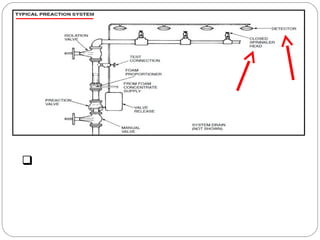
Pre-Action SystemPre-Action System
 Pipes are not filled with water,
 All sprinkler heads are of the standard type (they are closed),
 A detection device opens a water valve,
 Water fills the pipes,
 Water only flows from a sprinkler head if it is opened by heat
from a fire,
 Water flows until shut off and system is reset.
Pre-Action Sprinkler
 Used primarily to protect property where water could
severely damage facilities or equipment, (historical items)
 Similar to dry-pipe and deluge system;
 closed piping,
 little or no air/gas pressure,
 water does not flow to the sprinkler heads until detector
activates,
 water on fire after sprinkler head fuses,
 Turns into a wet system, but allows personnel to check/fight
fire before head fuses,
Pre-Action Sprinkler
 Pipes in protected area are empty; a detector signal
triggers the system, allowing water to enter pipes and flow
into piping network; heat from a fire may then open a
sprinkler head; accidental damage to a head will not result in
water flow,
 Restoration of the System;
 the deluge clapper valve must be manually reset with the
latching mechanism in place,
 the detection system, with supervisory features is re-
activated,
 because of these procedures, it is not recommended for the
FD to restore the system, leave it to the professionals.
Pre-Action Sprinkler
Sprinkler HeadsSprinkler Heads
Sprinkler Heads
 Sprinkler heads are the key components of the system,
 Heads must be suitable in design, performance,
application and temperature for type of property it is
protecting,
 Standard heads are marked with SSU (standard sprinkler upright) or
SSP (standard sprinkler pendent) on the deflector,
 Side wall heads may be pendent, upright, or horizontal,
Sprinkler Heads
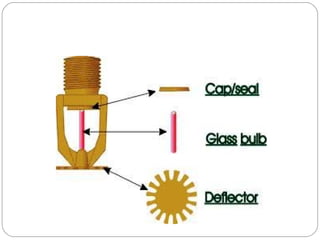
frangible bulb
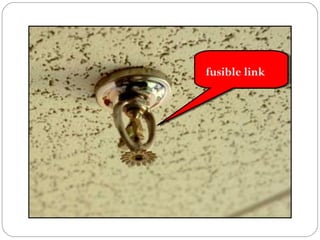
fusible link
 The typical sprinkler head is activated by heat (temperature),
 opens when a triggering action occurs,
 a frangible bulb breaks (color indicates temperature
setting),
 a fusible link melts,
 water flows when head is opened,
 water is manually shut off,
 once activated, head must be replace,
Sprinkler Heads
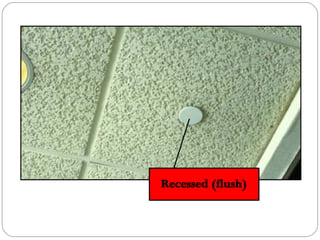
 Types;
 Upright
 Pendant
 Sidewall
 Recessed heads
Sprinkler Head Temperature Ratings, Classifications andSprinkler Head Temperature Ratings, Classifications and
Color CodingColor Coding
Temperature Rating
Temperature
Classification
Color Coding Glass Bulb Colors
F C
135-170 57-77
Ordinary
Uncolored or Black
Orange or Red
175-225 79-107
Intermediate White Yellow or Green
250-300 121-149
High Blue Blue
325-375 163-191
Extra High Red Purple
400-475 204-246
Very Extra High Green Black
500-575 250-302
Ultra High Orange Black
625 343
Ultra High Orange Black
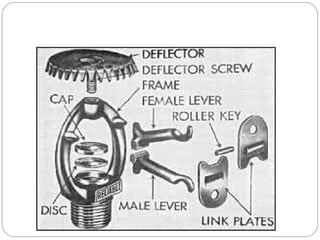
Sprinkler Head Parts
Fused Sprinkler Head
Frangible Bulb Head
frangible bulb
fusible link
Chemical pellet
Sprinkler Heads
 Storage Cabinet;
 extra heads
 sprinkler wrench
 Cabinets hold a minimum of six sprinklers and sprinkler
wrench in accordance with NFPA®
13.
• Less than 300 heads min 6 spares
• 300 – 1,000 heads min 12 spares
• More than 1000 heads min 24 spares
Control ValvesControl Valves
Control Valves
 OS&Y Valve
 Post Indicator Valve (PIV)
 Post Indicator Valve Assembly (PIVA)
 Operating Valves
OS&Y secured
in open
position by
chain & lock
OS&Y secured
in open
position by
chain & lock
 Outside Screw and Yoke (OS&Y)
Valve
 Post Indicator Valve (PIV)
Monitored
 Wall Post Indicator Valve
(WPIV)
 Post Indicator Valve
Assembly (PIVA)
Waterflow Alarms
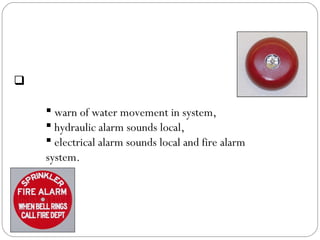
 Hydraulic or Electrical;
 warn of water movement in system,
 hydraulic alarm sounds local,
 electrical alarm sounds local and fire alarm
system.
Fire DepartmentFire Department
ConnectionConnection
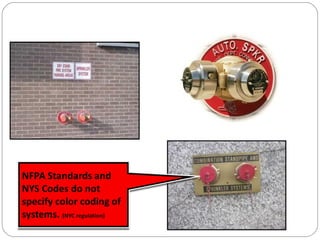
Fire Department Connection
(FDC)
 Connection usually by-passes control valve;
 system can be used regardless of position control valve
is in.
 Location:
 should be one located near main entrance of building,
 others may be located at various locations around
building,
 for use by additional companies,
 when system is divided into zones.
 allows FD to pump supplemental water,
 shall be visible and recognizable,
 located and arranged so that hose lines can be attached
without interference,
 min size of fittings 2 ½” (65 mm) (FCNYS),
 have a sign with at least 1” letters that read “AUTO
SPRINKLER”,
 shall not be less than 18” or more than 48” above grade.
Fire Department Connection
(FDC)
What it looks like
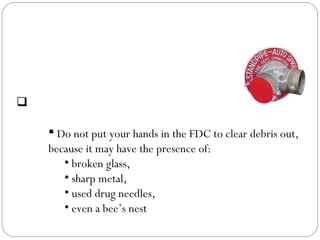
 Safety consideration:
 Do not put your hands in the FDC to clear debris out,
because it may have the presence of:
• broken glass,
• sharp metal,
• used drug needles,
• even a bee’s nest
Fire Department Connection
(FDC)
 Difficulties may be encountered with the FDC;
 These difficulties may include:
• missing or tight caps,
• defective or incompatible threads,
• debris stuffed into the connection,
• female swivels out-of-round,
• frozen female swivels,
• and clappers either broken or jammed open,
Fire Department Connection
(FDC)
Cans, bottles, balls, metals and drug
needles have been shoved into FDC’s.
Don’t use your hands to clean it out!!!!
Fire Department Connection
(FDC)
If the FDC is not usable, notify
the IC that water can not be
supplied to the system.
 Some Remedies; (frozen swivels, defective clapper)
 a spare male cap should be carried in the event it becomes
necessary to cap one side of the FDC to prevent an outflow of
water due to a malfunctioning clapper valve,
 connecting a second line is another solution,
 tap the swivels with a spanner wrench to loosen paint, dirt,
etc.,
 twist the supply hose 4 to 5 left turns, insert and turn to the
right,
Fire Department Connection
(FDC)
 Many FDC’s are equipped with either metallic or plastic
vandal proof caps,
 these caps are usually attached with screw eyes placed over
the pin lugs on the female swivel,
 both metal and plastic caps are removed by striking the
center of the cap with a tool,
 caps can also be removed by prying one of the screw eyes
off the pin lug.
Fire Department Connection
(FDC)
Some FD’s use security caps,
responding mutual aid
departments, without the key, will
not be able to remove the
cap……..
Knox registered FD ‘s should
request extra keys for their
mutual aid departments,
KNOX
KEY
Fire Department Connection
(FDC)
Sprinkler System FailuresSprinkler System Failures
Sprinkler System Failures
 There are three principal causes of unsatisfactory sprinkler
performance;
1. A closed valve in the water supply,
2. Inadequate water supply delivery,
3. Occupancy changes negating the system design.
 Pre-planning, inspections, proper maintenance and testing
should correct these problems.
 One of the leading causes of sprinkler system ineffectiveness
occurs when storage contents or configurations change and the
system is not altered to match the new hazard,
 Original sprinkler spacing, pipe size or water delivery
capacity might not control the new storage or layout,
Sprinkler System Failures
FD OperationsFD Operations
 We connect to the FDC in case of insufficient water supply or
many heads opened taxing the system,
 Upon arrival, stretch a supply line to the FDC, but don’t
charge it until confirmed working fire,
 Whenever possible, augment the system with two different
pumpers,
 Charge the line, start pump pressure at 150 psi unless system
is posted for a different pressure,
FD Operations
 If hose lines are used for firefighting, water for the system
should be taken from sources that do not reduce sprinkler
protection,
 Verify water is flowing from the system, if not, check if
control valves are open, have a FF with a radio positioned at the
valve,
 If present, shut the system down by using a sectional or floor
control valves instead of the main control valve,
FD Operations
 If system is connected to a potable water supply, avoid drafting
from open water sources unless backflow protection is installed,
 Unless tagged “Closed for Repair”, any control valves not open,
should be reported to the fire investigators office,
FD Operations
 Never shut the system down to improve visibility,
 Don’t shut the system down until fire has been extinguished,
 Notify the IC if water can not be supplied to the system due
to defective FDC,
 Lastly, a properly designed, installed, maintained and FD
augmented system can supply water directly to the fire in a more
effective manner than manual fire suppression,
Summary

Fire sprinkler systems read thoroughly

  • 1.
  • 2.
     A firesprinkler system is an ACTIVE fire protection measure, consisting of a water supply system, providing adequate pressure and flow of water through a distribution piping system, onto which fire sprinklers are connected,  Sprinkler systems have been around since the late 1880’s,  In 1874, H.S. Pamelee patented the first practical automatic sprinkler, What is a Sprinkler System
  • 3.
    Life Safety Considerations No reported multiple deaths in a completely sprinkled building,  Life Safety is enhanced,  Combustion products are limited, with extinguishment in the incipient stage,  Controls 70% of all fires with five or fewer sprinklers activated.
  • 4.
  • 5.
     By codedefinition, there are TWO categories of fire suppression systems; • Required Systems • Non-Required Systems  Required Systems are those required to be installed, by code, due to life safety and/or building contents,  Non-Required Systems are installed systems not required by the code, The Codes
  • 6.
     It isunlawful to occupy any portion of a building until the REQUIRED suppression system has been tested and approved,  When a REQUIRED system is out of service, and where required by code enforcement, the building shall evacuated or an approved Fire Watch shall be provided, whose only duty is to patrol the premises and keep watch for fires,  The Fire Watch must have means to notify the FD. The Codes
  • 7.
  • 8.
    Types of Systems Thereare four major types of sprinkler systems;  The Wet Pipe system,  The Dry Pipe system,  The Deluge system and  The Pre-Action system.
  • 9.
    Types of Systems Wetpipe --------- by far the most common, Dry-pipe --------- where water freezing is possible, Deluge ------------ for high hazard applications, Pre-Action ------- where concerns over water damage.
  • 10.
    Wet Pipe SprinklerWetPipe Sprinkler
  • 11.
     Pipes arealways filled with water. Heat from fire opens a sprinkler head,  Usually only one or two heads open,  Water flows until it is shut off,  The open sprinkler head(s) is replaced and the system is reset. Wet Pipe Sprinkler
  • 12.
    An opening sprinklerhead triggers the system
  • 13.
     A one-wayclapper prevents water from re-entering the water supply,  Gauges on both sides of the main valve, register pressure on the supply and system sides,  A retard chamber prevents sudden pressure surges which could cause a false alarm,  An alarm check valve detects water flow and activates the alarm system, Wet Pipe Sprinkler
  • 14.
  • 15.
    Dry Pipe SprinklerDryPipe Sprinkler
  • 16.
     Dry pipessystems are used in unheated buildings, but the valve room must be heated,  Dry pipe systems are more difficult to design than wet pipe systems and are harder to restore, Dry Pipe Sprinkler
  • 17.
     Pipes arenot filled with water (but with pressurized gas or air),  Heat from a fire opens a sprinkler head,  Usually only one or two heads open,  Air pressure drops in the piping and opens a water valve (the dry-pipe valve), Dry Pipe Sprinkler
  • 18.
     Water fillsthe pipes and exits through an open sprinkler head(s),  Water flows until shut off,  Open sprinkler head is replaced,  System is reset, Dry Pipe Sprinkler
  • 19.
     Pipes inprotected space are filled with air or inert gas; an opening sprinkler head, triggers the system by releasing the air or gas, which allows water to flow into the pipes and then out through the open sprinkler head,
  • 20.
     A drypipe valve keeps pressurized air above the supply water pressure,  The clapper valve has a locking mechanism to keep the clapper open until it is reset, by draining the system, opening the dry pipe valve cover and resetting the lock,  Dry pipe systems are a little slower to activate than wet pipe systems, so most have either an Exhauster or Accelerator to speed up the system operation, Dry Pipe Sprinkler
  • 21.
  • 22.
     The Exhausterdetects decrease in air pressure and helps bleed off air, Dry Pipe Sprinkler
  • 23.
     The Acceleratordetects decrease in air pressure and pipes air pressure below the clapper valve, to speed up it’s opening, Dry Pipe Sprinkler
  • 24.
  • 25.
  • 26.
    Deluge Sprinkler  Pipesare not filled with water (or gas),  All sprinkler heads are pre-opened,  A signal from a detection device mechanically opens a water valve,  water fills the pipes and flows from all heads,  water flows until shut off,  system is reset.
  • 27.
     Primarily installedin special hazard areas that have fast spreading fire, ( i.e. petroleum facilities, hazardous materials),  Are also used to apply protein and AFFF foams,  Activation will cause great quantities of water or foam to flow,  Usually requires several detectors to activate before discharging. Deluge Sprinkler
  • 28.
     Pipes inprotected area are empty; a detector signal triggers the system, allowing water/foam to enter pipes and flow from all sprinkler heads (which are already open),
  • 29.
    Deluge System  Restorationof the System;  the deluge clapper valve must be manually reset with the latching mechanism in place,  the detection system is re-activated,  because of these procedures, it is not recommended for the FD to restore the system, leave it to the professionals.
  • 30.
  • 31.
     Pipes arenot filled with water,  All sprinkler heads are of the standard type (they are closed),  A detection device opens a water valve,  Water fills the pipes,  Water only flows from a sprinkler head if it is opened by heat from a fire,  Water flows until shut off and system is reset. Pre-Action Sprinkler
  • 32.
     Used primarilyto protect property where water could severely damage facilities or equipment, (historical items)  Similar to dry-pipe and deluge system;  closed piping,  little or no air/gas pressure,  water does not flow to the sprinkler heads until detector activates,  water on fire after sprinkler head fuses,  Turns into a wet system, but allows personnel to check/fight fire before head fuses, Pre-Action Sprinkler
  • 33.
     Pipes inprotected area are empty; a detector signal triggers the system, allowing water to enter pipes and flow into piping network; heat from a fire may then open a sprinkler head; accidental damage to a head will not result in water flow,
  • 34.
     Restoration ofthe System;  the deluge clapper valve must be manually reset with the latching mechanism in place,  the detection system, with supervisory features is re- activated,  because of these procedures, it is not recommended for the FD to restore the system, leave it to the professionals. Pre-Action Sprinkler
  • 35.
  • 36.
    Sprinkler Heads  Sprinklerheads are the key components of the system,  Heads must be suitable in design, performance, application and temperature for type of property it is protecting,  Standard heads are marked with SSU (standard sprinkler upright) or SSP (standard sprinkler pendent) on the deflector,  Side wall heads may be pendent, upright, or horizontal,
  • 37.
    Sprinkler Heads frangible bulb fusiblelink  The typical sprinkler head is activated by heat (temperature),  opens when a triggering action occurs,  a frangible bulb breaks (color indicates temperature setting),  a fusible link melts,  water flows when head is opened,  water is manually shut off,  once activated, head must be replace,
  • 38.
    Sprinkler Heads  Types; Upright  Pendant  Sidewall  Recessed heads
  • 39.
    Sprinkler Head TemperatureRatings, Classifications andSprinkler Head Temperature Ratings, Classifications and Color CodingColor Coding Temperature Rating Temperature Classification Color Coding Glass Bulb Colors F C 135-170 57-77 Ordinary Uncolored or Black Orange or Red 175-225 79-107 Intermediate White Yellow or Green 250-300 121-149 High Blue Blue 325-375 163-191 Extra High Red Purple 400-475 204-246 Very Extra High Green Black 500-575 250-302 Ultra High Orange Black 625 343 Ultra High Orange Black
  • 40.
  • 41.
  • 42.
  • 44.
  • 45.
  • 46.
  • 48.
    Sprinkler Heads  StorageCabinet;  extra heads  sprinkler wrench  Cabinets hold a minimum of six sprinklers and sprinkler wrench in accordance with NFPA® 13. • Less than 300 heads min 6 spares • 300 – 1,000 heads min 12 spares • More than 1000 heads min 24 spares
  • 49.
  • 50.
    Control Valves  OS&YValve  Post Indicator Valve (PIV)  Post Indicator Valve Assembly (PIVA)  Operating Valves OS&Y secured in open position by chain & lock OS&Y secured in open position by chain & lock
  • 51.
     Outside Screwand Yoke (OS&Y) Valve  Post Indicator Valve (PIV) Monitored
  • 52.
     Wall PostIndicator Valve (WPIV)  Post Indicator Valve Assembly (PIVA)
  • 53.
    Waterflow Alarms  Hydraulicor Electrical;  warn of water movement in system,  hydraulic alarm sounds local,  electrical alarm sounds local and fire alarm system.
  • 54.
  • 55.
    Fire Department Connection (FDC) Connection usually by-passes control valve;  system can be used regardless of position control valve is in.  Location:  should be one located near main entrance of building,  others may be located at various locations around building,  for use by additional companies,  when system is divided into zones.
  • 56.
     allows FDto pump supplemental water,  shall be visible and recognizable,  located and arranged so that hose lines can be attached without interference,  min size of fittings 2 ½” (65 mm) (FCNYS),  have a sign with at least 1” letters that read “AUTO SPRINKLER”,  shall not be less than 18” or more than 48” above grade. Fire Department Connection (FDC)
  • 57.
  • 58.
     Safety consideration: Do not put your hands in the FDC to clear debris out, because it may have the presence of: • broken glass, • sharp metal, • used drug needles, • even a bee’s nest Fire Department Connection (FDC)
  • 59.
     Difficulties maybe encountered with the FDC;  These difficulties may include: • missing or tight caps, • defective or incompatible threads, • debris stuffed into the connection, • female swivels out-of-round, • frozen female swivels, • and clappers either broken or jammed open, Fire Department Connection (FDC)
  • 60.
    Cans, bottles, balls,metals and drug needles have been shoved into FDC’s. Don’t use your hands to clean it out!!!! Fire Department Connection (FDC) If the FDC is not usable, notify the IC that water can not be supplied to the system.
  • 61.
     Some Remedies;(frozen swivels, defective clapper)  a spare male cap should be carried in the event it becomes necessary to cap one side of the FDC to prevent an outflow of water due to a malfunctioning clapper valve,  connecting a second line is another solution,  tap the swivels with a spanner wrench to loosen paint, dirt, etc.,  twist the supply hose 4 to 5 left turns, insert and turn to the right, Fire Department Connection (FDC)
  • 62.
     Many FDC’sare equipped with either metallic or plastic vandal proof caps,  these caps are usually attached with screw eyes placed over the pin lugs on the female swivel,  both metal and plastic caps are removed by striking the center of the cap with a tool,  caps can also be removed by prying one of the screw eyes off the pin lug. Fire Department Connection (FDC)
  • 63.
    Some FD’s usesecurity caps, responding mutual aid departments, without the key, will not be able to remove the cap…….. Knox registered FD ‘s should request extra keys for their mutual aid departments, KNOX KEY Fire Department Connection (FDC)
  • 64.
  • 65.
    Sprinkler System Failures There are three principal causes of unsatisfactory sprinkler performance; 1. A closed valve in the water supply, 2. Inadequate water supply delivery, 3. Occupancy changes negating the system design.  Pre-planning, inspections, proper maintenance and testing should correct these problems.
  • 66.
     One ofthe leading causes of sprinkler system ineffectiveness occurs when storage contents or configurations change and the system is not altered to match the new hazard,  Original sprinkler spacing, pipe size or water delivery capacity might not control the new storage or layout, Sprinkler System Failures
  • 67.
  • 68.
     We connectto the FDC in case of insufficient water supply or many heads opened taxing the system,  Upon arrival, stretch a supply line to the FDC, but don’t charge it until confirmed working fire,  Whenever possible, augment the system with two different pumpers,  Charge the line, start pump pressure at 150 psi unless system is posted for a different pressure, FD Operations
  • 69.
     If hoselines are used for firefighting, water for the system should be taken from sources that do not reduce sprinkler protection,  Verify water is flowing from the system, if not, check if control valves are open, have a FF with a radio positioned at the valve,  If present, shut the system down by using a sectional or floor control valves instead of the main control valve, FD Operations
  • 70.
     If systemis connected to a potable water supply, avoid drafting from open water sources unless backflow protection is installed,  Unless tagged “Closed for Repair”, any control valves not open, should be reported to the fire investigators office, FD Operations
  • 71.
     Never shutthe system down to improve visibility,  Don’t shut the system down until fire has been extinguished,  Notify the IC if water can not be supplied to the system due to defective FDC,  Lastly, a properly designed, installed, maintained and FD augmented system can supply water directly to the fire in a more effective manner than manual fire suppression, Summary