 Guidance ISO 9000:2005 Quality Management Systems-
Fundamentals and vocabulary defines a document as an
information and its supporting medium.
 Medium can be:
◦ magnetic
◦ paper
◦ electronic or optical computer disc
◦ photograph
◦ master sample
Documentation is :
 A set of documents (written or graphical procedures,
manuals, policies , instructions, specifications) and
records (recorded information of performed activity).
 A process that involves the systematic interaction of
people, events and documents to create the records.
Quality can not be assured in a regulated industry
without good documentation practices.
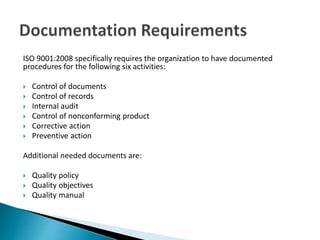
ISO 9001:2008 specifically requires the organization to have documented
procedures for the following six activities:
 Control of documents
 Control of records
 Internal audit
 Control of nonconforming product
 Corrective action
 Preventive action
Additional needed documents are:
 Quality policy
 Quality objectives
 Quality manual
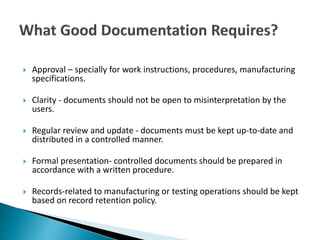
 Approval – specially for work instructions, procedures, manufacturing
specifications.
 Clarity - documents should not be open to misinterpretation by the
users.
 Regular review and update - documents must be kept up-to-date and
distributed in a controlled manner.
 Formal presentation- controlled documents should be prepared in
accordance with a written procedure.
 Records-related to manufacturing or testing operations should be kept
based on record retention policy.
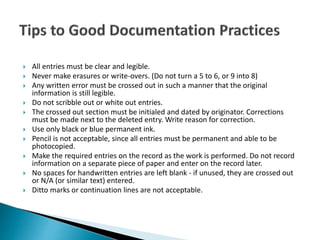
 All entries must be clear and legible.
 Never make erasures or write-overs. (Do not turn a 5 to 6, or 9 into 8)
 Any written error must be crossed out in such a manner that the original
information is still legible.
 Do not scribble out or white out entries.
 The crossed out section must be initialed and dated by originator. Corrections
must be made next to the deleted entry. Write reason for correction.
 Use only black or blue permanent ink.
 Pencil is not acceptable, since all entries must be permanent and able to be
photocopied.
 Make the required entries on the record as the work is performed. Do not record
information on a separate piece of paper and enter on the record later.
 No spaces for handwritten entries are left blank - if unused, they are crossed out
or N/A (or similar text) entered.
 Ditto marks or continuation lines are not acceptable.
Want to learn more about GDP, its requirements and best
practices to comply with them? ComplianceOnline
webinars and seminars are a great training resource.
Check out the following links:
 How to Comply with GDP Requirements?
 Good Documentation Practices for GXPs
 Introduction to FDA Good Documentation
Practices
 An Easy to Understand Guide to Good
Documentation Practices
 Good Laboratory Practices (GLP):
Documenting Deviations & Unexpected
Circumstances

Good documentation practices

  • 2.
     Guidance ISO9000:2005 Quality Management Systems- Fundamentals and vocabulary defines a document as an information and its supporting medium.  Medium can be: ◦ magnetic ◦ paper ◦ electronic or optical computer disc ◦ photograph ◦ master sample
  • 3.
    Documentation is : A set of documents (written or graphical procedures, manuals, policies , instructions, specifications) and records (recorded information of performed activity).  A process that involves the systematic interaction of people, events and documents to create the records. Quality can not be assured in a regulated industry without good documentation practices.
  • 4.
    ISO 9001:2008 specificallyrequires the organization to have documented procedures for the following six activities:  Control of documents  Control of records  Internal audit  Control of nonconforming product  Corrective action  Preventive action Additional needed documents are:  Quality policy  Quality objectives  Quality manual
  • 5.
     Approval –specially for work instructions, procedures, manufacturing specifications.  Clarity - documents should not be open to misinterpretation by the users.  Regular review and update - documents must be kept up-to-date and distributed in a controlled manner.  Formal presentation- controlled documents should be prepared in accordance with a written procedure.  Records-related to manufacturing or testing operations should be kept based on record retention policy.
  • 6.
     All entriesmust be clear and legible.  Never make erasures or write-overs. (Do not turn a 5 to 6, or 9 into 8)  Any written error must be crossed out in such a manner that the original information is still legible.  Do not scribble out or white out entries.  The crossed out section must be initialed and dated by originator. Corrections must be made next to the deleted entry. Write reason for correction.  Use only black or blue permanent ink.  Pencil is not acceptable, since all entries must be permanent and able to be photocopied.  Make the required entries on the record as the work is performed. Do not record information on a separate piece of paper and enter on the record later.  No spaces for handwritten entries are left blank - if unused, they are crossed out or N/A (or similar text) entered.  Ditto marks or continuation lines are not acceptable.
  • 7.
    Want to learnmore about GDP, its requirements and best practices to comply with them? ComplianceOnline webinars and seminars are a great training resource. Check out the following links:  How to Comply with GDP Requirements?  Good Documentation Practices for GXPs  Introduction to FDA Good Documentation Practices  An Easy to Understand Guide to Good Documentation Practices  Good Laboratory Practices (GLP): Documenting Deviations & Unexpected Circumstances