Dietary Supplements in the U.S.
Staying Alert as a Consumer
The Figures That Count
Dietary supplements are a $23.7 billion industry in the
United States.
Over 70 percent of the U.S. population has tried at least
one dietary supplement.
In the past 6 years, FDA has identified over 400 dietary
supplement products that were illegally manufactured,
misbranded, or falsely labeled.
FDA and DSHEA Join
Hands to Help Regulate
the Industry
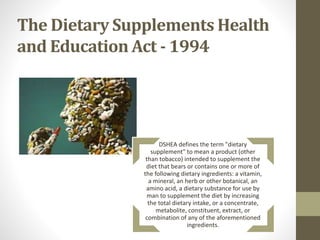
The Dietary Supplements Health
and Education Act - 1994
DSHEA defines the term "dietary
supplement" to mean a product (other
than tobacco) intended to supplement the
diet that bears or contains one or more of
the following dietary ingredients: a vitamin,
a mineral, an herb or other botanical, an
amino acid, a dietary substance for use by
man to supplement the diet by increasing
the total dietary intake, or a concentrate,
metabolite, constituent, extract, or
combination of any of the aforementioned
ingredients.
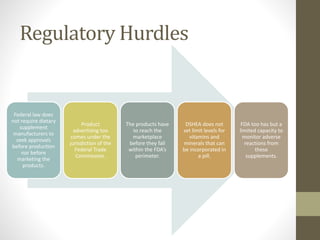
Regulatory Hurdles
Federal law does
not require dietary
supplement
manufacturers to
seek approvals
before production
nor before
marketing the
products.
Product
advertising too
comes under the
jurisdiction of the
Federal Trade
Commission.
The products have
to reach the
marketplace
before they fall
within the FDA’s
perimeter.
DSHEA does not
set limit levels for
vitamins and
minerals that can
be incorporated in
a pill.
FDA too has but a
limited capacity to
monitor adverse
reactions from
these
supplements.
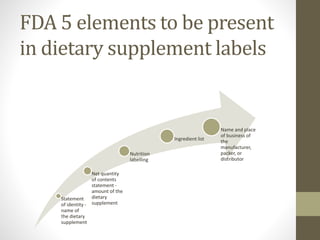
FDA 5 elements to be present
in dietary supplement labels
Statement
of identity -
name of
the dietary
supplement
Net quantity
of contents
statement -
amount of the
dietary
supplement
Nutrition
labelling
Ingredient list
Name and place
of business of
the
manufacturer,
packer, or
distributor
Stay Informed, Stay safe
www.complianceonline.com/fda-regulatory-compliance-training
FDA Safety Alerts and Recalls Page:
FDA Safety Alerts and Recalls
Forum to Report Adverse Effects:
Adverse Events

Dietary supplement

  • 1.
    Dietary Supplements inthe U.S. Staying Alert as a Consumer
  • 2.
    The Figures ThatCount Dietary supplements are a $23.7 billion industry in the United States. Over 70 percent of the U.S. population has tried at least one dietary supplement. In the past 6 years, FDA has identified over 400 dietary supplement products that were illegally manufactured, misbranded, or falsely labeled.
  • 3.
    FDA and DSHEAJoin Hands to Help Regulate the Industry
  • 4.
    The Dietary SupplementsHealth and Education Act - 1994 DSHEA defines the term "dietary supplement" to mean a product (other than tobacco) intended to supplement the diet that bears or contains one or more of the following dietary ingredients: a vitamin, a mineral, an herb or other botanical, an amino acid, a dietary substance for use by man to supplement the diet by increasing the total dietary intake, or a concentrate, metabolite, constituent, extract, or combination of any of the aforementioned ingredients.
  • 5.
    Regulatory Hurdles Federal lawdoes not require dietary supplement manufacturers to seek approvals before production nor before marketing the products. Product advertising too comes under the jurisdiction of the Federal Trade Commission. The products have to reach the marketplace before they fall within the FDA’s perimeter. DSHEA does not set limit levels for vitamins and minerals that can be incorporated in a pill. FDA too has but a limited capacity to monitor adverse reactions from these supplements.
  • 6.
    FDA 5 elementsto be present in dietary supplement labels Statement of identity - name of the dietary supplement Net quantity of contents statement - amount of the dietary supplement Nutrition labelling Ingredient list Name and place of business of the manufacturer, packer, or distributor
  • 7.
    Stay Informed, Staysafe www.complianceonline.com/fda-regulatory-compliance-training FDA Safety Alerts and Recalls Page: FDA Safety Alerts and Recalls Forum to Report Adverse Effects: Adverse Events