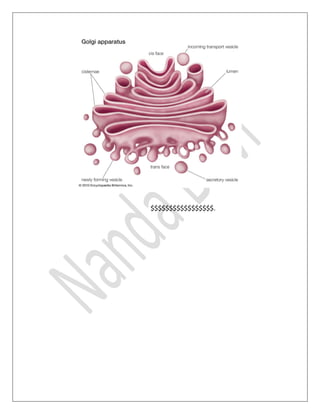
The Golgi apparatus was first discovered in 1898 by Camillo Golgi and plays an important role in protein modification and secretion. It has a characteristic structure when viewed under electron microscopes, consisting of stacked cisternae, tubules, and vesicles. The Golgi is involved in concentrating and modifying proteins and synthesizing carbohydrates as proteins and other molecules pass through. It plays a key role in packaging molecules for secretion from the cell.