Presenter- DaisyVishwakarma
2nd Year PG student
Moderator- Dr. A. Deori
Asstt. Professor
Deptt. of Ophthalmology, AMCH
Intra Ocular Pressure
IOP is the pressure within the eyeball
Normal IOP
It is that pressure that does not lead to
glaucomatous damage of the optic nerve
head.
Normal mean IOP = 15.5 +/- 2.57 mmHg & 2
SD above mean is 20.5 mmHg
Intra Ocular Tension
IOT is the pressure exerted by the
intraocular contents on the outer coats
of eye
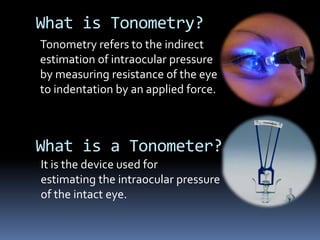
What is Tonometry?
Tonometry refers to the indirect
estimation of intraocular pressure
by measuring resistance of the eye
to indentation by an applied force.
What is a Tonometer?
It is the device used for
estimating the intraocular pressure
of the intact eye.
Role of tonometry in
glaucoma diagnosis
 Measurement of IOP plays a central role in glaucoma pt.
 It is the only known modifiable risk factor that has been
shown to delay progression of disease
 10% of normal individuals above 40 yr of age have IOP
above 21 mmHg
 40- 50% cases of open angle glaucoma have IOP less
than 21 mmHg
 IOP is dynamic & exhibit significant long-term, diurnal &
nocturnal fluctuations
 Illustrates the importance of taking multiple IOP
readings
Factors influencing tonometry
CCT Ocular rigidity
Corneal
curvature
Astigmatism
For every 10 µ
deviation from
assumed mean 520 µ
of CCT, an avg. error
is 0.7 mmHg
Increase of approx.
1 mmHg for every
3D of increase in
corneal power
underestimated for
WTR, overestimated
forATR, 1 mmHg of
error for every 4D
astigmatism
Techniques of Measuring IOP
DIRECT
METHOD
• Manometry
INDIRECT
METHOD
• Tonometry
Manometry
 Catheter is inserted into AC of
eye
 Other end is connected to a
manometric device
 MOST accurate method
 NOT feasible in humans
(invasive procedure)
Digital
Instrumental
Tonometry
History of Tonometry
In 1826
William Bowman used digital tonometry as a routine
examination test
In 1622
Bannister first suggested ‘Digital Palpation’
In 10th Century
Jarir Al-Tabari in Arabia first reported visual loss related
to a ‘hard or marble-like’ eye
In 1885
Maklakoff designed applanation tonometers
In 1865 and in 1880
Donders & Preistly-Smith invented indentation
tonometers that rested on sclera
In 1863
AlbrechtVon Graefe invented the first indentation
tonometer, over eyelid
In 1959
Invented Mackay-MargTonometer
In 1954
Professor Goldmann invented applanation tonometer
In 1897
Schiøtz developed an impression tonometer for the
Sclera, later updated to corneal plunger device in 1905
In 1987
TonoPenTonometer
In 1972
Grolman introduced the Air blast
Non ContactTonometer (NCT)
In 1969
Pneumatonometer
In 2000
iCareTonometer
In 1998
ProviewTonometer
In 1986
Keeler introduced the Pulsair NCT
In 2006
Reichert Ocular Response Analyser
In 2003
Pascal Dynamic contour tonometer
Digital Tonometry
 Response of eyeball to pressure
applied by pulp of finger
 METHOD: rest both hands on
patient’s forehead & alternately
apply just enough pressure on the
globe (above the superior tarsal
plate) to indent it slightly with 1
index finger while feeling the
compliance with the other
 Indents easily/ firm to touch
 NOT accurate (subjective)
Advantages
• Easiest to perform
• No equipments
• No anaesthesia
• No stain
• Estimation of IOP with
irregular corneas, where
applanation tonometry
is not possible.
Disadvantages
• Reading inaccurate
• Subjective
• Over-estimation or
under-estimation of IOP
INSTRUMENTAL
TONOMETRY
Indentation
Von
Graefe
Schiotz
Applanation
Contact
Non-
contact
Combined
indentation
&
applanation
MacKay-
Marg
Pneumotonometer
Rebound
iCare
Contour
Pascal’s DCT
Transpalpebral
Proview
phosphene
Diaton
An Ideal Tonometer
Should give accurate and
reasonable IOP measurement
Convenient to use
Simple to calibrate
Stable from day to day
Easier to standardize
Free of maintenance problems
Indentation Tonometer
Impression tonometer measures the depth of
indentation of the cornea produced by a
known weight.
Prototype - SchiötzTonometer
Schiøtz Tonometer (1905)
Hjalmar August Schiøtz
(1850 – 1927)
 First Norwegian Professor of
Ophthalmology
 First tonometers were applied
to sclera
 First reasonably accurate
trans- corneal indentation
tonometer in 1905
 Refined design over next 25 years
 Handle: to hold the instrument in
vertical position on the cornea
 Foot plate: rests on the cornea
 Plunger: moves freely within a shaft in
the foot plate
 Bent lever: short arm rests on the
upper end of the plunger and a long
arm which acts as a pointer needle
The degree to which the plunger indents
the cornea is indicated by the
movement of this needle on a scale
 Weights: 5.5 g weight is permanently
fixed to the plunger ,which can be
increased to 7.5 and 10gm.
Parts of SchiötzTonometer :
Indentation of cornea :
Base plate of
tonometer rests
on cornea.
Plunger of
tonometer
indents the
cornea
 The weight of tonometer on the eye increases
the actual IOP (Po) to a higher level (Pt)
 The change in pressure from Po to Pt is an
expression of the resistance of the eye
(scleral rigidity) to the displacement of fluid
 IOP withTonometer in position
Pt = Actual IOP Po + Scleral Rigidity E
 Because the tonometer actually measures Pt ,
it is necessary to estimate Po for each scale
reading & weight.
Principle :
P(t) = P(o) + E
 In 1940s, Friedenwald gave a mathematical formula
 Formula has a single numerical constant -
the coefficient of ocular rigidity (K), which is roughly
an expression of the distensibility of the eye
 Average value is 0.025
 He developed a nomogram for estimating K on the basis
of two tonometric readings with different weights
Log Pt2 / Pt1 = K (V2 –V1 )
Friedenwald’s formula :
 Pt1 & V1 represent the tonometric pressure & volume of
the indentation caused by the bar in the
determination made with the first weight
 Pt2 and V2 represent the respective values as obtained
with the second weight
 On the basis of his formula,
Friedenwald developed a set of
conversion tables for IOP
The indicated scale reading and the
plunger weight are converted to an
IOP measurement
 More the plunger indents the
cornea, higher the scale reading and
lower the IOP
 Each scale unit represents 0.05 mm
protrusion of the plunger
 Patient should be anasthetised with 4%
lignocaine
 In supine position
 fixation target just overhead
 examiner separates the lids
 Lower tonometer plate to rest on cornea
 plunger is free to move vertically
 Scale reading is measured
 5.5 gm weight is initially used
 If scale reading is 4 or less - additional weight is
added to plunger
 IOP measurement is repeated until 3 consecutive
readings agree within 0.5 scale units
 Conversion table is used to derive IOP in mmHg
from scale reading and plunger weight.
Procedure :
 Measure of distensibility or resistance to
deformation of ocular coats
 Important in indentation tonometer
Ocular Rigidity:
Increase in ocular rigidity
OVER-ESTIMATION
• Long standing
glaucoma
• ARMD
• High Hyperopia
• Vasoconstrictors
Decrease in ocular rigidity
UNDER-ESTIMATION
• Increasing age
• Strong miotic therapy
• Vasodilator therapy
• Post-op after RD
surgery (Vitrectomy,
cryopexy, scleral band)
• High myopia
• Compressible gas
 Technique for determining K
 A reading is taken with one weight on the Plunger
 a second reading is taken with a different weight
 Eg. Glaucoma in a pt. with myopia
DifferentialTonometry:
5.5 g 10 g Ocular rigidity IOP
18 mmHg 15 mmHg Lower > 18 mmHg
18 mmHg 21 mmHg Higher < 18 mmHg
18 mmHg 18 mmHg Equal 18 mmHg
 A calibration check - at the start of
every day
 Place the footplate of the instrument
on the rounded test block
(the dummy cornea)
 Footplate resting on the test block, a
correctly calibrated instrument -
scale reading of zero.
 If not - calibrate it to zero
Left of zero - rotate the
footplate in a clockwise direction
Right of zero - rotate the
footplate in an anti-clockwise
direction
Calibration :
 The tonometer is disassembled between each use - barrel is cleaned with 2
pipe cleaners
 the first soaked in isopropyl alcohol 70% or methylated spirit &
 the second dry
 Foot plate is cleaned with alcohol swab
 All surfaces must be dried before reassembling
 Instrument can be sterilized with UV radiation, steam, ethylene oxide
 In between patients, the tonometer should be disinfected by soaking it in
sodium hypochlorite
 As with other tonometer tips, Schiotz can be damaged by some disinfecting
solutions such as hydrogen peroxide & bleach.
Sterilization :
Advantages
• Portable
• Sturdy
• Relatively
inexpensive
• Easy to operate
• Easy to clean &
maintain
• Do not require Slit
lamp / power
supply
Disadvantages
• Falsely high/low
IOP - Ocular
rigidity
• Cannot be used in
traumatic
cases/early post-
op cases/ corneal
pathologies
Limitations
• Instrumental
errors
• Muscular
contractions of
• EOM - IOP
• accomodation -
IOP
• Variations in globe
volume-
• Microphthalmia
• High myopia
• Buphthalmos
• Thickness &
curvature of
cornea
APPLANATION
TONOMETERS
Non-contact
Grolman NCT
Ocular response analyzer
Contact
Fixed area variable force
Goldmann
Perkins
Fixed force variable
area
Maklakoff
ApplanationIndentation
 Shape of deformation-
TRUNCATED CONE
 Precise shape- variable &
unpredictable
 Displace large intraocular
volume
 Conversion tables based on
empirical data used
 Prototype- Schiøtz tonometer
 Shape of deformation-
FLATTENING
 Precise shape- constant
 Displace small intraocular
volume
 Mathematical calculations
for IOP
 Differentiated on the basis
of variable measured
Goldmann Applanation Tonometer (1954)
 Goldmann based his concept of tonometry
on the Modified Imbert- Fick Law
 When A1 = 7.35 mm2 S balances B &
W equals P
 this internal area of applanation is obtained
when diam. of external area of applanation
is 3.06 mm
 Volume of displacement produced by
applanating this area is approx. 0.50 mm3
 so P is very close to actual IOP & ocular
rigidity does not significantly influence
measurements
Hans Goldmann
(1899-1991)
W + S = PA1 + B
Imbert – Fick Principle (1885)
The pressure (P) of a body of fluid encapsulated
within a sphere is directly proportional to the
force (W) required to applanate an area (A) of
the sphere:
W= PA
 Infinitely thin
 perfectly elastic
 perfectly dry
 Perfectly flexible
The only force being exerted upon it is the force from
the applanating surface
The assumptions – the surface encapsulating
the sphere :
Cornea :
 finite thickness ( CCT = 0.55 mm)
 measurable corneal rigidity (push effect)
 capillary attraction force of the pre-corneal tear film
(pull effect)
Modified Imbert-Fick’s Law
W = tonometer force
s = surface tension of pre-corneal tear film
P = intra-ocular pressure
A1 = inner corneal area of applanation
b = corneal rigidity
W + S = PA1 + B
When A1 = 7.35 mm2, S balances B
andW = P
This internal area of applanation is
achieved when the diameter of
the external area of corneal
applanation is around 3.06 mm.
 Grams of force applied to flatten
3.06 mm diameter of the cornea
multiplied by 10 is directly
converted to IOP in mmHg.
Parts of GoldmannTonometer :
Control weight insert
Connects to the slit
lamp
Biprism
(measuring prism)
Feeler arm
Housing
Revolving knob &
measuring drum
Biprism Probe:
The two beam-splitting prism within the
applanating unit optically convert the circular
area of corneal contact into 2 semicircles
Procedure :
Instrument is mounted on Slit
lamp
Examiners view is directed
through the centre of Biprism
Biprism is attached by a rod to a
housing
Housing contains a coil spring &
series of levers that are
used to adjust the force of
biprism against the cornea
Two beam-splitting prisms
within probe optically
convert circular area of
corneal contact into 2 semicircles
 Angle between the illumination & microscope
should be approx. 60°
 Magnification 10X
 Maximum illumination
 Maximum beam height
 Room illumination is reduced
 A fixation light may be placed in front of the
fellow eye
 The tension knob is set at 1 g
 Pt. asked to look up but not more than 15° above
horizontal
 Instill topical anaesthesia
 Edge of corneal contact is made apparent by
instilling fluorescein dye
 View in cobalt blue light
 The biprism should not touch the lids or lashes
because this stimulates blinking & squeezing
Pt. should blink the eyes once or twice
to spread the fluorescein-stained
tear film over the cornea
Then keep eyes open wide
Should not apply any pressure on the
globe because this raises IOP
In some patients, hold eyelids open with
thumb & index finger of one hand
against the orbital rim
By manually rotating a dial calibrated in
grams, the force is adjusted by
changing the length of a spring
within the device
The prisms are calibrated in such a fashion
that inner margin of semicircles
touch when 3.06 mm of the cornea is
applanated
The IOP is then read directly from a scale on
the tonometer housing
The fluorescein rings should
be approx. 0.25–0.3 mm in
thickness – or about 1/10th
diameter of the flattened area
The fluorescent semicircles
are viewed through the
biprism and the force against
the cornea is adjusted until the
inner edges overlap.
Thin cornea
Thick cornea
Astigmatism > 3D
Irregular cornea
Inadequate fluorescein
Too much fluorescein
Tonometer out of calibration
Repeated tonometry
Elevating eyes > 15°
Pressing on the eyelids or globe
Squeezing of the eyelids
Observer bias (expectations and even Numbers)
Potential errors :
Falsely low IOP
• Inadequate flourescein
• thin cornea
• corneal edema
• with the rule astigmatism
(1mm Hg per 4 D)
• prolonged contact
• Repeated tonometry
Falsely high IOP
• Excess flourescein
• thick cornea
• steep cornea
• against the rule
astigmatism
(1mm Hg per 3D)
• wider meniscus
• Widening the lid fissure
excessively
• Elevating the eyes more
than 15°
 Thinner cornea require less force to
applanate it – underestimation of
true IOP
 Thicker cornea need more force to
applanate it – artificially higher IOP
 GAT was designed to give accurate
readings when the CCT was 520 μm
 Deviation of CCT from 520 μm –
change in applanation
readings of 0.71 mmHg per 10 μm
Effect of CCT :
Less than 3.00 D of astigmatism
Position the probe so that the patient’s minus
cylinder axis is aligned with the WHITE LINE on
the prism holder.
Astigmatism :
Greater than 3.00 D of astigmatism
Position the probe so that the patient’s minus
cylinder axis is aligned with the RED LINE on
the prism holder.
Incorrect mires :
 GAT should be calibrated periodically (at least
once a month)
 If it is not within 0.1 g (1 mmHg) of the correct
calibration, the instrument should be repaired
 Calibration errors of up to 2.5 mmHg may still be
tolerated clinically
Calibration :
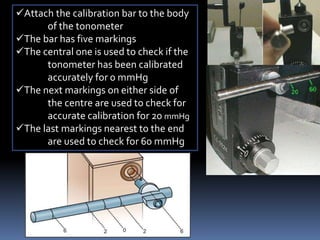
Attach the calibration bar to the body
of the tonometer
The bar has five markings
The central one is used to check if the
tonometer has been calibrated
accurately for 0 mmHg
The next markings on either side of
the centre are used to check for
accurate calibration for 20 mmHg
The last markings nearest to the end
are used to check for 60 mmHg
To check if tonometer has
been calibrated for 60 mmHg,
line up the 6 marking on the
bar with the marking on the
knob that hold up the bar
Now move the knob on
tonometer & note pressure at
which tonometer tip tilt
forward
If the tilt occurs when the
pressure is at 60 the tonometer
is calibrated correctly
If the tilt occurs below or
above 60, the tonometer
should be sent for recalibration
End Point
 Applanation tip should be soaked for 5-
15 min in diluted sodium hypochlorite,
3% H2O2 or 70% isopropyl alcohol or
 By wiping with alcohol, H2O2,povidone
iodine or 1: 1000 merthiolate.
 Other methods of sterilization include:
 10 min of rinsing in running tap water
 wash with soap & water
 cover the tip with a disposable film
 exposure to UV light.
 Disposable tonometer tips may also be
used
Sterilization:
Perkins Tonometer (1965)
 Developed by ES Perkins
 Hand-held applanation tonometer
 Uses same prism tips as GAT
 The prism is illuminated by battery
powered bulbs
 Advantages Over GAT:
 Portable & counter-balanced, so it
can be used in any position of pt.
 Infants/ children
 in the O.T.
 at the bedside for non-ambulatory
pt., who cannot be examined at the
slit lamp.
Draeger Tonometer (1965)
Hand-held applanation tonometer
Similar to the Goldmann & Perkins
tonometers
Except :
Uses a different biprism tip
Force for applanation is supplied
by an electric motor
Portable & counterbalanced
(used in any position of pt.)
Mackay Marg Tonometer (1959)
Parts
Plunger (1.5 mm diam.)
rigid spring
rubber sleeve ( 3 mm diam.)
Rigid spring extends 10 µ beyond plane
of surrounding rubber sleeve
Movement of plunger is electronically
monitored by a transducer &
recorded on a moving paper strip
Useful in eyes with scarred, irregular, or
edematous corneas because the
end point does not depend on the
evaluation of a light reflex sensitive
to optical irregularity, as does the
Goldmann tonometer
It is accurate when used over
therapeutic soft contact lenses
At 1.5 mm of corneal area
applanation, tracing reaches a
peak
the force applied = IOP +
force required to deform the
cornea
At 3 mm flattening, force
required to deform cornea is
transferred from plunger to
surrounding sleeve, creating a
dip in tracing corresponding to
IOP
Flattening of >3 mm of area
gives artificial elevation of IOP.
Pneumotonometer (1969)
First developed by Durham et al.
Refined by Langham & McCarthy
in 1969
Contact applanation tonometer
4 Components
1) Sensor
2) Transducer (pneumatic to
electrical)
3) Combined amplifier &
recorder
4) Air supply unit (supply
compressed air to probe)
Readout can be digital or on
graph paper
A plunger with a slightly convex 5 mm diam. tip made of
silicone rides on a piston of filtered air ( close to frictionless)
NO inherent force transmitted to eye by the tonometer
Cornea is indented slightly by the flat tip
When both tip & cornea are flat, the pressure pushing tip
forward equals IOP
Tip is held against the eye for 5 to 10 s measuring
fluctuations in IOP with cardiac cycle
Pneumatonometer maybe more accurate than GAT but less
accurate than McKay Marg tonometers in scarred corneas
Grolman Non-Contact Tonometer(1972)
Introduced by Grolman in 1972
Original NCT has 3 subsystems:
1. Alignment system: It aligns patient’s eye in 3
dimensions (axial/vertical/lateral)
2. Optoelectronic applanation monitoring system:
Comprises transmitter, receiver and detector & timer
a. Transmitter directs a collimated beam of light at
corneal apex
b. Receiver & detector accept only parallel coaxial
rays of light reflected from cornea
c. Timer measures from an internal reference to the
point of peak light intensity
3. Pneumatic system: It generates a puff of room air
directed against cornea
 A puff of room air (air jet) creates a constant force that
momentarily flattens the cornea
 The force of air jet (generated by a solenoid-activated
piston) increases linearly over time
 When the reflected light is at peak intensity, the cornea is
presumed to be flattened
 The time elapsed is directly related to the force of jet
necessary to flatten the cornea & correspondingly to IOP
 The time from an internal reference point to the moment
of flattening is measured & converted to IOP
 A puff of air of known area is
generated against cornea (B)
 At the moment of corneal
applanation, a light (T), which is
usually reflected from the normal
cornea into space, suddenly is
reflected (R) into an optical sensor
(A)
 When the sensor is activated by the
reflected light, the air generator is
switched off
 The level of force at which the
generator stops is recorded & a
computer calculates & displays the
IOP
ADVANTAGES
• Screening procedure
• Can be operated by
non-medical
personnel
• No anesthesia
required
• No contamination
• No chance of corneal
abrasion
LIMITATIONS
• IOP is near normal,
accuracy decreases
with increase in IOP
& in eyes with
abnormal
cornea/poor fixation
• sub-epithelial air
bubbles after
repeated use of NCT
(rare)
Pulsair Tonometer(1986)
New Non ContactTonometer
Keeler Pulsair Intellipuff is a
portable hand-held
tonometer
Launched in European market
in April 2007
Based on the same principle
as the Grolman NCT
TonoPen
 The most commonly used Mackay-Marg type
tonometer today is the Tono-Pen
 FDA approved in March 2006
 Portable handheld instrument with a strain
gauge that creates an electrical signal as the
footplate flattens the cornea
 Micro-strain gauge technology
 Computerised battery-operated pocket
tonometer
 Instrument is 18 cm in length and weighs 60 g
 Converts IOP into electric waves
 Wave form is internally analyzed by a
microprocessor
 Average of 3 to 6 readings of IOP
 As the area of applanation of theTonopen
is smaller than GAT (2.36mm2 Vs 7.35mm2)
therefore, theoretically the difference
between applanating pressure & IOP is
reduced due to reduced corneal
resistance of a smaller contact area
 It is particularly useful in community eye
camps, on ward rounds ,children,
irregular surfaces, measuring through an
amniotic membrane patch graft, to read
from the sclera
 A disposable latex cover which is
discarded after each use provides
infection control
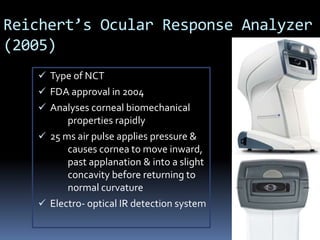
Reichert’s Ocular Response Analyzer
(2005)
 Type of NCT
 FDA approval in 2004
 Analyses corneal biomechanical
properties rapidly
 25 ms air pulse applies pressure &
causes cornea to move inward,
past applanation & into a slight
concavity before returning to
normal curvature
 Electro- optical IR detection system
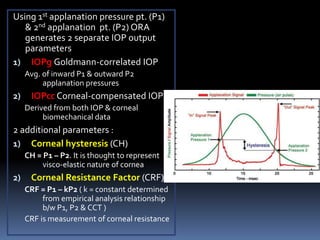
Using 1st applanation pressure pt. (P1)
& 2nd applanation pt. (P2) ORA
generates 2 separate IOP output
parameters
1) IOPg Goldmann-correlated IOP
Avg. of inward P1 & outward P2
applanation pressures
2) IOPcc Corneal-compensated IOP
Derived from both IOP & corneal
biomechanical data
2 additional parameters :
1) Corneal hysteresis (CH)
CH = P1 – P2. It is thought to represent
visco-elastic nature of cornea
2) Corneal Resistance Factor (CRF)
CRF = P1 – kP2 ( k = constant determined
from empirical analysis relationship
b/w P1, P2 & CCT )
CRF is measurement of corneal resistance
Rebound Tonometer
New version of indentation tonometer
Hand-held & portable
Consists of an assembly of two coaxial
coils which impel a magnetized
probe towards the cornea
Detect the deceleration of the probe as a
result of corneal contact
This deceleration speed is related to IOP
Time taken for the probe to return to its
resting position is longer in eyes
with lower IOP & faster in eyes
with higher IOP
The probe tip used is disposable
A plastic cover in the tip reduces the risk
of corneal injury
Takes 6 readings & gives digital readout
of avg. IOP
Advantages
• Portable
• Battery powered
• No anaesthesia
• Least contact time
• Easy to use
• Performed by non-
medical trained
personnel
• Young children, non-
cooperative adults,
blepharospasms
• No sterilization
Disadvantages
• Influenced by corneal
thickness
• Not very accurate
• Used in upright position
(pin falls out if
instrument faces
downward)
• Costly
iCare Tonometer (2000)
 Newest version of rebound
tonometer
 FDA approved in May 2007
 A 1.8mm diam. plastic ball on a
stainless steel wire is held in place
by an electromagnetic field
 Handheld battery-powered device
 The speed of deceleration is
measured & converted into IOP
 No anaesthetics
 Same limitations as RBT
 Used as a home tonometer
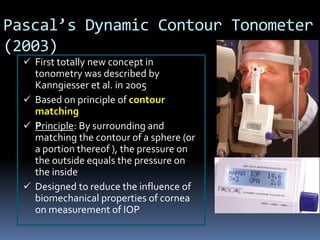
Pascal’s Dynamic Contour Tonometer
(2003)
 First totally new concept in
tonometry was described by
Kanngiesser et al. in 2005
 Based on principle of contour
matching
 Principle: By surrounding and
matching the contour of a sphere (or
a portion thereof ), the pressure on
the outside equals the pressure on
the inside
 Designed to reduce the influence of
biomechanical properties of cornea
on measurement of IOP
 Cup-like plastic device with contour
matched tip
 Concave surface of radius 10.5 mm,
which approx. to the shape of a normal
cornea when pressure on both sides is
equal
 Probe is placed in contact with cornea
with constant force of 1 g
 the integrated piezo-electric pressure
sensor automatically begins to acquire
data
 Measures IOP 100 times per second
 A complete measurement cycle requires
about 8 s of contact time
 The device also measures the variation
in pressure that occurs with cardiac
cycle (Ocular Pulse Amplitude)
 DCT is more accurate than Goldmann tonometry &
pneumotonometer
 Not affected by corneal thickness
 IOP is not altered by corneal refractive surgery that thins
the cornea
 DCT tells us ocular pulse amplitude
 OPA may be indicative of the status of ocular blood flow
(low OPA = low ocular blood flow)
 OPA is increased over normal ( 1.2 – 4 mmHg) in most
forms of glaucoma & may be related to the level of IOP
Diaton
Portable, hand-held device
Measuring IOP through the eyelid
FDA approved in 2006
Working principle: based on
determining the deceleration
of a freely falling rod as it
rebounds against the tarsal
plate of the eyelid through
the sclera
 Pt. is positioned so that the tip of
the device & lid are overlying
sclera
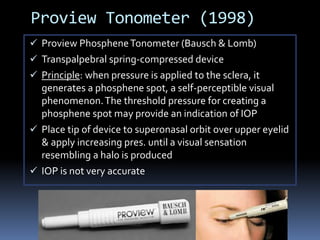
Proview Tonometer (1998)
 Proview PhospheneTonometer (Bausch & Lomb)
 Transpalpebral spring-compressed device
 Principle: when pressure is applied to the sclera, it
generates a phosphene spot, a self-perceptible visual
phenomenon.The threshold pressure for creating a
phosphene spot may provide an indication of IOP
 Place tip of device to superonasal orbit over upper eyelid
& apply increasing pres. until a visual sensation
resembling a halo is produced
 IOP is not very accurate
Triggerfish CLS
 Swiss company Sensimed has introduced
theTriggerfish contact lens sensor (CLS)
 Currently approved in Europe
 Approved by FDA in MARCH 2016
 The device is based on the principle that
small changes in ocular circumference,
measured at the cornea–scleral junction
correspond to changes in IOP & volume
 Underlying assumption is that 1 mmHg in
IOP is equivalent to a 3-μm change in radius
of curvature of cornea
 soft silicone contact lens embedded with a
circumferential sensor consisting of two
platinum–titanium strain gauges that
measure changes in the radius of curvature
of cornea
An embedded microprocessor transmits an
output signal to an adhesive wireless
antenna that is secured externally to
the periocular surface
The wireless antenna recharges the
microprocessor and simultaneously
receives continuous data
The data is transferred by a cable wire to a
portable recorder worn at pt. side,
which allows pt. to be ambulatory.
Each data set consists of 300 data points
acquired during a 30-s interval that occurs
every 5 min (equivalent to 288 data sets in
24 h)
Eyemate
 Consists of -
 Implantable micro sensor
 External hand held device (transfer energy
to the micro sensor)
 A GSM module is connected with the
device for transfer of measurement
data to an internet-based database
 Direct 24-hour IOP monitoring
 Micro sensor is a silicone-encapsulated
intraocular device (diam. 11.2 mm &
thickness 0.9 mm)
 8 pressure-sensitive capacitors & a
circular microcoil antenna
 Implanted into ciliary sulcus during
cataract surgery
Challenging situations in
tonometry
Estimating IOP in children
• Tonopen
• Perkins
Infants
• iCare RBT
• GAT
Toddlers
IOP in unusual corneas
Corneal
edema
Irregular
cornea
Band
keratopathy
High
Astigmatism
Keratoconus
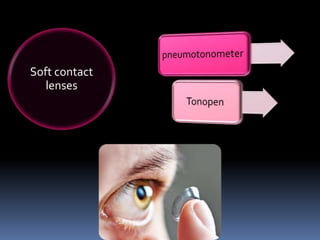
Soft contact
lenses
Penetrating/
Lamellar
Keratoplasty
Post- LASIK /
post- PRK
Gas filled eyes
Flat AC
Keratoprosthesis
24 Hr IOP monitoring
iCare RBT
EyemateTriggerfish
Conclusion
 Elevated IOP has been known to be associated with
glaucoma for over a millenium
 Our ability to determine the exact level of IOP has been
improving over last 150 yr
 All our instruments give us an indirect measure of IOP
 As we have a myriad of tonometers, we have to exercise
our clinical knowledge to choose the one best suited for
the pt.
 Most of the newer devices can measure higher IOPs
accurately but we are often interested in lower IOPs as
well (which is best measured by GAT)
 Despite all the limitations, GAT remains the GOLD
STANDARD for IOP measurement.
Thank You.

TONOMETRY

  • 1.
    Presenter- DaisyVishwakarma 2nd YearPG student Moderator- Dr. A. Deori Asstt. Professor Deptt. of Ophthalmology, AMCH
  • 2.
    Intra Ocular Pressure IOPis the pressure within the eyeball Normal IOP It is that pressure that does not lead to glaucomatous damage of the optic nerve head. Normal mean IOP = 15.5 +/- 2.57 mmHg & 2 SD above mean is 20.5 mmHg Intra Ocular Tension IOT is the pressure exerted by the intraocular contents on the outer coats of eye
  • 3.
    What is Tonometry? Tonometryrefers to the indirect estimation of intraocular pressure by measuring resistance of the eye to indentation by an applied force. What is a Tonometer? It is the device used for estimating the intraocular pressure of the intact eye.
  • 4.
    Role of tonometryin glaucoma diagnosis  Measurement of IOP plays a central role in glaucoma pt.  It is the only known modifiable risk factor that has been shown to delay progression of disease  10% of normal individuals above 40 yr of age have IOP above 21 mmHg  40- 50% cases of open angle glaucoma have IOP less than 21 mmHg  IOP is dynamic & exhibit significant long-term, diurnal & nocturnal fluctuations  Illustrates the importance of taking multiple IOP readings
  • 5.
    Factors influencing tonometry CCTOcular rigidity Corneal curvature Astigmatism For every 10 µ deviation from assumed mean 520 µ of CCT, an avg. error is 0.7 mmHg Increase of approx. 1 mmHg for every 3D of increase in corneal power underestimated for WTR, overestimated forATR, 1 mmHg of error for every 4D astigmatism
  • 6.
    Techniques of MeasuringIOP DIRECT METHOD • Manometry INDIRECT METHOD • Tonometry
  • 7.
    Manometry  Catheter isinserted into AC of eye  Other end is connected to a manometric device  MOST accurate method  NOT feasible in humans (invasive procedure)
  • 8.
  • 9.
    History of Tonometry In1826 William Bowman used digital tonometry as a routine examination test In 1622 Bannister first suggested ‘Digital Palpation’ In 10th Century Jarir Al-Tabari in Arabia first reported visual loss related to a ‘hard or marble-like’ eye
  • 10.
    In 1885 Maklakoff designedapplanation tonometers In 1865 and in 1880 Donders & Preistly-Smith invented indentation tonometers that rested on sclera In 1863 AlbrechtVon Graefe invented the first indentation tonometer, over eyelid
  • 11.
    In 1959 Invented Mackay-MargTonometer In1954 Professor Goldmann invented applanation tonometer In 1897 Schiøtz developed an impression tonometer for the Sclera, later updated to corneal plunger device in 1905
  • 12.
    In 1987 TonoPenTonometer In 1972 Grolmanintroduced the Air blast Non ContactTonometer (NCT) In 1969 Pneumatonometer
  • 13.
    In 2000 iCareTonometer In 1998 ProviewTonometer In1986 Keeler introduced the Pulsair NCT
  • 14.
    In 2006 Reichert OcularResponse Analyser In 2003 Pascal Dynamic contour tonometer
  • 15.
    Digital Tonometry  Responseof eyeball to pressure applied by pulp of finger  METHOD: rest both hands on patient’s forehead & alternately apply just enough pressure on the globe (above the superior tarsal plate) to indent it slightly with 1 index finger while feeling the compliance with the other  Indents easily/ firm to touch  NOT accurate (subjective)
  • 16.
    Advantages • Easiest toperform • No equipments • No anaesthesia • No stain • Estimation of IOP with irregular corneas, where applanation tonometry is not possible. Disadvantages • Reading inaccurate • Subjective • Over-estimation or under-estimation of IOP
  • 17.
  • 18.
    An Ideal Tonometer Shouldgive accurate and reasonable IOP measurement Convenient to use Simple to calibrate Stable from day to day Easier to standardize Free of maintenance problems
  • 19.
    Indentation Tonometer Impression tonometermeasures the depth of indentation of the cornea produced by a known weight. Prototype - SchiötzTonometer
  • 20.
    Schiøtz Tonometer (1905) HjalmarAugust Schiøtz (1850 – 1927)  First Norwegian Professor of Ophthalmology  First tonometers were applied to sclera  First reasonably accurate trans- corneal indentation tonometer in 1905  Refined design over next 25 years
  • 21.
     Handle: tohold the instrument in vertical position on the cornea  Foot plate: rests on the cornea  Plunger: moves freely within a shaft in the foot plate  Bent lever: short arm rests on the upper end of the plunger and a long arm which acts as a pointer needle The degree to which the plunger indents the cornea is indicated by the movement of this needle on a scale  Weights: 5.5 g weight is permanently fixed to the plunger ,which can be increased to 7.5 and 10gm. Parts of SchiötzTonometer :
  • 22.
    Indentation of cornea: Base plate of tonometer rests on cornea. Plunger of tonometer indents the cornea
  • 23.
     The weightof tonometer on the eye increases the actual IOP (Po) to a higher level (Pt)  The change in pressure from Po to Pt is an expression of the resistance of the eye (scleral rigidity) to the displacement of fluid  IOP withTonometer in position Pt = Actual IOP Po + Scleral Rigidity E  Because the tonometer actually measures Pt , it is necessary to estimate Po for each scale reading & weight. Principle : P(t) = P(o) + E
  • 24.
     In 1940s,Friedenwald gave a mathematical formula  Formula has a single numerical constant - the coefficient of ocular rigidity (K), which is roughly an expression of the distensibility of the eye  Average value is 0.025  He developed a nomogram for estimating K on the basis of two tonometric readings with different weights Log Pt2 / Pt1 = K (V2 –V1 ) Friedenwald’s formula :  Pt1 & V1 represent the tonometric pressure & volume of the indentation caused by the bar in the determination made with the first weight  Pt2 and V2 represent the respective values as obtained with the second weight
  • 25.
     On thebasis of his formula, Friedenwald developed a set of conversion tables for IOP The indicated scale reading and the plunger weight are converted to an IOP measurement  More the plunger indents the cornea, higher the scale reading and lower the IOP  Each scale unit represents 0.05 mm protrusion of the plunger
  • 26.
     Patient shouldbe anasthetised with 4% lignocaine  In supine position  fixation target just overhead  examiner separates the lids  Lower tonometer plate to rest on cornea  plunger is free to move vertically  Scale reading is measured  5.5 gm weight is initially used  If scale reading is 4 or less - additional weight is added to plunger  IOP measurement is repeated until 3 consecutive readings agree within 0.5 scale units  Conversion table is used to derive IOP in mmHg from scale reading and plunger weight. Procedure :
  • 27.
     Measure ofdistensibility or resistance to deformation of ocular coats  Important in indentation tonometer Ocular Rigidity: Increase in ocular rigidity OVER-ESTIMATION • Long standing glaucoma • ARMD • High Hyperopia • Vasoconstrictors Decrease in ocular rigidity UNDER-ESTIMATION • Increasing age • Strong miotic therapy • Vasodilator therapy • Post-op after RD surgery (Vitrectomy, cryopexy, scleral band) • High myopia • Compressible gas
  • 28.
     Technique fordetermining K  A reading is taken with one weight on the Plunger  a second reading is taken with a different weight  Eg. Glaucoma in a pt. with myopia DifferentialTonometry: 5.5 g 10 g Ocular rigidity IOP 18 mmHg 15 mmHg Lower > 18 mmHg 18 mmHg 21 mmHg Higher < 18 mmHg 18 mmHg 18 mmHg Equal 18 mmHg
  • 29.
     A calibrationcheck - at the start of every day  Place the footplate of the instrument on the rounded test block (the dummy cornea)  Footplate resting on the test block, a correctly calibrated instrument - scale reading of zero.  If not - calibrate it to zero Left of zero - rotate the footplate in a clockwise direction Right of zero - rotate the footplate in an anti-clockwise direction Calibration :
  • 30.
     The tonometeris disassembled between each use - barrel is cleaned with 2 pipe cleaners  the first soaked in isopropyl alcohol 70% or methylated spirit &  the second dry  Foot plate is cleaned with alcohol swab  All surfaces must be dried before reassembling  Instrument can be sterilized with UV radiation, steam, ethylene oxide  In between patients, the tonometer should be disinfected by soaking it in sodium hypochlorite  As with other tonometer tips, Schiotz can be damaged by some disinfecting solutions such as hydrogen peroxide & bleach. Sterilization :
  • 31.
    Advantages • Portable • Sturdy •Relatively inexpensive • Easy to operate • Easy to clean & maintain • Do not require Slit lamp / power supply Disadvantages • Falsely high/low IOP - Ocular rigidity • Cannot be used in traumatic cases/early post- op cases/ corneal pathologies Limitations • Instrumental errors • Muscular contractions of • EOM - IOP • accomodation - IOP • Variations in globe volume- • Microphthalmia • High myopia • Buphthalmos • Thickness & curvature of cornea
  • 32.
    APPLANATION TONOMETERS Non-contact Grolman NCT Ocular responseanalyzer Contact Fixed area variable force Goldmann Perkins Fixed force variable area Maklakoff
  • 33.
    ApplanationIndentation  Shape ofdeformation- TRUNCATED CONE  Precise shape- variable & unpredictable  Displace large intraocular volume  Conversion tables based on empirical data used  Prototype- Schiøtz tonometer  Shape of deformation- FLATTENING  Precise shape- constant  Displace small intraocular volume  Mathematical calculations for IOP  Differentiated on the basis of variable measured
  • 34.
    Goldmann Applanation Tonometer(1954)  Goldmann based his concept of tonometry on the Modified Imbert- Fick Law  When A1 = 7.35 mm2 S balances B & W equals P  this internal area of applanation is obtained when diam. of external area of applanation is 3.06 mm  Volume of displacement produced by applanating this area is approx. 0.50 mm3  so P is very close to actual IOP & ocular rigidity does not significantly influence measurements Hans Goldmann (1899-1991) W + S = PA1 + B
  • 35.
    Imbert – FickPrinciple (1885) The pressure (P) of a body of fluid encapsulated within a sphere is directly proportional to the force (W) required to applanate an area (A) of the sphere: W= PA
  • 36.
     Infinitely thin perfectly elastic  perfectly dry  Perfectly flexible The only force being exerted upon it is the force from the applanating surface The assumptions – the surface encapsulating the sphere : Cornea :  finite thickness ( CCT = 0.55 mm)  measurable corneal rigidity (push effect)  capillary attraction force of the pre-corneal tear film (pull effect)
  • 37.
    Modified Imbert-Fick’s Law W= tonometer force s = surface tension of pre-corneal tear film P = intra-ocular pressure A1 = inner corneal area of applanation b = corneal rigidity W + S = PA1 + B
  • 38.
    When A1 =7.35 mm2, S balances B andW = P This internal area of applanation is achieved when the diameter of the external area of corneal applanation is around 3.06 mm.  Grams of force applied to flatten 3.06 mm diameter of the cornea multiplied by 10 is directly converted to IOP in mmHg.
  • 39.
    Parts of GoldmannTonometer: Control weight insert Connects to the slit lamp Biprism (measuring prism) Feeler arm Housing Revolving knob & measuring drum
  • 40.
    Biprism Probe: The twobeam-splitting prism within the applanating unit optically convert the circular area of corneal contact into 2 semicircles
  • 41.
    Procedure : Instrument ismounted on Slit lamp Examiners view is directed through the centre of Biprism Biprism is attached by a rod to a housing Housing contains a coil spring & series of levers that are used to adjust the force of biprism against the cornea Two beam-splitting prisms within probe optically convert circular area of corneal contact into 2 semicircles
  • 42.
     Angle betweenthe illumination & microscope should be approx. 60°  Magnification 10X  Maximum illumination  Maximum beam height  Room illumination is reduced  A fixation light may be placed in front of the fellow eye  The tension knob is set at 1 g  Pt. asked to look up but not more than 15° above horizontal  Instill topical anaesthesia  Edge of corneal contact is made apparent by instilling fluorescein dye  View in cobalt blue light  The biprism should not touch the lids or lashes because this stimulates blinking & squeezing
  • 43.
    Pt. should blinkthe eyes once or twice to spread the fluorescein-stained tear film over the cornea Then keep eyes open wide Should not apply any pressure on the globe because this raises IOP In some patients, hold eyelids open with thumb & index finger of one hand against the orbital rim By manually rotating a dial calibrated in grams, the force is adjusted by changing the length of a spring within the device The prisms are calibrated in such a fashion that inner margin of semicircles touch when 3.06 mm of the cornea is applanated The IOP is then read directly from a scale on the tonometer housing
  • 44.
    The fluorescein ringsshould be approx. 0.25–0.3 mm in thickness – or about 1/10th diameter of the flattened area The fluorescent semicircles are viewed through the biprism and the force against the cornea is adjusted until the inner edges overlap.
  • 45.
    Thin cornea Thick cornea Astigmatism> 3D Irregular cornea Inadequate fluorescein Too much fluorescein Tonometer out of calibration Repeated tonometry Elevating eyes > 15° Pressing on the eyelids or globe Squeezing of the eyelids Observer bias (expectations and even Numbers) Potential errors :
  • 46.
    Falsely low IOP •Inadequate flourescein • thin cornea • corneal edema • with the rule astigmatism (1mm Hg per 4 D) • prolonged contact • Repeated tonometry Falsely high IOP • Excess flourescein • thick cornea • steep cornea • against the rule astigmatism (1mm Hg per 3D) • wider meniscus • Widening the lid fissure excessively • Elevating the eyes more than 15°
  • 47.
     Thinner cornearequire less force to applanate it – underestimation of true IOP  Thicker cornea need more force to applanate it – artificially higher IOP  GAT was designed to give accurate readings when the CCT was 520 μm  Deviation of CCT from 520 μm – change in applanation readings of 0.71 mmHg per 10 μm Effect of CCT :
  • 48.
    Less than 3.00D of astigmatism Position the probe so that the patient’s minus cylinder axis is aligned with the WHITE LINE on the prism holder. Astigmatism :
  • 49.
    Greater than 3.00D of astigmatism Position the probe so that the patient’s minus cylinder axis is aligned with the RED LINE on the prism holder.
  • 50.
  • 54.
     GAT shouldbe calibrated periodically (at least once a month)  If it is not within 0.1 g (1 mmHg) of the correct calibration, the instrument should be repaired  Calibration errors of up to 2.5 mmHg may still be tolerated clinically Calibration :
  • 55.
    Attach the calibrationbar to the body of the tonometer The bar has five markings The central one is used to check if the tonometer has been calibrated accurately for 0 mmHg The next markings on either side of the centre are used to check for accurate calibration for 20 mmHg The last markings nearest to the end are used to check for 60 mmHg
  • 56.
    To check iftonometer has been calibrated for 60 mmHg, line up the 6 marking on the bar with the marking on the knob that hold up the bar Now move the knob on tonometer & note pressure at which tonometer tip tilt forward If the tilt occurs when the pressure is at 60 the tonometer is calibrated correctly If the tilt occurs below or above 60, the tonometer should be sent for recalibration End Point
  • 57.
     Applanation tipshould be soaked for 5- 15 min in diluted sodium hypochlorite, 3% H2O2 or 70% isopropyl alcohol or  By wiping with alcohol, H2O2,povidone iodine or 1: 1000 merthiolate.  Other methods of sterilization include:  10 min of rinsing in running tap water  wash with soap & water  cover the tip with a disposable film  exposure to UV light.  Disposable tonometer tips may also be used Sterilization:
  • 58.
    Perkins Tonometer (1965) Developed by ES Perkins  Hand-held applanation tonometer  Uses same prism tips as GAT  The prism is illuminated by battery powered bulbs  Advantages Over GAT:  Portable & counter-balanced, so it can be used in any position of pt.  Infants/ children  in the O.T.  at the bedside for non-ambulatory pt., who cannot be examined at the slit lamp.
  • 59.
    Draeger Tonometer (1965) Hand-heldapplanation tonometer Similar to the Goldmann & Perkins tonometers Except : Uses a different biprism tip Force for applanation is supplied by an electric motor Portable & counterbalanced (used in any position of pt.)
  • 60.
    Mackay Marg Tonometer(1959) Parts Plunger (1.5 mm diam.) rigid spring rubber sleeve ( 3 mm diam.) Rigid spring extends 10 µ beyond plane of surrounding rubber sleeve Movement of plunger is electronically monitored by a transducer & recorded on a moving paper strip Useful in eyes with scarred, irregular, or edematous corneas because the end point does not depend on the evaluation of a light reflex sensitive to optical irregularity, as does the Goldmann tonometer
  • 61.
    It is accuratewhen used over therapeutic soft contact lenses At 1.5 mm of corneal area applanation, tracing reaches a peak the force applied = IOP + force required to deform the cornea At 3 mm flattening, force required to deform cornea is transferred from plunger to surrounding sleeve, creating a dip in tracing corresponding to IOP Flattening of >3 mm of area gives artificial elevation of IOP.
  • 62.
    Pneumotonometer (1969) First developedby Durham et al. Refined by Langham & McCarthy in 1969 Contact applanation tonometer 4 Components 1) Sensor 2) Transducer (pneumatic to electrical) 3) Combined amplifier & recorder 4) Air supply unit (supply compressed air to probe) Readout can be digital or on graph paper
  • 63.
    A plunger witha slightly convex 5 mm diam. tip made of silicone rides on a piston of filtered air ( close to frictionless) NO inherent force transmitted to eye by the tonometer Cornea is indented slightly by the flat tip When both tip & cornea are flat, the pressure pushing tip forward equals IOP Tip is held against the eye for 5 to 10 s measuring fluctuations in IOP with cardiac cycle Pneumatonometer maybe more accurate than GAT but less accurate than McKay Marg tonometers in scarred corneas
  • 64.
    Grolman Non-Contact Tonometer(1972) Introducedby Grolman in 1972 Original NCT has 3 subsystems: 1. Alignment system: It aligns patient’s eye in 3 dimensions (axial/vertical/lateral) 2. Optoelectronic applanation monitoring system: Comprises transmitter, receiver and detector & timer a. Transmitter directs a collimated beam of light at corneal apex b. Receiver & detector accept only parallel coaxial rays of light reflected from cornea c. Timer measures from an internal reference to the point of peak light intensity 3. Pneumatic system: It generates a puff of room air directed against cornea
  • 65.
     A puffof room air (air jet) creates a constant force that momentarily flattens the cornea  The force of air jet (generated by a solenoid-activated piston) increases linearly over time  When the reflected light is at peak intensity, the cornea is presumed to be flattened  The time elapsed is directly related to the force of jet necessary to flatten the cornea & correspondingly to IOP  The time from an internal reference point to the moment of flattening is measured & converted to IOP
  • 66.
     A puffof air of known area is generated against cornea (B)  At the moment of corneal applanation, a light (T), which is usually reflected from the normal cornea into space, suddenly is reflected (R) into an optical sensor (A)  When the sensor is activated by the reflected light, the air generator is switched off  The level of force at which the generator stops is recorded & a computer calculates & displays the IOP
  • 67.
    ADVANTAGES • Screening procedure •Can be operated by non-medical personnel • No anesthesia required • No contamination • No chance of corneal abrasion LIMITATIONS • IOP is near normal, accuracy decreases with increase in IOP & in eyes with abnormal cornea/poor fixation • sub-epithelial air bubbles after repeated use of NCT (rare)
  • 68.
    Pulsair Tonometer(1986) New NonContactTonometer Keeler Pulsair Intellipuff is a portable hand-held tonometer Launched in European market in April 2007 Based on the same principle as the Grolman NCT
  • 69.
    TonoPen  The mostcommonly used Mackay-Marg type tonometer today is the Tono-Pen  FDA approved in March 2006  Portable handheld instrument with a strain gauge that creates an electrical signal as the footplate flattens the cornea  Micro-strain gauge technology  Computerised battery-operated pocket tonometer  Instrument is 18 cm in length and weighs 60 g  Converts IOP into electric waves  Wave form is internally analyzed by a microprocessor  Average of 3 to 6 readings of IOP
  • 70.
     As thearea of applanation of theTonopen is smaller than GAT (2.36mm2 Vs 7.35mm2) therefore, theoretically the difference between applanating pressure & IOP is reduced due to reduced corneal resistance of a smaller contact area  It is particularly useful in community eye camps, on ward rounds ,children, irregular surfaces, measuring through an amniotic membrane patch graft, to read from the sclera  A disposable latex cover which is discarded after each use provides infection control
  • 71.
    Reichert’s Ocular ResponseAnalyzer (2005)  Type of NCT  FDA approval in 2004  Analyses corneal biomechanical properties rapidly  25 ms air pulse applies pressure & causes cornea to move inward, past applanation & into a slight concavity before returning to normal curvature  Electro- optical IR detection system
  • 72.
    Using 1st applanationpressure pt. (P1) & 2nd applanation pt. (P2) ORA generates 2 separate IOP output parameters 1) IOPg Goldmann-correlated IOP Avg. of inward P1 & outward P2 applanation pressures 2) IOPcc Corneal-compensated IOP Derived from both IOP & corneal biomechanical data 2 additional parameters : 1) Corneal hysteresis (CH) CH = P1 – P2. It is thought to represent visco-elastic nature of cornea 2) Corneal Resistance Factor (CRF) CRF = P1 – kP2 ( k = constant determined from empirical analysis relationship b/w P1, P2 & CCT ) CRF is measurement of corneal resistance
  • 73.
    Rebound Tonometer New versionof indentation tonometer Hand-held & portable Consists of an assembly of two coaxial coils which impel a magnetized probe towards the cornea Detect the deceleration of the probe as a result of corneal contact This deceleration speed is related to IOP Time taken for the probe to return to its resting position is longer in eyes with lower IOP & faster in eyes with higher IOP The probe tip used is disposable A plastic cover in the tip reduces the risk of corneal injury Takes 6 readings & gives digital readout of avg. IOP
  • 74.
    Advantages • Portable • Batterypowered • No anaesthesia • Least contact time • Easy to use • Performed by non- medical trained personnel • Young children, non- cooperative adults, blepharospasms • No sterilization Disadvantages • Influenced by corneal thickness • Not very accurate • Used in upright position (pin falls out if instrument faces downward) • Costly
  • 75.
    iCare Tonometer (2000) Newest version of rebound tonometer  FDA approved in May 2007  A 1.8mm diam. plastic ball on a stainless steel wire is held in place by an electromagnetic field  Handheld battery-powered device  The speed of deceleration is measured & converted into IOP  No anaesthetics  Same limitations as RBT  Used as a home tonometer
  • 76.
    Pascal’s Dynamic ContourTonometer (2003)  First totally new concept in tonometry was described by Kanngiesser et al. in 2005  Based on principle of contour matching  Principle: By surrounding and matching the contour of a sphere (or a portion thereof ), the pressure on the outside equals the pressure on the inside  Designed to reduce the influence of biomechanical properties of cornea on measurement of IOP
  • 78.
     Cup-like plasticdevice with contour matched tip  Concave surface of radius 10.5 mm, which approx. to the shape of a normal cornea when pressure on both sides is equal  Probe is placed in contact with cornea with constant force of 1 g  the integrated piezo-electric pressure sensor automatically begins to acquire data  Measures IOP 100 times per second  A complete measurement cycle requires about 8 s of contact time  The device also measures the variation in pressure that occurs with cardiac cycle (Ocular Pulse Amplitude)
  • 79.
     DCT ismore accurate than Goldmann tonometry & pneumotonometer  Not affected by corneal thickness  IOP is not altered by corneal refractive surgery that thins the cornea  DCT tells us ocular pulse amplitude  OPA may be indicative of the status of ocular blood flow (low OPA = low ocular blood flow)  OPA is increased over normal ( 1.2 – 4 mmHg) in most forms of glaucoma & may be related to the level of IOP
  • 80.
    Diaton Portable, hand-held device MeasuringIOP through the eyelid FDA approved in 2006 Working principle: based on determining the deceleration of a freely falling rod as it rebounds against the tarsal plate of the eyelid through the sclera  Pt. is positioned so that the tip of the device & lid are overlying sclera
  • 81.
    Proview Tonometer (1998) Proview PhospheneTonometer (Bausch & Lomb)  Transpalpebral spring-compressed device  Principle: when pressure is applied to the sclera, it generates a phosphene spot, a self-perceptible visual phenomenon.The threshold pressure for creating a phosphene spot may provide an indication of IOP  Place tip of device to superonasal orbit over upper eyelid & apply increasing pres. until a visual sensation resembling a halo is produced  IOP is not very accurate
  • 82.
    Triggerfish CLS  Swisscompany Sensimed has introduced theTriggerfish contact lens sensor (CLS)  Currently approved in Europe  Approved by FDA in MARCH 2016  The device is based on the principle that small changes in ocular circumference, measured at the cornea–scleral junction correspond to changes in IOP & volume  Underlying assumption is that 1 mmHg in IOP is equivalent to a 3-μm change in radius of curvature of cornea  soft silicone contact lens embedded with a circumferential sensor consisting of two platinum–titanium strain gauges that measure changes in the radius of curvature of cornea
  • 83.
    An embedded microprocessortransmits an output signal to an adhesive wireless antenna that is secured externally to the periocular surface The wireless antenna recharges the microprocessor and simultaneously receives continuous data The data is transferred by a cable wire to a portable recorder worn at pt. side, which allows pt. to be ambulatory. Each data set consists of 300 data points acquired during a 30-s interval that occurs every 5 min (equivalent to 288 data sets in 24 h)
  • 84.
    Eyemate  Consists of-  Implantable micro sensor  External hand held device (transfer energy to the micro sensor)  A GSM module is connected with the device for transfer of measurement data to an internet-based database  Direct 24-hour IOP monitoring  Micro sensor is a silicone-encapsulated intraocular device (diam. 11.2 mm & thickness 0.9 mm)  8 pressure-sensitive capacitors & a circular microcoil antenna  Implanted into ciliary sulcus during cataract surgery
  • 85.
  • 86.
    Estimating IOP inchildren • Tonopen • Perkins Infants • iCare RBT • GAT Toddlers
  • 87.
    IOP in unusualcorneas Corneal edema
  • 88.
  • 89.
  • 90.
  • 91.
  • 92.
  • 93.
  • 94.
  • 95.
  • 96.
  • 97.
  • 98.
    24 Hr IOPmonitoring iCare RBT EyemateTriggerfish
  • 99.
    Conclusion  Elevated IOPhas been known to be associated with glaucoma for over a millenium  Our ability to determine the exact level of IOP has been improving over last 150 yr  All our instruments give us an indirect measure of IOP  As we have a myriad of tonometers, we have to exercise our clinical knowledge to choose the one best suited for the pt.  Most of the newer devices can measure higher IOPs accurately but we are often interested in lower IOPs as well (which is best measured by GAT)  Despite all the limitations, GAT remains the GOLD STANDARD for IOP measurement.
  • 100.