Business Marketing Management –
Case Analysis
International Trade Biggest Market
of the world
Submitted by -
•Ankit Sha
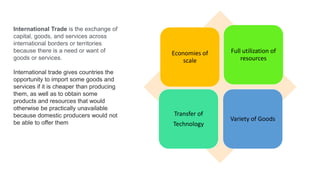
International Trade is the exchange of
capital, goods, and services across
international borders or territories
because there is a need or want of
goods or services.
International trade gives countries the
opportunity to import some goods and
services if it is cheaper than producing
them, as well as to obtain some
products and resources that would
otherwise be practically unavailable
because domestic producers would not
be able to offer them
Economies of
scale
Full utilization of
resources
Transfer of
Technology
Variety of Goods
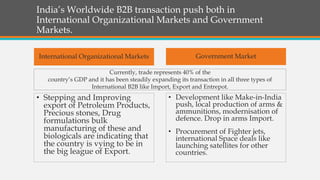
India’s Worldwide B2B transaction push both in
International Organizational Markets and Government
Markets.
International Organizational Markets
• Stepping and Improving
export of Petroleum Products,
Precious stones, Drug
formulations bulk
manufacturing of these and
biologicals are indicating that
the country is vying to be in
the big league of Export.
Government Market
• Development like Make-in-India
push, local production of arms &
ammunitions, modernisation of
defence. Drop in arms Import.
• Procurement of Fighter jets,
international Space deals like
launching satellites for other
countries.
Currently, trade represents 40% of the
country’s GDP and it has been steadily expanding its transaction in all three types of
International B2B like Import, Export and Entrepot.
The importance of International Business Centers for Macro and Micro environmental scan
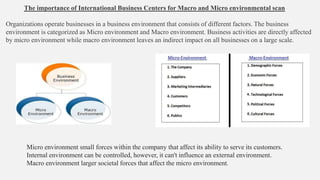
Organizations operate businesses in a business environment that consists of different factors. The business
environment is categorized as Micro environment and Macro environment. Business activities are directly affected
by micro environment while macro environment leaves an indirect impact on all businesses on a large scale.
Micro environment small forces within the company that affect its ability to serve its customers.
Internal environment can be controlled, however, it can't influence an external environment.
Macro environment larger societal forces that affect the micro environment.
The importance of International Business Centers for
Macro and Micro environmental strategy
• Globalization continues to influence world economies, as reduced tariffs, enhanced communications, and increased capital
mobility have allowed companies to connect to global financial markets and expand their businesses internationally.
However, successful expansion into new foreign markets demands that companies adopt international business strategies
that best fit their needs and capabilities.
• It is a strategy through which the firm sells its goods or services outside its domestic market. International markets yield
plenty of new opportunities for our business to grow. With an internationalization strategy our business could see:
 Increase in market size and emergence of new markets
 Greater ROI
 Competitive advantage by location
 Global brand recognition
 Global customer satisfaction
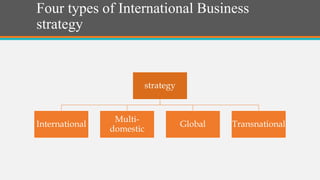
Four types of International Business
strategy
strategy
International
Multi-
domestic
Global Transnational
Continue..
• International :- Using an international strategy means focusing on exporting products and services to foreign markets, or conversely, importing goods and
resources from other countries for domestic use. For Ex- wine
Key Features –
 Business objectives and competitive advantage relate primarily to the home market
 Products are produced in the company’s home country then sent to customers all over the world
 Often referred to as an exporting strategy
• Multi-domestic :- The multi-domestic business strategy invests in establishing a presence in a foreign market and tailoring its products to the local
market. Companies adapt their products and offerings and reposition their marketing strategies to engage with a foreign audience. This includes taking into account
foreign customs, traditions, and cultural traits. For Ex- Nestle.
Key Features –
 Focus on establishing a presence and tailoring products to suit new markets
 Competitive advantage determined separately for each country
 Multi-domestic strategies are largely used by food and beverage companies.
Continue..
• Global :- When companies adopt a global business strategy they treat the world as one market and leverage economies of scale to boost reach and revenue. Global companies have little local variation, as products and
services are homogenized to reduce costs while reaching as many people as possible. Usually, these companies have a central office or headquarters in their country of origin, while also establishing operations in
foreign markets. For Ex- fast food companies like McDonald’s or Burger King might have to alter, add, or remove certain menus from their menus to suit the needs of local markets. Pharmaceutical companies are a
great example of a global strategy in use.
Key Features –
 An integrated approach across different countries
 Homogenized products to minimize costs and reach a broad audience
 Small adjustments needed to break into international markets
 Transnational :- The transnational business strategy combines elements of global and multi-domestic strategies. This means that the business is still operating from its headquarters in its country of origin, however, it
also allows the company to expand with full-scale operations in foreign markets. For Ex – Coca-Cola.
The challenges of the transnational strategy include identifying effective management tactics and large investment costs.
Key Features –
 Combination of global and multi-domestic strategies
 Allows the establishment of full-scale operations in foreign markets
 Companies have separate marketing, research, and development departments to respond to local customers
 Product or service is the same for different markets
Global Information System
• Simply put, a global information system (GIS) is a tool that collects
and shares data on a global scale.
• When it comes to market research, a GIS can collect demographic
info and consumer practices on a specific population.
• For example, data collected on families living in mountainous
regions in Eastern Europe may assist a Japanese company in
developing a better automobile that can travel through rough
terrain.
• With some tweaks, not only can this automobile be sold to those
European families, but also to populations in South America as
well.
The marketing information
system process
• Determine what metrics to include in your marketing information system.
This is a very serious step in creating an effective marketing information
system.
• Gather relevant data.
• Plot data.
• Communicate results.
• Make marketing decisions.
• 10 Principles to Consider When Marketing Your Brand Internationally
• Well, you can start by making sure that you effectively dive into the
following 10 pillars of international marketing and integrate them into
your global marketing strategy.
• You may recognize 7 of them, which are derived from the 7 Ps of
marketing.
• First up, what your brand and marketing should revolve around — the
people!
• People - Understanding Customer Behavior in a Different
World
• The people you are marketing to and the product that you are
marketing go hand in hand. However, we’re leading off with
the people because if you don’t first and foremost understand
who you are marketing to, you may end up trying to sell them
a product they don’t want and probably will never buy.
• get more into how important the ‘place’ is in which you sell
your product internationally in a bit.
• So, when it comes to taking a product or service abroad, you
first have to see if there is even a market for your offering.
• Product - Altering to Fit the Needs of Your New Market
• If you notice that the current offering of your product now
won’t play in the new market you want to enter then you can
do one of two things:
• A.) Decide not to sell in that market
• B.) Change your offering to meet the local demand
• Overall, this decision is an excellent one to learn from for
those looking to branch out to foreign markets.
CONCLUSION
• In conclusion it can be said that, international trade leads to
economic growth provided the policy measures & economic
infrastructure are accommodative enough to cope with the changes
in social and financial scenario that result from it.
• In order to face the cross border competition challenges, a vell
functioning, national competition regime is insufficient.
• International trade opens up the opportunity for develop countries
whereby it increases their capacity to produce and acquire goods. It
should however be controlled so as to avoid the closure of some
local companies.
International trade

International trade

  • 1.
    Business Marketing Management– Case Analysis International Trade Biggest Market of the world Submitted by - •Ankit Sha
  • 2.
    International Trade isthe exchange of capital, goods, and services across international borders or territories because there is a need or want of goods or services. International trade gives countries the opportunity to import some goods and services if it is cheaper than producing them, as well as to obtain some products and resources that would otherwise be practically unavailable because domestic producers would not be able to offer them Economies of scale Full utilization of resources Transfer of Technology Variety of Goods
  • 3.
    India’s Worldwide B2Btransaction push both in International Organizational Markets and Government Markets. International Organizational Markets • Stepping and Improving export of Petroleum Products, Precious stones, Drug formulations bulk manufacturing of these and biologicals are indicating that the country is vying to be in the big league of Export. Government Market • Development like Make-in-India push, local production of arms & ammunitions, modernisation of defence. Drop in arms Import. • Procurement of Fighter jets, international Space deals like launching satellites for other countries. Currently, trade represents 40% of the country’s GDP and it has been steadily expanding its transaction in all three types of International B2B like Import, Export and Entrepot.
  • 4.
    The importance ofInternational Business Centers for Macro and Micro environmental scan Organizations operate businesses in a business environment that consists of different factors. The business environment is categorized as Micro environment and Macro environment. Business activities are directly affected by micro environment while macro environment leaves an indirect impact on all businesses on a large scale. Micro environment small forces within the company that affect its ability to serve its customers. Internal environment can be controlled, however, it can't influence an external environment. Macro environment larger societal forces that affect the micro environment.
  • 5.
    The importance ofInternational Business Centers for Macro and Micro environmental strategy • Globalization continues to influence world economies, as reduced tariffs, enhanced communications, and increased capital mobility have allowed companies to connect to global financial markets and expand their businesses internationally. However, successful expansion into new foreign markets demands that companies adopt international business strategies that best fit their needs and capabilities. • It is a strategy through which the firm sells its goods or services outside its domestic market. International markets yield plenty of new opportunities for our business to grow. With an internationalization strategy our business could see:  Increase in market size and emergence of new markets  Greater ROI  Competitive advantage by location  Global brand recognition  Global customer satisfaction
  • 6.
    Four types ofInternational Business strategy strategy International Multi- domestic Global Transnational
  • 7.
    Continue.. • International :-Using an international strategy means focusing on exporting products and services to foreign markets, or conversely, importing goods and resources from other countries for domestic use. For Ex- wine Key Features –  Business objectives and competitive advantage relate primarily to the home market  Products are produced in the company’s home country then sent to customers all over the world  Often referred to as an exporting strategy • Multi-domestic :- The multi-domestic business strategy invests in establishing a presence in a foreign market and tailoring its products to the local market. Companies adapt their products and offerings and reposition their marketing strategies to engage with a foreign audience. This includes taking into account foreign customs, traditions, and cultural traits. For Ex- Nestle. Key Features –  Focus on establishing a presence and tailoring products to suit new markets  Competitive advantage determined separately for each country  Multi-domestic strategies are largely used by food and beverage companies.
  • 8.
    Continue.. • Global :-When companies adopt a global business strategy they treat the world as one market and leverage economies of scale to boost reach and revenue. Global companies have little local variation, as products and services are homogenized to reduce costs while reaching as many people as possible. Usually, these companies have a central office or headquarters in their country of origin, while also establishing operations in foreign markets. For Ex- fast food companies like McDonald’s or Burger King might have to alter, add, or remove certain menus from their menus to suit the needs of local markets. Pharmaceutical companies are a great example of a global strategy in use. Key Features –  An integrated approach across different countries  Homogenized products to minimize costs and reach a broad audience  Small adjustments needed to break into international markets  Transnational :- The transnational business strategy combines elements of global and multi-domestic strategies. This means that the business is still operating from its headquarters in its country of origin, however, it also allows the company to expand with full-scale operations in foreign markets. For Ex – Coca-Cola. The challenges of the transnational strategy include identifying effective management tactics and large investment costs. Key Features –  Combination of global and multi-domestic strategies  Allows the establishment of full-scale operations in foreign markets  Companies have separate marketing, research, and development departments to respond to local customers  Product or service is the same for different markets
  • 9.
    Global Information System •Simply put, a global information system (GIS) is a tool that collects and shares data on a global scale. • When it comes to market research, a GIS can collect demographic info and consumer practices on a specific population. • For example, data collected on families living in mountainous regions in Eastern Europe may assist a Japanese company in developing a better automobile that can travel through rough terrain. • With some tweaks, not only can this automobile be sold to those European families, but also to populations in South America as well.
  • 10.
    The marketing information systemprocess • Determine what metrics to include in your marketing information system. This is a very serious step in creating an effective marketing information system. • Gather relevant data. • Plot data. • Communicate results. • Make marketing decisions.
  • 11.
    • 10 Principlesto Consider When Marketing Your Brand Internationally • Well, you can start by making sure that you effectively dive into the following 10 pillars of international marketing and integrate them into your global marketing strategy. • You may recognize 7 of them, which are derived from the 7 Ps of marketing. • First up, what your brand and marketing should revolve around — the people!
  • 12.
    • People -Understanding Customer Behavior in a Different World • The people you are marketing to and the product that you are marketing go hand in hand. However, we’re leading off with the people because if you don’t first and foremost understand who you are marketing to, you may end up trying to sell them a product they don’t want and probably will never buy. • get more into how important the ‘place’ is in which you sell your product internationally in a bit. • So, when it comes to taking a product or service abroad, you first have to see if there is even a market for your offering.
  • 13.
    • Product -Altering to Fit the Needs of Your New Market • If you notice that the current offering of your product now won’t play in the new market you want to enter then you can do one of two things: • A.) Decide not to sell in that market • B.) Change your offering to meet the local demand • Overall, this decision is an excellent one to learn from for those looking to branch out to foreign markets.
  • 14.
    CONCLUSION • In conclusionit can be said that, international trade leads to economic growth provided the policy measures & economic infrastructure are accommodative enough to cope with the changes in social and financial scenario that result from it. • In order to face the cross border competition challenges, a vell functioning, national competition regime is insufficient. • International trade opens up the opportunity for develop countries whereby it increases their capacity to produce and acquire goods. It should however be controlled so as to avoid the closure of some local companies.