Global
Marketing
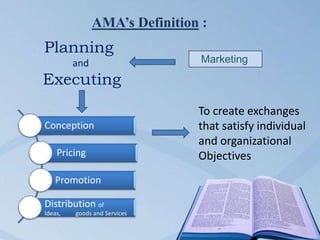
AMA’s Definition :
Conception
Pricing
Promotion
Distribution of
Ideas, goods and Services
Marketing
Planning
and
Executing
To create exchanges
that satisfy individual
and organizational
Objectives
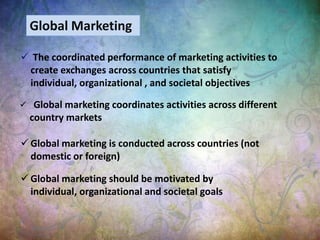
 The coordinated performance of marketing activities to
create exchanges across countries that satisfy
individual, organizational , and societal objectives
 Global marketing is conducted across countries (not
domestic or foreign)
 Global marketing coordinates activities across different
country markets
 Global marketing should be motivated by
individual, organizational and societal goals
Global Marketing
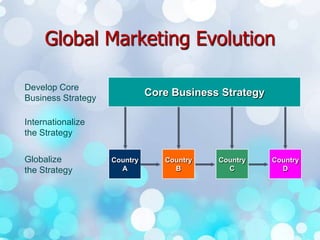
Core Business Strategy
Country
A
Country
B
Country
C
Country
D
Develop Core
Business Strategy
Internationalize
the Strategy
Globalize
the Strategy
Global Marketing Evolution
What is Internationalization ?
• As the process of increasing involvement in
international operations.
Why consider going international ?
• To increase overall customer base.
• To offset seasonal fluctuations in local markets
• To minimize risk of losing market share to clients who
themselves use internet to find goods / services in
overseas markets
• To offset increasing costs of doing business at home
• To gain prestige with customers at home .
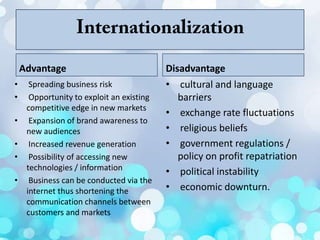
Advantage
• Spreading business risk
• Opportunity to exploit an existing
competitive edge in new markets
• Expansion of brand awareness to
new audiences
• Increased revenue generation
• Possibility of accessing new
technologies / information
• Business can be conducted via the
internet thus shortening the
communication channels between
customers and markets
Disadvantage
• cultural and language
barriers
• exchange rate fluctuations
• religious beliefs
• government regulations /
policy on profit repatriation
• political instability
• economic downturn.
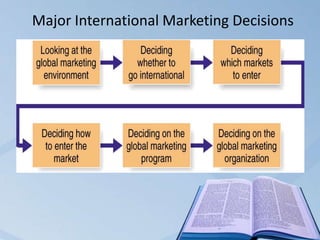
Major International Marketing Decisions
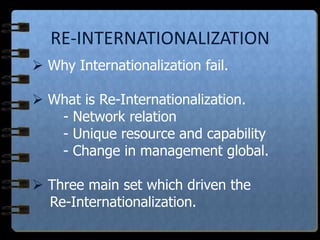
RE-INTERNATIONALIZATION
 Why Internationalization fail.
 What is Re-Internationalization.
- Network relation
- Unique resource and capability
- Change in management global.
 Three main set which driven the
Re-Internationalization.
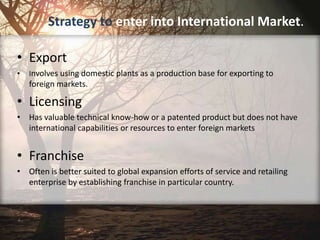
Strategy to enter into International Market.
• Export
• Involves using domestic plants as a production base for exporting to
foreign markets.
• Licensing
• Has valuable technical know-how or a patented product but does not have
international capabilities or resources to enter foreign markets
• Franchise
• Often is better suited to global expansion efforts of service and retailing
enterprise by establishing franchise in particular country.
• Strategic alliance
• Through strategic alliance you can enter into international market.
• Global strategy
• Pursue basic strategy world wide.
• Sell the same products under the same brand
• Production plants located local efficiencies
• Best suppliers from anywhere
• Coordinated marketing and distribution worldwide
• Multi country strategy
• Production plants in each country
– Producing products for that country
– Using local suppliers where possible
• Strategic alliance
• Through strategic alliance you can enter into international market.
• Global strategy
• Pursue basic strategy world wide.
• Sell the same products under the same brand
• Production plants located local efficiencies
• Best suppliers from anywhere
• Coordinated marketing and distribution worldwide
• Multi country strategy
• Production plants in each country
– Producing products for that country
– Using local suppliers where possible
to enter International
market
 While choosing new markets, MNCs
need to consider several factors:
1)
2)
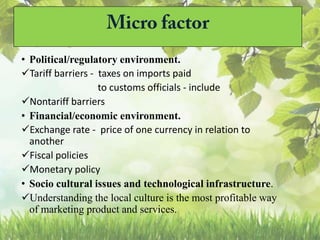
• Political/regulatory environment.
Tariff barriers - taxes on imports paid
to customs officials - include
Nontariff barriers
• Financial/economic environment.
Exchange rate - price of one currency in relation to
another
Fiscal policies
Monetary policy
• Socio cultural issues and technological infrastructure.
Understanding the local culture is the most profitable way
of marketing product and services.
• Competitive considerations.
• Local infrastructure such as
transportation & logistics network.
• Availability of mass media for
advertising is important.
What
is
Channel Management ?
 CHANNEL MANAGEMENT involves
the strategy; development and
alignment of channels or customer
inter faces, across your
marketing, sales and services.
 It is term that business or supplier of
products uses various marketing
techniques and sales strategy to reach
the widest possible customer base.
It creates the formulized programs for selling
servicing the customers within specific channels
can really impact your business. Customized a
channel management program which includes-
 Goals
 Policies
 Products
 Sales and marketing programs
 No longer can a business rely simply on
good Customer relations or word of mouth
to maintain or improve revenue.
 Possibilities for marketing a product or
service grow seemingly each day, and
keeping track of all of these disparate
marketing avenues is not an easy chore.
 That is why the concept
of channel management has become so
prevalent in marketing.
- Restaurant marketing
- Business start up tips
 Optimal channel management drives growth and profit- This
program addresses the needs of consumer goods and services
companies selling through wholesalers and retailers;
 Business-to-business firms working through independent
distributors and sales representative firms;
 Retailers seeking to improve efficiency in an increasingly
competitive marketplace; and
 Intermediaries seeking to preserve their role in an increasingly
fluid channel structure.
 Reduce cost
 Improve customer relations
 Increase revenue
 Building the high performing
sales force
Implementing Global Marketing



Localizing Global Marketing





Global marketing

Global marketing

  • 1.
  • 3.
    AMA’s Definition : Conception Pricing Promotion Distributionof Ideas, goods and Services Marketing Planning and Executing To create exchanges that satisfy individual and organizational Objectives
  • 4.
     The coordinatedperformance of marketing activities to create exchanges across countries that satisfy individual, organizational , and societal objectives  Global marketing is conducted across countries (not domestic or foreign)  Global marketing coordinates activities across different country markets  Global marketing should be motivated by individual, organizational and societal goals Global Marketing
  • 5.
    Core Business Strategy Country A Country B Country C Country D DevelopCore Business Strategy Internationalize the Strategy Globalize the Strategy Global Marketing Evolution
  • 6.
    What is Internationalization? • As the process of increasing involvement in international operations. Why consider going international ? • To increase overall customer base. • To offset seasonal fluctuations in local markets • To minimize risk of losing market share to clients who themselves use internet to find goods / services in overseas markets • To offset increasing costs of doing business at home • To gain prestige with customers at home .
  • 7.
    Advantage • Spreading businessrisk • Opportunity to exploit an existing competitive edge in new markets • Expansion of brand awareness to new audiences • Increased revenue generation • Possibility of accessing new technologies / information • Business can be conducted via the internet thus shortening the communication channels between customers and markets Disadvantage • cultural and language barriers • exchange rate fluctuations • religious beliefs • government regulations / policy on profit repatriation • political instability • economic downturn.
  • 8.
  • 9.
    RE-INTERNATIONALIZATION  Why Internationalizationfail.  What is Re-Internationalization. - Network relation - Unique resource and capability - Change in management global.  Three main set which driven the Re-Internationalization.
  • 10.
    Strategy to enterinto International Market. • Export • Involves using domestic plants as a production base for exporting to foreign markets. • Licensing • Has valuable technical know-how or a patented product but does not have international capabilities or resources to enter foreign markets • Franchise • Often is better suited to global expansion efforts of service and retailing enterprise by establishing franchise in particular country.
  • 11.
    • Strategic alliance •Through strategic alliance you can enter into international market. • Global strategy • Pursue basic strategy world wide. • Sell the same products under the same brand • Production plants located local efficiencies • Best suppliers from anywhere • Coordinated marketing and distribution worldwide • Multi country strategy • Production plants in each country – Producing products for that country – Using local suppliers where possible
  • 12.
    • Strategic alliance •Through strategic alliance you can enter into international market. • Global strategy • Pursue basic strategy world wide. • Sell the same products under the same brand • Production plants located local efficiencies • Best suppliers from anywhere • Coordinated marketing and distribution worldwide • Multi country strategy • Production plants in each country – Producing products for that country – Using local suppliers where possible
  • 13.
    to enter International market While choosing new markets, MNCs need to consider several factors: 1) 2)
  • 14.
    • Political/regulatory environment. Tariffbarriers - taxes on imports paid to customs officials - include Nontariff barriers • Financial/economic environment. Exchange rate - price of one currency in relation to another Fiscal policies Monetary policy • Socio cultural issues and technological infrastructure. Understanding the local culture is the most profitable way of marketing product and services.
  • 15.
    • Competitive considerations. •Local infrastructure such as transportation & logistics network. • Availability of mass media for advertising is important.
  • 16.
  • 17.
     CHANNEL MANAGEMENTinvolves the strategy; development and alignment of channels or customer inter faces, across your marketing, sales and services.  It is term that business or supplier of products uses various marketing techniques and sales strategy to reach the widest possible customer base.
  • 18.
    It creates theformulized programs for selling servicing the customers within specific channels can really impact your business. Customized a channel management program which includes-  Goals  Policies  Products  Sales and marketing programs
  • 19.
     No longercan a business rely simply on good Customer relations or word of mouth to maintain or improve revenue.  Possibilities for marketing a product or service grow seemingly each day, and keeping track of all of these disparate marketing avenues is not an easy chore.  That is why the concept of channel management has become so prevalent in marketing. - Restaurant marketing - Business start up tips
  • 20.
     Optimal channelmanagement drives growth and profit- This program addresses the needs of consumer goods and services companies selling through wholesalers and retailers;  Business-to-business firms working through independent distributors and sales representative firms;  Retailers seeking to improve efficiency in an increasingly competitive marketplace; and  Intermediaries seeking to preserve their role in an increasingly fluid channel structure.
  • 21.
     Reduce cost Improve customer relations  Increase revenue  Building the high performing sales force
  • 22.
  • 23.
  • 24.