Definition:
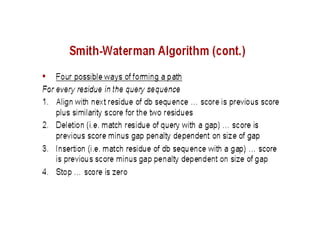
•Procedure for comparing two or more sequences by
searching for a series of individual characters or
character patterns that are in the same order in the
sequences.
– Pair-wise alignment: compare two sequences.
– Multiple sequence alignment: compare more than
two sequences.
Sequence Alignment
Need
• To find whether two (or more) genes or
proteins are evolutionarily related to each
Other.
• To find structurally or functionally similar
regions within proteins.
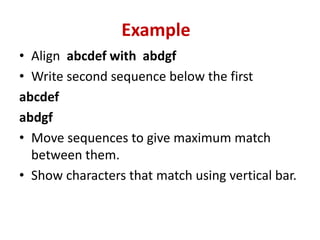
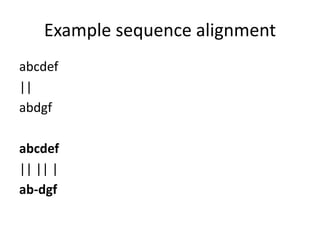
• Align abcdef with abdgf
• Write second sequence below the first
abcdef
abdgf
• Move sequences to give maximum match
between them.
• Show characters that match using vertical bar.
Example
Example sequence alignment
abcdef
||
abdgf
abcdef
|| || |
ab-dgf
Matching Similarity vs. Identity
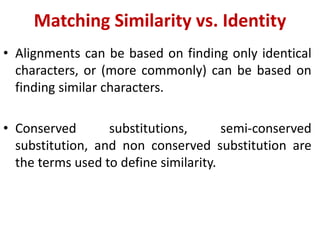
• Alignments can be based on finding only identical
characters, or (more commonly) can be based on
finding similar characters.
• Conserved substitutions, semi-conserved
substitution, and non conserved substitution are
the terms used to define similarity.
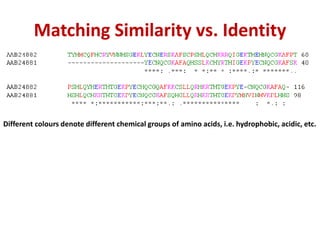
Matching Similarity vs. Identity
Different colours denote different chemical groups of amino acids, i.e. hydrophobic, acidic, etc.
Inferences
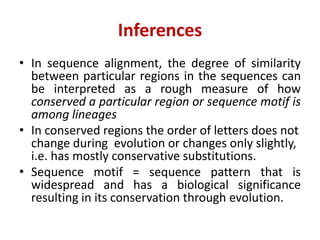
• In sequence alignment, the degree of similarity
between particular regions in the sequences can
be interpreted as a rough measure of how
conserved a particular region or sequence motif is
among lineages
• In conserved regions the order of letters does not
change during evolution or changes only slightly,
i.e. has mostly conservative substitutions.
• Sequence motif = sequence pattern that is
widespread and has a biological significance
resulting in its conservation through evolution.
Global vs. Local Alignment
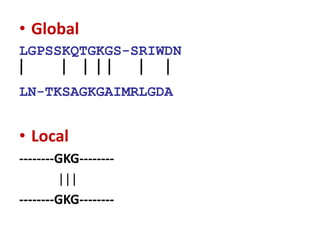
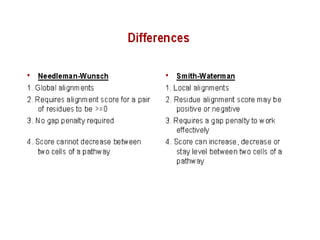
– Global alignment algorithms which optimize
overall alignment between two sequences.
– Local alignment algorithms which seek only
relatively conserved pieces of sequence.
Alignment stops at the ends of regions of
strong similarity.
– Favors finding conserved patterns in different pairs
of sequences.
• Global
LGPSSKQTGKGS-SRIWDN
LN-TKSAGKGAIMRLGDA
• Local
--------GKG--------
|||
--------GKG--------
Methods for Pair-wise Alignment
• Dot matrix analysis
• Dynamic Programming (Needleman- Wunsch,
Smith-Waterman algorithms)
• Word or k-tuple methods (BLAST and FASTA)
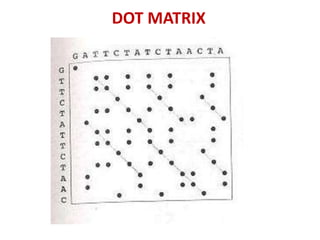
DOT MATRIX
Interpretation of Dot Matrices
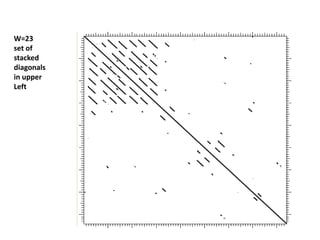
• Regions of similarity appear as diagonal runs
of dots.
• Interruption in middle of diagonal line
indicates insertions or deletions.
• Parallel diagonal line within the matrix
represents repetitive regions of the sequence.
Uses
• Can use dot matrices to align two proteins or two
nucleic acid sequences.
• Can use to find amino acid repeats within a
protein by comparing a protein sequence to itself.
• Used in identifying Nucleic Acids secondary
structure detecting self complementarily of the
sequence.
• Used in comparative genomics by predicting gene
order conservation between closely related
genomes.
Limitations
• A problem with dot matrices for long
sequences is that they can be very noisy due
to lots of insignificant matches.
• Only a pairwise alignment method not
suitable for multiple alignment of sequences.
• It lacks statistically rigor in assessing the
quality of alignment.
Solution
• By using a window (W)/ tuple.
– compare character by character within a
window (have to choose window size).
– require certain fraction of matches within
window in order to display it with a “dot”.
W=23
set of
stacked
diagonals
in upper
Left
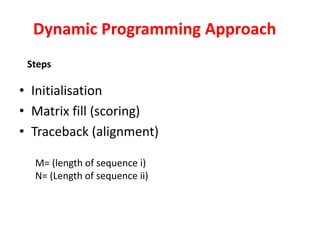
• Initialisation
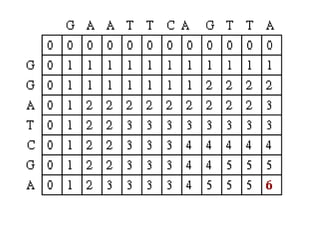
• Matrix fill (scoring)
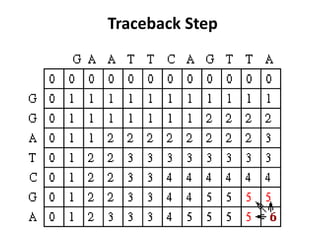
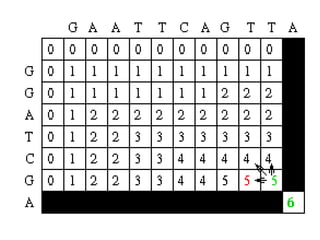
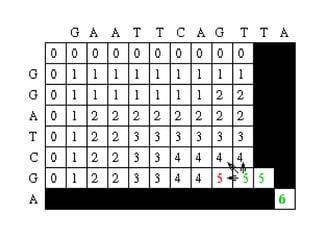
• Traceback (alignment)
Dynamic Programming Approach
Steps
M= (length of sequence i)
N= (Length of sequence ii)
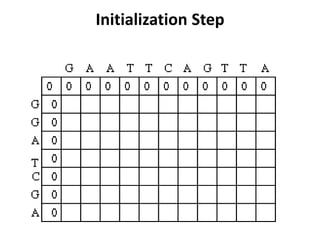
Initialization Step
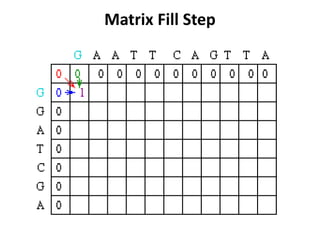
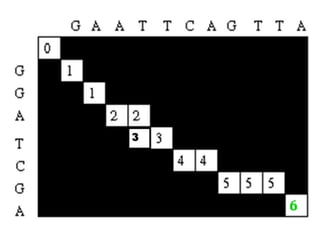
Scoring
• For each position, Mi,j is defined to be the
maximum score at position i,j; i.e.
Mi,j = MAXIMUM [ Mi-1, j-1 + Si,j (match/mismatch in the diagonal)
Mi,j-1 + w (gap in sequence #1),
Mi-1,j + w (gap in sequence #2)]
• In the following case, Mi-1,j-1 will be red, Mi,j-1 will
be green and Mi-1,j will be blue.
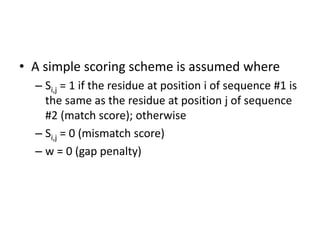
• A simple scoring scheme is assumed where
– Si,j = 1 if the residue at position i of sequence #1 is
the same as the residue at position j of sequence
#2 (match score); otherwise
– Si,j = 0 (mismatch score)
– w = 0 (gap penalty)
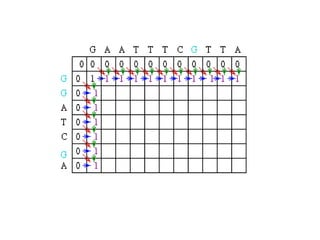
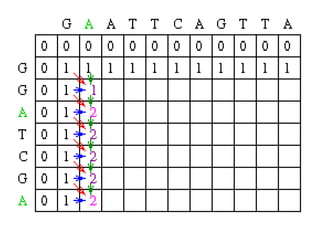
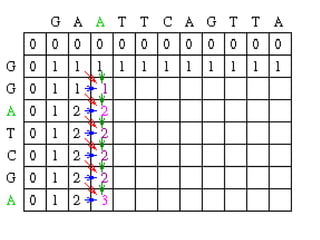
Matrix Fill Step
Traceback Step
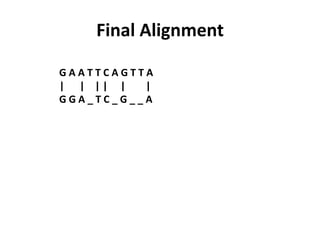
Final Alignment
G A A T T C A G T T A
| | | | | |
G G A _ T C _ G _ _ A
Summary
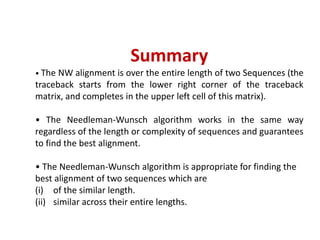
• The NW alignment is over the entire length of two Sequences (the
traceback starts from the lower right corner of the traceback
matrix, and completes in the upper left cell of this matrix).
• The Needleman-Wunsch algorithm works in the same way
regardless of the length or complexity of sequences and guarantees
to find the best alignment.
• The Needleman-Wunsch algorithm is appropriate for finding the
best alignment of two sequences which are
(i) of the similar length.
(ii) similar across their entire lengths.
seq alignment.ppt
seq alignment.ppt
seq alignment.ppt
seq alignment.ppt
seq alignment.ppt

seq alignment.ppt

  • 1.
    Definition: •Procedure for comparingtwo or more sequences by searching for a series of individual characters or character patterns that are in the same order in the sequences. – Pair-wise alignment: compare two sequences. – Multiple sequence alignment: compare more than two sequences. Sequence Alignment
  • 2.
    Need • To findwhether two (or more) genes or proteins are evolutionarily related to each Other. • To find structurally or functionally similar regions within proteins.
  • 3.
    • Align abcdefwith abdgf • Write second sequence below the first abcdef abdgf • Move sequences to give maximum match between them. • Show characters that match using vertical bar. Example
  • 4.
  • 5.
    Matching Similarity vs.Identity • Alignments can be based on finding only identical characters, or (more commonly) can be based on finding similar characters. • Conserved substitutions, semi-conserved substitution, and non conserved substitution are the terms used to define similarity.
  • 6.
    Matching Similarity vs.Identity Different colours denote different chemical groups of amino acids, i.e. hydrophobic, acidic, etc.
  • 7.
    Inferences • In sequencealignment, the degree of similarity between particular regions in the sequences can be interpreted as a rough measure of how conserved a particular region or sequence motif is among lineages • In conserved regions the order of letters does not change during evolution or changes only slightly, i.e. has mostly conservative substitutions. • Sequence motif = sequence pattern that is widespread and has a biological significance resulting in its conservation through evolution.
  • 8.
    Global vs. LocalAlignment – Global alignment algorithms which optimize overall alignment between two sequences. – Local alignment algorithms which seek only relatively conserved pieces of sequence. Alignment stops at the ends of regions of strong similarity. – Favors finding conserved patterns in different pairs of sequences.
  • 9.
  • 10.
    Methods for Pair-wiseAlignment • Dot matrix analysis • Dynamic Programming (Needleman- Wunsch, Smith-Waterman algorithms) • Word or k-tuple methods (BLAST and FASTA)
  • 11.
  • 12.
    Interpretation of DotMatrices • Regions of similarity appear as diagonal runs of dots. • Interruption in middle of diagonal line indicates insertions or deletions. • Parallel diagonal line within the matrix represents repetitive regions of the sequence.
  • 13.
    Uses • Can usedot matrices to align two proteins or two nucleic acid sequences. • Can use to find amino acid repeats within a protein by comparing a protein sequence to itself. • Used in identifying Nucleic Acids secondary structure detecting self complementarily of the sequence. • Used in comparative genomics by predicting gene order conservation between closely related genomes.
  • 14.
    Limitations • A problemwith dot matrices for long sequences is that they can be very noisy due to lots of insignificant matches. • Only a pairwise alignment method not suitable for multiple alignment of sequences. • It lacks statistically rigor in assessing the quality of alignment.
  • 15.
    Solution • By usinga window (W)/ tuple. – compare character by character within a window (have to choose window size). – require certain fraction of matches within window in order to display it with a “dot”.
  • 16.
  • 17.
    • Initialisation • Matrixfill (scoring) • Traceback (alignment) Dynamic Programming Approach Steps M= (length of sequence i) N= (Length of sequence ii)
  • 18.
  • 19.
    Scoring • For eachposition, Mi,j is defined to be the maximum score at position i,j; i.e. Mi,j = MAXIMUM [ Mi-1, j-1 + Si,j (match/mismatch in the diagonal) Mi,j-1 + w (gap in sequence #1), Mi-1,j + w (gap in sequence #2)] • In the following case, Mi-1,j-1 will be red, Mi,j-1 will be green and Mi-1,j will be blue.
  • 20.
    • A simplescoring scheme is assumed where – Si,j = 1 if the residue at position i of sequence #1 is the same as the residue at position j of sequence #2 (match score); otherwise – Si,j = 0 (mismatch score) – w = 0 (gap penalty)
  • 21.
  • 26.
  • 30.
    Final Alignment G AA T T C A G T T A | | | | | | G G A _ T C _ G _ _ A
  • 34.
    Summary • The NWalignment is over the entire length of two Sequences (the traceback starts from the lower right corner of the traceback matrix, and completes in the upper left cell of this matrix). • The Needleman-Wunsch algorithm works in the same way regardless of the length or complexity of sequences and guarantees to find the best alignment. • The Needleman-Wunsch algorithm is appropriate for finding the best alignment of two sequences which are (i) of the similar length. (ii) similar across their entire lengths.

Editor's Notes

  • #7 Conserved amino acid substitution are the replacement of an amino acid residue with another one with similar properties such as aspartate and glutamate. They are both negatively charged. Semi-conserved amino acid substitution replaces one residue with another one that has similar steric conformation but does not share chemical properties like substitution of cysteine for alanine or leucine.