Lecture 2
Pairwise sequence alignment.
Principles Computational Biology
Teresa Przytycka, PhD
Assumptions:
• Biological sequences evolved by evolution.
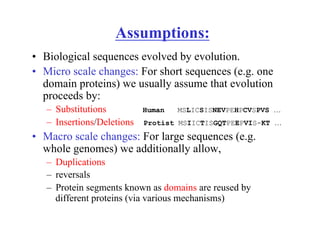
• Micro scale changes: For short sequences (e.g. one
domain proteins) we usually assume that evolution
proceeds by:
– Substitutions Human MSLICSISNEVPEHPCVSPVS …
– Insertions/Deletions Protist MSIICTISGQTPEEPVIS-KT …
• Macro scale changes: For large sequences (e.g.
whole genomes) we additionally allow,
– Duplications
– reversals
– Protein segments known as domains are reused by
different proteins (via various mechanisms)
Importance of sequence comparison
Discovering functional and evolutional relationships
in biological sequences:
– Similar sequences ! evolutionary relationship
– evolutionary relationship ! related function
– Orthologs ! same (almost same) function in different
organisms.
“!” should be read usually implies
Discovering sequence similarity by
dot plots
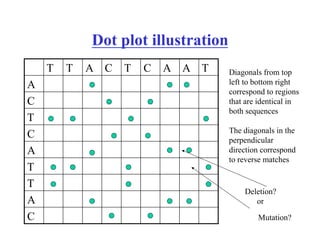
Given are two sequence lengths n and m respectively. Do they
share a similarity and if so in which region?
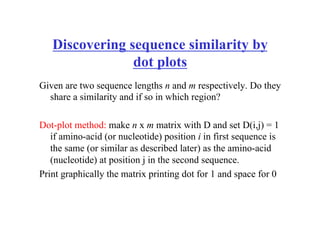
Dot-plot method: make n x m matrix with D and set D(i,j) = 1
if amino-acid (or nucleotide) position i in first sequence is
the same (or similar as described later) as the amino-acid
(nucleotide) at position j in the second sequence.
Print graphically the matrix printing dot for 1 and space for 0
Dot plot illustration
T T A C T C A A T
A
C
T
C
A
T
T
A
C
Diagonals from top
left to bottom right
correspond to regions
that are identical in
both sequences
The diagonals in the
perpendicular
direction correspond
to reverse matches
Mutation?
Deletion?
or
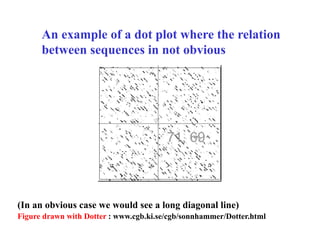
An example of a dot plot where the relation
between sequences in not obvious
(In an obvious case we would see a long diagonal line)
Figure drawn with Dotter : www.cgb.ki.se/cgb/sonnhammer/Dotter.html
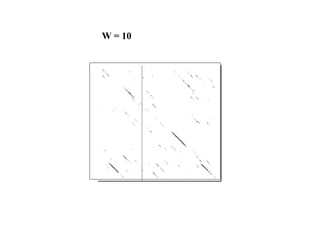
Removing noise in dot plots
• Most of dots in a dot plot are by chance and
introduce a lot of noise.
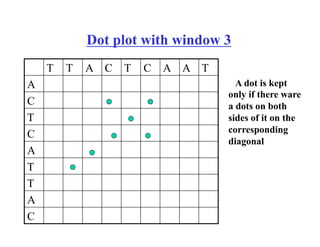
• Removing the noise: Put a dot ONLY if in
addition to the similarity in the given position
there is a similarity in the surrounding
positions (we look at in a “window” of a size
given as a parameter).
Dot plot with window 3
T T A C T C A A T
A
C
T
C
A
T
T
A
C
A dot is kept
only if there ware
a dots on both
sides of it on the
corresponding
diagonal
W = 10
0
500
1000
1500
2000
2500
3000
0 500 1000 1500 2000 2500
Vvu Chr I
Vpa
Chr
I
0
500
1000
1500
2000
2500
3000
0 500 1000 1500 2000 2500
Vch Chr I
Vpa
Chr
I
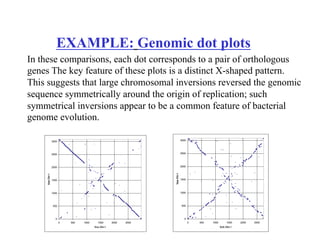
EXAMPLE: Genomic dot plots
In these comparisons, each dot corresponds to a pair of orthologous
genes The key feature of these plots is a distinct X-shaped pattern.
This suggests that large chromosomal inversions reversed the genomic
sequence symmetrically around the origin of replication; such
symmetrical inversions appear to be a common feature of bacterial
genome evolution.
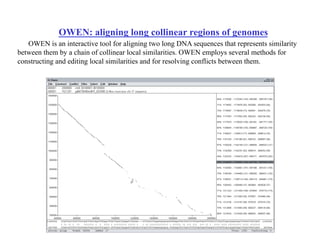
OWEN: aligning long collinear regions of genomes
OWEN is an interactive tool for aligning two long DNA sequences that represents similarity
between them by a chain of collinear local similarities. OWEN employs several methods for
constructing and editing local similarities and for resolving conflicts between them.
Sequence alignment
• Write one sequence along the other so that to expose
any similarity between the sequences. Each element of
a sequence is either placed alongside of corresponding
element in the other sequence or alongside a special
“gap” character
• Example: TGKGI and AGKVGL can be aligned as
TGK - GI
AGKVGL
• Is there a better alignment? How can we compare the
“goodness” of two alignments.
• We need to have:
– A way of scoring an alignment
– A way of computing maximum score alignment.
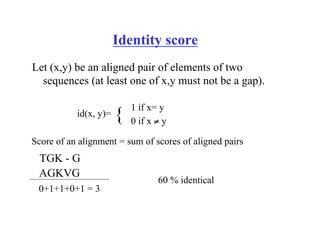
Identity score
Let (x,y) be an aligned pair of elements of two
sequences (at least one of x,y must not be a gap).
{
1 if x= y
0 if x ≠ y
id(x, y)=
TGK - G
AGKVG
Score of an alignment = sum of scores of aligned pairs
0+1+1+0+1 = 3
60 % identical
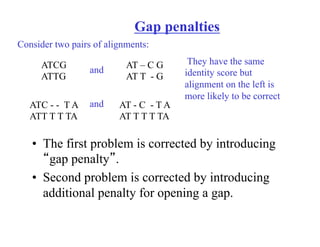
Gap penalties
• The first problem is corrected by introducing
“gap penalty”.
• Second problem is corrected by introducing
additional penalty for opening a gap.
ATCG
ATTG
and
AT – C G
AT T - G
They have the same
identity score but
alignment on the left is
more likely to be correct
AT - C - T A
AT T T T TA
ATC - - T A
ATT T T TA
Consider two pairs of alignments:
and
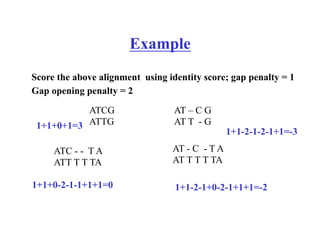
Example
ATCG
ATTG
AT – C G
AT T - G
AT - C - T A
AT T T T TA
ATC - - T A
ATT T T TA
Score the above alignment using identity score; gap penalty = 1
Gap opening penalty = 2
1+1+0+1=3
1+1-2-1-2-1+1=-3
1+1-2-1+0-2-1+1+1=-2
1+1+0-2-1-1+1+1=0
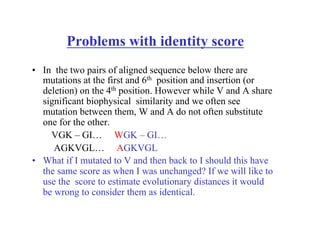
Problems with identity score
• In the two pairs of aligned sequence below there are
mutations at the first and 6th position and insertion (or
deletion) on the 4th position. However while V and A share
significant biophysical similarity and we often see
mutation between them, W and A do not often substitute
one for the other.
VGK – GI… WGK – GI…
AGKVGL… AGKVGL
• What if I mutated to V and then back to I should this have
the same score as when I was unchanged? If we will like to
use the score to estimate evolutionary distances it would
be wrong to consider them as identical.
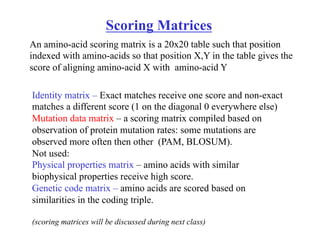
Scoring Matrices
Identity matrix – Exact matches receive one score and non-exact
matches a different score (1 on the diagonal 0 everywhere else)
Mutation data matrix – a scoring matrix compiled based on
observation of protein mutation rates: some mutations are
observed more often then other (PAM, BLOSUM).
Not used:
Physical properties matrix – amino acids with similar
biophysical properties receive high score.
Genetic code matrix – amino acids are scored based on
similarities in the coding triple.
(scoring matrices will be discussed during next class)
An amino-acid scoring matrix is a 20x20 table such that position
indexed with amino-acids so that position X,Y in the table gives the
score of aligning amino-acid X with amino-acid Y
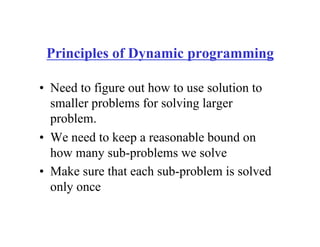
Principles of Dynamic programming
• Need to figure out how to use solution to
smaller problems for solving larger
problem.
• We need to keep a reasonable bound on
how many sub-problems we solve
• Make sure that each sub-problem is solved
only once
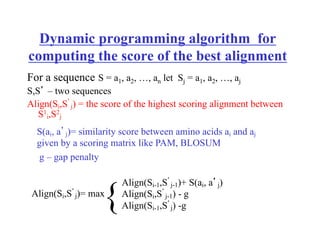
Dynamic programming algorithm for
computing the score of the best alignment
For a sequence S = a1, a2, …, an let Sj = a1, a2, …, aj
S,S’ – two sequences
Align(Si,S’
j) = the score of the highest scoring alignment between
S1
i,S2
j
S(ai, a’j)= similarity score between amino acids ai and aj
given by a scoring matrix like PAM, BLOSUM
g – gap penalty
Align(Si,S’
j)= max
Align(Si-1,S’
j-1)+ S(ai, a’j)
Align(Si,S’
j-1) - g
Align(Si-1,S’
j) -g
{
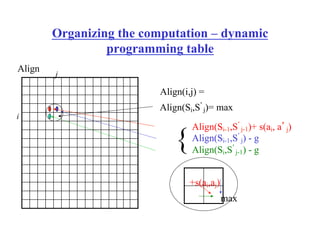
Organizing the computation – dynamic
programming table
Align(Si-1,S’
j-1)+ s(ai, a’j)
Align(Si-1,S’
j) - g
Align(Si,S’
j-1) - g
Align(Si,S’
j)= max
{
j
i
Align(i,j) =
Align
+s(ai,aj)
max
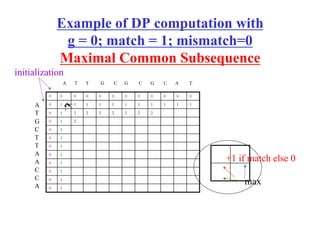
Example of DP computation with
g = 0; match = 1; mismatch=0
Maximal Common Subsequence
A T T G C G C G C A T
A
T
G
C
T
T
A
A
C
C
A
+1 if match else 0
max
0 0 0 0 0 0 0 0 0 0 0 0
0 1 1 1 1 1 1 1 1 1 1 1
0 1 2 2 2 2 2 2 2
0 1 2
0 1
0 1
0 1
0 1
0 1
0 1
0 1
0 1
initialization
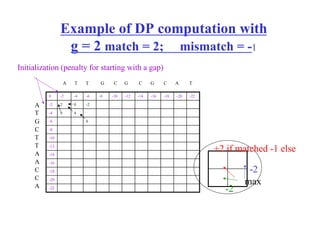
Example of DP computation with
g = 2 match = 2; mismatch = -1
A T T G C G C G C A T
A
T
G
C
T
T
A
A
C
C
A
+2 if matched -1 else
max
-2
-2
Initialization (penalty for starting with a gap)
0 -2 -4 -6 -8 -10 -12 -14 -16 -18 -20 -22
-2 2 0 -2
-4 0 4
-6 6
-8
-10
-12
-14
-16
-18
-20
-22
The iterative algorithm
m = |S|; n = |S’|
for i " 0 to m do A[i,0]"- i * g
for j " 0 to n do A[0,j]" - j * g
for i " 1 to m do
for j " 1 to n
A[i,j]"max (
A[i-1,j] – g
A[i-1,j-1] + s(i,j)
A[i,j-1] – g
)
return(A[m,n])
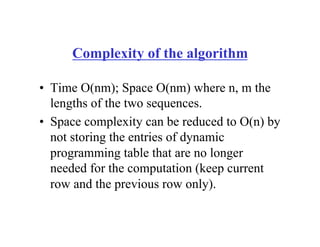
Complexity of the algorithm
• Time O(nm); Space O(nm) where n, m the
lengths of the two sequences.
• Space complexity can be reduced to O(n) by
not storing the entries of dynamic
programming table that are no longer
needed for the computation (keep current
row and the previous row only).
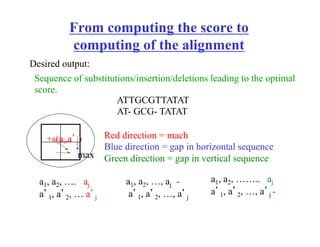
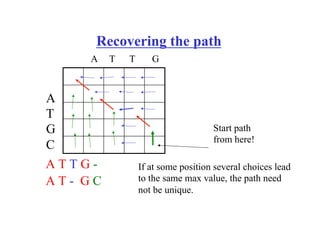
From computing the score to
computing of the alignment
Desired output:
ATTGCGTTATAT
AT- GCG- TATAT
Sequence of substitutions/insertion/deletions leading to the optimal
score.
a1, a2, …. aj
a’1, a’2, … a’j
+s(ai,a’j)
max
Red direction = mach
Blue direction = gap in horizontal sequence
Green direction = gap in vertical sequence
a1, a2, …, aj -
a’1, a’2, …, a’j
a1, a2, …….. aj
a’1, a’2, …, a’j -
Recovering the path
A T T G -
A T - G C
A T T G
A
T
G
C
If at some position several choices lead
to the same max value, the path need
not be unique.
Start path
from here!
Reducing space complexity in the
global alignment
Recall: Computing the score in linear space is easy.
Leaving “trace” for finding optimal alignment is harder. Why?
OPT [ x
y ] be an optimal alignment between
sequence x and y
fix i, then there exist j such that OPT [ x
y ] can be obtained as
OPT [
x[1,…i-1]
y[1,…,j-1]]+
x[i]
y[j]
+ OPT
x[i+1,…m]
y[j+1,…,n]
[ ]
OPT
[
x[1,…i-1]
y[1,…,j] ]+
x[i]
-
+ OPT
x[i+1,…m]
y[j+1,…,n]
[ ]
OR
Let
Extra information not obligatory
Computing which of the two cases holds and for
what value of j:
1. Use dynamic programming for to compute the scores a[i,j] for
fixed i=n/2 and all j. O(nm/2)-time; linear space
2. Do the same for the suffixes. O(nm/2)-time; linear space
3. Find out which of the two cases from the previous case applies
and for which value of j.
4. Apply 1 & 2 recursively for the sequences to the left of (i,j)
and to the right of (i,j) (figure from previous slide)
Extra information – not obligatory
Ignoring initial and final gaps –
semiglobal comparison
Recall the initialization step for the dynamic programming table:
A[0,i] = ig; A[j,0]=jg – these are responsible for initial gaps.
set them to zero!
How to ignore final gaps?
CAGCA - CTTGGATTCTCGG
- - - CAGCGTGG - - - - - - - -
No penalties for
these gaps
Take the largest value in the last row /column and trace-back form there
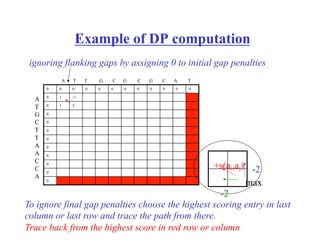
Example of DP computation
0 0 0 0 0 0 0 0 0 0 0 0
0 1 -1
0 1 2
0
0
0
0
0
0
0
0
0
A T T G C G C G C A T
A
T
G
C
T
T
A
A
C
C
A
+s(ai,aj)
max
-2
-2
ignoring flanking gaps by assigning 0 to initial gap penalties
To ignore final gap penalties choose the highest scoring entry in last
column or last row and trace the path from there.
Trace back from the highest score in red row or column
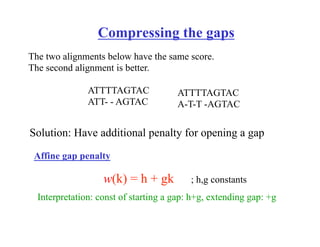
Compressing the gaps
Solution: Have additional penalty for opening a gap
ATTTTAGTAC
ATT- - AGTAC
ATTTTAGTAC
A-T-T -AGTAC
The two alignments below have the same score.
The second alignment is better.
w(k) = h + gk ; h,g constants
Interpretation: const of starting a gap: h+g, extending gap: +g
Affine gap penalty
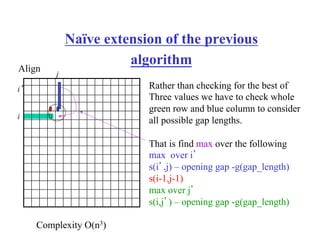
Naïve extension of the previous
algorithm
j
i
Align
Rather than checking for the best of
Three values we have to check whole
green row and blue column to consider
all possible gap lengths.
That is find max over the following
max over i’
s(i’,j) – opening gap -g(gap_length)
s(i-1,j-1)
max over j’
s(i,j’) – opening gap -g(gap_length)
i’
Complexity O(n3)
General gap penalty
a[i,j]= max
a[i-1,j-1] + s(i,j)
max b[i,j-k] – w(k) for 0 <=k<=i
max b[i-k,j] – w(k) for 0 <=k<=j
{
w(k) any gap penalty function (not necessarily afine)
k = size of a gap.
O(n2) algorithm for afine gap penalty
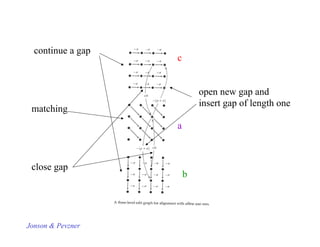
We will have 3 dynamic programming tables:
s a[i,j] best possible alignment of Si and S’
j
s b[i,j] best possible alignment of Si and S’
j that ends with a gap in S
s c[i,j] best possible alignment of Si and S’
j that ends with a gap in S’
Let w(k) = h + gk
S1, S2 compared sequences
Text Pevzner’s book notation
open new gap and
insert gap of length one
continue a gap
matching
close gap
a
b
c
Jonson & Pevzner
Jonson & Pevzner
Initialization
Assume that we charge for initial and terminal gaps
a[0,0] = 0;
a[i,0] = - infinity (i<>0);
a[0,j] = -infinity (j<>0)
b[i,0] = - infinity
b[0,j] = - (h+gj)
c[i,0] = - (h+gi)
c[0,j] = - infinity
-infinity is assigned where no alignment possible
Affine gap penalty function - cont
w(k) = h + gk ; h,g constants
Let a,b,c be as before. Now they can be completed as follows:
a[i,j]= max
a[i-1,j-1] + s(i,j)
b[i,j]
c[i,j]
{
b[i,j]= max
a[i,j-1] – (h+g) --- start a new gap in first seq
b[i,j-1] – g -- extend gap in second first by one
{
c[i,j]= max
a[i-1,j] – (h+g)
c[i-1,j] – g
{
Interpretation: const of starting a gap: h+g, extending gap: +g
More sophisticated gap penalties
• if w(k) is an arbitrary function – O(n3) algorithm
• w(k) = log k (and other concave or convex functions)
- O(n2 log n) algorithm (non-trivial)
Let gap penalty be given by function w(k), where k-gap
length.
• gap penalty can be made to dependent non-
linearly on length (e.g. as log function)
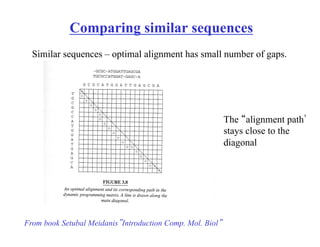
Comparing similar sequences
Similar sequences – optimal alignment has small number of gaps.
The “alignment path”
stays close to the
diagonal
From book Setubal Meidanis”Introduction Comp. Mol. Biol”
Speeding up dynamic programming
under assumption of small number of
gaps
Idea: Use only strip of width 2k+1 along the diagonal. The rest
of the array remains unused (and not initialized)
Modify the “max” expressions so that cell outside the strip are
not considered.
Time complexity O(kn)
Space complexity – if you store only cells that are used – O(kn)
Identifying diagonals:
Number the diagonals as follows:
0 – main diagonal
+i ith diagonal above 0 diagonal
-i ith diagonal below 0 diagonal
Simple test to find the number of diagonal for element a(i,j):
j-i
k-band alignment
n = |S|= |S’|
for i " 0 to k do A[i,0]"- i * g
for j " 0 to k do A[0,j]" - j * g
for i " 1 to n do
for d " -k to k
j = i+d;
if inside_strip(i,j,k) then:
A[i,j]"max (
if inside_strip(i-1,j,k) then A[i-1,j] – g else -infinity
A[i-1,j-1] + s(i,j)
if inside_strip(i-1,j,k) then A[i,j-1] – g else -infinity
)
return(A[m,n])
Where insid _strip(i,j,k) is a test if cell A[i.j] is inside the strip that is if |i-j|<=k
Local alignment
• The alignment techniques considered so far
worked well for sequences which are similar over
all their length
• This does not need to be the case: example gene
from hox family have very short but highly
conserved subsequence – the so called hox
domain.
• Considered so far global alignment methods (that
is algorithm that try to find the best alignment
over whole length can miss this local similarity
region
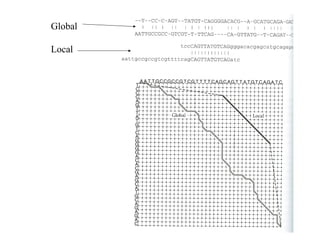
Global
Local
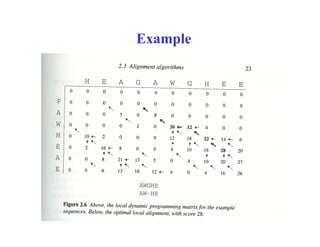
Local alignment (Smith, Waterman)
So far we have been dealing with global alignment.
Local alignment – alignment between substrings.
Main idea: If alignment becomes to bad – drop it.
a[i,j]= max
a[i-1,j-1]+ s(ai, aj)
a[i-1,j +g
a[i,j-1]+ g
0
{
Set p and g so that alignment of random strings gives negative
score
Finding the alignment: find the highest scoring cell and trace it back
Example
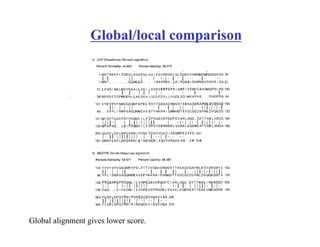
Global/local comparison
Global alignment gives lower score.
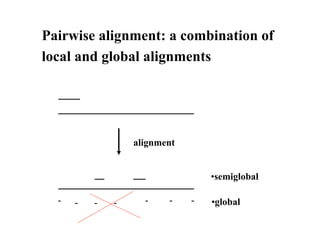
Pairwise alignment: a combination of
local and global alignments
alignment
•semiglobal
•global
Step 2 of FASTA
Locate best diagonal runs (gapless alignments) Give
positive score for each hot spot
– Give negative score for each space between hot spots
– Find best scoring runs
– Score the alignments from the runs and find ones above
a threshold. These are possible “sub-alignments”
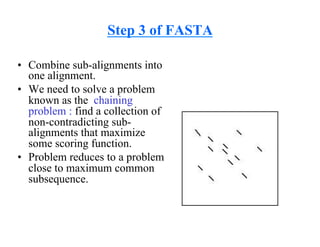
Step 3 of FASTA
• Combine sub-alignments into
one alignment.
• We need to solve a problem
known as the chaining
problem : find a collection of
non-contradicting sub-
alignments that maximize
some scoring function.
• Problem reduces to a problem
close to maximum common
subsequence.

PCB_Lect02_Pairwise_allign (1).pdf

  • 1.
    Lecture 2 Pairwise sequencealignment. Principles Computational Biology Teresa Przytycka, PhD
  • 2.
    Assumptions: • Biological sequencesevolved by evolution. • Micro scale changes: For short sequences (e.g. one domain proteins) we usually assume that evolution proceeds by: – Substitutions Human MSLICSISNEVPEHPCVSPVS … – Insertions/Deletions Protist MSIICTISGQTPEEPVIS-KT … • Macro scale changes: For large sequences (e.g. whole genomes) we additionally allow, – Duplications – reversals – Protein segments known as domains are reused by different proteins (via various mechanisms)
  • 3.
    Importance of sequencecomparison Discovering functional and evolutional relationships in biological sequences: – Similar sequences ! evolutionary relationship – evolutionary relationship ! related function – Orthologs ! same (almost same) function in different organisms. “!” should be read usually implies
  • 4.
    Discovering sequence similarityby dot plots Given are two sequence lengths n and m respectively. Do they share a similarity and if so in which region? Dot-plot method: make n x m matrix with D and set D(i,j) = 1 if amino-acid (or nucleotide) position i in first sequence is the same (or similar as described later) as the amino-acid (nucleotide) at position j in the second sequence. Print graphically the matrix printing dot for 1 and space for 0
  • 5.
    Dot plot illustration TT A C T C A A T A C T C A T T A C Diagonals from top left to bottom right correspond to regions that are identical in both sequences The diagonals in the perpendicular direction correspond to reverse matches Mutation? Deletion? or
  • 6.
    An example ofa dot plot where the relation between sequences in not obvious (In an obvious case we would see a long diagonal line) Figure drawn with Dotter : www.cgb.ki.se/cgb/sonnhammer/Dotter.html
  • 7.
    Removing noise indot plots • Most of dots in a dot plot are by chance and introduce a lot of noise. • Removing the noise: Put a dot ONLY if in addition to the similarity in the given position there is a similarity in the surrounding positions (we look at in a “window” of a size given as a parameter).
  • 8.
    Dot plot withwindow 3 T T A C T C A A T A C T C A T T A C A dot is kept only if there ware a dots on both sides of it on the corresponding diagonal
  • 9.
  • 10.
    0 500 1000 1500 2000 2500 3000 0 500 10001500 2000 2500 Vvu Chr I Vpa Chr I 0 500 1000 1500 2000 2500 3000 0 500 1000 1500 2000 2500 Vch Chr I Vpa Chr I EXAMPLE: Genomic dot plots In these comparisons, each dot corresponds to a pair of orthologous genes The key feature of these plots is a distinct X-shaped pattern. This suggests that large chromosomal inversions reversed the genomic sequence symmetrically around the origin of replication; such symmetrical inversions appear to be a common feature of bacterial genome evolution.
  • 11.
    OWEN: aligning longcollinear regions of genomes OWEN is an interactive tool for aligning two long DNA sequences that represents similarity between them by a chain of collinear local similarities. OWEN employs several methods for constructing and editing local similarities and for resolving conflicts between them.
  • 12.
    Sequence alignment • Writeone sequence along the other so that to expose any similarity between the sequences. Each element of a sequence is either placed alongside of corresponding element in the other sequence or alongside a special “gap” character • Example: TGKGI and AGKVGL can be aligned as TGK - GI AGKVGL • Is there a better alignment? How can we compare the “goodness” of two alignments. • We need to have: – A way of scoring an alignment – A way of computing maximum score alignment.
  • 13.
    Identity score Let (x,y)be an aligned pair of elements of two sequences (at least one of x,y must not be a gap). { 1 if x= y 0 if x ≠ y id(x, y)= TGK - G AGKVG Score of an alignment = sum of scores of aligned pairs 0+1+1+0+1 = 3 60 % identical
  • 14.
    Gap penalties • Thefirst problem is corrected by introducing “gap penalty”. • Second problem is corrected by introducing additional penalty for opening a gap. ATCG ATTG and AT – C G AT T - G They have the same identity score but alignment on the left is more likely to be correct AT - C - T A AT T T T TA ATC - - T A ATT T T TA Consider two pairs of alignments: and
  • 15.
    Example ATCG ATTG AT – CG AT T - G AT - C - T A AT T T T TA ATC - - T A ATT T T TA Score the above alignment using identity score; gap penalty = 1 Gap opening penalty = 2 1+1+0+1=3 1+1-2-1-2-1+1=-3 1+1-2-1+0-2-1+1+1=-2 1+1+0-2-1-1+1+1=0
  • 16.
    Problems with identityscore • In the two pairs of aligned sequence below there are mutations at the first and 6th position and insertion (or deletion) on the 4th position. However while V and A share significant biophysical similarity and we often see mutation between them, W and A do not often substitute one for the other. VGK – GI… WGK – GI… AGKVGL… AGKVGL • What if I mutated to V and then back to I should this have the same score as when I was unchanged? If we will like to use the score to estimate evolutionary distances it would be wrong to consider them as identical.
  • 17.
    Scoring Matrices Identity matrix– Exact matches receive one score and non-exact matches a different score (1 on the diagonal 0 everywhere else) Mutation data matrix – a scoring matrix compiled based on observation of protein mutation rates: some mutations are observed more often then other (PAM, BLOSUM). Not used: Physical properties matrix – amino acids with similar biophysical properties receive high score. Genetic code matrix – amino acids are scored based on similarities in the coding triple. (scoring matrices will be discussed during next class) An amino-acid scoring matrix is a 20x20 table such that position indexed with amino-acids so that position X,Y in the table gives the score of aligning amino-acid X with amino-acid Y
  • 18.
    Principles of Dynamicprogramming • Need to figure out how to use solution to smaller problems for solving larger problem. • We need to keep a reasonable bound on how many sub-problems we solve • Make sure that each sub-problem is solved only once
  • 19.
    Dynamic programming algorithmfor computing the score of the best alignment For a sequence S = a1, a2, …, an let Sj = a1, a2, …, aj S,S’ – two sequences Align(Si,S’ j) = the score of the highest scoring alignment between S1 i,S2 j S(ai, a’j)= similarity score between amino acids ai and aj given by a scoring matrix like PAM, BLOSUM g – gap penalty Align(Si,S’ j)= max Align(Si-1,S’ j-1)+ S(ai, a’j) Align(Si,S’ j-1) - g Align(Si-1,S’ j) -g {
  • 20.
    Organizing the computation– dynamic programming table Align(Si-1,S’ j-1)+ s(ai, a’j) Align(Si-1,S’ j) - g Align(Si,S’ j-1) - g Align(Si,S’ j)= max { j i Align(i,j) = Align +s(ai,aj) max
  • 21.
    Example of DPcomputation with g = 0; match = 1; mismatch=0 Maximal Common Subsequence A T T G C G C G C A T A T G C T T A A C C A +1 if match else 0 max 0 0 0 0 0 0 0 0 0 0 0 0 0 1 1 1 1 1 1 1 1 1 1 1 0 1 2 2 2 2 2 2 2 0 1 2 0 1 0 1 0 1 0 1 0 1 0 1 0 1 0 1 initialization
  • 22.
    Example of DPcomputation with g = 2 match = 2; mismatch = -1 A T T G C G C G C A T A T G C T T A A C C A +2 if matched -1 else max -2 -2 Initialization (penalty for starting with a gap) 0 -2 -4 -6 -8 -10 -12 -14 -16 -18 -20 -22 -2 2 0 -2 -4 0 4 -6 6 -8 -10 -12 -14 -16 -18 -20 -22
  • 23.
    The iterative algorithm m= |S|; n = |S’| for i " 0 to m do A[i,0]"- i * g for j " 0 to n do A[0,j]" - j * g for i " 1 to m do for j " 1 to n A[i,j]"max ( A[i-1,j] – g A[i-1,j-1] + s(i,j) A[i,j-1] – g ) return(A[m,n])
  • 24.
    Complexity of thealgorithm • Time O(nm); Space O(nm) where n, m the lengths of the two sequences. • Space complexity can be reduced to O(n) by not storing the entries of dynamic programming table that are no longer needed for the computation (keep current row and the previous row only).
  • 25.
    From computing thescore to computing of the alignment Desired output: ATTGCGTTATAT AT- GCG- TATAT Sequence of substitutions/insertion/deletions leading to the optimal score. a1, a2, …. aj a’1, a’2, … a’j +s(ai,a’j) max Red direction = mach Blue direction = gap in horizontal sequence Green direction = gap in vertical sequence a1, a2, …, aj - a’1, a’2, …, a’j a1, a2, …….. aj a’1, a’2, …, a’j -
  • 26.
    Recovering the path AT T G - A T - G C A T T G A T G C If at some position several choices lead to the same max value, the path need not be unique. Start path from here!
  • 27.
    Reducing space complexityin the global alignment Recall: Computing the score in linear space is easy. Leaving “trace” for finding optimal alignment is harder. Why? OPT [ x y ] be an optimal alignment between sequence x and y fix i, then there exist j such that OPT [ x y ] can be obtained as OPT [ x[1,…i-1] y[1,…,j-1]]+ x[i] y[j] + OPT x[i+1,…m] y[j+1,…,n] [ ] OPT [ x[1,…i-1] y[1,…,j] ]+ x[i] - + OPT x[i+1,…m] y[j+1,…,n] [ ] OR Let Extra information not obligatory
  • 28.
    Computing which ofthe two cases holds and for what value of j: 1. Use dynamic programming for to compute the scores a[i,j] for fixed i=n/2 and all j. O(nm/2)-time; linear space 2. Do the same for the suffixes. O(nm/2)-time; linear space 3. Find out which of the two cases from the previous case applies and for which value of j. 4. Apply 1 & 2 recursively for the sequences to the left of (i,j) and to the right of (i,j) (figure from previous slide) Extra information – not obligatory
  • 29.
    Ignoring initial andfinal gaps – semiglobal comparison Recall the initialization step for the dynamic programming table: A[0,i] = ig; A[j,0]=jg – these are responsible for initial gaps. set them to zero! How to ignore final gaps? CAGCA - CTTGGATTCTCGG - - - CAGCGTGG - - - - - - - - No penalties for these gaps Take the largest value in the last row /column and trace-back form there
  • 30.
    Example of DPcomputation 0 0 0 0 0 0 0 0 0 0 0 0 0 1 -1 0 1 2 0 0 0 0 0 0 0 0 0 A T T G C G C G C A T A T G C T T A A C C A +s(ai,aj) max -2 -2 ignoring flanking gaps by assigning 0 to initial gap penalties To ignore final gap penalties choose the highest scoring entry in last column or last row and trace the path from there. Trace back from the highest score in red row or column
  • 31.
    Compressing the gaps Solution:Have additional penalty for opening a gap ATTTTAGTAC ATT- - AGTAC ATTTTAGTAC A-T-T -AGTAC The two alignments below have the same score. The second alignment is better. w(k) = h + gk ; h,g constants Interpretation: const of starting a gap: h+g, extending gap: +g Affine gap penalty
  • 32.
    Naïve extension ofthe previous algorithm j i Align Rather than checking for the best of Three values we have to check whole green row and blue column to consider all possible gap lengths. That is find max over the following max over i’ s(i’,j) – opening gap -g(gap_length) s(i-1,j-1) max over j’ s(i,j’) – opening gap -g(gap_length) i’ Complexity O(n3)
  • 33.
    General gap penalty a[i,j]=max a[i-1,j-1] + s(i,j) max b[i,j-k] – w(k) for 0 <=k<=i max b[i-k,j] – w(k) for 0 <=k<=j { w(k) any gap penalty function (not necessarily afine) k = size of a gap.
  • 34.
    O(n2) algorithm forafine gap penalty We will have 3 dynamic programming tables: s a[i,j] best possible alignment of Si and S’ j s b[i,j] best possible alignment of Si and S’ j that ends with a gap in S s c[i,j] best possible alignment of Si and S’ j that ends with a gap in S’ Let w(k) = h + gk S1, S2 compared sequences Text Pevzner’s book notation
  • 35.
    open new gapand insert gap of length one continue a gap matching close gap a b c Jonson & Pevzner
  • 36.
  • 37.
    Initialization Assume that wecharge for initial and terminal gaps a[0,0] = 0; a[i,0] = - infinity (i<>0); a[0,j] = -infinity (j<>0) b[i,0] = - infinity b[0,j] = - (h+gj) c[i,0] = - (h+gi) c[0,j] = - infinity -infinity is assigned where no alignment possible
  • 38.
    Affine gap penaltyfunction - cont w(k) = h + gk ; h,g constants Let a,b,c be as before. Now they can be completed as follows: a[i,j]= max a[i-1,j-1] + s(i,j) b[i,j] c[i,j] { b[i,j]= max a[i,j-1] – (h+g) --- start a new gap in first seq b[i,j-1] – g -- extend gap in second first by one { c[i,j]= max a[i-1,j] – (h+g) c[i-1,j] – g { Interpretation: const of starting a gap: h+g, extending gap: +g
  • 39.
    More sophisticated gappenalties • if w(k) is an arbitrary function – O(n3) algorithm • w(k) = log k (and other concave or convex functions) - O(n2 log n) algorithm (non-trivial) Let gap penalty be given by function w(k), where k-gap length. • gap penalty can be made to dependent non- linearly on length (e.g. as log function)
  • 40.
    Comparing similar sequences Similarsequences – optimal alignment has small number of gaps. The “alignment path” stays close to the diagonal From book Setubal Meidanis”Introduction Comp. Mol. Biol”
  • 41.
    Speeding up dynamicprogramming under assumption of small number of gaps Idea: Use only strip of width 2k+1 along the diagonal. The rest of the array remains unused (and not initialized) Modify the “max” expressions so that cell outside the strip are not considered. Time complexity O(kn) Space complexity – if you store only cells that are used – O(kn)
  • 42.
    Identifying diagonals: Number thediagonals as follows: 0 – main diagonal +i ith diagonal above 0 diagonal -i ith diagonal below 0 diagonal Simple test to find the number of diagonal for element a(i,j): j-i
  • 43.
    k-band alignment n =|S|= |S’| for i " 0 to k do A[i,0]"- i * g for j " 0 to k do A[0,j]" - j * g for i " 1 to n do for d " -k to k j = i+d; if inside_strip(i,j,k) then: A[i,j]"max ( if inside_strip(i-1,j,k) then A[i-1,j] – g else -infinity A[i-1,j-1] + s(i,j) if inside_strip(i-1,j,k) then A[i,j-1] – g else -infinity ) return(A[m,n]) Where insid _strip(i,j,k) is a test if cell A[i.j] is inside the strip that is if |i-j|<=k
  • 44.
    Local alignment • Thealignment techniques considered so far worked well for sequences which are similar over all their length • This does not need to be the case: example gene from hox family have very short but highly conserved subsequence – the so called hox domain. • Considered so far global alignment methods (that is algorithm that try to find the best alignment over whole length can miss this local similarity region
  • 45.
  • 46.
    Local alignment (Smith,Waterman) So far we have been dealing with global alignment. Local alignment – alignment between substrings. Main idea: If alignment becomes to bad – drop it. a[i,j]= max a[i-1,j-1]+ s(ai, aj) a[i-1,j +g a[i,j-1]+ g 0 { Set p and g so that alignment of random strings gives negative score Finding the alignment: find the highest scoring cell and trace it back
  • 47.
  • 48.
  • 49.
    Pairwise alignment: acombination of local and global alignments alignment •semiglobal •global
  • 50.
    Step 2 ofFASTA Locate best diagonal runs (gapless alignments) Give positive score for each hot spot – Give negative score for each space between hot spots – Find best scoring runs – Score the alignments from the runs and find ones above a threshold. These are possible “sub-alignments”
  • 51.
    Step 3 ofFASTA • Combine sub-alignments into one alignment. • We need to solve a problem known as the chaining problem : find a collection of non-contradicting sub- alignments that maximize some scoring function. • Problem reduces to a problem close to maximum common subsequence.