What a general practitioner
should know about

Glaucoma

Dr. Anthony
20 Dec, 2013
Glaucoma

What is it?

Glaucoma – is a disease of
optic nerve. It may have a
classical sign – elevated
intraocular pressure.
Glaucoma

Why is it important for
you?

Glaucoma eventually leads
to irreversible blindness if
uncontrolled
Glaucoma

Who has glaucoma?
Glaucoma

Why is it important for
you?

Glaucoma is a silent chronic
bilateral sight-killer. Patient
usually has NO complaints!
And then he goes blind.
Glaucoma

So can we do at least
something with it?

Patient has a good chance to
live a long happy life with a
satisfactory vision, if the
disease is caught in time.
Yes, you can make a difference.
Glaucoma

What are the types of
glaucoma? (1)

There are two major types:
-open angle glaucoma
-angle-closure glaucoma
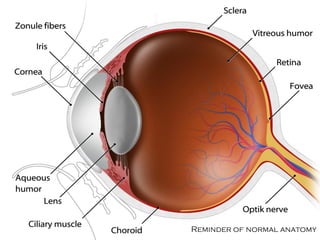
Anatomical basics of
glaucoma

Reminder of normal anatomy
Glaucoma

What is the nature of
this disease?

Of many types of glaucoma –
primary open angle
glaucoma is the most
common
Glaucoma

What is the nature of
this disease?

The pathogenesis of the
primary open angle
glaucoma can be described
like this:
Glaucoma

The nature of the disease
Glaucoma

Actually, the
same goes for
open-angle
glaucoma...

The nature of the disease
Glaucoma

The simple classic explanation of the nature of the disease
Glaucoma

So what is the difference
between two major types?
The level of aquous humor
blockage... In angle-closure type
trabecular meshwork is not
available for humor. In open angle
it is available, though working
badly and sadly.
Glaucoma

So what is the difference
between two major types?
Open angle glaucoma is the most
common form in the European
and African regions.
Angle-closure glaucoma is
characteristic for people of Asian
descent.
Glaucoma

Angle-closure glaucoma scheme
Glaucoma

Classification of
glaucoma

1) open angle / angle-closure
Glaucoma

What are the types of
glaucoma? (2)
Glaucoma can be chronic (and
it usually is), but also it can turn
into acute (one of the biggest
emergencies in
Ophthalmology!)
Glaucoma

What are the types of
glaucoma? (2)

Chronic glaucoma is totally
unremarkable for a physician
and inconspicuous for a
patient
Glaucoma

What are the types of
glaucoma? (2)
Acute glaucoma is the one that
should be very clearly
understood by any doctor.
There’re fulminant forms, that
lead to the blindness during
several hours.
Glaucoma

Types of glaucoma – acute glaucoma attack
Glaucoma

Classification of
glaucoma

1) open angle / angle-closure
2) chronic / acute
Glaucoma

What are the types of
glaucoma? (3)

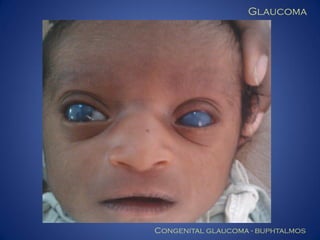
Glaucoma can be either
congenital, or acquired
Glaucoma

Congenital glaucoma - buphtalmos
Glaucoma

Congenital glaucoma - buphtalmos
Glaucoma

Classification of
glaucoma

1) open angle / angle-closure
2) chronic / acute
3) congenital / acquired
Glaucoma

What are the types of
glaucoma? (4)

Glaucoma is always either
primary or secondary
Glaucoma

What are the types of
glaucoma? (4)

For the primary type (either
open angle or angle-closure
glaucoma) - there is no
pre-existing condition.
Glaucoma

What are the types of
glaucoma? (4)
For the secondary type (either
open angle or angle-closure
glaucoma) - there is always
definite pre-existing eye or orbit
disease or systemic condition
Glaucoma

What are the types of
glaucoma? (4)
Secondary open angle glaucoma reasons:
phacolysis, red blood cells, hypertensive
uveitis, pigmentary dispersion,
pseudoexfoliation, neovascularization of
angle, congenital conditions (iridocorneal
endothelial syndrome, sturge-weber
syndrome), carotid-cavernous fistula, trauma
(recession of angle), medications (steroids!)
Glaucoma

Secondary open angle glaucoma – phacolytic
Glaucoma

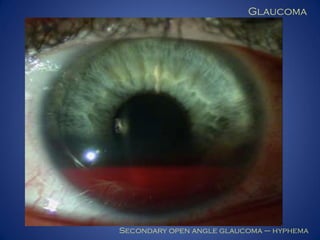
Secondary open angle glaucoma – hyphema
Glaucoma

Secondary open angle glaucoma – bilateral sturge-weber syndrome
Glaucoma

Secondary open angle glaucoma – pseudoexfoliation syndrome
Glaucoma

What are the types of
glaucoma? (4)
Secondary angle-closure
glaucoma reasons: iridocorneal
synechiae (iridocyclitis),
subluxation of a lens, tumors
Glaucoma

Secondary angle-closure glaucoma – posterior synechiae of iris
Glaucoma

What are the types of
glaucoma? (4)
In any case of secondary
glaucoma the IOP is highly
elevated, and it eventually
leads to irriversible optic nerve
damage
Glaucoma

Classification of
glaucoma

1)
2)
3)
4)

open angle / angle-closure
chronic / acute
congenital / acquired
primary / secondary
Glaucoma

What are the signs of
this disease?

Chronic glaucoma at the
beginning is clinically
irrelevant
Glaucoma

What are the signs of
this disease?
During the development of the
chronic disease patiend may
start noticing blurred vision,
and the gradual decrease of
visual field
Glaucoma

What are the signs of
this disease?

Any damage to optic nerve
(including glaucoma)
inevitably leads to visual
field defect
Glaucoma

Visual field deterioration during the glaucoma progression
Glaucoma

What are the signs of
this disease?

False! Typically patients do
not notice these kinds of
defects, if notice any at all!
Glaucoma

What are the signs of
this disease?
The only patient with glaucoma,
who is complaining – is either the
patient with advanced glaucoma
(significant visual acuity
decrease!) or the patient with an
acute glaucoma attack
Glaucoma

What are the signs of
this disease?
In acute glaucoma attack:
-painful eye (+irradiation of pain)
-no discharge, no pus
-blurred vision
-red eye
-fixed dilated pupil
-highly elevated IOP
Glaucoma

What is the diagnostics?
1)
2)
3)
4)

5)
6)

assess family history! Any blinds? Glaucoma is
inheritable!
check visual acuity
check intraocular pressure (at least by palpation!)
check pupillary reactions (are pupils reactive? are
the reactions symmetric?)
perform ophthalmoscopy (if available)
perform confrontational visual field test
Intraocular pressure sometimes
makes the eye “hard as a stone”.
Just touch each eyes with two fingers, palpate it.

Glaucoma

Visual field deterioration during the glaucoma progression
Glaucoma

Visual field simple confrontational test. It allows to detect very rough field
defects
Glaucoma

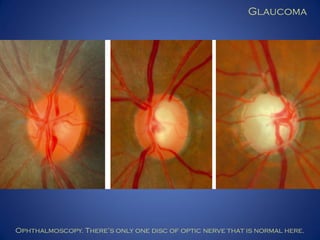
Ophthalmoscopy. There’s only one disc of optic nerve that is normal here.
Glaucoma

What we do in eye
clinics
1)
2)
3)
4)
5)

Basic ophthalmological exam (visual acuity, intraocular
pressure, external exam)
Slit lamp examination of anterior and posterior segment
of the eyeball (gonioscopy and ophthalmoscopy! We’re
looking for angle-closure and “cupping” of the disc)
In certain cases we must perform automated visual field
test with computer
We can perform tomography of optic nerve disc, if optic
tomograph is available
We make an appointment! We see if our treatment
works.
Glaucoma
Tonometry with schiotz
tonometer

Ophthalmoscopy. There’s only one disc of optic nerve that is normal here.
Glaucoma

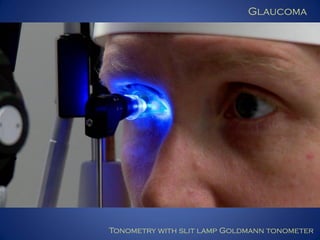
Tonometry with slit lamp Goldmann tonometer
Glaucoma

Gonioscopy with slit lamp and four-mirror contact lens
Glaucoma

How can we stop this
blinding condition?
We should lower intraocular
pressure at least by 30% of initial
point.
This is the only measure now, that
is proven to help such patients.
Glaucoma

How can we stop this
blinding condition?
We use medications (in acute
glaucomas – acetazolamide
p/o; mannitol i/v; in chronic
glaucomas – timolol and
latanoprost eyedrops)
Glaucoma

How can we stop this
blinding condition?

In case medications failed to
stabilize the process – we
move forward to laser or
surgical treatment.
Glaucoma

Can we stop this
blinding condition?
Unfortunately glaucoma continues
progressing even with the best
control of IOP. But the rate of
progression is much slower with
treatment. The prognosis for vision is
satisfactory with treatment and poor
without treatment.
Glaucoma

Can we stop this
blinding condition?
Unfortunately glaucoma continues
progressing even with the best
control of IOP. But the rate of
progression is much slower with
treatment. The prognosis for vision is
satisfactory with treatment and poor
without treatment.

Any questions?

Glaucoma for the students and general practitioners

  • 1.
    What a generalpractitioner should know about Glaucoma Dr. Anthony 20 Dec, 2013
  • 2.
    Glaucoma What is it? Glaucoma– is a disease of optic nerve. It may have a classical sign – elevated intraocular pressure.
  • 3.
    Glaucoma Why is itimportant for you? Glaucoma eventually leads to irreversible blindness if uncontrolled
  • 4.
  • 5.
    Glaucoma Why is itimportant for you? Glaucoma is a silent chronic bilateral sight-killer. Patient usually has NO complaints! And then he goes blind.
  • 6.
    Glaucoma So can wedo at least something with it? Patient has a good chance to live a long happy life with a satisfactory vision, if the disease is caught in time. Yes, you can make a difference.
  • 7.
    Glaucoma What are thetypes of glaucoma? (1) There are two major types: -open angle glaucoma -angle-closure glaucoma
  • 8.
  • 9.
    Glaucoma What is thenature of this disease? Of many types of glaucoma – primary open angle glaucoma is the most common
  • 10.
    Glaucoma What is thenature of this disease? The pathogenesis of the primary open angle glaucoma can be described like this:
  • 11.
  • 12.
    Glaucoma Actually, the same goesfor open-angle glaucoma... The nature of the disease
  • 13.
    Glaucoma The simple classicexplanation of the nature of the disease
  • 14.
    Glaucoma So what isthe difference between two major types? The level of aquous humor blockage... In angle-closure type trabecular meshwork is not available for humor. In open angle it is available, though working badly and sadly.
  • 15.
    Glaucoma So what isthe difference between two major types? Open angle glaucoma is the most common form in the European and African regions. Angle-closure glaucoma is characteristic for people of Asian descent.
  • 16.
  • 17.
  • 18.
    Glaucoma What are thetypes of glaucoma? (2) Glaucoma can be chronic (and it usually is), but also it can turn into acute (one of the biggest emergencies in Ophthalmology!)
  • 19.
    Glaucoma What are thetypes of glaucoma? (2) Chronic glaucoma is totally unremarkable for a physician and inconspicuous for a patient
  • 20.
    Glaucoma What are thetypes of glaucoma? (2) Acute glaucoma is the one that should be very clearly understood by any doctor. There’re fulminant forms, that lead to the blindness during several hours.
  • 21.
    Glaucoma Types of glaucoma– acute glaucoma attack
  • 22.
    Glaucoma Classification of glaucoma 1) openangle / angle-closure 2) chronic / acute
  • 23.
    Glaucoma What are thetypes of glaucoma? (3) Glaucoma can be either congenital, or acquired
  • 24.
  • 25.
  • 26.
    Glaucoma Classification of glaucoma 1) openangle / angle-closure 2) chronic / acute 3) congenital / acquired
  • 27.
    Glaucoma What are thetypes of glaucoma? (4) Glaucoma is always either primary or secondary
  • 28.
    Glaucoma What are thetypes of glaucoma? (4) For the primary type (either open angle or angle-closure glaucoma) - there is no pre-existing condition.
  • 29.
    Glaucoma What are thetypes of glaucoma? (4) For the secondary type (either open angle or angle-closure glaucoma) - there is always definite pre-existing eye or orbit disease or systemic condition
  • 30.
    Glaucoma What are thetypes of glaucoma? (4) Secondary open angle glaucoma reasons: phacolysis, red blood cells, hypertensive uveitis, pigmentary dispersion, pseudoexfoliation, neovascularization of angle, congenital conditions (iridocorneal endothelial syndrome, sturge-weber syndrome), carotid-cavernous fistula, trauma (recession of angle), medications (steroids!)
  • 31.
    Glaucoma Secondary open angleglaucoma – phacolytic
  • 32.
    Glaucoma Secondary open angleglaucoma – hyphema
  • 33.
    Glaucoma Secondary open angleglaucoma – bilateral sturge-weber syndrome
  • 34.
    Glaucoma Secondary open angleglaucoma – pseudoexfoliation syndrome
  • 35.
    Glaucoma What are thetypes of glaucoma? (4) Secondary angle-closure glaucoma reasons: iridocorneal synechiae (iridocyclitis), subluxation of a lens, tumors
  • 36.
    Glaucoma Secondary angle-closure glaucoma– posterior synechiae of iris
  • 37.
    Glaucoma What are thetypes of glaucoma? (4) In any case of secondary glaucoma the IOP is highly elevated, and it eventually leads to irriversible optic nerve damage
  • 38.
    Glaucoma Classification of glaucoma 1) 2) 3) 4) open angle/ angle-closure chronic / acute congenital / acquired primary / secondary
  • 39.
    Glaucoma What are thesigns of this disease? Chronic glaucoma at the beginning is clinically irrelevant
  • 40.
    Glaucoma What are thesigns of this disease? During the development of the chronic disease patiend may start noticing blurred vision, and the gradual decrease of visual field
  • 41.
    Glaucoma What are thesigns of this disease? Any damage to optic nerve (including glaucoma) inevitably leads to visual field defect
  • 42.
    Glaucoma Visual field deteriorationduring the glaucoma progression
  • 43.
    Glaucoma What are thesigns of this disease? False! Typically patients do not notice these kinds of defects, if notice any at all!
  • 44.
    Glaucoma What are thesigns of this disease? The only patient with glaucoma, who is complaining – is either the patient with advanced glaucoma (significant visual acuity decrease!) or the patient with an acute glaucoma attack
  • 45.
    Glaucoma What are thesigns of this disease? In acute glaucoma attack: -painful eye (+irradiation of pain) -no discharge, no pus -blurred vision -red eye -fixed dilated pupil -highly elevated IOP
  • 46.
    Glaucoma What is thediagnostics? 1) 2) 3) 4) 5) 6) assess family history! Any blinds? Glaucoma is inheritable! check visual acuity check intraocular pressure (at least by palpation!) check pupillary reactions (are pupils reactive? are the reactions symmetric?) perform ophthalmoscopy (if available) perform confrontational visual field test
  • 47.
    Intraocular pressure sometimes makesthe eye “hard as a stone”. Just touch each eyes with two fingers, palpate it. Glaucoma Visual field deterioration during the glaucoma progression
  • 48.
    Glaucoma Visual field simpleconfrontational test. It allows to detect very rough field defects
  • 49.
    Glaucoma Ophthalmoscopy. There’s onlyone disc of optic nerve that is normal here.
  • 50.
    Glaucoma What we doin eye clinics 1) 2) 3) 4) 5) Basic ophthalmological exam (visual acuity, intraocular pressure, external exam) Slit lamp examination of anterior and posterior segment of the eyeball (gonioscopy and ophthalmoscopy! We’re looking for angle-closure and “cupping” of the disc) In certain cases we must perform automated visual field test with computer We can perform tomography of optic nerve disc, if optic tomograph is available We make an appointment! We see if our treatment works.
  • 51.
    Glaucoma Tonometry with schiotz tonometer Ophthalmoscopy.There’s only one disc of optic nerve that is normal here.
  • 52.
    Glaucoma Tonometry with slitlamp Goldmann tonometer
  • 53.
    Glaucoma Gonioscopy with slitlamp and four-mirror contact lens
  • 54.
    Glaucoma How can westop this blinding condition? We should lower intraocular pressure at least by 30% of initial point. This is the only measure now, that is proven to help such patients.
  • 55.
    Glaucoma How can westop this blinding condition? We use medications (in acute glaucomas – acetazolamide p/o; mannitol i/v; in chronic glaucomas – timolol and latanoprost eyedrops)
  • 56.
    Glaucoma How can westop this blinding condition? In case medications failed to stabilize the process – we move forward to laser or surgical treatment.
  • 57.
    Glaucoma Can we stopthis blinding condition? Unfortunately glaucoma continues progressing even with the best control of IOP. But the rate of progression is much slower with treatment. The prognosis for vision is satisfactory with treatment and poor without treatment.
  • 58.
    Glaucoma Can we stopthis blinding condition? Unfortunately glaucoma continues progressing even with the best control of IOP. But the rate of progression is much slower with treatment. The prognosis for vision is satisfactory with treatment and poor without treatment. Any questions?