Glaucoma
opthalmology
Glaucoma
 Glaucoma is a disease where the optic
nerve dies.
 Glaucoma is one of the leading causes of blindness in the world., and
patients with acute glaucoma can develop irreversible vision loss within a
few hours, so it is important that you understand how this disease works and
recognize it in your patients.
Glaucoma
 We are not sure why or how this happens but high
intraocular pressure certainly seems to be associated,
as the cause of optic nerve death.
The Aqueous Pathway
Aqueous is the fluid that fills the front
part of the eye, and it is important for
maintaining поддерживать the shape of
the eye and providing nourishment for the
avascular lens and cornea.
The Aqueous Pathway
 Aqueous humor is first produced by the
ciliary body within the posterior
chamber.
 After filling the posterior chamber,
aqueous moves forward around the lens
 and flows through the pupil into the
anterior chamber.
The Aqueous
Pathway
 As the anterior chamber fills, the aqueous spreads outwards into the angle
formed by the iris and cornea. Within this irido-corneal angle the aqueous
exits the eye by filtering through the trabecular meshwork into the Canal of
Schlemm, where it returns back into the blood circulation.
The Aqueous Pathway
The pressure within the eye is
maintained by this steady
state of aqueous production
and egress exits, and it is an
imbalance in this equilibrium
that causes the increased
pressure associated with
glaucoma.
Open vs. Closed-Angle
Glaucoma
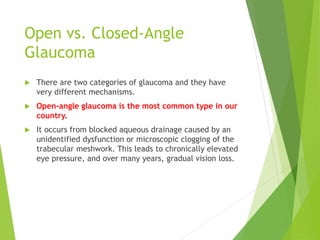
 There are two categories of glaucoma and they have
very different mechanisms.
 Open-angle glaucoma is the most common type in our
country.
 It occurs from blocked aqueous drainage caused by an
unidentified dysfunction or microscopic clogging of the
trabecular meshwork. This leads to chronically elevated
eye pressure, and over many years, gradual vision loss.
closed-angle glaucoma
 This differs from closed-angle glaucoma, also called
“acute glaucoma,” which occurs when the
angle between the cornea and iris closes abruptly. With
this closure, aqueous fluid can’t access the drainage
pathway entirely, causing ocular pressure to increase
rapidly.
 This is an ophthalmological emergency and patients can
lose all vision in their eye within hours.
Let’s examine each of these types of
glaucoma in more detail.
 Open-Angle
Glaucoma
Open-Angle Glaucoma
 The majority of glaucoma
patients (about 80% ) have
chronic open angle glaucoma.
 Most patients are over the age of
40. This condition is more
common in African Americans,
but really anyone can get it.
Risk factors
 The major risk factors are:
 family history
 age
 race
 high eye pressure
 large vertical nerve cupping
 More recently, thin-corneas have been found to be
major.
mechanism for open-angle
glaucoma  The underlying mechanism for open-
angle glaucoma involves
degeneration of the trabecular
meshwork filter, usually by unknown
causes, that leads to aqueous back
up and chronically elevated eye
pressure.
mechanism for open-angle
glaucoma
 With prolonged high pressure, the ganglion nerves in the
retina (the same nerves that form the optic nerve)
atrophy.
 The exact mechanism for this nerve damage is poorly
understood and proposed mechanisms include
stretching, vascular compromise, and glutamate
transmitter pathways.
 As the ganglion nerves are progressively destroyed,
vision is gradually lost.
sneaky thief of sight
 Open-angle glaucoma has the reputation
of being the «sneaky thief of sight»
because the visual loss occurs so slowly
that many patients don't realize they have
the disease until it is far advanced.
open-angle glaucoma
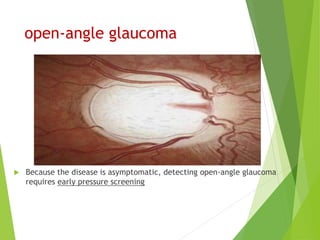
 Because the disease is asymptomatic, detecting open-angle glaucoma
requires early pressure screening
Presentation
 Open-angle glaucoma patients usually present with
three exam findings:
 elevated eye pressure,
 optic disk changes,
 and repeatable visual field loss patterns.
. Pressure
 The gold standard for measuring eye pressure
is with the Goldman applanation tonometer.
 This is a device mounted on the slit-lamp
that measures the force required to flatten a
fixed area of the cornea.
 Normal pressures range from 10 to 22 mm
Hg.
Keep in mind
 That eye pressure can fluctuate throughout the day
(typically highest in the morning) so the pressure should
be checked with each visit and the time of
measurement should be noted.
 Also, some glaucomatous eyes have a “normal”
pressure.
 In other words, a “good pressure” doesn’t rule out
glaucoma, nor does a high pressure necessarily
indicate glaucoma
Device “Tono-Pen”
 You can also measure pressure with a device called a “Tono-Pen.”
 This expensive little gadget is handy for bed-bound patients and down in the
emergency room, though it’s inaccurate in the wrong hands!
Tonometry by
Maklakov
Corneal Thickness can affect your pressure
measurement:
 When we measure the pressure in the eye, we are actually
measuring how much resistance we get when pressing on the
cornea.
 ( This is analogous to kicking a car-tire with your
foot or
pressing your hand against a bicycle tire to estimate
how much air pressure is inside.)
 We do the same thing with the Goldman applanation tonometer
mounted on the slit-lamp - we measure how
 much force it takes to flatten a 3mm diameter area of corneal
 surface.
corneal thickness
 Knowing corneal thickness is important in a
glaucoma clinic
 So we can calibrate the accuracy of our
pressure readings.
 This is why we always check corneal
thickness with an ultrasonic pachymeter
on the first visit.
2. Fundus Exam
 The optic disk looks striking in advanced
glaucoma. In normal patients, the optic disk has
a physiological indentation or “cup” that is less
than one-third the disk diameter.
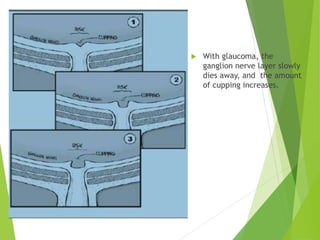
 With glaucoma, the
ganglion nerve layer slowly
dies away, and the amount
of cupping increases.
 The space between the inner cup and
surrounding disk is called the neural rim
and is comprised of the actual retinal
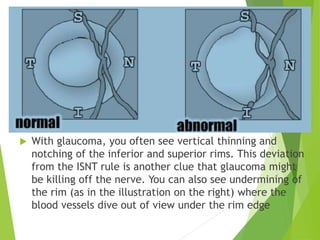
ganglion nerves. In a normal eye, this rim
follows the ISNT rule of decreasing
thickness … meaning that the Inferior rim
is thickest while the Temporal rim is the
skinniest.
 With glaucoma, you often see vertical thinning and
notching of the inferior and superior rims. This deviation
from the ISNT rule is another clue that glaucoma might
be killing off the nerve. You can also see undermining of
the rim (as in the illustration on the right) where the
blood vessels dive out of view under the rim edge
3. Visual Loss:
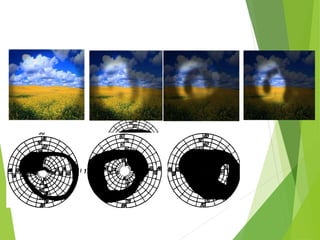
 The vision loss from chronic glaucoma occurs in
 characteristic patterns that can be followed by
automated perimetry (machines that map out the
peripheral vision).
 The central vision is typically spared – in fact, late
stage patients may have 20/20 central vision, but be
otherwise legally blind because of peripheral blindness.
:
Treatment
 Since IOP (intraocular pressure) is the only risk factor
we can treat, the primary treatment of glaucoma
focuses on decreasing eye pressure to less
 than 20 mm Hg or even lower, depending upon the
severity of disease.
 Treatment may be either pharmaceutically or surgically
done.
Medical Treatment
 Topical beta-blockers are the traditional therapy for these patients and have
been around for decades. Beta-blockers work by blocked the sympathetic
nerve endings ,which decreases aqueous humor production at the ciliary
body.(propanalol,carvidalol,labetalol)
 Unfortunately, systemic side effects can occur from nasal absorption, making
it especially important to ask your patients about history ofasthma, COPD,
and cardiac problems.
Medical Treatment
 These days, many physicians are using newer drugs like:
 topical CAIs (AZOPT)- (inhibit the active aqueous
humor secretion by blocking CA in the
nonpigmented ciliary epithelial cells in the ciliary processes.
Systemic acetazolamide decreases aqueous humor secretion
by 30%.)
 Exm:- Cosopt®: Timolol and dorzolamide (beta-
blocker and carbonic anhydrase inhibitor)
 alpha-agonists ( ALPHAGAN)
 prostaglandin analogues (TRAVATAN)
 for first-line therapy,
Prostaglandin analogues
 Prostaglandin analogues like latanoprost (Xalatan™) are
the newest of these glaucoma drugs, and they are very
popular as a first-line agent.
 They work by increasing aqueous humor outflow.
 They do have some side effects, though.
 They can make eyelashes grow longer (many patients
actually like this), and in a few patients may darken
the iris color, turning green and blue eyes brown.
Surgical Treatment for
Chronic Glaucoma
 If eye drops aren’t working, there are several surgical
techniques available to relieve eye pressure.
 One common surgery is the trabeculectomy,
 local anesthesia and light sedation, an
ostium/flap is created into the anterior chamber
from underneath a partial thickness scleral flap to
allow for aqueous flow out of the eye. The
aqueous flows into the subconjunctival space,
TRABECULECTOMY
 A small hole is cut through the superior
limbus, so that aqueous can drain under
the conjunctiva. This can be very effective
in decreasing pressure.
 However, if the patient is a rapid healer
the conjunctiva can scar down, so anti-
metabolites like mitomycin-C are often
applied to the site.
 If this surgery
doesn’t work, a
plastic tube-shunt
can be inserted into
the anterior chamber
that drains to a plate
fixed under the
conjunctiva further
back behind the eye.
Argon laser trabeculoplasty
 Several laser procedures can also help to
 release pressure.
 Argon laser trabeculoplasty (ALT) can be used to burn
portions of the trabecular meshwork itself.
 The resulting scarring opens up the meshwork and
 increases outflow.
 A laser can also be used to burn the ciliary body
 to decrease aqueous production at its source, but this is
usually a last resort.
Causes of angle closed
glaucoma
 Angle-closure glaucoma, or acute glaucoma, is caused
by a sudden and complete blockade of aqueous humor
drainage narrow drainage angle,
Causes (2)
 shallow anterior chamber,
 the lens might get stick to the back of the iris. This
prevents the aqueous humor from flowing through the
pupil into the anterior chamber.
Causes (3)
 Accumulation of fluid in the posterior chamber presses
on the iris causing the blockage of the drainage angle
completely.
Clinical signs
 It often starts with an acute attack
 Pain in the eyes
 Periodic headache
 Blurred vision in the morning
 Midriasis
 WIDE EPISCLERAL VEINS!!
treatment
 Prostaglandins to increase the outflow of the fluid in
your eye
 Beta blockers. These reduce the production of fluid in
your eye (timolol, betaxolol...)
 Drainage tubes by inserting a small tube in your eye.
 laser or
 Surgery to unblock the drainage canals so that the extra
fluid can drain.
Acute Glaucoma
 Acute glaucoma is a medical emergency. The most
common mechanism is pupillary block.
 This occurs when the lens plasters up against the back
of the iris, blocking aqueous flow through the pupil.
This resistance produces a pressure gradient (this is a
good buzz word to memorize) across the iris that forces
the iris and lens to move anteriorly. When the iris moves
forward, the irido-corneal angle closes, blocking the
trabecular meshwork.
 Without an exit pathway, aqueous fluid builds up, eye
pressure increases rapidly, and the optic nerve is
damaged from stretching and decreased blood supply.
 This sequence of events can occur for many reasons,
and people with naturally shallow anterior chambers
such as hyperopes (far-sighted people with small eyes)
and Asians are predisposed to developing angle
 One inciting condition that is typical in acute glaucoma
is pupil dilation --many patients describe onset of their
symptoms occurring while in the dark
 or during stressful situations.
 When the iris dilates, the iris muscle gets
 thicker and the irido-corneal angle becomes smaller,
making it more likely to spontaneously close.
 Along those lines, medications that dilate the eye, such
as over-the-counter antihistamines and cold
medications, also predispose angle closure
Presentation
 A patient in the middle of an acute glaucoma attack will
present with an extremely red and painful eye, often
complaining of nausea and vomiting
 On exam, you’ll find their pupil sluggish and mid-
dilated. Pressures in the affected eye can be very high,
often 60 mm Hg or higher.
 The eye will feel rock hard, and you can actually
palpate the difference between the eyes with your
fingers
 One classic sign that
patients often describe is
seeing halos around lights.
This occurs because the
cornea swells as water is
pushed under high pressure
through the endothelium
into the corneal stroma.
This corneal swelling also
makes it hard for you to
see into the eye, further
complicating diagnosis and
Corneal swelling
 This corneal swelling also makes it hard for you to see into the eye, further
complicating diagnosis and
 treatment.
Acute Glaucoma Exam Techniques:
Ophthalmologic examination
for acute glaucoma
involves:
 measuring the eye
pressure
 accessing the anterior
chamber angle
fundus exam.
 One trick to determine whether an angle is shallow is to shine a simple
penlight across the eyes. If the iris is pushed forward, it will cast a shadow.
Gonioscopy:
 Additionally, an ophthalmologist can visualize the angle
directly through gonioscopy.
 Here’s how it works: Gonioscopy:
 Normally, the inner “iris-cornea angle” cannot be seen
with a microscope because the cornea-air interface
creates "total internal reflection." However,
we can use a goniolens, which is a special glass lens with
mirrors on its sides, to look directly at the angle. When the
glass lens is placed directly onto the cornea, the cornea-air
interface reflection is broken and light from
the angle can escape and be seen through the mirrors
Gonioscopy:
Acute Glaucoma Treatment
 In cases of acute glaucoma, you want to decrease the
pressure in the eye as quickly as possible.
 1. You can decrease aqueous production using a topical
beta-blocker like Timolol and a carbonic anhydrase
inhibitor like Diamox.
 2.Also, osmotic agents such as oral glycerin or IV mannitol
can be given systemically to draw тяга fluid out of the eye
and back into the bloodstream.
 3. Finally, a miotic such as pilocarpine may be helpful in
certain
 cases to constrict the pupil and thus open up the outflow
angle.
 4.You can also use topical glycerin to transiently
dehydrate/clear the cornea to aid with examination.
Laser treatment(laser iridotomy)
 Ultimately, these patients need
surgical treatment to avoid
recurrence of their angle closure. A
high intensity laser can burn a hole
through the iris and create a
communication between the
 posterior and anterior chambers.
This relieves the pressure gradient
across the iris, and allows it to move
back into a normal position.

Glaucoma,topic 4 presentation

  • 1.
  • 2.
    Glaucoma  Glaucoma isa disease where the optic nerve dies.  Glaucoma is one of the leading causes of blindness in the world., and patients with acute glaucoma can develop irreversible vision loss within a few hours, so it is important that you understand how this disease works and recognize it in your patients.
  • 3.
    Glaucoma  We arenot sure why or how this happens but high intraocular pressure certainly seems to be associated, as the cause of optic nerve death.
  • 4.
    The Aqueous Pathway Aqueousis the fluid that fills the front part of the eye, and it is important for maintaining поддерживать the shape of the eye and providing nourishment for the avascular lens and cornea.
  • 5.
    The Aqueous Pathway Aqueous humor is first produced by the ciliary body within the posterior chamber.  After filling the posterior chamber, aqueous moves forward around the lens  and flows through the pupil into the anterior chamber.
  • 6.
    The Aqueous Pathway  Asthe anterior chamber fills, the aqueous spreads outwards into the angle formed by the iris and cornea. Within this irido-corneal angle the aqueous exits the eye by filtering through the trabecular meshwork into the Canal of Schlemm, where it returns back into the blood circulation.
  • 7.
    The Aqueous Pathway Thepressure within the eye is maintained by this steady state of aqueous production and egress exits, and it is an imbalance in this equilibrium that causes the increased pressure associated with glaucoma.
  • 8.
    Open vs. Closed-Angle Glaucoma There are two categories of glaucoma and they have very different mechanisms.  Open-angle glaucoma is the most common type in our country.  It occurs from blocked aqueous drainage caused by an unidentified dysfunction or microscopic clogging of the trabecular meshwork. This leads to chronically elevated eye pressure, and over many years, gradual vision loss.
  • 9.
    closed-angle glaucoma  Thisdiffers from closed-angle glaucoma, also called “acute glaucoma,” which occurs when the angle between the cornea and iris closes abruptly. With this closure, aqueous fluid can’t access the drainage pathway entirely, causing ocular pressure to increase rapidly.  This is an ophthalmological emergency and patients can lose all vision in their eye within hours.
  • 10.
    Let’s examine eachof these types of glaucoma in more detail.  Open-Angle Glaucoma
  • 11.
    Open-Angle Glaucoma  Themajority of glaucoma patients (about 80% ) have chronic open angle glaucoma.  Most patients are over the age of 40. This condition is more common in African Americans, but really anyone can get it.
  • 12.
    Risk factors  Themajor risk factors are:  family history  age  race  high eye pressure  large vertical nerve cupping  More recently, thin-corneas have been found to be major.
  • 13.
    mechanism for open-angle glaucoma The underlying mechanism for open- angle glaucoma involves degeneration of the trabecular meshwork filter, usually by unknown causes, that leads to aqueous back up and chronically elevated eye pressure.
  • 14.
    mechanism for open-angle glaucoma With prolonged high pressure, the ganglion nerves in the retina (the same nerves that form the optic nerve) atrophy.  The exact mechanism for this nerve damage is poorly understood and proposed mechanisms include stretching, vascular compromise, and glutamate transmitter pathways.  As the ganglion nerves are progressively destroyed, vision is gradually lost.
  • 15.
    sneaky thief ofsight  Open-angle glaucoma has the reputation of being the «sneaky thief of sight» because the visual loss occurs so slowly that many patients don't realize they have the disease until it is far advanced.
  • 16.
    open-angle glaucoma  Becausethe disease is asymptomatic, detecting open-angle glaucoma requires early pressure screening
  • 17.
    Presentation  Open-angle glaucomapatients usually present with three exam findings:  elevated eye pressure,  optic disk changes,  and repeatable visual field loss patterns.
  • 18.
    . Pressure  Thegold standard for measuring eye pressure is with the Goldman applanation tonometer.  This is a device mounted on the slit-lamp that measures the force required to flatten a fixed area of the cornea.  Normal pressures range from 10 to 22 mm Hg.
  • 20.
    Keep in mind That eye pressure can fluctuate throughout the day (typically highest in the morning) so the pressure should be checked with each visit and the time of measurement should be noted.  Also, some glaucomatous eyes have a “normal” pressure.  In other words, a “good pressure” doesn’t rule out glaucoma, nor does a high pressure necessarily indicate glaucoma
  • 21.
    Device “Tono-Pen”  Youcan also measure pressure with a device called a “Tono-Pen.”  This expensive little gadget is handy for bed-bound patients and down in the emergency room, though it’s inaccurate in the wrong hands!
  • 23.
  • 24.
    Corneal Thickness canaffect your pressure measurement:  When we measure the pressure in the eye, we are actually measuring how much resistance we get when pressing on the cornea.  ( This is analogous to kicking a car-tire with your foot or pressing your hand against a bicycle tire to estimate how much air pressure is inside.)  We do the same thing with the Goldman applanation tonometer mounted on the slit-lamp - we measure how  much force it takes to flatten a 3mm diameter area of corneal  surface.
  • 25.
    corneal thickness  Knowingcorneal thickness is important in a glaucoma clinic  So we can calibrate the accuracy of our pressure readings.  This is why we always check corneal thickness with an ultrasonic pachymeter on the first visit.
  • 26.
    2. Fundus Exam The optic disk looks striking in advanced glaucoma. In normal patients, the optic disk has a physiological indentation or “cup” that is less than one-third the disk diameter.
  • 27.
     With glaucoma,the ganglion nerve layer slowly dies away, and the amount of cupping increases.
  • 28.
     The spacebetween the inner cup and surrounding disk is called the neural rim and is comprised of the actual retinal ganglion nerves. In a normal eye, this rim follows the ISNT rule of decreasing thickness … meaning that the Inferior rim is thickest while the Temporal rim is the skinniest.
  • 29.
     With glaucoma,you often see vertical thinning and notching of the inferior and superior rims. This deviation from the ISNT rule is another clue that glaucoma might be killing off the nerve. You can also see undermining of the rim (as in the illustration on the right) where the blood vessels dive out of view under the rim edge
  • 30.
    3. Visual Loss: The vision loss from chronic glaucoma occurs in  characteristic patterns that can be followed by automated perimetry (machines that map out the peripheral vision).  The central vision is typically spared – in fact, late stage patients may have 20/20 central vision, but be otherwise legally blind because of peripheral blindness.
  • 33.
    : Treatment  Since IOP(intraocular pressure) is the only risk factor we can treat, the primary treatment of glaucoma focuses on decreasing eye pressure to less  than 20 mm Hg or even lower, depending upon the severity of disease.  Treatment may be either pharmaceutically or surgically done.
  • 34.
    Medical Treatment  Topicalbeta-blockers are the traditional therapy for these patients and have been around for decades. Beta-blockers work by blocked the sympathetic nerve endings ,which decreases aqueous humor production at the ciliary body.(propanalol,carvidalol,labetalol)  Unfortunately, systemic side effects can occur from nasal absorption, making it especially important to ask your patients about history ofasthma, COPD, and cardiac problems.
  • 35.
    Medical Treatment  Thesedays, many physicians are using newer drugs like:  topical CAIs (AZOPT)- (inhibit the active aqueous humor secretion by blocking CA in the nonpigmented ciliary epithelial cells in the ciliary processes. Systemic acetazolamide decreases aqueous humor secretion by 30%.)  Exm:- Cosopt®: Timolol and dorzolamide (beta- blocker and carbonic anhydrase inhibitor)  alpha-agonists ( ALPHAGAN)  prostaglandin analogues (TRAVATAN)  for first-line therapy,
  • 36.
    Prostaglandin analogues  Prostaglandinanalogues like latanoprost (Xalatan™) are the newest of these glaucoma drugs, and they are very popular as a first-line agent.  They work by increasing aqueous humor outflow.  They do have some side effects, though.  They can make eyelashes grow longer (many patients actually like this), and in a few patients may darken the iris color, turning green and blue eyes brown.
  • 37.
    Surgical Treatment for ChronicGlaucoma  If eye drops aren’t working, there are several surgical techniques available to relieve eye pressure.  One common surgery is the trabeculectomy,  local anesthesia and light sedation, an ostium/flap is created into the anterior chamber from underneath a partial thickness scleral flap to allow for aqueous flow out of the eye. The aqueous flows into the subconjunctival space,
  • 38.
    TRABECULECTOMY  A smallhole is cut through the superior limbus, so that aqueous can drain under the conjunctiva. This can be very effective in decreasing pressure.  However, if the patient is a rapid healer the conjunctiva can scar down, so anti- metabolites like mitomycin-C are often applied to the site.
  • 39.
     If thissurgery doesn’t work, a plastic tube-shunt can be inserted into the anterior chamber that drains to a plate fixed under the conjunctiva further back behind the eye.
  • 40.
    Argon laser trabeculoplasty Several laser procedures can also help to  release pressure.  Argon laser trabeculoplasty (ALT) can be used to burn portions of the trabecular meshwork itself.  The resulting scarring opens up the meshwork and  increases outflow.  A laser can also be used to burn the ciliary body  to decrease aqueous production at its source, but this is usually a last resort.
  • 41.
    Causes of angleclosed glaucoma  Angle-closure glaucoma, or acute glaucoma, is caused by a sudden and complete blockade of aqueous humor drainage narrow drainage angle,
  • 42.
    Causes (2)  shallowanterior chamber,  the lens might get stick to the back of the iris. This prevents the aqueous humor from flowing through the pupil into the anterior chamber.
  • 43.
    Causes (3)  Accumulationof fluid in the posterior chamber presses on the iris causing the blockage of the drainage angle completely.
  • 44.
    Clinical signs  Itoften starts with an acute attack  Pain in the eyes  Periodic headache  Blurred vision in the morning  Midriasis  WIDE EPISCLERAL VEINS!!
  • 45.
    treatment  Prostaglandins toincrease the outflow of the fluid in your eye  Beta blockers. These reduce the production of fluid in your eye (timolol, betaxolol...)  Drainage tubes by inserting a small tube in your eye.  laser or  Surgery to unblock the drainage canals so that the extra fluid can drain.
  • 46.
    Acute Glaucoma  Acuteglaucoma is a medical emergency. The most common mechanism is pupillary block.  This occurs when the lens plasters up against the back of the iris, blocking aqueous flow through the pupil. This resistance produces a pressure gradient (this is a good buzz word to memorize) across the iris that forces the iris and lens to move anteriorly. When the iris moves forward, the irido-corneal angle closes, blocking the trabecular meshwork.  Without an exit pathway, aqueous fluid builds up, eye pressure increases rapidly, and the optic nerve is damaged from stretching and decreased blood supply.
  • 47.
     This sequenceof events can occur for many reasons, and people with naturally shallow anterior chambers such as hyperopes (far-sighted people with small eyes) and Asians are predisposed to developing angle
  • 48.
     One incitingcondition that is typical in acute glaucoma is pupil dilation --many patients describe onset of their symptoms occurring while in the dark  or during stressful situations.
  • 49.
     When theiris dilates, the iris muscle gets  thicker and the irido-corneal angle becomes smaller, making it more likely to spontaneously close.  Along those lines, medications that dilate the eye, such as over-the-counter antihistamines and cold medications, also predispose angle closure
  • 50.
    Presentation  A patientin the middle of an acute glaucoma attack will present with an extremely red and painful eye, often complaining of nausea and vomiting
  • 51.
     On exam,you’ll find their pupil sluggish and mid- dilated. Pressures in the affected eye can be very high, often 60 mm Hg or higher.  The eye will feel rock hard, and you can actually palpate the difference between the eyes with your fingers
  • 52.
     One classicsign that patients often describe is seeing halos around lights. This occurs because the cornea swells as water is pushed under high pressure through the endothelium into the corneal stroma. This corneal swelling also makes it hard for you to see into the eye, further complicating diagnosis and Corneal swelling
  • 53.
     This cornealswelling also makes it hard for you to see into the eye, further complicating diagnosis and  treatment.
  • 54.
    Acute Glaucoma ExamTechniques: Ophthalmologic examination for acute glaucoma involves:  measuring the eye pressure  accessing the anterior chamber angle fundus exam.
  • 55.
     One trickto determine whether an angle is shallow is to shine a simple penlight across the eyes. If the iris is pushed forward, it will cast a shadow.
  • 56.
    Gonioscopy:  Additionally, anophthalmologist can visualize the angle directly through gonioscopy.  Here’s how it works: Gonioscopy:  Normally, the inner “iris-cornea angle” cannot be seen with a microscope because the cornea-air interface creates "total internal reflection." However, we can use a goniolens, which is a special glass lens with mirrors on its sides, to look directly at the angle. When the glass lens is placed directly onto the cornea, the cornea-air interface reflection is broken and light from the angle can escape and be seen through the mirrors
  • 57.
  • 58.
    Acute Glaucoma Treatment In cases of acute glaucoma, you want to decrease the pressure in the eye as quickly as possible.  1. You can decrease aqueous production using a topical beta-blocker like Timolol and a carbonic anhydrase inhibitor like Diamox.  2.Also, osmotic agents such as oral glycerin or IV mannitol can be given systemically to draw тяга fluid out of the eye and back into the bloodstream.  3. Finally, a miotic such as pilocarpine may be helpful in certain  cases to constrict the pupil and thus open up the outflow angle.  4.You can also use topical glycerin to transiently dehydrate/clear the cornea to aid with examination.
  • 59.
    Laser treatment(laser iridotomy) Ultimately, these patients need surgical treatment to avoid recurrence of their angle closure. A high intensity laser can burn a hole through the iris and create a communication between the  posterior and anterior chambers. This relieves the pressure gradient across the iris, and allows it to move back into a normal position.