By. Chittranjan kumar 
Enternship
Def of lacrimal Apparatus 
It is physiological system has 
formation and drainage also give nurshiment 
to cornea with help of tear 
HENCE 
Any occlusion or defect in lacrimal 
drainage detected to a investigation is called 
lacrimal syringing. 
Syringing is the method to test the 
structural integrity of lacrimal drainage system 
.
ANATOMY OF THE LACRIMAL 
DRAINAGE SYSTEM 
 Puncta 
One punctum is present at the medial 
end of both the superior and inferior lid. 
 Vertical canaliculus 
This is about 2mm long and joins the 
horizontal canaliculus at a right angle 
called the ampulla.
 Horizontal canaliculus 
This is about 8mm long and usually joins 
its fellow to form the common 
canaliculus 
 (Naso)lacrimal sac 
This is about lOmm long and 
funnels into the nasolacrimal duct. 
 Nasolacrimal duct 
This is about l2mm long and 
opens into the inferior nasal meatus The 
Valve of Hasner closes the
 Most common blockage is at junction 
of sac and NLD near valve of 
haustner . 
 Syringing should be done with lower 
canaliculus .
PHYSIOLOGY OF THE LACRIMAL 
DRAINAGE SYSTEM 
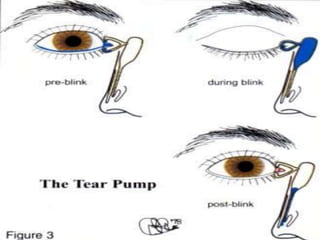
Pre –blink :- 
Tear spread on the globe 
Like Tear Meniscus 
During blink:- 
On blinking, the attachment of the 
preseptal orbicularis muscle helps create 
positive and negative pressure. 
Due to pressure in the lacrimal sac 
which sucks the tears. 
This is called the tear pump. 
Post-blink:- 
Gravity then helps keep the sac empty.
PHYSIOLOGY OF THE LACRIMAL DRAINAGE 
SYSTEM 
Pre Blink 
Tear spread on the Globe 
During Blink 
Post Blink 
Like tear Meniscus 
Lacrimal sac suck the tear 
Empty the lacrimal Sac 
Tear meniscus 
Known as 
Tear pump
Lacrimal punctum Dialatation 
Vertically Dialatation 
Horizontally Dialatation
Lacrimal syringing
No Regurgitation Regurgitation with 
pus other punctum 
Regurgitation other 
punctum clear without 
delay 
Regurgitation 
same punctum 
Passage patent 
Sac NLD junction block 
Common canaliculus 
block 
Same canali block 
Interpretation
EQUIPMENT REQUIRED 
 Lacrimal punctum dilator 
 lacrimal cannulae 
 3 or 5m1 disposable sterile syringes 
 Anaesthetic drops, e.g. 4% xylocaine 
 cotton 
 Normal saline/ Ringer lacted 
 antibiotic solution 
 pt Better to supine position
Importance of syringing 
 One of the most 
important prior to intra ocular 
surgery . 
 If syringing is abnormal 
first the surgery of lacrimal sac 
is required before cataract 
surgery otherwise infection can 
reach intra ocular causing . 
Endopthalmitis
Diseases of lacrimal sac 
 Dacryocystitis 
Inflammation of Lacrimal sac is 
not uncommon condition may occur in 
two form 
- Congenital Dacrycystitis 
Occurs in new born infant. 
- Adult Dacrycystitis
Surgery of Lacrimal sac 
Dacryocystorhinostomy(DCR) 
Re stablishes the lacrimal 
drainage. 
Dacryostectomy (DCT) 
Removal of lacrimal sac.
THANKS 
FOR 
YOUR 
ATTENTION 
Prepared by : Chittranjan kumar 
DOT final yaer

Lacrimal sac syringing

  • 1.
  • 2.
    Def of lacrimalApparatus It is physiological system has formation and drainage also give nurshiment to cornea with help of tear HENCE Any occlusion or defect in lacrimal drainage detected to a investigation is called lacrimal syringing. Syringing is the method to test the structural integrity of lacrimal drainage system .
  • 3.
    ANATOMY OF THELACRIMAL DRAINAGE SYSTEM  Puncta One punctum is present at the medial end of both the superior and inferior lid.  Vertical canaliculus This is about 2mm long and joins the horizontal canaliculus at a right angle called the ampulla.
  • 4.
     Horizontal canaliculus This is about 8mm long and usually joins its fellow to form the common canaliculus  (Naso)lacrimal sac This is about lOmm long and funnels into the nasolacrimal duct.  Nasolacrimal duct This is about l2mm long and opens into the inferior nasal meatus The Valve of Hasner closes the
  • 5.
     Most commonblockage is at junction of sac and NLD near valve of haustner .  Syringing should be done with lower canaliculus .
  • 7.
    PHYSIOLOGY OF THELACRIMAL DRAINAGE SYSTEM Pre –blink :- Tear spread on the globe Like Tear Meniscus During blink:- On blinking, the attachment of the preseptal orbicularis muscle helps create positive and negative pressure. Due to pressure in the lacrimal sac which sucks the tears. This is called the tear pump. Post-blink:- Gravity then helps keep the sac empty.
  • 8.
    PHYSIOLOGY OF THELACRIMAL DRAINAGE SYSTEM Pre Blink Tear spread on the Globe During Blink Post Blink Like tear Meniscus Lacrimal sac suck the tear Empty the lacrimal Sac Tear meniscus Known as Tear pump
  • 9.
    Lacrimal punctum Dialatation Vertically Dialatation Horizontally Dialatation
  • 10.
  • 11.
    No Regurgitation Regurgitationwith pus other punctum Regurgitation other punctum clear without delay Regurgitation same punctum Passage patent Sac NLD junction block Common canaliculus block Same canali block Interpretation
  • 12.
    EQUIPMENT REQUIRED Lacrimal punctum dilator  lacrimal cannulae  3 or 5m1 disposable sterile syringes  Anaesthetic drops, e.g. 4% xylocaine  cotton  Normal saline/ Ringer lacted  antibiotic solution  pt Better to supine position
  • 13.
    Importance of syringing  One of the most important prior to intra ocular surgery .  If syringing is abnormal first the surgery of lacrimal sac is required before cataract surgery otherwise infection can reach intra ocular causing . Endopthalmitis
  • 14.
    Diseases of lacrimalsac  Dacryocystitis Inflammation of Lacrimal sac is not uncommon condition may occur in two form - Congenital Dacrycystitis Occurs in new born infant. - Adult Dacrycystitis
  • 15.
    Surgery of Lacrimalsac Dacryocystorhinostomy(DCR) Re stablishes the lacrimal drainage. Dacryostectomy (DCT) Removal of lacrimal sac.
  • 16.
    THANKS FOR YOUR ATTENTION Prepared by : Chittranjan kumar DOT final yaer