MOUNTAIN BUILDING
THEORY
Bhagyashri
GEOSYNCLINE
 LONG, NARROW, SHALLOW DIPRESSIONS OF WATER.
 CHARACTERIZED BY GRADUAL SEDIMENTATION AND SUBSISDENCES.
 LOCATION, SHAPE, DIMENSION, AND EXTENT OF GEOSYNCLINE IS CONSIDERABLY
CHANGED DUE TO EARTH MOVEMENT AND GEOLOGICAL PROCESS.
 MOBILE ZONE OF WATER
 GEOSYCLINE ARE BORDERED BY TWO RIGID MASSES
STAGES OF GEOSYNCLINES
 DIVIDED INTO THREE STAGES:
 LITHOGENSIS: STAGE OF CREATION OF GEOSYNCLINES, SEDIMENTATION
AND SUBSIDENCE OF THE BEDS OF GEOSYNCLINE.
 OROGENESIS: THE STAGE OF SQUEEZING AND FOLDING OF GEOSYNCLINE
SEDIMENTS INTO MOUNTAIN RANGES.
 GLIPTOGENESIS: THE STAGE OF GRADUL RISE OF MOUNTAINS, AND THEIR
DENUDATION AND CONSEQUENTT LOWERING OF THEIR HIEGHTS
THEORIES OF MOUNTAIN BUILDING
 GEOSYNCLINE OROGEN THEORRY OF KOBER:
 OBJECTIVE OF THEORY:
To establish relationship between ancient rigid masses or tablelands and more
mobile zones or geosynclines, which he called orogen.
 OROGENETIC FORCE:
Theory is based on the force of contraction produced by the cooling of the earth.
BASE OF THE THEORY
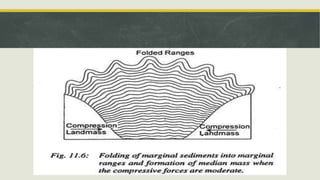
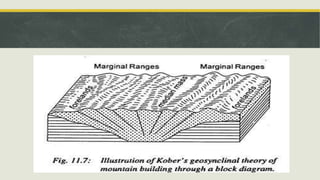
 Mobile zones of water : geosynclines or orogen (the place of mountain building).
 These mobile zones of geosynclines were surrounded by rigid masses which
were termed by Kober as kratogen / Foreland.
 This unfolded middle portion is called zwischengebirge.
 MARGINAL RANGE: Randketten
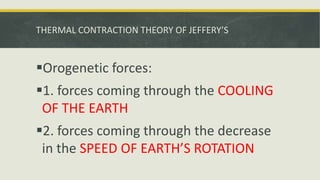
THERMAL CONTRACTION THEORY OF JEFFERY’S
Orogenetic forces:
1. forces coming through the COOLING
OF THE EARTH
2. forces coming through the decrease
in the SPEED OF EARTH’S ROTATION
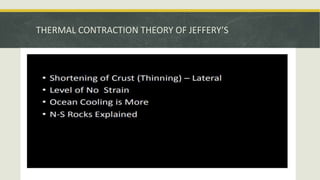
THERMAL CONTRACTION THEORY OF JEFFERY’S
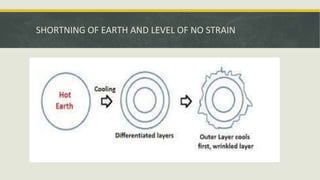
SHORTNING OF EARTH AND LEVEL OF NO STRAIN
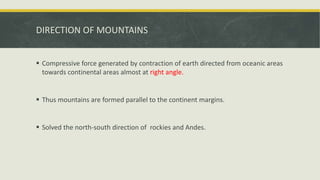
DIRECTION OF MOUNTAINS
 Compressive force generated by contraction of earth directed from oceanic areas
towards continental areas almost at right angle.
 Thus mountains are formed parallel to the continent margins.
 Solved the north-south direction of rockies and Andes.
RADIOACTIVE THEORY OF JOLY
 The driving force of the mountain building as invoked by Joly is provided by
expansion and contraction of the substratum of the earth resulting into
transgressional and regressional phases of the seas (geosynclines).
 The expansion and contraction of the substratum are based on the mechanism of
heat generated by radioactive elements of the rocks.
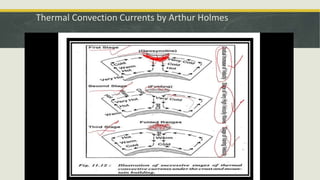
 Holmes used radioactive elements to explain the origin of thermal convective
currents in the substratum while Joly used them to explain the melting and re-
solidification of the substratum.
RADIOACTIVE THEORY OF JOLY
 continents are made of lighter sialic materials the density of which is 2.67 while
the oceanic beds are formed of heavier materials of sima having average density
of 3.0.
 Rocks of the earth contain radioactive elements but their distribution is not uni-
form in all zones of the earth.
 Radioactive elements are found in abundance in the continental rocks
 The rocks of sima forming the oceanic crusts are less radioactive.
 Production of heat is comparatively higher in the continental crust because of
more radioactive elements than the oceanic beds.
 There is no large-scale accumulation of heat in the continental crust due to
continuous loss of heat through radiation.
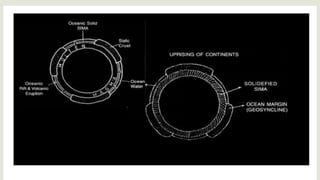
 Retention of heat below SIMA due to radioactivity and lack of thermal gradient
b/w SIMA and SIAL
 Melting -> Expansion
Melting of Substratum -> Max Expansion –
Transgressional Sea
Re-solidification of Substratum -> Max
Contraction – Regressional Sea
CONCLUSION
 Thus, contracting beds of two oceans exert
lateral compression on the sediments deposited
on the continental margins (geosynclines),
consequently the sediments deposited during
the period of transgressional sea are squeezed,
buckled and folded and thus mountains are
formed.
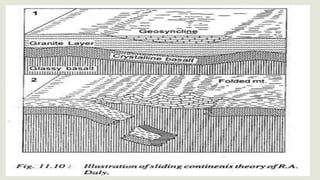
Continent Sliding Hypothesis of Mountain Building of Daly
 The main force implied by Daly: the force of gravity
 there has been downhill sliding movement of continental masses.
Thermal Convection Currents by Arthur Holmes

Mountain building theory

  • 1.
  • 2.
    GEOSYNCLINE  LONG, NARROW,SHALLOW DIPRESSIONS OF WATER.  CHARACTERIZED BY GRADUAL SEDIMENTATION AND SUBSISDENCES.  LOCATION, SHAPE, DIMENSION, AND EXTENT OF GEOSYNCLINE IS CONSIDERABLY CHANGED DUE TO EARTH MOVEMENT AND GEOLOGICAL PROCESS.  MOBILE ZONE OF WATER  GEOSYCLINE ARE BORDERED BY TWO RIGID MASSES
  • 3.
    STAGES OF GEOSYNCLINES DIVIDED INTO THREE STAGES:  LITHOGENSIS: STAGE OF CREATION OF GEOSYNCLINES, SEDIMENTATION AND SUBSIDENCE OF THE BEDS OF GEOSYNCLINE.  OROGENESIS: THE STAGE OF SQUEEZING AND FOLDING OF GEOSYNCLINE SEDIMENTS INTO MOUNTAIN RANGES.  GLIPTOGENESIS: THE STAGE OF GRADUL RISE OF MOUNTAINS, AND THEIR DENUDATION AND CONSEQUENTT LOWERING OF THEIR HIEGHTS
  • 4.
    THEORIES OF MOUNTAINBUILDING  GEOSYNCLINE OROGEN THEORRY OF KOBER:  OBJECTIVE OF THEORY: To establish relationship between ancient rigid masses or tablelands and more mobile zones or geosynclines, which he called orogen.  OROGENETIC FORCE: Theory is based on the force of contraction produced by the cooling of the earth.
  • 5.
    BASE OF THETHEORY  Mobile zones of water : geosynclines or orogen (the place of mountain building).  These mobile zones of geosynclines were surrounded by rigid masses which were termed by Kober as kratogen / Foreland.  This unfolded middle portion is called zwischengebirge.  MARGINAL RANGE: Randketten
  • 8.
    THERMAL CONTRACTION THEORYOF JEFFERY’S Orogenetic forces: 1. forces coming through the COOLING OF THE EARTH 2. forces coming through the decrease in the SPEED OF EARTH’S ROTATION
  • 9.
  • 10.
    SHORTNING OF EARTHAND LEVEL OF NO STRAIN
  • 11.
    DIRECTION OF MOUNTAINS Compressive force generated by contraction of earth directed from oceanic areas towards continental areas almost at right angle.  Thus mountains are formed parallel to the continent margins.  Solved the north-south direction of rockies and Andes.
  • 13.
    RADIOACTIVE THEORY OFJOLY  The driving force of the mountain building as invoked by Joly is provided by expansion and contraction of the substratum of the earth resulting into transgressional and regressional phases of the seas (geosynclines).  The expansion and contraction of the substratum are based on the mechanism of heat generated by radioactive elements of the rocks.  Holmes used radioactive elements to explain the origin of thermal convective currents in the substratum while Joly used them to explain the melting and re- solidification of the substratum.
  • 14.
    RADIOACTIVE THEORY OFJOLY  continents are made of lighter sialic materials the density of which is 2.67 while the oceanic beds are formed of heavier materials of sima having average density of 3.0.  Rocks of the earth contain radioactive elements but their distribution is not uni- form in all zones of the earth.  Radioactive elements are found in abundance in the continental rocks  The rocks of sima forming the oceanic crusts are less radioactive.
  • 15.
     Production ofheat is comparatively higher in the continental crust because of more radioactive elements than the oceanic beds.  There is no large-scale accumulation of heat in the continental crust due to continuous loss of heat through radiation.  Retention of heat below SIMA due to radioactivity and lack of thermal gradient b/w SIMA and SIAL  Melting -> Expansion
  • 16.
    Melting of Substratum-> Max Expansion – Transgressional Sea Re-solidification of Substratum -> Max Contraction – Regressional Sea
  • 18.
    CONCLUSION  Thus, contractingbeds of two oceans exert lateral compression on the sediments deposited on the continental margins (geosynclines), consequently the sediments deposited during the period of transgressional sea are squeezed, buckled and folded and thus mountains are formed.
  • 19.
    Continent Sliding Hypothesisof Mountain Building of Daly  The main force implied by Daly: the force of gravity  there has been downhill sliding movement of continental masses.
  • 21.