Global J. Environ. Sci. Manage., 2(1): 87-93, Winter 2016
87
ABSTRACT: The major aim of the present study was to investigate elements (Fe, Ni, Pb, V, Zn) concentration in
sediment and different tissues of Phragmities australis and Typha latifolia in Hor al-Azim Wetland southwest of Iran.
Sampling of sediments and aquatic plants was carried out during spring and summer 2014. Results showed that the
mean concentrations of chemical elements in Phragmities australis in root and stem-leaf were as follows: iron: 4448
mg/kg, nickel: 28 mg/kg, lead: 8 mg/kg, vanadium: 10 mg/kg and zinc: 15.5 mg/kg in root and Iron: 645 mg/kg, nickel:
15 mg/kg, lead: 4 mg/kg, vanadium: 4 mg/kg and zinc 16 mg/kg respectively. Also, the mean concentrations of iron,
nickel, lead, vanadium and zinc in roots of Typha latifolia were 8696 mg/kg, 34 mg/kg, 5 mg/kg, 19 mg/kg and 27 mg/
kg respectively. The mean concentrations of iron, nickel, vanadium, lead and zinc in stem-leaves of Typha latifolia
were as follows: 321 mg/kg, 3 mg/kg, 7 mg/kg, 2 mg/kg and 14 mg/kg respectively. The mean concentrations of iron,
nickel, vanadium, lead and zinc were as: 40991 mg/kg, 65 mg/kg, 60 mg/kg, 31 mg/kg and 60 mg/kg respectively in
surface sediment of the study area. Concentration pattern of the elements in sediment were as: Fe>Ni>Zn>V>Pb.
The highest concentration of the elements in the plant was seen in the roots. Also, Typha latifolia can uptake more
concentration of elements than Phragmities australis. Based on the enrichment factor, nickel in summer had the
highest enrichment factor values among the elements studied and it has a moderate enrichment.
KEYWORDS: Elements; Enrichment factor; Hor al-Azim Wetland; Phragmities australis; Typha latifolia.
Global J. Environ. Sci. Manage., 2(1): 87-93, Winter 2016
DOI: 10.7508/gjesm.2016.01.010
*Corresponding author E-mail address:
azamhosseini.srb@gmail.com
Tel: (+98) 912 612 9263; Fax: (+98) 613 320 7329.
Note. Discussion period for this manuscript open until March
1, 2016 on GJESM website at the “Show Article”.
Investigation on concentration of elements in wetland sediments and
aquatic plants
H. Janadeleh1
, A. Hosseini Alhashemi1,*
, S.M.B. Nabavi2
1
Department of Environmental Science, Ahvaz Branch, Islamic Azad University, Ahvaz, Iran
2
Department of Marine Biology, Faculty of Marine Science, Khorramshahr University of Marine
Science and Technology, Khorramshahr, Iran
INTRODUCTION
Chemical elements are ubiquitous, highly persistent,
and non-biodegradable with long biological half-lives
and they can accumulate in soils at environmentally
hazardous levels (Burger et al., 2007; Mensi et al., 2008;
Murugesan et al., 2008; Uba et al., 2009; Nouri et al.,
2009; Ahmad et al., 2010; Sekhavatjou et al., 2010).
elements in essential and non-essential forms
accumulate in nature especially in sediments
(Fairbrother et al., 2007; Karbassi et al., 2007; Priju and
Narayana, 2007; Karbassi et al., 2008; Muchaa et al.,
2008; Mazeja and Germb, 2009;Venugopal et al.,2009).
The toxicity of chemical elements is highly influenced
by geochemical factors that influence element
bioavailability (Fairbrother et al., 2007). Wetlands
represent some of the most productive habitat on earth.
They are often referred to as “nature’s kidneys”
because of their ability to filter, metabolize, and
sequester nutrients and metals. Wetlands have been
applied for use as a flood control mechanism, as filters
for removing toxic elements from aquatic ecosystems,
treating urban storm water runoff, and purifying
municipal wastewater (Kadlec and Knight, 1996). There
are basically three reservoirs of elements in a wetland
ecosystem: water, sediment, and biotic components.
Received 20 August 2015; revised 1 September 2015; accepted 13 October 2015; available online 1 December 2015
ORIGINAL RESEARCH PAPER
Global J. Environ. Sci. Manage., 2(1): 87-93, Winter 2016
88
H. Janadeleh et al.
Among these reservoirs, the sediment could be
recognized as the major repository for elements. As
these sediments are an integral part of the pond system
and may be influenced by pollution over long period
of time and over a wide spread area, these are proved
to be monitored easily and efficiently. As elements
which are potentially harmful to human health persist
in sediments for long time and may enter the food chain
in significantly elevated amounts, it should be
monitored properly in a regular interval. Several studies
have looked at the possible contribution of submerged
and emergent macrophytes on the overall budget of
elements in rivers and lakes (Brix and Lyngby, 1983;
Peverly, 1985; St-Cyr et al., 1994). For example, St-Cyr
and Campbell (1996) showed that elements
concentrations were higher in sediments than in the
roots, which suggests that adjacent sediments are the
main sink for metals. In addition, a mass-balance study
showed that macrophyte beds were a total sink for
particulate metals on a yearly basis and can be
considered to retain metals (Jackson et al., 1994).
According to HosseiniAlhashemi et al. (2011) reported
that uptake trend of trace elements in plant decreases
as root>stem>leaf. Accumulation levels of trace
elements in different tissues of P. porphyrio and M.
angustirostris are almost identical and considerable.
Accumulation and toxicity of Cd in birds is more than
plants in T. australis, Cu and Pb possesses the highest
TF. Also Cr, Co, Mn, Ni, and Zn have higher TF from
stem to leaf than root to stem in P. australis (Hosseini
Alhashemi et al., 2011). Carranza-Álvarez et al. (2008)
report that S. americanus and T. latifolia have the
ability to extract Pb, Cd, Cr, Mn and Fe from their water
surroundings; on the whole, the roots presented higher
concentrations of elements than the stem and the leaves
(Carranza-Álvarez et al., 2008). Macrophytes are
believed to have significant effects on the
biogeochemistry of sediments (Wigand et al., 1997).
Macrophytes are essential components of wetlands
by stabilizing and oxidizing the surface of sediments
(Dunbabin et al., 1988; Brix, 1994).Aquatic organisms
can bioaccumulate, biomagnificate or biotransfer
certain elements to concentrations high enough to
bring about harmful effects (Opuene et al., 2008). The
presence of macrophyte beds also allows the
deposition of particulate elements and organic matter
by decreasing water flow(Kadlec, 1995; Caçador et al.,
1996). Consequently, total metal concentrations should
be higher in vegetated sediments However, there is no
general consensus: some studies show higher
concentrations in vegetated sediments (Kostka and
Luther III, 1995; Doyle and Otte, 1997) while others
demonstrate the opposite situation (Otte et al., 1995;
Caçador et al., 1996). The Hor al-Azim wetland is
covered by different flora and fauna such as mangroves,
hydrophyte vegetation, xerohalophytic vegetation,
halophyte vegetation, fishes, and different types of
birds. The climate in Hor al-Azim wetland and
surrounding area is classified between semi-arid and
arid, with a mean annual rainfall of 240 mm and a mean
annual temperature of 24 °C. There is no evidence
regarding natural sources of element in site, while most
of element pollution is related to oil industry. Known
sources of contamination in this area include oil fields
activities and agricultural runoff from the use of
fertilizers, herbicides, and pesticides. It should be
pointed that there is not any investigation about
elements in this important wetland, whereas numerous
pollution sources discharge elements in the area of
study. The results of present study can be useful to
understand the effects of oil activities and other
pollution sources on the environmental pollution in
the area of study. The main goal of the present study is
determination of elements (Fe, Ni, Pb, V, Zn) in
sediments and different tissues of Phragmities
australis and Typha latifolia in North Azadegan Zone,
Hor al-Azim wetland. This Study has been performed
in Hor al-Azim wetland North Azadegan Zone of
Khuzestan Province, Iran in 2014.
MATERIALSANDMETHODS
Elements analysis and sample collection
The present study is carried out in surface sediment
of Hor al-Azim wetland NorthAzadegan Zone. The Hor
al-Azim wetland is located southwest of Iran and lies
to the east of the Tigris River, in the Iran-Iraq border, as
well as is one of the Mesopotamian marshlands. This
wetland is located north of Persian Gulf, ranging from
31° 002 N to 31° 472 N in latitude and 47° 202 E to 47°
572 E. The Hor al-Azim wetland is the main revenue of
people in the west of Khuzestan province. The selected
plants involving Phragmites australis and Typha
australis are the most abundant plants. For
determination of element concentrations in sediments
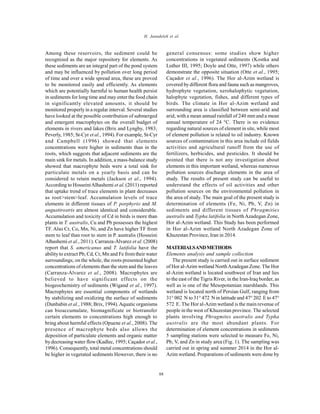
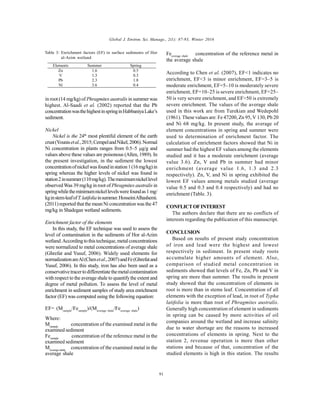
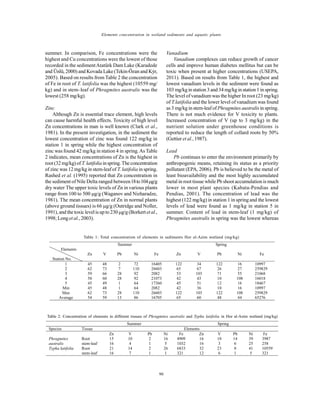
5 sampling stations were selected to measure Fe, Ni,
Pb, V, and Zn in study area (Fig. 1). The sampling was
carried out in spring and summer 2014 in the Hor al-
Azim wetland. Preparations of sediments were done by
Global J. Environ. Sci. Manage., 2(1): 87-93, Winter 2016
89
air drying and then passing samples through a 63-m
mesh. (Sieve No. 230, ASTM E-11). The sieved
sediments were powdered by an agate mortar and
pestle.About 0.5 g of the powdered sample was placed
in a beaker containing 5 mL of 3:1 HNO3 to HCl and
covered with a watch glass. Then, samples were heated
until most of the liquid had evaporated, and allowed to
cool before 3 mL of perchloric acid were added. Then
the cover was replaced and heated again till
evaporation of most of the liquid. Finally, samples were
cooled to room temperature before being filtered. The
filtrates were transferred to 50 mL volumetric flasks
and brought to volume with 1 N HCl. Three samples of
each two plant species including P. australis, T.
latifolia, were randomly collected from sampling sites.
The collected samples were thoroughly cleaned with
distilled water for removal of soil and other extraneous
particles. The plant samples were cut into two pieces
involving root, stem-leaf and dried at 65°C for 24 h in
an oven. To ensure uniform distribution of metals in
the sample, the material was milled in a microhammer
cutter and sieved through a 1.5-mm sieve (Hosseini
Alhashemi et al., 2011).
Statistical analysis
Pearson correlation matrix was applied to identify
the relationship between the six elements. Analysis of
variance (ANOVA) was done to evaluate significant
differences in element concentrations during sampling
periods. All statistical analyses were carried out using
SPSS software (version 17.0).
RESULTSANDDISCUSSION
The concentrations of elements in the sediments
and different tissues of Phragmites australis and Typha
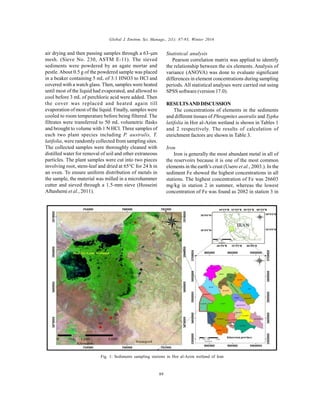
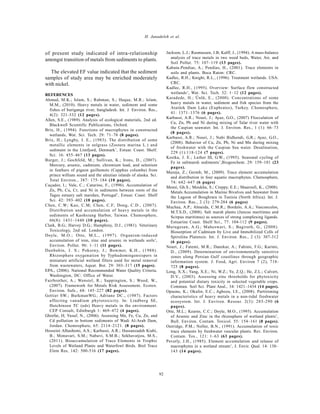
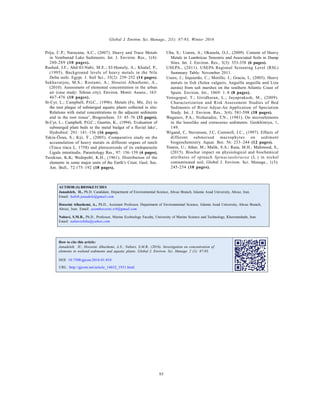
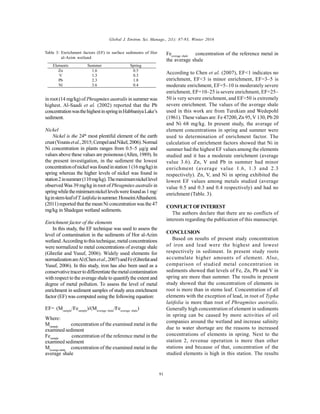
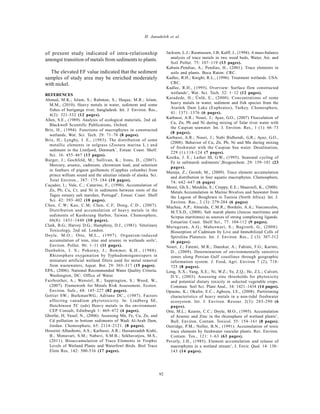
latifolia in Hor al-Azim wetland is shown in Tables 1
and 2 respectively. The results of calculation of
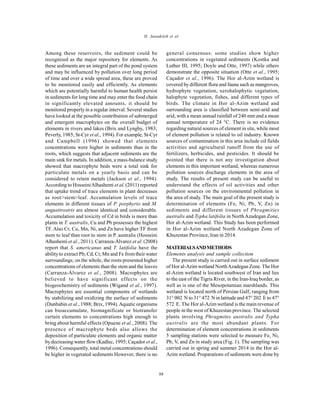
enrichment factors are shown in Table 3.
Iron
Iron is generally the most abundant metal in all of
the reservoirs because it is one of the most common
elements in the earth’s crust (Usero et al., 2003.). In the
sediment Fe showed the highest concentrations in all
stations. The highest concentration of Fe was 26603
mg/kg in station 2 in summer, whereas the lowest
concentration of Fe was found as 2082 in station 3 in
Fig. 1: Sediments sampling stations in Hor al-Azim wetland of Iran
Global J. Environ. Sci. Manage., 2(1): 87-93, Winter 2016
90
Elements concentration in wetland sediments and aquatic plants
summer. In comparison, Fe concentrations were the
highest and Cu concentrations were the lowest of those
recorded in the sedimentAtatürk Dam Lake (Karadede
and Ünlü, 2000) and Kovada Lake(Tekin-Özan and Kýr,
2005). Based on results from Table 2 the concentration
of Fe in root of T. latifolia was the highest (10559 mg/
kg) and in stem–leaf of Phragmites australis was the
lowest (258 mg/kg).
Zinc
Although Zn is essential trace element, high levels
can cause harmful health effects. Toxicity of high level
Zn concentrations in man is well known (Clark et al.,
1981). In the present investigation, in the sediment the
lowest concentration of zinc was found 122 mg/kg in
station 1 in spring while the highest concentration of
zinc was found 42 mg/kg in station 4 in spring.As Table
2 indicates, mean concentrations of Zn is the highest in
root(32 mg/kg)of T.latifolia inspring.Theconcentration
of zinc was 12 mg/kg in stem-leafof T. latifolia in spring.
Rashed et al. (1995) reported that Zn concentration in
the sediment ofNile Delta ranged between18to104g/g
dry water The upper toxic levels of Zn in various plants
range from 100 to 500 g/g (Waganov and Nizharadze,
1981). The mean concentration of Zn in normal plants
(above ground tissues) is 66 g/g (Outridge and Noller,
1991), and the toxic levelis up to 230 g/g (Borkert etal.,
1998; Long et al., 2003).
Vanadium
Vanadium complexes can reduce growth of cancer
cells and improve human diabetes mellitus but can be
toxic when present at higher concentrations (USEPA,
2011). Based on results from Table 1, the highest and
lowest vanadium levels in the sediment were found as
103 mg/kgin station 3 and 34 mg/kg in station1 in spring.
The level ofvanadium was the higher In root (23 mg/kg)
of T.latifolia and the lower level of vanadium was found
as 3 mg/kg in stem-leafof Phragmites australis in spring.
There is not much evidence for V toxicity to plants.
Increased concentration of V (up to 3 mg/kg) in the
nutrient solution under greenhouse conditions is
reported to reduce the length of collard roots by 50%
(Gettier et al., 1987).
Lead
Pb continues to enter the environment primarily by
anthropogenic means, retaining its status as a priority
pollutant (EPA, 2006). Pb is believed to be the metal of
least bioavailability and the most highly accumulated
metal in root tissue while Pb shoot accumulation is much
lower in most plant species (Kabata-Pendias and
Pendias, 2001). The concentration of lead was the
highest (122 mg/kg) in station 1 in spring and the lowest
levels of lead were found as 1 mg/kg in station 5 in
summer. Content of lead in stem-leaf (1 mg/kg) of
Phragmites australis in spring was the lowest whereas
SpringSummer
FeNiPbVZnFeNiPbVZn
Elements
Station No.
1099716122341221640572248451
2598292726676526603110773622
210685571103532082922866593
1601810810434221073922860584
18467161251451736064149455
109971610364220826414845Min
25982910812210312226603110287362Max
65276444860651670586135954Average
Table 1: Total concentration of elements in sediments Hor al-Azim wetland (mg/kg)
SpringSummer
ElementsTissueSpecies
FeNiPbVZnFeNiPbVZn
39873914101649091621015RootPhragmites
australis 258256316103251416stem-leaf
10559418233268332621421RootTypha latifolia
3215161232111716stem-leaf
Table 2: Concentration of elements in different tissues of Phragmites australis and Typha latifolia in Hor al-Azim wetland (mg/kg)
Global J. Environ. Sci. Manage., 2(1): 87-93, Winter 2016
91
in root (14 mg/kg) of Phragmites australis in summer was
highest. Al-Saadi et al. (2002) reported that the Pb
concentrationwasthehighestinspringinHabbaniyaLake’s
sediment.
Nickel
Nickel is the 24th
most plentiful element of the earth
crust(Younisetal.,2015;CempelandNikel,2006).Normal
Ni concentration in plants ranges from 0.5–5 g/g and
values above these values are poisonous (Allen, 1989). In
the present investigation, in the sediment the lowest
concentrationofnickelwasfoundinstation1(16mg/kg)in
spring whereas the higher levels of nickel was found in
station2insummer(110mg/kg).Themaximumnickellevel
observed Was 39 mg/kg in root of Phragmites australis in
springwhiletheminimumnickellevelswerefoundas1mg/
kginstem-leafofT.latifoliainsummer.HosseiniAlhashemi.
(2011)reported thatthe meanNi concentration was the 47
mg/kg in Shadegan wetland sediments.
Enrichment factor of the elements
In this study, the EF technique was used to assess the
level of contamination in the sediments of Hor al-Azim
wetland.Accordingtothistechnique,metalconcentrations
were normalized to metal concentrations of average shale
(Ghrefat and Yusuf, 2006). Widely used elements for
normalizationareAl(Chenetal.,2007)andFe(Ghrefatand
Yusuf, 2006). In this study, iron has also been used as a
conservativetracertodifferentiatethemetalcontamination
with respect to the average shale to quantifythe extent and
degree of metal pollution. To assess the level of metal
enrichment in sediment samples of study area enrichment
factor (EF) was computed using the following equation:
EF= (Msample
/Fesample
)/(Maverage shale
/Feaverage shale
)
Where:
Msample
concentration of the examined metal in the
examined sediment
Fesample
concentration of the reference metal in the
examined sediment
Maverage shale
concentration of the examined metal in the
average shale
Feaverage shale
concentration of the reference metal in
the average shale
According to Chen et al. (2007), EF<1 indicates no
enrichment, EF<3 is minor enrichment, EF=3–5 is
moderate enrichment, EF=5–10 is moderately severe
enrichment, EF=10–25 is severe enrichment, EF=25–
50 is very severe enrichment, and EF>50 is extremely
severe enrichment. The values of the average shale
used in this work are from Turekian and Wedepohl
(1961). These values are: Fe 47200, Zn 95, V 130, Pb 20
and Ni 68 mg/kg. In present study, the average of
element concentrations in spring and summer were
used to determination of enrichment factor. The
calculation of enrichment factors showed that Ni in
summer had the highest EF values among the elements
studied and it has a moderate enrichment (average
value 3.6). Zn, V and Pb in summer had minor
enrichment (average value 1.6, 1.3 and 2.3
respectively). Zn, V, and Ni in spring exhibited the
lowest EF values among metals studied (average
value 0.5 and 0.3 and 0.4 respectively) and had no
enrichment (Table. 3).
CONFLICTOFINTEREST
The authors declare that there are no conflicts of
interests regarding the publication of this manuscript.
CONCLUSION
Based on results of present study concentration
of iron and lead were the highest and lowest
respectively in sediment. In present study roots
accumulate higher amounts of element. Also,
comparison of studied metal concentration in
sediments showed that levels of Fe, Zn, Pb and V in
spring are more than summer. The results in present
study showed that the concentration of elements in
root is more than in stems leaf. Concentration of all
elements with the exception of lead, in root of Typha
latifolia is more than root of Phragmites australis.
Generally high concentration of element in sediments
in spring can be caused by more activities of oil
companies around the wetland and increase salinity
due to water shortage are the reasons to increased
concentrations of elements in spring. Next to the
station 2, revenue operation is more than other
stations and because of that, concentration of the
studied elements is high in this station. The results
SpringSummerElements
0.51.6Zn
0.31.3V
1.82.3Pb
0.43.6Ni
Table 3: Enrichment factors (EF) in surface sediments of Hor
al-Azim wetland
Global J. Environ. Sci. Manage., 2(1): 87-93, Winter 2016
92
H. Janadeleh et al.
of present study indicated of intra-relationship
amongst transition of metals from sediments to plants.
The elevated EF value indicated that the sediment
samples of study area may be enriched moderately
with nickel.
REFERENCES
Ahmad, M.K.; Islam, S.; Rahman, S.; Haque, M.R.; Islam,
M.M., (2010). Heavy metals in water, sediment and some
fishes of buriganga river, bangladesh. Int. J. Environ. Res.,
4(2): 321-332 (12 pages).
Allen, S.E., (1989). Analysis of ecological materials, 2nd ed.
Blackwell Scientific Publications, Oxford.
Brix, H., (1994). Functions of macrophytes in constructed
wetlands, Wat. Sci. Tech. 29: 71–78 (8 pages).
Brix, H.; Lyngby, J. E., (1983). The distribution of some
metallic elements in eelgrass (Zostera marina L.) and
sediment in the Limfjord, Denmark’, Estuar. Coast. Shelf.
Sci. 16: 455–467 (13 pages).
Burger, J.; Gochfeld, M.; Sullivan, K.; Irons, D., (2007).
Mercury, arsenic, cadmium, chromium lead, and selenium
in feathers of pigeon guillemots (Cepphus columba) from
prince william sound and the aleutian islands of alaska. Sci.
Total Environ., 387: 175–184 (10 pages).
Caçador, I.; Vale, C.; Catarino, F., (1996). Accumulation of
Zn, Pb, Cu, Cr, and Ni in sediments between roots of the
Tagus estuary salt marshes, Portugal’, Estuar. Coast. Shelf
Sci. 42: 393–402 (10 pages).
Chen, C.W; Kao, C.M; Chen, C.F; Dong, C.D., (2007).
Distribution and accumulation of heavy metals in the
sediments of Kaohsiung Harbor, Taiwan. Chemosphere,
66(8): 1431–1440 (10 pages).
Clark, B.G.; Harvey D.G.; Humphrey, D.J., (1981). Veterinary
Toxicology, 2nd ed. London.
Doyle, M.O.; Otte, M.L., (1997). Organism-induced
accumulation of iron, zinc and arsenic in wetlands soils’,
Environ. Pollut. 96: 1–11 (11 pages).
Dunbabin, J. S.; Pokorny, J.; Bowmer, K.H., (1988).
Rhizosphere oxygenation by Typhadomingensispers in
miniature artificial wetland filters used for metal removal
from wastewaters, Aquat. Bot. 29: 303–317 (15 pages).
EPA., (2006). National Recommended Water Quality Criteria.
Washington, DC: Office of Water.
Fairbrother, A.; Wenstel, R.; Sappington, S.; Wood, W.,
(2007). Framework for Metals Risk Assessment. Ecotox.
Environ. Safe., 68: 145–227 (82 pages).
Gettier SW.; BurkmanWG.; Adriano DC., (1987). Factors
affecting vanadium phytotoxicity. In: Lindberg SE,
Hutchinson TC (eds) Heavy metals in the environment.
CEP Consult, Edinburgh 1: 469–472 (4 pages).
Ghrefat, H; Yusuf, N., (2006). Assessing Mn, Fe, Cu, Zn, and
Cd pollution in bottom sediments of Wadi Al-Arab Dam,
Jordan. Chemosphere, 65: 2114–2121. (8 pages).
Hosseini Alhashemi, A.S.; Karbassi, A.R.; Hassanzadeh Kiabi,
B.; Monavari, S.M.; Nabavi, S.M.B.; Sekhavatjou, M.S.,
(2011). Bioaccumulation of Trace Elements in Trophic
Levels of Wetland Plants and Waterfowl Birds. Biol Trace
Elem Res, 142: 500-516 (17 pages).
Jackson, L.J.; Rasmussen, J.B; Kalff, J., (1994). A mass-balance
analysis of trace metals in two weed beds, Water, Air, and
Soil Pollut. 75: 107–119 (13 pages).
Kabata-Pendias, A.; Pendias, H., (2001). Trace elements in
soils and plants. Boca Raton: CRC.
Kadlec, R.H.; Knight, R.L., (1996). Treatment wetlands. USA:
CRC.
Kadlec, R.H., (1995). Overview: Surface flow constructed
wetlands’, Wat. Sci. Tech. 32: 1–12 (12 pages).
Karadede, H.; Ünlü, E., (2000). Concentrations of some
heavy metals in water, sediment and fish species from the
Atatürk Dam Lake (Euphrates), Turkey. Chemosphere,
41: 1371–1376 (6 pages).
Karbassi, A.R.; Nouri, J.; Ayaz, G.O., (2007) Flocculation of
Cu, Zn, Pb and Ni during mixing of Talar river water with
the Caspian seawater. Int. J. Environ. Res., 1 (1): 66–73
(8 pages).
Karbassi, A.R.; Nouri, J.; Nabi Bidhendi, G.R.; Ayaz, G.O.,
(2008). Behavior of Cu, Zn, Pb, Ni and Mn during mixing
of freshwater with the Caspian Sea water. Desalination,
229 (1):118-124 (7 pages).
Kostka, J. E.; Luther III, G.W., (1995). Seasonal cycling of
Fe in saltmarsh sediments’,Biogeochem. 29: 159–181 (23
pages).
Mazeja, Z.; Germb, M., (2009). Trace element accumulation
and distribution in four aquatic macrophytes. Chemosphere,
74: 642–647 (6 pages)
Mensi, Gh.S.; Moukha, S.; Creppy, E.E.; Maaroufi, K., (2008).
Metals Accumulation in Marine Bivalves and Seawater from
the Lagoon of Boughrara in Tunisia (North Africa). Int. J.
Environ. Res., 2 (3): 279-284 (6 pages)
Muchaa, A.P.; Almeida, C.M.R.; Bordalo, A.A.; Vasconcelos,
M.T.S.D., (2008). Salt marsh plants (Juncus maritimus and
Scirpus maritimus) as sources of strong complexing ligands.
Estuarine Coast. Shelf Sci., 77: 104-112 (9 pages).
Murugesan, A.G.; Maheswari, S.; Bagirath, G., (2008).
Biosorption of Cadmium by Live and Immobilized Cells of
Spirulina Platensis. Int. J. Environ. Res., 2 (3): 307-312
(6 pages).
Nouri, J.; Fatemi, M.R.; Danekar, A.; Fahimi, F.G.; Karimi,
D., (2009). Determination of environmentally sensitive
zones along Persian Gulf coastlines through geographic
information system. J. Food, Agri. Environ 7 (2), 718-
725 (8 pages).
Long, X.X.; Yang, X.E.; Ni, W.Z.; Ye, Z.Q.; He, Z.L.; Calvert,
D.V., (2003). Assessing zinc thresholds for phytoxicity
and potential dietary toxicity in selected vegetable crops.
Commun. Soil Sci. Plant Anal., 34: 1421–1434 (14 pages).
Opuene, K.; Okafor, E.C.; Agbozu, I.E., (2008). Partitioning
characteristics of heavy metals in a non-tidal freshwater
ecosystem. Int. J. Environ. Resour. 2(3): 285-290 (6
pages).
Otte, M.L.; Kearns, C.C.; Doyle, M.O., (1995). Accumulation
of Arsenic and Zinc in the rhizosphere of wetland plants’,
Bull. Environ. Contam. Toxicol. 55: 154–161 (8 pages).
Outridge, P.M.; Noller, B.N., (1991). Accumulation of toxic
trace elements by freshwater vascular plants. Rev. Environ.
Contam. Tox., 121: 1–63 (63 pages).
Peverly, J.H., (1985). Element accumulation and release of
macrophytes in a wetland stream’, J. Envir. Qual. 14: 130–
143 (14 pages).
Global J. Environ. Sci. Manage., 2(1): 87-93, Winter 2016
93
Priju, C.P.; Narayana, A.C., (2007). Heavy and Trace Metals
in Vembanad Lake Sediments. Int. J. Environ. Res., 1(4):
280-289 (10 pages).
Rashed, I.F.; Abd-El-Nabi, M.E.; El-Hemely, A.; Khalaf, P.,
(1995). Background levels of heavy metals in the Nile
Delta soils. Egypt. J. Soil Sci., 35(2): 239–252 (14 pages).
Sekhavatjou, M.S.; Rostami, A.; Hoseini Alhashemi, A.,
(2010). Assessment of elemental concentration in the urban
air (case study: Tehran city). Environ. Monit. Assess., 163:
467-476 (10 pages).
St-Cyr, L.; Campbell, P.G.C., (1996). Metals (Fe, Mn, Zn) in
the root plaque of submerged aquatic plants collected in situ:
Relations with metal concentrations in the adjacent sediments
and in the root tissue’, Biogeochem. 33: 45–76 (32 pages).
St-Cyr, L.; Campbell, P.G.C.; Guertin, K., (1994). Evaluation of
submerged plant beds in the metal budget of a fluvial lake’,
Hydrobiol. 291: 141–156 (16 pages).
Tekin-Özan, S.; Kýr, Ý., (2005). Comparative study on the
accumulation of heavy metals in different organs of tench
(Tinca tinca L. 1758) and plerocercoids of its endoparasite
Ligula intestinalis. Parasitology Res., 97: 156–159 (4 pages).
Turekian, K.K; Wedepohl, K.H., (1961). Distribution of the
elements in some major units of the Earth’s Crust. Geol. Soc.
Am. Bull., 72:175–192 (18 pages).
AUTHOR (S) BIOSKETCHES
Janadeleh, H., Ph.D. Candidate, Department of Environmental Science, Ahvaz Branch, Islamic Azad University, Ahvaz, Iran.
Email: habib.janadele@gmail.com
Hosseini Alhashemi, A., Ph.D., Assistant Professor, Department of Environmental Science, Islamic Azad University, Ahvaz Branch,
Ahvaz, Iran. Email: azamhosseini.srb@gmail.com
Nabavi, S.M.B., Ph.D., Professor, Marine Ecobiology Faculty, University of Marine Science and Technology, Khorramshahr, Iran.
Email: nabavishiba@yahoo.com
Uba, S.; Uzairu, A.; Okunola, O.J., (2009). Content of Heavy
Metals in Lumbricus Terrestris and Associated Soils in Dump
Sites. Int. J. Environ. Res., 3(3): 353-358 (6 pages).
USEPA., (2011). USEPA Regional Screening Level (RSL)
Summary Table: November 2011.
Usero, J.; Izquierdo, C.; Morillo, J.; Gracia, I., (2003). Heavy
metals in fish (Solea vulgaris, Anguilla anguilla and Liza
aurata) from salt marshes on the southern Atlantic Coast of
Spain. Environ. Int., 1069: 1–8 (8 pages).
Venugopal, T.; Giridharan, L.; Jayaprakash, M., (2009).
Characterization and Risk Assessment Studies of Bed
Sediments of River Adyar-An Application of Speciation
Study. Int. J. Environ. Res., 3(4): 581-598 (18 pages).
Waganov, P.A.; Nizharadze, T.N., (1981). On microelements
in the loesslike and cretaceous sediments. Geokhimiya, 1,
149.
Wigand, C, Stevenson, J.C, Cornwell, J.C., (1997). Effects of
different submersed macrophytes on sediment
biogeochemistry. Aquat. Bot. 56: 233–244 (12 pages).
Younis, U.; Athar, M.; Malik, S.A.; Raza, M.H.; Mahmood, S.,
(2015). Biochar impact on physiological and biochemical
attributes of spinach Spinaciaoleracea (L.) in nickel
contaminated soil, Global J. Environ. Sci. Manage., 1(3):
245-254 (10 pages).
DOI: 10.7508/gjesm.2016.01.010
URL: http://gjesm.net/article_14652_1931.html
How to cite this article:
Janadeleh, H.; Hosseini Alhashemi, A.S.; Nabavi, S.M.B., (2016). Investigation on concentration of
elements in wetland sediments and aquatic plants. Global J. Environ. Sci. Manage. 2 (1): 87-93.
Global J. Environ. Sci. Manage., 2(1): 87-93, Winter 2016
88
H. Janadeleh et al.
Among these reservoirs, the sediment could be
recognized as the major repository for elements. As
these sediments are an integral part of the pond system
and may be influenced by pollution over long period
of time and over a wide spread area, these are proved
to be monitored easily and efficiently. As elements
which are potentially harmful to human health persist
in sediments for long time and may enter the food chain
in significantly elevated amounts, it should be
monitored properly in a regular interval. Several studies
have looked at the possible contribution of submerged
and emergent macrophytes on the overall budget of
elements in rivers and lakes (Brix and Lyngby, 1983;
Peverly, 1985; St-Cyr et al., 1994). For example, St-Cyr
and Campbell (1996) showed that elements
concentrations were higher in sediments than in the
roots, which suggests that adjacent sediments are the
main sink for metals. In addition, a mass-balance study
showed that macrophyte beds were a total sink for
particulate metals on a yearly basis and can be
considered to retain metals (Jackson et al., 1994).
According to HosseiniAlhashemi et al. (2011) reported
that uptake trend of trace elements in plant decreases
as root>stem>leaf. Accumulation levels of trace
elements in different tissues of P. porphyrio and M.
angustirostris are almost identical and considerable.
Accumulation and toxicity of Cd in birds is more than
plants in T. australis, Cu and Pb possesses the highest
TF. Also Cr, Co, Mn, Ni, and Zn have higher TF from
stem to leaf than root to stem in P. australis (Hosseini
Alhashemi et al., 2011). Carranza-Álvarez et al. (2008)
report that S. americanus and T. latifolia have the
ability to extract Pb, Cd, Cr, Mn and Fe from their water
surroundings; on the whole, the roots presented higher
concentrations of elements than the stem and the leaves
(Carranza-Álvarez et al., 2008). Macrophytes are
believed to have significant effects on the
biogeochemistry of sediments (Wigand et al., 1997).
Macrophytes are essential components of wetlands
by stabilizing and oxidizing the surface of sediments
(Dunbabin et al., 1988; Brix, 1994).Aquatic organisms
can bioaccumulate, biomagnificate or biotransfer
certain elements to concentrations high enough to
bring about harmful effects (Opuene et al., 2008). The
presence of macrophyte beds also allows the
deposition of particulate elements and organic matter
by decreasing water flow(Kadlec, 1995; Caçador et al.,
1996). Consequently, total metal concentrations should
be higher in vegetated sediments However, there is no
general consensus: some studies show higher
concentrations in vegetated sediments (Kostka and
Luther III, 1995; Doyle and Otte, 1997) while others
demonstrate the opposite situation (Otte et al., 1995;
Caçador et al., 1996). The Hor al-Azim wetland is
covered by different flora and fauna such as mangroves,
hydrophyte vegetation, xerohalophytic vegetation,
halophyte vegetation, fishes, and different types of
birds. The climate in Hor al-Azim wetland and
surrounding area is classified between semi-arid and
arid, with a mean annual rainfall of 240 mm and a mean
annual temperature of 24 °C. There is no evidence
regarding natural sources of element in site, while most
of element pollution is related to oil industry. Known
sources of contamination in this area include oil fields
activities and agricultural runoff from the use of
fertilizers, herbicides, and pesticides. It should be
pointed that there is not any investigation about
elements in this important wetland, whereas numerous
pollution sources discharge elements in the area of
study. The results of present study can be useful to
understand the effects of oil activities and other
pollution sources on the environmental pollution in
the area of study. The main goal of the present study is
determination of elements (Fe, Ni, Pb, V, Zn) in
sediments and different tissues of Phragmities
australis and Typha latifolia in North Azadegan Zone,
Hor al-Azim wetland. This Study has been performed
in Hor al-Azim wetland North Azadegan Zone of
Khuzestan Province, Iran in 2014.
MATERIALSANDMETHODS
Elements analysis and sample collection
The present study is carried out in surface sediment
of Hor al-Azim wetland NorthAzadegan Zone. The Hor
al-Azim wetland is located southwest of Iran and lies
to the east of the Tigris River, in the Iran-Iraq border, as
well as is one of the Mesopotamian marshlands. This
wetland is located north of Persian Gulf, ranging from
31° 002 N to 31° 472 N in latitude and 47° 202 E to 47°
572 E. The Hor al-Azim wetland is the main revenue of
people in the west of Khuzestan province. The selected
plants involving Phragmites australis and Typha
australis are the most abundant plants. For
determination of element concentrations in sediments
5 sampling stations were selected to measure Fe, Ni,
Pb, V, and Zn in study area (Fig. 1). The sampling was
carried out in spring and summer 2014 in the Hor al-
Azim wetland. Preparations of sediments were done by
Global J. Environ. Sci. Manage., 2(1): 87-93, Winter 2016
89
air drying and then passing samples through a 63-m
mesh. (Sieve No. 230, ASTM E-11). The sieved
sediments were powdered by an agate mortar and
pestle.About 0.5 g of the powdered sample was placed
in a beaker containing 5 mL of 3:1 HNO3 to HCl and
covered with a watch glass. Then, samples were heated
until most of the liquid had evaporated, and allowed to
cool before 3 mL of perchloric acid were added. Then
the cover was replaced and heated again till
evaporation of most of the liquid. Finally, samples were
cooled to room temperature before being filtered. The
filtrates were transferred to 50 mL volumetric flasks
and brought to volume with 1 N HCl. Three samples of
each two plant species including P. australis, T.
latifolia, were randomly collected from sampling sites.
The collected samples were thoroughly cleaned with
distilled water for removal of soil and other extraneous
particles. The plant samples were cut into two pieces
involving root, stem-leaf and dried at 65°C for 24 h in
an oven. To ensure uniform distribution of metals in
the sample, the material was milled in a microhammer
cutter and sieved through a 1.5-mm sieve (Hosseini
Alhashemi et al., 2011).
Statistical analysis
Pearson correlation matrix was applied to identify
the relationship between the six elements. Analysis of
variance (ANOVA) was done to evaluate significant
differences in element concentrations during sampling
periods. All statistical analyses were carried out using
SPSS software (version 17.0).
RESULTSANDDISCUSSION
The concentrations of elements in the sediments
and different tissues of Phragmites australis and Typha
latifolia in Hor al-Azim wetland is shown in Tables 1
and 2 respectively. The results of calculation of
enrichment factors are shown in Table 3.
Iron
Iron is generally the most abundant metal in all of
the reservoirs because it is one of the most common
elements in the earth’s crust (Usero et al., 2003.). In the
sediment Fe showed the highest concentrations in all
stations. The highest concentration of Fe was 26603
mg/kg in station 2 in summer, whereas the lowest
concentration of Fe was found as 2082 in station 3 in
Fig. 1: Sediments sampling stations in Hor al-Azim wetland of Iran
Global J. Environ. Sci. Manage., 2(1): 87-93, Winter 2016
90
Elements concentration in wetland sediments and aquatic plants
summer. In comparison, Fe concentrations were the
highest and Cu concentrations were the lowest of those
recorded in the sedimentAtatürk Dam Lake (Karadede
and Ünlü, 2000) and Kovada Lake(Tekin-Özan and Kýr,
2005). Based on results from Table 2 the concentration
of Fe in root of T. latifolia was the highest (10559 mg/
kg) and in stem–leaf of Phragmites australis was the
lowest (258 mg/kg).
Zinc
Although Zn is essential trace element, high levels
can cause harmful health effects. Toxicity of high level
Zn concentrations in man is well known (Clark et al.,
1981). In the present investigation, in the sediment the
lowest concentration of zinc was found 122 mg/kg in
station 1 in spring while the highest concentration of
zinc was found 42 mg/kg in station 4 in spring.As Table
2 indicates, mean concentrations of Zn is the highest in
root(32 mg/kg)of T.latifolia inspring.Theconcentration
of zinc was 12 mg/kg in stem-leafof T. latifolia in spring.
Rashed et al. (1995) reported that Zn concentration in
the sediment ofNile Delta ranged between18to104g/g
dry water The upper toxic levels of Zn in various plants
range from 100 to 500 g/g (Waganov and Nizharadze,
1981). The mean concentration of Zn in normal plants
(above ground tissues) is 66 g/g (Outridge and Noller,
1991), and the toxic levelis up to 230 g/g (Borkert etal.,
1998; Long et al., 2003).
Vanadium
Vanadium complexes can reduce growth of cancer
cells and improve human diabetes mellitus but can be
toxic when present at higher concentrations (USEPA,
2011). Based on results from Table 1, the highest and
lowest vanadium levels in the sediment were found as
103 mg/kgin station 3 and 34 mg/kg in station1 in spring.
The level ofvanadium was the higher In root (23 mg/kg)
of T.latifolia and the lower level of vanadium was found
as 3 mg/kg in stem-leafof Phragmites australis in spring.
There is not much evidence for V toxicity to plants.
Increased concentration of V (up to 3 mg/kg) in the
nutrient solution under greenhouse conditions is
reported to reduce the length of collard roots by 50%
(Gettier et al., 1987).
Lead
Pb continues to enter the environment primarily by
anthropogenic means, retaining its status as a priority
pollutant (EPA, 2006). Pb is believed to be the metal of
least bioavailability and the most highly accumulated
metal in root tissue while Pb shoot accumulation is much
lower in most plant species (Kabata-Pendias and
Pendias, 2001). The concentration of lead was the
highest (122 mg/kg) in station 1 in spring and the lowest
levels of lead were found as 1 mg/kg in station 5 in
summer. Content of lead in stem-leaf (1 mg/kg) of
Phragmites australis in spring was the lowest whereas
SpringSummer
FeNiPbVZnFeNiPbVZn
Elements
Station No.
1099716122341221640572248451
2598292726676526603110773622
210685571103532082922866593
1601810810434221073922860584
18467161251451736064149455
109971610364220826414845Min
25982910812210312226603110287362Max
65276444860651670586135954Average
Table 1: Total concentration of elements in sediments Hor al-Azim wetland (mg/kg)
SpringSummer
ElementsTissueSpecies
FeNiPbVZnFeNiPbVZn
39873914101649091621015RootPhragmites
australis 258256316103251416stem-leaf
10559418233268332621421RootTypha latifolia
3215161232111716stem-leaf
Table 2: Concentration of elements in different tissues of Phragmites australis and Typha latifolia in Hor al-Azim wetland (mg/kg)
Global J. Environ. Sci. Manage., 2(1): 87-93, Winter 2016
91
in root (14 mg/kg) of Phragmites australis in summer was
highest. Al-Saadi et al. (2002) reported that the Pb
concentrationwasthehighestinspringinHabbaniyaLake’s
sediment.
Nickel
Nickel is the 24th
most plentiful element of the earth
crust(Younisetal.,2015;CempelandNikel,2006).Normal
Ni concentration in plants ranges from 0.5–5 g/g and
values above these values are poisonous (Allen, 1989). In
the present investigation, in the sediment the lowest
concentrationofnickelwasfoundinstation1(16mg/kg)in
spring whereas the higher levels of nickel was found in
station2insummer(110mg/kg).Themaximumnickellevel
observed Was 39 mg/kg in root of Phragmites australis in
springwhiletheminimumnickellevelswerefoundas1mg/
kginstem-leafofT.latifoliainsummer.HosseiniAlhashemi.
(2011)reported thatthe meanNi concentration was the 47
mg/kg in Shadegan wetland sediments.
Enrichment factor of the elements
In this study, the EF technique was used to assess the
level of contamination in the sediments of Hor al-Azim
wetland.Accordingtothistechnique,metalconcentrations
were normalized to metal concentrations of average shale
(Ghrefat and Yusuf, 2006). Widely used elements for
normalizationareAl(Chenetal.,2007)andFe(Ghrefatand
Yusuf, 2006). In this study, iron has also been used as a
conservativetracertodifferentiatethemetalcontamination
with respect to the average shale to quantifythe extent and
degree of metal pollution. To assess the level of metal
enrichment in sediment samples of study area enrichment
factor (EF) was computed using the following equation:
EF= (Msample
/Fesample
)/(Maverage shale
/Feaverage shale
)
Where:
Msample
concentration of the examined metal in the
examined sediment
Fesample
concentration of the reference metal in the
examined sediment
Maverage shale
concentration of the examined metal in the
average shale
Feaverage shale
concentration of the reference metal in
the average shale
According to Chen et al. (2007), EF<1 indicates no
enrichment, EF<3 is minor enrichment, EF=3–5 is
moderate enrichment, EF=5–10 is moderately severe
enrichment, EF=10–25 is severe enrichment, EF=25–
50 is very severe enrichment, and EF>50 is extremely
severe enrichment. The values of the average shale
used in this work are from Turekian and Wedepohl
(1961). These values are: Fe 47200, Zn 95, V 130, Pb 20
and Ni 68 mg/kg. In present study, the average of
element concentrations in spring and summer were
used to determination of enrichment factor. The
calculation of enrichment factors showed that Ni in
summer had the highest EF values among the elements
studied and it has a moderate enrichment (average
value 3.6). Zn, V and Pb in summer had minor
enrichment (average value 1.6, 1.3 and 2.3
respectively). Zn, V, and Ni in spring exhibited the
lowest EF values among metals studied (average
value 0.5 and 0.3 and 0.4 respectively) and had no
enrichment (Table. 3).
CONFLICTOFINTEREST
The authors declare that there are no conflicts of
interests regarding the publication of this manuscript.
CONCLUSION
Based on results of present study concentration
of iron and lead were the highest and lowest
respectively in sediment. In present study roots
accumulate higher amounts of element. Also,
comparison of studied metal concentration in
sediments showed that levels of Fe, Zn, Pb and V in
spring are more than summer. The results in present
study showed that the concentration of elements in
root is more than in stems leaf. Concentration of all
elements with the exception of lead, in root of Typha
latifolia is more than root of Phragmites australis.
Generally high concentration of element in sediments
in spring can be caused by more activities of oil
companies around the wetland and increase salinity
due to water shortage are the reasons to increased
concentrations of elements in spring. Next to the
station 2, revenue operation is more than other
stations and because of that, concentration of the
studied elements is high in this station. The results
SpringSummerElements
0.51.6Zn
0.31.3V
1.82.3Pb
0.43.6Ni
Table 3: Enrichment factors (EF) in surface sediments of Hor
al-Azim wetland
Global J. Environ. Sci. Manage., 2(1): 87-93, Winter 2016
92
H. Janadeleh et al.
of present study indicated of intra-relationship
amongst transition of metals from sediments to plants.
The elevated EF value indicated that the sediment
samples of study area may be enriched moderately
with nickel.
REFERENCES
Ahmad, M.K.; Islam, S.; Rahman, S.; Haque, M.R.; Islam,
M.M., (2010). Heavy metals in water, sediment and some
fishes of buriganga river, bangladesh. Int. J. Environ. Res.,
4(2): 321-332 (12 pages).
Allen, S.E., (1989). Analysis of ecological materials, 2nd ed.
Blackwell Scientific Publications, Oxford.
Brix, H., (1994). Functions of macrophytes in constructed
wetlands, Wat. Sci. Tech. 29: 71–78 (8 pages).
Brix, H.; Lyngby, J. E., (1983). The distribution of some
metallic elements in eelgrass (Zostera marina L.) and
sediment in the Limfjord, Denmark’, Estuar. Coast. Shelf.
Sci. 16: 455–467 (13 pages).
Burger, J.; Gochfeld, M.; Sullivan, K.; Irons, D., (2007).
Mercury, arsenic, cadmium, chromium lead, and selenium
in feathers of pigeon guillemots (Cepphus columba) from
prince william sound and the aleutian islands of alaska. Sci.
Total Environ., 387: 175–184 (10 pages).
Caçador, I.; Vale, C.; Catarino, F., (1996). Accumulation of
Zn, Pb, Cu, Cr, and Ni in sediments between roots of the
Tagus estuary salt marshes, Portugal’, Estuar. Coast. Shelf
Sci. 42: 393–402 (10 pages).
Chen, C.W; Kao, C.M; Chen, C.F; Dong, C.D., (2007).
Distribution and accumulation of heavy metals in the
sediments of Kaohsiung Harbor, Taiwan. Chemosphere,
66(8): 1431–1440 (10 pages).
Clark, B.G.; Harvey D.G.; Humphrey, D.J., (1981). Veterinary
Toxicology, 2nd ed. London.
Doyle, M.O.; Otte, M.L., (1997). Organism-induced
accumulation of iron, zinc and arsenic in wetlands soils’,
Environ. Pollut. 96: 1–11 (11 pages).
Dunbabin, J. S.; Pokorny, J.; Bowmer, K.H., (1988).
Rhizosphere oxygenation by Typhadomingensispers in
miniature artificial wetland filters used for metal removal
from wastewaters, Aquat. Bot. 29: 303–317 (15 pages).
EPA., (2006). National Recommended Water Quality Criteria.
Washington, DC: Office of Water.
Fairbrother, A.; Wenstel, R.; Sappington, S.; Wood, W.,
(2007). Framework for Metals Risk Assessment. Ecotox.
Environ. Safe., 68: 145–227 (82 pages).
Gettier SW.; BurkmanWG.; Adriano DC., (1987). Factors
affecting vanadium phytotoxicity. In: Lindberg SE,
Hutchinson TC (eds) Heavy metals in the environment.
CEP Consult, Edinburgh 1: 469–472 (4 pages).
Ghrefat, H; Yusuf, N., (2006). Assessing Mn, Fe, Cu, Zn, and
Cd pollution in bottom sediments of Wadi Al-Arab Dam,
Jordan. Chemosphere, 65: 2114–2121. (8 pages).
Hosseini Alhashemi, A.S.; Karbassi, A.R.; Hassanzadeh Kiabi,
B.; Monavari, S.M.; Nabavi, S.M.B.; Sekhavatjou, M.S.,
(2011). Bioaccumulation of Trace Elements in Trophic
Levels of Wetland Plants and Waterfowl Birds. Biol Trace
Elem Res, 142: 500-516 (17 pages).
Jackson, L.J.; Rasmussen, J.B; Kalff, J., (1994). A mass-balance
analysis of trace metals in two weed beds, Water, Air, and
Soil Pollut. 75: 107–119 (13 pages).
Kabata-Pendias, A.; Pendias, H., (2001). Trace elements in
soils and plants. Boca Raton: CRC.
Kadlec, R.H.; Knight, R.L., (1996). Treatment wetlands. USA:
CRC.
Kadlec, R.H., (1995). Overview: Surface flow constructed
wetlands’, Wat. Sci. Tech. 32: 1–12 (12 pages).
Karadede, H.; Ünlü, E., (2000). Concentrations of some
heavy metals in water, sediment and fish species from the
Atatürk Dam Lake (Euphrates), Turkey. Chemosphere,
41: 1371–1376 (6 pages).
Karbassi, A.R.; Nouri, J.; Ayaz, G.O., (2007) Flocculation of
Cu, Zn, Pb and Ni during mixing of Talar river water with
the Caspian seawater. Int. J. Environ. Res., 1 (1): 66–73
(8 pages).
Karbassi, A.R.; Nouri, J.; Nabi Bidhendi, G.R.; Ayaz, G.O.,
(2008). Behavior of Cu, Zn, Pb, Ni and Mn during mixing
of freshwater with the Caspian Sea water. Desalination,
229 (1):118-124 (7 pages).
Kostka, J. E.; Luther III, G.W., (1995). Seasonal cycling of
Fe in saltmarsh sediments’,Biogeochem. 29: 159–181 (23
pages).
Mazeja, Z.; Germb, M., (2009). Trace element accumulation
and distribution in four aquatic macrophytes. Chemosphere,
74: 642–647 (6 pages)
Mensi, Gh.S.; Moukha, S.; Creppy, E.E.; Maaroufi, K., (2008).
Metals Accumulation in Marine Bivalves and Seawater from
the Lagoon of Boughrara in Tunisia (North Africa). Int. J.
Environ. Res., 2 (3): 279-284 (6 pages)
Muchaa, A.P.; Almeida, C.M.R.; Bordalo, A.A.; Vasconcelos,
M.T.S.D., (2008). Salt marsh plants (Juncus maritimus and
Scirpus maritimus) as sources of strong complexing ligands.
Estuarine Coast. Shelf Sci., 77: 104-112 (9 pages).
Murugesan, A.G.; Maheswari, S.; Bagirath, G., (2008).
Biosorption of Cadmium by Live and Immobilized Cells of
Spirulina Platensis. Int. J. Environ. Res., 2 (3): 307-312
(6 pages).
Nouri, J.; Fatemi, M.R.; Danekar, A.; Fahimi, F.G.; Karimi,
D., (2009). Determination of environmentally sensitive
zones along Persian Gulf coastlines through geographic
information system. J. Food, Agri. Environ 7 (2), 718-
725 (8 pages).
Long, X.X.; Yang, X.E.; Ni, W.Z.; Ye, Z.Q.; He, Z.L.; Calvert,
D.V., (2003). Assessing zinc thresholds for phytoxicity
and potential dietary toxicity in selected vegetable crops.
Commun. Soil Sci. Plant Anal., 34: 1421–1434 (14 pages).
Opuene, K.; Okafor, E.C.; Agbozu, I.E., (2008). Partitioning
characteristics of heavy metals in a non-tidal freshwater
ecosystem. Int. J. Environ. Resour. 2(3): 285-290 (6
pages).
Otte, M.L.; Kearns, C.C.; Doyle, M.O., (1995). Accumulation
of Arsenic and Zinc in the rhizosphere of wetland plants’,
Bull. Environ. Contam. Toxicol. 55: 154–161 (8 pages).
Outridge, P.M.; Noller, B.N., (1991). Accumulation of toxic
trace elements by freshwater vascular plants. Rev. Environ.
Contam. Tox., 121: 1–63 (63 pages).
Peverly, J.H., (1985). Element accumulation and release of
macrophytes in a wetland stream’, J. Envir. Qual. 14: 130–
143 (14 pages).
Global J. Environ. Sci. Manage., 2(1): 87-93, Winter 2016
93
Priju, C.P.; Narayana, A.C., (2007). Heavy and Trace Metals
in Vembanad Lake Sediments. Int. J. Environ. Res., 1(4):
280-289 (10 pages).
Rashed, I.F.; Abd-El-Nabi, M.E.; El-Hemely, A.; Khalaf, P.,
(1995). Background levels of heavy metals in the Nile
Delta soils. Egypt. J. Soil Sci., 35(2): 239–252 (14 pages).
Sekhavatjou, M.S.; Rostami, A.; Hoseini Alhashemi, A.,
(2010). Assessment of elemental concentration in the urban
air (case study: Tehran city). Environ. Monit. Assess., 163:
467-476 (10 pages).
St-Cyr, L.; Campbell, P.G.C., (1996). Metals (Fe, Mn, Zn) in
the root plaque of submerged aquatic plants collected in situ:
Relations with metal concentrations in the adjacent sediments
and in the root tissue’, Biogeochem. 33: 45–76 (32 pages).
St-Cyr, L.; Campbell, P.G.C.; Guertin, K., (1994). Evaluation of
submerged plant beds in the metal budget of a fluvial lake’,
Hydrobiol. 291: 141–156 (16 pages).
Tekin-Özan, S.; Kýr, Ý., (2005). Comparative study on the
accumulation of heavy metals in different organs of tench
(Tinca tinca L. 1758) and plerocercoids of its endoparasite
Ligula intestinalis. Parasitology Res., 97: 156–159 (4 pages).
Turekian, K.K; Wedepohl, K.H., (1961). Distribution of the
elements in some major units of the Earth’s Crust. Geol. Soc.
Am. Bull., 72:175–192 (18 pages).
AUTHOR (S) BIOSKETCHES
Janadeleh, H., Ph.D. Candidate, Department of Environmental Science, Ahvaz Branch, Islamic Azad University, Ahvaz, Iran.
Email: habib.janadele@gmail.com
Hosseini Alhashemi, A., Ph.D., Assistant Professor, Department of Environmental Science, Islamic Azad University, Ahvaz Branch,
Ahvaz, Iran. Email: azamhosseini.srb@gmail.com
Nabavi, S.M.B., Ph.D., Professor, Marine Ecobiology Faculty, University of Marine Science and Technology, Khorramshahr, Iran.
Email: nabavishiba@yahoo.com
Uba, S.; Uzairu, A.; Okunola, O.J., (2009). Content of Heavy
Metals in Lumbricus Terrestris and Associated Soils in Dump
Sites. Int. J. Environ. Res., 3(3): 353-358 (6 pages).
USEPA., (2011). USEPA Regional Screening Level (RSL)
Summary Table: November 2011.
Usero, J.; Izquierdo, C.; Morillo, J.; Gracia, I., (2003). Heavy
metals in fish (Solea vulgaris, Anguilla anguilla and Liza
aurata) from salt marshes on the southern Atlantic Coast of
Spain. Environ. Int., 1069: 1–8 (8 pages).
Venugopal, T.; Giridharan, L.; Jayaprakash, M., (2009).
Characterization and Risk Assessment Studies of Bed
Sediments of River Adyar-An Application of Speciation
Study. Int. J. Environ. Res., 3(4): 581-598 (18 pages).
Waganov, P.A.; Nizharadze, T.N., (1981). On microelements
in the loesslike and cretaceous sediments. Geokhimiya, 1,
149.
Wigand, C, Stevenson, J.C, Cornwell, J.C., (1997). Effects of
different submersed macrophytes on sediment
biogeochemistry. Aquat. Bot. 56: 233–244 (12 pages).
Younis, U.; Athar, M.; Malik, S.A.; Raza, M.H.; Mahmood, S.,
(2015). Biochar impact on physiological and biochemical
attributes of spinach Spinaciaoleracea (L.) in nickel
contaminated soil, Global J. Environ. Sci. Manage., 1(3):
245-254 (10 pages).
DOI: 10.7508/gjesm.2016.01.010
URL: http://gjesm.net/article_14652_1931.html
How to cite this article:
Janadeleh, H.; Hosseini Alhashemi, A.S.; Nabavi, S.M.B., (2016). Investigation on concentration of
elements in wetland sediments and aquatic plants. Global J. Environ. Sci. Manage. 2 (1): 87-93.

Gjesm146521451593800

  • 1.
    Global J. Environ.Sci. Manage., 2(1): 87-93, Winter 2016 87 ABSTRACT: The major aim of the present study was to investigate elements (Fe, Ni, Pb, V, Zn) concentration in sediment and different tissues of Phragmities australis and Typha latifolia in Hor al-Azim Wetland southwest of Iran. Sampling of sediments and aquatic plants was carried out during spring and summer 2014. Results showed that the mean concentrations of chemical elements in Phragmities australis in root and stem-leaf were as follows: iron: 4448 mg/kg, nickel: 28 mg/kg, lead: 8 mg/kg, vanadium: 10 mg/kg and zinc: 15.5 mg/kg in root and Iron: 645 mg/kg, nickel: 15 mg/kg, lead: 4 mg/kg, vanadium: 4 mg/kg and zinc 16 mg/kg respectively. Also, the mean concentrations of iron, nickel, lead, vanadium and zinc in roots of Typha latifolia were 8696 mg/kg, 34 mg/kg, 5 mg/kg, 19 mg/kg and 27 mg/ kg respectively. The mean concentrations of iron, nickel, vanadium, lead and zinc in stem-leaves of Typha latifolia were as follows: 321 mg/kg, 3 mg/kg, 7 mg/kg, 2 mg/kg and 14 mg/kg respectively. The mean concentrations of iron, nickel, vanadium, lead and zinc were as: 40991 mg/kg, 65 mg/kg, 60 mg/kg, 31 mg/kg and 60 mg/kg respectively in surface sediment of the study area. Concentration pattern of the elements in sediment were as: Fe>Ni>Zn>V>Pb. The highest concentration of the elements in the plant was seen in the roots. Also, Typha latifolia can uptake more concentration of elements than Phragmities australis. Based on the enrichment factor, nickel in summer had the highest enrichment factor values among the elements studied and it has a moderate enrichment. KEYWORDS: Elements; Enrichment factor; Hor al-Azim Wetland; Phragmities australis; Typha latifolia. Global J. Environ. Sci. Manage., 2(1): 87-93, Winter 2016 DOI: 10.7508/gjesm.2016.01.010 *Corresponding author E-mail address: azamhosseini.srb@gmail.com Tel: (+98) 912 612 9263; Fax: (+98) 613 320 7329. Note. Discussion period for this manuscript open until March 1, 2016 on GJESM website at the “Show Article”. Investigation on concentration of elements in wetland sediments and aquatic plants H. Janadeleh1 , A. Hosseini Alhashemi1,* , S.M.B. Nabavi2 1 Department of Environmental Science, Ahvaz Branch, Islamic Azad University, Ahvaz, Iran 2 Department of Marine Biology, Faculty of Marine Science, Khorramshahr University of Marine Science and Technology, Khorramshahr, Iran INTRODUCTION Chemical elements are ubiquitous, highly persistent, and non-biodegradable with long biological half-lives and they can accumulate in soils at environmentally hazardous levels (Burger et al., 2007; Mensi et al., 2008; Murugesan et al., 2008; Uba et al., 2009; Nouri et al., 2009; Ahmad et al., 2010; Sekhavatjou et al., 2010). elements in essential and non-essential forms accumulate in nature especially in sediments (Fairbrother et al., 2007; Karbassi et al., 2007; Priju and Narayana, 2007; Karbassi et al., 2008; Muchaa et al., 2008; Mazeja and Germb, 2009;Venugopal et al.,2009). The toxicity of chemical elements is highly influenced by geochemical factors that influence element bioavailability (Fairbrother et al., 2007). Wetlands represent some of the most productive habitat on earth. They are often referred to as “nature’s kidneys” because of their ability to filter, metabolize, and sequester nutrients and metals. Wetlands have been applied for use as a flood control mechanism, as filters for removing toxic elements from aquatic ecosystems, treating urban storm water runoff, and purifying municipal wastewater (Kadlec and Knight, 1996). There are basically three reservoirs of elements in a wetland ecosystem: water, sediment, and biotic components. Received 20 August 2015; revised 1 September 2015; accepted 13 October 2015; available online 1 December 2015 ORIGINAL RESEARCH PAPER
  • 2.
    Global J. Environ.Sci. Manage., 2(1): 87-93, Winter 2016 88 H. Janadeleh et al. Among these reservoirs, the sediment could be recognized as the major repository for elements. As these sediments are an integral part of the pond system and may be influenced by pollution over long period of time and over a wide spread area, these are proved to be monitored easily and efficiently. As elements which are potentially harmful to human health persist in sediments for long time and may enter the food chain in significantly elevated amounts, it should be monitored properly in a regular interval. Several studies have looked at the possible contribution of submerged and emergent macrophytes on the overall budget of elements in rivers and lakes (Brix and Lyngby, 1983; Peverly, 1985; St-Cyr et al., 1994). For example, St-Cyr and Campbell (1996) showed that elements concentrations were higher in sediments than in the roots, which suggests that adjacent sediments are the main sink for metals. In addition, a mass-balance study showed that macrophyte beds were a total sink for particulate metals on a yearly basis and can be considered to retain metals (Jackson et al., 1994). According to HosseiniAlhashemi et al. (2011) reported that uptake trend of trace elements in plant decreases as root>stem>leaf. Accumulation levels of trace elements in different tissues of P. porphyrio and M. angustirostris are almost identical and considerable. Accumulation and toxicity of Cd in birds is more than plants in T. australis, Cu and Pb possesses the highest TF. Also Cr, Co, Mn, Ni, and Zn have higher TF from stem to leaf than root to stem in P. australis (Hosseini Alhashemi et al., 2011). Carranza-Álvarez et al. (2008) report that S. americanus and T. latifolia have the ability to extract Pb, Cd, Cr, Mn and Fe from their water surroundings; on the whole, the roots presented higher concentrations of elements than the stem and the leaves (Carranza-Álvarez et al., 2008). Macrophytes are believed to have significant effects on the biogeochemistry of sediments (Wigand et al., 1997). Macrophytes are essential components of wetlands by stabilizing and oxidizing the surface of sediments (Dunbabin et al., 1988; Brix, 1994).Aquatic organisms can bioaccumulate, biomagnificate or biotransfer certain elements to concentrations high enough to bring about harmful effects (Opuene et al., 2008). The presence of macrophyte beds also allows the deposition of particulate elements and organic matter by decreasing water flow(Kadlec, 1995; Caçador et al., 1996). Consequently, total metal concentrations should be higher in vegetated sediments However, there is no general consensus: some studies show higher concentrations in vegetated sediments (Kostka and Luther III, 1995; Doyle and Otte, 1997) while others demonstrate the opposite situation (Otte et al., 1995; Caçador et al., 1996). The Hor al-Azim wetland is covered by different flora and fauna such as mangroves, hydrophyte vegetation, xerohalophytic vegetation, halophyte vegetation, fishes, and different types of birds. The climate in Hor al-Azim wetland and surrounding area is classified between semi-arid and arid, with a mean annual rainfall of 240 mm and a mean annual temperature of 24 °C. There is no evidence regarding natural sources of element in site, while most of element pollution is related to oil industry. Known sources of contamination in this area include oil fields activities and agricultural runoff from the use of fertilizers, herbicides, and pesticides. It should be pointed that there is not any investigation about elements in this important wetland, whereas numerous pollution sources discharge elements in the area of study. The results of present study can be useful to understand the effects of oil activities and other pollution sources on the environmental pollution in the area of study. The main goal of the present study is determination of elements (Fe, Ni, Pb, V, Zn) in sediments and different tissues of Phragmities australis and Typha latifolia in North Azadegan Zone, Hor al-Azim wetland. This Study has been performed in Hor al-Azim wetland North Azadegan Zone of Khuzestan Province, Iran in 2014. MATERIALSANDMETHODS Elements analysis and sample collection The present study is carried out in surface sediment of Hor al-Azim wetland NorthAzadegan Zone. The Hor al-Azim wetland is located southwest of Iran and lies to the east of the Tigris River, in the Iran-Iraq border, as well as is one of the Mesopotamian marshlands. This wetland is located north of Persian Gulf, ranging from 31° 002 N to 31° 472 N in latitude and 47° 202 E to 47° 572 E. The Hor al-Azim wetland is the main revenue of people in the west of Khuzestan province. The selected plants involving Phragmites australis and Typha australis are the most abundant plants. For determination of element concentrations in sediments 5 sampling stations were selected to measure Fe, Ni, Pb, V, and Zn in study area (Fig. 1). The sampling was carried out in spring and summer 2014 in the Hor al- Azim wetland. Preparations of sediments were done by
  • 3.
    Global J. Environ.Sci. Manage., 2(1): 87-93, Winter 2016 89 air drying and then passing samples through a 63-m mesh. (Sieve No. 230, ASTM E-11). The sieved sediments were powdered by an agate mortar and pestle.About 0.5 g of the powdered sample was placed in a beaker containing 5 mL of 3:1 HNO3 to HCl and covered with a watch glass. Then, samples were heated until most of the liquid had evaporated, and allowed to cool before 3 mL of perchloric acid were added. Then the cover was replaced and heated again till evaporation of most of the liquid. Finally, samples were cooled to room temperature before being filtered. The filtrates were transferred to 50 mL volumetric flasks and brought to volume with 1 N HCl. Three samples of each two plant species including P. australis, T. latifolia, were randomly collected from sampling sites. The collected samples were thoroughly cleaned with distilled water for removal of soil and other extraneous particles. The plant samples were cut into two pieces involving root, stem-leaf and dried at 65°C for 24 h in an oven. To ensure uniform distribution of metals in the sample, the material was milled in a microhammer cutter and sieved through a 1.5-mm sieve (Hosseini Alhashemi et al., 2011). Statistical analysis Pearson correlation matrix was applied to identify the relationship between the six elements. Analysis of variance (ANOVA) was done to evaluate significant differences in element concentrations during sampling periods. All statistical analyses were carried out using SPSS software (version 17.0). RESULTSANDDISCUSSION The concentrations of elements in the sediments and different tissues of Phragmites australis and Typha latifolia in Hor al-Azim wetland is shown in Tables 1 and 2 respectively. The results of calculation of enrichment factors are shown in Table 3. Iron Iron is generally the most abundant metal in all of the reservoirs because it is one of the most common elements in the earth’s crust (Usero et al., 2003.). In the sediment Fe showed the highest concentrations in all stations. The highest concentration of Fe was 26603 mg/kg in station 2 in summer, whereas the lowest concentration of Fe was found as 2082 in station 3 in Fig. 1: Sediments sampling stations in Hor al-Azim wetland of Iran
  • 4.
    Global J. Environ.Sci. Manage., 2(1): 87-93, Winter 2016 90 Elements concentration in wetland sediments and aquatic plants summer. In comparison, Fe concentrations were the highest and Cu concentrations were the lowest of those recorded in the sedimentAtatürk Dam Lake (Karadede and Ünlü, 2000) and Kovada Lake(Tekin-Özan and Kýr, 2005). Based on results from Table 2 the concentration of Fe in root of T. latifolia was the highest (10559 mg/ kg) and in stem–leaf of Phragmites australis was the lowest (258 mg/kg). Zinc Although Zn is essential trace element, high levels can cause harmful health effects. Toxicity of high level Zn concentrations in man is well known (Clark et al., 1981). In the present investigation, in the sediment the lowest concentration of zinc was found 122 mg/kg in station 1 in spring while the highest concentration of zinc was found 42 mg/kg in station 4 in spring.As Table 2 indicates, mean concentrations of Zn is the highest in root(32 mg/kg)of T.latifolia inspring.Theconcentration of zinc was 12 mg/kg in stem-leafof T. latifolia in spring. Rashed et al. (1995) reported that Zn concentration in the sediment ofNile Delta ranged between18to104g/g dry water The upper toxic levels of Zn in various plants range from 100 to 500 g/g (Waganov and Nizharadze, 1981). The mean concentration of Zn in normal plants (above ground tissues) is 66 g/g (Outridge and Noller, 1991), and the toxic levelis up to 230 g/g (Borkert etal., 1998; Long et al., 2003). Vanadium Vanadium complexes can reduce growth of cancer cells and improve human diabetes mellitus but can be toxic when present at higher concentrations (USEPA, 2011). Based on results from Table 1, the highest and lowest vanadium levels in the sediment were found as 103 mg/kgin station 3 and 34 mg/kg in station1 in spring. The level ofvanadium was the higher In root (23 mg/kg) of T.latifolia and the lower level of vanadium was found as 3 mg/kg in stem-leafof Phragmites australis in spring. There is not much evidence for V toxicity to plants. Increased concentration of V (up to 3 mg/kg) in the nutrient solution under greenhouse conditions is reported to reduce the length of collard roots by 50% (Gettier et al., 1987). Lead Pb continues to enter the environment primarily by anthropogenic means, retaining its status as a priority pollutant (EPA, 2006). Pb is believed to be the metal of least bioavailability and the most highly accumulated metal in root tissue while Pb shoot accumulation is much lower in most plant species (Kabata-Pendias and Pendias, 2001). The concentration of lead was the highest (122 mg/kg) in station 1 in spring and the lowest levels of lead were found as 1 mg/kg in station 5 in summer. Content of lead in stem-leaf (1 mg/kg) of Phragmites australis in spring was the lowest whereas SpringSummer FeNiPbVZnFeNiPbVZn Elements Station No. 1099716122341221640572248451 2598292726676526603110773622 210685571103532082922866593 1601810810434221073922860584 18467161251451736064149455 109971610364220826414845Min 25982910812210312226603110287362Max 65276444860651670586135954Average Table 1: Total concentration of elements in sediments Hor al-Azim wetland (mg/kg) SpringSummer ElementsTissueSpecies FeNiPbVZnFeNiPbVZn 39873914101649091621015RootPhragmites australis 258256316103251416stem-leaf 10559418233268332621421RootTypha latifolia 3215161232111716stem-leaf Table 2: Concentration of elements in different tissues of Phragmites australis and Typha latifolia in Hor al-Azim wetland (mg/kg)
  • 5.
    Global J. Environ.Sci. Manage., 2(1): 87-93, Winter 2016 91 in root (14 mg/kg) of Phragmites australis in summer was highest. Al-Saadi et al. (2002) reported that the Pb concentrationwasthehighestinspringinHabbaniyaLake’s sediment. Nickel Nickel is the 24th most plentiful element of the earth crust(Younisetal.,2015;CempelandNikel,2006).Normal Ni concentration in plants ranges from 0.5–5 g/g and values above these values are poisonous (Allen, 1989). In the present investigation, in the sediment the lowest concentrationofnickelwasfoundinstation1(16mg/kg)in spring whereas the higher levels of nickel was found in station2insummer(110mg/kg).Themaximumnickellevel observed Was 39 mg/kg in root of Phragmites australis in springwhiletheminimumnickellevelswerefoundas1mg/ kginstem-leafofT.latifoliainsummer.HosseiniAlhashemi. (2011)reported thatthe meanNi concentration was the 47 mg/kg in Shadegan wetland sediments. Enrichment factor of the elements In this study, the EF technique was used to assess the level of contamination in the sediments of Hor al-Azim wetland.Accordingtothistechnique,metalconcentrations were normalized to metal concentrations of average shale (Ghrefat and Yusuf, 2006). Widely used elements for normalizationareAl(Chenetal.,2007)andFe(Ghrefatand Yusuf, 2006). In this study, iron has also been used as a conservativetracertodifferentiatethemetalcontamination with respect to the average shale to quantifythe extent and degree of metal pollution. To assess the level of metal enrichment in sediment samples of study area enrichment factor (EF) was computed using the following equation: EF= (Msample /Fesample )/(Maverage shale /Feaverage shale ) Where: Msample concentration of the examined metal in the examined sediment Fesample concentration of the reference metal in the examined sediment Maverage shale concentration of the examined metal in the average shale Feaverage shale concentration of the reference metal in the average shale According to Chen et al. (2007), EF<1 indicates no enrichment, EF<3 is minor enrichment, EF=3–5 is moderate enrichment, EF=5–10 is moderately severe enrichment, EF=10–25 is severe enrichment, EF=25– 50 is very severe enrichment, and EF>50 is extremely severe enrichment. The values of the average shale used in this work are from Turekian and Wedepohl (1961). These values are: Fe 47200, Zn 95, V 130, Pb 20 and Ni 68 mg/kg. In present study, the average of element concentrations in spring and summer were used to determination of enrichment factor. The calculation of enrichment factors showed that Ni in summer had the highest EF values among the elements studied and it has a moderate enrichment (average value 3.6). Zn, V and Pb in summer had minor enrichment (average value 1.6, 1.3 and 2.3 respectively). Zn, V, and Ni in spring exhibited the lowest EF values among metals studied (average value 0.5 and 0.3 and 0.4 respectively) and had no enrichment (Table. 3). CONFLICTOFINTEREST The authors declare that there are no conflicts of interests regarding the publication of this manuscript. CONCLUSION Based on results of present study concentration of iron and lead were the highest and lowest respectively in sediment. In present study roots accumulate higher amounts of element. Also, comparison of studied metal concentration in sediments showed that levels of Fe, Zn, Pb and V in spring are more than summer. The results in present study showed that the concentration of elements in root is more than in stems leaf. Concentration of all elements with the exception of lead, in root of Typha latifolia is more than root of Phragmites australis. Generally high concentration of element in sediments in spring can be caused by more activities of oil companies around the wetland and increase salinity due to water shortage are the reasons to increased concentrations of elements in spring. Next to the station 2, revenue operation is more than other stations and because of that, concentration of the studied elements is high in this station. The results SpringSummerElements 0.51.6Zn 0.31.3V 1.82.3Pb 0.43.6Ni Table 3: Enrichment factors (EF) in surface sediments of Hor al-Azim wetland
  • 6.
    Global J. Environ.Sci. Manage., 2(1): 87-93, Winter 2016 92 H. Janadeleh et al. of present study indicated of intra-relationship amongst transition of metals from sediments to plants. The elevated EF value indicated that the sediment samples of study area may be enriched moderately with nickel. REFERENCES Ahmad, M.K.; Islam, S.; Rahman, S.; Haque, M.R.; Islam, M.M., (2010). Heavy metals in water, sediment and some fishes of buriganga river, bangladesh. Int. J. Environ. Res., 4(2): 321-332 (12 pages). Allen, S.E., (1989). Analysis of ecological materials, 2nd ed. Blackwell Scientific Publications, Oxford. Brix, H., (1994). Functions of macrophytes in constructed wetlands, Wat. Sci. Tech. 29: 71–78 (8 pages). Brix, H.; Lyngby, J. E., (1983). The distribution of some metallic elements in eelgrass (Zostera marina L.) and sediment in the Limfjord, Denmark’, Estuar. Coast. Shelf. Sci. 16: 455–467 (13 pages). Burger, J.; Gochfeld, M.; Sullivan, K.; Irons, D., (2007). Mercury, arsenic, cadmium, chromium lead, and selenium in feathers of pigeon guillemots (Cepphus columba) from prince william sound and the aleutian islands of alaska. Sci. Total Environ., 387: 175–184 (10 pages). Caçador, I.; Vale, C.; Catarino, F., (1996). Accumulation of Zn, Pb, Cu, Cr, and Ni in sediments between roots of the Tagus estuary salt marshes, Portugal’, Estuar. Coast. Shelf Sci. 42: 393–402 (10 pages). Chen, C.W; Kao, C.M; Chen, C.F; Dong, C.D., (2007). Distribution and accumulation of heavy metals in the sediments of Kaohsiung Harbor, Taiwan. Chemosphere, 66(8): 1431–1440 (10 pages). Clark, B.G.; Harvey D.G.; Humphrey, D.J., (1981). Veterinary Toxicology, 2nd ed. London. Doyle, M.O.; Otte, M.L., (1997). Organism-induced accumulation of iron, zinc and arsenic in wetlands soils’, Environ. Pollut. 96: 1–11 (11 pages). Dunbabin, J. S.; Pokorny, J.; Bowmer, K.H., (1988). Rhizosphere oxygenation by Typhadomingensispers in miniature artificial wetland filters used for metal removal from wastewaters, Aquat. Bot. 29: 303–317 (15 pages). EPA., (2006). National Recommended Water Quality Criteria. Washington, DC: Office of Water. Fairbrother, A.; Wenstel, R.; Sappington, S.; Wood, W., (2007). Framework for Metals Risk Assessment. Ecotox. Environ. Safe., 68: 145–227 (82 pages). Gettier SW.; BurkmanWG.; Adriano DC., (1987). Factors affecting vanadium phytotoxicity. In: Lindberg SE, Hutchinson TC (eds) Heavy metals in the environment. CEP Consult, Edinburgh 1: 469–472 (4 pages). Ghrefat, H; Yusuf, N., (2006). Assessing Mn, Fe, Cu, Zn, and Cd pollution in bottom sediments of Wadi Al-Arab Dam, Jordan. Chemosphere, 65: 2114–2121. (8 pages). Hosseini Alhashemi, A.S.; Karbassi, A.R.; Hassanzadeh Kiabi, B.; Monavari, S.M.; Nabavi, S.M.B.; Sekhavatjou, M.S., (2011). Bioaccumulation of Trace Elements in Trophic Levels of Wetland Plants and Waterfowl Birds. Biol Trace Elem Res, 142: 500-516 (17 pages). Jackson, L.J.; Rasmussen, J.B; Kalff, J., (1994). A mass-balance analysis of trace metals in two weed beds, Water, Air, and Soil Pollut. 75: 107–119 (13 pages). Kabata-Pendias, A.; Pendias, H., (2001). Trace elements in soils and plants. Boca Raton: CRC. Kadlec, R.H.; Knight, R.L., (1996). Treatment wetlands. USA: CRC. Kadlec, R.H., (1995). Overview: Surface flow constructed wetlands’, Wat. Sci. Tech. 32: 1–12 (12 pages). Karadede, H.; Ünlü, E., (2000). Concentrations of some heavy metals in water, sediment and fish species from the Atatürk Dam Lake (Euphrates), Turkey. Chemosphere, 41: 1371–1376 (6 pages). Karbassi, A.R.; Nouri, J.; Ayaz, G.O., (2007) Flocculation of Cu, Zn, Pb and Ni during mixing of Talar river water with the Caspian seawater. Int. J. Environ. Res., 1 (1): 66–73 (8 pages). Karbassi, A.R.; Nouri, J.; Nabi Bidhendi, G.R.; Ayaz, G.O., (2008). Behavior of Cu, Zn, Pb, Ni and Mn during mixing of freshwater with the Caspian Sea water. Desalination, 229 (1):118-124 (7 pages). Kostka, J. E.; Luther III, G.W., (1995). Seasonal cycling of Fe in saltmarsh sediments’,Biogeochem. 29: 159–181 (23 pages). Mazeja, Z.; Germb, M., (2009). Trace element accumulation and distribution in four aquatic macrophytes. Chemosphere, 74: 642–647 (6 pages) Mensi, Gh.S.; Moukha, S.; Creppy, E.E.; Maaroufi, K., (2008). Metals Accumulation in Marine Bivalves and Seawater from the Lagoon of Boughrara in Tunisia (North Africa). Int. J. Environ. Res., 2 (3): 279-284 (6 pages) Muchaa, A.P.; Almeida, C.M.R.; Bordalo, A.A.; Vasconcelos, M.T.S.D., (2008). Salt marsh plants (Juncus maritimus and Scirpus maritimus) as sources of strong complexing ligands. Estuarine Coast. Shelf Sci., 77: 104-112 (9 pages). Murugesan, A.G.; Maheswari, S.; Bagirath, G., (2008). Biosorption of Cadmium by Live and Immobilized Cells of Spirulina Platensis. Int. J. Environ. Res., 2 (3): 307-312 (6 pages). Nouri, J.; Fatemi, M.R.; Danekar, A.; Fahimi, F.G.; Karimi, D., (2009). Determination of environmentally sensitive zones along Persian Gulf coastlines through geographic information system. J. Food, Agri. Environ 7 (2), 718- 725 (8 pages). Long, X.X.; Yang, X.E.; Ni, W.Z.; Ye, Z.Q.; He, Z.L.; Calvert, D.V., (2003). Assessing zinc thresholds for phytoxicity and potential dietary toxicity in selected vegetable crops. Commun. Soil Sci. Plant Anal., 34: 1421–1434 (14 pages). Opuene, K.; Okafor, E.C.; Agbozu, I.E., (2008). Partitioning characteristics of heavy metals in a non-tidal freshwater ecosystem. Int. J. Environ. Resour. 2(3): 285-290 (6 pages). Otte, M.L.; Kearns, C.C.; Doyle, M.O., (1995). Accumulation of Arsenic and Zinc in the rhizosphere of wetland plants’, Bull. Environ. Contam. Toxicol. 55: 154–161 (8 pages). Outridge, P.M.; Noller, B.N., (1991). Accumulation of toxic trace elements by freshwater vascular plants. Rev. Environ. Contam. Tox., 121: 1–63 (63 pages). Peverly, J.H., (1985). Element accumulation and release of macrophytes in a wetland stream’, J. Envir. Qual. 14: 130– 143 (14 pages).
  • 7.
    Global J. Environ.Sci. Manage., 2(1): 87-93, Winter 2016 93 Priju, C.P.; Narayana, A.C., (2007). Heavy and Trace Metals in Vembanad Lake Sediments. Int. J. Environ. Res., 1(4): 280-289 (10 pages). Rashed, I.F.; Abd-El-Nabi, M.E.; El-Hemely, A.; Khalaf, P., (1995). Background levels of heavy metals in the Nile Delta soils. Egypt. J. Soil Sci., 35(2): 239–252 (14 pages). Sekhavatjou, M.S.; Rostami, A.; Hoseini Alhashemi, A., (2010). Assessment of elemental concentration in the urban air (case study: Tehran city). Environ. Monit. Assess., 163: 467-476 (10 pages). St-Cyr, L.; Campbell, P.G.C., (1996). Metals (Fe, Mn, Zn) in the root plaque of submerged aquatic plants collected in situ: Relations with metal concentrations in the adjacent sediments and in the root tissue’, Biogeochem. 33: 45–76 (32 pages). St-Cyr, L.; Campbell, P.G.C.; Guertin, K., (1994). Evaluation of submerged plant beds in the metal budget of a fluvial lake’, Hydrobiol. 291: 141–156 (16 pages). Tekin-Özan, S.; Kýr, Ý., (2005). Comparative study on the accumulation of heavy metals in different organs of tench (Tinca tinca L. 1758) and plerocercoids of its endoparasite Ligula intestinalis. Parasitology Res., 97: 156–159 (4 pages). Turekian, K.K; Wedepohl, K.H., (1961). Distribution of the elements in some major units of the Earth’s Crust. Geol. Soc. Am. Bull., 72:175–192 (18 pages). AUTHOR (S) BIOSKETCHES Janadeleh, H., Ph.D. Candidate, Department of Environmental Science, Ahvaz Branch, Islamic Azad University, Ahvaz, Iran. Email: habib.janadele@gmail.com Hosseini Alhashemi, A., Ph.D., Assistant Professor, Department of Environmental Science, Islamic Azad University, Ahvaz Branch, Ahvaz, Iran. Email: azamhosseini.srb@gmail.com Nabavi, S.M.B., Ph.D., Professor, Marine Ecobiology Faculty, University of Marine Science and Technology, Khorramshahr, Iran. Email: nabavishiba@yahoo.com Uba, S.; Uzairu, A.; Okunola, O.J., (2009). Content of Heavy Metals in Lumbricus Terrestris and Associated Soils in Dump Sites. Int. J. Environ. Res., 3(3): 353-358 (6 pages). USEPA., (2011). USEPA Regional Screening Level (RSL) Summary Table: November 2011. Usero, J.; Izquierdo, C.; Morillo, J.; Gracia, I., (2003). Heavy metals in fish (Solea vulgaris, Anguilla anguilla and Liza aurata) from salt marshes on the southern Atlantic Coast of Spain. Environ. Int., 1069: 1–8 (8 pages). Venugopal, T.; Giridharan, L.; Jayaprakash, M., (2009). Characterization and Risk Assessment Studies of Bed Sediments of River Adyar-An Application of Speciation Study. Int. J. Environ. Res., 3(4): 581-598 (18 pages). Waganov, P.A.; Nizharadze, T.N., (1981). On microelements in the loesslike and cretaceous sediments. Geokhimiya, 1, 149. Wigand, C, Stevenson, J.C, Cornwell, J.C., (1997). Effects of different submersed macrophytes on sediment biogeochemistry. Aquat. Bot. 56: 233–244 (12 pages). Younis, U.; Athar, M.; Malik, S.A.; Raza, M.H.; Mahmood, S., (2015). Biochar impact on physiological and biochemical attributes of spinach Spinaciaoleracea (L.) in nickel contaminated soil, Global J. Environ. Sci. Manage., 1(3): 245-254 (10 pages). DOI: 10.7508/gjesm.2016.01.010 URL: http://gjesm.net/article_14652_1931.html How to cite this article: Janadeleh, H.; Hosseini Alhashemi, A.S.; Nabavi, S.M.B., (2016). Investigation on concentration of elements in wetland sediments and aquatic plants. Global J. Environ. Sci. Manage. 2 (1): 87-93.
  • 8.
    Global J. Environ.Sci. Manage., 2(1): 87-93, Winter 2016 88 H. Janadeleh et al. Among these reservoirs, the sediment could be recognized as the major repository for elements. As these sediments are an integral part of the pond system and may be influenced by pollution over long period of time and over a wide spread area, these are proved to be monitored easily and efficiently. As elements which are potentially harmful to human health persist in sediments for long time and may enter the food chain in significantly elevated amounts, it should be monitored properly in a regular interval. Several studies have looked at the possible contribution of submerged and emergent macrophytes on the overall budget of elements in rivers and lakes (Brix and Lyngby, 1983; Peverly, 1985; St-Cyr et al., 1994). For example, St-Cyr and Campbell (1996) showed that elements concentrations were higher in sediments than in the roots, which suggests that adjacent sediments are the main sink for metals. In addition, a mass-balance study showed that macrophyte beds were a total sink for particulate metals on a yearly basis and can be considered to retain metals (Jackson et al., 1994). According to HosseiniAlhashemi et al. (2011) reported that uptake trend of trace elements in plant decreases as root>stem>leaf. Accumulation levels of trace elements in different tissues of P. porphyrio and M. angustirostris are almost identical and considerable. Accumulation and toxicity of Cd in birds is more than plants in T. australis, Cu and Pb possesses the highest TF. Also Cr, Co, Mn, Ni, and Zn have higher TF from stem to leaf than root to stem in P. australis (Hosseini Alhashemi et al., 2011). Carranza-Álvarez et al. (2008) report that S. americanus and T. latifolia have the ability to extract Pb, Cd, Cr, Mn and Fe from their water surroundings; on the whole, the roots presented higher concentrations of elements than the stem and the leaves (Carranza-Álvarez et al., 2008). Macrophytes are believed to have significant effects on the biogeochemistry of sediments (Wigand et al., 1997). Macrophytes are essential components of wetlands by stabilizing and oxidizing the surface of sediments (Dunbabin et al., 1988; Brix, 1994).Aquatic organisms can bioaccumulate, biomagnificate or biotransfer certain elements to concentrations high enough to bring about harmful effects (Opuene et al., 2008). The presence of macrophyte beds also allows the deposition of particulate elements and organic matter by decreasing water flow(Kadlec, 1995; Caçador et al., 1996). Consequently, total metal concentrations should be higher in vegetated sediments However, there is no general consensus: some studies show higher concentrations in vegetated sediments (Kostka and Luther III, 1995; Doyle and Otte, 1997) while others demonstrate the opposite situation (Otte et al., 1995; Caçador et al., 1996). The Hor al-Azim wetland is covered by different flora and fauna such as mangroves, hydrophyte vegetation, xerohalophytic vegetation, halophyte vegetation, fishes, and different types of birds. The climate in Hor al-Azim wetland and surrounding area is classified between semi-arid and arid, with a mean annual rainfall of 240 mm and a mean annual temperature of 24 °C. There is no evidence regarding natural sources of element in site, while most of element pollution is related to oil industry. Known sources of contamination in this area include oil fields activities and agricultural runoff from the use of fertilizers, herbicides, and pesticides. It should be pointed that there is not any investigation about elements in this important wetland, whereas numerous pollution sources discharge elements in the area of study. The results of present study can be useful to understand the effects of oil activities and other pollution sources on the environmental pollution in the area of study. The main goal of the present study is determination of elements (Fe, Ni, Pb, V, Zn) in sediments and different tissues of Phragmities australis and Typha latifolia in North Azadegan Zone, Hor al-Azim wetland. This Study has been performed in Hor al-Azim wetland North Azadegan Zone of Khuzestan Province, Iran in 2014. MATERIALSANDMETHODS Elements analysis and sample collection The present study is carried out in surface sediment of Hor al-Azim wetland NorthAzadegan Zone. The Hor al-Azim wetland is located southwest of Iran and lies to the east of the Tigris River, in the Iran-Iraq border, as well as is one of the Mesopotamian marshlands. This wetland is located north of Persian Gulf, ranging from 31° 002 N to 31° 472 N in latitude and 47° 202 E to 47° 572 E. The Hor al-Azim wetland is the main revenue of people in the west of Khuzestan province. The selected plants involving Phragmites australis and Typha australis are the most abundant plants. For determination of element concentrations in sediments 5 sampling stations were selected to measure Fe, Ni, Pb, V, and Zn in study area (Fig. 1). The sampling was carried out in spring and summer 2014 in the Hor al- Azim wetland. Preparations of sediments were done by
  • 9.
    Global J. Environ.Sci. Manage., 2(1): 87-93, Winter 2016 89 air drying and then passing samples through a 63-m mesh. (Sieve No. 230, ASTM E-11). The sieved sediments were powdered by an agate mortar and pestle.About 0.5 g of the powdered sample was placed in a beaker containing 5 mL of 3:1 HNO3 to HCl and covered with a watch glass. Then, samples were heated until most of the liquid had evaporated, and allowed to cool before 3 mL of perchloric acid were added. Then the cover was replaced and heated again till evaporation of most of the liquid. Finally, samples were cooled to room temperature before being filtered. The filtrates were transferred to 50 mL volumetric flasks and brought to volume with 1 N HCl. Three samples of each two plant species including P. australis, T. latifolia, were randomly collected from sampling sites. The collected samples were thoroughly cleaned with distilled water for removal of soil and other extraneous particles. The plant samples were cut into two pieces involving root, stem-leaf and dried at 65°C for 24 h in an oven. To ensure uniform distribution of metals in the sample, the material was milled in a microhammer cutter and sieved through a 1.5-mm sieve (Hosseini Alhashemi et al., 2011). Statistical analysis Pearson correlation matrix was applied to identify the relationship between the six elements. Analysis of variance (ANOVA) was done to evaluate significant differences in element concentrations during sampling periods. All statistical analyses were carried out using SPSS software (version 17.0). RESULTSANDDISCUSSION The concentrations of elements in the sediments and different tissues of Phragmites australis and Typha latifolia in Hor al-Azim wetland is shown in Tables 1 and 2 respectively. The results of calculation of enrichment factors are shown in Table 3. Iron Iron is generally the most abundant metal in all of the reservoirs because it is one of the most common elements in the earth’s crust (Usero et al., 2003.). In the sediment Fe showed the highest concentrations in all stations. The highest concentration of Fe was 26603 mg/kg in station 2 in summer, whereas the lowest concentration of Fe was found as 2082 in station 3 in Fig. 1: Sediments sampling stations in Hor al-Azim wetland of Iran
  • 10.
    Global J. Environ.Sci. Manage., 2(1): 87-93, Winter 2016 90 Elements concentration in wetland sediments and aquatic plants summer. In comparison, Fe concentrations were the highest and Cu concentrations were the lowest of those recorded in the sedimentAtatürk Dam Lake (Karadede and Ünlü, 2000) and Kovada Lake(Tekin-Özan and Kýr, 2005). Based on results from Table 2 the concentration of Fe in root of T. latifolia was the highest (10559 mg/ kg) and in stem–leaf of Phragmites australis was the lowest (258 mg/kg). Zinc Although Zn is essential trace element, high levels can cause harmful health effects. Toxicity of high level Zn concentrations in man is well known (Clark et al., 1981). In the present investigation, in the sediment the lowest concentration of zinc was found 122 mg/kg in station 1 in spring while the highest concentration of zinc was found 42 mg/kg in station 4 in spring.As Table 2 indicates, mean concentrations of Zn is the highest in root(32 mg/kg)of T.latifolia inspring.Theconcentration of zinc was 12 mg/kg in stem-leafof T. latifolia in spring. Rashed et al. (1995) reported that Zn concentration in the sediment ofNile Delta ranged between18to104g/g dry water The upper toxic levels of Zn in various plants range from 100 to 500 g/g (Waganov and Nizharadze, 1981). The mean concentration of Zn in normal plants (above ground tissues) is 66 g/g (Outridge and Noller, 1991), and the toxic levelis up to 230 g/g (Borkert etal., 1998; Long et al., 2003). Vanadium Vanadium complexes can reduce growth of cancer cells and improve human diabetes mellitus but can be toxic when present at higher concentrations (USEPA, 2011). Based on results from Table 1, the highest and lowest vanadium levels in the sediment were found as 103 mg/kgin station 3 and 34 mg/kg in station1 in spring. The level ofvanadium was the higher In root (23 mg/kg) of T.latifolia and the lower level of vanadium was found as 3 mg/kg in stem-leafof Phragmites australis in spring. There is not much evidence for V toxicity to plants. Increased concentration of V (up to 3 mg/kg) in the nutrient solution under greenhouse conditions is reported to reduce the length of collard roots by 50% (Gettier et al., 1987). Lead Pb continues to enter the environment primarily by anthropogenic means, retaining its status as a priority pollutant (EPA, 2006). Pb is believed to be the metal of least bioavailability and the most highly accumulated metal in root tissue while Pb shoot accumulation is much lower in most plant species (Kabata-Pendias and Pendias, 2001). The concentration of lead was the highest (122 mg/kg) in station 1 in spring and the lowest levels of lead were found as 1 mg/kg in station 5 in summer. Content of lead in stem-leaf (1 mg/kg) of Phragmites australis in spring was the lowest whereas SpringSummer FeNiPbVZnFeNiPbVZn Elements Station No. 1099716122341221640572248451 2598292726676526603110773622 210685571103532082922866593 1601810810434221073922860584 18467161251451736064149455 109971610364220826414845Min 25982910812210312226603110287362Max 65276444860651670586135954Average Table 1: Total concentration of elements in sediments Hor al-Azim wetland (mg/kg) SpringSummer ElementsTissueSpecies FeNiPbVZnFeNiPbVZn 39873914101649091621015RootPhragmites australis 258256316103251416stem-leaf 10559418233268332621421RootTypha latifolia 3215161232111716stem-leaf Table 2: Concentration of elements in different tissues of Phragmites australis and Typha latifolia in Hor al-Azim wetland (mg/kg)
  • 11.
    Global J. Environ.Sci. Manage., 2(1): 87-93, Winter 2016 91 in root (14 mg/kg) of Phragmites australis in summer was highest. Al-Saadi et al. (2002) reported that the Pb concentrationwasthehighestinspringinHabbaniyaLake’s sediment. Nickel Nickel is the 24th most plentiful element of the earth crust(Younisetal.,2015;CempelandNikel,2006).Normal Ni concentration in plants ranges from 0.5–5 g/g and values above these values are poisonous (Allen, 1989). In the present investigation, in the sediment the lowest concentrationofnickelwasfoundinstation1(16mg/kg)in spring whereas the higher levels of nickel was found in station2insummer(110mg/kg).Themaximumnickellevel observed Was 39 mg/kg in root of Phragmites australis in springwhiletheminimumnickellevelswerefoundas1mg/ kginstem-leafofT.latifoliainsummer.HosseiniAlhashemi. (2011)reported thatthe meanNi concentration was the 47 mg/kg in Shadegan wetland sediments. Enrichment factor of the elements In this study, the EF technique was used to assess the level of contamination in the sediments of Hor al-Azim wetland.Accordingtothistechnique,metalconcentrations were normalized to metal concentrations of average shale (Ghrefat and Yusuf, 2006). Widely used elements for normalizationareAl(Chenetal.,2007)andFe(Ghrefatand Yusuf, 2006). In this study, iron has also been used as a conservativetracertodifferentiatethemetalcontamination with respect to the average shale to quantifythe extent and degree of metal pollution. To assess the level of metal enrichment in sediment samples of study area enrichment factor (EF) was computed using the following equation: EF= (Msample /Fesample )/(Maverage shale /Feaverage shale ) Where: Msample concentration of the examined metal in the examined sediment Fesample concentration of the reference metal in the examined sediment Maverage shale concentration of the examined metal in the average shale Feaverage shale concentration of the reference metal in the average shale According to Chen et al. (2007), EF<1 indicates no enrichment, EF<3 is minor enrichment, EF=3–5 is moderate enrichment, EF=5–10 is moderately severe enrichment, EF=10–25 is severe enrichment, EF=25– 50 is very severe enrichment, and EF>50 is extremely severe enrichment. The values of the average shale used in this work are from Turekian and Wedepohl (1961). These values are: Fe 47200, Zn 95, V 130, Pb 20 and Ni 68 mg/kg. In present study, the average of element concentrations in spring and summer were used to determination of enrichment factor. The calculation of enrichment factors showed that Ni in summer had the highest EF values among the elements studied and it has a moderate enrichment (average value 3.6). Zn, V and Pb in summer had minor enrichment (average value 1.6, 1.3 and 2.3 respectively). Zn, V, and Ni in spring exhibited the lowest EF values among metals studied (average value 0.5 and 0.3 and 0.4 respectively) and had no enrichment (Table. 3). CONFLICTOFINTEREST The authors declare that there are no conflicts of interests regarding the publication of this manuscript. CONCLUSION Based on results of present study concentration of iron and lead were the highest and lowest respectively in sediment. In present study roots accumulate higher amounts of element. Also, comparison of studied metal concentration in sediments showed that levels of Fe, Zn, Pb and V in spring are more than summer. The results in present study showed that the concentration of elements in root is more than in stems leaf. Concentration of all elements with the exception of lead, in root of Typha latifolia is more than root of Phragmites australis. Generally high concentration of element in sediments in spring can be caused by more activities of oil companies around the wetland and increase salinity due to water shortage are the reasons to increased concentrations of elements in spring. Next to the station 2, revenue operation is more than other stations and because of that, concentration of the studied elements is high in this station. The results SpringSummerElements 0.51.6Zn 0.31.3V 1.82.3Pb 0.43.6Ni Table 3: Enrichment factors (EF) in surface sediments of Hor al-Azim wetland
  • 12.
    Global J. Environ.Sci. Manage., 2(1): 87-93, Winter 2016 92 H. Janadeleh et al. of present study indicated of intra-relationship amongst transition of metals from sediments to plants. The elevated EF value indicated that the sediment samples of study area may be enriched moderately with nickel. REFERENCES Ahmad, M.K.; Islam, S.; Rahman, S.; Haque, M.R.; Islam, M.M., (2010). Heavy metals in water, sediment and some fishes of buriganga river, bangladesh. Int. J. Environ. Res., 4(2): 321-332 (12 pages). Allen, S.E., (1989). Analysis of ecological materials, 2nd ed. Blackwell Scientific Publications, Oxford. Brix, H., (1994). Functions of macrophytes in constructed wetlands, Wat. Sci. Tech. 29: 71–78 (8 pages). Brix, H.; Lyngby, J. E., (1983). The distribution of some metallic elements in eelgrass (Zostera marina L.) and sediment in the Limfjord, Denmark’, Estuar. Coast. Shelf. Sci. 16: 455–467 (13 pages). Burger, J.; Gochfeld, M.; Sullivan, K.; Irons, D., (2007). Mercury, arsenic, cadmium, chromium lead, and selenium in feathers of pigeon guillemots (Cepphus columba) from prince william sound and the aleutian islands of alaska. Sci. Total Environ., 387: 175–184 (10 pages). Caçador, I.; Vale, C.; Catarino, F., (1996). Accumulation of Zn, Pb, Cu, Cr, and Ni in sediments between roots of the Tagus estuary salt marshes, Portugal’, Estuar. Coast. Shelf Sci. 42: 393–402 (10 pages). Chen, C.W; Kao, C.M; Chen, C.F; Dong, C.D., (2007). Distribution and accumulation of heavy metals in the sediments of Kaohsiung Harbor, Taiwan. Chemosphere, 66(8): 1431–1440 (10 pages). Clark, B.G.; Harvey D.G.; Humphrey, D.J., (1981). Veterinary Toxicology, 2nd ed. London. Doyle, M.O.; Otte, M.L., (1997). Organism-induced accumulation of iron, zinc and arsenic in wetlands soils’, Environ. Pollut. 96: 1–11 (11 pages). Dunbabin, J. S.; Pokorny, J.; Bowmer, K.H., (1988). Rhizosphere oxygenation by Typhadomingensispers in miniature artificial wetland filters used for metal removal from wastewaters, Aquat. Bot. 29: 303–317 (15 pages). EPA., (2006). National Recommended Water Quality Criteria. Washington, DC: Office of Water. Fairbrother, A.; Wenstel, R.; Sappington, S.; Wood, W., (2007). Framework for Metals Risk Assessment. Ecotox. Environ. Safe., 68: 145–227 (82 pages). Gettier SW.; BurkmanWG.; Adriano DC., (1987). Factors affecting vanadium phytotoxicity. In: Lindberg SE, Hutchinson TC (eds) Heavy metals in the environment. CEP Consult, Edinburgh 1: 469–472 (4 pages). Ghrefat, H; Yusuf, N., (2006). Assessing Mn, Fe, Cu, Zn, and Cd pollution in bottom sediments of Wadi Al-Arab Dam, Jordan. Chemosphere, 65: 2114–2121. (8 pages). Hosseini Alhashemi, A.S.; Karbassi, A.R.; Hassanzadeh Kiabi, B.; Monavari, S.M.; Nabavi, S.M.B.; Sekhavatjou, M.S., (2011). Bioaccumulation of Trace Elements in Trophic Levels of Wetland Plants and Waterfowl Birds. Biol Trace Elem Res, 142: 500-516 (17 pages). Jackson, L.J.; Rasmussen, J.B; Kalff, J., (1994). A mass-balance analysis of trace metals in two weed beds, Water, Air, and Soil Pollut. 75: 107–119 (13 pages). Kabata-Pendias, A.; Pendias, H., (2001). Trace elements in soils and plants. Boca Raton: CRC. Kadlec, R.H.; Knight, R.L., (1996). Treatment wetlands. USA: CRC. Kadlec, R.H., (1995). Overview: Surface flow constructed wetlands’, Wat. Sci. Tech. 32: 1–12 (12 pages). Karadede, H.; Ünlü, E., (2000). Concentrations of some heavy metals in water, sediment and fish species from the Atatürk Dam Lake (Euphrates), Turkey. Chemosphere, 41: 1371–1376 (6 pages). Karbassi, A.R.; Nouri, J.; Ayaz, G.O., (2007) Flocculation of Cu, Zn, Pb and Ni during mixing of Talar river water with the Caspian seawater. Int. J. Environ. Res., 1 (1): 66–73 (8 pages). Karbassi, A.R.; Nouri, J.; Nabi Bidhendi, G.R.; Ayaz, G.O., (2008). Behavior of Cu, Zn, Pb, Ni and Mn during mixing of freshwater with the Caspian Sea water. Desalination, 229 (1):118-124 (7 pages). Kostka, J. E.; Luther III, G.W., (1995). Seasonal cycling of Fe in saltmarsh sediments’,Biogeochem. 29: 159–181 (23 pages). Mazeja, Z.; Germb, M., (2009). Trace element accumulation and distribution in four aquatic macrophytes. Chemosphere, 74: 642–647 (6 pages) Mensi, Gh.S.; Moukha, S.; Creppy, E.E.; Maaroufi, K., (2008). Metals Accumulation in Marine Bivalves and Seawater from the Lagoon of Boughrara in Tunisia (North Africa). Int. J. Environ. Res., 2 (3): 279-284 (6 pages) Muchaa, A.P.; Almeida, C.M.R.; Bordalo, A.A.; Vasconcelos, M.T.S.D., (2008). Salt marsh plants (Juncus maritimus and Scirpus maritimus) as sources of strong complexing ligands. Estuarine Coast. Shelf Sci., 77: 104-112 (9 pages). Murugesan, A.G.; Maheswari, S.; Bagirath, G., (2008). Biosorption of Cadmium by Live and Immobilized Cells of Spirulina Platensis. Int. J. Environ. Res., 2 (3): 307-312 (6 pages). Nouri, J.; Fatemi, M.R.; Danekar, A.; Fahimi, F.G.; Karimi, D., (2009). Determination of environmentally sensitive zones along Persian Gulf coastlines through geographic information system. J. Food, Agri. Environ 7 (2), 718- 725 (8 pages). Long, X.X.; Yang, X.E.; Ni, W.Z.; Ye, Z.Q.; He, Z.L.; Calvert, D.V., (2003). Assessing zinc thresholds for phytoxicity and potential dietary toxicity in selected vegetable crops. Commun. Soil Sci. Plant Anal., 34: 1421–1434 (14 pages). Opuene, K.; Okafor, E.C.; Agbozu, I.E., (2008). Partitioning characteristics of heavy metals in a non-tidal freshwater ecosystem. Int. J. Environ. Resour. 2(3): 285-290 (6 pages). Otte, M.L.; Kearns, C.C.; Doyle, M.O., (1995). Accumulation of Arsenic and Zinc in the rhizosphere of wetland plants’, Bull. Environ. Contam. Toxicol. 55: 154–161 (8 pages). Outridge, P.M.; Noller, B.N., (1991). Accumulation of toxic trace elements by freshwater vascular plants. Rev. Environ. Contam. Tox., 121: 1–63 (63 pages). Peverly, J.H., (1985). Element accumulation and release of macrophytes in a wetland stream’, J. Envir. Qual. 14: 130– 143 (14 pages).
  • 13.
    Global J. Environ.Sci. Manage., 2(1): 87-93, Winter 2016 93 Priju, C.P.; Narayana, A.C., (2007). Heavy and Trace Metals in Vembanad Lake Sediments. Int. J. Environ. Res., 1(4): 280-289 (10 pages). Rashed, I.F.; Abd-El-Nabi, M.E.; El-Hemely, A.; Khalaf, P., (1995). Background levels of heavy metals in the Nile Delta soils. Egypt. J. Soil Sci., 35(2): 239–252 (14 pages). Sekhavatjou, M.S.; Rostami, A.; Hoseini Alhashemi, A., (2010). Assessment of elemental concentration in the urban air (case study: Tehran city). Environ. Monit. Assess., 163: 467-476 (10 pages). St-Cyr, L.; Campbell, P.G.C., (1996). Metals (Fe, Mn, Zn) in the root plaque of submerged aquatic plants collected in situ: Relations with metal concentrations in the adjacent sediments and in the root tissue’, Biogeochem. 33: 45–76 (32 pages). St-Cyr, L.; Campbell, P.G.C.; Guertin, K., (1994). Evaluation of submerged plant beds in the metal budget of a fluvial lake’, Hydrobiol. 291: 141–156 (16 pages). Tekin-Özan, S.; Kýr, Ý., (2005). Comparative study on the accumulation of heavy metals in different organs of tench (Tinca tinca L. 1758) and plerocercoids of its endoparasite Ligula intestinalis. Parasitology Res., 97: 156–159 (4 pages). Turekian, K.K; Wedepohl, K.H., (1961). Distribution of the elements in some major units of the Earth’s Crust. Geol. Soc. Am. Bull., 72:175–192 (18 pages). AUTHOR (S) BIOSKETCHES Janadeleh, H., Ph.D. Candidate, Department of Environmental Science, Ahvaz Branch, Islamic Azad University, Ahvaz, Iran. Email: habib.janadele@gmail.com Hosseini Alhashemi, A., Ph.D., Assistant Professor, Department of Environmental Science, Islamic Azad University, Ahvaz Branch, Ahvaz, Iran. Email: azamhosseini.srb@gmail.com Nabavi, S.M.B., Ph.D., Professor, Marine Ecobiology Faculty, University of Marine Science and Technology, Khorramshahr, Iran. Email: nabavishiba@yahoo.com Uba, S.; Uzairu, A.; Okunola, O.J., (2009). Content of Heavy Metals in Lumbricus Terrestris and Associated Soils in Dump Sites. Int. J. Environ. Res., 3(3): 353-358 (6 pages). USEPA., (2011). USEPA Regional Screening Level (RSL) Summary Table: November 2011. Usero, J.; Izquierdo, C.; Morillo, J.; Gracia, I., (2003). Heavy metals in fish (Solea vulgaris, Anguilla anguilla and Liza aurata) from salt marshes on the southern Atlantic Coast of Spain. Environ. Int., 1069: 1–8 (8 pages). Venugopal, T.; Giridharan, L.; Jayaprakash, M., (2009). Characterization and Risk Assessment Studies of Bed Sediments of River Adyar-An Application of Speciation Study. Int. J. Environ. Res., 3(4): 581-598 (18 pages). Waganov, P.A.; Nizharadze, T.N., (1981). On microelements in the loesslike and cretaceous sediments. Geokhimiya, 1, 149. Wigand, C, Stevenson, J.C, Cornwell, J.C., (1997). Effects of different submersed macrophytes on sediment biogeochemistry. Aquat. Bot. 56: 233–244 (12 pages). Younis, U.; Athar, M.; Malik, S.A.; Raza, M.H.; Mahmood, S., (2015). Biochar impact on physiological and biochemical attributes of spinach Spinaciaoleracea (L.) in nickel contaminated soil, Global J. Environ. Sci. Manage., 1(3): 245-254 (10 pages). DOI: 10.7508/gjesm.2016.01.010 URL: http://gjesm.net/article_14652_1931.html How to cite this article: Janadeleh, H.; Hosseini Alhashemi, A.S.; Nabavi, S.M.B., (2016). Investigation on concentration of elements in wetland sediments and aquatic plants. Global J. Environ. Sci. Manage. 2 (1): 87-93.