Global J. Environ. Sci. Manage., 2(1): 39-48, Winter 2016
39
ABSTRACT: India is rapidly urbanizing and the class I cities contribute more than 72 percent of the total solid waste
generated in urban areas. However managing solid waste scientifically has become one of the biggest challenges in front
of state and local authorities. Limited space for dumping and skilled manpower is a constraint for managing the solid
wastes. Illegal dumping outside cities and unscientific processing often leads to foul odor generation, leachate contaminating
the water streams and spreading of germs detrimental to public health and society. Globally environmental scientists are
looking for innovative and sustainable methods for recovering the useful components from waste consisting of value and
can be reused. Presently several waste to energy projects have gained popularity across the world. Unfortunately none
of these practices have gained popularity in India and further motivated in pursuing the present study. The objective of
the study is twofold. First authors assessed the current status of solid waste management practices in India. Secondly
the leading barriers are identified and interpretive structural modeling technique is performed to identify the contextual
interrelationships between leading barriers influencing the solid waste to energy programs in the country. The dependence
and driving power of the barriers are further analyzed. Finally the conclusions are drawn which may assist policy
makers in designing sustainable waste management programs.
KEYWORDS: Solid waste management (SWM); Waste to Energy technology; Barriers; interpretive structural modeling
(ISM); Matrice d’impacts croises multiplication appliqué à un classement (MICMAC)
Global J. Environ. Sci. Manage., 2(1): 39-48, Winter 2016
DOI: 10.7508/gjesm.2016.01.005
*Corresponding Author Email: surajit.bag@gmail.com
Tel.: +8902647271; Fax: +27 11 845 1472
Note. Discussion period for this manuscript open until March
1, 2016 on GJESM website at the “Show Article”.
Modeling barriers of solid waste to energy practices:
An Indian perspective
S. Bag1,
*, N. Mondal2
, R. Dubey3
1
Procurement Head, Tega Industries South Africa Pty Ltd, 2 Uranium Road, Vulcania, Brakpan-1541,
South Africa
2
Scientific Officer, Aquacheck Kolkata Laboratory, Water Quality Research Centre, EFL, P/1J, Survey Park,
Ajaynagar, Kolkata-700075, W.B, India
3
HOD Science and PGT Chemistry, ST. Xaviers School, Balia, U.P, India
INTRODUCTION
Sustainable waste management framework is the
pressing call of the day in a developing country like
India. The population of India has increased by more
than 181 million during the decade 2001-2011 (Census,
2011). Urban India generates 68.8 million tons of
municipal solid waste per year (SWM India, 2011). The
importance of the subject is reflected in the themes of
conferences and growing number of publications.
However several barriers are hindering the progress of
solid waste to energy projects in India.
The main objectives of this study are:
1. To assess the current status of solid waste
management practices in India.
2. To identify the barriers influencing solid waste to
energy programs in India
Received 3 September 2015; revised 29 October 2015; accepted 8 November 2015; available online 1 December 2015
ORIGINAL RESEARCH PAPER
Global J. Environ. Sci. Manage., 2(1): 39-48, Winter 2016
40
S. Bag et al.
3. To determine the interactions among the identified
barriers; and
4.To understand themanagerialimplicationsofthisstudy.
Waste to energy status
The present review has been attempted to assess the
current status of waste to energy programs in India
and abroad. Review has been conducted from reputed
peer reviewed journals, books and published
secondary sources. Several researchers have reported
the status of conversion of waste to energy (Bag et al.,
2015; Kalyani and Pandey, 2014; Kothari et al., 2010;
Swati et al., 2008; Joseph, 2007; Cheng et al., 2007;
Esakku et al., 2006; Joseph, 2006; Nagendran et al.,
2006; Jin et al., 2006; Finnveden et al., 2005; Murphy
and McKeogh, 2004; Kathirvale et al., 2004; Girija and
Kurian, 2004; Kumar, 2000; Ruth, 1998; Lorber et al.,
1998; Miranda and Hale, 1997; Huang et al., 1992).
Waste to energy practices involves any process that
produces energy efficiently in the form of power, heat
or fuel from municipal solid waste, commercial waste,
domestic sewage, and gaseous wastes. Thus, far
municipal solid waste has been popularly used for
converting into energy. The generated power can be
distributed through state and national grid systems to
meet the growing demand of developing countries.
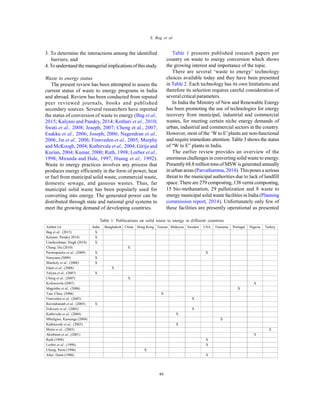
Table 1 presents published research papers per
country on waste to energy conversion which shows
the growing interest and importance of the topic.
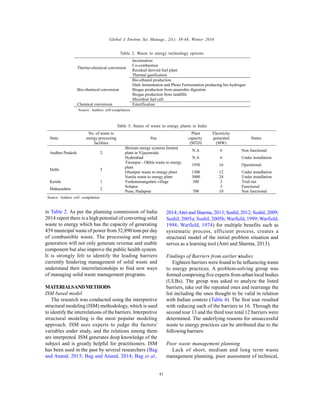
There are several ‘waste to energy’ technology
choices available today and they have been presented
in Table 2. Each technology has its own limitations and
therefore its selection requires careful consideration of
several critical parameters.
In India the Ministry of New and Renewable Energy
has been promoting the use of technologies for energy
recovery from municipal, industrial and commercial
wastes, for meeting certain niche energy demands of
urban, industrial and commercial sectors in the country.
However, most of the ‘W to E’plants are non-functional
and require immediate attention.Table 3 shows the status
of “W to E” plants in India.
The earlier review provides an overview of the
enormous challenges in converting solid waste to energy.
Presently68.8 million tons ofMSW is generated annually
in urban areas (Parvathamma,2014). Thisposes a serious
threat to the municipal authorities due to lack of landfill
space. Thereare 279 composting, 138 vermi composting,
15 bio-methanation, 29 palletization and 8 waste to
energy municipal solid waste facilities in India (Planning
commission report, 2014). Unfortunately only few of
these facilities are presently operational as presented
Table 1: Publications on solid waste to energy in different countries
Author (s) India Bangladesh China Hong Kong Taiwan Malaysia Sweden USA Tanzania Portugal Nigeria Turkey
Bag et al., (2015) X
Kalyani; Pandey 2014) X
Unnikrishnan; Singh (2010) X
Cheng; Hu (2010) X
Psomopoulos et al., (2009) X X
Narayana (2009) X
Sharholy et al., (2008) X
Islam et al., (2008) X
Talyan et al., (2007) X
Cheng et al., (2007) X
Kofoworola (2007) X
Magrinho et al., (2006) X
Tsai; Chou, (2006) X
Finnveden et al., (2005) X
Ravindranath et al., (2005) X
Eriksson et al., (2005) X
Kathirvale et al., (2004) X
Mbuligwe; Kassenga (2004) X
Kathiravale et al., (2003) X
Metin et al., (2003) X
Akinbami et al., (2001) X
Ruth (1998) X
Lorber et al., (1998) X
Chung; Poon (1996) X
Alter; Dunn (1980) X
Global J. Environ. Sci. Manage., 2(1): 39-48, Winter 2016
41
in Table 2. As per the planning commission of India
2014 report there is a high potential of converting solid
waste to energy which has the capacity of generating
439 municipal waste of power from 32,890 tons per day
of combustible waste. The processing and energy
generation will not only generate revenue and usable
component but also improve the public health system.
It is strongly felt to identify the leading barriers
currently hindering management of solid waste and
understand their interrelationships to find new ways
of managing solid waste management programs.
MATERIALSANDMETHODS
ISM based model
The research was conducted using the interpretive
structural modeling (ISM) methodology, which is used
to identify the interrelations of the barriers. Interpretive
structural modeling is the most popular modeling
approach. ISM uses experts to judge the factors/
variables under study, and the relations among them
are interpreted. ISM generates deep knowledge of the
subject and is greatly helpful for practitioners. ISM
has been used in the past by several researchers (Bag
and Anand, 2015; Bag and Anand, 2014; Bag et al.,
2014;Attriand Sharma, 2013; Sushil,2012;Sushil,2009;
Sushil, 2005a; Sushil, 2005b; Warfield, 1999; Warfield,
1994; Warfield, 1974) for multiple benefits such as
systematic process, efficient process, creates a
structural model of the initial problem situation and
serves as a learning tool (Attri and Sharma, 2013).
Findings of Barriers from earlier studies
Eighteen barriers were found to be influencing waste
to energy practices. A problem-solving group was
formed comprising five experts from urban local bodies
(ULBs). The group was asked to analyze the listed
barriers, take out the repeated ones and rearrange the
list including the ones thought to be valid in relation
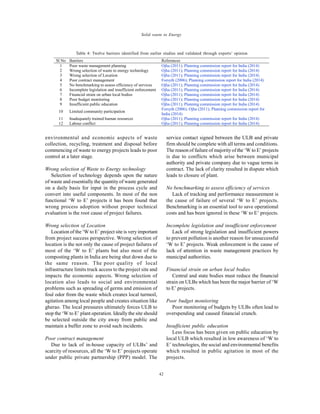
with Indian context (Table 4). The first tour resulted
with reducing each of the barriers to 16. Through the
second tour 13 and the third tour total 12 barriers were
determined. The underlying reasons for unsuccessful
waste to energy practices can be attributed due to the
following barriers:
Poor waste management planning
Lack of short, medium and long term waste
management planning, poor assessment of technical,
Table 2: Waste to energy technology options
Thermo-chemical conversion
Incineration
Co-combustion
Residual derived fuel plant
Thermal gasification
Bio-chemical conversion
Bio-ethanol production
Dark fermentation and Photo Fermentation producing bio-hydrogen
Biogas production from anaerobic digestion
Biogas production from landfills
Microbial fuel cell
Chemical conversion Esterification
Source: Authors self-compilation
Table 3: Status of waste to energy plants in India
State
No. of waste to
energy processing
facilities
Site
Plant
capacity
(MTD)
Electricity
generated
(MW)
Status
Andhra Pradesh 2
Shriram energy systems limited
plant in Vijayawada
N.A 6 Non functional
Hyderabad N.A 6 Under installation
Delhi 3
Timarpur - Okhla waste to energy
plant
1950 16 Operational
Ghazipur waste to energy plant 1300 12 Under installation
Narela waste to energy plant 3000 24 Under installation
Kerala 1 Venkatamangalam village 300 3 Trial run
Maharashtra 2
Solapur 3 Functional
Pune, Hadapsar 700 10 Non functional
Source: Authors self- compilation
Global J. Environ. Sci. Manage., 2(1): 39-48, Winter 2016
42
Solid waste to Energy
environmental and economic aspects of waste
collection, recycling, treatment and disposal before
commencing of waste to energy projects leads to poor
control at a later stage.
Wrong selection of Waste to Energy technology
Selection of technology depends upon the nature
of waste and essentially the quantity of waste generated
on a daily basis for input in the process cycle and
convert into useful components. In most of the non
functional ‘W to E’ projects it has been found that
wrong process adoption without proper technical
evaluation is the root cause of project failures.
Wrong selection of Location
Location of the ‘W to E’ project site is very important
from project success perspective. Wrong selection of
location is the not only the cause of project failures of
most of the ‘W to E’ plants but also most of the
composting plants in India are being shut down due to
the same reason. The poor quality of local
infrastructure limits truck access to the project site and
impacts the economic aspects. Wrong selection of
location also leads to social and environmental
problems such as spreading of germs and emission of
foul odor from the waste which creates local turmoil,
agitation among local people and creates situation like
gherao. The local pressures ultimately forces ULB to
stop the ‘W to E’ plant operation. Ideally the site should
be selected outside the city away from public and
maintain a buffer zone to avoid such incidents.
Poor contract management
Due to lack of in-house capacity of ULBs’ and
scarcity of resources, all the ‘W to E’ projects operate
under public private partnership (PPP) model. The
service contact signed between the ULB and private
firm should be complete with all terms and conditions.
The reason of failure of majority of the ‘W to E’ projects
is due to conflicts which arise between municipal
authority and private company due to vague terms in
contract. The lack of clarity resulted in dispute which
leads to closure of plant.
No benchmarking to assess efficiency of services
Lack of tracking and performance measurement is
the cause of failure of several ‘W to E’ projects.
Benchmarking is an essential tool to save operational
costs and has been ignored in these ‘W to E’ projects.
Incomplete legislation and insufficient enforcement
Lack of strong legislation and insufficient powers
to prevent pollution is another reason for unsuccessful
‘W to E’ projects. Weak enforcement is the cause of
lack of attention in waste management practices by
municipal authorities.
Financial strain on urban local bodies
Central and state bodies must reduce the financial
strain on ULBs which has been the major barrier of ‘W
to E’ projects.
Poor budget monitoring
Poor monitoring of budgets by ULBs often lead to
overspending and caused financial crunch.
Insufficient public education
Less focus has been given on public education by
local ULB which resulted in low awareness of ‘W to
E’ technologies, the social and environmental benefits
which resulted in public agitation in most of the
projects.
Sl No Barriers References
1 Poor waste management planning Ojha (2011); Planning commission report for India (2014)
2 Wrong selection of waste to energy technology Ojha (2011); Planning commission report for India (2014)
3 Wrong selection of Location Ojha (2011); Planning commission report for India (2014)
4 Poor contract management Forsyth (2006); Planning commission report for India (2014)
5 No benchmarking to assess efficiency of services Ojha (2011); Planning commission report for India (2014)
6 Incomplete legislation and insufficient enforcement Ojha (2011); Planning commission report for India (2014)
7 Financial strain on urban local bodies Ojha (2011); Planning commission report for India (2014)
8 Poor budget monitoring Ojha (2011); Planning commission report for India (2014)
9 Insufficient public education Ojha (2011); Planning commission report for India (2014)
10 Limited community participation
Forsyth (2006); Ojha (2011); Planning commission report for
India (2014)
11 Inadequately trained human resources Ojha (2011); Planning commission report for India (2014)
12 Labour conflict Ojha (2011); Planning commission report for India (2014)
Table 4: Twelve barriers identified from earlier studies and validated through experts’ opinion
Global J. Environ. Sci. Manage., 2(1): 39-48, Winter 2016
43
Limited community participation
While selecting the ‘W to E’ technology it is
essential that members from the local community
participate in the discussion and understand the entire
operations. The comments of the community members
are essential before an ULB go ahead for final signing
of contract and further investment in project. This has
never been practiced so far and main reason of conflicts
at the later project stage.
Inadequately trained human resources
Lack of in-house resources and competency is a
major barrier in ‘W to E’ projects. Lack of knowledge in
handling and running equipment and machineries is
the cause of project failures.
Labour conflict
Lack of knowledge in handling and running
machineries, lack of health and safety instructions often
lead to major accidents. Moreover low wages and lack
of proper HR management is the cause of conflicts
among labour groups with ULB and main cause of
stoppage of plant operations.
RESULTS AND DISCUSSION
In this study the contextual relationships between
pair of barriers are analyzed. For the purpose of
understanding and capturing the data, a questionnaire
was prepared and sent to seven SWM inspectors
working with various ‘W to E’ projects. The data is
converted into SSIM matrix which is further converted
into reachibility matrix. Further the level partitions are
done and the ISM model is developed.
Structural self interaction matrix (SSIM)
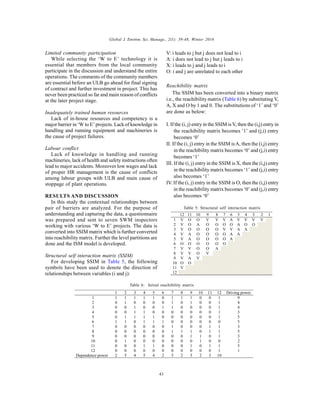
For developing SSIM in Table 5, the following
symbols have been used to denote the direction of
relationships between variables (i and j):
V: i leads to j but j does not lead to i
A: i does not lead to j but j leads to i
X: i leads to j and j leads to i
O: i and j are unrelated to each other
Reachibility matrix
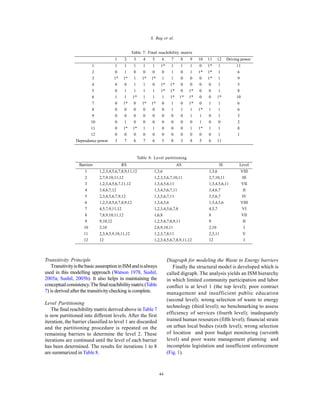
The SSIM has been converted into a binary matrix
i.e., the reachibility matrix (Table 6) by substituting V,
A, X and O by 1 and 0. The substitutions of ‘1’ and ‘0’
are done as below:
I. If the (i, j) entry in the SSIM is V, then the (i,j) entry in
the reachibility matrix becomes ‘1’ and (j,i) entry
becomes ‘0’
II. If the (i, j) entry in the SSIM isA, then the (i,j) entry
in the reachibility matrix becomes ‘0’ and (j,i) entry
becomes ‘1’
III. If the (i, j) entry in the SSIM is X, then the (i,j) entry
in the reachibility matrix becomes ‘1’ and (j,i) entry
also becomes ‘1’
IV. If the (i, j) entry in the SSIM is O, then the (i,j) entry
in the reachibility matrix becomes ‘0’ and (j,i) entry
also becomes ‘0’
Table 5: Structural self interaction matrix
12 11 10 9 8 7 6 5 4 3 2 1
1 V O O V V V A V V V V
2 V O A O O O O A O O
3 V O O O O V V A A
4 V A O O O O A A
5 V A O O O O A
6 O O O O O O
7 V V O O A
8 V V O V
9 V A V
10 O O
11 V
12
Table 6: Initial reachibility matrix
1 2 3 4 5 6 7 8 9 10 11 12 Driving power
1 1 1 1 1 1 0 1 1 1 0 0 1 9
2 0 1 0 0 0 0 1 0 1 0 0 1 4
3 0 0 1 0 0 1 1 0 0 0 0 1 4
4 0 0 1 1 0 0 0 0 0 0 0 1 3
5 0 1 1 1 1 0 0 0 0 0 0 1 5
6 1 1 0 1 1 1 0 0 0 0 0 0 5
7 0 0 0 0 0 0 1 0 0 0 1 1 3
8 0 0 0 0 0 0 1 1 1 0 1 1 5
9 0 0 0 0 0 0 0 0 1 1 0 1 3
10 0 1 0 0 0 0 0 0 0 1 0 0 2
11 0 0 0 1 1 0 0 0 1 0 1 1 5
12 0 0 0 0 0 0 0 0 0 0 0 1 1
Dependence power 2 5 4 5 4 2 5 2 5 2 3 10
Global J. Environ. Sci. Manage., 2(1): 39-48, Winter 2016
44
S. Bag et al.
Transitivity Principle
TransitivityisthebasicassumptioninISMandisalways
used in this modelling approach (Watson 1978, Sushil,
2005a; Sushil, 2005b). It also helps in maintaining the
conceptualconsistency.Thefinalreachibilitymatrix(Table
7) is derived after the transitivity checking is complete.
Level Partitioning
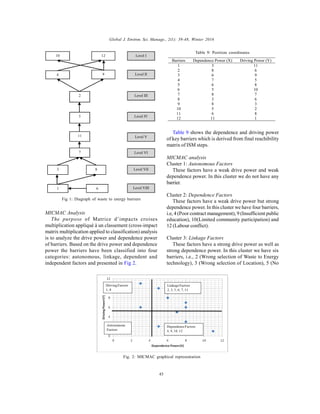
The final reachibility matrix derived above in Table 7
is now partitioned into different levels. After the first
iteration, the barrier classified to level 1 are discarded
and the partitioning procedure is repeated on the
remaining barriers to determine the level 2. These
iterations are continued until the level of each barrier
has been determined. The results for iterations 1 to 8
are summarized in Table 8.
Table 7: Final reachibility matrix
1 2 3 4 5 6 7 8 9 10 11 12 Driving power
1 1 1 1 1 1 1* 1 1 1 0 1* 1 11
2 0 1 0 0 0 0 1 0 1 1* 1* 1 6
3 1* 1* 1 1* 1* 1 1 0 0 0 1* 1 9
4 0 0 1 1 0 1* 1* 0 0 0 0 1 5
5 0 1 1 1 1 1* 1* 0 1* 0 0 1 8
6 1 1 1* 1 1 1 1* 1* 1* 0 0 1* 10
7 0 1* 0 1* 1* 0 1 0 1* 0 1 1 6
8 0 0 0 0 0 0 1 1 1 1* 1 1 6
9 0 0 0 0 0 0 0 0 1 1 0 1 3
10 0 1 0 0 0 0 0 0 0 1 0 0 2
11 0 1* 1* 1 1 0 0 0 1 1* 1 1 8
12 0 0 0 0 0 0 0 0 0 0 0 1 1
Dependence power 3 7 6 7 6 5 8 3 8 5 6 11
Table 8: Level partitioning
Barriers RS AS IS Level
1 1,2,3,4,5,6,7,8,9,11,12 1,3,6 1,3,6 VIII
2 2,7,9,10,11,12 1,2,3,5,6,7,10,11 2,7,10,11 III
3 1,2,3,4,5,6,7,11,12 1,3,4,5,6,11 1,3,4,5,6,11 VII
4 3,4,6,7,12 1,3,4,5,6,7,11 3,4,6,7 II
5 2,3,4,5,6,7,9,12 1,3,5,6,7,11 3,5,6,7 IV
6 1,2,3,4,5,6,7,8,9,12 1,3,4,5,6 1,3,4,5,6 VIII
7 4,5,7,9,11,12 1,2,3,4,5,6,7,8 4,5,7 VI
8 7,8,9,10,11,12 1,6,8 8 VII
9 9,10,12 1,2,5,6,7,8,9,11 9 II
10 2,10 2,8,9,10,11 2,10 I
11 2,3,4,5,9,10,11,12 1,2,3,7,8,11 2,3,11 V
12 12 1,2,3,4,5,6,7,8,9,11,12 12 I
Diagraph for modeling the Waste to Energy barriers
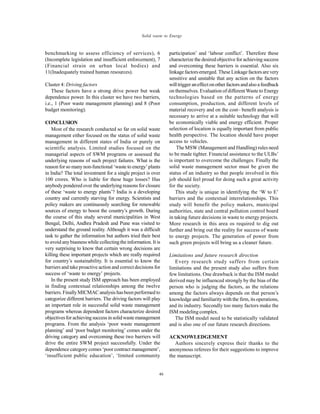
Finally the structural model is developed which is
called digraph. The analysis yields an ISM hierarchy
in which limited community participation and labor
conflict is at level 1 (the top level); poor contract
management and insufficient public education
(second level); wrong selection of waste to energy
technology (third level); no benchmarking to assess
efficiency of services (fourth level); inadequately
trained human resources (fifth level); financial strain
on urban local bodies (sixth level); wrong selection
of location and poor budget monitoring (seventh
level) and poor waste management planning and
incomplete legislation and insufficient enforcement
(Fig. 1).
Global J. Environ. Sci. Manage., 2(1): 39-48, Winter 2016
45
MICMAC Analysis
The purpose of Matrice d’impacts croises
multiplication appliqué à un classement (cross-impact
matrix multiplication applied to classification) analysis
is to analyze the drive power and dependence power
of barriers. Based on the drive power and dependence
power the barriers have been classified into four
categories: autonomous, linkage, dependent and
independent factors and presented in Fig 2.
10 12
4 9
2
5
11
7
3 8
1 6 Level VIII
Level I
Level II
Level III
Level IV
Level V
Level VI
Level VII
Fig 1: Diagraph of waste to energy barriers
Barriers Dependence Power (X) Driving Power (Y)
1 3 11
2 8 6
3 6 9
4 7 5
5 6 8
6 5 10
7 8 7
8 3 6
9 8 3
10 5 2
11 6 8
12 11 1
Table 9: Position coordinates
Table 9 shows the dependence and driving power
of key barriers which is derived from final reachibility
matrix of ISM steps.
MICMAC analysis
Cluster 1: Autonomous Factors
These factors have a weak drive power and weak
dependence power. In this cluster we do not have any
barrier.
Cluster 2: Dependence Factors
These factors have a weak drive power but strong
dependence power. In this cluster we have four barriers,
i.e, 4 (Poor contract management), 9 (Insufficient public
education), 10(Limited community participation) and
12 (Labour conflict).
Cluster 3: Linkage Factors
These factors have a strong drive power as well as
strong dependence power. In this cluster we have six
barriers, i.e., 2 (Wrong selection of Waste to Energy
technology), 3 (Wrong selection of Location), 5 (No
Fig. 2: MICMAC graphical representation
Global J. Environ. Sci. Manage., 2(1): 39-48, Winter 2016
46
Solid waste to Energy
benchmarking to assess efficiency of services), 6
(Incomplete legislation and insufficient enforcement), 7
(Financial strain on urban local bodies) and
11(Inadequately trained human resources).
Cluster 4: Driving factors
These factors have a strong drive power but weak
dependence power. In this cluster we have two barriers,
i.e., 1 (Poor waste management planning) and 8 (Poor
budget monitoring).
CONCLUSION
Most of the research conducted so far on solid waste
management either focused on the status of solid waste
management in different states of India or purely on
scientific analysis. Limited studies focused on the
managerial aspects of SWM programs or assessed the
underlying reasons of such project failures. What is the
reason for so manynon-functional ‘waste to energy’plants
in India? The total investment for a single project is over
100 crores. Who is liable for these huge losses? Has
anybody pondered over the underlying reasons for closure
of these ‘waste to energy plants’? India is a developing
country and currently starving for energy. Scientists and
policy makers are continuously searching for renewable
sources of energy to boost the country’s growth. During
the course of this study several municipalities in West
Bengal, Delhi, Andhra Pradesh and Pune was visited to
understand the ground reality. Although it was a difficult
task to gather the information but authors tried their best
to avoid anybiasness while collecting theinformation. It is
very surprising to know that certain wrong decisions are
killing these important projects which are really required
for country’s sustainability. It is essential to know the
barriers and take proactive action and correctdecisions for
success of ‘waste to energy’ projects.
In the present study ISM approach has been employed
in finding contextual relationships among the twelve
barriers. FinallyMICMAC analysis hasbeen performed to
categorize different barriers. The driving factors will play
an important role in successful solid waste management
programs whereas dependent factors characterize desired
objectivesforachievingsuccessinsolidwastemanagement
programs. From the analysis ‘poor waste management
planning’ and ‘poor budget monitoring’ comes under the
driving category and overcoming these two barriers will
drive the entire SWM project successfully. Under the
dependence category comes ‘poor contract management’,
‘insufficient public education’, ‘limited community
participation’ and ‘labour conflict’. Therefore these
characterize the desired objective for achieving success
and overcoming these barriers is essential. Also six
linkagefactorsemerged. These Linkage factorsare very
sensitive and unstable that any action on the factors
willtrigger aneffectonother factors andalso afeedback
on themselves. Evaluation of different Waste to Energy
technologies based on the patterns of energy
consumption, production, and different levels of
material recovery and on the cost– benefit analysis is
necessary to arrive at a suitable technology that will
be economically viable and energy efficient. Proper
selection of location is equally important from public
health perspective. The location should have proper
access to vehicles.
The MSW (Management and Handling) rules need
to be made tighter. Financial assistance to the ULBs’
is important to overcome the challenges. Finally the
solid waste management sector must be given the
status of an industry so that people involved in this
job should feel proud for doing such a great activity
for the society.
This study is unique in identifying the ‘W to E’
barriers and the contextual interrelationships. This
study will benefit the policy makers, municipal
authorities, state and central pollution control board
in taking future decisions in waste to energy projects.
More research in this area os required to dig out
further and bring out the reality for success of waste
to energy projects. The generation of power from
such green projects will bring us a cleaner future.
Limitations and future research direction
Every research study suffers from certain
limitations and the present study also suffers from
few limitations. One drawback is that the ISM model
derived may be influenced strongly by the bias of the
person who is judging the factors, as the relations
among the factors always depends on that person’s
knowledge and familiarity with the firm, its operations,
and its industry. Secondly too many factors make the
ISM modeling complex.
The ISM model need to be statistically validated
and is also one of our future research directions.
ACKNOWLEDGEMENT
Authors sincerely express their thanks to the
anonymous referees for their suggestions to improve
the manuscript.
Global J. Environ. Sci. Manage., 2(1): 39-48, Winter 2016
47
CONFLICT OF INTEREST
The authors declare that there are no conflicts of
interest regarding the publication of this manuscript.
REFERENCES
Akinbami, J. F.; Ilori, M. O.; Oyebisi, T. O.; Akinwumi, I. O.;
Adeoti, O., (2001). Biogas energy use in Nigeria: current
status, future prospects and policy implications. Renew.
Sustain. Energ. Rev., 5(1): 97-112 (16 Pages).
Attri, R.D.N.; Sharma, V., (2013). Interpretive structural
modeling approach: An overview. Res. J. Manage. Sci., 2(2):
3-8 (6 pages).
Alter, H. ; Dunn, J. J., (1980). Solid waste conversion to energy:
Current European US Practice.
Bag, S., Dubey, R., Mondal, N., (2015). Solid Waste to Energy
Status in India: A short review. Discovery, 39(177): 75-81
(7 pages).
Bag, S.; Anand, N., (2015). Modeling barriers of sustainable
supply chain network design using interpretive structural
modeling: An insight from food processing sector in India,
Int. J. Autom. Logist., 3(1): 234-255 (22 pages).
Bag, S.; Anand, N., (2014). Modelling GSCM framework using
ISM and MICMAC analysis. African J. Bus. Manage., 8(22):
1053-1065 (13 pages).
Bag, S.; Anand, N.; Pandey, K.K., (2014). A framework for the
analysis of Sustainable Supply Chain Management: an insight
from Indian rubber industry. J. Supply Chain Manage. Sys.,
3(1): 68-83 (16 pages).
Census, (2011). Provisional population totals report, (2011).
Available at http://censusindia.gov.in
Cheng, H.; Hu, Y., (2010). Municipal solid waste as a renewable
source of energy: Current and future practices in
China. Bioresource Tech., 101(11): 3816-3824 (9 pages).
Cheng, H.; Zhang, Y.; Meng, A.; Li, Q., (2007). Municipal
solid waste fueled power generation in China: a case study of
waste to energy in Changchun city. Environ. Sci.
Tech., 41(21): 7509-7515 (7 pages).
Chung, S.S.; Poon, C. S., (1996). Evaluating waste management
alternatives by the multiple criteria approach. Resour.,
Conserv. Recy.,17(3): 189-210 (22 pages).
Eriksson, O.; Reich, M. C.; Frostell, B.; Björklund, A.; Assefa,
G.; Sundqvist, J. O.; Thyselius, L., (2005). Municipal solid
waste management from a systems perspective. J. Cleaner
Product., 13(3): 241-252 (12 pages).
Esakku, S.; Selvam, A.; Palanivelu, K.; Nagendran, R.; Joseph,
K., (2006). Leachate quality of municipal solid waste
dumpsites at Chennai, India. Asian J. Water, Environ.
Poll., 3(1): 69-76 (8 pages).
Finnveden, G.; Johansson, J.; Lind, P.; Moberg, Å., (2005).
Life cycle assessment of energy from solid waste—part 1:
general methodology and results. J. Cleaner Product., 13(3):
213-229 (17 pages).
Forsyth, T., (2006), Cooperative environmental governance
and waste-to-energy technologies in Asia. Int. J. Tech.
Manage. Sustain. Dev., 5(3): 209-220 (12 pages).
Girija, D.G.; Kurian, J., (2004). Solid phase anaerobic digestion
of municipal solid waste. J. IAEM, 31: 147-152 (6 pages).
Huang, G.; Baetz, B. W.; Patry, G. G., (1992). A grey linear
programming approach for municipal solid waste
management planning under uncertainty. Civil Eng.
Sys., 9(4): 319-335 (17 pages).
Islam, M. R.; Beg, M. R. A., (2008). Renewable energy resources
and technologies practice in Bangladesh. Renew. Sustain.
Energ. Rev., 12(2): 299-343 (45 pages).
Jin, J.; Wang, Z.; Ran, S., (2006). Solid waste management in
Macao: Practices and challenges. J. Waste Manage., 26:
1045-1051 (7 pages).
Joseph, K., (2006). Stakeholder participation for sustainable
waste management. Habitat Int., 30(4): 863-871 (9 pages).
Joseph, K., (2007). Electronic waste management in India–
issues and strategies. In Eleventh International Waste
Management and Landfill Symposium, Sardinia. In October.
Kalyani, K.A. ; Pandey, K.K., (2014). Waste to energy status
in India: A short review. Renew. Sustain. Energ. Rev., 31:
113-120 (8 pages).
Kathirvale, S.; Yunus, M.N.M.; Sopian, K.; Samsuddin, A. H.,
(2004). Energy potential from municipal solid waste in
Malaysia. Renew. Energ.,29(4): 559-567 (9 pages).
Kathiravale, S.; Yunus, M.N.M.; Sopian, K.; Samsuddin,
A.H.; Rahman, R.A., (2003). Modeling the heating value
of municipal solid waste. Fuel, 82(9): 1119-1125 (10
pages).
Kofoworola, O.F., (2007). Recovery and recycling practices
in municipal solid waste management in Lagos,
Nigeria. Waste Manage., 27(9): 1139-1143 (5 pages).
Kothari, R. ; Tyagi, V. V. ; Pathak, A., (2010). Waste-to-
energy: A way from renewable energy sources to sustainable
development. Renew. Sustain. Energ. Rev., 14(9): 3164-
3170 (7 pages).
Kumar, S., (2000). Technology options for municipal solid
waste-to-energy project. TIMES Teri Info. Monit. Environ.
Sci., 5(1): 1-11 (11 pages).
Lorber, M.; Pinsky, P.; Gehring, P.; Braverman, C.; Winters,
D.; Sovocool, W., (1998). Relationships between dioxins in
soil, air, ash, and emissions from a municipal solid waste
incinerator emitting large amounts of dioxins.
Chemosphere, 37(9): 2173-2197 (25 pages).
Magrinho, A.; Didelet, F.; Semiao, V., (2006). Municipal solid
waste disposal in Portugal. Waste Manage., 26(12): 1477-
1489 (12pages).
Mbuligwe, S.E.; Kassenga, G. R., (2004). Feasibility and
strategies for anaerobic digestion of solid waste for energy
production in Dar es Salaam city, Tanzania. Resources,
Conserv. Recy., 42(2): 183-203 (21 pages).
Metin, E.; Eröztürk, A.; Neyim, C., (2003). Solid waste
management practices and review of recovery and recycling
operations in Turkey. Waste Manage., 23(5): 425-432 (8
pages).
Miranda, M. L.; Hale, B., (1997). Waste not, want not: the
private and social costs of waste-to-energy
production. Energ. Pol., 25(6): 587-600 (14 pages).
Murphy, J. D.; McKeogh, E., (2004). Technical, economic
and environmental analysis of energy production from
municipal solid waste. Renew. Energ., 29(7): 1043-1057 (14
pages).
Nagendran, R.; Selvam, A.; Joseph, K.; Chiemchaisri, C., (2006).
Phytoremediation rehabilitation of municipal solid waste
landfills and dumpsites: A brief review. Waste
Manage., 26(12): 1357-1369 (13 pages).
Narayana, T., (2009). Municipal solid waste management in
India: From waste disposal to recovery of resources? Waste
Manage., 29(3): 1163-1166 (4 pages).
Global J. Environ. Sci. Manage., 2(1): 39-48, Winter 2016
48
S. Bag et al.
AUTHOR (S) BIOSKETCHES
Bag, S., Ph.D., Instructor, Procurement Head, Tega Industries South Africa Pty Ltd, 2 Uranium Road, Vulcania, Brakpan-1541, South
Africa. Email: surajit.bag@tegaindustries.com
Mondal, N., M.Sc., Instructor, Scientific Officer, Aquacheck Kolkata Laboratory, Water Quality Research Centre, EFL, P/1J, Survey Park,
Ajaynagar, Kolkata-700075, W.B, India. Email: nil.mondal2007@gmail.com
Dubey, R., M.Sc., Instructor, HOD Science and PGT Chemistry, ST. Xaviers School, Balia, U.P, India. Email: dubeylive@gmail.com
Ojha, K., (2011). Status of MSW management system in
northern India-an overview, Environ Dev Sustain, 13: 203-
215 (13 pages).
Parvathamma, G., (2014). An analytical study on problems
and policies of solid waste management in India–special
reference to Bangalore City, 8(10): 6-15 (10 pages).
Planning Commission Report of India for the task force on
waste to energy, (2014). Volume 1. Available at http://
p la n n i n gc omm i ssi on . n i c . i n / rep ort s/ gen rep / rep _
wte1205.pdf
Psomopoulos, C.S. ; Bourka, A. ; Themelis, N.J., (2009).
Waste-to-energy: A review of the status and benefits in
USA. Waste Manage., 29(5): 1718-1724 (7 pages).
Ravindranath, N.H. ; Somashekar, H.I. ; Nagaraja, M.S. ; Sudha,
P. ; Sangeetha, G. ; Bhattacharya, S.C.; Salam, P. A., (2005).
Assess. Sustain. non-plantation biomass Res. Potential Energ.
in India. Biomass Bioenerg., 29(3): 178-190 (13 pages).
Ruth, L.A., (1998). Energy from municipal solid waste: A
comparison with coal combustion technology. Prog. Energ.
Combust. Sci., 24(6): 545-564 (20 pages).
Sharholy, M.; Ahmad, K.; Mahmood, G.; Trivedi, R. C., (2008).
Municipal solid waste management in Indian cities: A
review. Waste Manage., 28(2): 459-467 (9 pages).
Sushil, (2005a). Interpretive matrix: A tool to aid interpretation
of management and social research. Global J. Flex. Sys.
Manage., 6(2): 27-30 (4 pages).
Sushil, (2005b). A flexible strategy framework for managing
community and change. Int. J. Global Bus. Competitiveness,
1(1): 22-32 (11 pages).
Sushil, (2009). Interpretive ranking process. Global Journal of
Global J. Flex. Sys. Manage., 10(4): 1-10 (10 pages).
Sushil, (2012). Interpreting the Interpretive Structural Model.
Global J. Flex. Sys. Manage., 13(2): 87-106 (20 pages).
Swati, M.; Rema, T.; Joseph, K., (2008). Hazardous organic
compounds in urban municipal solid waste from a developing
country. J. hazard. Mater., 160(1): 213-219 (7 pages).
Talyan, V.; Dahiya, R. P.; Anand, S.; Sreekrishnan, T.R., (2007).
Quantification of methane emission from municipal solid
waste disposal in Delhi. Resour., Conserv. Recy., 50(3): 240-
259 (20 pages).
Tsai, W. T.; Chou, Y. H., (2006). An overview of renewable
energy utilization from municipal solid waste (MSW)
incineration in Taiwan. Renewable and Sustainable Energ.
Rev., 10(5): 491-502 (12 pages).
Unnikrishnan, S.; Singh, A., (2010). Energy recovery in solid
waste management through CDM in India and other
countries. Res., Conserv. Recy., 54(10): 630-640 (10 pages).
Warfield, J.N., (1974). Structuring complex systems. Battele
monograph. Columbus, O.H: Battele Memorial Ins. 4.
Warfield, J.N., (1994). A science of generic design: Managing
complexity through systems design, Iowa: Iowa State
University Press.
Warfield, J.N., (1999). Twenty laws of complexity: Science
applicability in organizations. Syst. Res. Behav. Sci., 16(1):
3-40 (38 pages).
Watson, R.H., (1978). Interpretive structural modeling—A
useful tool for technology assessment? Tech. Forecasting
Soc. Change, 11(2): 165-185 (21 pages).
DOI: 10.7508/gjesm.2016.01.005
URL: http://gjesm.net/article_14910_1931.html
How to cite this article:
Bag, S.; Mondal, N.; Dubey, R.,(2016). Modeling barriers of solid waste to energy practices: An Indian
perspective. Global J. Environ. Sci. Manage. 2 (1): 39-48.

Gjesm149101451593800

  • 1.
    Global J. Environ.Sci. Manage., 2(1): 39-48, Winter 2016 39 ABSTRACT: India is rapidly urbanizing and the class I cities contribute more than 72 percent of the total solid waste generated in urban areas. However managing solid waste scientifically has become one of the biggest challenges in front of state and local authorities. Limited space for dumping and skilled manpower is a constraint for managing the solid wastes. Illegal dumping outside cities and unscientific processing often leads to foul odor generation, leachate contaminating the water streams and spreading of germs detrimental to public health and society. Globally environmental scientists are looking for innovative and sustainable methods for recovering the useful components from waste consisting of value and can be reused. Presently several waste to energy projects have gained popularity across the world. Unfortunately none of these practices have gained popularity in India and further motivated in pursuing the present study. The objective of the study is twofold. First authors assessed the current status of solid waste management practices in India. Secondly the leading barriers are identified and interpretive structural modeling technique is performed to identify the contextual interrelationships between leading barriers influencing the solid waste to energy programs in the country. The dependence and driving power of the barriers are further analyzed. Finally the conclusions are drawn which may assist policy makers in designing sustainable waste management programs. KEYWORDS: Solid waste management (SWM); Waste to Energy technology; Barriers; interpretive structural modeling (ISM); Matrice d’impacts croises multiplication appliqué à un classement (MICMAC) Global J. Environ. Sci. Manage., 2(1): 39-48, Winter 2016 DOI: 10.7508/gjesm.2016.01.005 *Corresponding Author Email: surajit.bag@gmail.com Tel.: +8902647271; Fax: +27 11 845 1472 Note. Discussion period for this manuscript open until March 1, 2016 on GJESM website at the “Show Article”. Modeling barriers of solid waste to energy practices: An Indian perspective S. Bag1, *, N. Mondal2 , R. Dubey3 1 Procurement Head, Tega Industries South Africa Pty Ltd, 2 Uranium Road, Vulcania, Brakpan-1541, South Africa 2 Scientific Officer, Aquacheck Kolkata Laboratory, Water Quality Research Centre, EFL, P/1J, Survey Park, Ajaynagar, Kolkata-700075, W.B, India 3 HOD Science and PGT Chemistry, ST. Xaviers School, Balia, U.P, India INTRODUCTION Sustainable waste management framework is the pressing call of the day in a developing country like India. The population of India has increased by more than 181 million during the decade 2001-2011 (Census, 2011). Urban India generates 68.8 million tons of municipal solid waste per year (SWM India, 2011). The importance of the subject is reflected in the themes of conferences and growing number of publications. However several barriers are hindering the progress of solid waste to energy projects in India. The main objectives of this study are: 1. To assess the current status of solid waste management practices in India. 2. To identify the barriers influencing solid waste to energy programs in India Received 3 September 2015; revised 29 October 2015; accepted 8 November 2015; available online 1 December 2015 ORIGINAL RESEARCH PAPER
  • 2.
    Global J. Environ.Sci. Manage., 2(1): 39-48, Winter 2016 40 S. Bag et al. 3. To determine the interactions among the identified barriers; and 4.To understand themanagerialimplicationsofthisstudy. Waste to energy status The present review has been attempted to assess the current status of waste to energy programs in India and abroad. Review has been conducted from reputed peer reviewed journals, books and published secondary sources. Several researchers have reported the status of conversion of waste to energy (Bag et al., 2015; Kalyani and Pandey, 2014; Kothari et al., 2010; Swati et al., 2008; Joseph, 2007; Cheng et al., 2007; Esakku et al., 2006; Joseph, 2006; Nagendran et al., 2006; Jin et al., 2006; Finnveden et al., 2005; Murphy and McKeogh, 2004; Kathirvale et al., 2004; Girija and Kurian, 2004; Kumar, 2000; Ruth, 1998; Lorber et al., 1998; Miranda and Hale, 1997; Huang et al., 1992). Waste to energy practices involves any process that produces energy efficiently in the form of power, heat or fuel from municipal solid waste, commercial waste, domestic sewage, and gaseous wastes. Thus, far municipal solid waste has been popularly used for converting into energy. The generated power can be distributed through state and national grid systems to meet the growing demand of developing countries. Table 1 presents published research papers per country on waste to energy conversion which shows the growing interest and importance of the topic. There are several ‘waste to energy’ technology choices available today and they have been presented in Table 2. Each technology has its own limitations and therefore its selection requires careful consideration of several critical parameters. In India the Ministry of New and Renewable Energy has been promoting the use of technologies for energy recovery from municipal, industrial and commercial wastes, for meeting certain niche energy demands of urban, industrial and commercial sectors in the country. However, most of the ‘W to E’plants are non-functional and require immediate attention.Table 3 shows the status of “W to E” plants in India. The earlier review provides an overview of the enormous challenges in converting solid waste to energy. Presently68.8 million tons ofMSW is generated annually in urban areas (Parvathamma,2014). Thisposes a serious threat to the municipal authorities due to lack of landfill space. Thereare 279 composting, 138 vermi composting, 15 bio-methanation, 29 palletization and 8 waste to energy municipal solid waste facilities in India (Planning commission report, 2014). Unfortunately only few of these facilities are presently operational as presented Table 1: Publications on solid waste to energy in different countries Author (s) India Bangladesh China Hong Kong Taiwan Malaysia Sweden USA Tanzania Portugal Nigeria Turkey Bag et al., (2015) X Kalyani; Pandey 2014) X Unnikrishnan; Singh (2010) X Cheng; Hu (2010) X Psomopoulos et al., (2009) X X Narayana (2009) X Sharholy et al., (2008) X Islam et al., (2008) X Talyan et al., (2007) X Cheng et al., (2007) X Kofoworola (2007) X Magrinho et al., (2006) X Tsai; Chou, (2006) X Finnveden et al., (2005) X Ravindranath et al., (2005) X Eriksson et al., (2005) X Kathirvale et al., (2004) X Mbuligwe; Kassenga (2004) X Kathiravale et al., (2003) X Metin et al., (2003) X Akinbami et al., (2001) X Ruth (1998) X Lorber et al., (1998) X Chung; Poon (1996) X Alter; Dunn (1980) X
  • 3.
    Global J. Environ.Sci. Manage., 2(1): 39-48, Winter 2016 41 in Table 2. As per the planning commission of India 2014 report there is a high potential of converting solid waste to energy which has the capacity of generating 439 municipal waste of power from 32,890 tons per day of combustible waste. The processing and energy generation will not only generate revenue and usable component but also improve the public health system. It is strongly felt to identify the leading barriers currently hindering management of solid waste and understand their interrelationships to find new ways of managing solid waste management programs. MATERIALSANDMETHODS ISM based model The research was conducted using the interpretive structural modeling (ISM) methodology, which is used to identify the interrelations of the barriers. Interpretive structural modeling is the most popular modeling approach. ISM uses experts to judge the factors/ variables under study, and the relations among them are interpreted. ISM generates deep knowledge of the subject and is greatly helpful for practitioners. ISM has been used in the past by several researchers (Bag and Anand, 2015; Bag and Anand, 2014; Bag et al., 2014;Attriand Sharma, 2013; Sushil,2012;Sushil,2009; Sushil, 2005a; Sushil, 2005b; Warfield, 1999; Warfield, 1994; Warfield, 1974) for multiple benefits such as systematic process, efficient process, creates a structural model of the initial problem situation and serves as a learning tool (Attri and Sharma, 2013). Findings of Barriers from earlier studies Eighteen barriers were found to be influencing waste to energy practices. A problem-solving group was formed comprising five experts from urban local bodies (ULBs). The group was asked to analyze the listed barriers, take out the repeated ones and rearrange the list including the ones thought to be valid in relation with Indian context (Table 4). The first tour resulted with reducing each of the barriers to 16. Through the second tour 13 and the third tour total 12 barriers were determined. The underlying reasons for unsuccessful waste to energy practices can be attributed due to the following barriers: Poor waste management planning Lack of short, medium and long term waste management planning, poor assessment of technical, Table 2: Waste to energy technology options Thermo-chemical conversion Incineration Co-combustion Residual derived fuel plant Thermal gasification Bio-chemical conversion Bio-ethanol production Dark fermentation and Photo Fermentation producing bio-hydrogen Biogas production from anaerobic digestion Biogas production from landfills Microbial fuel cell Chemical conversion Esterification Source: Authors self-compilation Table 3: Status of waste to energy plants in India State No. of waste to energy processing facilities Site Plant capacity (MTD) Electricity generated (MW) Status Andhra Pradesh 2 Shriram energy systems limited plant in Vijayawada N.A 6 Non functional Hyderabad N.A 6 Under installation Delhi 3 Timarpur - Okhla waste to energy plant 1950 16 Operational Ghazipur waste to energy plant 1300 12 Under installation Narela waste to energy plant 3000 24 Under installation Kerala 1 Venkatamangalam village 300 3 Trial run Maharashtra 2 Solapur 3 Functional Pune, Hadapsar 700 10 Non functional Source: Authors self- compilation
  • 4.
    Global J. Environ.Sci. Manage., 2(1): 39-48, Winter 2016 42 Solid waste to Energy environmental and economic aspects of waste collection, recycling, treatment and disposal before commencing of waste to energy projects leads to poor control at a later stage. Wrong selection of Waste to Energy technology Selection of technology depends upon the nature of waste and essentially the quantity of waste generated on a daily basis for input in the process cycle and convert into useful components. In most of the non functional ‘W to E’ projects it has been found that wrong process adoption without proper technical evaluation is the root cause of project failures. Wrong selection of Location Location of the ‘W to E’ project site is very important from project success perspective. Wrong selection of location is the not only the cause of project failures of most of the ‘W to E’ plants but also most of the composting plants in India are being shut down due to the same reason. The poor quality of local infrastructure limits truck access to the project site and impacts the economic aspects. Wrong selection of location also leads to social and environmental problems such as spreading of germs and emission of foul odor from the waste which creates local turmoil, agitation among local people and creates situation like gherao. The local pressures ultimately forces ULB to stop the ‘W to E’ plant operation. Ideally the site should be selected outside the city away from public and maintain a buffer zone to avoid such incidents. Poor contract management Due to lack of in-house capacity of ULBs’ and scarcity of resources, all the ‘W to E’ projects operate under public private partnership (PPP) model. The service contact signed between the ULB and private firm should be complete with all terms and conditions. The reason of failure of majority of the ‘W to E’ projects is due to conflicts which arise between municipal authority and private company due to vague terms in contract. The lack of clarity resulted in dispute which leads to closure of plant. No benchmarking to assess efficiency of services Lack of tracking and performance measurement is the cause of failure of several ‘W to E’ projects. Benchmarking is an essential tool to save operational costs and has been ignored in these ‘W to E’ projects. Incomplete legislation and insufficient enforcement Lack of strong legislation and insufficient powers to prevent pollution is another reason for unsuccessful ‘W to E’ projects. Weak enforcement is the cause of lack of attention in waste management practices by municipal authorities. Financial strain on urban local bodies Central and state bodies must reduce the financial strain on ULBs which has been the major barrier of ‘W to E’ projects. Poor budget monitoring Poor monitoring of budgets by ULBs often lead to overspending and caused financial crunch. Insufficient public education Less focus has been given on public education by local ULB which resulted in low awareness of ‘W to E’ technologies, the social and environmental benefits which resulted in public agitation in most of the projects. Sl No Barriers References 1 Poor waste management planning Ojha (2011); Planning commission report for India (2014) 2 Wrong selection of waste to energy technology Ojha (2011); Planning commission report for India (2014) 3 Wrong selection of Location Ojha (2011); Planning commission report for India (2014) 4 Poor contract management Forsyth (2006); Planning commission report for India (2014) 5 No benchmarking to assess efficiency of services Ojha (2011); Planning commission report for India (2014) 6 Incomplete legislation and insufficient enforcement Ojha (2011); Planning commission report for India (2014) 7 Financial strain on urban local bodies Ojha (2011); Planning commission report for India (2014) 8 Poor budget monitoring Ojha (2011); Planning commission report for India (2014) 9 Insufficient public education Ojha (2011); Planning commission report for India (2014) 10 Limited community participation Forsyth (2006); Ojha (2011); Planning commission report for India (2014) 11 Inadequately trained human resources Ojha (2011); Planning commission report for India (2014) 12 Labour conflict Ojha (2011); Planning commission report for India (2014) Table 4: Twelve barriers identified from earlier studies and validated through experts’ opinion
  • 5.
    Global J. Environ.Sci. Manage., 2(1): 39-48, Winter 2016 43 Limited community participation While selecting the ‘W to E’ technology it is essential that members from the local community participate in the discussion and understand the entire operations. The comments of the community members are essential before an ULB go ahead for final signing of contract and further investment in project. This has never been practiced so far and main reason of conflicts at the later project stage. Inadequately trained human resources Lack of in-house resources and competency is a major barrier in ‘W to E’ projects. Lack of knowledge in handling and running equipment and machineries is the cause of project failures. Labour conflict Lack of knowledge in handling and running machineries, lack of health and safety instructions often lead to major accidents. Moreover low wages and lack of proper HR management is the cause of conflicts among labour groups with ULB and main cause of stoppage of plant operations. RESULTS AND DISCUSSION In this study the contextual relationships between pair of barriers are analyzed. For the purpose of understanding and capturing the data, a questionnaire was prepared and sent to seven SWM inspectors working with various ‘W to E’ projects. The data is converted into SSIM matrix which is further converted into reachibility matrix. Further the level partitions are done and the ISM model is developed. Structural self interaction matrix (SSIM) For developing SSIM in Table 5, the following symbols have been used to denote the direction of relationships between variables (i and j): V: i leads to j but j does not lead to i A: i does not lead to j but j leads to i X: i leads to j and j leads to i O: i and j are unrelated to each other Reachibility matrix The SSIM has been converted into a binary matrix i.e., the reachibility matrix (Table 6) by substituting V, A, X and O by 1 and 0. The substitutions of ‘1’ and ‘0’ are done as below: I. If the (i, j) entry in the SSIM is V, then the (i,j) entry in the reachibility matrix becomes ‘1’ and (j,i) entry becomes ‘0’ II. If the (i, j) entry in the SSIM isA, then the (i,j) entry in the reachibility matrix becomes ‘0’ and (j,i) entry becomes ‘1’ III. If the (i, j) entry in the SSIM is X, then the (i,j) entry in the reachibility matrix becomes ‘1’ and (j,i) entry also becomes ‘1’ IV. If the (i, j) entry in the SSIM is O, then the (i,j) entry in the reachibility matrix becomes ‘0’ and (j,i) entry also becomes ‘0’ Table 5: Structural self interaction matrix 12 11 10 9 8 7 6 5 4 3 2 1 1 V O O V V V A V V V V 2 V O A O O O O A O O 3 V O O O O V V A A 4 V A O O O O A A 5 V A O O O O A 6 O O O O O O 7 V V O O A 8 V V O V 9 V A V 10 O O 11 V 12 Table 6: Initial reachibility matrix 1 2 3 4 5 6 7 8 9 10 11 12 Driving power 1 1 1 1 1 1 0 1 1 1 0 0 1 9 2 0 1 0 0 0 0 1 0 1 0 0 1 4 3 0 0 1 0 0 1 1 0 0 0 0 1 4 4 0 0 1 1 0 0 0 0 0 0 0 1 3 5 0 1 1 1 1 0 0 0 0 0 0 1 5 6 1 1 0 1 1 1 0 0 0 0 0 0 5 7 0 0 0 0 0 0 1 0 0 0 1 1 3 8 0 0 0 0 0 0 1 1 1 0 1 1 5 9 0 0 0 0 0 0 0 0 1 1 0 1 3 10 0 1 0 0 0 0 0 0 0 1 0 0 2 11 0 0 0 1 1 0 0 0 1 0 1 1 5 12 0 0 0 0 0 0 0 0 0 0 0 1 1 Dependence power 2 5 4 5 4 2 5 2 5 2 3 10
  • 6.
    Global J. Environ.Sci. Manage., 2(1): 39-48, Winter 2016 44 S. Bag et al. Transitivity Principle TransitivityisthebasicassumptioninISMandisalways used in this modelling approach (Watson 1978, Sushil, 2005a; Sushil, 2005b). It also helps in maintaining the conceptualconsistency.Thefinalreachibilitymatrix(Table 7) is derived after the transitivity checking is complete. Level Partitioning The final reachibility matrix derived above in Table 7 is now partitioned into different levels. After the first iteration, the barrier classified to level 1 are discarded and the partitioning procedure is repeated on the remaining barriers to determine the level 2. These iterations are continued until the level of each barrier has been determined. The results for iterations 1 to 8 are summarized in Table 8. Table 7: Final reachibility matrix 1 2 3 4 5 6 7 8 9 10 11 12 Driving power 1 1 1 1 1 1 1* 1 1 1 0 1* 1 11 2 0 1 0 0 0 0 1 0 1 1* 1* 1 6 3 1* 1* 1 1* 1* 1 1 0 0 0 1* 1 9 4 0 0 1 1 0 1* 1* 0 0 0 0 1 5 5 0 1 1 1 1 1* 1* 0 1* 0 0 1 8 6 1 1 1* 1 1 1 1* 1* 1* 0 0 1* 10 7 0 1* 0 1* 1* 0 1 0 1* 0 1 1 6 8 0 0 0 0 0 0 1 1 1 1* 1 1 6 9 0 0 0 0 0 0 0 0 1 1 0 1 3 10 0 1 0 0 0 0 0 0 0 1 0 0 2 11 0 1* 1* 1 1 0 0 0 1 1* 1 1 8 12 0 0 0 0 0 0 0 0 0 0 0 1 1 Dependence power 3 7 6 7 6 5 8 3 8 5 6 11 Table 8: Level partitioning Barriers RS AS IS Level 1 1,2,3,4,5,6,7,8,9,11,12 1,3,6 1,3,6 VIII 2 2,7,9,10,11,12 1,2,3,5,6,7,10,11 2,7,10,11 III 3 1,2,3,4,5,6,7,11,12 1,3,4,5,6,11 1,3,4,5,6,11 VII 4 3,4,6,7,12 1,3,4,5,6,7,11 3,4,6,7 II 5 2,3,4,5,6,7,9,12 1,3,5,6,7,11 3,5,6,7 IV 6 1,2,3,4,5,6,7,8,9,12 1,3,4,5,6 1,3,4,5,6 VIII 7 4,5,7,9,11,12 1,2,3,4,5,6,7,8 4,5,7 VI 8 7,8,9,10,11,12 1,6,8 8 VII 9 9,10,12 1,2,5,6,7,8,9,11 9 II 10 2,10 2,8,9,10,11 2,10 I 11 2,3,4,5,9,10,11,12 1,2,3,7,8,11 2,3,11 V 12 12 1,2,3,4,5,6,7,8,9,11,12 12 I Diagraph for modeling the Waste to Energy barriers Finally the structural model is developed which is called digraph. The analysis yields an ISM hierarchy in which limited community participation and labor conflict is at level 1 (the top level); poor contract management and insufficient public education (second level); wrong selection of waste to energy technology (third level); no benchmarking to assess efficiency of services (fourth level); inadequately trained human resources (fifth level); financial strain on urban local bodies (sixth level); wrong selection of location and poor budget monitoring (seventh level) and poor waste management planning and incomplete legislation and insufficient enforcement (Fig. 1).
  • 7.
    Global J. Environ.Sci. Manage., 2(1): 39-48, Winter 2016 45 MICMAC Analysis The purpose of Matrice d’impacts croises multiplication appliqué à un classement (cross-impact matrix multiplication applied to classification) analysis is to analyze the drive power and dependence power of barriers. Based on the drive power and dependence power the barriers have been classified into four categories: autonomous, linkage, dependent and independent factors and presented in Fig 2. 10 12 4 9 2 5 11 7 3 8 1 6 Level VIII Level I Level II Level III Level IV Level V Level VI Level VII Fig 1: Diagraph of waste to energy barriers Barriers Dependence Power (X) Driving Power (Y) 1 3 11 2 8 6 3 6 9 4 7 5 5 6 8 6 5 10 7 8 7 8 3 6 9 8 3 10 5 2 11 6 8 12 11 1 Table 9: Position coordinates Table 9 shows the dependence and driving power of key barriers which is derived from final reachibility matrix of ISM steps. MICMAC analysis Cluster 1: Autonomous Factors These factors have a weak drive power and weak dependence power. In this cluster we do not have any barrier. Cluster 2: Dependence Factors These factors have a weak drive power but strong dependence power. In this cluster we have four barriers, i.e, 4 (Poor contract management), 9 (Insufficient public education), 10(Limited community participation) and 12 (Labour conflict). Cluster 3: Linkage Factors These factors have a strong drive power as well as strong dependence power. In this cluster we have six barriers, i.e., 2 (Wrong selection of Waste to Energy technology), 3 (Wrong selection of Location), 5 (No Fig. 2: MICMAC graphical representation
  • 8.
    Global J. Environ.Sci. Manage., 2(1): 39-48, Winter 2016 46 Solid waste to Energy benchmarking to assess efficiency of services), 6 (Incomplete legislation and insufficient enforcement), 7 (Financial strain on urban local bodies) and 11(Inadequately trained human resources). Cluster 4: Driving factors These factors have a strong drive power but weak dependence power. In this cluster we have two barriers, i.e., 1 (Poor waste management planning) and 8 (Poor budget monitoring). CONCLUSION Most of the research conducted so far on solid waste management either focused on the status of solid waste management in different states of India or purely on scientific analysis. Limited studies focused on the managerial aspects of SWM programs or assessed the underlying reasons of such project failures. What is the reason for so manynon-functional ‘waste to energy’plants in India? The total investment for a single project is over 100 crores. Who is liable for these huge losses? Has anybody pondered over the underlying reasons for closure of these ‘waste to energy plants’? India is a developing country and currently starving for energy. Scientists and policy makers are continuously searching for renewable sources of energy to boost the country’s growth. During the course of this study several municipalities in West Bengal, Delhi, Andhra Pradesh and Pune was visited to understand the ground reality. Although it was a difficult task to gather the information but authors tried their best to avoid anybiasness while collecting theinformation. It is very surprising to know that certain wrong decisions are killing these important projects which are really required for country’s sustainability. It is essential to know the barriers and take proactive action and correctdecisions for success of ‘waste to energy’ projects. In the present study ISM approach has been employed in finding contextual relationships among the twelve barriers. FinallyMICMAC analysis hasbeen performed to categorize different barriers. The driving factors will play an important role in successful solid waste management programs whereas dependent factors characterize desired objectivesforachievingsuccessinsolidwastemanagement programs. From the analysis ‘poor waste management planning’ and ‘poor budget monitoring’ comes under the driving category and overcoming these two barriers will drive the entire SWM project successfully. Under the dependence category comes ‘poor contract management’, ‘insufficient public education’, ‘limited community participation’ and ‘labour conflict’. Therefore these characterize the desired objective for achieving success and overcoming these barriers is essential. Also six linkagefactorsemerged. These Linkage factorsare very sensitive and unstable that any action on the factors willtrigger aneffectonother factors andalso afeedback on themselves. Evaluation of different Waste to Energy technologies based on the patterns of energy consumption, production, and different levels of material recovery and on the cost– benefit analysis is necessary to arrive at a suitable technology that will be economically viable and energy efficient. Proper selection of location is equally important from public health perspective. The location should have proper access to vehicles. The MSW (Management and Handling) rules need to be made tighter. Financial assistance to the ULBs’ is important to overcome the challenges. Finally the solid waste management sector must be given the status of an industry so that people involved in this job should feel proud for doing such a great activity for the society. This study is unique in identifying the ‘W to E’ barriers and the contextual interrelationships. This study will benefit the policy makers, municipal authorities, state and central pollution control board in taking future decisions in waste to energy projects. More research in this area os required to dig out further and bring out the reality for success of waste to energy projects. The generation of power from such green projects will bring us a cleaner future. Limitations and future research direction Every research study suffers from certain limitations and the present study also suffers from few limitations. One drawback is that the ISM model derived may be influenced strongly by the bias of the person who is judging the factors, as the relations among the factors always depends on that person’s knowledge and familiarity with the firm, its operations, and its industry. Secondly too many factors make the ISM modeling complex. The ISM model need to be statistically validated and is also one of our future research directions. ACKNOWLEDGEMENT Authors sincerely express their thanks to the anonymous referees for their suggestions to improve the manuscript.
  • 9.
    Global J. Environ.Sci. Manage., 2(1): 39-48, Winter 2016 47 CONFLICT OF INTEREST The authors declare that there are no conflicts of interest regarding the publication of this manuscript. REFERENCES Akinbami, J. F.; Ilori, M. O.; Oyebisi, T. O.; Akinwumi, I. O.; Adeoti, O., (2001). Biogas energy use in Nigeria: current status, future prospects and policy implications. Renew. Sustain. Energ. Rev., 5(1): 97-112 (16 Pages). Attri, R.D.N.; Sharma, V., (2013). Interpretive structural modeling approach: An overview. Res. J. Manage. Sci., 2(2): 3-8 (6 pages). Alter, H. ; Dunn, J. J., (1980). Solid waste conversion to energy: Current European US Practice. Bag, S., Dubey, R., Mondal, N., (2015). Solid Waste to Energy Status in India: A short review. Discovery, 39(177): 75-81 (7 pages). Bag, S.; Anand, N., (2015). Modeling barriers of sustainable supply chain network design using interpretive structural modeling: An insight from food processing sector in India, Int. J. Autom. Logist., 3(1): 234-255 (22 pages). Bag, S.; Anand, N., (2014). Modelling GSCM framework using ISM and MICMAC analysis. African J. Bus. Manage., 8(22): 1053-1065 (13 pages). Bag, S.; Anand, N.; Pandey, K.K., (2014). A framework for the analysis of Sustainable Supply Chain Management: an insight from Indian rubber industry. J. Supply Chain Manage. Sys., 3(1): 68-83 (16 pages). Census, (2011). Provisional population totals report, (2011). Available at http://censusindia.gov.in Cheng, H.; Hu, Y., (2010). Municipal solid waste as a renewable source of energy: Current and future practices in China. Bioresource Tech., 101(11): 3816-3824 (9 pages). Cheng, H.; Zhang, Y.; Meng, A.; Li, Q., (2007). Municipal solid waste fueled power generation in China: a case study of waste to energy in Changchun city. Environ. Sci. Tech., 41(21): 7509-7515 (7 pages). Chung, S.S.; Poon, C. S., (1996). Evaluating waste management alternatives by the multiple criteria approach. Resour., Conserv. Recy.,17(3): 189-210 (22 pages). Eriksson, O.; Reich, M. C.; Frostell, B.; Björklund, A.; Assefa, G.; Sundqvist, J. O.; Thyselius, L., (2005). Municipal solid waste management from a systems perspective. J. Cleaner Product., 13(3): 241-252 (12 pages). Esakku, S.; Selvam, A.; Palanivelu, K.; Nagendran, R.; Joseph, K., (2006). Leachate quality of municipal solid waste dumpsites at Chennai, India. Asian J. Water, Environ. Poll., 3(1): 69-76 (8 pages). Finnveden, G.; Johansson, J.; Lind, P.; Moberg, Å., (2005). Life cycle assessment of energy from solid waste—part 1: general methodology and results. J. Cleaner Product., 13(3): 213-229 (17 pages). Forsyth, T., (2006), Cooperative environmental governance and waste-to-energy technologies in Asia. Int. J. Tech. Manage. Sustain. Dev., 5(3): 209-220 (12 pages). Girija, D.G.; Kurian, J., (2004). Solid phase anaerobic digestion of municipal solid waste. J. IAEM, 31: 147-152 (6 pages). Huang, G.; Baetz, B. W.; Patry, G. G., (1992). A grey linear programming approach for municipal solid waste management planning under uncertainty. Civil Eng. Sys., 9(4): 319-335 (17 pages). Islam, M. R.; Beg, M. R. A., (2008). Renewable energy resources and technologies practice in Bangladesh. Renew. Sustain. Energ. Rev., 12(2): 299-343 (45 pages). Jin, J.; Wang, Z.; Ran, S., (2006). Solid waste management in Macao: Practices and challenges. J. Waste Manage., 26: 1045-1051 (7 pages). Joseph, K., (2006). Stakeholder participation for sustainable waste management. Habitat Int., 30(4): 863-871 (9 pages). Joseph, K., (2007). Electronic waste management in India– issues and strategies. In Eleventh International Waste Management and Landfill Symposium, Sardinia. In October. Kalyani, K.A. ; Pandey, K.K., (2014). Waste to energy status in India: A short review. Renew. Sustain. Energ. Rev., 31: 113-120 (8 pages). Kathirvale, S.; Yunus, M.N.M.; Sopian, K.; Samsuddin, A. H., (2004). Energy potential from municipal solid waste in Malaysia. Renew. Energ.,29(4): 559-567 (9 pages). Kathiravale, S.; Yunus, M.N.M.; Sopian, K.; Samsuddin, A.H.; Rahman, R.A., (2003). Modeling the heating value of municipal solid waste. Fuel, 82(9): 1119-1125 (10 pages). Kofoworola, O.F., (2007). Recovery and recycling practices in municipal solid waste management in Lagos, Nigeria. Waste Manage., 27(9): 1139-1143 (5 pages). Kothari, R. ; Tyagi, V. V. ; Pathak, A., (2010). Waste-to- energy: A way from renewable energy sources to sustainable development. Renew. Sustain. Energ. Rev., 14(9): 3164- 3170 (7 pages). Kumar, S., (2000). Technology options for municipal solid waste-to-energy project. TIMES Teri Info. Monit. Environ. Sci., 5(1): 1-11 (11 pages). Lorber, M.; Pinsky, P.; Gehring, P.; Braverman, C.; Winters, D.; Sovocool, W., (1998). Relationships between dioxins in soil, air, ash, and emissions from a municipal solid waste incinerator emitting large amounts of dioxins. Chemosphere, 37(9): 2173-2197 (25 pages). Magrinho, A.; Didelet, F.; Semiao, V., (2006). Municipal solid waste disposal in Portugal. Waste Manage., 26(12): 1477- 1489 (12pages). Mbuligwe, S.E.; Kassenga, G. R., (2004). Feasibility and strategies for anaerobic digestion of solid waste for energy production in Dar es Salaam city, Tanzania. Resources, Conserv. Recy., 42(2): 183-203 (21 pages). Metin, E.; Eröztürk, A.; Neyim, C., (2003). Solid waste management practices and review of recovery and recycling operations in Turkey. Waste Manage., 23(5): 425-432 (8 pages). Miranda, M. L.; Hale, B., (1997). Waste not, want not: the private and social costs of waste-to-energy production. Energ. Pol., 25(6): 587-600 (14 pages). Murphy, J. D.; McKeogh, E., (2004). Technical, economic and environmental analysis of energy production from municipal solid waste. Renew. Energ., 29(7): 1043-1057 (14 pages). Nagendran, R.; Selvam, A.; Joseph, K.; Chiemchaisri, C., (2006). Phytoremediation rehabilitation of municipal solid waste landfills and dumpsites: A brief review. Waste Manage., 26(12): 1357-1369 (13 pages). Narayana, T., (2009). Municipal solid waste management in India: From waste disposal to recovery of resources? Waste Manage., 29(3): 1163-1166 (4 pages).
  • 10.
    Global J. Environ.Sci. Manage., 2(1): 39-48, Winter 2016 48 S. Bag et al. AUTHOR (S) BIOSKETCHES Bag, S., Ph.D., Instructor, Procurement Head, Tega Industries South Africa Pty Ltd, 2 Uranium Road, Vulcania, Brakpan-1541, South Africa. Email: surajit.bag@tegaindustries.com Mondal, N., M.Sc., Instructor, Scientific Officer, Aquacheck Kolkata Laboratory, Water Quality Research Centre, EFL, P/1J, Survey Park, Ajaynagar, Kolkata-700075, W.B, India. Email: nil.mondal2007@gmail.com Dubey, R., M.Sc., Instructor, HOD Science and PGT Chemistry, ST. Xaviers School, Balia, U.P, India. Email: dubeylive@gmail.com Ojha, K., (2011). Status of MSW management system in northern India-an overview, Environ Dev Sustain, 13: 203- 215 (13 pages). Parvathamma, G., (2014). An analytical study on problems and policies of solid waste management in India–special reference to Bangalore City, 8(10): 6-15 (10 pages). Planning Commission Report of India for the task force on waste to energy, (2014). Volume 1. Available at http:// p la n n i n gc omm i ssi on . n i c . i n / rep ort s/ gen rep / rep _ wte1205.pdf Psomopoulos, C.S. ; Bourka, A. ; Themelis, N.J., (2009). Waste-to-energy: A review of the status and benefits in USA. Waste Manage., 29(5): 1718-1724 (7 pages). Ravindranath, N.H. ; Somashekar, H.I. ; Nagaraja, M.S. ; Sudha, P. ; Sangeetha, G. ; Bhattacharya, S.C.; Salam, P. A., (2005). Assess. Sustain. non-plantation biomass Res. Potential Energ. in India. Biomass Bioenerg., 29(3): 178-190 (13 pages). Ruth, L.A., (1998). Energy from municipal solid waste: A comparison with coal combustion technology. Prog. Energ. Combust. Sci., 24(6): 545-564 (20 pages). Sharholy, M.; Ahmad, K.; Mahmood, G.; Trivedi, R. C., (2008). Municipal solid waste management in Indian cities: A review. Waste Manage., 28(2): 459-467 (9 pages). Sushil, (2005a). Interpretive matrix: A tool to aid interpretation of management and social research. Global J. Flex. Sys. Manage., 6(2): 27-30 (4 pages). Sushil, (2005b). A flexible strategy framework for managing community and change. Int. J. Global Bus. Competitiveness, 1(1): 22-32 (11 pages). Sushil, (2009). Interpretive ranking process. Global Journal of Global J. Flex. Sys. Manage., 10(4): 1-10 (10 pages). Sushil, (2012). Interpreting the Interpretive Structural Model. Global J. Flex. Sys. Manage., 13(2): 87-106 (20 pages). Swati, M.; Rema, T.; Joseph, K., (2008). Hazardous organic compounds in urban municipal solid waste from a developing country. J. hazard. Mater., 160(1): 213-219 (7 pages). Talyan, V.; Dahiya, R. P.; Anand, S.; Sreekrishnan, T.R., (2007). Quantification of methane emission from municipal solid waste disposal in Delhi. Resour., Conserv. Recy., 50(3): 240- 259 (20 pages). Tsai, W. T.; Chou, Y. H., (2006). An overview of renewable energy utilization from municipal solid waste (MSW) incineration in Taiwan. Renewable and Sustainable Energ. Rev., 10(5): 491-502 (12 pages). Unnikrishnan, S.; Singh, A., (2010). Energy recovery in solid waste management through CDM in India and other countries. Res., Conserv. Recy., 54(10): 630-640 (10 pages). Warfield, J.N., (1974). Structuring complex systems. Battele monograph. Columbus, O.H: Battele Memorial Ins. 4. Warfield, J.N., (1994). A science of generic design: Managing complexity through systems design, Iowa: Iowa State University Press. Warfield, J.N., (1999). Twenty laws of complexity: Science applicability in organizations. Syst. Res. Behav. Sci., 16(1): 3-40 (38 pages). Watson, R.H., (1978). Interpretive structural modeling—A useful tool for technology assessment? Tech. Forecasting Soc. Change, 11(2): 165-185 (21 pages). DOI: 10.7508/gjesm.2016.01.005 URL: http://gjesm.net/article_14910_1931.html How to cite this article: Bag, S.; Mondal, N.; Dubey, R.,(2016). Modeling barriers of solid waste to energy practices: An Indian perspective. Global J. Environ. Sci. Manage. 2 (1): 39-48.