Aquatic macrophytes potential for the simultaneous
removal of heavy metals (Buenos Aires, Argentina)
Patricia Miretzky, Andrea Saralegui, Alicia Ferna´ndez Cirelli *
Centro de Estudios Transdisciplinarios del Agua, Facultad de Ciencias Veterinarias, Universidad de Buenos Aires,
Chorroarı´n 280, 1427 Buenos Aires, Argentina
Received 28 August 2003; received in revised form 1 July 2004; accepted 13 July 2004
Abstract
Heavy metal removal from water has been approached by using different technologies. Phytotechnologies, with an
increasing development during the last two decades, involve using plants for metal removal. Three autochthonous float-
ing macrophytes, common in pampean shallow lakes (Argentina), Pista stratiotes, Spirodela intermedia and Lemna
minor were used in laboratory experiences for the simultaneously removal of several heavy metals (Fe, Cu, Zn, Mn,
Cr and Pb) resulting from anthropogenic activity, in order to simulate a naturally polluted environment. The experi-
ences were performed for different concentrations of metals along 15 days. High metal removal percentages were
obtained for the 3 species and metals. L. minor did not survive the conditions of the experiment. High correlation
between the final water and the macrophytes metal concentration was obtained, deviations were due to PbCrO4 preci-
pitation. The rate of metal uptake was dependent on the metal concentration for the 3 species studied.
Ó 2004 Elsevier Ltd. All rights reserved.
Keywords: Macrophytes; Metal removal; Removal rate; Pampean shallow lakes
1. Introduction
Heavy metals, industrial pollutants, in contrast with
organic materials cannot be degraded and therefore
accumulate in water, soil, bottom sediments and living
organisms. Water contamination with heavy metals is
a very important problem in the current world. Occur-
rence of toxic metals in pond, ditch and river water
affect the lives of local people that depend upon these
water sources for their daily requirements (Rai et al.,
2002). Consumption of such aquatic food stuff en-
riched with toxic metals may cause serious health haz-
ards through food-chain magnification (Khan et al.,
2000).
A number of methods are available to remove toxic
metals from water: ion exchange, reverse osmosis, elec-
trolysis, precipitation and adsorption. The latter is by
far the most versatile and widely used. However, the
methods present different efficiencies for different metals
and they can be very expensive especially if large vol-
umes, low metal concentration and high standards of
cleaning are required. The main processes by which hea-
vy metals are removed from aquatic environment are
physical, biological and biochemical and they take place
in water, biota and suspended solids. The predominance
0045-6535/$ - see front matter Ó 2004 Elsevier Ltd. All rights reserved.
doi:10.1016/j.chemosphere.2004.07.024
*
Corresponding author. Tel.: +54 11 45248484; fax: +54 11
45248499.
E-mail address: afcirelli@fvet.uba.ar (A.F. Cirelli).
Chemosphere 57 (2004) 997–1005
www.elsevier.com/locate/chemosphere
of one of them will depend on the composition of the
system, the pH, the redox condition, and the pollutant
nature.
It is a well known fact that aquatic plants accumulate
metals that they take from the environment and concen-
trate on the trophic chains with accumulative effect
(Outridge and Noller, 1991; Tremp and Kohler, 1995).
The final metal concentration in plants is usually signif-
icantly larger than in the watercolumn and this fact has
led investigators to be interested in the toxicity of these
metals for the plants, in the plant tolerance (Ernst et al.,
1992; van Steveninck et al., 1992); in the roll of the aqua-
tic plants in the biochemical cycles (Jackson et al., 1994;
St-Cyr et al., 1994); in their use as biological filters for
polluted waters (Brix and Schierup, 1989; Dunbabin
and Bowmer, 1992; Ellis et al., 1994) and in their use
as biomonitors of environment metal levels (Whitton,
1985; Phillips, 1994; Market, 1995; Whitton and Kelly,
1995; Mal et al., 2002). Some investigators have studied
the metal uptake kinetics, but always in laboratory scale
(Lee and Hardy, 1987; Thornton and Macklon, 1989;
Brune et al., 1994). The extent of metal adsorption
and its distribution in plants seems to have important
consequences in the capacity and rate of metal remove,
in the metal residence time and in the eventual metal re-
lease to the environment (Ellis et al., 1994).
Phytotechnologies are an effective and valid alterna-
tive for the remediation of contaminated water bodies,
not only under experimental conditions but also under
natural conditions. Aquatic macrophytes have been used
during the last two decades for water metal removal
competing with other secondary treatments, being the
principal mechanism for metal uptake adsorption
trough roots (Denny and Wilkins, 1987). For aquatic
macrophytes that possess roots but do not have a close
physical association with sediments, the water is
undoubtedly the principal source of elements. The up-
take of trace metals through the root systems and subse-
quent release of metals during decomposition of plant
material and transmission of these metals to organisms
of higher trophic levels represent a pathway of cycling
of trace metals in aquatic ecosystems.
The aquatic floating macrophytes Pistia stratiotes L.
(water lettuce), Spirodela intermedia W. Koch (duck-
weed) and Lemna minor L. (duckweed) present a high
growth rate and have been used for the removal of
Cd, Cr and Pb from watercolumn (Nasu and Kugimoto,
1981; Sridahar, 1986; Bassi et al., 1990; Jain et al., 1990;
Taraldzen and Norberg-King, 1990; Wang, 1990; Maine
et al., 2001; Cardwell et al., 2002). S. intermedia and L.
minor present the additional advantage of growing
under varied climatic conditions. Also they diminish
algal production as they compete for nutrients and ex-
tend all over the water surface, restricting the light pen-
etration and consequently photosynthesis (Hammouda
et al., 1990). The above studies refer, in general, to the
removal of only one or two metals, few of them refer
to the simultaneous removal of various metals, and the
synergy and antagonism between the metal removing is
scarcely evaluated.
In previous studies (Miretzky et al., 1998) surficial
waters of the Sistema de Encadenadas de Chascomu´s,
pampean shallow lakes, were characterized, and high
concentrations of heavy metals were observed, likely
due to industrial activities in Chascomu´s city. In partic-
ular Fe, Zn, Mn, Cu, Pb concentrations were above the
values recommended by Argentinean law for the protec-
tion of the aquatic life.
The objective of the present study is to select among
the autochthonous floating macrophytes those of high
potential for removing different metals simultaneously
from the water column by means of laboratory experi-
ences and to analyse the removal process rate.
2. Study area
The Salado River lower drainage basin, Chaco-
Pampa plain, Argentina (34°200
to 35°400
S and 57°400
to 61°100
W), constitutes an interesting system for envi-
ronmental studies as it presents essential characteristics
of wetlands, hydrophytic vegetation, hydric soils and
wetland hydrology. The Chaco-Pampa plain socio-eco-
nomical importance derives from its major agricultural,
cattle and farming development.
The region has a wet climate and a mean temperature
between 13 and 16 °C. Mean annual precipitation
(1961–1990) was between 850 and 950 mm. Although
precipitation is high in the summer, the precipitation-
evaporation balance is usually negative in this season.
The region is characterized by a very gentle slope (0.3
mkmÀ1
, Sala, 1975) and extremely low morphologic
potential that makes the runoff difficult during flooding
periods.
Pampean lakes are shallow alkaline ecosystems, with
circulation pattern corresponding to polymictic lakes.
This obeys to the nearly continuous vertical mixing that
promotes a high concentration of suspended particulate
matter and low transparency. The water column is al-
most always thermally homogeneous, saturated with
dissolved oxygen and with a high content of dissolved
organic matter, mainly humic substances (Conzonno
and Ferna´ndez, 1988), with aquatic macrophytes at dif-
ferent development stages. Nutrient concentrations,
total phosphorus (mean value 0.250 mglÀ1
, Conzonno
and Ferna´ndez, 1987, 1988) and total nitrogen (mean
value 1.56 mglÀ1
, Conzonno and Ferna´ndez, 1995) as
well as organic matter, phytoplankton biomass (chloro-
phyll a mean value 25.3 lglÀ1
, Conzonno and Ferna´n-
dez, 1995), presence of aquatic macrophytes, algae
blooms and fish community let to consider these ecosys-
tems as eutrophic (Ringuelet, 1962; Quiro´s, 1999).
998 P. Miretzky et al. / Chemosphere 57 (2004) 997–1005
Vegetation in the catchment area is mainly herba-
ceous, stable and cosmopolitan, denominated ‘‘pastizal’’
and used for cattle production (Barbagallo, 1983).
3. Materials and methods
3.1. Experimental set-up
Floating macrophytes from Chascomu´s area were
collected, P. stratiotes from Lake Chascomu´s, S. inter-
media from Vitel stream and L. minor from Lake Vitel.
Macrophytes were washed with miliQ water to eliminate
remains of lake sediments and were placed in 10 l plastic
reactors with the corresponding lake water receiving 8 h
of fluorescent light per day. The following experiences
(in duplicate) were performed:
Experience I (control). P. stratiotes 50 g (fresh
weight) in 5 l of Lake Chascomu´s water.
Experience II. P. stratiotes 50 g (fresh weight) in 5 l of
Lake Chascomu´s water. Fe, Mn, Cu, Zn, Pb and Cr
were added simultaneously so that the concentration in
the plastic reactor of each metal added was 1 mglÀ1
.
Experience III. P. stratiotes 50 g (fresh weight) in 5 l
of Lake Chascomu´s water. Fe, Mn, Cu, Zn, Pb and Cr
were added simultaneously so that the concentration in
the plastic reactor of each metal added was 2 mglÀ1
.
Experience IV. P. stratiotes 50 g (fresh weight) in 5 l
of Lake Chascomu´s water. Fe, Mn, Cu, Zn, Pb and Cr
were added simultaneously so that the concentration in
the plastic reactor of each metal added was 4 mglÀ1
.
Experience V (control). S. intermedia 50 g (fresh
weight) in 5 l of Vitel stream water.
Experience VI. S. intermedia 50 g (fresh weight) in 5 l
of Vitel stream water. Fe, Mn, Cu, Zn, Pb and Cr were
added simultaneously so that the concentration in the
plastic reactor of each metal added was 1 mglÀ1
.
Experience VII (control). L. minor 50 g (fresh weight)
in 5 l of Lake Vitel water.
Experience VIII. L. minor 50 g (fresh weight) in 5 l of
Vitel stream water. Fe, Mn, Cu, Zn, Pb and Cr were
added simultaneously so that the concentration in the
plastic reactor of each metal added was 1 mglÀ1
.
3.2. Data analysis
Duplicate water samples (10 ml each one) from all
reactors were taken at 0, 1, 2, 4, 6, 24 h and 2, 4, 8
and 15 days and Fe, Mn, Cu, Zn, Pb and Cr concentra-
tion was determined in all of them. Also, Fe, Mn, Cu,
Zn, Pb and Cr concentration was determined in Lake
Chascomu´s, Lake Vitel and Vitel stream water used to
perform the experiences.
The entire macrophytes specimens of the 3 species
were thoroughly cleaned with miliQ water, dried at 60
°C to constant weight, then pulverized in a Moulinex
mill and digested with H2SO4–H2O2. The content of
Fe, Mn, Cu, Zn, Cr and Pb in the digested plants, before
and after performing the experiments was determined.
Metal concentration was determined by ICP-emis-
sion (Perkin–Elmer, Optima 2000) according to norms
APHA, 1993. Determinations were performed in dupli-
cate being the relative error <1.0% for all of them.
Statistical analysis of data and simple regression
analysis was performed by the use of Spearman correla-
tion (Sokal and Rolhf, 1995; Zar, 1999). All data were
tested for normality and homogeneity of variance by
the Kolmogorov–Smirnov (Lilliefors) test and the Le-
vene statistic, respectively (p < 0.05). The software used
in statistical analysis was Statistica 5.1 (StatsoftÒ
1999).
4. Results
Heavy metal mean concentration (Pb, Cu, Cr, Zn,
Fe, Mn) in Lake Chascomu´s, Lake Vitel and Vitel
stream watercolumn is observed in Table 1. It is impor-
tant to note the high Fe mean concentration value (2.84
mglÀ1
) in Lake Chascomu´s.
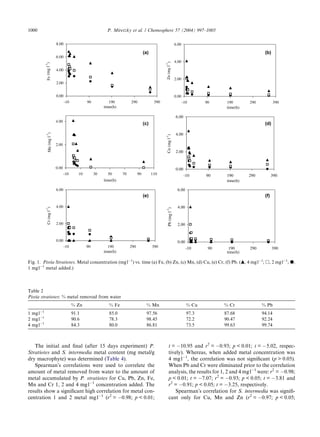
The variation of the Fe, Zn, Mn, Cu, Cr and Pb
water concentration vs. time in the reactors with P.
Stratiotes for concentrations of added metal 1, 2 and 4
mglÀ1
is shown in Fig. 1(a)–(f). All metals were added
simultaneously with the purpose of simulating a natural
polluted environment from diverse industries. The metal
removed percentages for P. Stratiotes when added metal
concentration is 1, 2 and 4 mglÀ1
are detailed in Table 2.
It is important to note the immediate diminish of Pb and
Cr initial concentration to minimum values when the
amount added is 4 mglÀ1
(Fig. 1(e) and (f)).
The variation of the Fe, Zn, Mn, Cu, Cr and Pb
water concentration vs. time in the reactors with S. inter-
media and L. minor respectively when the concentrations
of added metal is 1 mglÀ1
is shown in Fig. 2(a), (b) Fig.
3(a) and (b). Metal removal percentages by S. intermedia
and L. minor are shown in Table 3.
Table 1
Water chemical composition
Fe (mglÀ1
) Zn (mglÀ1
) Mn (mglÀ1
) Cu (mglÀ1
) Cr (mglÀ1
) Pb (mglÀ1
)
Vitel stream 0.214 0.007 0.036 0.089 0.014 0.069
Lake Vitel 0.245 0.023 0.021 0.032 0.014 0.032
Lake Chascomu´s 2.84 0.079 0.065 0.039 0.015 0.029
P. Miretzky et al. / Chemosphere 57 (2004) 997–1005 999
The initial and final (after 15 days experiment) P.
Stratiotes and S. intermedia metal content (mg metal/g
dry macrophyte) was determined (Table 4).
SpearmanÕs correlations were used to correlate the
amount of metal removed from water to the amount of
metal accumulated by P. stratiotes for Cu, Pb, Zn, Fe,
Mn and Cr 1, 2 and 4 mglÀ1
concentration added. The
results show a significant high correlation for metal con-
centration 1 and 2 metal mglÀ1
(r2
= À0.98; p < 0.01;
t = À10.95 and r2
= À0.93; p < 0.01; t = À5.02, respec-
tively). Whereas, when added metal concentration was
4 mglÀ1
, the correlation was not significant (p > 0.05).
When Pb and Cr were eliminated prior to the correlation
analysis, the results for 1, 2 and 4 mglÀ1
were: r2
= À0.98;
p < 0.01; t = À7.07; r2
= À0.93; p < 0.05; t = À3.81 and
r2
= À0.91; p < 0.05; t = À3.25, respectively.
SpearmanÕs correlation for S. intermedia was signifi-
cant only for Cu, Mn and Zn (r2
= À0.97; p < 0.05;
0.00
2.00
4.00
6.00
8.00
-10 90 190 290 390
Fe
0.00
2.00
4.00
6.00
-10 90 190 290 390
Zn(mg 0.00
2.00
4.00
6.00
-10 90 190 290 390
Cu(mgl-1
)
0.00
2.00
4.00
6.00
-10 90 190 290 390
Cr(mgl
-1
)
0.00
2.00
4.00
6.00
-10 90 190 290 390
Pb(mgl-1
)0.00
2.00
4.00
-10 10 30 50 70 90 110
time(h)
time(h)
time(h)
time(h)
time(h)
time(h)
Mn(mgl-1
)(mgl-1
)
l-1
)
(a) (b)
(c) (d)
(e) (f)
Fig. 1. Pistia Stratiotes. Metal concentration (mglÀ1
) vs. time (a) Fe, (b) Zn, (c) Mn, (d) Cu, (e) Cr, (f) Pb. (m, 4 mglÀ1
; h, 2 mglÀ1
; d,
1 mglÀ1
metal added.)
Table 2
Pistia stratiotes: % metal removed from water
% Zn % Fe % Mn % Cu % Cr % Pb
1 mglÀ1
91.1 85.0 97.56 97.3 87.68 94.14
2 mglÀ1
90.6 78.3 98.45 72.2 90.47 92.24
4 mglÀ1
84.3 80.0 86.81 73.5 99.63 99.74
1000 P. Miretzky et al. / Chemosphere 57 (2004) 997–1005
t = À4.05). SpearmanÕs correlation for L. minor is not
shown because the species did not survive the end of
the experiment. Concentration factors (CF) defined as
(Metal)plant/(Metal)aq were calculated (Table 5). P.
stratiotes CFFe remained the same for Fe concentration
1, 2 and 4 mglÀ1
whereas CFZn CFMn CFCu increased
with metal concentration. CFZn CFFe CFMn were higher
for S. intermedia than for P. stratiotes.
The relation of the removal rate with the metal con-
centration was analysed. The removal rate was assumed
to be proportional to metal concentration
v ¼ Àdc=dt ¼ kc;
ln C ¼ ln C0
À kt:
In the above equation, the rate coefficient (Àk) is the
slope of the line (k, l/g; C and C0
, mM). Simple regres-
sion analysis results are shown in Tables 6 and 7.
0.00
0.40
0.80
1.20
1.60
-10 90 190 290 390
time (h)
mgl-1
mgl-1
Fe Zn Cu
0.00
0.40
0.80
1.20
-10 90 190 290 390
time (h)
Mn Cr Pb
(a) (b)
Fig. 3. Lemna minor. Metal concentration (mglÀ1
) vs. time (a) Fe Zn Cu, (b) Mn Cr Pb.
(a) (b)
0.00
0.40
0.80
1.20
1.60
-10 90 190 290 390
time (h)
mgl-1
mgl-1
Fe Zn Cu
0.00
0.40
0.80
1.20
-10 90 190 290 390
time (h)
Mn Cr Pb
Fig. 2. Spirodela intermedia. Metal concentration (mglÀ1
) vs. time (a) Fe Zn Cu, (b) Mn Cr Pb.
Table 4
Initial and final metal concentration (mggÀ1
) in Pistia stratiotes and Spirodela intermedia
Pistia stratiotes Spirodela intermedia
Initial
mggÀ1
Final (1 mglÀ1
)
mggÀ1
Final (2 mglÀ1
)
mggÀ1
Final (4 mglÀ1
)
mggÀ1
Initial
mggÀ1
Final (1 mglÀ1
)
mggÀ1
Fe 7.969 9.694 9.881 9.869 4.113 4.288
Zn 0.096 0.518 0.889 1.214 0.031 0.479
Mn 1.089 1.319 1.425 1.750 5.038 5.513
Cu 0.019 0.349 0.655 0.965 0.010 0.431
Cr 0.012 0.189 0.400 0.013 0.005 0.099
Pb 0.013 0.203 0.227 0.019 0.012 0.078
Table 3
% metal removed from water
Spirodela intermedia (%) Lemna minor (%)
Fe 80.23 78.47
Zn 95.73 97.56
Mn 96.91 95.20
Cu 91.70 90.41
Cr 33.88 96.94
Pb 98.22 98.55
P. Miretzky et al. / Chemosphere 57 (2004) 997–1005 1001
Table 6
Pistia stratiotes: regression analysis
F p k (minÀ1
) lnC 0
r2
Fe 1 mglÀ1
F(0.05;1;6) = 305.9 <0.01** À0.005 À2.77 0.99
Fe 2 mglÀ1
F(0.05;1;6) = 186.9 <0.01** À0.004 À2.55 0.98
Fe 4 mglÀ1
F(0.05;1;6) = 640.8 <0.01** À0.004 À2.13 0.97
Zn 1 mglÀ1
F(0.05;1;6) = 22.48 <0.01** À0.217 À4.56 0.44
Zn 2 mglÀ1
F(0.05;1;6) = 53.27 <0.01** À0.189 À3.84 0.45
Zn 4 mglÀ1
F(0.05;1;6) = 62.92 <0.01** À0.179 À2.97 0.72
Mn 1 mglÀ1
F(0.05;1;5) = 10.44 <0.05* À0.109 À4.65 0.85
Mn 2 mglÀ1
F(0.05;1;5) = 18.10 <0.01** À0.121 À3.80 0.94
Mn 4 mglÀ1
F(0.05;1;5) = 13.04 <0.05* À0.061 À2.90 0.88
Cu 1 mglÀ1
F(0.05;1;6) = 34.01 <0.05* À0.222 À4.03 0.84
Cu 2 mglÀ1
F(0.05;1;5) = 25.05 <0.01** À0.208 À3.44 0.85
Cu 4 mglÀ1
F(0.05;1;6) = 7.81 <0.05* À0.178 À2.85 0.77
Cr 1 mglÀ1
F(0.05;1;6) = 66.89 <0.01** À0.004 À4.12 0.88
Cr 2 mglÀ1
F(0.05;1;6) = 81.94 <0.01** À0.007 À3.40 0.77
Pb 1 mglÀ1
F(0.05;1;6) = 64.88 <0.01** À0.158 À6.22 0.26
Pb 2 mglÀ1
F(0.05;1;6) = 7.40 ns
Table 7
Spirodela intermedia y Lemna minor: regression analysis
F p k (minÀ1
) lnC0
r2
Spirodela intermedia
Fe 1 mglÀ1
F(0.05;1;7) = 45.25 <0.01** À0.111 À3.85 0.93
Zn 1 mglÀ1
F(0.05;1;7) = 5.43 <0.05* À0.534 À4.60 0.66
Mn 1 mglÀ1
F(0.05;1;7) = 6.32 <0.05* À0.481 À4.04 0.69
Cu 1 mglÀ1
F(0.05;1;6) = 17.98 <0.01** À0.303 À4.11 0.87
Cr 1 mglÀ1
F(0.05;1;7) = 7.72 <0.05*
Pb 1 mglÀ1
F(0.05;1;6) = 36.60 <0.01** À0.617 À5.27 0.93
Lemmna minor
Fe 1 mglÀ1
F(0.05;1;5) = 18.22 <0.01** À0.096 À3.90 0.85
Zn 1 mglÀ1
F(0.05;1;5) = 14.37 <0.05* À0.322 À4.61 0.72
Mn 1 mglÀ1
F(0.05;1;4) = 3.26 ns
Cu 1 mglÀ1
F(0.05;1;5) = 87.81 <0.05* À0.155 À4.51 0.49
Cr 1 mglÀ1
F(0.05;1;7) = 108.49 <0.01** À0.046 À3.97 0.81
Pb 1 mglÀ1
F(0.05;1;5) = 27.37 <0.01** À0.288 À5.71 0.74
Table 5
Concentration factors CF = (Metal)plant/(Metal)aq
Metal Pistia stratiotes Spirodela intermedia
1 mglÀ1
CF (lgÀ1
) 2 mglÀ1
CF (lgÀ1
) 4 mglÀ1
CF (lgÀ1
) 1 mglÀ1
CF (lgÀ1
)
Fe 3.41 3.48 3.47 20.04
Zn 6.55 11.26 15.37 68.48
Mn 20.29 21.92 26.92 153.13
Cu 8.94 16.79 24.74 4.84
Cr 12.63 26.67 0.87 7.04
Pb 7.00 7.82 0.65 1.13
1002 P. Miretzky et al. / Chemosphere 57 (2004) 997–1005
5. Discussion
Hydrochemical analysis of Lake Chascomu´s, Lake
Vitel and Vitel stream showed that Pb, Cu, Cr, and Zn
(only in Lake Chascomu´s) mean concentration values
exceeded the recommended values for the protection of
the aquatic life (1.0, 2.0, 2.0 and 30 glÀ1
, respectively;
Niveles Guı´a para la proteccio´n de la biota acua´tica,
2001(Recommended)).
The percentages removed by P. stratiotes were very
high (ca >85% Pb, Cr, Mn and Zn) P. stratiotes was able
to remove the metals almost completely in the first 24 h
of exposure. Fe showed the minor removal percentages,
but it should be kept in mind that Fe concentration in
aquatic environment was high (Lake Chascomu´s 2.84
mglÀ1
) and that macrophytes had already assimilated
it previous to the sampling.
The immediate diminish of Pb and Cr initial concen-
tration to minimum values when the amount added was
4 mglÀ1
, suggest PbCrO4 precipitation implying that
high Cr and Pb removal percentages are observed not
only due to macrophyte removal process but also to
PbCrO4 precipitation. When 4 mglÀ1
of polluting metals
are added the ionic product overcomes Kps (1.8 · 10À14
at 25 °C). According to the stoichiometry of the precip-
itation reaction and to the reagent amounts added, Pb is
the restrictive reagent, being Cr in excess removed by
macrophytes.
Although the removal percentages by S. intermedia
and L. minor were very high, the Fe percentage is the
minor, probably due to the fact that macrophytes had
already assimilated it previous to the sampling. It is
interesting to note that S. intermedia removes Cr only
in a low percentage (33%). It is known that in many
plant species the mobility of Cr is low due to the fact
that there are barriers or lack of transport mechanism
suitable for Cr transport from roots to shoots (Ka¨hko¨-
nen and Manninen, 1998). In Spirodela polyrhiza, the
Cr presence decreases growth rate inhibing photosynthe-
sis (Appenroth et al., 2001).
When the initial and final plant metal content was
determined, it was observed that Cu, Zn, Cr and Pb final
concentration was more than 10 times the initial for S.
intermedia and P. stratiotes, but Fe and Mn showed a
smaller increase, probably because the macrophytes
had already removed Fe and Mn from the aquatic envi-
ronment. L. minor did not survive the end of the exper-
iment, probably due to the low dissolved oxygen
concentration in the reactor. L. minor extends as a man-
tle, covering the total surface and impeding the free ex-
change with the atmospheric oxygen. Although there are
very few studies on bioassays using heavy metals and
aquatic macrophytes, Cd concentrations above 10 mM
and Cu concentrations above 50 lM promote pigment
degradation and photosynthesis inhibition in Lemna
trisulca L (Prasad et al., 2001). These concentrations
are higher than those used to perform our experiments.
Fja¨llborg and Dave, 2003 have reported that
EC50 = 3800 mgCu/kg L. minor.
The correlation of the amount of metal removed
from water with the amount of metal accumulated by
P. stratiotes for Cu, Pb, Zn, Fe, Mn and Cr 1, 2 mglÀ1
was significant, instead was not significant when 4 mglÀ1
of metals was added. When Pb and Cr were eliminated
prior to the correlation analysis, the results were signif-
icant, implying that when Pb and Cr concentration is 4
mglÀ1
, the main process of water removal is PbCrO4
precipitation instead of macrophytes metal uptake.
The analysis of the CF obtained showed that P.
Stratiotes had already accumulated Fe from the environ-
ment and was unable to remove further amounts,
whereas Zn, Cu and Mn amounts removed were larger
at higher metal concentrations. S. intermedia seem to
be more efficient than P. Stratiotes in removing Fe, Zn
and Mn from the contaminated environment.
The results of the regression analysis confirm that the
metal removal rate by the 3 macrophytes studied is pro-
portional to metal concentration at least in the first
hours, as all the regressions were highly significant
(p < 0.01) or significant (p < 0.05) and the r2
values were
high. The P. stratiotes rate coefficient (k) value obtained
for 1, 2 and 4 mglÀ1
metal concentration was higher for
Mn, Cu, Zn and Pb (1 mglÀ1
) than for Fe, suggesting a
faster process. The same tendency is observed for S.
intermedia and L. minor, probably due to the fact that
the species had already accumulated Fe from the aquatic
environment. S. intermedia shows the highest rate coef-
ficients among the 3 species studied, resulting the most
appropriated for metal removal.
6. Conclusions
The simultaneous removal of Fe, Cu, Zn, Mn, Cr and
Pb by P. stratiotes, S. intermedia and L. minor was ana-
lysed. The macrophytes resulted highly effective in the
uptake of heavy metals, even when prior to sampling
they had already accumulated Fe and Mn from the
aquatic environment (P. stratiotes: Fe 7.97 mggÀ1
, Mn
1.09 mggÀ1
; S. intermedia: Fe 4.11 mggÀ1
, Mn 5.04
mggÀ1
).
The high correlation between the final metal concen-
tration in the water and the metal concentration in
macrophytes ratifies that the main process of metal re-
moval from water is macrophytes uptake. S. intermedia
showed the highest rate coefficients and concentration
factors, resulting the most appropriated for metal re-
moval. The main deviations were observed with Cr
and Pb, and were due to the competition with the
PbCrO4 precipitation process. The fact that they have
been able to remove all metals simultaneously consti-
tutes a strong indication of their potential for advanced
P. Miretzky et al. / Chemosphere 57 (2004) 997–1005 1003
treatment of polluted waters. However, the economic
potential of the studied macrophytes may not be fully
realized until they can be economically reduced to a
dried, compact commodity.
The rate of the metal uptake process was dependent
on the metal concentration for the three species studied
in the first hours of the experiment. After the first hours,
the rate of sorption gradually recedes and becomes neg-
ligible. It is therefore suggested that in treatment plants,
resultant plant growth might be harvested regularly, so
that the water purification becomes a continuous proc-
ess. Studies with regard to aquatic macrophytes combi-
nations to be used in treatment ponds and the period
of macrophyte replacement should be seriously under-
taken for developing a more efficient, natural and eco-
nomic integrated macrophyte based system, most
advantageous for heavy metal removal.
Acknowledgments
We are grateful to the Universidad de Buenos Aires
and to the Consejo Nacional de Investigaciones Cientı´f-
icas y Te´cnicas (CONICET) for the financial support to
this project.
References
Appenroth, K., Sto¨ckel, J., Srivastava, A., Strasser, R., 2001.
Multiple effect of chromate on the photosynthetic apparatus
of Spirodela polyrhiza as probed by OJIP chlorohphyll a
fluorescence measurements. Environ. Pollut. 115, 49–64.
APHA, 1993. Standard Methods for the Examination of Water
and Wastewaters. American Public Health Association,
Washington DC, USA, 874pp.
Barbagallo, J., 1983. Las a´reas anegables de la Pampa Depri-
mida. Un planteo agrohidrologico para su solucio´n. Colo-
quio Internacional De Grandes Llanuras, UNESCO, VIII,
Provincia de Buenos Aires, Olavarrı´a, pp. 789–827.
Bassi, M., Grazia-Corradi, M., Realini, M., 1990. Effect of
chromium (VI) in two freshwater plants, Lemna minor and
Pistia stratiotes. 2. Biochemical and physiological observa-
tions. Cytobious 62, 101–109.
Brix, H., Schierup, H., 1989. The use of aquatic macrophytes in
water-pollution control. Ambio 18, 100–107.
Brune, A., Urbach, W., Dietz, K., 1994. Compartmentation
and transport of zinc in barley primary leaves as basic
mechanisms involved in zinc tolerance. Plant Cell Environ.
17, 153–162.
Cardwell, A., Hawker, D., Greenway, M., 2002. Metal accu-
mulation in aquatic macrophytes from southeast Queens-
land, Australia. Chemosphere 48, 653–663.
Conzonno, V., Ferna´ndez Cirelli, A., 1987. Soluble humic
substances from the affluents of Lake Chascomu´s (Argen-
tina). Arch. Hydrobiol. 109, 305–314.
Conzonno, V., Ferna´ndez Cirelli, A., 1988. Soluble humic
substances from Lake Chascomu´s (Argentina). Factors
influencing distribution and dynamics. Arch. Hydrobiol.
111, 467–473.
Conzonno, V., Ferna´ndez Cirelli, A., 1995. Dissolved organic
matter in Chascomu´s pond (Argentina). Factors influencing
distribution and dynamics. Hydrobiologia 297, 55–59.
Denny, H., Wilkins, D., 1987. Zinc tolerance in Betula spp. II.
Microanalytical studies of zinc uptake into root tissues.
New Phytol. 106, 525–534.
Dunbabin, J., Bowmer, K., 1992. Potential use of constructed
wetlands for treatment of industrial wastewaters containing
metals. Sci. Total Environ. III, 151–168.
Ellis, J., Shutes, R., Revitt, D., Zhang, T., 1994. Use of
macrophytes for pollution treatment in urban wetlands.
Resour. Conserv. Recy. 11, 1–12.
Ernst, W., Verkleij, J., Schat, H., 1992. Metal tolerance in
plants. Acta Bot. Neerlandica 41, 229–248.
Fja¨lborg, B., Dave, G., 2003. Toxicity of copper in sewage
sludge. Environ. Int. 28, 761–769.
Hammouda, O., Gaber, S., Abdul-Hameed, M., 1990. Assess-
ment of the effectiveness of treatment of wastewater-
contaminated aquatic systems with Lemna gibba. Enzyme
Microb. Technol. 17, 317–323.
Jain, S., Valsudevan, P., Jha, N., 1990. Azolla pinnata R Br. and
Lemna minor for removal of lead and cadmium from
polluted water. Water Res. 24, 177–183.
Jackson, L., Rasmussen, J., Kalff, J., 1994. A mass balance
analysis of trace metals in two weedbeds. Water Air Soil
Pollut. 75, 107–119.
Ka¨hko¨nen, M., Manninen, P., 1998. The uptake of nickel and
chromium from water by Elodea Canadensis at different
nickel and chromium exposure levels. Chemosphere 36,
1381–1390.
Khan, G., Kuek, C., Chaudhary, T., Fhoo, C., Hayes, W.,
2000. Role of mycorrhizae and phytochelators in heavy
metal contaminated land remediation. Chemosphere 41,
197–207.
Lee, T., Hardy, J., 1987. Copper uptake by the water hyacinth.
J. Environ. Sci. Health Ser. A 22, 141–160.
Mal, T., Adorjan, P., Corbett, A., 2002. Effect of copper on
growth of an aquatic macrophyte, Elodea canadensis.
Environ. Pollut. 120, 307–311.
Maine, M., Duarte, M., Sun˜e´, N., 2001. Cadmium uptake by
floating macrophytes. Water Res. 35, 2629–2634.
Market, B., 1995. Sample preparation (cleaning, drying,
homogenization) for trace element analysis in plant matri-
ces. Sci. Total Environ. 176, 45–61.
Miretzky, P., Herrero, M., Galindo, G., Ferna´ndez Cirelli, A.,
1998. Caracterizacio´n de los recursos hı´dricos en la zona del
sistema de las lagunas encadenadas de Chascomu´s. Provin-
cia de Buenos Aires. Estudios Preliminares. Revista de la
Asociacio´n Argentina de Geologı´a aplicada a la Ingenierı´a y
al ambiente 12, 85–100.
Nasu, Y., Kugimoto, M., 1981. Duckweed as an indicator of
water pollution. I. The sensitivity of Lemna pancicostata to
heavy metals. Arch. Environ. Cont. Toxicol. 10, 159–169.
Niveles Guı´a para la proteccio´n de la biota acua´tica, 2001(Rec-
ommended values for the protection of aquatic life).
Subsecretarı´a de Recursos Hı´dricos Nacio´n, Argentina.
Outridge, P., Noller, B., 1991. Accumulation of toxic trace
elements by freshwater vascular plants. Rev. Environ. Cont.
Toxicol. 121, 2–63.
1004 P. Miretzky et al. / Chemosphere 57 (2004) 997–1005
Phillips, D., 1994. Bioaccumulation. In: Calow, P. (Ed.),
Handbook of Ecotoxicology, vol. 1. Blackwell Scientific
Publications, Oxford, pp. 378–396.
Prasad, M., Malec, P., Walaszek, A., Bojko, M., Strzafka, K.,
2001. Physiological responses of Lemna trisulca L. (duck-
weed) to cadmium and copper bioaccumulation. Plant Sci.
161, 881–889.
Quiro´s, R., Drago, E., 1999. The environmental state of
Argentinean lakes: an overview. Lakes Reserv. 4, 55–
64.
Rai, U.N., Tripathi, R.D., Vajpayee, P., Vidyanath, Jha., Ali,
M.B., 2002. Bioaccumulation of toxic metals (Cr, Cd, Pb
and Cu) by seeds of Euryale ferox Salisb (Makhana).
Chemosphere 46, 267–272.
Ringuelet, R., 1962. Ecologı´a Acua´tica Continental. Eudeba,
Buenos Aires, p. 137.
Sala, J., 1975. Geologı´a de la Provincia de Buenos Aires.
Recursos hı´dricos. VI Congreso Geolo´gico Argentino,
Relatorio, Buenos Aires, pp. 169–251.
Sokal, R., Rohlf, F., 1995. Biometry: the principles and practice
of statistics in biological research, third ed. W.H. Freeman
and Company, p. 887.
Sridahar, M., 1986. Trace element composition of Pistia
stratiotes in a polluted lake in Nigeria. Hydrobiologia 131,
273–276.
St-Cyr, L., Cambell, P., Guertin, K., 1994. Evaluation of the
role of submerged plant beds in the metal budget of a fluvial
lake. Hydrobiologia 291, 141–156.
Taraldzen, J., Norberg-King, T., 1990. New method for
determining effluent toxicity using duckweed (Lemna
minor). Environ. Toxicol. Chem. 9, 761–767.
Thornton, B., Macklon, A., 1989. Copper uptake by ryegrass
seedling; contribution of cell wall adsorption. J. Exp. Bot.
40, 1105–1111.
Tremp, H., Kohler, A., 1995. The usefulness of macrophyte-
monitoring systems, exemplified on eutrophication and
acidification of running waters. Acta Bot. Gall. 142, 541–550.
van Steveninck, R., van Steveninck, M., Fernando, D., 1992.
Heavy metal (Zn, Cd) tolerance in selected clones of
duckweed (Lemna minor). Plant Soil 146, 271–280.
Wang, W., 1990. Literature review on duckweed toxicity
testing. Environ. Res. 52, 7–22.
Whitton, B., 1985. Biological monitoring of heavy metals in
flowing waters. Symposium Biomonitoring State Environ-
ment, New Delhi, Indian Science Academy, New Delhi, pp.
50–55.
Whitton, B., Kelly, M., 1995. Use of algae and other plants for
monitoring rivers. Aust. J. Ecol. 20, 45–56.
Zar, J., 1999. Biostatistical Analysis, fourth ed. Prentice Hall,
p. 929.
P. Miretzky et al. / Chemosphere 57 (2004) 997–1005 1005

remediación con plantas acuaticas

  • 1.
    Aquatic macrophytes potentialfor the simultaneous removal of heavy metals (Buenos Aires, Argentina) Patricia Miretzky, Andrea Saralegui, Alicia Ferna´ndez Cirelli * Centro de Estudios Transdisciplinarios del Agua, Facultad de Ciencias Veterinarias, Universidad de Buenos Aires, Chorroarı´n 280, 1427 Buenos Aires, Argentina Received 28 August 2003; received in revised form 1 July 2004; accepted 13 July 2004 Abstract Heavy metal removal from water has been approached by using different technologies. Phytotechnologies, with an increasing development during the last two decades, involve using plants for metal removal. Three autochthonous float- ing macrophytes, common in pampean shallow lakes (Argentina), Pista stratiotes, Spirodela intermedia and Lemna minor were used in laboratory experiences for the simultaneously removal of several heavy metals (Fe, Cu, Zn, Mn, Cr and Pb) resulting from anthropogenic activity, in order to simulate a naturally polluted environment. The experi- ences were performed for different concentrations of metals along 15 days. High metal removal percentages were obtained for the 3 species and metals. L. minor did not survive the conditions of the experiment. High correlation between the final water and the macrophytes metal concentration was obtained, deviations were due to PbCrO4 preci- pitation. The rate of metal uptake was dependent on the metal concentration for the 3 species studied. Ó 2004 Elsevier Ltd. All rights reserved. Keywords: Macrophytes; Metal removal; Removal rate; Pampean shallow lakes 1. Introduction Heavy metals, industrial pollutants, in contrast with organic materials cannot be degraded and therefore accumulate in water, soil, bottom sediments and living organisms. Water contamination with heavy metals is a very important problem in the current world. Occur- rence of toxic metals in pond, ditch and river water affect the lives of local people that depend upon these water sources for their daily requirements (Rai et al., 2002). Consumption of such aquatic food stuff en- riched with toxic metals may cause serious health haz- ards through food-chain magnification (Khan et al., 2000). A number of methods are available to remove toxic metals from water: ion exchange, reverse osmosis, elec- trolysis, precipitation and adsorption. The latter is by far the most versatile and widely used. However, the methods present different efficiencies for different metals and they can be very expensive especially if large vol- umes, low metal concentration and high standards of cleaning are required. The main processes by which hea- vy metals are removed from aquatic environment are physical, biological and biochemical and they take place in water, biota and suspended solids. The predominance 0045-6535/$ - see front matter Ó 2004 Elsevier Ltd. All rights reserved. doi:10.1016/j.chemosphere.2004.07.024 * Corresponding author. Tel.: +54 11 45248484; fax: +54 11 45248499. E-mail address: afcirelli@fvet.uba.ar (A.F. Cirelli). Chemosphere 57 (2004) 997–1005 www.elsevier.com/locate/chemosphere
  • 2.
    of one ofthem will depend on the composition of the system, the pH, the redox condition, and the pollutant nature. It is a well known fact that aquatic plants accumulate metals that they take from the environment and concen- trate on the trophic chains with accumulative effect (Outridge and Noller, 1991; Tremp and Kohler, 1995). The final metal concentration in plants is usually signif- icantly larger than in the watercolumn and this fact has led investigators to be interested in the toxicity of these metals for the plants, in the plant tolerance (Ernst et al., 1992; van Steveninck et al., 1992); in the roll of the aqua- tic plants in the biochemical cycles (Jackson et al., 1994; St-Cyr et al., 1994); in their use as biological filters for polluted waters (Brix and Schierup, 1989; Dunbabin and Bowmer, 1992; Ellis et al., 1994) and in their use as biomonitors of environment metal levels (Whitton, 1985; Phillips, 1994; Market, 1995; Whitton and Kelly, 1995; Mal et al., 2002). Some investigators have studied the metal uptake kinetics, but always in laboratory scale (Lee and Hardy, 1987; Thornton and Macklon, 1989; Brune et al., 1994). The extent of metal adsorption and its distribution in plants seems to have important consequences in the capacity and rate of metal remove, in the metal residence time and in the eventual metal re- lease to the environment (Ellis et al., 1994). Phytotechnologies are an effective and valid alterna- tive for the remediation of contaminated water bodies, not only under experimental conditions but also under natural conditions. Aquatic macrophytes have been used during the last two decades for water metal removal competing with other secondary treatments, being the principal mechanism for metal uptake adsorption trough roots (Denny and Wilkins, 1987). For aquatic macrophytes that possess roots but do not have a close physical association with sediments, the water is undoubtedly the principal source of elements. The up- take of trace metals through the root systems and subse- quent release of metals during decomposition of plant material and transmission of these metals to organisms of higher trophic levels represent a pathway of cycling of trace metals in aquatic ecosystems. The aquatic floating macrophytes Pistia stratiotes L. (water lettuce), Spirodela intermedia W. Koch (duck- weed) and Lemna minor L. (duckweed) present a high growth rate and have been used for the removal of Cd, Cr and Pb from watercolumn (Nasu and Kugimoto, 1981; Sridahar, 1986; Bassi et al., 1990; Jain et al., 1990; Taraldzen and Norberg-King, 1990; Wang, 1990; Maine et al., 2001; Cardwell et al., 2002). S. intermedia and L. minor present the additional advantage of growing under varied climatic conditions. Also they diminish algal production as they compete for nutrients and ex- tend all over the water surface, restricting the light pen- etration and consequently photosynthesis (Hammouda et al., 1990). The above studies refer, in general, to the removal of only one or two metals, few of them refer to the simultaneous removal of various metals, and the synergy and antagonism between the metal removing is scarcely evaluated. In previous studies (Miretzky et al., 1998) surficial waters of the Sistema de Encadenadas de Chascomu´s, pampean shallow lakes, were characterized, and high concentrations of heavy metals were observed, likely due to industrial activities in Chascomu´s city. In partic- ular Fe, Zn, Mn, Cu, Pb concentrations were above the values recommended by Argentinean law for the protec- tion of the aquatic life. The objective of the present study is to select among the autochthonous floating macrophytes those of high potential for removing different metals simultaneously from the water column by means of laboratory experi- ences and to analyse the removal process rate. 2. Study area The Salado River lower drainage basin, Chaco- Pampa plain, Argentina (34°200 to 35°400 S and 57°400 to 61°100 W), constitutes an interesting system for envi- ronmental studies as it presents essential characteristics of wetlands, hydrophytic vegetation, hydric soils and wetland hydrology. The Chaco-Pampa plain socio-eco- nomical importance derives from its major agricultural, cattle and farming development. The region has a wet climate and a mean temperature between 13 and 16 °C. Mean annual precipitation (1961–1990) was between 850 and 950 mm. Although precipitation is high in the summer, the precipitation- evaporation balance is usually negative in this season. The region is characterized by a very gentle slope (0.3 mkmÀ1 , Sala, 1975) and extremely low morphologic potential that makes the runoff difficult during flooding periods. Pampean lakes are shallow alkaline ecosystems, with circulation pattern corresponding to polymictic lakes. This obeys to the nearly continuous vertical mixing that promotes a high concentration of suspended particulate matter and low transparency. The water column is al- most always thermally homogeneous, saturated with dissolved oxygen and with a high content of dissolved organic matter, mainly humic substances (Conzonno and Ferna´ndez, 1988), with aquatic macrophytes at dif- ferent development stages. Nutrient concentrations, total phosphorus (mean value 0.250 mglÀ1 , Conzonno and Ferna´ndez, 1987, 1988) and total nitrogen (mean value 1.56 mglÀ1 , Conzonno and Ferna´ndez, 1995) as well as organic matter, phytoplankton biomass (chloro- phyll a mean value 25.3 lglÀ1 , Conzonno and Ferna´n- dez, 1995), presence of aquatic macrophytes, algae blooms and fish community let to consider these ecosys- tems as eutrophic (Ringuelet, 1962; Quiro´s, 1999). 998 P. Miretzky et al. / Chemosphere 57 (2004) 997–1005
  • 3.
    Vegetation in thecatchment area is mainly herba- ceous, stable and cosmopolitan, denominated ‘‘pastizal’’ and used for cattle production (Barbagallo, 1983). 3. Materials and methods 3.1. Experimental set-up Floating macrophytes from Chascomu´s area were collected, P. stratiotes from Lake Chascomu´s, S. inter- media from Vitel stream and L. minor from Lake Vitel. Macrophytes were washed with miliQ water to eliminate remains of lake sediments and were placed in 10 l plastic reactors with the corresponding lake water receiving 8 h of fluorescent light per day. The following experiences (in duplicate) were performed: Experience I (control). P. stratiotes 50 g (fresh weight) in 5 l of Lake Chascomu´s water. Experience II. P. stratiotes 50 g (fresh weight) in 5 l of Lake Chascomu´s water. Fe, Mn, Cu, Zn, Pb and Cr were added simultaneously so that the concentration in the plastic reactor of each metal added was 1 mglÀ1 . Experience III. P. stratiotes 50 g (fresh weight) in 5 l of Lake Chascomu´s water. Fe, Mn, Cu, Zn, Pb and Cr were added simultaneously so that the concentration in the plastic reactor of each metal added was 2 mglÀ1 . Experience IV. P. stratiotes 50 g (fresh weight) in 5 l of Lake Chascomu´s water. Fe, Mn, Cu, Zn, Pb and Cr were added simultaneously so that the concentration in the plastic reactor of each metal added was 4 mglÀ1 . Experience V (control). S. intermedia 50 g (fresh weight) in 5 l of Vitel stream water. Experience VI. S. intermedia 50 g (fresh weight) in 5 l of Vitel stream water. Fe, Mn, Cu, Zn, Pb and Cr were added simultaneously so that the concentration in the plastic reactor of each metal added was 1 mglÀ1 . Experience VII (control). L. minor 50 g (fresh weight) in 5 l of Lake Vitel water. Experience VIII. L. minor 50 g (fresh weight) in 5 l of Vitel stream water. Fe, Mn, Cu, Zn, Pb and Cr were added simultaneously so that the concentration in the plastic reactor of each metal added was 1 mglÀ1 . 3.2. Data analysis Duplicate water samples (10 ml each one) from all reactors were taken at 0, 1, 2, 4, 6, 24 h and 2, 4, 8 and 15 days and Fe, Mn, Cu, Zn, Pb and Cr concentra- tion was determined in all of them. Also, Fe, Mn, Cu, Zn, Pb and Cr concentration was determined in Lake Chascomu´s, Lake Vitel and Vitel stream water used to perform the experiences. The entire macrophytes specimens of the 3 species were thoroughly cleaned with miliQ water, dried at 60 °C to constant weight, then pulverized in a Moulinex mill and digested with H2SO4–H2O2. The content of Fe, Mn, Cu, Zn, Cr and Pb in the digested plants, before and after performing the experiments was determined. Metal concentration was determined by ICP-emis- sion (Perkin–Elmer, Optima 2000) according to norms APHA, 1993. Determinations were performed in dupli- cate being the relative error <1.0% for all of them. Statistical analysis of data and simple regression analysis was performed by the use of Spearman correla- tion (Sokal and Rolhf, 1995; Zar, 1999). All data were tested for normality and homogeneity of variance by the Kolmogorov–Smirnov (Lilliefors) test and the Le- vene statistic, respectively (p < 0.05). The software used in statistical analysis was Statistica 5.1 (StatsoftÒ 1999). 4. Results Heavy metal mean concentration (Pb, Cu, Cr, Zn, Fe, Mn) in Lake Chascomu´s, Lake Vitel and Vitel stream watercolumn is observed in Table 1. It is impor- tant to note the high Fe mean concentration value (2.84 mglÀ1 ) in Lake Chascomu´s. The variation of the Fe, Zn, Mn, Cu, Cr and Pb water concentration vs. time in the reactors with P. Stratiotes for concentrations of added metal 1, 2 and 4 mglÀ1 is shown in Fig. 1(a)–(f). All metals were added simultaneously with the purpose of simulating a natural polluted environment from diverse industries. The metal removed percentages for P. Stratiotes when added metal concentration is 1, 2 and 4 mglÀ1 are detailed in Table 2. It is important to note the immediate diminish of Pb and Cr initial concentration to minimum values when the amount added is 4 mglÀ1 (Fig. 1(e) and (f)). The variation of the Fe, Zn, Mn, Cu, Cr and Pb water concentration vs. time in the reactors with S. inter- media and L. minor respectively when the concentrations of added metal is 1 mglÀ1 is shown in Fig. 2(a), (b) Fig. 3(a) and (b). Metal removal percentages by S. intermedia and L. minor are shown in Table 3. Table 1 Water chemical composition Fe (mglÀ1 ) Zn (mglÀ1 ) Mn (mglÀ1 ) Cu (mglÀ1 ) Cr (mglÀ1 ) Pb (mglÀ1 ) Vitel stream 0.214 0.007 0.036 0.089 0.014 0.069 Lake Vitel 0.245 0.023 0.021 0.032 0.014 0.032 Lake Chascomu´s 2.84 0.079 0.065 0.039 0.015 0.029 P. Miretzky et al. / Chemosphere 57 (2004) 997–1005 999
  • 4.
    The initial andfinal (after 15 days experiment) P. Stratiotes and S. intermedia metal content (mg metal/g dry macrophyte) was determined (Table 4). SpearmanÕs correlations were used to correlate the amount of metal removed from water to the amount of metal accumulated by P. stratiotes for Cu, Pb, Zn, Fe, Mn and Cr 1, 2 and 4 mglÀ1 concentration added. The results show a significant high correlation for metal con- centration 1 and 2 metal mglÀ1 (r2 = À0.98; p < 0.01; t = À10.95 and r2 = À0.93; p < 0.01; t = À5.02, respec- tively). Whereas, when added metal concentration was 4 mglÀ1 , the correlation was not significant (p > 0.05). When Pb and Cr were eliminated prior to the correlation analysis, the results for 1, 2 and 4 mglÀ1 were: r2 = À0.98; p < 0.01; t = À7.07; r2 = À0.93; p < 0.05; t = À3.81 and r2 = À0.91; p < 0.05; t = À3.25, respectively. SpearmanÕs correlation for S. intermedia was signifi- cant only for Cu, Mn and Zn (r2 = À0.97; p < 0.05; 0.00 2.00 4.00 6.00 8.00 -10 90 190 290 390 Fe 0.00 2.00 4.00 6.00 -10 90 190 290 390 Zn(mg 0.00 2.00 4.00 6.00 -10 90 190 290 390 Cu(mgl-1 ) 0.00 2.00 4.00 6.00 -10 90 190 290 390 Cr(mgl -1 ) 0.00 2.00 4.00 6.00 -10 90 190 290 390 Pb(mgl-1 )0.00 2.00 4.00 -10 10 30 50 70 90 110 time(h) time(h) time(h) time(h) time(h) time(h) Mn(mgl-1 )(mgl-1 ) l-1 ) (a) (b) (c) (d) (e) (f) Fig. 1. Pistia Stratiotes. Metal concentration (mglÀ1 ) vs. time (a) Fe, (b) Zn, (c) Mn, (d) Cu, (e) Cr, (f) Pb. (m, 4 mglÀ1 ; h, 2 mglÀ1 ; d, 1 mglÀ1 metal added.) Table 2 Pistia stratiotes: % metal removed from water % Zn % Fe % Mn % Cu % Cr % Pb 1 mglÀ1 91.1 85.0 97.56 97.3 87.68 94.14 2 mglÀ1 90.6 78.3 98.45 72.2 90.47 92.24 4 mglÀ1 84.3 80.0 86.81 73.5 99.63 99.74 1000 P. Miretzky et al. / Chemosphere 57 (2004) 997–1005
  • 5.
    t = À4.05).SpearmanÕs correlation for L. minor is not shown because the species did not survive the end of the experiment. Concentration factors (CF) defined as (Metal)plant/(Metal)aq were calculated (Table 5). P. stratiotes CFFe remained the same for Fe concentration 1, 2 and 4 mglÀ1 whereas CFZn CFMn CFCu increased with metal concentration. CFZn CFFe CFMn were higher for S. intermedia than for P. stratiotes. The relation of the removal rate with the metal con- centration was analysed. The removal rate was assumed to be proportional to metal concentration v ¼ Àdc=dt ¼ kc; ln C ¼ ln C0 À kt: In the above equation, the rate coefficient (Àk) is the slope of the line (k, l/g; C and C0 , mM). Simple regres- sion analysis results are shown in Tables 6 and 7. 0.00 0.40 0.80 1.20 1.60 -10 90 190 290 390 time (h) mgl-1 mgl-1 Fe Zn Cu 0.00 0.40 0.80 1.20 -10 90 190 290 390 time (h) Mn Cr Pb (a) (b) Fig. 3. Lemna minor. Metal concentration (mglÀ1 ) vs. time (a) Fe Zn Cu, (b) Mn Cr Pb. (a) (b) 0.00 0.40 0.80 1.20 1.60 -10 90 190 290 390 time (h) mgl-1 mgl-1 Fe Zn Cu 0.00 0.40 0.80 1.20 -10 90 190 290 390 time (h) Mn Cr Pb Fig. 2. Spirodela intermedia. Metal concentration (mglÀ1 ) vs. time (a) Fe Zn Cu, (b) Mn Cr Pb. Table 4 Initial and final metal concentration (mggÀ1 ) in Pistia stratiotes and Spirodela intermedia Pistia stratiotes Spirodela intermedia Initial mggÀ1 Final (1 mglÀ1 ) mggÀ1 Final (2 mglÀ1 ) mggÀ1 Final (4 mglÀ1 ) mggÀ1 Initial mggÀ1 Final (1 mglÀ1 ) mggÀ1 Fe 7.969 9.694 9.881 9.869 4.113 4.288 Zn 0.096 0.518 0.889 1.214 0.031 0.479 Mn 1.089 1.319 1.425 1.750 5.038 5.513 Cu 0.019 0.349 0.655 0.965 0.010 0.431 Cr 0.012 0.189 0.400 0.013 0.005 0.099 Pb 0.013 0.203 0.227 0.019 0.012 0.078 Table 3 % metal removed from water Spirodela intermedia (%) Lemna minor (%) Fe 80.23 78.47 Zn 95.73 97.56 Mn 96.91 95.20 Cu 91.70 90.41 Cr 33.88 96.94 Pb 98.22 98.55 P. Miretzky et al. / Chemosphere 57 (2004) 997–1005 1001
  • 6.
    Table 6 Pistia stratiotes:regression analysis F p k (minÀ1 ) lnC 0 r2 Fe 1 mglÀ1 F(0.05;1;6) = 305.9 <0.01** À0.005 À2.77 0.99 Fe 2 mglÀ1 F(0.05;1;6) = 186.9 <0.01** À0.004 À2.55 0.98 Fe 4 mglÀ1 F(0.05;1;6) = 640.8 <0.01** À0.004 À2.13 0.97 Zn 1 mglÀ1 F(0.05;1;6) = 22.48 <0.01** À0.217 À4.56 0.44 Zn 2 mglÀ1 F(0.05;1;6) = 53.27 <0.01** À0.189 À3.84 0.45 Zn 4 mglÀ1 F(0.05;1;6) = 62.92 <0.01** À0.179 À2.97 0.72 Mn 1 mglÀ1 F(0.05;1;5) = 10.44 <0.05* À0.109 À4.65 0.85 Mn 2 mglÀ1 F(0.05;1;5) = 18.10 <0.01** À0.121 À3.80 0.94 Mn 4 mglÀ1 F(0.05;1;5) = 13.04 <0.05* À0.061 À2.90 0.88 Cu 1 mglÀ1 F(0.05;1;6) = 34.01 <0.05* À0.222 À4.03 0.84 Cu 2 mglÀ1 F(0.05;1;5) = 25.05 <0.01** À0.208 À3.44 0.85 Cu 4 mglÀ1 F(0.05;1;6) = 7.81 <0.05* À0.178 À2.85 0.77 Cr 1 mglÀ1 F(0.05;1;6) = 66.89 <0.01** À0.004 À4.12 0.88 Cr 2 mglÀ1 F(0.05;1;6) = 81.94 <0.01** À0.007 À3.40 0.77 Pb 1 mglÀ1 F(0.05;1;6) = 64.88 <0.01** À0.158 À6.22 0.26 Pb 2 mglÀ1 F(0.05;1;6) = 7.40 ns Table 7 Spirodela intermedia y Lemna minor: regression analysis F p k (minÀ1 ) lnC0 r2 Spirodela intermedia Fe 1 mglÀ1 F(0.05;1;7) = 45.25 <0.01** À0.111 À3.85 0.93 Zn 1 mglÀ1 F(0.05;1;7) = 5.43 <0.05* À0.534 À4.60 0.66 Mn 1 mglÀ1 F(0.05;1;7) = 6.32 <0.05* À0.481 À4.04 0.69 Cu 1 mglÀ1 F(0.05;1;6) = 17.98 <0.01** À0.303 À4.11 0.87 Cr 1 mglÀ1 F(0.05;1;7) = 7.72 <0.05* Pb 1 mglÀ1 F(0.05;1;6) = 36.60 <0.01** À0.617 À5.27 0.93 Lemmna minor Fe 1 mglÀ1 F(0.05;1;5) = 18.22 <0.01** À0.096 À3.90 0.85 Zn 1 mglÀ1 F(0.05;1;5) = 14.37 <0.05* À0.322 À4.61 0.72 Mn 1 mglÀ1 F(0.05;1;4) = 3.26 ns Cu 1 mglÀ1 F(0.05;1;5) = 87.81 <0.05* À0.155 À4.51 0.49 Cr 1 mglÀ1 F(0.05;1;7) = 108.49 <0.01** À0.046 À3.97 0.81 Pb 1 mglÀ1 F(0.05;1;5) = 27.37 <0.01** À0.288 À5.71 0.74 Table 5 Concentration factors CF = (Metal)plant/(Metal)aq Metal Pistia stratiotes Spirodela intermedia 1 mglÀ1 CF (lgÀ1 ) 2 mglÀ1 CF (lgÀ1 ) 4 mglÀ1 CF (lgÀ1 ) 1 mglÀ1 CF (lgÀ1 ) Fe 3.41 3.48 3.47 20.04 Zn 6.55 11.26 15.37 68.48 Mn 20.29 21.92 26.92 153.13 Cu 8.94 16.79 24.74 4.84 Cr 12.63 26.67 0.87 7.04 Pb 7.00 7.82 0.65 1.13 1002 P. Miretzky et al. / Chemosphere 57 (2004) 997–1005
  • 7.
    5. Discussion Hydrochemical analysisof Lake Chascomu´s, Lake Vitel and Vitel stream showed that Pb, Cu, Cr, and Zn (only in Lake Chascomu´s) mean concentration values exceeded the recommended values for the protection of the aquatic life (1.0, 2.0, 2.0 and 30 glÀ1 , respectively; Niveles Guı´a para la proteccio´n de la biota acua´tica, 2001(Recommended)). The percentages removed by P. stratiotes were very high (ca >85% Pb, Cr, Mn and Zn) P. stratiotes was able to remove the metals almost completely in the first 24 h of exposure. Fe showed the minor removal percentages, but it should be kept in mind that Fe concentration in aquatic environment was high (Lake Chascomu´s 2.84 mglÀ1 ) and that macrophytes had already assimilated it previous to the sampling. The immediate diminish of Pb and Cr initial concen- tration to minimum values when the amount added was 4 mglÀ1 , suggest PbCrO4 precipitation implying that high Cr and Pb removal percentages are observed not only due to macrophyte removal process but also to PbCrO4 precipitation. When 4 mglÀ1 of polluting metals are added the ionic product overcomes Kps (1.8 · 10À14 at 25 °C). According to the stoichiometry of the precip- itation reaction and to the reagent amounts added, Pb is the restrictive reagent, being Cr in excess removed by macrophytes. Although the removal percentages by S. intermedia and L. minor were very high, the Fe percentage is the minor, probably due to the fact that macrophytes had already assimilated it previous to the sampling. It is interesting to note that S. intermedia removes Cr only in a low percentage (33%). It is known that in many plant species the mobility of Cr is low due to the fact that there are barriers or lack of transport mechanism suitable for Cr transport from roots to shoots (Ka¨hko¨- nen and Manninen, 1998). In Spirodela polyrhiza, the Cr presence decreases growth rate inhibing photosynthe- sis (Appenroth et al., 2001). When the initial and final plant metal content was determined, it was observed that Cu, Zn, Cr and Pb final concentration was more than 10 times the initial for S. intermedia and P. stratiotes, but Fe and Mn showed a smaller increase, probably because the macrophytes had already removed Fe and Mn from the aquatic envi- ronment. L. minor did not survive the end of the exper- iment, probably due to the low dissolved oxygen concentration in the reactor. L. minor extends as a man- tle, covering the total surface and impeding the free ex- change with the atmospheric oxygen. Although there are very few studies on bioassays using heavy metals and aquatic macrophytes, Cd concentrations above 10 mM and Cu concentrations above 50 lM promote pigment degradation and photosynthesis inhibition in Lemna trisulca L (Prasad et al., 2001). These concentrations are higher than those used to perform our experiments. Fja¨llborg and Dave, 2003 have reported that EC50 = 3800 mgCu/kg L. minor. The correlation of the amount of metal removed from water with the amount of metal accumulated by P. stratiotes for Cu, Pb, Zn, Fe, Mn and Cr 1, 2 mglÀ1 was significant, instead was not significant when 4 mglÀ1 of metals was added. When Pb and Cr were eliminated prior to the correlation analysis, the results were signif- icant, implying that when Pb and Cr concentration is 4 mglÀ1 , the main process of water removal is PbCrO4 precipitation instead of macrophytes metal uptake. The analysis of the CF obtained showed that P. Stratiotes had already accumulated Fe from the environ- ment and was unable to remove further amounts, whereas Zn, Cu and Mn amounts removed were larger at higher metal concentrations. S. intermedia seem to be more efficient than P. Stratiotes in removing Fe, Zn and Mn from the contaminated environment. The results of the regression analysis confirm that the metal removal rate by the 3 macrophytes studied is pro- portional to metal concentration at least in the first hours, as all the regressions were highly significant (p < 0.01) or significant (p < 0.05) and the r2 values were high. The P. stratiotes rate coefficient (k) value obtained for 1, 2 and 4 mglÀ1 metal concentration was higher for Mn, Cu, Zn and Pb (1 mglÀ1 ) than for Fe, suggesting a faster process. The same tendency is observed for S. intermedia and L. minor, probably due to the fact that the species had already accumulated Fe from the aquatic environment. S. intermedia shows the highest rate coef- ficients among the 3 species studied, resulting the most appropriated for metal removal. 6. Conclusions The simultaneous removal of Fe, Cu, Zn, Mn, Cr and Pb by P. stratiotes, S. intermedia and L. minor was ana- lysed. The macrophytes resulted highly effective in the uptake of heavy metals, even when prior to sampling they had already accumulated Fe and Mn from the aquatic environment (P. stratiotes: Fe 7.97 mggÀ1 , Mn 1.09 mggÀ1 ; S. intermedia: Fe 4.11 mggÀ1 , Mn 5.04 mggÀ1 ). The high correlation between the final metal concen- tration in the water and the metal concentration in macrophytes ratifies that the main process of metal re- moval from water is macrophytes uptake. S. intermedia showed the highest rate coefficients and concentration factors, resulting the most appropriated for metal re- moval. The main deviations were observed with Cr and Pb, and were due to the competition with the PbCrO4 precipitation process. The fact that they have been able to remove all metals simultaneously consti- tutes a strong indication of their potential for advanced P. Miretzky et al. / Chemosphere 57 (2004) 997–1005 1003
  • 8.
    treatment of pollutedwaters. However, the economic potential of the studied macrophytes may not be fully realized until they can be economically reduced to a dried, compact commodity. The rate of the metal uptake process was dependent on the metal concentration for the three species studied in the first hours of the experiment. After the first hours, the rate of sorption gradually recedes and becomes neg- ligible. It is therefore suggested that in treatment plants, resultant plant growth might be harvested regularly, so that the water purification becomes a continuous proc- ess. Studies with regard to aquatic macrophytes combi- nations to be used in treatment ponds and the period of macrophyte replacement should be seriously under- taken for developing a more efficient, natural and eco- nomic integrated macrophyte based system, most advantageous for heavy metal removal. Acknowledgments We are grateful to the Universidad de Buenos Aires and to the Consejo Nacional de Investigaciones Cientı´f- icas y Te´cnicas (CONICET) for the financial support to this project. References Appenroth, K., Sto¨ckel, J., Srivastava, A., Strasser, R., 2001. Multiple effect of chromate on the photosynthetic apparatus of Spirodela polyrhiza as probed by OJIP chlorohphyll a fluorescence measurements. Environ. Pollut. 115, 49–64. APHA, 1993. Standard Methods for the Examination of Water and Wastewaters. American Public Health Association, Washington DC, USA, 874pp. Barbagallo, J., 1983. Las a´reas anegables de la Pampa Depri- mida. Un planteo agrohidrologico para su solucio´n. Colo- quio Internacional De Grandes Llanuras, UNESCO, VIII, Provincia de Buenos Aires, Olavarrı´a, pp. 789–827. Bassi, M., Grazia-Corradi, M., Realini, M., 1990. Effect of chromium (VI) in two freshwater plants, Lemna minor and Pistia stratiotes. 2. Biochemical and physiological observa- tions. Cytobious 62, 101–109. Brix, H., Schierup, H., 1989. The use of aquatic macrophytes in water-pollution control. Ambio 18, 100–107. Brune, A., Urbach, W., Dietz, K., 1994. Compartmentation and transport of zinc in barley primary leaves as basic mechanisms involved in zinc tolerance. Plant Cell Environ. 17, 153–162. Cardwell, A., Hawker, D., Greenway, M., 2002. Metal accu- mulation in aquatic macrophytes from southeast Queens- land, Australia. Chemosphere 48, 653–663. Conzonno, V., Ferna´ndez Cirelli, A., 1987. Soluble humic substances from the affluents of Lake Chascomu´s (Argen- tina). Arch. Hydrobiol. 109, 305–314. Conzonno, V., Ferna´ndez Cirelli, A., 1988. Soluble humic substances from Lake Chascomu´s (Argentina). Factors influencing distribution and dynamics. Arch. Hydrobiol. 111, 467–473. Conzonno, V., Ferna´ndez Cirelli, A., 1995. Dissolved organic matter in Chascomu´s pond (Argentina). Factors influencing distribution and dynamics. Hydrobiologia 297, 55–59. Denny, H., Wilkins, D., 1987. Zinc tolerance in Betula spp. II. Microanalytical studies of zinc uptake into root tissues. New Phytol. 106, 525–534. Dunbabin, J., Bowmer, K., 1992. Potential use of constructed wetlands for treatment of industrial wastewaters containing metals. Sci. Total Environ. III, 151–168. Ellis, J., Shutes, R., Revitt, D., Zhang, T., 1994. Use of macrophytes for pollution treatment in urban wetlands. Resour. Conserv. Recy. 11, 1–12. Ernst, W., Verkleij, J., Schat, H., 1992. Metal tolerance in plants. Acta Bot. Neerlandica 41, 229–248. Fja¨lborg, B., Dave, G., 2003. Toxicity of copper in sewage sludge. Environ. Int. 28, 761–769. Hammouda, O., Gaber, S., Abdul-Hameed, M., 1990. Assess- ment of the effectiveness of treatment of wastewater- contaminated aquatic systems with Lemna gibba. Enzyme Microb. Technol. 17, 317–323. Jain, S., Valsudevan, P., Jha, N., 1990. Azolla pinnata R Br. and Lemna minor for removal of lead and cadmium from polluted water. Water Res. 24, 177–183. Jackson, L., Rasmussen, J., Kalff, J., 1994. A mass balance analysis of trace metals in two weedbeds. Water Air Soil Pollut. 75, 107–119. Ka¨hko¨nen, M., Manninen, P., 1998. The uptake of nickel and chromium from water by Elodea Canadensis at different nickel and chromium exposure levels. Chemosphere 36, 1381–1390. Khan, G., Kuek, C., Chaudhary, T., Fhoo, C., Hayes, W., 2000. Role of mycorrhizae and phytochelators in heavy metal contaminated land remediation. Chemosphere 41, 197–207. Lee, T., Hardy, J., 1987. Copper uptake by the water hyacinth. J. Environ. Sci. Health Ser. A 22, 141–160. Mal, T., Adorjan, P., Corbett, A., 2002. Effect of copper on growth of an aquatic macrophyte, Elodea canadensis. Environ. Pollut. 120, 307–311. Maine, M., Duarte, M., Sun˜e´, N., 2001. Cadmium uptake by floating macrophytes. Water Res. 35, 2629–2634. Market, B., 1995. Sample preparation (cleaning, drying, homogenization) for trace element analysis in plant matri- ces. Sci. Total Environ. 176, 45–61. Miretzky, P., Herrero, M., Galindo, G., Ferna´ndez Cirelli, A., 1998. Caracterizacio´n de los recursos hı´dricos en la zona del sistema de las lagunas encadenadas de Chascomu´s. Provin- cia de Buenos Aires. Estudios Preliminares. Revista de la Asociacio´n Argentina de Geologı´a aplicada a la Ingenierı´a y al ambiente 12, 85–100. Nasu, Y., Kugimoto, M., 1981. Duckweed as an indicator of water pollution. I. The sensitivity of Lemna pancicostata to heavy metals. Arch. Environ. Cont. Toxicol. 10, 159–169. Niveles Guı´a para la proteccio´n de la biota acua´tica, 2001(Rec- ommended values for the protection of aquatic life). Subsecretarı´a de Recursos Hı´dricos Nacio´n, Argentina. Outridge, P., Noller, B., 1991. Accumulation of toxic trace elements by freshwater vascular plants. Rev. Environ. Cont. Toxicol. 121, 2–63. 1004 P. Miretzky et al. / Chemosphere 57 (2004) 997–1005
  • 9.
    Phillips, D., 1994.Bioaccumulation. In: Calow, P. (Ed.), Handbook of Ecotoxicology, vol. 1. Blackwell Scientific Publications, Oxford, pp. 378–396. Prasad, M., Malec, P., Walaszek, A., Bojko, M., Strzafka, K., 2001. Physiological responses of Lemna trisulca L. (duck- weed) to cadmium and copper bioaccumulation. Plant Sci. 161, 881–889. Quiro´s, R., Drago, E., 1999. The environmental state of Argentinean lakes: an overview. Lakes Reserv. 4, 55– 64. Rai, U.N., Tripathi, R.D., Vajpayee, P., Vidyanath, Jha., Ali, M.B., 2002. Bioaccumulation of toxic metals (Cr, Cd, Pb and Cu) by seeds of Euryale ferox Salisb (Makhana). Chemosphere 46, 267–272. Ringuelet, R., 1962. Ecologı´a Acua´tica Continental. Eudeba, Buenos Aires, p. 137. Sala, J., 1975. Geologı´a de la Provincia de Buenos Aires. Recursos hı´dricos. VI Congreso Geolo´gico Argentino, Relatorio, Buenos Aires, pp. 169–251. Sokal, R., Rohlf, F., 1995. Biometry: the principles and practice of statistics in biological research, third ed. W.H. Freeman and Company, p. 887. Sridahar, M., 1986. Trace element composition of Pistia stratiotes in a polluted lake in Nigeria. Hydrobiologia 131, 273–276. St-Cyr, L., Cambell, P., Guertin, K., 1994. Evaluation of the role of submerged plant beds in the metal budget of a fluvial lake. Hydrobiologia 291, 141–156. Taraldzen, J., Norberg-King, T., 1990. New method for determining effluent toxicity using duckweed (Lemna minor). Environ. Toxicol. Chem. 9, 761–767. Thornton, B., Macklon, A., 1989. Copper uptake by ryegrass seedling; contribution of cell wall adsorption. J. Exp. Bot. 40, 1105–1111. Tremp, H., Kohler, A., 1995. The usefulness of macrophyte- monitoring systems, exemplified on eutrophication and acidification of running waters. Acta Bot. Gall. 142, 541–550. van Steveninck, R., van Steveninck, M., Fernando, D., 1992. Heavy metal (Zn, Cd) tolerance in selected clones of duckweed (Lemna minor). Plant Soil 146, 271–280. Wang, W., 1990. Literature review on duckweed toxicity testing. Environ. Res. 52, 7–22. Whitton, B., 1985. Biological monitoring of heavy metals in flowing waters. Symposium Biomonitoring State Environ- ment, New Delhi, Indian Science Academy, New Delhi, pp. 50–55. Whitton, B., Kelly, M., 1995. Use of algae and other plants for monitoring rivers. Aust. J. Ecol. 20, 45–56. Zar, J., 1999. Biostatistical Analysis, fourth ed. Prentice Hall, p. 929. P. Miretzky et al. / Chemosphere 57 (2004) 997–1005 1005