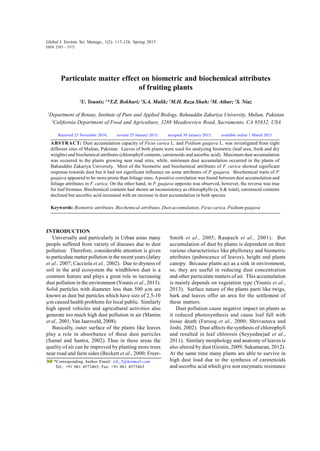
Global J. Environ. Sci. Manage., 1(2): 117-124, Spring 2015
Particulate matter effect on biometric and biochemical attributes
of fruiting plants
1
U. Younis; 1
*T.Z. Bokhari; 1
S.A. Malik; 1
M.H. Raza Shah; 2
M. Athar; 1
S. Niaz
1
Department of Botany, Institute of Pure and Applied Biology, Bahauddin Zakariya University, Multan, Pakistan
2
California Department of Food and Agriculture, 3288 Meadowview Road, Sacramento, CA 95832, USA
ABSTRACT: Dust accumulation capacity of Ficus carica L. and Psidium guajava L. was investigated from eight
different sites of Multan, Pakistan. Leaves of both plants were used for analyzing biometric (leaf area, fresh and dry
weights) and biochemical attributes (chlorophyll contents, carotenoids and ascorbic acid). Maximum dust accumulation
was occurred in the plants growing near road sites, while, minimum dust accumulation occurred in the plants of
Bahauddin Zakariya University. Most of the biometric and biochemical attributes of F. carica showed significant
response towards dust but it had not significant influence on some attributes of P. guajava. Biochemical traits of P.
guajava appeared to be more prone than foliage ones. Apositive correlation was found between dust accumulation and
foliage attributes in F. carica. On the other hand, in P. guajava opposite was observed, however, the reverse was true
for leaf biomass. Biochemical contents had shown an inconsistency as chlorophylls (a, b & total), carotenoid contents
declined but ascorbic acid increased with an increase in dust accumulation in both species.
Keywords: Biometric attributes, Biochemical attributes, Dust accumulation, Ficus carica, Psidium guajava
Global J. Environ. Sci. Manage., 1(2): 117-124, Spring 2015
ISSN 2383 - 3572
*Corresponding Author Email: tzb_5@hotmail.com
Tel.: +91 061 4573463; Fax: +91 061 4573463
INTRODUCTION
Universally and particularly in Urban areas many
people suffered from variety of diseases due to dust
pollution. Therefore, considerable attention is given
to particulate matter pollution in the recent years (Jafary
et al., 2007; Cacciola et al., 2002). Due to dryness of
soil in the arid ecosystem the windblown dust is a
common feature and plays a great role in increasing
dust pollution in the environment (Younis et al., 2013).
Solid particles with diameter less than 500 µm are
known as dust but particles which have size of 2.5-10
µm caused health problems for local public. Similarly
high speed vehicles and agricultural activities also
generate too much high dust pollution in air (Manins
et al., 2001; Van Jaarsveld, 2008).
Basically, outer surface of the plants like leaves
play a role in absorbance of these dust particles
(Samal and Santra, 2002). Thus in these areas the
quality of air can be improved by planting more trees
near road and farm sides (Beckett et al., 2000; Freer-
Received 25 November 2014; revised 25 January 2015; accepted 30 January 2015; available online 1 March 2015
Smith et al., 2005; Raupach et al., 2001). But
accumulation of dust by plants is dependent on their
various characteristics like phyllotaxy and biometric
attributes (pubescence of leaves), height and plants
canopy. Because plants act as a sink in environment,
so, they are useful in reducing dust concentration
and other particulate matters of air. This accumulation
is mainly depends on vegetation type (Younis et al.,
2013). Surface nature of the plants parts like twigs,
bark and leaves offer an area for the settlement of
these matters.
Dust pollution cause negative impact on plants as
it reduced photosynthesis and cause leaf fall with
tissue death (Farooq et al., 2000; Shrivastava and
Joshi, 2002). Dust affects the synthesis of chlorophyll
and resulted in leaf chlorosis (Seyyednejad et al.,
2011). Similary morphology and anatomy of leaves is
also altered by dust (Gostin, 2009; Sukumaran, 2012).
At the same time many plants are able to survive in
high dust load due to the synthesis of carotenoids
and ascorbic acid which give non enzymatic resistance
Global J. Environ. Sci. Manage., 1(2): 117-124, Spring 2015U. Younis et al.
118
to plants to numerous abiotic stresses (Prajapati and
Tripathi, 2008).
Multan is popular for dust storms and with the
passage of time this problem is increasing day by
day. Keeping in sight the above condition, the present
work was aimed to estimate the disparity in dust
gathering capacity of Ficus carica and Psidium
guajava because species were present in a diversity
of habitats in Multan. The foremost objective is to
asses the role of leaves of these species in the
reduction of dust pollution. In addition, foliage and
biochemical traits were analyzed to suggest the
probable mechanism of vegetation to combat stress
induced by dust particles.
MATERIALS AND METHODS
Plant material and sampling
Two plant species (Ficus carica and Psidium
guajava) were selected for study. Both species are
small trees about 3-10 m tall. The phyllotaxy for the
two species is opposite and alternate respectively. The
selection of these two species was made because of
their contrasting leaf characteristics. As the former
species has broadly ovate foliage with long petiole,
however, the later species has broad oblong elliptic
leaves with short leaf stalk or petiole.
Cultivated inhabitants of two fruit varieties were
chosen for sampling of plant tissues from 8 major areas
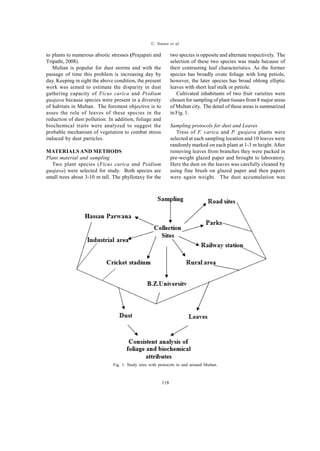
of Multan city. The detail of these areas is summarized
in Fig. 1.
Sampling protocols for dust and Leaves
Tress of F. carica and P. guajava plants were
selected at each sampling location and 10 leaves were
randomly marked on each plant at 1-3 m height. After
removing leaves from branches they were packed in
pre-weight glazed paper and brought to laboratory.
Here the dust on the leaves was carefully cleaned by
using fine brush on glazed paper and then papers
were again weight. The dust accumulation was
Fig. 1: Study sites with protocols in and around Multan.
Global J. Environ. Sci. Manage., 1(2): 117-124, Spring 2015
119
calculated by using following formula (Prajapati and
Tripathi, 2008).
W = (w2 – w1)/a
Where W is dust content (g/m), w1 is initial weight
of glazed paper, w2 is final weight of glazed paper with
dust, and “a” is total area of the leaf (m2).
Fresh weights of leaves were taken, than oven dried
at 70o
C for 72 h for dry weight measurements.
Chlorophyll determination
0.2 g fresh leave samples were extracted overnight
with 80% acetone (4 ml) then grinded and
homogenized well in pestle and mortar. The
homogenized mixture was filtered and volume of the
filtrate was raised up-to 25 ml with 80% acetone. The
absorbance of the chlorophyll filtrate was determined
at 663, 645 and 480 by spectrophotometer (Optima
2100 DV Perkin-Elmer). The chlorophylls (a, b and
total) contents were calculated by the following
formulae:
Chlorophyll“a” (mg/gF.W) = [12.7 (OD663) -2.69 (OD
645)]xV/1000xW
Chlorophyll“b”(mg/gF.W) = [22.9 (OD645) -4.68 (OD
663)]xV/1000xW
“Total” chlorophyll (mg/g F. W) = [20.2 (OD 645) +8.02
(OD663)]xV/1000xW
V =Filtrate volume (mL)
W = Leaf weight (g)
OD =optical density
Ascorbic Acid
For determination of ascorbic acid 5 g of fresh leaves
were grinded and homogenized in 20 ml extracting
solution (5 goxalic acid + 0.75 g Na salt of EDTA100 ml
d i s t i l l e d w a t e r . A f t e r c e n t r i f u g a t i o n a t 6 8 2 . 2 r a d s
–1
for
15 minutes, the 1 ml of homogenate was mixed carefully
with 5 ml DCPIP (Dichlorophenol indophenol). Color
of homogenate changed into pink, its absorbance was
noted at 520 nm then one drop of 1% ascorbic acid was
added to make solution colorless. The absorbance of
colorless solution was also noted at same wavelength.
A standard curve was draw by using ascorbic acid
solution of different dilution (0.01–0.07 g/L). The
ascorbic acid was determined by following Keller and
Schwager, (1977).
Ascorbicacid(mg/gF.W)=[((Eo-Es-Et)V/100xW)x100]
For determination of ascorbic acid following procedure
is used
5gleafsample homogenized 20mlextractingsolution
628.2rads-1
(15min.)
Homogenate Centrifuged
1mlhomogenate+5mlDCPIP measure opticaldensity(520nm)
opticaldensity(520nm) measure onedrop15ascorbicacid
20 ml extracting solution
628.2 rads-1
(15 min.)
CentrifugedHomogenate
1 ml homogenate + 5ml DCPIP
measure
optical density (520 nm)measure
optical density (520 nm) one drop 15 ascorbic acid
homogenized5 g leaf sample
where, Eo
=OD of blank, Es
=OD of plant sample and
Et
= OD of sample + ascorbic acid,V = extract volume;
and W = leaf sample weight (g).
RESULTS AND DISCUSSION
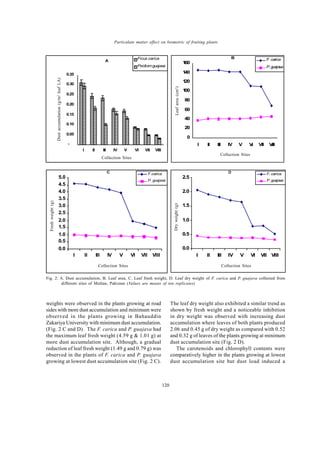
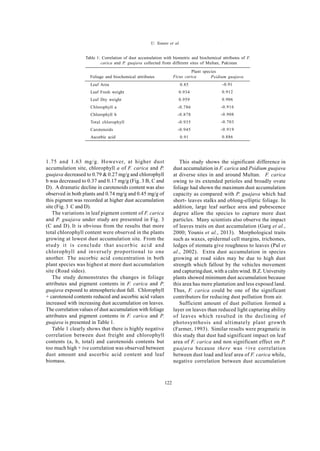
Fig. 2 A represented the dust accumulation or dust
load on leaves of Ficus carica and Psidium guajava
under study. It is evident from the Figure that F.
carica and P. guajava showed higher dust deposition
on leaves at road sides followed by parks, railway
station, Pak Arab Fertilizer - Industrial Estate,
cultivated wheat field, cricket stadium area and
lowest at Bahauddin Zakariya University. It is also
cleared from the mentioned figure that F. carica
leaves had more dust accumulation than P. guajava
leaves.
Higher dust accumulation had affected foliage
attributes of F. carica and P. guajava and leaf area of
F. carica increased (146.48 cm2
) and P. guajava
decreased (37.81 cm2
) with increasing dust
accumulation (Fig. 2 B). Whereas significant
increased of fresh and dry weights of leaves of F.
carica and P. guajava was observed with increasing
dust accumulation. The maximum leaf fresh and dry
distilled water.After centrifugation at 682.2 rads–1
for
Global J. Environ. Sci. Manage., 1(2): 117-124, Spring 2015
120
Particulate matter effect on biometric of fruiting plants
weights were observed in the plants growing at road
sides with more dust accumulation and minimum were
observed in the plants growing in Bahauddin
Zakariya University with minimum dust accumulation.
(Fig. 2 C and D). The F. carica and P. guajava had
the maximum leaf fresh weight (4.59 g & 1.01 g) at
more dust accumulation site. Although, a gradual
reduction of leaf fresh weight (1.49 g and 0.79 g) was
observed in the plants of F. carica and P. guajava
growing at lowest dust accumulation site (Fig. 2 C).
The leaf dry weight also exhibited a similar trend as
shown by fresh weight and a noticeable inhibition
in dry weight was observed with increasing dust
accumulation where leaves of both plants produced
2.06 and 0.45 g of dry weight as compared with 0.52
and 0.32 g of leaves of the plants growing at minimum
dust accumulation site (Fig. 2 D).
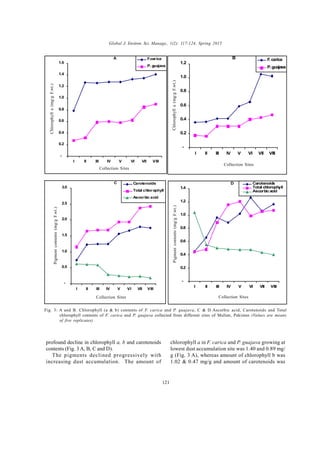
The carotenoids and chlorophyll contents were
comparatively higher in the plants growing at lowest
dust accumulation site but dust load induced a
A
-
0.05
0.10
0.15
0.20
0.25
0.30
0.35
I II III IV V VI VII VIII
Collection sites
Dustaccumulation(g/m2leafLA) Ficus carica
Psidiumguajava
0
20
40
60
80
100
120
140
160
I II III IV V VI VII VIII
Collectionsites
Leafarea(cm2)
F. carica
P. guajava
B
0.0
0.5
1.0
1.5
2.0
2.5
3.0
3.5
4.0
4.5
5.0
I II III IV V VI VII VIII
Collection sites
Freshweight(g)
F.carica
P. guajava
C
0.0
0.5
1.0
1.5
2.0
2.5
I II III IV V VI VII VIII
Collectionsites
Dryweight(g)
F. carica
P. guajava
D
Fig. 2: A. Dust accumulation, B. Leaf area, C. Leaf fresh weight, D. Leaf dry weight of F. carica and P. guajava collected from
different sites of Multan, Pakistan (Values are means of ten replicates)
Collection Sites Collection Sites
Collection Sites
Collection Sites
Freshweight(g)
Dryweight(g)
Dustaccumulation(g/m2
leafLA)
Leafarea(cm2
)
Global J. Environ. Sci. Manage., 1(2): 117-124, Spring 2015
121
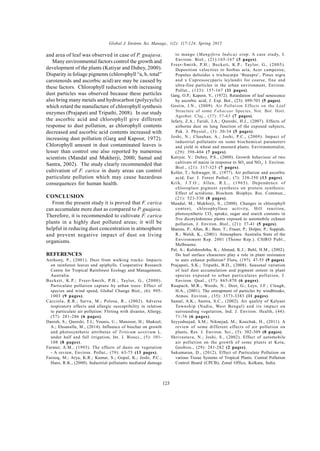
profound decline in chlorophyll a, b and carotenoids
contents (Fig. 3 A, B, C and D).
The pigments declined progressively with
increasing dust accumulation. The amount of
-
0.2
0.4
0.6
0.8
1.0
1.2
1.4
1.6
I II III IV V VI VII VIII
Collection sites
Chlorophylla(mg/gF.wt.)
F.carica
P. guajava
A
-
0.2
0.4
0.6
0.8
1.0
1.2
I II III IV V VI VII VIII
Collectionsites
Chlorophyllb(mg/gF.wt.)
F. carica
P. guajava
B
-
0.5
1.0
1.5
2.0
2.5
3.0
I II III IV V VI VII VIII
Collection Sites
Pigmentcontents(mg/gF.wt.)
Carotenoids
Total chlorophyll
Ascorbic acid
C
-
0.2
0.4
0.6
0.8
1.0
1.2
1.4
I II III IV V VI VII VIII
Collection sites
pigmentcontents(mg/gf.wt.)
Carotenoids
Total chlorophyll
Ascorbicacid
D
Fig. 3: A and B. Chlorophyll (a & b) contents of F. carica and P. guajava, C & D Ascorbic acid, Carotenoids and Total
chlorophyll contents of F. carica and P. guajava collected from different sites of Multan, Pakistan (Values are means
of five replicates)
chlorophyll a in F. carica and P. guajava growing at
lowest dust accumulation site was 1.40 and 0.89 mg/
g (Fig. 3 A), whereas amount of chlorophyll b was
1.02 & 0.47 mg/g and amount of carotenoids was
Collection SitesCollection Sites
Collection Sites
Collection Sites
Pigmentcontents(mg/gF.wt.)
Chlorophylla(mg/gF.wt.)
Global J. Environ. Sci. Manage., 1(2): 117-124, Spring 2015
122
U. Younis et al.
1.75 and 1.63 mg/g. However, at higher dust
accumulation site, chlorophyll a of F. carica and P.
guajava decreased to 0.79 & 0.27 mg/g and chlorophyll
b was decreased to 0.37 and 0.17 mg/g (Fig. 3 B, C and
D). A dramatic decline in carotenoids content was also
observed in both plants and 0.74 mg/g and 0.45 mg/g of
this pigment was recorded at higher dust accumulation
site (Fig. 3 C and D).
The variations in leaf pigment content of F. carica
and P. guajava under study are presented in Fig. 3
(C and D). It is obvious from the results that more
total chlorophyll content were observed in the plants
growing at lowest dust accumulation site. From the
study it is conclude that ascorbic acid and
chlorophyll and inversely proportional to one
another. The ascorbic acid concentration in both
plant species was highest at more dust accumulation
site (Road sides).
The study demonstrates the changes in foliage
attributes and pigment contents in F. carica and P.
guajava exposed to atmosphericdust fall. Chlorophyll
+ carotenoid contents reduced and ascorbic acid values
increased with increasing dust accumulation on leaves.
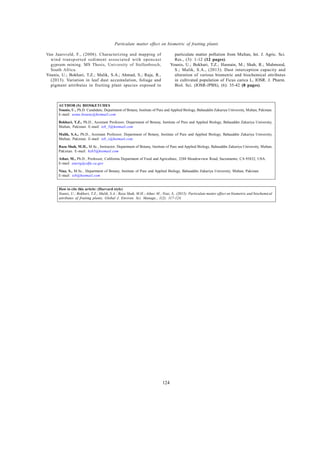
The correlation values of dust accumulation with foliage
attributes and pigment contents in F. carica and P.
guajava is presented in Table 1.
Table 1 clearly shows that there is highly negative
correlation between dust freight and chlorophyll
contents (a, b, total) and carotenoids contents but
too much high + ive correlation was observed between
dust amount and ascorbic acid content and leaf
biomass.
This study shows the significant difference in
dust accumulation in F. carica and Psidium guajava
at diverse sites in and around Multan. F. carica
owing to its extended petioles and broadly ovate
foliage had shown the maximum dust accumulation
capacity as compared with P. guajava which had
short- leaves stalks and oblong-elliptic foliage. In
addition, large leaf surface area and pubescence
degree allow the species to capture more dust
particles. Many scientists also observe the impact
of leaves traits on dust accumulation (Garg et al.,
2000; Younis et al., 2013). Morphological traits
such as waxes, epidermal cell margins, trichomes,
ledges of stomata give roughness to leaves (Pal et
al., 2002). Extra dust accumulation in species
growing at road sides may be due to high dust
strength which fallout by the vehicles movement
and capturingdust, with a calm wind. B.Z. University
plants showed minimum dust accumulation because
this area has more plantation and less exposed land.
Thus, F. carica could be one of the significant
contributors for reducing dust pollution from air.
Sufficient amount of dust pollution formed a
layer on leaves than reduced light capturing ability
of leaves which resulted in the declining of
photosynthesis and ultimately plant growth
(Farmer, 1993). Similar results were pragmatic in
this study that dust had significant impact on leaf
area of F. carica and non significant effect on P.
guajava because there was +ive correlation
between dust load and leaf area of F. carica while,
negative correlation between dust accumulation
Table 1: Correlation of dust accumulation with biometric and biochemical attributes of F.
carica and P. guajava collected from different sites of Multan, Pakistan
Leaf Area
Leaf Fresh weight
Leaf Dry weight
Chlorophyll a
Chlorophyll b
Total chlorophyll
Carotenoids
Ascorbic acid
0.85
0.934
0.959
-0.786
-0.878
-0.935
-0.945
0.91
-0.91
0.912
0.906
-0.916
-0.908
-0.703
-0.919
0.886
Foliage and biochemical attributes Ficus carica Psidium guajava
Plant species
Global J. Environ. Sci. Manage., 1(2): 117-124, Spring 2015
123
and area of leaf was observed in case of P. guajava.
Many environmental factors control the growth and
development of the plants (Katiyar and Dubey, 2000).
Disparity in foliage pigments (chlorophyll “a, b, total”
carotenoids and ascorbic acid) are may be caused by
these factors. Chlorophyll reduction with increasing
dust particles was observed because these particles
also bring many metals and hydrocarbon (polycyclic)
which retard the manufacture of chlorophyll synthesis
enzymes (Prajapati and Tripathi, 2008). In our study
the ascorbic acid and chlorophyll give different
response to dust pollution, as chlorophyll contents
decreased and ascorbic acid contents increased with
increasing dust pollution (Garg and Kapoor, 1972).
Chlorophyll amount in dust contaminated leaves is
lesser than control one also reported by numerous
scientists (Mandal and Mukherji, 2000; Samal and
Santra, 2002). The study clearly recommended that
cultivation of F. carica in dusty areas can control
particulate pollution which may cause hazardous
consequences for human health.
CONCLUSION
From the present study it is proved that F. carica
can accumulate more dust as compared to P. guajava.
Therefore, it is recommended to cultivate F. carica
plants in a highly dust polluted areas; it will be
helpful in reducing dust concentration in atmosphere
and prevent negative impact of dust on living
organisms.
REFERENCES
Anthony, P., (2001). Dust from walking tracks: Impacts
on rainforest leaves and epiphylls. Cooperative Research
Centre for Tropical Rainforest Ecology and Management,
Australia.
Beckett, K.P.; Freer-Smith, P.H.; Taylor, G., (2000).
Particulate pollution capture by urban trees: Effect of
species and wind speed, Global Change Biol., (6): 995-
1003 (9 pages).
Cacciola, R.R.; Sarva, M.; Polosa, R., (2002). Adverse
respiratory effects and allergic susceptibility in relation
to particulate air pollution: Flirting with disaster, Allergy,
(57): 281-286 (6 pages).
Danish, S.; Qureshi, T.I.; Younis, U.; Manzoor, H.; Shakeel,
A.; Ehsanulla, M., (2014). Influence of biochar on growth
and photosynthetic attributes of Triticum aestivum L.
under half and full irrigation, Int. J. Biosci., (5): 101-
108 (8 pages).
Farmer, A.M., (1993). The effects of dusts on vegetation
- A review, Environ. Pollut., (79): 63-75 (13 pages).
Farooq, M.; Arya, K.R.; Kumar, S.; Gopal, K.; Joshi, P.C.;
Hans, R.K., (2000). Industrial pollutants mediated damage
to mango (Mangifera Indica) crop: A case study, J.
Environ. Biol., (21):165-167 (3 pages).
Freer-Smith, P.H.; Beckett, K.P.; Taylor, G., (2005).
Deposition velocities to Sorbus aria, Acer campestre,
Populus deltoides x trichocarpa ‘Beaupre’, Pinus nigra
and x Cupressocyparis leylandii for coarse, fine and
ultra-fine particles in the urban environment, Environ.
Pollut., (133): 157-167 (11 pages).
Garg, O.P.; Kapoor, V., (1972). Retardation of leaf senescence
by ascorbic acid, J. Exp. Bot., (23): 699-703 (5 pages).
Gostin, I.N., (2009). Air Pollution Effects on the Leaf
Structure of some Fabaceae Species, Not. Bot. Hort.
Agrobot. Cluj., (37): 57-63 (7 pages).
Jafary, Z.A.; Faridi, I.A.; Qureshi, H.J., (2007). Effects of
airborne dust on lung function of the exposed subjects,
Pak. J. Physiol., (3): 30-34 (5 pages).
Joshi, N.; Chauhan, A.; Joshi, P.C., (2009). Impact of
industrial pollutants on some biochemical parameters
and yield in wheat and mustard plants. Environmentalist,
(29): 398-404 (7 pages).
Katiyar, V.; Dubey, P.S., (2000). Growth behaviour of two
cultivars of maize in response to SO2
and NO2
, J. Environ.
Biol., (21): 317-323 (7 pages).
Keller, T.; Schwager, H., (1977). Air pollution and ascorbic
acid, Eur. J. Forest Pathol., (7): 338-350 (13 pages).
Krik, J.T.O.; Allen, R.L., (1965). Dependence of
chloroplast pigment synthesis on protein synthesis:
Effect of actidione, Biochem. Biophys. Res. Commun.,
(21): 523-530 (8 pages).
Mandal, M.; Mukherji, S., (2000). Changes in chlorophyll
context, chlorophyllase activity, Hill reaction,
photosynthetic CO2
uptake, sugar and starch contents in
five dicotyledonous plants exposed to automobile exhaust
pollution, J. Environ. Biol., (21): 37-41 (5 pages).
Manins, P.; Allan, R.; Beer, T.; Fraser, P.; Holper, P.; Suppiah,
R.; Walsh, K., (2001). Atmosphere. Australia State of the
Environment Rep. 2001 (Theme Rep.). CSIRO Publ.,
Melbourne.
Pal, A.; Kulshreshtha, K.; Ahmad, K.J.; Behl, H.M., (2002).
Do leaf surface characters play a role in plant resistance
to auto exhaust pollution? Flora, (197): 47-55 (9 pages).
Prajapati, S.K.; Tripathi, B.D., (2008). Seasonal variation
of leaf dust accumulation and pigment ontent in plant
species exposed to urban particulates pollution, J.
Environ. Qual., (37): 865-870 (6 pages).
Raupach, M.R.; Woods, N.; Dorr, G.; Leys, J.F.; Cleugh,
H.A., (2001). The entrapment of particles by windbreaks,
Atmos. Environ., (35): 3373-3383 (11 pages).
Samal, A.K.; Santra, S.C., (2002). Air quality of Kalyani
Township (Nadia, West Bengal) and its impact on
surrounding vegetation, Ind. J. Environ. Health, (44):
71-76 (6 pages).
Seyyednejad, S.M.; Niknejad, M.; Koochak, H., (2011). A
review of some different effects of air pollution on
plants, Res. J. Environ. Sci., (5): 302-309 (8 pages).
Shrivastava, N.; Joshi, S., (2002). Effect of automobile
air pollution on the growth of some plants at Kota,
Geobios., (29): 281-282 (2 pages).
Sukumaran, D., (2012). Effect of Particulate Pollution on
various Tissue Systems of Tropical Plants. Central Pollution
Control Board (CPCB), Zonal Office, Kolkata, India.
Global J. Environ. Sci. Manage., 1(2): 117-124, Spring 2015
124
Particulate matter effect on biometric of fruiting plants
AUTHOR (S) BIOSKETCHES
Younis, U., Ph.D. Candidate; Department of Botany, Institute of Pure and Applied Biology, Bahauddin Zakariya University, Multan, Pakistan.
E-mail: uzma.botany@hotmail.com
Bokhari, T.Z., Ph.D., Assistant Professor; Department of Botany, Institute of Pure and Applied Biology, Bahauddin Zakariya University,
Multan, Pakistan. E-mail: tzb_5@hotmail.com
Malik, S.A., Ph.D., Assistant Professor; Department of Botany, Institute of Pure and Applied Biology, Bahauddin Zakariya University,
Multan, Pakistan. E-mail: tzb_s@hotmail.com
Raza Shah, M.H., M.Sc., Instructor; Department of Botany, Institute of Pure and Applied Biology, Bahauddin Zakariya University, Multan,
Pakistan. E-mail: hzb5@hotmail.com
Athar, M., Ph.D., Professor; California Department of Food and Agriculture, 3288 Meadowview Road, Sacramento, CA 95832, USA.
E-mail: atariq@cdfa.ca.gov
Niaz, S., M.Sc., Department of Botany, Institute of Pure and Applied Biology, Bahauddin Zakariya University, Multan, Pakistan.
E-mail: tzb@hotmail.com
How to cite this article: (Harvard style)
Younis, U.; Bokhari, T.Z.; Malik, S.A.; Raza Shah, M.H.; Athar, M.; Niaz, S., (2015). Particulate matter effect on biometric and biochemical
attributes of fruiting plants, Global J. Environ. Sci. Manage., 1(2): 117-124.
Van Jaarsveld, F., (2008). Characterizing and mapping of
wind transported sediment associated with opencast
gypsum mining. MS Thesis, University of Stellenbosch,
South Africa.
Younis, U.; Bokhari, T.Z.; Malik, S.A.; Ahmad, S.; Raja, R.,
(2013). Variation in leaf dust accumulation, foliage and
pigment attributes in fruiting plant species exposed to
particulate matter pollution from Multan, Int. J. Agric. Sci.
Res., (3): 1-12 (12 pages).
Younis, U.; Bokhari, T.Z.; Hasnain, M.; Shah, R.; Mahmood,
S.; Malik, S.A., (2013). Dust interception capacity and
alteration of various biometric and biochemical attributes
in cultivated population of Ficus carica L, IOSR. J. Pharm.
Biol. Sci. (IOSR-JPBS), (6): 35-42 (8 pages).

Particulate matter effect on biometric and biochemical attributes of fruiting plants

  • 1.
    Global J. Environ.Sci. Manage., 1(2): 117-124, Spring 2015 Particulate matter effect on biometric and biochemical attributes of fruiting plants 1 U. Younis; 1 *T.Z. Bokhari; 1 S.A. Malik; 1 M.H. Raza Shah; 2 M. Athar; 1 S. Niaz 1 Department of Botany, Institute of Pure and Applied Biology, Bahauddin Zakariya University, Multan, Pakistan 2 California Department of Food and Agriculture, 3288 Meadowview Road, Sacramento, CA 95832, USA ABSTRACT: Dust accumulation capacity of Ficus carica L. and Psidium guajava L. was investigated from eight different sites of Multan, Pakistan. Leaves of both plants were used for analyzing biometric (leaf area, fresh and dry weights) and biochemical attributes (chlorophyll contents, carotenoids and ascorbic acid). Maximum dust accumulation was occurred in the plants growing near road sites, while, minimum dust accumulation occurred in the plants of Bahauddin Zakariya University. Most of the biometric and biochemical attributes of F. carica showed significant response towards dust but it had not significant influence on some attributes of P. guajava. Biochemical traits of P. guajava appeared to be more prone than foliage ones. Apositive correlation was found between dust accumulation and foliage attributes in F. carica. On the other hand, in P. guajava opposite was observed, however, the reverse was true for leaf biomass. Biochemical contents had shown an inconsistency as chlorophylls (a, b & total), carotenoid contents declined but ascorbic acid increased with an increase in dust accumulation in both species. Keywords: Biometric attributes, Biochemical attributes, Dust accumulation, Ficus carica, Psidium guajava Global J. Environ. Sci. Manage., 1(2): 117-124, Spring 2015 ISSN 2383 - 3572 *Corresponding Author Email: tzb_5@hotmail.com Tel.: +91 061 4573463; Fax: +91 061 4573463 INTRODUCTION Universally and particularly in Urban areas many people suffered from variety of diseases due to dust pollution. Therefore, considerable attention is given to particulate matter pollution in the recent years (Jafary et al., 2007; Cacciola et al., 2002). Due to dryness of soil in the arid ecosystem the windblown dust is a common feature and plays a great role in increasing dust pollution in the environment (Younis et al., 2013). Solid particles with diameter less than 500 µm are known as dust but particles which have size of 2.5-10 µm caused health problems for local public. Similarly high speed vehicles and agricultural activities also generate too much high dust pollution in air (Manins et al., 2001; Van Jaarsveld, 2008). Basically, outer surface of the plants like leaves play a role in absorbance of these dust particles (Samal and Santra, 2002). Thus in these areas the quality of air can be improved by planting more trees near road and farm sides (Beckett et al., 2000; Freer- Received 25 November 2014; revised 25 January 2015; accepted 30 January 2015; available online 1 March 2015 Smith et al., 2005; Raupach et al., 2001). But accumulation of dust by plants is dependent on their various characteristics like phyllotaxy and biometric attributes (pubescence of leaves), height and plants canopy. Because plants act as a sink in environment, so, they are useful in reducing dust concentration and other particulate matters of air. This accumulation is mainly depends on vegetation type (Younis et al., 2013). Surface nature of the plants parts like twigs, bark and leaves offer an area for the settlement of these matters. Dust pollution cause negative impact on plants as it reduced photosynthesis and cause leaf fall with tissue death (Farooq et al., 2000; Shrivastava and Joshi, 2002). Dust affects the synthesis of chlorophyll and resulted in leaf chlorosis (Seyyednejad et al., 2011). Similary morphology and anatomy of leaves is also altered by dust (Gostin, 2009; Sukumaran, 2012). At the same time many plants are able to survive in high dust load due to the synthesis of carotenoids and ascorbic acid which give non enzymatic resistance
  • 2.
    Global J. Environ.Sci. Manage., 1(2): 117-124, Spring 2015U. Younis et al. 118 to plants to numerous abiotic stresses (Prajapati and Tripathi, 2008). Multan is popular for dust storms and with the passage of time this problem is increasing day by day. Keeping in sight the above condition, the present work was aimed to estimate the disparity in dust gathering capacity of Ficus carica and Psidium guajava because species were present in a diversity of habitats in Multan. The foremost objective is to asses the role of leaves of these species in the reduction of dust pollution. In addition, foliage and biochemical traits were analyzed to suggest the probable mechanism of vegetation to combat stress induced by dust particles. MATERIALS AND METHODS Plant material and sampling Two plant species (Ficus carica and Psidium guajava) were selected for study. Both species are small trees about 3-10 m tall. The phyllotaxy for the two species is opposite and alternate respectively. The selection of these two species was made because of their contrasting leaf characteristics. As the former species has broadly ovate foliage with long petiole, however, the later species has broad oblong elliptic leaves with short leaf stalk or petiole. Cultivated inhabitants of two fruit varieties were chosen for sampling of plant tissues from 8 major areas of Multan city. The detail of these areas is summarized in Fig. 1. Sampling protocols for dust and Leaves Tress of F. carica and P. guajava plants were selected at each sampling location and 10 leaves were randomly marked on each plant at 1-3 m height. After removing leaves from branches they were packed in pre-weight glazed paper and brought to laboratory. Here the dust on the leaves was carefully cleaned by using fine brush on glazed paper and then papers were again weight. The dust accumulation was Fig. 1: Study sites with protocols in and around Multan.
  • 3.
    Global J. Environ.Sci. Manage., 1(2): 117-124, Spring 2015 119 calculated by using following formula (Prajapati and Tripathi, 2008). W = (w2 – w1)/a Where W is dust content (g/m), w1 is initial weight of glazed paper, w2 is final weight of glazed paper with dust, and “a” is total area of the leaf (m2). Fresh weights of leaves were taken, than oven dried at 70o C for 72 h for dry weight measurements. Chlorophyll determination 0.2 g fresh leave samples were extracted overnight with 80% acetone (4 ml) then grinded and homogenized well in pestle and mortar. The homogenized mixture was filtered and volume of the filtrate was raised up-to 25 ml with 80% acetone. The absorbance of the chlorophyll filtrate was determined at 663, 645 and 480 by spectrophotometer (Optima 2100 DV Perkin-Elmer). The chlorophylls (a, b and total) contents were calculated by the following formulae: Chlorophyll“a” (mg/gF.W) = [12.7 (OD663) -2.69 (OD 645)]xV/1000xW Chlorophyll“b”(mg/gF.W) = [22.9 (OD645) -4.68 (OD 663)]xV/1000xW “Total” chlorophyll (mg/g F. W) = [20.2 (OD 645) +8.02 (OD663)]xV/1000xW V =Filtrate volume (mL) W = Leaf weight (g) OD =optical density Ascorbic Acid For determination of ascorbic acid 5 g of fresh leaves were grinded and homogenized in 20 ml extracting solution (5 goxalic acid + 0.75 g Na salt of EDTA100 ml d i s t i l l e d w a t e r . A f t e r c e n t r i f u g a t i o n a t 6 8 2 . 2 r a d s –1 for 15 minutes, the 1 ml of homogenate was mixed carefully with 5 ml DCPIP (Dichlorophenol indophenol). Color of homogenate changed into pink, its absorbance was noted at 520 nm then one drop of 1% ascorbic acid was added to make solution colorless. The absorbance of colorless solution was also noted at same wavelength. A standard curve was draw by using ascorbic acid solution of different dilution (0.01–0.07 g/L). The ascorbic acid was determined by following Keller and Schwager, (1977). Ascorbicacid(mg/gF.W)=[((Eo-Es-Et)V/100xW)x100] For determination of ascorbic acid following procedure is used 5gleafsample homogenized 20mlextractingsolution 628.2rads-1 (15min.) Homogenate Centrifuged 1mlhomogenate+5mlDCPIP measure opticaldensity(520nm) opticaldensity(520nm) measure onedrop15ascorbicacid 20 ml extracting solution 628.2 rads-1 (15 min.) CentrifugedHomogenate 1 ml homogenate + 5ml DCPIP measure optical density (520 nm)measure optical density (520 nm) one drop 15 ascorbic acid homogenized5 g leaf sample where, Eo =OD of blank, Es =OD of plant sample and Et = OD of sample + ascorbic acid,V = extract volume; and W = leaf sample weight (g). RESULTS AND DISCUSSION Fig. 2 A represented the dust accumulation or dust load on leaves of Ficus carica and Psidium guajava under study. It is evident from the Figure that F. carica and P. guajava showed higher dust deposition on leaves at road sides followed by parks, railway station, Pak Arab Fertilizer - Industrial Estate, cultivated wheat field, cricket stadium area and lowest at Bahauddin Zakariya University. It is also cleared from the mentioned figure that F. carica leaves had more dust accumulation than P. guajava leaves. Higher dust accumulation had affected foliage attributes of F. carica and P. guajava and leaf area of F. carica increased (146.48 cm2 ) and P. guajava decreased (37.81 cm2 ) with increasing dust accumulation (Fig. 2 B). Whereas significant increased of fresh and dry weights of leaves of F. carica and P. guajava was observed with increasing dust accumulation. The maximum leaf fresh and dry distilled water.After centrifugation at 682.2 rads–1 for
  • 4.
    Global J. Environ.Sci. Manage., 1(2): 117-124, Spring 2015 120 Particulate matter effect on biometric of fruiting plants weights were observed in the plants growing at road sides with more dust accumulation and minimum were observed in the plants growing in Bahauddin Zakariya University with minimum dust accumulation. (Fig. 2 C and D). The F. carica and P. guajava had the maximum leaf fresh weight (4.59 g & 1.01 g) at more dust accumulation site. Although, a gradual reduction of leaf fresh weight (1.49 g and 0.79 g) was observed in the plants of F. carica and P. guajava growing at lowest dust accumulation site (Fig. 2 C). The leaf dry weight also exhibited a similar trend as shown by fresh weight and a noticeable inhibition in dry weight was observed with increasing dust accumulation where leaves of both plants produced 2.06 and 0.45 g of dry weight as compared with 0.52 and 0.32 g of leaves of the plants growing at minimum dust accumulation site (Fig. 2 D). The carotenoids and chlorophyll contents were comparatively higher in the plants growing at lowest dust accumulation site but dust load induced a A - 0.05 0.10 0.15 0.20 0.25 0.30 0.35 I II III IV V VI VII VIII Collection sites Dustaccumulation(g/m2leafLA) Ficus carica Psidiumguajava 0 20 40 60 80 100 120 140 160 I II III IV V VI VII VIII Collectionsites Leafarea(cm2) F. carica P. guajava B 0.0 0.5 1.0 1.5 2.0 2.5 3.0 3.5 4.0 4.5 5.0 I II III IV V VI VII VIII Collection sites Freshweight(g) F.carica P. guajava C 0.0 0.5 1.0 1.5 2.0 2.5 I II III IV V VI VII VIII Collectionsites Dryweight(g) F. carica P. guajava D Fig. 2: A. Dust accumulation, B. Leaf area, C. Leaf fresh weight, D. Leaf dry weight of F. carica and P. guajava collected from different sites of Multan, Pakistan (Values are means of ten replicates) Collection Sites Collection Sites Collection Sites Collection Sites Freshweight(g) Dryweight(g) Dustaccumulation(g/m2 leafLA) Leafarea(cm2 )
  • 5.
    Global J. Environ.Sci. Manage., 1(2): 117-124, Spring 2015 121 profound decline in chlorophyll a, b and carotenoids contents (Fig. 3 A, B, C and D). The pigments declined progressively with increasing dust accumulation. The amount of - 0.2 0.4 0.6 0.8 1.0 1.2 1.4 1.6 I II III IV V VI VII VIII Collection sites Chlorophylla(mg/gF.wt.) F.carica P. guajava A - 0.2 0.4 0.6 0.8 1.0 1.2 I II III IV V VI VII VIII Collectionsites Chlorophyllb(mg/gF.wt.) F. carica P. guajava B - 0.5 1.0 1.5 2.0 2.5 3.0 I II III IV V VI VII VIII Collection Sites Pigmentcontents(mg/gF.wt.) Carotenoids Total chlorophyll Ascorbic acid C - 0.2 0.4 0.6 0.8 1.0 1.2 1.4 I II III IV V VI VII VIII Collection sites pigmentcontents(mg/gf.wt.) Carotenoids Total chlorophyll Ascorbicacid D Fig. 3: A and B. Chlorophyll (a & b) contents of F. carica and P. guajava, C & D Ascorbic acid, Carotenoids and Total chlorophyll contents of F. carica and P. guajava collected from different sites of Multan, Pakistan (Values are means of five replicates) chlorophyll a in F. carica and P. guajava growing at lowest dust accumulation site was 1.40 and 0.89 mg/ g (Fig. 3 A), whereas amount of chlorophyll b was 1.02 & 0.47 mg/g and amount of carotenoids was Collection SitesCollection Sites Collection Sites Collection Sites Pigmentcontents(mg/gF.wt.) Pigmentcontents(mg/gF.wt.) Chlorophylla(mg/gF.wt.) Chlorophylla(mg/gF.wt.)
  • 6.
    Global J. Environ.Sci. Manage., 1(2): 117-124, Spring 2015 122 U. Younis et al. 1.75 and 1.63 mg/g. However, at higher dust accumulation site, chlorophyll a of F. carica and P. guajava decreased to 0.79 & 0.27 mg/g and chlorophyll b was decreased to 0.37 and 0.17 mg/g (Fig. 3 B, C and D). A dramatic decline in carotenoids content was also observed in both plants and 0.74 mg/g and 0.45 mg/g of this pigment was recorded at higher dust accumulation site (Fig. 3 C and D). The variations in leaf pigment content of F. carica and P. guajava under study are presented in Fig. 3 (C and D). It is obvious from the results that more total chlorophyll content were observed in the plants growing at lowest dust accumulation site. From the study it is conclude that ascorbic acid and chlorophyll and inversely proportional to one another. The ascorbic acid concentration in both plant species was highest at more dust accumulation site (Road sides). The study demonstrates the changes in foliage attributes and pigment contents in F. carica and P. guajava exposed to atmosphericdust fall. Chlorophyll + carotenoid contents reduced and ascorbic acid values increased with increasing dust accumulation on leaves. The correlation values of dust accumulation with foliage attributes and pigment contents in F. carica and P. guajava is presented in Table 1. Table 1 clearly shows that there is highly negative correlation between dust freight and chlorophyll contents (a, b, total) and carotenoids contents but too much high + ive correlation was observed between dust amount and ascorbic acid content and leaf biomass. This study shows the significant difference in dust accumulation in F. carica and Psidium guajava at diverse sites in and around Multan. F. carica owing to its extended petioles and broadly ovate foliage had shown the maximum dust accumulation capacity as compared with P. guajava which had short- leaves stalks and oblong-elliptic foliage. In addition, large leaf surface area and pubescence degree allow the species to capture more dust particles. Many scientists also observe the impact of leaves traits on dust accumulation (Garg et al., 2000; Younis et al., 2013). Morphological traits such as waxes, epidermal cell margins, trichomes, ledges of stomata give roughness to leaves (Pal et al., 2002). Extra dust accumulation in species growing at road sides may be due to high dust strength which fallout by the vehicles movement and capturingdust, with a calm wind. B.Z. University plants showed minimum dust accumulation because this area has more plantation and less exposed land. Thus, F. carica could be one of the significant contributors for reducing dust pollution from air. Sufficient amount of dust pollution formed a layer on leaves than reduced light capturing ability of leaves which resulted in the declining of photosynthesis and ultimately plant growth (Farmer, 1993). Similar results were pragmatic in this study that dust had significant impact on leaf area of F. carica and non significant effect on P. guajava because there was +ive correlation between dust load and leaf area of F. carica while, negative correlation between dust accumulation Table 1: Correlation of dust accumulation with biometric and biochemical attributes of F. carica and P. guajava collected from different sites of Multan, Pakistan Leaf Area Leaf Fresh weight Leaf Dry weight Chlorophyll a Chlorophyll b Total chlorophyll Carotenoids Ascorbic acid 0.85 0.934 0.959 -0.786 -0.878 -0.935 -0.945 0.91 -0.91 0.912 0.906 -0.916 -0.908 -0.703 -0.919 0.886 Foliage and biochemical attributes Ficus carica Psidium guajava Plant species
  • 7.
    Global J. Environ.Sci. Manage., 1(2): 117-124, Spring 2015 123 and area of leaf was observed in case of P. guajava. Many environmental factors control the growth and development of the plants (Katiyar and Dubey, 2000). Disparity in foliage pigments (chlorophyll “a, b, total” carotenoids and ascorbic acid) are may be caused by these factors. Chlorophyll reduction with increasing dust particles was observed because these particles also bring many metals and hydrocarbon (polycyclic) which retard the manufacture of chlorophyll synthesis enzymes (Prajapati and Tripathi, 2008). In our study the ascorbic acid and chlorophyll give different response to dust pollution, as chlorophyll contents decreased and ascorbic acid contents increased with increasing dust pollution (Garg and Kapoor, 1972). Chlorophyll amount in dust contaminated leaves is lesser than control one also reported by numerous scientists (Mandal and Mukherji, 2000; Samal and Santra, 2002). The study clearly recommended that cultivation of F. carica in dusty areas can control particulate pollution which may cause hazardous consequences for human health. CONCLUSION From the present study it is proved that F. carica can accumulate more dust as compared to P. guajava. Therefore, it is recommended to cultivate F. carica plants in a highly dust polluted areas; it will be helpful in reducing dust concentration in atmosphere and prevent negative impact of dust on living organisms. REFERENCES Anthony, P., (2001). Dust from walking tracks: Impacts on rainforest leaves and epiphylls. Cooperative Research Centre for Tropical Rainforest Ecology and Management, Australia. Beckett, K.P.; Freer-Smith, P.H.; Taylor, G., (2000). Particulate pollution capture by urban trees: Effect of species and wind speed, Global Change Biol., (6): 995- 1003 (9 pages). Cacciola, R.R.; Sarva, M.; Polosa, R., (2002). Adverse respiratory effects and allergic susceptibility in relation to particulate air pollution: Flirting with disaster, Allergy, (57): 281-286 (6 pages). Danish, S.; Qureshi, T.I.; Younis, U.; Manzoor, H.; Shakeel, A.; Ehsanulla, M., (2014). Influence of biochar on growth and photosynthetic attributes of Triticum aestivum L. under half and full irrigation, Int. J. Biosci., (5): 101- 108 (8 pages). Farmer, A.M., (1993). The effects of dusts on vegetation - A review, Environ. Pollut., (79): 63-75 (13 pages). Farooq, M.; Arya, K.R.; Kumar, S.; Gopal, K.; Joshi, P.C.; Hans, R.K., (2000). Industrial pollutants mediated damage to mango (Mangifera Indica) crop: A case study, J. Environ. Biol., (21):165-167 (3 pages). Freer-Smith, P.H.; Beckett, K.P.; Taylor, G., (2005). Deposition velocities to Sorbus aria, Acer campestre, Populus deltoides x trichocarpa ‘Beaupre’, Pinus nigra and x Cupressocyparis leylandii for coarse, fine and ultra-fine particles in the urban environment, Environ. Pollut., (133): 157-167 (11 pages). Garg, O.P.; Kapoor, V., (1972). Retardation of leaf senescence by ascorbic acid, J. Exp. Bot., (23): 699-703 (5 pages). Gostin, I.N., (2009). Air Pollution Effects on the Leaf Structure of some Fabaceae Species, Not. Bot. Hort. Agrobot. Cluj., (37): 57-63 (7 pages). Jafary, Z.A.; Faridi, I.A.; Qureshi, H.J., (2007). Effects of airborne dust on lung function of the exposed subjects, Pak. J. Physiol., (3): 30-34 (5 pages). Joshi, N.; Chauhan, A.; Joshi, P.C., (2009). Impact of industrial pollutants on some biochemical parameters and yield in wheat and mustard plants. Environmentalist, (29): 398-404 (7 pages). Katiyar, V.; Dubey, P.S., (2000). Growth behaviour of two cultivars of maize in response to SO2 and NO2 , J. Environ. Biol., (21): 317-323 (7 pages). Keller, T.; Schwager, H., (1977). Air pollution and ascorbic acid, Eur. J. Forest Pathol., (7): 338-350 (13 pages). Krik, J.T.O.; Allen, R.L., (1965). Dependence of chloroplast pigment synthesis on protein synthesis: Effect of actidione, Biochem. Biophys. Res. Commun., (21): 523-530 (8 pages). Mandal, M.; Mukherji, S., (2000). Changes in chlorophyll context, chlorophyllase activity, Hill reaction, photosynthetic CO2 uptake, sugar and starch contents in five dicotyledonous plants exposed to automobile exhaust pollution, J. Environ. Biol., (21): 37-41 (5 pages). Manins, P.; Allan, R.; Beer, T.; Fraser, P.; Holper, P.; Suppiah, R.; Walsh, K., (2001). Atmosphere. Australia State of the Environment Rep. 2001 (Theme Rep.). CSIRO Publ., Melbourne. Pal, A.; Kulshreshtha, K.; Ahmad, K.J.; Behl, H.M., (2002). Do leaf surface characters play a role in plant resistance to auto exhaust pollution? Flora, (197): 47-55 (9 pages). Prajapati, S.K.; Tripathi, B.D., (2008). Seasonal variation of leaf dust accumulation and pigment ontent in plant species exposed to urban particulates pollution, J. Environ. Qual., (37): 865-870 (6 pages). Raupach, M.R.; Woods, N.; Dorr, G.; Leys, J.F.; Cleugh, H.A., (2001). The entrapment of particles by windbreaks, Atmos. Environ., (35): 3373-3383 (11 pages). Samal, A.K.; Santra, S.C., (2002). Air quality of Kalyani Township (Nadia, West Bengal) and its impact on surrounding vegetation, Ind. J. Environ. Health, (44): 71-76 (6 pages). Seyyednejad, S.M.; Niknejad, M.; Koochak, H., (2011). A review of some different effects of air pollution on plants, Res. J. Environ. Sci., (5): 302-309 (8 pages). Shrivastava, N.; Joshi, S., (2002). Effect of automobile air pollution on the growth of some plants at Kota, Geobios., (29): 281-282 (2 pages). Sukumaran, D., (2012). Effect of Particulate Pollution on various Tissue Systems of Tropical Plants. Central Pollution Control Board (CPCB), Zonal Office, Kolkata, India.
  • 8.
    Global J. Environ.Sci. Manage., 1(2): 117-124, Spring 2015 124 Particulate matter effect on biometric of fruiting plants AUTHOR (S) BIOSKETCHES Younis, U., Ph.D. Candidate; Department of Botany, Institute of Pure and Applied Biology, Bahauddin Zakariya University, Multan, Pakistan. E-mail: uzma.botany@hotmail.com Bokhari, T.Z., Ph.D., Assistant Professor; Department of Botany, Institute of Pure and Applied Biology, Bahauddin Zakariya University, Multan, Pakistan. E-mail: tzb_5@hotmail.com Malik, S.A., Ph.D., Assistant Professor; Department of Botany, Institute of Pure and Applied Biology, Bahauddin Zakariya University, Multan, Pakistan. E-mail: tzb_s@hotmail.com Raza Shah, M.H., M.Sc., Instructor; Department of Botany, Institute of Pure and Applied Biology, Bahauddin Zakariya University, Multan, Pakistan. E-mail: hzb5@hotmail.com Athar, M., Ph.D., Professor; California Department of Food and Agriculture, 3288 Meadowview Road, Sacramento, CA 95832, USA. E-mail: atariq@cdfa.ca.gov Niaz, S., M.Sc., Department of Botany, Institute of Pure and Applied Biology, Bahauddin Zakariya University, Multan, Pakistan. E-mail: tzb@hotmail.com How to cite this article: (Harvard style) Younis, U.; Bokhari, T.Z.; Malik, S.A.; Raza Shah, M.H.; Athar, M.; Niaz, S., (2015). Particulate matter effect on biometric and biochemical attributes of fruiting plants, Global J. Environ. Sci. Manage., 1(2): 117-124. Van Jaarsveld, F., (2008). Characterizing and mapping of wind transported sediment associated with opencast gypsum mining. MS Thesis, University of Stellenbosch, South Africa. Younis, U.; Bokhari, T.Z.; Malik, S.A.; Ahmad, S.; Raja, R., (2013). Variation in leaf dust accumulation, foliage and pigment attributes in fruiting plant species exposed to particulate matter pollution from Multan, Int. J. Agric. Sci. Res., (3): 1-12 (12 pages). Younis, U.; Bokhari, T.Z.; Hasnain, M.; Shah, R.; Mahmood, S.; Malik, S.A., (2013). Dust interception capacity and alteration of various biometric and biochemical attributes in cultivated population of Ficus carica L, IOSR. J. Pharm. Biol. Sci. (IOSR-JPBS), (6): 35-42 (8 pages).