GINKGO
MERIN ALICE GEORGE
• CLASS: CONIFEROPSIDA
• ORDER: CONIFERALES
• FAMILY: GINKOACEAE
• The maidenhair tree is one of the oldest living tree species in the
world.
• Known as a ‘living fossil’, it is the sole survivor of an ancient group
of trees that outlived the dinosaurs.
• Though endangered in the wild because of deforestation, the
maidenhair tree is cultivated throughout the world and prized for the
medicinal properties of its leaves.
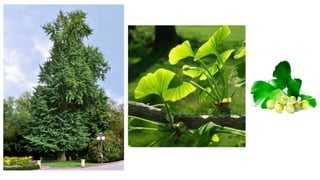
• It has fan-shaped, greenish-yellow leaves that have two or more distinct lobes.
• In autumn, the leaves of the maidenhair tree turn golden and fall to the ground.
• Whilst male trees have pollen-producing floral spikes, fertilized female trees bear
round, fleshy, yellowish fruits that contain a large seed and have an unpleasant
scent.
• It takes 20—35 years for maidenhair trees to reach maturity and start bearing
fruits.
• MORPHOLOGY
• An attractive tree – pyramidal shape. Trees 30 m tall, fan-shaped
deciduous leaves. Fruits – orange in colour – resemble apricot in size &
colour. Female tree – fruits emit offensive odour – due to lactic acid – hence
only male trees are preferred in gardens.
• Male & female trees identical – takes 20 years to flower – seed propagation
not common – since female plants are not preferred.
• Propagation mainly by layering, grafting and cuttings.
• Stem – 2 types of branches – shoot dimorphism – long shoots & dwarf
shoots.
• Long shoots – 1 meter long – unlimited growth – elongate rapidly –
grow fast – bear scattered leaves.
• Dwarf shoots – spur shoots – limited growth – slow growth – cluster of
leaves at apex – arise from axils of leaves on the long shoot – produce
crown of leaves and reproductive structures.
• Leaves - bilobed, fan – shaped – deciduous – golden yellow when they
are shed – resemble Adiantum – so called “Maiden hair tree”.
• Root - tap root.
ANATOMY
• Root Anatomy – diarch. Endodermis with conspicuous thickening on
radial walls (casparian thickening). Pericycle broad. Sec. growth – as
usual – but annual rings not so conspicuous. Xylem parenchyma – some
cells with crystals.
• Phloem – with thick walled fibres.
• VAM found in the roots. Fontana 1985, reported Glomus epigaeum
fungus from roots. Growth of seedlings increased when inoculated with
G. epigaeum.
• Stem Anatomy – Epidermis highly cuticularised. Cortex & pith
prominent and large.
• Tannin cells, Ca-oxalate crystal cells, etc. found in outer cortex. Large
mucilage canals in inner cortex.
• Old stem – cortex with fibres & sclereids. Long shoots – cortex & pith
small. . Pri. structure like other gymnosperms. Sec. thickening as usual.
• Wood is brittle & of no commercial value. Xylem & phloem as in others.
Rays uniseriate. Trachieds narrow, X-parenchyma with Ca-oxalate
crystals. So Ginkgo wood differs from other Coniferales. Dwarf shoot with
manoxylic wood & phloem with crystals & so similar to Cycads. Cork
cambium also formed.
• Long Shoot – cortex & pith narrow, few mucilage ducts present, wood is
hard & pycnoxylic & leaf traces few as leaves are scattered.
• Dwarf Shoot – cortex & pith more, more mucilage ducts present, wood is
less, manoxylic & double leaf traces in dwarf shoot due to crown of leaves.
• Leaf Anatomy – wavy margins – Upper & lower epidermis – thick cuticle.
Stomata sunken – present on lower side - haplochelic.
• Mesophyll with palisade & spongy in leaves of long shoots. No palisade in
leaves of dwarf shoots.
• Mucilage canals seen in mesophyll between the veins. Vas.bundles many –
each with sclerenchymatous & crystal celled bundle sheath.
REPRODUCTION
• Most primitive among living seed plants. Heterosporous – dioecious. Male
& female trees indistinguishable till cones are produced.
• Male cone – axillary, not compact – a loose structure resembling a catkin
inflorescence - central axis 2.3 to 3 cm with 2 vas. traces.
Microsporophylls stalked & spirally arranged.
• Each sporophyll – has a slender stalk with knob-like hump or projection
& 2 pendant sporangia – longitudinal dehiscence – lines face each other.
• Hump has a mucilage cavity – which on shrinkage pulls the sporangia
apart – lines are exposed & pollen shed.
• Female cone – greatly reduced – axillary in origin of a leaf or scale leaf – with a long
peduncle – that bifurcates at apex & each branch bears a single ovule. Of the two
ovules 1 aborts. Sometimes both develop into seeds.
• At the base of ovule – a rim of swelling present – the collar – it sometimes grows into a
leafy structure – hence it represents a reduced megasporophyll. Collar originates after
integument – devoid of vas. supply.
• Ovules of Ginkgo are considered as cauline & terminal on lateral axes.
• MICROSPOROGENESIS- Same as in other gymnosperms
• POLLINATION – by wind – pollination drop.
• FERTILIZATION – Zygote formed.
• EMBRYOGENY
• Zygote nucleus
• 256 free nuclei
• Cells of micropylar region elongate rapidly to form massive suspensor
• Cells of chalazal region develop into proembryo / embryonal mass.
• Cotyledons 2 – rarely 3
• A weak coleorrhiza present.
SEED
• Bilaterally symmetrical. Of two ovules - one aborts – so each branch has one seed – germination is hypogeal.
• Fruit – orange red coloured – emits offensive smell.
•
•
GINKGO...................................pptx

GINKGO...................................pptx

  • 1.
  • 2.
    • CLASS: CONIFEROPSIDA •ORDER: CONIFERALES • FAMILY: GINKOACEAE
  • 5.
    • The maidenhairtree is one of the oldest living tree species in the world. • Known as a ‘living fossil’, it is the sole survivor of an ancient group of trees that outlived the dinosaurs. • Though endangered in the wild because of deforestation, the maidenhair tree is cultivated throughout the world and prized for the medicinal properties of its leaves.
  • 6.
    • It hasfan-shaped, greenish-yellow leaves that have two or more distinct lobes. • In autumn, the leaves of the maidenhair tree turn golden and fall to the ground. • Whilst male trees have pollen-producing floral spikes, fertilized female trees bear round, fleshy, yellowish fruits that contain a large seed and have an unpleasant scent. • It takes 20—35 years for maidenhair trees to reach maturity and start bearing fruits.
  • 7.
    • MORPHOLOGY • Anattractive tree – pyramidal shape. Trees 30 m tall, fan-shaped deciduous leaves. Fruits – orange in colour – resemble apricot in size & colour. Female tree – fruits emit offensive odour – due to lactic acid – hence only male trees are preferred in gardens. • Male & female trees identical – takes 20 years to flower – seed propagation not common – since female plants are not preferred. • Propagation mainly by layering, grafting and cuttings. • Stem – 2 types of branches – shoot dimorphism – long shoots & dwarf shoots.
  • 8.
    • Long shoots– 1 meter long – unlimited growth – elongate rapidly – grow fast – bear scattered leaves. • Dwarf shoots – spur shoots – limited growth – slow growth – cluster of leaves at apex – arise from axils of leaves on the long shoot – produce crown of leaves and reproductive structures. • Leaves - bilobed, fan – shaped – deciduous – golden yellow when they are shed – resemble Adiantum – so called “Maiden hair tree”. • Root - tap root.
  • 9.
    ANATOMY • Root Anatomy– diarch. Endodermis with conspicuous thickening on radial walls (casparian thickening). Pericycle broad. Sec. growth – as usual – but annual rings not so conspicuous. Xylem parenchyma – some cells with crystals. • Phloem – with thick walled fibres. • VAM found in the roots. Fontana 1985, reported Glomus epigaeum fungus from roots. Growth of seedlings increased when inoculated with G. epigaeum.
  • 10.
    • Stem Anatomy– Epidermis highly cuticularised. Cortex & pith prominent and large. • Tannin cells, Ca-oxalate crystal cells, etc. found in outer cortex. Large mucilage canals in inner cortex. • Old stem – cortex with fibres & sclereids. Long shoots – cortex & pith small. . Pri. structure like other gymnosperms. Sec. thickening as usual. • Wood is brittle & of no commercial value. Xylem & phloem as in others. Rays uniseriate. Trachieds narrow, X-parenchyma with Ca-oxalate crystals. So Ginkgo wood differs from other Coniferales. Dwarf shoot with manoxylic wood & phloem with crystals & so similar to Cycads. Cork cambium also formed.
  • 11.
    • Long Shoot– cortex & pith narrow, few mucilage ducts present, wood is hard & pycnoxylic & leaf traces few as leaves are scattered. • Dwarf Shoot – cortex & pith more, more mucilage ducts present, wood is less, manoxylic & double leaf traces in dwarf shoot due to crown of leaves. • Leaf Anatomy – wavy margins – Upper & lower epidermis – thick cuticle. Stomata sunken – present on lower side - haplochelic. • Mesophyll with palisade & spongy in leaves of long shoots. No palisade in leaves of dwarf shoots. • Mucilage canals seen in mesophyll between the veins. Vas.bundles many – each with sclerenchymatous & crystal celled bundle sheath.
  • 12.
    REPRODUCTION • Most primitiveamong living seed plants. Heterosporous – dioecious. Male & female trees indistinguishable till cones are produced. • Male cone – axillary, not compact – a loose structure resembling a catkin inflorescence - central axis 2.3 to 3 cm with 2 vas. traces. Microsporophylls stalked & spirally arranged. • Each sporophyll – has a slender stalk with knob-like hump or projection & 2 pendant sporangia – longitudinal dehiscence – lines face each other. • Hump has a mucilage cavity – which on shrinkage pulls the sporangia apart – lines are exposed & pollen shed.
  • 14.
    • Female cone– greatly reduced – axillary in origin of a leaf or scale leaf – with a long peduncle – that bifurcates at apex & each branch bears a single ovule. Of the two ovules 1 aborts. Sometimes both develop into seeds. • At the base of ovule – a rim of swelling present – the collar – it sometimes grows into a leafy structure – hence it represents a reduced megasporophyll. Collar originates after integument – devoid of vas. supply. • Ovules of Ginkgo are considered as cauline & terminal on lateral axes. • MICROSPOROGENESIS- Same as in other gymnosperms
  • 16.
    • POLLINATION –by wind – pollination drop. • FERTILIZATION – Zygote formed. • EMBRYOGENY • Zygote nucleus • 256 free nuclei • Cells of micropylar region elongate rapidly to form massive suspensor • Cells of chalazal region develop into proembryo / embryonal mass. • Cotyledons 2 – rarely 3 • A weak coleorrhiza present. SEED • Bilaterally symmetrical. Of two ovules - one aborts – so each branch has one seed – germination is hypogeal. • Fruit – orange red coloured – emits offensive smell. • •