Cellular and molecular mechanism of action of
Growth hormone
Presented by:
Mohd. Ashhar Suhail Nomani
M.Pharm 2nd Semester
Department of Pharmacology
Jamia Hamdard, New Delhi 1
Presentation Outline
• Introduction
• Regulation of secretion
• Growth Hormone Receptors
• Actions of GH
• Pathological involvements
• GH Inhibitors
• References
2
GROWTH HORMONE
• Growth hormone(GH) or Somatotropic hormone(STH) is secreted by
acidophil cell of anterior pituitary gland.
• It is a polypeptide with 191 amino acid residue.
• Maintains lean body mass and bone mass in adults.
• Important for postnatal growth and development to adult size.
3
VARIATIONS IN PLASMA LEVEL OF GH
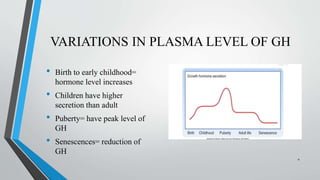
• Birth to early childhood=
hormone level increases
• Children have higher
secretion than adult
• Puberty= have peak level of
GH
• Senescences= reduction of
GH
4
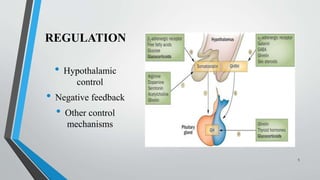
REGULATION
• Hypothalamic
control
• Negative feedback
• Other control
mechanisms
5
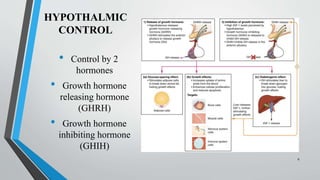
HYPOTHALMIC
CONTROL
• Control by 2
hormones
• Growth hormone
releasing hormone
(GHRH)
• Growth hormone
inhibiting hormone
(GHIH)
6
GROWTH HORMONE RELEASING
HORMONE(GHRH)
• Polypeptide with 44 amino acids.
• Produced by hypothalamic neurons, stimulates GH secretion by binding to
specific GPCR on somatotrophs in the anterior pituitary.
• The stimulated GHRH receptor couples to Gs to raise intra-cellular levels of
cAMP and Ca2+, thereby stimulating GH synthesis and secretion.
7
FACTORS STIMULATING GHRH SECRETION
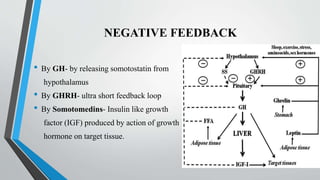
• Hypoglycemia- through glucoreceptors in ventromedial nucleus of
hypothalamus(NE)
• Emotions, exercise & physical stress- pain, surgery, trauma & inflammation.
• Slow wave phase of sleep(5HT)
• Certain amino acids- arginine after protein meal
• Growth hormone releasing peptide(GHRP) – Ghrelin from oxyntic glands of
stomach.
8
GROWTH HORMONE INHIBITING
HORMONE(GHIH)
• Somatostatin
• Polypeptide with 14 amino acids
• Factors stimulating GHIH-
Hyperglycemia
High FFA conc.
9
NEGATIVE FEEDBACK
• By GH- by releasing somotostatin from
hypothalamus
• By GHRH- ultra short feedback loop
• By Somotomedins- Insulin like growth
factor (IGF) produced by action of growth
hormone on target tissue.
10
OTHER CONTROL MECHANISMS
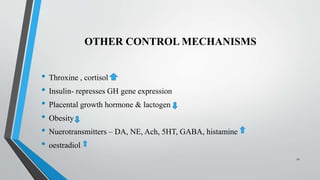
• Throxine , cortisol
• Insulin- represses GH gene expression
• Placental growth hormone & lactogen
• Obesity
• Nuerotransmitters – DA, NE, Ach, 5HT, GABA, histamine
• oestradiol
11
GROWTH HORMONE RECEPTORS
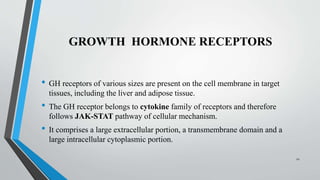
• GH receptors of various sizes are present on the cell membrane in target
tissues, including the liver and adipose tissue.
• The GH receptor belongs to cytokine family of receptors and therefore
follows JAK-STAT pathway of cellular mechanism.
• It comprises a large extracellular portion, a transmembrane domain and a
large intracellular cytoplasmic portion.
12
13
Mechanism of Action
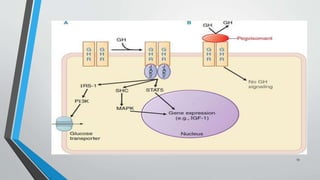
• Binding of one GH molecule to extracellular domain of a GH- receptor diamer
results in formation of ternary complex which undergoes a conformational change.
• That is followed by dimerization of receptors and activation of tyrosine kinase
enzyme known as Janus kinase 2 (Jak-2)
• This Jak-2 phosphorylate each other and tyrosine residues of the receptor.
• This leads to cascade of phosphorylation reactions result in activation of:
- proteins transcription(STAT)
- Mitogen activated protein(MAP) kinase
- Phosphoinositide-3-kinase (PI kinase)
• Overall results is linear growth and metabolism of carbohydrate, lipid, mineral &
protein as well as regulation of gene expression.
14
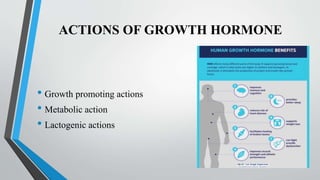
ACTIONS OF GROWTH HORMONE
• Growth promoting actions
• Metabolic action
• Lactogenic actions
15
GROWTH PROMOTING ACTIONS
• Promotes linear growth.
• Bone- stimulate osteoblastic activity converts cartilage into bone.
• Increases bone mass.
• Cartilage – stimulate proliferation of chondrocytes in epiphyseal
end plate of long bones.
16
METABOLIC ACTION
PROTEIN METABOLISM (Positive Nitrogen Balance)
• Anabolic effect
• Promotes protein deposition in tissue.
• Increase amino acid uptake into cell
• Increase protein synthesis by ribosomes.
• Stimulates Transcription
17
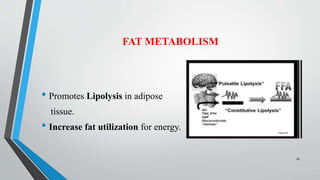
FAT METABOLISM
• Promotes Lipolysis in adipose
tissue.
• Increase fat utilization for energy.
18
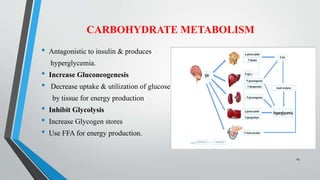
CARBOHYDRATE METABOLISM
• Antagonistic to insulin & produces
hyperglycemia.
• Increase Gluconeogenesis
• Decrease uptake & utilization of glucose by
by tissue for energy production
• Inhibit Glycolysis
• Increase Glycogen stores
• Use FFA for energy production.
19
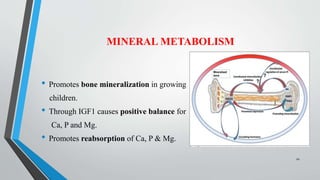
MINERAL METABOLISM
• Promotes bone mineralization in growing
children.
• Through IGF1 causes positive balance for
Ca, P and Mg.
• Promotes reabsorption of Ca, P & Mg.
20
LACTOGENIC ACTIONS
• Enhances milk production
• Acts like Prolactin so called Prolactin like effect
of growth hormone.
21
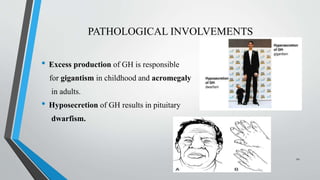
PATHOLOGICAL INVOLVEMENTS
• Excess production of GH is responsible
for gigantism in childhood and acromegaly
in adults.
• Hyposecretion of GH results in pituitary
dwarfism.
22
GH INHIBITORS
• Somatostatin – 14 amino acid long peptide, inhibits GH, PRL, TSH, insulin,
glucagon, gastrin and HCl.
• GI actions causes steatorrhoea (the excretion of abnormal quantities of fat
with faeces), hypochlorhydria, dyspepsia and nausea.
• Use in acromegaly is limited because of duration of action is short(2-3 min)
• Octreotide- synthetic octapeptide surrogate of somatostatin
• 40 times more potent in suppressing GH secretion
• Longer acting( 90 min) therefore preferred over somatostatin for acromegaly.
23
• Lanreotide – long acting octapeptide SST analogue that causes prolonged
suppression of GH secretion when administered subcutaneously.
• Its efficacy appears comparable to that of octreotide.
• Pegvisomant- GHR antagonist approved for treatment of acromegaly.
• It binds to GHR but does not activate JAK-STAT signalling or stimulate IGF1
secretion.
24
REFERENCES
• Mark E. Molitch and Bernard P. Schimmer, ‘The Hypothalamic – Pituitary
Axis’; Goodman & Gilman’s ‘The Pharmacological Basis of Therapeutics’
13th Edition 2017, pp. 771-778
• Ritter M. et al., 2020 Rang and Dale’s Pharmacology. 9th Ed., Edinburgh:
Elsevier, pp 404-410
• F. Dehkhoda,Christine M.Lee, Andrew J. Brooks; 2018. ‘Growth Hormone
Receptor’. Sec. Molecular and Structural Endocrinology
25

GH RECEPTORS.pptx

  • 1.
    Cellular and molecularmechanism of action of Growth hormone Presented by: Mohd. Ashhar Suhail Nomani M.Pharm 2nd Semester Department of Pharmacology Jamia Hamdard, New Delhi 1
  • 2.
    Presentation Outline • Introduction •Regulation of secretion • Growth Hormone Receptors • Actions of GH • Pathological involvements • GH Inhibitors • References 2
  • 3.
    GROWTH HORMONE • Growthhormone(GH) or Somatotropic hormone(STH) is secreted by acidophil cell of anterior pituitary gland. • It is a polypeptide with 191 amino acid residue. • Maintains lean body mass and bone mass in adults. • Important for postnatal growth and development to adult size. 3
  • 4.
    VARIATIONS IN PLASMALEVEL OF GH • Birth to early childhood= hormone level increases • Children have higher secretion than adult • Puberty= have peak level of GH • Senescences= reduction of GH 4
  • 5.
    REGULATION • Hypothalamic control • Negativefeedback • Other control mechanisms 5
  • 6.
    HYPOTHALMIC CONTROL • Control by2 hormones • Growth hormone releasing hormone (GHRH) • Growth hormone inhibiting hormone (GHIH) 6
  • 7.
    GROWTH HORMONE RELEASING HORMONE(GHRH) •Polypeptide with 44 amino acids. • Produced by hypothalamic neurons, stimulates GH secretion by binding to specific GPCR on somatotrophs in the anterior pituitary. • The stimulated GHRH receptor couples to Gs to raise intra-cellular levels of cAMP and Ca2+, thereby stimulating GH synthesis and secretion. 7
  • 8.
    FACTORS STIMULATING GHRHSECRETION • Hypoglycemia- through glucoreceptors in ventromedial nucleus of hypothalamus(NE) • Emotions, exercise & physical stress- pain, surgery, trauma & inflammation. • Slow wave phase of sleep(5HT) • Certain amino acids- arginine after protein meal • Growth hormone releasing peptide(GHRP) – Ghrelin from oxyntic glands of stomach. 8
  • 9.
    GROWTH HORMONE INHIBITING HORMONE(GHIH) •Somatostatin • Polypeptide with 14 amino acids • Factors stimulating GHIH- Hyperglycemia High FFA conc. 9
  • 10.
    NEGATIVE FEEDBACK • ByGH- by releasing somotostatin from hypothalamus • By GHRH- ultra short feedback loop • By Somotomedins- Insulin like growth factor (IGF) produced by action of growth hormone on target tissue. 10
  • 11.
    OTHER CONTROL MECHANISMS •Throxine , cortisol • Insulin- represses GH gene expression • Placental growth hormone & lactogen • Obesity • Nuerotransmitters – DA, NE, Ach, 5HT, GABA, histamine • oestradiol 11
  • 12.
    GROWTH HORMONE RECEPTORS •GH receptors of various sizes are present on the cell membrane in target tissues, including the liver and adipose tissue. • The GH receptor belongs to cytokine family of receptors and therefore follows JAK-STAT pathway of cellular mechanism. • It comprises a large extracellular portion, a transmembrane domain and a large intracellular cytoplasmic portion. 12
  • 13.
  • 14.
    Mechanism of Action •Binding of one GH molecule to extracellular domain of a GH- receptor diamer results in formation of ternary complex which undergoes a conformational change. • That is followed by dimerization of receptors and activation of tyrosine kinase enzyme known as Janus kinase 2 (Jak-2) • This Jak-2 phosphorylate each other and tyrosine residues of the receptor. • This leads to cascade of phosphorylation reactions result in activation of: - proteins transcription(STAT) - Mitogen activated protein(MAP) kinase - Phosphoinositide-3-kinase (PI kinase) • Overall results is linear growth and metabolism of carbohydrate, lipid, mineral & protein as well as regulation of gene expression. 14
  • 15.
    ACTIONS OF GROWTHHORMONE • Growth promoting actions • Metabolic action • Lactogenic actions 15
  • 16.
    GROWTH PROMOTING ACTIONS •Promotes linear growth. • Bone- stimulate osteoblastic activity converts cartilage into bone. • Increases bone mass. • Cartilage – stimulate proliferation of chondrocytes in epiphyseal end plate of long bones. 16
  • 17.
    METABOLIC ACTION PROTEIN METABOLISM(Positive Nitrogen Balance) • Anabolic effect • Promotes protein deposition in tissue. • Increase amino acid uptake into cell • Increase protein synthesis by ribosomes. • Stimulates Transcription 17
  • 18.
    FAT METABOLISM • PromotesLipolysis in adipose tissue. • Increase fat utilization for energy. 18
  • 19.
    CARBOHYDRATE METABOLISM • Antagonisticto insulin & produces hyperglycemia. • Increase Gluconeogenesis • Decrease uptake & utilization of glucose by by tissue for energy production • Inhibit Glycolysis • Increase Glycogen stores • Use FFA for energy production. 19
  • 20.
    MINERAL METABOLISM • Promotesbone mineralization in growing children. • Through IGF1 causes positive balance for Ca, P and Mg. • Promotes reabsorption of Ca, P & Mg. 20
  • 21.
    LACTOGENIC ACTIONS • Enhancesmilk production • Acts like Prolactin so called Prolactin like effect of growth hormone. 21
  • 22.
    PATHOLOGICAL INVOLVEMENTS • Excessproduction of GH is responsible for gigantism in childhood and acromegaly in adults. • Hyposecretion of GH results in pituitary dwarfism. 22
  • 23.
    GH INHIBITORS • Somatostatin– 14 amino acid long peptide, inhibits GH, PRL, TSH, insulin, glucagon, gastrin and HCl. • GI actions causes steatorrhoea (the excretion of abnormal quantities of fat with faeces), hypochlorhydria, dyspepsia and nausea. • Use in acromegaly is limited because of duration of action is short(2-3 min) • Octreotide- synthetic octapeptide surrogate of somatostatin • 40 times more potent in suppressing GH secretion • Longer acting( 90 min) therefore preferred over somatostatin for acromegaly. 23
  • 24.
    • Lanreotide –long acting octapeptide SST analogue that causes prolonged suppression of GH secretion when administered subcutaneously. • Its efficacy appears comparable to that of octreotide. • Pegvisomant- GHR antagonist approved for treatment of acromegaly. • It binds to GHR but does not activate JAK-STAT signalling or stimulate IGF1 secretion. 24
  • 25.
    REFERENCES • Mark E.Molitch and Bernard P. Schimmer, ‘The Hypothalamic – Pituitary Axis’; Goodman & Gilman’s ‘The Pharmacological Basis of Therapeutics’ 13th Edition 2017, pp. 771-778 • Ritter M. et al., 2020 Rang and Dale’s Pharmacology. 9th Ed., Edinburgh: Elsevier, pp 404-410 • F. Dehkhoda,Christine M.Lee, Andrew J. Brooks; 2018. ‘Growth Hormone Receptor’. Sec. Molecular and Structural Endocrinology 25