CALCIUM REGULATION
PRESENTED BY:
MOHD MONISH
M PHARM (PHARMACOLOGY) 2ND SEMESTER
SPER, JAMIA HAMDARD
PRESENTATION OUTLINE
 Calcium Homeostasis…………………………………………………………………….03-04
 Calcium regulating hormones…………………………………………………………..05
 Parathyroid Hormone……………………………………………………………………..06-09
 Vitamin D…………………………………………………………………………………….10-12
 Calcitonin…………………………………………………………………………………....13-14
 Physiological actions of calcium……………………………………………………….15
 References…………………………………………………………………………………..16
2
CALCIUM HOMEOSTASIS
 Calcium is an essential element that serves an
important role in skeletal mineralization. More than
99% of the calcium in the body is stored in bone as
hydroxyapatite, 0.99% in blood and 0.01% inside
cells.
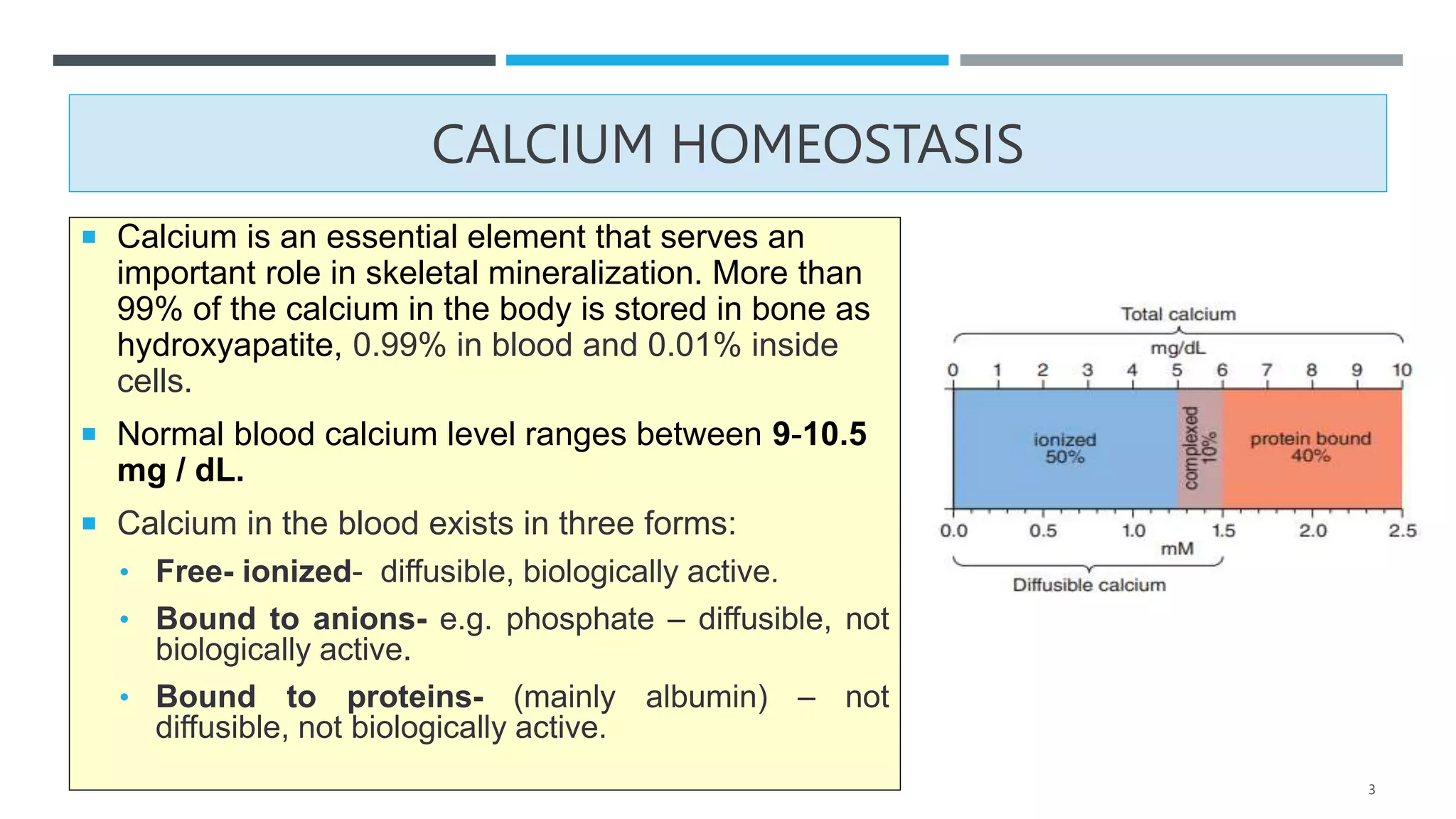
 Normal blood calcium level ranges between 9-10.5
mg / dL.
 Calcium in the blood exists in three forms:
• Free- ionized- diffusible, biologically active.
• Bound to anions- e.g. phosphate – diffusible, not
biologically active.
• Bound to proteins- (mainly albumin) – not
diffusible, not biologically active.
3
ABSORPTION OF CALCIUM
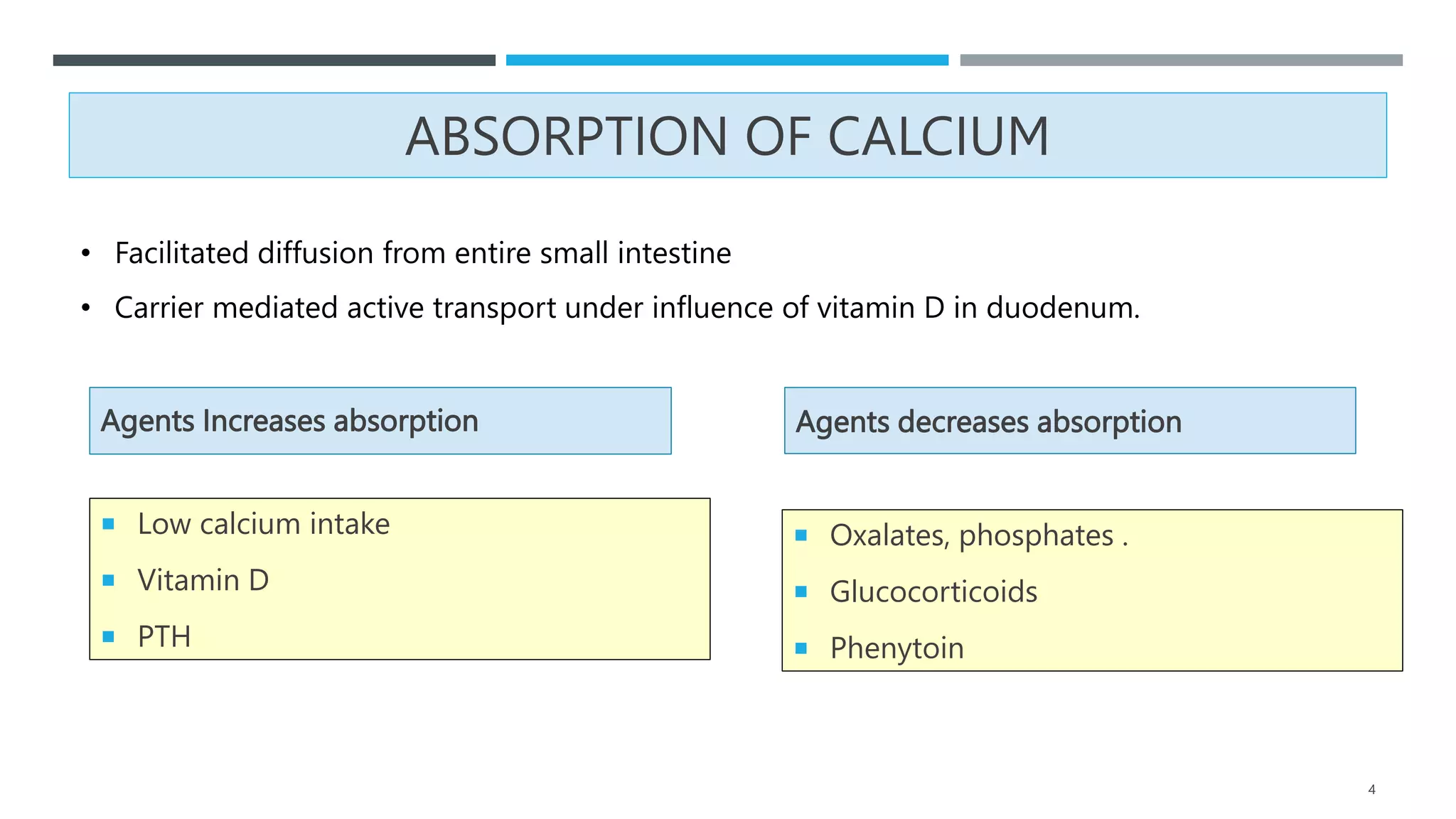
Agents Increases absorption
 Low calcium intake
 Vitamin D
 PTH
Agents decreases absorption
 Oxalates, phosphates .
 Glucocorticoids
 Phenytoin
• Facilitated diffusion from entire small intestine
• Carrier mediated active transport under influence of vitamin D in duodenum.
4
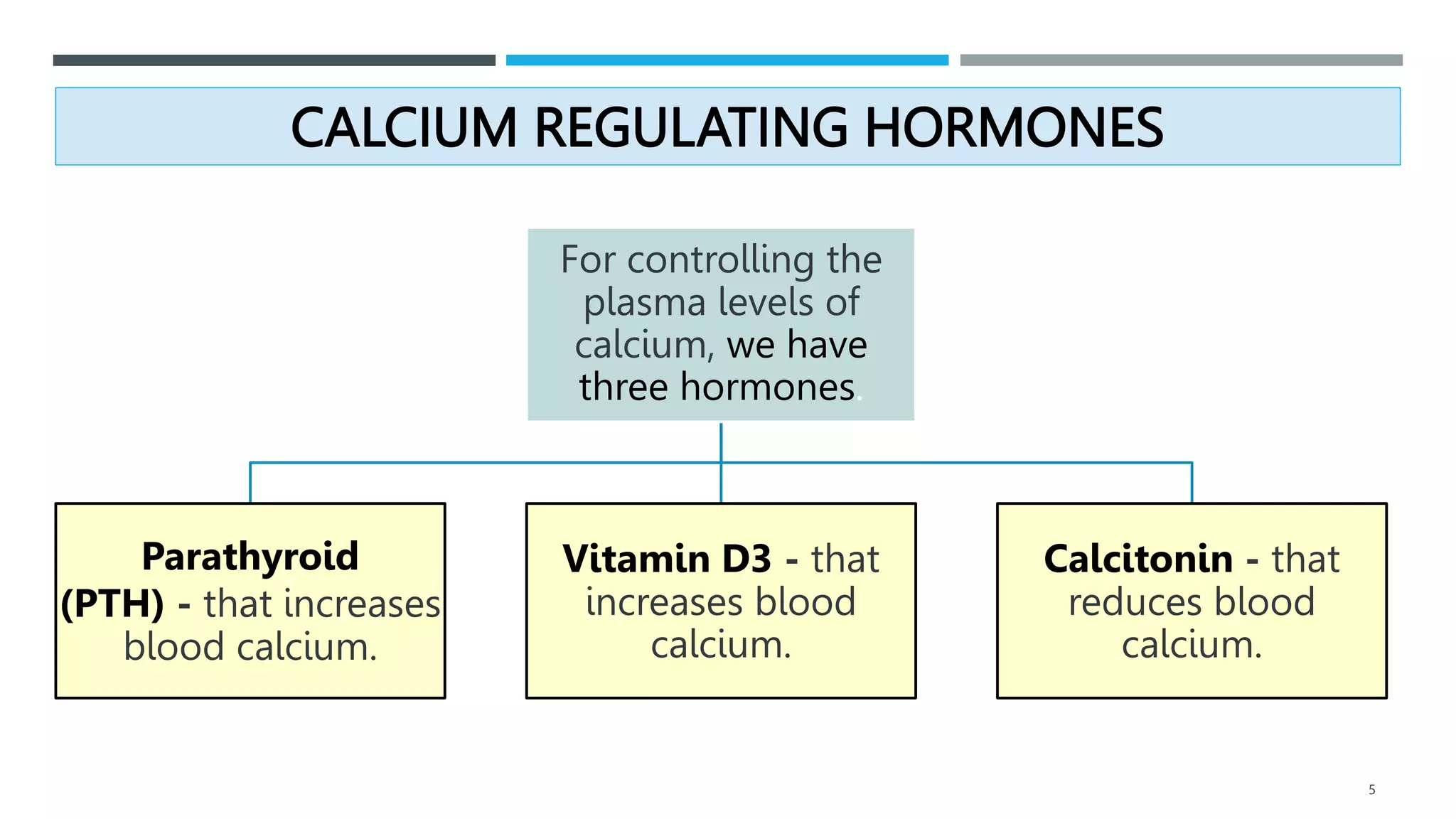
For controlling the
plasma levels of
calcium, we have
three hormones.
Parathyroid
(PTH) - that increases
blood calcium.
Vitamin D3 - that
increases blood
calcium.
Calcitonin - that
reduces blood
calcium.
CALCIUM REGULATING HORMONES
5
 Parathyroid Hormone is a polypeptide hormone that helps to
regulate plasma Ca2+ by affecting bone resorption/formation,
renal Ca2+ excretion/reabsorption, and calcitriol synthesis.
 In kidneys, it increases calcium reabsorption mainly from
distal convoluted tubule, and proximal part of collecting duct,
and inhibits phosphate reabsorption in the proximal tubule,
increasing its excretion in urine. PTH also increases the
conversion of 25-hydroxycholecalciferol to the 1,25-
dihydroxycholecalciferol, which increases the absorption of
calcium ions from the GI tract, indirectly.
PARATHYROID HORMONE (PTH)
6
KIDNEY
• PTH binds to receptors on cells
of PCT inhibits sodium
phosphate co-transporters
decrease sodium phosphate
reabsorption thus increase
urinary phosphate excretion.
• PTH binds to receptors on
principal cells of DCT
sodium/calcium channel
upregulation increase
calcium reabsorption from
urine.
7
BONE
• PTH increases extracellular calcium levels is by stimulating
osteoclast formation in bone. 8
INTESTINE
• PTH increases
extracellular calcium
levels is by helping
convert
cholecalciferol into
Vit D. It does so by
upregulating
enzyme 1α-
hydroxylase.
9
 Vitamin D is a fat-soluble steroid. It includes Ergocalciferol, which is called as vitamin D2,
and cholecalciferol known as vitamin D3, derived from pro-vitamin D (7-dehydrocholesterol).
dehydrocholesterol).
 Activation of Vitamin D occurs in 2 steps.
• First: Cholecalciferol is converted into 25-hydroxycholecalciferol in liver.
• Second: 25-hydroxycholecalciferol is converted into 1,25-dihydroxycholecalciferol in kidney,
by enzyme 1α-hydroxylase enzyme.
 Now, this 1,25-dihydroxycholecalciferol increases the calcium level in plasma.
VITAMIN D
10
Activation of Vit-
D
11
ACTIONS OF VITAMIN D
 Increase absorption of calcium and phosphate from intestine.
 Increase reabsorption of calcium and phosphate from bone.
 Increase tubular reabsorption of calcium and phosphate in kidneys.
 Cell differentiation: particularly of collagen and skin epithelium.
 Important for cell mediated immunity and coordination of the immune response.
12
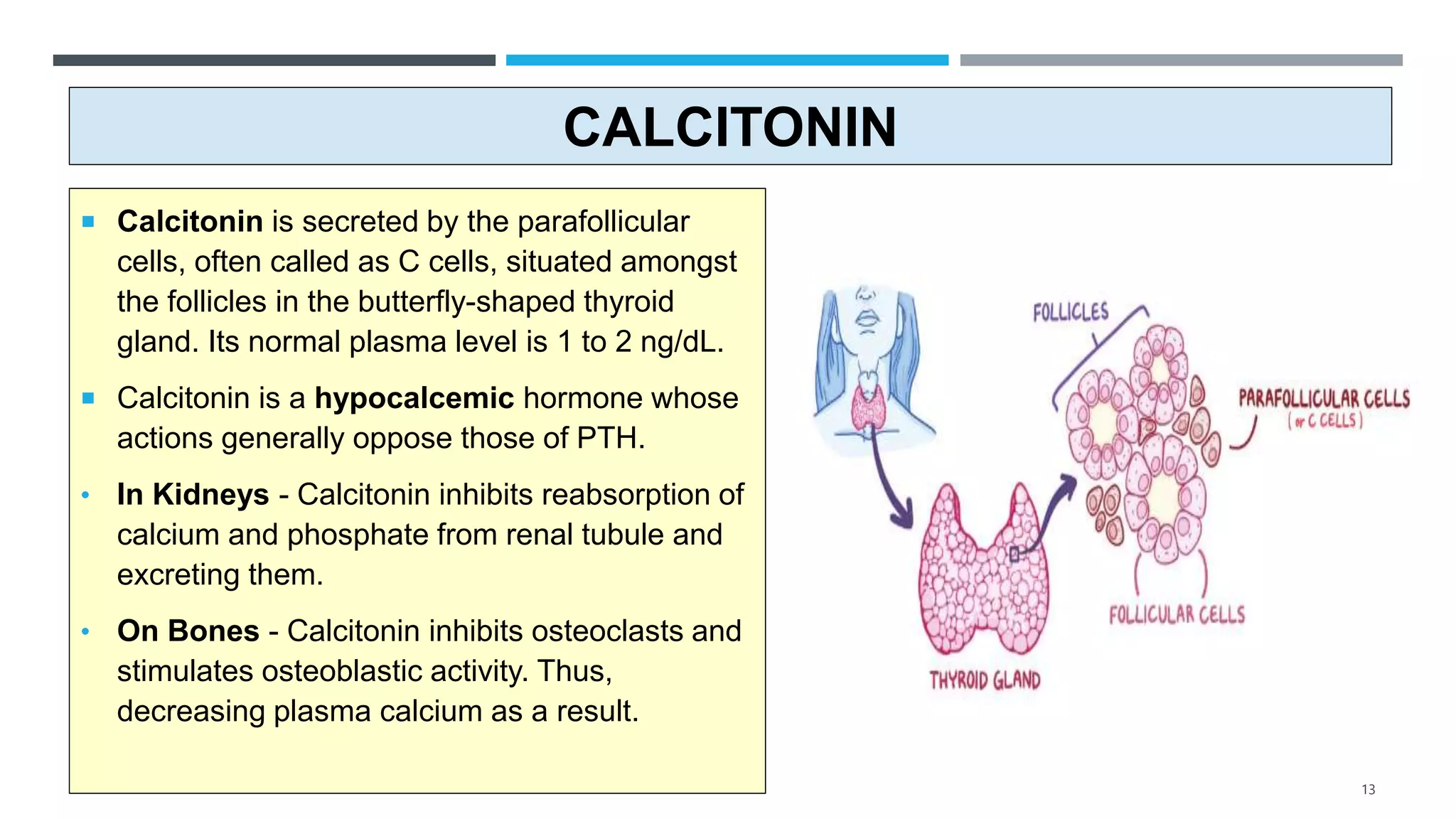
 Calcitonin is secreted by the parafollicular
cells, often called as C cells, situated amongst
the follicles in the butterfly-shaped thyroid
gland. Its normal plasma level is 1 to 2 ng/dL.
 Calcitonin is a hypocalcemic hormone whose
actions generally oppose those of PTH.
• In Kidneys - Calcitonin inhibits reabsorption of
calcium and phosphate from renal tubule and
excreting them.
• On Bones - Calcitonin inhibits osteoclasts and
stimulates osteoblastic activity. Thus,
decreasing plasma calcium as a result.
CALCITONIN
13
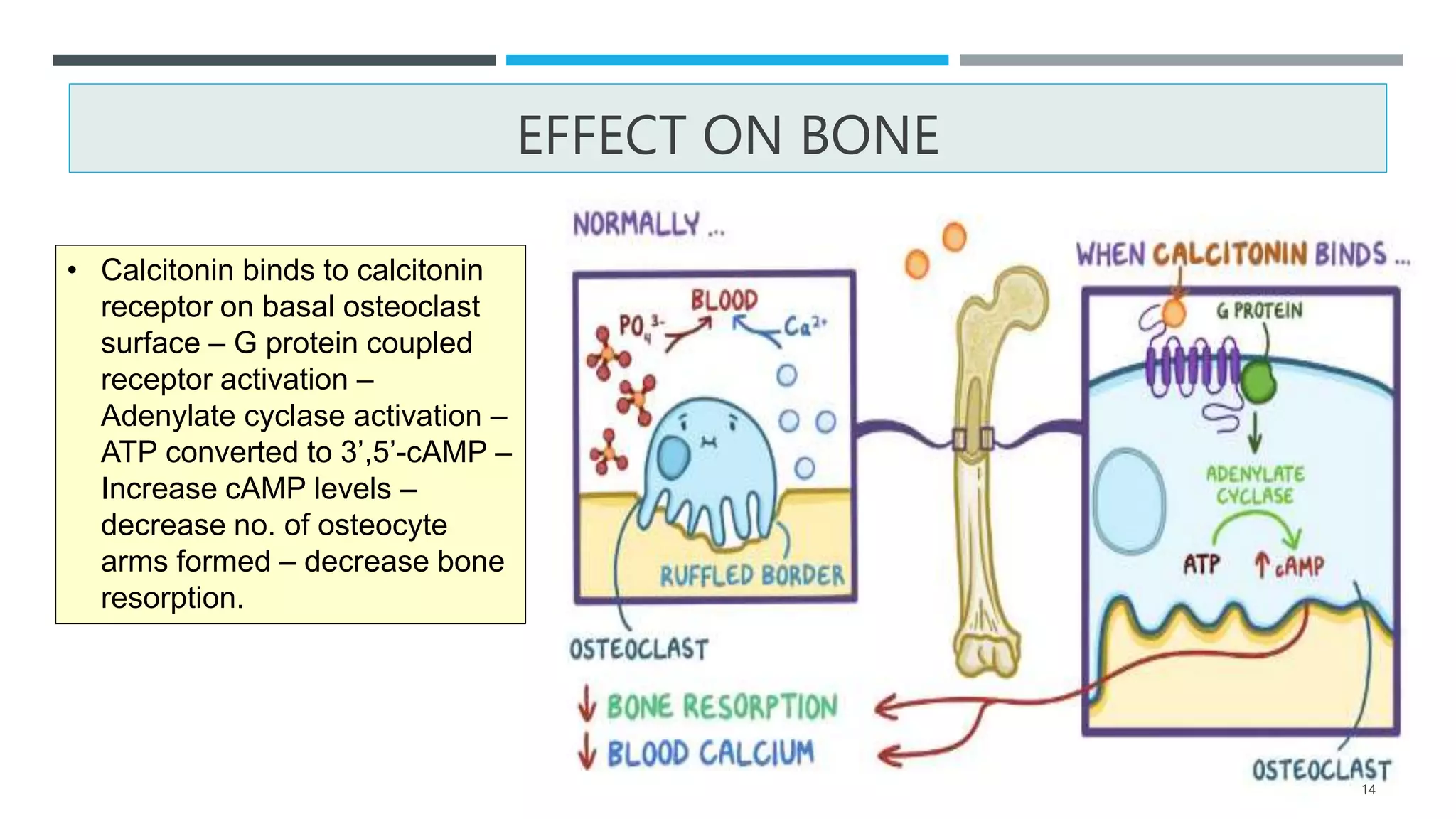
EFFECT ON BONE
• Calcitonin binds to calcitonin
receptor on basal osteoclast
surface – G protein coupled
receptor activation –
Adenylate cyclase activation –
ATP converted to 3’,5’-cAMP –
Increase cAMP levels –
decrease no. of osteocyte
arms formed – decrease bone
resorption.
14
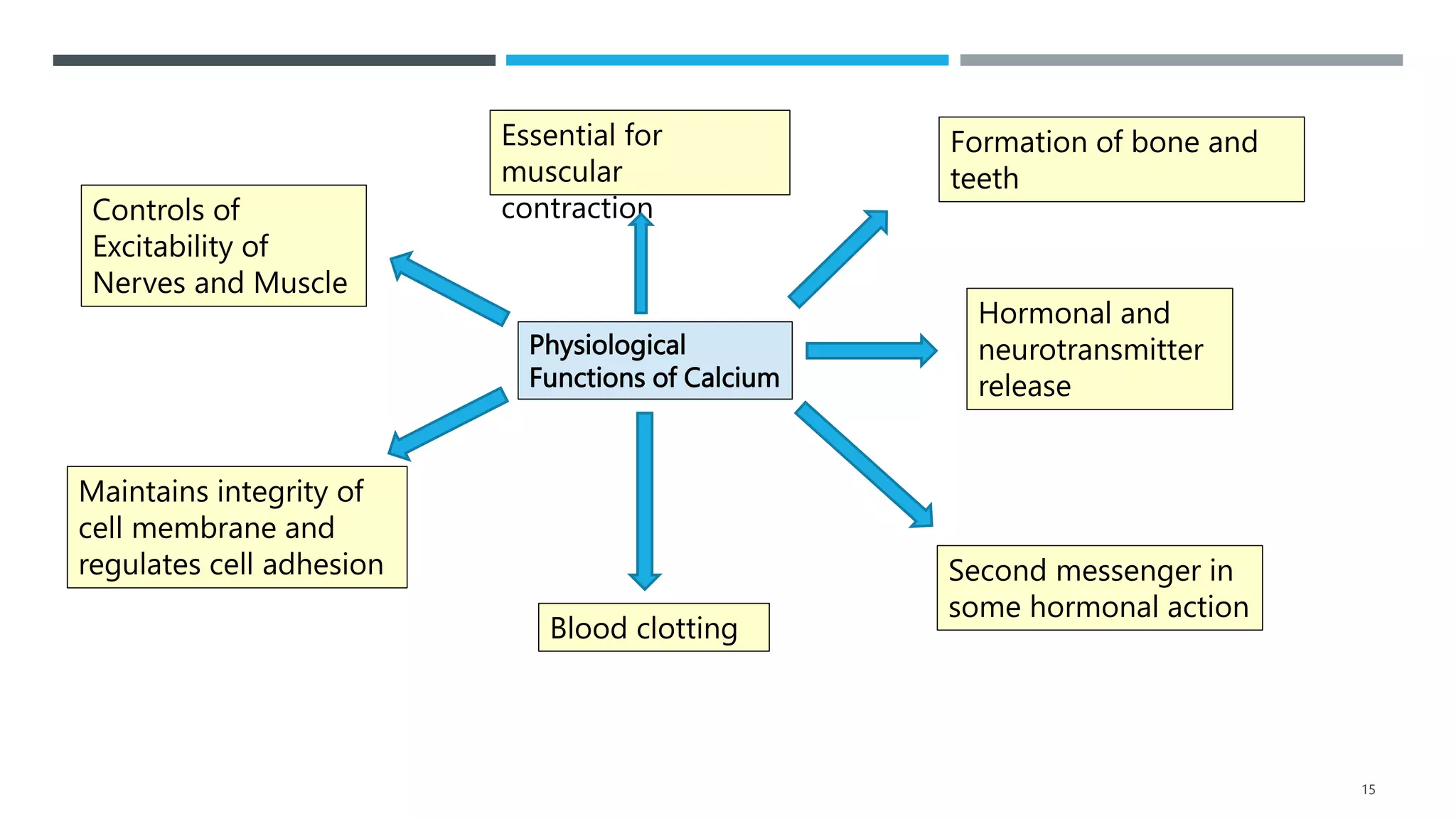
Physiological
Functions of Calcium
Controls of
Excitability of
Nerves and Muscle
Maintains integrity of
cell membrane and
regulates cell adhesion
Essential for
muscular
contraction
Blood clotting
Formation of bone and
teeth
Hormonal and
neurotransmitter
release
Second messenger in
some hormonal action
15
REFERENCES
• Osmosis from Elsevier, Calcium and phosphate regulation, n.d.
https://www.osmosis.org/notes/Calcium_and_Phosphate_Hormonal_Regulation, accessed 15/04/2023.
• Thomas D. Nolin and Peter A. Friedman, Agents affecting mineral ion homeostasis and bone turnover,
The pharmacological basis of therapeutics, Goodman & Gilman’s, 13th edn. MC Graw Hill Education:
2018: 887-906.
16
THANK YOU
17

Calcium regulation.pptx

  • 1.
    CALCIUM REGULATION PRESENTED BY: MOHDMONISH M PHARM (PHARMACOLOGY) 2ND SEMESTER SPER, JAMIA HAMDARD
  • 2.
    PRESENTATION OUTLINE  CalciumHomeostasis…………………………………………………………………….03-04  Calcium regulating hormones…………………………………………………………..05  Parathyroid Hormone……………………………………………………………………..06-09  Vitamin D…………………………………………………………………………………….10-12  Calcitonin…………………………………………………………………………………....13-14  Physiological actions of calcium……………………………………………………….15  References…………………………………………………………………………………..16 2
  • 3.
    CALCIUM HOMEOSTASIS  Calciumis an essential element that serves an important role in skeletal mineralization. More than 99% of the calcium in the body is stored in bone as hydroxyapatite, 0.99% in blood and 0.01% inside cells.  Normal blood calcium level ranges between 9-10.5 mg / dL.  Calcium in the blood exists in three forms: • Free- ionized- diffusible, biologically active. • Bound to anions- e.g. phosphate – diffusible, not biologically active. • Bound to proteins- (mainly albumin) – not diffusible, not biologically active. 3
  • 4.
    ABSORPTION OF CALCIUM AgentsIncreases absorption  Low calcium intake  Vitamin D  PTH Agents decreases absorption  Oxalates, phosphates .  Glucocorticoids  Phenytoin • Facilitated diffusion from entire small intestine • Carrier mediated active transport under influence of vitamin D in duodenum. 4
  • 5.
    For controlling the plasmalevels of calcium, we have three hormones. Parathyroid (PTH) - that increases blood calcium. Vitamin D3 - that increases blood calcium. Calcitonin - that reduces blood calcium. CALCIUM REGULATING HORMONES 5
  • 6.
     Parathyroid Hormoneis a polypeptide hormone that helps to regulate plasma Ca2+ by affecting bone resorption/formation, renal Ca2+ excretion/reabsorption, and calcitriol synthesis.  In kidneys, it increases calcium reabsorption mainly from distal convoluted tubule, and proximal part of collecting duct, and inhibits phosphate reabsorption in the proximal tubule, increasing its excretion in urine. PTH also increases the conversion of 25-hydroxycholecalciferol to the 1,25- dihydroxycholecalciferol, which increases the absorption of calcium ions from the GI tract, indirectly. PARATHYROID HORMONE (PTH) 6
  • 7.
    KIDNEY • PTH bindsto receptors on cells of PCT inhibits sodium phosphate co-transporters decrease sodium phosphate reabsorption thus increase urinary phosphate excretion. • PTH binds to receptors on principal cells of DCT sodium/calcium channel upregulation increase calcium reabsorption from urine. 7
  • 8.
    BONE • PTH increasesextracellular calcium levels is by stimulating osteoclast formation in bone. 8
  • 9.
    INTESTINE • PTH increases extracellularcalcium levels is by helping convert cholecalciferol into Vit D. It does so by upregulating enzyme 1α- hydroxylase. 9
  • 10.
     Vitamin Dis a fat-soluble steroid. It includes Ergocalciferol, which is called as vitamin D2, and cholecalciferol known as vitamin D3, derived from pro-vitamin D (7-dehydrocholesterol). dehydrocholesterol).  Activation of Vitamin D occurs in 2 steps. • First: Cholecalciferol is converted into 25-hydroxycholecalciferol in liver. • Second: 25-hydroxycholecalciferol is converted into 1,25-dihydroxycholecalciferol in kidney, by enzyme 1α-hydroxylase enzyme.  Now, this 1,25-dihydroxycholecalciferol increases the calcium level in plasma. VITAMIN D 10
  • 11.
  • 12.
    ACTIONS OF VITAMIND  Increase absorption of calcium and phosphate from intestine.  Increase reabsorption of calcium and phosphate from bone.  Increase tubular reabsorption of calcium and phosphate in kidneys.  Cell differentiation: particularly of collagen and skin epithelium.  Important for cell mediated immunity and coordination of the immune response. 12
  • 13.
     Calcitonin issecreted by the parafollicular cells, often called as C cells, situated amongst the follicles in the butterfly-shaped thyroid gland. Its normal plasma level is 1 to 2 ng/dL.  Calcitonin is a hypocalcemic hormone whose actions generally oppose those of PTH. • In Kidneys - Calcitonin inhibits reabsorption of calcium and phosphate from renal tubule and excreting them. • On Bones - Calcitonin inhibits osteoclasts and stimulates osteoblastic activity. Thus, decreasing plasma calcium as a result. CALCITONIN 13
  • 14.
    EFFECT ON BONE •Calcitonin binds to calcitonin receptor on basal osteoclast surface – G protein coupled receptor activation – Adenylate cyclase activation – ATP converted to 3’,5’-cAMP – Increase cAMP levels – decrease no. of osteocyte arms formed – decrease bone resorption. 14
  • 15.
    Physiological Functions of Calcium Controlsof Excitability of Nerves and Muscle Maintains integrity of cell membrane and regulates cell adhesion Essential for muscular contraction Blood clotting Formation of bone and teeth Hormonal and neurotransmitter release Second messenger in some hormonal action 15
  • 16.
    REFERENCES • Osmosis fromElsevier, Calcium and phosphate regulation, n.d. https://www.osmosis.org/notes/Calcium_and_Phosphate_Hormonal_Regulation, accessed 15/04/2023. • Thomas D. Nolin and Peter A. Friedman, Agents affecting mineral ion homeostasis and bone turnover, The pharmacological basis of therapeutics, Goodman & Gilman’s, 13th edn. MC Graw Hill Education: 2018: 887-906. 16
  • 17.